responsivereiding

Archive for December, 2008|Monthly archive page

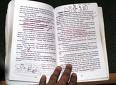
Margin notes: Things I scribbled in the white spaces on 12/31/2K8

In Uncategorized on December 31, 2008 at 1:55 pm

1. The Lord spoke to Moses in the wilderness of Sinai, in the tent of meeting, on the first day of the second month, in the second year after they had come out of the land of Egypt, saying, 2 “Take a census of all the congregation of the people of Israel, by clans, by fathers’ houses, according to the number of names, every male, head by head. ESV., Numb. 1:1-2

RAF: Our English Bibles take the title of “Numbers” due to the fact that there are two, very important censuses taken during the period of history it covers. However, the traditional Hebrew title of “In The Wilderness” seems more appropriate. Note how God culls out those who fail to believe His promises. How unbelief and disobedience are so linked as to be virtual synonyms. Indeed, the first transgression – the root of all disobedience – is failure to believe God above Satan, the World, and even (perhaps especially) ourselves.

2. The Lord spoke to Moses and Aaron, saying, 2 “The people of Israel shall camp each by his own standard, with the banners of their fathers’ houses. They shall camp facing the tent of meeting on every side. ESV., Numb 2:1-2

RAF: This is a most wonderfully graphic illustration of what it means to have God at the very center of your life. No matter what direction geographically each one was facing, they were ALL to be facing the “tent of meeting” – the place of God’s presence. Some would be facing north, some south, some east, and some west – but all were oriented NOT according to the map, but according to the Tabernacle. How about you? Is this how you orient your life? Regardless of your career, irrespective of your family situation, regardless of your financial or social status – do you camp, do you reside, always facing the place of God’s presence? This is the great need. They could have all had their tents pitched all around the Tabernacle, but still not been facing it. It is not enough to say that Christ is simply at the center – we must be truly facing Him, seeking Him, looking to Him at all times and in every encampment or situation.

3. 5 And the Lord spoke to Moses, saying, 6 “Bring the tribe of Levi near, and set them before Aaron the priest, that they may minister to him. 7 They shall keep guard over him and over the whole congregation before the tent of meeting, as they minister at the tabernacle. 8 They shall guard all the furnishings of the tent of meeting, and keep guard over the people of Israel as they minister at the tabernacle. 9 And you shall give the Levites to Aaron and his sons; they are wholly given to him from among the people of Israel. 10 And you shall appoint Aaron and his sons, and they shall guard their priesthood. But if any outsider comes near, he shall be put to death.” ESV., Numb. 3:5-10

RAF: 1 Pet. 2:9 reminds us that the Church comprises a “royal priesthood.” It is our duty to be the guardians, the protectors of our Great High Priest, His People, His Church – His Truth. Do we give ourselves to guard the sacred trust of His Word to us? This is so that who and what Christ is and what He has done and continues to do in His High Priestly role is preserved and proclaimed from generation to generation. In every generation there are those who would obscure Him. They would deny His divinity, or His humanity, or His being the God/Man. They would begin and propagate myths about Him contrary to the truth of His Word. They would obscure the need for His substitutionary sacrifice. They would add works to salvation or deny we need saving from the wrath of God at all. They would seek to undermine the authority of Scripture and the exclusivity of Christ as the Savior alone. They would pervert the nature of His Church and His teaching and His mission. We are set here to protect His Gospel, His name, His glory. We are to be sure that what has been built upon the foundation of Christ is passed on faithfully to the generations which follow as long as He tarries. We are to keep men apprised of their hopeless condition in sin, their lost and dead state and of the salvation to be found only by means of faith in the work of the Son of God at Calvary. We are to keep His reputation from being mythologized or co-opted by those who would use it for their own ends. We are guardians of the sacred glories of Christ our Savior. Are we about this business? What about those who come behind us? Young men, are you ready to take up this challenge? Old men, are you training them? Church – do we take our Guardianship seriously?

4. The Lord spoke to Moses and Aaron, saying, 18 “Let not the tribe of the clans of the Kohathites be destroyed from among the Levites, 19 but deal thus with them, that they may live and not die when they come near to the most holy things: Aaron and his sons shall go in and appoint them each to his task and to his burden, 20 but they shall not go in to look on the holy things even for a moment, lest they die.” ESV., Numb. 4:17-20

RAF: It is true even in ministry, that everyone neither can nor should do everything. There are some appointed to one aspect of ministry, and others to other aspects. But it is a sad truth that often, we are not content with God’s gifts to us. Sometimes we can lust after the gifts and privileges of others. When we do so, we expose ourselves to God’s discipline. Jealousy of other’s ministries is one sure way to disqualify ourselves from what God has given to us. Israel’s history will show how among the 3 divisions of the Levites, jealousy and seeking the place of others will be terribly destructive. Let it not be so among us. Let us remember that every gift of God, is, a gift of God. And to weigh or compare our gifts against one another to think as the world and the flesh does. Given all the fruit of all the trees on the Garden, the one Adam and Eve just HAD to have – was the one not given to them. Oh Father, guard our hearts against such craven longings. Another’s office may be well and good, but to lust after it over and above what you have given to us, is rank idolatry and is sure to bring your hand upon us heavily. Keep us from it. Let us prize what you have placed in our hands – and tend to it with all that is within us.
notes4

Margin notes: Things I scribbled in the white spaces on 12/30/2K8

In Uncategorized on December 30, 2008 at 1:18 pm


notes21. And the Lord spoke to Moses, saying, 18 “Speak to Aaron and his sons and all the people of Israel and say to them, When any one of the house of Israel or of the sojourners in Israel presents a burnt offering as his offering, for any of their vows or freewill offerings that they offer to the Lord, 19 if it is to be accepted for you it shall be a male without blemish, of the bulls or the sheep or the goats. 20 You shall not offer anything that has a blemish, for it will not be acceptable for you. 21 And when anyone offers a sacrifice of peace offerings to the Lord to fulfill a vow or as a freewill offering from the herd or from the flock, to be accepted it must be perfect; there shall be no blemish in it. 22 Animals blind or disabled or mutilated or having a discharge or an itch or scabs you shall not offer to the Lord or give them to the Lord as a food offering on the altar. 23 You may present a bull or a lamb that has a part too long or too short for a freewill offering, but for a vow offering it cannot be accepted. 24 Any animal that has its testicles bruised or crushed or torn or cut you shall not offer to the Lord; you shall not do it within your land, 25 neither shall you offer as the bread of your God any such animals gotten from a foreigner. Since there is a blemish in them, because of their mutilation, they will not be accepted for you.” ESV., Lev. 22:17-25

RAF: We are not to offer to God our second best. Yet how often this is very much the case. We worship Him with little or no energy – having used it up throughout the week on other things. We often give Him the time, the resources we have left over, not the firstfruits. When we do take on a task, sometimes we can do it in a fashion less careful or meticulously than we would if we did it for ourselves, or our employer. Why then would we imagine that such would be pleasing to God? When we do so, we reveal that in fact God is not the center of our lives, but merely a segment. Perhaps (we may say) the most important segment – but not the true hub. This passage ought to serve as a good reminder to examine ourselves once again to see whether or not such is the case.

Then again, note by way of contrast how much better off we are under the New Covenant of Christ than the old Mosaic one. What one among us feels that even their best is without defect? None. But we have this promise: “1 Pet. 2:5 you yourselves like living stones are being built up as a spiritual house, to be a holy priesthood, to offer spiritual sacrifices acceptable to God through Jesus Christ.” Our spiritual sacrifices ARE acceptable. How? “Through Jesus Christ.” What a great Redeemer He is!

2. The Lord spoke to Moses, saying, 2 “Speak to the people of Israel and say to them, These are the appointed feasts of the Lord that you shall proclaim as holy convocations; they are my appointed feasts. ESV., Lev. 23:1-2

RAF: This passage lists the 7 “feasts” God appointed for His people Israel.

a. A weekly Sabbath

b. Yearly Passover

c. Yearly Firstfruits

d. Yearly Weeks (or Pentecost)

e. Yearly Trumpets

f. Yearly Day of Atonement

g. Yearly Booths

Of all these, only one is not a feast in the proper sense: Atonement. This is the single day of fasting commanded by God for His people. By example, we can see that God appoints far more feasting for His people than fasting. More days of resting than mourning. There is to be sorrow over sin, but much more rejoicing over redemption. Where sin has abounded, grace has much more abounded (Rom. 5:20). Those who would forget their sin altogether err, but those who focus upon it more than their forgiveness and reconciliation do as well. May our rejoicing be proportionate to the glory of our forgiveness, and our sorrow not outstrip our glorying in the finished work of Christ. The legalists would give us more fast days than feast days – or at least as many. The licentious would have no fast days at all and feast only. God appoints both, but in their proper measure. May we have the wisdom to do so as well.

3. The Lord spoke to Moses, saying, 2 “Command the people of Israel to bring you pure oil from beaten olives for the lamp, that a light may be kept burning regularly. 3 Outside the veil of the testimony, in the tent of meeting, Aaron shall arrange it from evening to morning before the Lord regularly. It shall be a statute forever throughout your generations. 4 He shall arrange the lamps on the lampstand of pure gold before the Lord regularly. ESV., Lev. 24:1-4

RAF: It is the both the high privilege and the sacred duty of ministers to attend the house of the Lord, so that there is light. In other words, the ministry of the Word, opened and expounded that men’s souls may have the light of God’s Word illuminating them at all times. Whenever this is abandoned, the essentials are plunged into darkness:

a. The altar of incense; our prayers and petitions are to be illuminated by God’s Word that we might pray aright, and see its significance before God.

b. The table of the “shew-bread” – where the testimony that Christ is God’s Bread for us come down out of heaven, our soul’s sole sustenance.

c. The Ark of God’s Covenant. Then, behind a veil, but now, open to our full view. Here, God has made known His sworn faithfulness, and it is here where mercy covers our sins – where the blood of the Lamb is seen, and full and free forgiveness reigns while we fellowship with God.

Take away the light of God’s Word, and these three are obscured in total darkness. How powerful are Paul’s parting words to Timothy – “preach the word”. 2 Timothy 4:2

4. Now an Israelite woman’s son, whose father was an Egyptian, went out among the people of Israel. And the Israelite woman’s son and a man of Israel fought in the camp, 11 and the Israelite woman’s son blasphemed the Name, and cursed. Then they brought him to Moses. His mother’s name was Shelomith, the daughter of Dibri, of the tribe of Dan. 12 And they put him in custody, till the will of the Lord should be clear to them.

13 Then the Lord spoke to Moses, saying, 14 “Bring out of the camp the one who cursed, and let all who heard him lay their hands on his head, and let all the congregation stone him. 15 And speak to the people of Israel, saying, Whoever curses his God shall bear his sin. 16 Whoever blasphemes the name of the Lord shall surely be put to death. All the congregation shall stone him. The sojourner as well as the native, when he blasphemes the Name, shall be put to death. ESV., Lev. 24:10-16

RAF: How is it? Why is it – that when men strive with one another, it somehow seems fitting to curse God’s name? It is nothing other than the tendency within us to shift blame for sin and discomfort – for any problem – away from human sin and the Fall, back to God. Man will seek even unconsciously (perhaps we could call this the instinct of the fallen soul) to justify himself at all times – and to thrust his fist into the face of God. No wonder then it is to be met with such violence and disdain. Thoughts against God can arise from within in a moment. And while the Fall was eternally ordained, we must never sever it from the reality of man’s own responsibility in bringing it about – God is not to blame. But oh, how we want that weight off of our collective shoulders.

5. 17 “Whoever takes a human life shall surely be put to death. 18 Whoever takes an animal’s life shall make it good, life for life. 19 If anyone injures his neighbor, as he has done it shall be done to him, 20 fracture for fracture, eye for eye, tooth for tooth; whatever injury he has given a person shall be given to him. 21 Whoever kills an animal shall make it good, and whoever kills a person shall be put to death. 22 You shall have the same rule for the sojourner and for the native, for I am the Lord your God.” 23 So Moses spoke to the people of Israel, and they brought out of the camp the one who had cursed and stoned him with stones. Thus the people of Israel did as the Lord commanded Moses. ESV., Lev. 24:17-23

RAF: We must never forget the purpose of the command is to establish equity, not barbarism. In other words, the concept of an “eye for an eye” is twofold:

a. It prevents the thwarting of justice by failing to punish crimes at all. Sins against one another in society are not to be summarily dismissed. Personal forgiveness is always requisite, but sin often extends beyond the individual into society as a whole. It is one thing for me to forgive one who has broken into my house and stolen from me. To forgive and not require restitution of any kind is good. But it is another thing altogether to let such thieves go, only to rob my neighbor! This is to fail to love my neighbor as myself – and to see to it he is protected from harm. Thus I dare not let the thief go completely, but am responsible to see that justice is done for the good and protection of others. Hence Paul can warn Timothy regarding Alexander the coppersmith who did him “great harm.” (2 Tim. 4:14) The warning was necessary as an act of love for Timothy and others.

b. Note too that justice can be thwarted – or perverted – by OVER punishment. How easily we can see in our day, disproportionate monetary settlements in legal cases. Such fails to recognize that the punishment(s) must fit the crime in order for justice to be served. The loss of a tooth is to be compensated commensurately, not wildly. If someone steps on our toe, it is not to be a Federal case. It is not a warrant for death or taking away the whole of one’s home or goods. This statute in God’s Law for Israel prevents using the courts for revenge and promotes true equity among men.

For justice to be served, we must neither under punish, nor over punish. Failure in either direction, destroys a society eventually for it is contrary to God’s own attribute of just-ness.

Margin ntes: Things I scribbled in the white spaces on Dec. 29, 2K8

In Uncategorized on December 29, 2008 at 3:57 pm

1. And the Lord spoke to Moses, saying, 2 “Speak to Aaron and his sons and to all the people of Israel and say to them, this is the thing that the Lord has commanded. 3 If any one of the house of Israel kills an ox or a lamb or a goat in the camp, or kills it outside the camp, 4 and does not bring it to the entrance of the tent of meeting to offer it as a gift to the Lord in front of the tabernacle of the Lord, bloodguilt shall be imputed to that man. He has shed blood, and that man shall be cut off from among his people. 5 This is to the end that the people of Israel may bring their sacrifices that they sacrifice in the open field, that they may bring them to the Lord, to the priest at the entrance of the tent of meeting, and sacrifice them as sacrifices of peace offerings to the Lord. 6 And the priest shall throw the blood on the altar of the Lord at the entrance of the tent of meeting and burn the fat for a pleasing aroma to the Lord. 7 So they shall no more sacrifice their sacrifices to goat demons, after whom they whore. This shall be a statute forever for them throughout their generations. English Standard Version., Le 17:1-7.

RAF: There could be no such thing as private sacrifice in Israel. This is perhaps the equivalent of modern home or single family churches. Sacrifice was commanded worship and it was not allowed to be conducted outside the context of the Tabernacle. Why? Because as the text shows, it leads to idolatry, and a service to God which is detached from the rest of His people. One cannot have a right relationship with God, and not also be connected to His people. One ought to want connection to His people in the larger context and not want to privatize his service to God. This of course does not mean Churches cannot be small, especially at the beginning. It does mean Churches while autonomous, are not to be excessively privatized. The Body of Christ as a whole must not be ignored or discounted. This may mean we will be forced to interact with those who do not subscribe to our particular slant on everything. We do not abandon individual responsibility to understand God’s Word and to follow it, but we also must let humility prevent us from thinking we have a corner on all the truth and monopolize the one true understanding of all things. The Body is large and diverse. We must make room for one another when and where we can. We must seek connection with the Body of Christ in the larger context – even when it is in bad condition spiritually. We are not speaking of indiscriminate ecumenism, but rather of a proper, Biblical catholicity among those who hold to standards like “There is one body and one Spirit—just as you were called to the one hope that belongs to your call— 5 one Lord, one faith, one baptism, 6 one God and Father of all, who is over all and through all and in all.” English Standard Version., Eph 4:4-6.
2. Leviticus 17:10-12 (ESV) 10 “If any one of the house of Israel or of the strangers who sojourn among them eats any blood, I will set my face against that person who eats blood and will cut him off from among his people. 11 For the life of the flesh is in the blood, and I have given it for you on the altar to make atonement for your souls, for it is the blood that makes atonement by the life. 12 Therefore I have said to the people of Israel, No person among you shall eat blood, neither shall any stranger who sojourns among you eat blood.

RAF: Man as made in God’s image is the only earthly creature capable making a distinction between mankind and beasts. Beasts kill and eat without regard for the reality of the life being in the blood. Men are not beasts. We cannot even do such a thing as eat as though we were not created in God’s image. To eat like a beast is to degrade, to abase the image of God we bear.

Contrary to the fallen worldview, we ARE different than the animals.

Even more, God’s reason is that He has specifically designated blood as the symbolic of Christ in making atonement. Therefore they are to be reminded always of the reality of blood and what it means to God in having it used in demonstrating the death of the Savior for sins.

3. And the Lord spoke to Moses, saying, 2 “Speak to the people of Israel and say to them, I am the Lord your God. 3 You shall not do as they do in the land of Egypt, where you lived, and you shall not do as they do in the land of Canaan, to which I am bringing you. You shall not walk in their statutes. 4 You shall follow my rules and keep my statutes and walk in them. I am the Lord your God. 5 You shall therefore keep my statutes and my rules; if a person does them, he shall live by them: I am the Lord. ESV – Lev. 18:1-5

RAF: We are to live as though we are God’s people, in contradistinction from all other peoples. This does not require us to go out of our way to be different, but to make our difference known simply in our hearkening to and living under the authority of God’s Word. Is God’s Word what directs us in all things? Is it to this we find our final appeal in weighing all truth? God’s truth “sanctifies” us.

John 17:17

In this text, the defining difference will be marked out as the understanding and carrying out of human sexuality. The way Israel is contrasted here to Egypt cannot be missed as the contrast between God’s people and the World at large.

Nowhere does the Church stand in a more obviously and markedly different place than the World, than in our attitudes toward and the living out of – our sexuality. Where the World not only has no self-control in this area, they despise the very mention of it. Not so with us. The exalted nature of sex and the intimacy and glory of the sexual union in its portrayal of Christ’s intimacy with His Bride the Church, informs every aspect of its sacredness and glory to us.

Here, the believer finds himself & herself combating the single most pervasive avenue of influence from the World that we face. No wonder then it is such a struggle. To disconnect ourselves from the attitudes and mindsets of the World in this area – is the most profound and violent battlefield. Let the Christian be aware – this battle affects all others. Sexual purity is at the very core of the true Christian life. And it is an area not easily subdued. Only by the wisdom of the Word, the power of the Holy Spirit and the absolute necessity of constant vigilance and self-conscious seeking for the Spirit’s work and reign can it be done. But it CAN and MUST be done.

4. You shall not give any of your children to offer them to Molech, and so profane the name of your God: I am the Lord. ESV – Lev. 18:21

RAF: What made sacrifice to Molech particularly heinous, is located in one thing: It was the sacrificing of infants in a most horrifying, burning death – for the sake of securing personal benefits.

The question then naturally arises for us – what perceived benefit(s) are willing to sacrifice the good and well being of our children for?

The name “Molech” comes from a word which means “king.” Hence God emphasizes that He alone is LORD, no one else is to be seen as our King in the same capacity.

And our King Jesus calls us not to sacrifice our children – ever. Rather, His call to us to raise them in His nurture and admonition. To pray for and labor for their conversion. To display to them the glories of our God – especially His mercy and grace toward sinners as we have experienced it and as it is offered to them in the Gospel. To expose them to the preaching of the Word, the worship of the saints, the fellowship of the Church, our constant prayers, our lives of service to the Kingdom, our submission to the Spirit and their need for salvation in Christ Jesus.

5. 9 “When you reap the harvest of your land, you shall not reap your field right up to its edge, neither shall you gather the gleanings after your harvest. 10 And you shall not strip your vineyard bare, neither shall you gather the fallen grapes of your vineyard. You shall leave them for the poor and for the sojourner: I am the Lord your God. ESV – Lev. 19:9-10

RAF: What follows, follows on this principle. In other words, God is going to give a series of charges that demonstrate the acts of loving one another in the society of God’s people. But such charges are not random, they issue from God’s own holiness. These are predicated on His nature. They are a means of living with one another in the same attitudes which God holds toward us. It is most instructive.

9-10: CHARITABLENESS – “When you reap the harvest of your land, you shall not reap your field right up to its edge, neither shall you gather the gleanings after your harvest. And you shall not strip your vineyard bare, neither shall you gather the fallen grapes of your vineyard. You shall leave them for the poor and for the sojourner: I am the Lord your God.

God has a heart of great charity toward those who are poor. We manifest this aspect of His character when we do the same. We must see them in their distress, and make provision for them – and that, in such a way that preserves their dignity and keeps them from falling into a pattern of receiving without laboring. Thus, the fields are not to reaped entirely, and so those in need, can gather the food themselves, without disgrace, and leave knowing they’ve done the harvesting themselves and remain dignified.
11-12: HONESTY – “You shall not steal; you shall not deal falsely; you shall not lie to one another. You shall not swear by my name falsely, and so profane the name of your God: I am the Lord.

God deals with us in truth. He desires it in our own inward parts, and it is essential in our dealings with one another. We do not steal, because our God does not. We do not deal falsely, because He does not. We do not lie to one another because He IS truth. Nor do we take any oaths by His name but what is honest and upright and true. As our God is, so are we to be.

13: INTEGRITY – “You shall not oppress your neighbor or rob him. The wages of a hired servant shall not remain with you all night until the morning.

Greed an laziness and lack of care for others can allow us to deal with one another in ways that are less than forthcoming and in the other’s best interest. But this is not how our God deals with us. He thinks of our welfare in His dealings with us and so we are to do the same in dealing with others. We are to be sure we do not take advantage of them. We are safe with Him, and thus others are to be sage with us.

14: COMPASSION – You shall not curse the deaf or put a stumbling block before the blind, but you shall fear your God: I am the Lord.

The deaf cannot hear such curses, nor the blind know who would put such things in their way. But because we cannot be discovered, does not mean we are not to have every compassion on those in such condition, and again, not to take even the slightest advantage of them. Man’s cruelty to man sometimes knows no bounds. But our God is not this way. His own heart sees our defects and does not use them against us. Children especially need to know God’s heart toward those who need compassion, that they too may learn to display the goodness of their God to others from an early age.

15: IMPARTIALITY – “You shall do no injustice in court. You shall not be partial to the poor or defer to the great, but in righteousness shall you judge your neighbor.

God’s people above all the people of the earth are to be vested in seeing justice done around us. And not vigilante justice. We are not to have our favorites, where justice is lessened because we like them or they can offer us some advantage. We are not to have those whom we dislike and thus let them become “examples” or bear heavier penalties without concern. We are to deal with all men the same in such matters, because this is how our God is. Those closest to Him, are no less responsible than those farthest from Him. Those farthest, are no more culpable than those near. We must show the world our God deals impartially – which is why each and every one, needs the work of Christ at Calvary.

16: HARMLESSNESS – You shall not go around as a slanderer among your people, and you shall not stand up against the life of your neighbor: I am the Lord.

No one should ever fear harm at our hands. People should feel safe in that they would never suffer harm at our hands for any reason. We are not against them, but for them. They are the ones we are to bless by giving them the Gospel, and rescuing their souls from the fire.

17: NO INDIFFERENCE – “You shall not hate your brother in your heart, but you shall reason frankly with your neighbor, lest you incur sin because of him.

Rather than resolve issues, we sometimes prefer to simply write the other off. But this not how our God deals with us. If there is anything the Cross is, it is the symbol of the very opposite of God’s indifference e to we, who have made ourselves His enemies. Nothing is worse than to be meaningless in the eyes of others. Our God treats no man so, and neither can we.

18: NO VINDICITVENESS – You shall not take vengeance or bear a grudge against the sons of your own people, but you shall love your neighbor as yourself: I am the Lord.”

Justice is never a private matter. How easy it is for us to justify all sorts of actions and attitudes under the umbrella of seeing some sort of secret or “poetic” justice done. But this is not how our God loves us. And this is how we are to love our neighbors as ourselves. To refuse to bear grudges or to exact our pound of flesh. To love, as He loves us – and to make that known to all.
notes1

Away on Vay-Cay

In Uncategorized on December 27, 2008 at 3:13 pm

Sorry – I forgot to mention I’m away until Jan. 7th.

As I write this, I’m in my shorts, enjoying the sunshine and warm breeze blowing off of the lake.

I love Texas!texas

Margin notes: Things I scribbled in the white spaces on De. 15, 2K8

In 'Nuff Said, Atonement, Blogroll, Calvin, Calvinism, Christianity, Jesus, Margin Notes, New Covenant Theology, News, redemption, Reformed, Responsive Reid-ing...blogging Christian style, Salvation, soteriology, Uncategorized, Walk in Wisdom, Walking in Wisdom - Gleanings from the Scriptures on December 15, 2008 at 11:17 am

notes1 – Numbers 5:5-8 5 And the Lord spoke to Moses, saying, 6 “Speak to the people of Israel, When a man or woman commits any of the sins that people commit by breaking faith with the Lord, and that person realizes his guilt, 7 he shall confess his sin that he has committed. And he shall make full restitution for his wrong, adding a fifth to it and giving it to him to whom he did the wrong. 8 But if the man has no next of kin to whom restitution may be made for the wrong, the restitution for wrong shall go to the Lord for the priest, in addition to the ram of atonement with which atonement is made for him.

RAF: This passage offers insight both into true forgiveness, and true repentance.

True repentance is not something single. In other words, it does not simply apologize to the offended – though apology is first. True repentance includes willingness to make restitution – where proper. (See: 2 Cor. 7:9-11) As as seen in the example here, if repentance is long over due, and one cannot make it right with the individual anymore, acts of confession and restitution can still be made. Our text sees it done with the priests. Today, we might employ the Church.

But then too we see how forgiveness sometimes has two aspects as well. Forgiveness is conditioned first – on confession (Luke 17:4). And forgiveness is quick to respond in release. When forgiveness really shows its colors however, is when we wave restitution. When the penitent one comes, and seeks to make some form of reparation, and we are willing to suffer the loss because we are more concerned that the relationship is righted. This is a form of forgiveness that points men to our Heavenly Father. Make no mistake, His forgiveness of our sins included His willingness to suffer the loss in the imputation of our penalty to the Son. It was costly.

2 – Numbers 6:1-2 (ESV) And the Lord spoke to Moses, saying, 2 “Speak to the people of Israel and say to them, When either a man or a woman makes a special vow, the vow of a Nazirite, to separate himself to the Lord,

RAF: Nazirite vows were completely voluntary. Two notable exceptions (perhaps) were Samson and John the Baptizer. What is of interest however is the practice of voluntarily entering into seasons of special consecration before the Lord. Times of separating ourselves from legitimate things that we might draw near to Him. Days or weeks – or perhaps months of seeking Him out in a special manner. I cannot help but think how beneficial such times would be for us as well. It is not mandated anywhere in Scripture (except Deut. 24:5) that you take time for instance to be alone with your spouse – special times away with one another. But none can argue the wisdom and benefit of it. So too with our Lord: Times apart with Him will keep your relationship fresh, sweet and close.

3 – Numbers 6:22-27 (ESV) The Lord spoke to Moses, saying, 23 “Speak to Aaron and his sons, saying, Thus you shall bless the people of Israel: you shall say to them,

24 The Lord bless you and keep you;

25 the Lord make his face to shine upon you and be gracious to you;

26 the Lord lift up his countenance upon you and give you peace.

27 “So shall they put my name upon the people of Israel, and I will bless them.”

RAF: What is important to note here is that the fullness of blessing is located completely in the Lord Himself.

a. The Lord be your happiness.

b. The Lord be your safety.

c. The Lord be personally and favorably disposed toward you.

d. The Lord be to you what you do not deserve.

e. The Lord look at you with smile on His face.

f. The Lord be the source of your peace.

Our blessing – our total blessing is in Him. All external blessings are but symbols of being His in glorious union.

4 – Numbers 8:10 (ESV) When you bring the Levites before the Lord, the people of Israel shall lay their hands on the Levites,

RAF: Note the involvement of the Congregation. This is not simply done by Aaron and his sons unilaterally, the entire congregation lays hands on them. While the priesthood was divinely directed, nevertheless the congregation was involved in making their recognition of it publicly known.

5 – Numbers 8:23-26 (ESV) And the Lord spoke to Moses, saying, 24 “This applies to the Levites: from twenty-five years old and upward they shall come to do duty in the service of the tent of meeting. 25 And from the age of fifty years they shall withdraw from the duty of the service and serve no more. 26 They minister to their brothers in the tent of meeting by keeping guard, but they shall do no service. Thus shall you do to the Levites in assigning their duties.”

RAF: No doubt there is great wisdom here: The greater burden is to be borne by those between 25 & 50. Those above 50 are to counsel and assist, but leave the “heavy” work to those between the ages. This is probably to be applied regarding the carrying of the structure of the Tabernacle as they walked through the wilderness. But it is a good reminder that those older and more experienced must be willing in the right season to let others carry certain burdens, and to shift the focus of their own service. The mentality that one must “do it all”, and that, to perpetuity, is wrong headed and prideful. Maybe the younger ones won’t do it as well – but if the more experienced will take the time to be with them, instruct them, pass on their experiences and gained wisdom – it will still be done well. How hard it is for us older ones to let go, or shift our efforts.

Margin notes: Things I scribbled in the white spaces on 12/11/2K8

In 'Nuff Said, Atonement, Blogroll, Calvin, Calvinism, Christianity, Jesus, Margin Notes, New Covenant Theology, News, redemption, Reformed, Responsive Reid-ing...blogging Christian style, Salvation, soteriology, Uncategorized, Walk in Wisdom, Walking in Wisdom - Gleanings from the Scriptures on December 11, 2008 at 10:20 am

notes3Lev. 16 details the various sacrifices and ceremony to be carried out on the Day of Atonement under the Levitical Law. Throughout, it is a study in both contrasts and comparisons between Aaron (and all the successive High Priests from his lineage) – And Christ Jesus our “Great High Priest.” It is a study in the glorious work of Christ at Calvary. Here are at least some of the Contrasts and Comparisons to consider.

1. (2) Contrast: Aaron could not enter the holy place “at any time”./ Jesus both went in & remains – Heb. 9:6-12

2. (3) Contrast: Aaron had animal sacrifices./ Jesus had only His own blood – Heb. 9:12

3. (4) Comparison: Aaron was dressed in the linen garments, plain – not the High Priestly “gorgeous garments” of Exodus 28:2 (glory & beauty). / The soldiers at the Cross cast lots for Jesus’ seamless garment – probably a linen garment: John 19:23-24 (Flax linen was common).

4. (4) Comparison: Aaron was to bathe first./ Jesus is baptized in the Jordan – Matt. 3;13

5. (5) Contrast: Aaron receives the two goats FROM the congregation. / Jesus receive nothing from the “congregation” but supplies all in Himself. Heb. 9:12

6. (3 & 5) Contrast: Aaron has TWO rams as burnt offerings. / Jesus has no burnt offering. He is not to see corruption. Offered but not consumed. Ps. 16:10.

7. (6) Contrast: Aaron must offer up a sacrifice for his OWN sins first. / Jesus has no need to offer anything for Himself. Heb. 9:6-7 / Hebrews 7:26 For it was indeed fitting that we should have such a high priest, holy, innocent, unstained, separated from sinners, and exalted above the heavens.

8. (6-10) Comparison: Aaron has one goat whose blood is shed and sprinkled on the mercy seat, and the other sent away with the confessed sins of the people. / Jesus carries out both pictures in Himself. Rom. 3:21-25 / John 1:29 The next day he saw Jesus coming toward him, and said, “Behold, the Lamb of God, who takes away the sin of the world!

9. (11-13) Contrast: Aaron must burn incense to obscure God’s presence that he may not die. / Jesus enters right into God’s presence as the radiance of God’s own glory. Heb. 1:3-4

10. (11-13) Comparison: Aaron offers up incense which is used as a type of prayer in Rev. 8:3-5. /  Jesus offers up His High Priestly prayer in John 17.

11. (15-16) Contrast: Aaron’s service was to cleanse only the types and shadows. / Jesus’ work was to actually cleanse the Heavenly things themselves – Heb. 9:23-24

12. (17) Comparison: Aaron had to perform this service alone. / Jesus had to perform this work alone – no one could assist Him. Heb. 1:3

13. (20-22) Contrast: Aaron confesses the sins of the people over the goat and sends it away. / Jesus allows the sins of the people to be imputed to Him – 2 Corinthians 5:21 For our sake he made him to be sin who knew no sin, so that in him we might become the righteousness of God.

Isaiah 53:6

All we like sheep have gone astray;

we have turned—every one—to his own way;

and the Lord has laid on him

the iniquity of us all.


14. (27-28) Comparison: The sin offerings must be finally consumed outside of the camp. In uncleanness. / Jesus was counted with the unclean, outside of the camp – Heb. 13:11-13

15. (29-34) Comparison: The Day of Atonement allowed the worshipers to bring their various offerings again for the coming year without fear of rejection. / Since Christ’s atonement, we can now draw near too.

Romans 12:1 I appeal to you therefore, brothers, by the mercies of God, to present your bodies as a living sacrifice, holy and acceptable to God, which is your spiritual worship.

Philippians 4:18 18 I have received full payment, and more. I am well supplied, having received from Epaphroditus the gifts you sent, a fragrant offering, a sacrifice acceptable and pleasing to God.

1 Peter 2:5 you yourselves like living stones are being built up as a spiritual house, to be a holy priesthood, to offer spiritual sacrifices acceptable to God through Jesus Christ.


Follow

Get every new post delivered to your Inbox.

Join 63 other followers