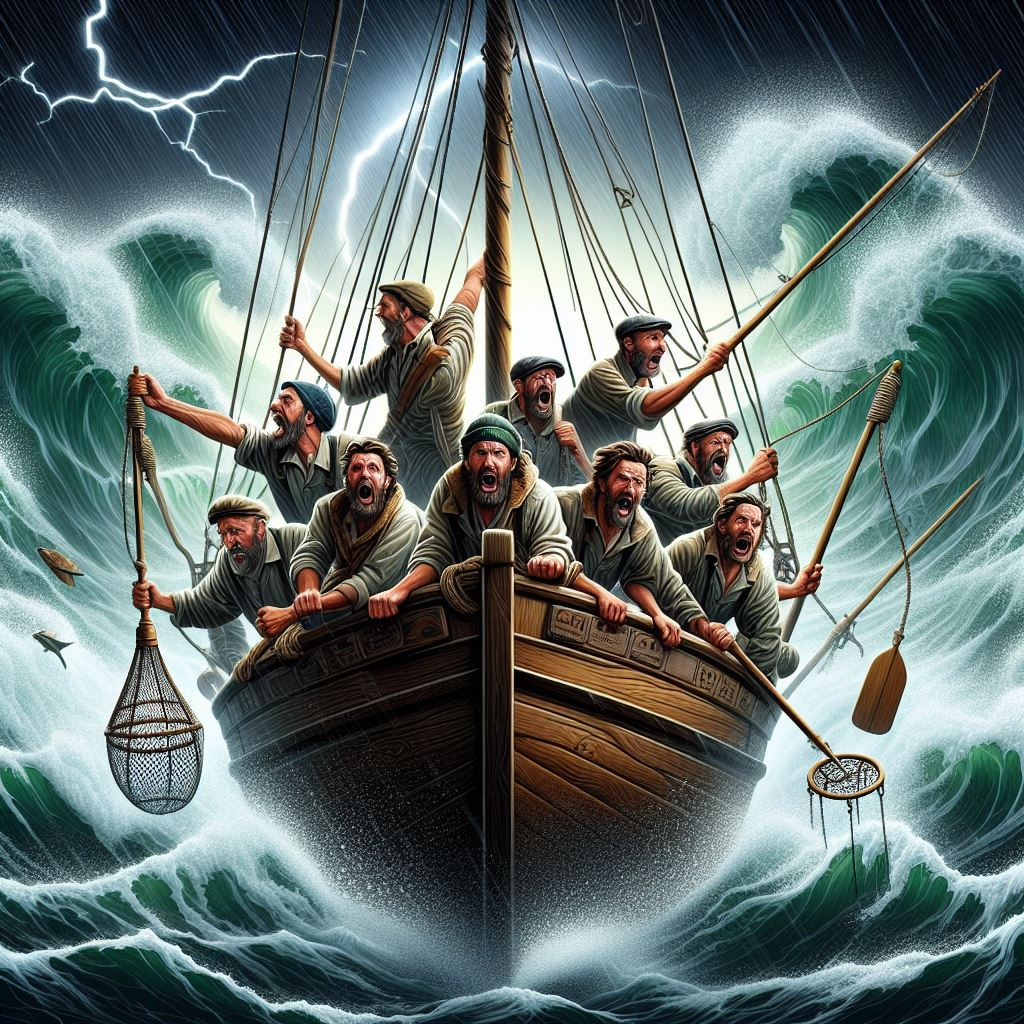
From Matthew 14:22-27 / The Unexpected Jesus
Throughout His incarnation, Jesus was continually doing the unexpected.
It was not expected that the Messiah would be born to a virgin.
It was not expected that He would come when Israel’s spiritual state was at such a low ebb.
It was not expected He would be so humble and – ordinary.
It was not expected that He would preach as He did.
Not expected that He would avoid seeking authority or power among men.
Not expected that His public ministry would be so short.
Not expected that He would die on a cross.
And certainly not expected – by ANY – that He would rise again the 3rd day.
Jesus did then, and continues even now to defy human expectations – constructed out of our own imaginations and preferences.
And so it is in this frightful moment on the sea. The last thing any of the Disciples would have expected was to find Jesus walking to them on the water in the midst of a life-threatening storm.
But there He was.
Note first: Here He still is in our hour of need today. No child of His is in such a place where He cannot be found. No matter how unlikely, how unexpected, how impossible. No matter how stormy, how bleak, how seemingly beyond all hope – He comes to us where we are.
He is magnificent.
Note second: Obedience to Christ is no barrier to trial, danger and struggle. This scenario will be repeated in the lives of His disciples both in similar circumstances as well as in very different ones. There they were, doing what He had specifically asked, while facing inhuman and insurmountable opposition. It is in these hours we are to look for His visitation.
It is a myth that serving and obeying Christ somehow exempts His servants from danger.
There are many who believe that as long as they have a sense of peace about their decisions, that He will always make their path smooth and easy. It is not so. These men were as “in the center of God’s will” as they could possibly be; and never were they less peaceful and more troubled.
Note third: How this scene might parallel the return of Christ? Contrary to my postmillennial brethren, He does not come to a “Christianized” world, but to one in turmoil. It was true in His first coming, and we’ve no reason to believe it will not be when He returns. If Jesus Himself can query as to whether or not He will find faith in the earth when He comes (Luke 18:8), should we expect it to be any different?
I’ve little doubt that before He returns, that it will be a season of darkness and great labor for the Church, but seeming to make little headway?
But when He does finally appear, we may well fear Him before we recognize Him, so focused on the struggle, and fearful of sinking. But it will be then that He calls to us and tells us – the storm is not the problem, “it is I” – I am here. All will be well.
Note third: The nature of great prayer revealed here twice. And observe, I said great prayer, not eloquent, verbose or well thought out prayer. First was a cry of fear in their misunderstanding. How graciously He responds to such prayers with His blessed: “Take heart; it is I. Do not be afraid.” The second will come soon after in Peter’s “Lord save me!”
How He hears are gasps in His direction. And answers in grace.
Note fourth: We may well have before us a hint of what the dying saint may face in their final hours. Having exhausted all, failing to reach the final shore, struggling in the dark, no more progress being made, fearful, doubtful, and as the final time approaches, the specter of Christ seems more fearful than joyful. But even then, in that near-sinking bark, He will call out and say “Take heart; it is I” – and He will not only come to us, but in that moment, we be immediately at the shore.
Oh praise the name of our unexpected Jesus!
 ResponsiveReiding
One response to “The Unexpected Jesus”
Reid: An excellent post as always, with meaningful application and theological points. Not to quibble, but you have two “Note thirds.” This should bring your final “note” to “fifth.” Also, in this sentence did you intend the “are” to be “our”? “How He hears are gasps in His direction.” In the last full paragraph, last sentence, did you mean “we’ll be” rather than “we be”? “…but in that moment, we be immediately at the shore.”