
From Genesis 31:49
Beware the temptation to read a verse or even a larger portion of God’s Word, without paying careful attention to the context.
I blush to share the following, but perhaps it may serve to prevent you from making the same error, which now I can look back upon and laugh. An error which may have more serious consequences given the passage.
When I was a young man, I was dating a girl who was about to go off to Bible College in the mid-west. I was absolutely mad for her. And in a Christian bookstore, looking for a gift to give her, I found a piece of jewelry. It was a heart, cut into two to make two necklaces which fit together like puzzle pieces when side by side. There was one half for each of us to wear.
Very similar to this:
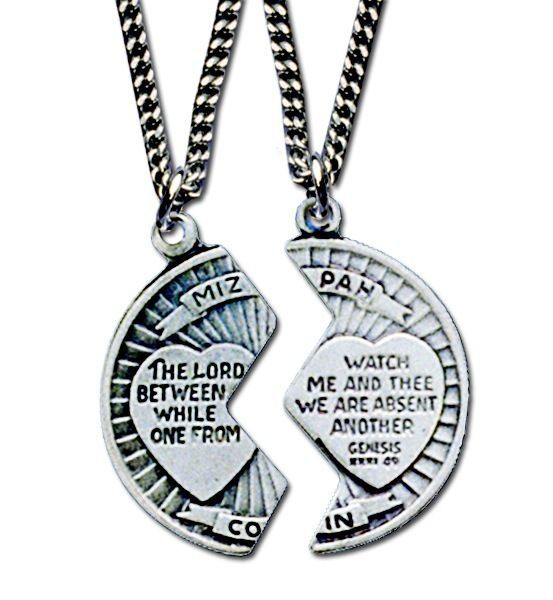
On the heart – when the two pieces were put together were inscribed these words: “May the Lord watch between you and me when we are out of each other’s sight” – along with the Scripture reference.
A home run! Romantic AND Biblical.
Sure.
However, I, like the manufacturer never bothered to understand the context of that verse. It comes out of Genesis 31 and issues from the lips of Laban, Jacob’s less than upright and godly Father-in-law. And here’s where the context really messed up my delusional attempt at godly romance.
These words in fact are not the Biblical equivalent of “absence makes the heart grow fonder.” They are the very opposite! They are an explicit statement of distrust; not a statement of fondness and well-wishing while apart.
Laban had felt cheated by Jacob’s absconding with his wives, cattle and grand-kids. He had been pursuing Jacob for 7 days with a household posse. It was hardly to throw a going away party. He was angry. Had God not appeared to Laban in a dream (vs. 24), and warned him to tread lightly when dealing with Jacob – no doubt the end would have been a violent one.
After a rather bristling encounter, Jacob and Laban decide to go their separate ways and bother each other no more. They make a sort of official treaty. True to his own devious nature, and suspecting Jacob of perhaps coming back some day to do him more harm – the two of them set up a monument to mark the agreement they came to. It is then that Laban says – “The Lord watch between you and me, when we are out of one another’s sight.” i.e. – God’s got His eye on you Jacob – if you think to do me wrong in the future. And adds: “If you oppress my daughters, or if you take wives besides my daughters” – God will getchya. Among other things.
There could not have been a less romantic, a lesser statement of fondness and well-wishing than what Laban meant by “The Lord watch between you and me, when we are out of one another’s sight.” No sir. It was practically a curse.
Truth be told, misapplications of a text like mine in this place, are rampant today. The problem of reading God’s Word in tiny sound-bites without regard to the context to truly understand its meaning so as to arrive at a proper application are everywhere. One immediately thinks of Paul’s “I can do all things” in Phil. 4, or the “If my people” of 2 Chron. 7 – which in no way shape or form can be applied to the United States.
Mine, is just one more example of how unthinking we can be in taking verses out of their context, and using them in ways never intended.
Be a careful reader Beloved. Thoughtful. Take time to think about who is writing and their situation. Who they are writing to and their situation. And in the broader scope, what is actually being communicated. Then we may find a more general principle which may be applied according to what is really being meant.
Believe me, the real stuff, is better than the made up stuff.
Don’t be like me. Don’t use a curse when trying to be spiritual and romantic.
Don’t do it.
 ResponsiveReiding