
Simplism as Webster defines it, is “the act or an instance of oversimplifying especially : the reduction of a problem to a false simplicity by ignoring complicating factors.”
And in an age of soundbite news, the problem of simplism is compounded horrifically. Geo-politics get reduced to quippy (or not so quippy) one liners from politicians, pundits and private opinionaters left and right – no pun intended.
People chime in with “the” answer to the economy, social upheaval, disease, racism, poverty, etc. Often, such comments are prefaced by something like “all we need to do is…”, and bingo! We have a one-line, easy-peasy solution to issues impacting millions of people across the globe.
Yeah. Right.
But what’s worse is when this kind of simplism manifests itself in theology and Biblical concerns. When theological concepts and doctrines are so utterly reduced as to ignore broad, deep and thorough examination. I get that we like things in nice, tidy, intellectually portable packages. I like it too. And labels for instance can be a handy form of shorthand at times. But then it backfires. We take a tiny one strand brush and try to cover a vast canvass with it.
I know I might get shot for this one, but take the beloved T.U.L.I.P. If you are of a Calvinistic bent (like me), it forms a handy-dandy summary of some very important Biblical concepts. But. But! When it becomes a substitute for the Gospel – as simplistic – it becomes horrifically problematic. How so? Simple (how’s that for irony) – the T.U.L.I.P. doesn’t contain the Gospel of justification by faith. It articulates some things well, and some things not so well – but gets glommed onto like it is the end-all in theological thought even though there is nothing in the T.U.L.I.P. about the triune nature of God, the deity of Jesus, regeneration or a host of other crucial doctrines. It is great for what it does, but it has its very, very severe limitations. But o, how we love our simplicity, our reductionistic tendency. Michael Horton’s YouTube video is a worthy view in this regard in a piece titled: “The TULIP is not enough.”
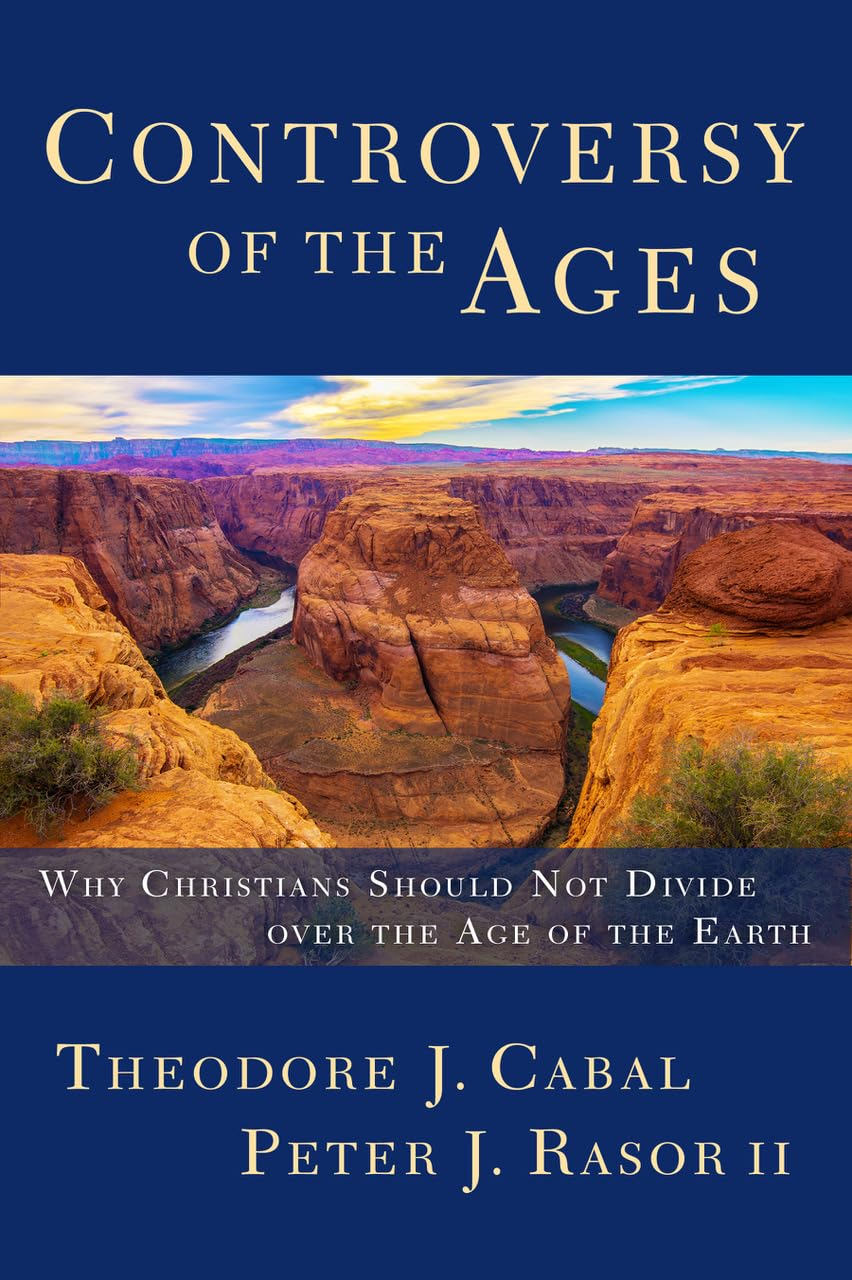
Now all of that is but introductory to what I really want to get at in recommending the above-named book: Controversy of The Ages. For if nothing else, what Cabal and Rasor do in this excellent volume, is disabuse the reader of overly simplified approaches to the debate regarding positions on Young Earth vs Old Earth vs some form of Evolution – among Bible believing Christians.
The truth is, its complicated. The science is complicated and the hermeneutical issues are complicated. And to ignore those complexities in favor of quippy one-offs in either direction, is to grossly misstate the facts and leads to unfair and often very incorrect characterizations. Mischaracterizations of other sincere Christians trying to make full sense of the two books of revelation given to us by God: The Written Word of the Bible, and the Book of Nature (Ps. 19). Two testimonies which can never contradict one another – but each of which can be and are often – misinterpreted.
The authors take the time to work through their case by contrasting 3 views using representative ministries. They examine the claims and approaches of the proponents of Young Earth Creationists (YEC) as represented by Ken Ham and Answers in Genesis (also touching on Henry Morris’ Institute for Creation Research); Old Earth Creationists (OEC) as found in Reasons to Believe and headed by Hugh Ross; and lastly, the Evolutionary Creationists (EC) of Biologos.
I will warn you now, there will be a lot of time taken to unpack the historic record of how the debate over heliocentrism was dealt with both theologically and scientifically, and then the rise of evolutionary thought following the publication of Darwin’s The Origin of the Species. But it is well worth the labor. Why? Because, to be overly simplistic – it’s complicated!
Neither pop science nor pop theology are sufficient to work through the issues. Theologians from at least Augustine (see his commentaries on Genesis) through today have had deep and probing questions and discussions on how we are to rightly interpret the opening chapters of Genesis. And it is not a question of “does Science have more authority than Scripture?” Of course not. But it IS a question of how we interpret the way “the heavens declare the glory of God” in light of the Scripture, and the Scripture in light of the revelation in nature. Both come infallibly from the hand of God. And both must be read and interpreted in light of each other. When rightly interpreted, they will never contradict one another. Never. If they do, we are interpreting either one or both wrongly. And sorting out which of those options takes hard, prayerful, thoughtful work.
While all of this is treated in as complete terms as can be given the limitations of a mere 225 page monograph, the aim and outcome of it all is a clarion call to be careful to listen well to one another in the Evangelical Church; to dialog in charity with each other; and to be seriously careful not to make issues which are not inherently Gospel issues, into Gospel issues, and thereby anathematizing genuine brothers and sisters in Christ when we disagree.
I so appreciated the tenor of the work which emerges on every page. There is no stone throwing, even when there is genuine and very serious disagreement. It is a call to value true unity in Christ and the God of Scripture above personal convictions, even in regard to very important topics – especially among those who place a high and unwavering value on the inerrancy and authority of Scripture.
And, to go back to where we started, it is a fine example of refusing to cave to simplism. To recognize that people often come to conclusions different from my own, not because they haven’t thought much about their positions – but because we have thought differently about the very same data. And that that, is a place to sit and dialog in the Spirit of Christ.
I highly recommend this most interesting, informative and useful book. Buy it and read it before you engage someone from one of the other positions again. It will be worth it.
Authors:
Theodore J. Cabal – Senior Professor of Philosophy of Religion at Southwestern Baptist Theological Seminary
Peter J. Rasor II – Assistant professor of Philosophy at Grand Canyon University
 ResponsiveReiding