Vol. 3 of The Works of John Newton(Newton, John, and Richard Cecil. The Works of John Newton. London: Hamilton, Adams & Co., 1824.) contains a work titled: “A REVIEW OF ECCLESIASTICAL HISTORY, SO FAR AS IT CONCERNS THE PROGRESS, DECLENSIONS, AND REVIVALS OF EVANGELICAL DOCTRINE AND PRACTICE: WITH A BRIEF ACCOUNT OF THE SPIRIT AND METHODS BY WHICH VITAL AND EXPERIMENTAL RELIGION HAVE BEEN OPPOSED, IN ALL AGES OF THE CHURCH.”
It sounds imposing but it really isn’t. It is comprised of 2 short “books.”
Book one consists of a very readable recounting of the Gospel narratives as though someone sat down to just tell you the whole story in their own words with some reflections here and there. Newton titles it: “Of the First Period of Christianity.”
Book two – “Of the Second Period of Christianity” recounts all of Acts in the same style. It contains 4 chapters.
Ch. 1 – Covers Acts to the close of the 1st Century.
Ch. 2 – “An Essay on the Character of St. Paul, considered as an Exemplar or Pattern of a Minister of Jesus Christ.” A must read for all who entertain being in ministry.
Ch. 3 – Examines how quickly aberrant doctrines and practices emerged in the early Church. So early, Peter, Paul, James and Jude need to address them in their letters. There is nothing new under the sun.
Ch. 4 – Deals with the heresies which arose even in Apostolic times. Heresies which emerge, sink and re-emerge in every generation.
It is in the 4th chapter that we find the following which I am calling a sketch of the true Christian. I found it so succinct and refreshing as to warrant this post. I pray it will be a blessing to you as well.
If you are Christ’s today, may this serve as a great reminder of just what that means. And if you are not – may this whet your appetite to possess what belongs to all of the heirs of salvation.
“A believer in Jesus, however obscure, unnoticed, or oppressed in the present life, is happy; he is a child of God, the charge of angels, an heir of glory;* he has meat to eat that the world knows not of; and from the knowledge of his union and relation to his Redeemer, he derives a peace which passes understanding,† and a power suited to every service and circumstance of life.‡ Though weak in himself, he is strong in the grace that is in Christ Jesus the Lord,§ upon whom he relies, as his wisdom, righteousness, sanctification; and expects from him, in due time, a complete redemption from every evil.|| His faith is not merely speculative, like the cold assent we give to a mathematical truth, nor is it the blind impulse of a warm imagination; but it is the effect of an apprehension of the wisdom, power, and love displayed in the redemption of sinners by Jesus Christ; it is a constraining principle, that works by love, purifies the heart, and overcomes the world; it gives the foretaste and evidence of things invisible to mortal eyes, and, transforming the soul into the resemblance of what it beholds, fills the heart with benevolence, gentleness, and patience, and directs every action to the sublimest ends, the glory of God, and the good of mankind.*
In volume 3 of the works of John Newton, there is a gem of a somewhat unknown work. He titled it “A Review of Ecclesiastical History.
Chapter 1 recounts the Gospel narratives and Acts like a simple recounting of the facts. It is brilliant.
Chapter 2 is “An Essay on the Character of St. Paul, considered as an Exemplar or Pattern of a Minister of Jesus Christ.” I am going to simply give you his key observations here as encouragement and motivation. On each of the points he expatiates – all of which is so very worth the reading. But here are the capstones to consider briefly as you head into the sacred desk today. May they inspire you to seek the love of God supremely.
I. The characteristic excellence of St. Paul, which was as the spring or source of every other grace, was the ardency of the supreme love he bore to his Lord and Saviour.
II. The inseparable effect, and one of the surest evidences of love to Christ, is a love to his people.
III. St. Paul’s inflexible attachment to the great doctrines of the Gospel is another part of his character which deserves our attention.
IV. But though St. Paul was so tenacious of the great foundation-truths of the Gospel, and would not admit or connive at any doctrine that interfered with them, he exercised, upon all occasions, a great tenderness to weak consciences, in matters that were not essential to the faith, and when the scruples were owing rather to a want of clear light than to obstinacy.
V. Every part of St. Paul’s history and writings demonstrates a disinterested spirit, and that his uncommon labours were directed to no other ends than the glory of God and the good of men.
(RAF – i.e. His focus was never about him or his ministry.)
VI. From the foregoing particulars we may collect the idea of true Christian zeal, as exemplified in our apostle.
VII. Having considered the subject-matter and the leading views of the apostle’s ministry, it may not be improper to take some notice of his manner as a preacher.
Newton expands here: “Instead of vain conjectures,* he spoke from certain experience; he could say, “I received of the Lord, that which I also delivered to you:” instead of accommodating his doctrine to the taste and judgement of his hearers, he spoke with authority, in the name of God whom he served: instead of losing time in measuring words and syllables, that he might obtain the character of a fine speaker, he spoke, from the feeling and fulness of his heart, the words of simplicity and truth.”
VIII. Another observable part of St. Paul’s character, is his unaffected humility.
Having said all this and so much more – he summarizes all these points this way as follows. May it be a sweet reminder for you today.
“Such was our apostle, and the same spirit (though in an inferior degree) will be found in all the faithful ministers of the Lord Jesus. They love his name; it is the pleasing theme of their ministry, and to render it glorious in the eyes of sinners is the great study of their lives. For his sake they love all who love him, and are their willing servants to promote the comfort and edification of their souls. They love his Gospel, faithfully proclaim it, without disguise or alteration, and shun not to declare the whole counsel of God, so far as they are themselves acquainted with it. They contend earnestly for the faith once delivered to the saints; and are desirous to preserve and maintain the truth, in its power and purity. The knowledge of their own weakness and fallibility makes them tender to the weaknesses of others; and though they dare not lay, or allow, any other foundation than that which God has laid in Zion, yet, knowing that the kingdom of God does not consist in meats and drinks, but in righteousness, peace, and joy in the Holy Ghost, they guard against the influence of a party spirit: and, if their labours are confined to Christians of one denomination, their love and prayers are not limited within such narrow bounds, but extend to all who love and serve their Master. They have entered upon the ministry, not for low and sordid ends, for popular applause, or filthy lucre, but from a constraining sense of the love of Jesus, and a just regard to the worth and danger of immortal souls. Their zeal is conducted and modelled by the example and precepts of their Lord; their desire is not to destroy, but to save; and they wish their greatest enemies a participation in their choicest blessings. In the subject-matter and the manner of their preaching, they show that they seek not to be men-pleasers, but to commend the truth to every man’s conscience in the sight of God; and when they have done their utmost, and when God has blessed their labours, and given them acceptance and success beyond their hopes, they are conscious of the defects and evils attending their best endeavours, of the weak influence the truths they preach to others have upon their own hearts; that their sufficiency of every kind is of God, and not of themselves; and therefore they sit down, ashamed, as unprofitable servants, and can rejoice or glory in nothing but in him who came into the world to save the chief of sinners.”
John Newton and Richard Cecil, The Works of John Newton (London: Hamilton, Adams & Co., 1824), 247–248.
Luke 5:36-39 (BSB) “He also told them a parable: “No one tears a piece of cloth from a new garment and sews it on an old one. If he does, he will tear the new garment as well, and the patch from the new will not match the old. And no one pours new wine into old wineskins. If he does, the new wine will burst the skins, the wine will spill, and the wineskins will be ruined. Instead, new wine is poured into new wineskins. And no one after drinking old wine wants new, for he says, ‘The old is better.’ ”
Jesus did not come to repair or prop up up the old Mosaic system. Its time was over. It had run its course and served it purpose. A new day had come. This was not time to sew a patch on an old rend, nor even to breathe all new life into it. It could not contain what was to be poured out. Only new creatures would do. New wineskins to receive the new wine. New men as well as new life. A new covenant, as well as a new Mediator.
So it is today. All attempts to merge, marry or unite the Old and the New Covenants is out of order. Yes, there is connection. The Old portends the New in astounding and countless ways. But just as a baby is conceived in the womb of its mother, yet the two are just that – two, so for a season they may share one systemic life – and yet they are not somehow merged into one entity. From the moment of conception – they are two.
We might say that the Church was always in utero (in Israel – there was always a believing remnant) until Pentecost. Israel bore her, and they share so much. And yet each is its own when all is said and done. Going back to Old Covenant rites and rituals, days, observances and customs fails to recognize the transition which has occurred. It is the failure to recognize this which causes so much confusion about the Believer’s relationship to the Law. The Law hasn’t changed, we have. And in the change, the entire relationship is also changed.
Christians are not “newized” Old Testament Believers. Out of the two (Believing Jews and Gentiles) He has made one new man (Eph. 2:15). We do not go back to pick this here and that there from the Old Covenant system. We have a new garment of the righteousness of Christ to wear, not the old garment of its picture. We are new wineskins, born again as new creatures, not Old Covenant believers jazzed up. Our covenant has been explicated (Jer. 31; Heb. 8), inaugurated (Luke 22:20), ratified (Heb. 9:16) and is being probated by The Spirit (Eph. 1:14). We no longer live under the old arrangement of signs, pictures, tokens and allegories. Ours is the fulfillment in Christ.
We drink the new wine poured into new wineskins. Some will always go back and say the “old is better.” They want no change. But Christ has come. The new day has dawned. The Kingdom has drawn near. The Spirit has been poured out. Look up – for your redemption draws nigh. Soon, ALL things will be made new. And He will live and reign in His manifest glory before the cosmos.
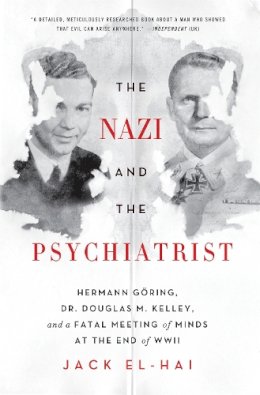
Recently I watched the movie Nuremberg starring Russell Crowe and Rami Malek. The movie is based on the book whose cover appears above. It is a fascinating and well-made movie in my opinion, worth the viewing. I followed up watching the film with the book. And it is a fascinating and penetrating study all its own. I can highly recommend both – but would really recommend the book.
The basic story is an historical one. At the close of World War II and the total defeat of Nazi Germany – for the first time in history, an international tribunal was convened charging many of the leading Nazis and their collaborators with war crimes. The Allies, led primarily by France, England, Russia and the USA undertook an unprecedented and colossal task. First to be prosecuted were 22 high ranking Nazis – the chief among them being Hermann Goering, Hitler’s handpicked successor. Goering was also the 16th President of the Reichstag (presiding officer of the German legislature); Supreme Commander of the Air Force (Luftwaffe); an aviator and architect of many of the oppressive laws governing how the Jews (along with others) found themselves not just disenfranchised but set on the path to extermination. He is played by Russell Crowe in the film.
The Psychiatrist (played by Malek) was Dr. Douglas Kelley. A native Californian, Kelley was a well credentialed practitioner with extensive experience in treating soldiers returning from war with various psychological maladies issuing from their battlefield experiences. And for around 5 months, he was the chief Psychiatrist tasked with analyzing, assessing and maintaining the mental fitness of the 22 Nazis to be first on trial at Nuremberg.
Kelley and Goering especially spent considerable time together. This relationship forms the core of both the book and the movie.
All of the very, very interesting facts and events aside, the account boils down to Kelley’s attempt to find some clue, some common trait among the 22 that could account both for their utter devotion to Hitler and the Nazi agenda – and (of course) their willing participation in the monstrous atrocities perpetrated by the Reich. His goal was to understand them, not judge them. He did indeed abhor and judge their actions. But he really wanted to understand why they did what they did. How they could justify their crimes – or even if they perceived them as crimes.
Kelley thought if he could pin-point “the” common cause, that such information could provide governments with the tools to prevent anything of the like ever happening again. If we could spot such men before they did such things, if we could head off their courses before they were set – what a boon that would be. And maybe such information could even be used domestically to identify and predict criminality of all sorts in advance. We could make ours and all societies safer in the future. Not to mention Kelley himself would gain global recognition. If he could just find the defect, the trigger, the trait. If only.
And here is where the theological implications get thick.
Kelley’s conclusion? There was nothing of the sort to be found. With only 2 real exceptions among the 22 (Ley and Hess), these men were mainly well adjusted psychologically. Not insane in the least. Highly intelligent, rational, educated, highly motivated, successful and even loving and devoted family men. To Kelley’s great dismay, they were just like you and me. They displayed no dominating or defining psychoses. They didn’t come from abnormal backgrounds or families. They were just good old normal folk found in every society. The types found in American politics, running corporations and living in suburbia. Businessmen. Doctors, lawyers, accountants, bankers, community organizers, and military men. Smart but average Joes.
Herein lay Kelley’s great dismay. If there was nothing to set these apart – the worst of the worst – then what prevents something like this happening all over again, anywhere? The answer, so utterly terrifying to him was – nothing. And so when his war-time labors were over and he returned to the States, he went far and near lecturing wherever he could – warning everyone he could that men just like these 22, walk among us here too. He just had no idea how really right he was. He was missing the facts that only the Bible can reveal regarding it all.
In the first place, Kelley had no category for the Fall, and the doctrine of the depravity of man. He believed in the innate goodness of most. And so he could never find an explanation for why anyone would do what these, and countless others have done. He was at a total loss. It terrified him. In time, he exhibited severe paranoid traits. He lived in fear even as he poured himself into more and more research that added nothing to provide him an answer.
In the second place, he began to wrestle with fact that he knew he had some of the very same traits as his subjects. And there was nothing he could do about it. He had recurrent bouts of rage, anger and depression. He drank too much. He tried to domineer others. He was a workaholic as he tried to disregard and bury his own eruptions of evil. He longed for the spotlight like Goering, and it drove him to extremes too. But still he found no answers. He had no concept of himself as a sinner needing grace. He was just someone who needed some sort of social or psychological adjustments.
Third, he tried to make his own son into a sort of super-man, the way the Nazis wanted to create their super-race. Forcing him to excel intellectually and academically, he drove his son to be an over-achiever at every turn. In this, he ultimately alienated his son and found him wanting to do just the opposite of achieve. He ruined their relationship in his incessant domination. He Nazi-ed his boy as he sought to revel in his own imagined superiority over others. And it failed too. We are made to bear the image of God, not of someone else. But fallen man seeks power. In the Garden, our first parents wanted to usurp God’s exclusive right to declare good and evil, to be our own de facto Creators (or at least seize the privileges thereof). We have never ceased from that impulse. Only the Christian informed by the Scripture can understand this iniquitous bent. Psychiatry and Psychology have no category for such a state.
Fourth, Kelley had no doctrine of Common Grace. He thought there was nothing to restrain men in their pursuits. So he lived in constant fear and outrage. He had no idea that God is constantly restraining evil. That the reason why everyone isn’t acting out their inner Nazi at all times, in all places and in every way is because our God is sovereignly preventing it. Holding it back. There are times when He withdraws and allows us some sense of how dire the human condition truly is. He does allow certain breaches in fulfilling His works among us. But the Believer can live knowing the one who loves them supremely can rebuke even the winds and the waves. That all of His are safe in Him, even in what He permits.
Lastly, Kelley didn’t know that ultimate justice will be done at the hands of Jesus Christ. That the Father has committed all judgment into His hands. That no one will escape either their just due or just reward. That there is a sure day of reckoning ahead. A day no human courts can ever even approximate. True justice.
Absent any of the answers that were at both his and our fingertips in the Word of God – Kelley continued to spiral inwardly. It agitated him that Goering ultimately committed suicide before he was to be hanged. He understood Hermann’s attempt to keep his own fate in his own hands and not be humiliated as a common criminal when he was – after all – the true German Head of State and was due high honor for all he had done. And in a fit of rage in 1958, Kelley took his own life, in front of his family, and in exactly the same way as Goering – cyanide.
We cannot psychologize, socialize or medicalize evil. Yes, there are times when all of those areas factor in to the heinous crimes of some. But ultimately, wickedness is a moral and spiritual issue. The Scripture is clear on it. And the remedy is to be found only in Jesus Christ. Only in reconciliation back to right relationship to our Creator and by that fact to one another. In the recognition of our sin and defilement before a holy God, and the provision He had made for us in the substitutionary death of His Son on the Cross – by faith in Jesus as Lord and Savior.
Only the genuine Christian can fully face the depths of their own sin (and that of others) without despair. For we know the truth of it all – and the remedy, the rescue – in Christ Jesus of Nazareth.
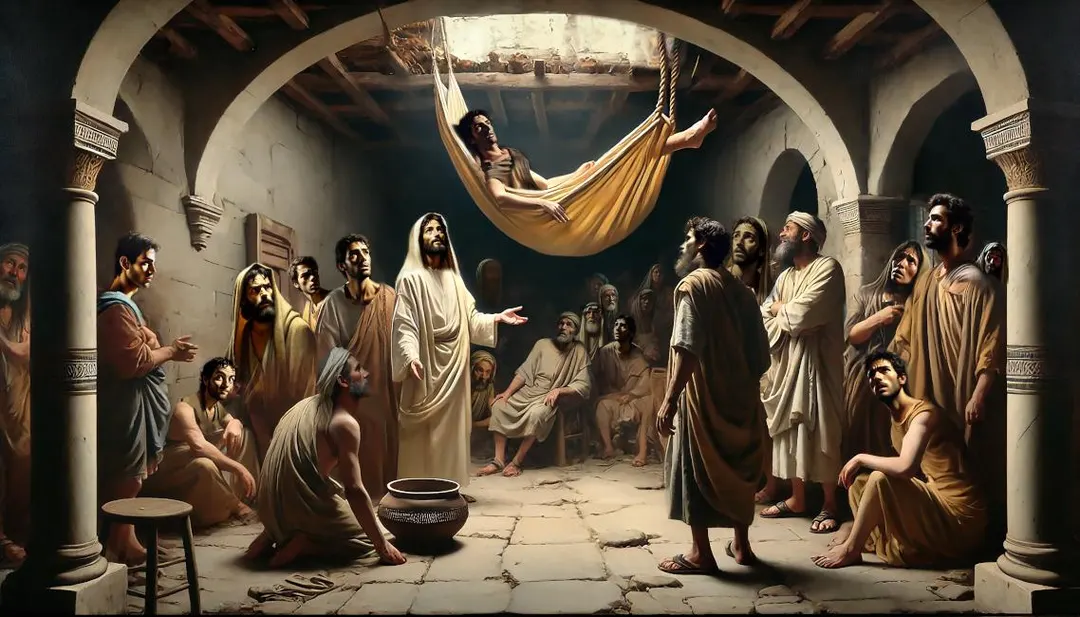
Mattew 9, Luke 5 and Mark 2 all give us the account of 4 men bringing a paralytic to Jesus.
The BSB relays Mark’s account this way: “A few days later Jesus went back to Capernaum. And when the people heard that He was home, they gathered in such large numbers that there was no more room, not even outside the door, as Jesus spoke the word to them. Then a paralytic was brought to Him, carried by four men. Since they were unable to get to Jesus through the crowd, they uncovered the roof above Him, made an opening, and lowered the paralytic on his mat. When Jesus saw their faith, He said to the paralytic, “Son, your sins are forgiven.” But some of the scribes were sitting there and thinking in their hearts, “Why does this man speak like this? He is blaspheming! Who can forgive sins but God alone?” At once Jesus knew in His spirit that they were thinking this way within themselves. “Why are you thinking these things in your hearts?” He asked. “Which is easier: to say to a paralytic, ‘Your sins are forgiven,’ or to say, ‘Get up, pick up your mat, and walk’? But so that you may know that the Son of Man has authority on earth to forgive sins…” He said to the paralytic, “I tell you, get up, pick up your mat, and go home.” And immediately the man got up, picked up his mat, and walked out in front of them all. As a result, they were all astounded and glorified God, saying, “We have never seen anything like this!” (Mark 2:1-12)
I have but one simple thought here – but what I hope will be a word of encouragment.
Our faith greatly effects others, when by virtue of it, we bring men to Him – either in the sense of giving them the Gospel, or bringing them to sit under the preaching of the Word, or even in prayer – that they might be touched by Him. Pray beloved. It is not a fruitless exercise. When we believe enough to bring men before Him, He is willing enough to respond.
Especially, I want to emphasize what an encouragement this is to pray for others.
We have no indication in this account that the paralytic had any faith or hope of restoration of his own. But these men, they were faithful to bring the man before the King of Kings. And this is what we do when we pray for those yet bound in their trespasses and sins.
In prayer, we take the roof off. We bring them into His presence. We make their need known to Him. And as the good God He is – He responds to our faith in bringing them to Him.
Bring them all. Do not hesitate.
Many cannot nor will not bring themselves. But that makes no difference. In prayer, we bring them directly into the presence of the God of Glory. And He responds.
He has providentially placed them in your circle, that you might intervene on their behalf. He invites you to participate in His wondrous work.
Pray for your lost loved ones beloved. Pray in faith. Pray expectantly. You have every reason to believe He will hear you.
Awake my soul, rise up and sing My great Redeemer’s praise Whose loving kindness e’re abides Throughout my earthly days
Shake off the chains of doubt and fear
Let nothing you dismay
For Christ your King rules over all
And he must win the day
No trials here, no troubled seas
But he does rise above
Who walks on every stormy crest
To hold you fast in love
Give all your care and worried mind
Into his nailed scarred hands
Who stands behind each providence
Who winds and seas commands
Rest all your weight on he who rules
In sov’reign majesty
Will not the one who died for you
Forever faithful be?

Cling fast to all his promises
Trust fully in his grace
Set all your heart on things above
Behold his smiling face
The one who bought you with his blood
Cannot forsake his own
The ones by faith in Spirit joined
As very flesh and bone
In seasons of the thickest clouds
In nights of darkest black
Sustained by his own life within
We suffer no true lack
Awake my soul, rise up and sing
Your great Redeemer’s praise
Lift up your voice in joyful song
Be still, and stand amazed
It has become common in American Evangelicalism to conceive of the notion of repentance, as a mere change of mind. But to be true to the Biblical pictures of repentance, there is much more involved – especially more than simply saying one is sorry, or feeling bad about this or that sin. Repentance does indeed involve a change of mind – but it is more than that.
Repentance necessarily includes – a change of direction. It is coming to the place where I see my sin for what it is, confess it, yes, even mourn over it – but then take the necessary steps to walk differently. And the closing section of the book of Hosea provides one of the best pictures of genuine repentance to be found in Scripture.
The character Hosea was a prophet to the northern kingdom of Israel as opposed to the southern kingdom of Judah. Israel had gone down the route of idolatry almost from its inception. And now, in the mid-700’s B.C., they are nearing their end. Refusing God’s repeated calls to repentance for 100’s of years through his prophets, they are about to be swept away by the Assyrians in judgment. It is a turbulent time. But right up to the end – God sends his men to call them back to fidelity to him alone. They will not listen.
In the 14th chapter of Hosea, God addresses his people over and over and over, exposing their sin. Then, at the very end of the book, he tells them exactly what is needed to avoid their prophesied fate. What true repentance to stay God’s judgment looks like. And it serves as a most wonderful model for all who may have fallen into sin and need to be recovered.
We read in Hosea 14:1-3 – “Return, O Israel, to the LORD your God, for you have stumbled by your iniquity. Bring your confessions and return to the LORD. Say to Him: “Take away all our iniquity and receive us graciously, that we may present the fruit of our lips. Assyria will not save us, nor will we ride on horses. We will never again say, ‘Our gods!’ to the work of our own hands. For in You the fatherless find compassion.”
Let’s break that down quickly. What a sweet model of repentance this is.
a. We can come with nothing but words. There are no gifts to bring. No goods to bestow. No sacrifices. No imagined penance. We come only with our humble pleas.
b. We come asking to have our iniquity taken away – the perverseness of our own hearts removed. We come in recognition that we ARE sinners, not simply those who sin. Surely, when we are in right relationship with Him that is not our primary designation – but when in rebellion, it is once again as though before we were His.
c. We ask Him to receive our gifts and offerings once again – to make our worship acceptable. We stop pretending that worship when we are in rebellion against him can somehow offset our sins.
d. We promise to make good on our previous vows – to fulfill the covenant we already had with Him. To be a faithful spouse.
e. We denounce finding our joy or safety in anything place else but Him. That we will look to Him alone and trust Him in these matters. After all, it is the sin of spiritual adultery which is the foundation of all other sins – seeking from the world, the flesh or the devil, what we ought to seek in him along. For in him alone is true peace, holiness, satisfaction, safety, contentment and the everlasting promises.
f. We utterly forsake every instrument of reducing God to tangible form, and every thing other than Him that claimed our affections and pursuit.
g. We walk in the glory of a God who is mercy and grace itself.
It is then we read the most wonderful promise in verse 4-7:
“I will heal their apostasy; I will freely love them, for My anger has turned away from them. I will be like the dew to Israel; he will blossom like the lily and take root like the cedars of Lebanon. His shoots will sprout, and his splendor will be like the olive tree, his fragrance like the cedars of Lebanon. They will return and dwell in his shade; they will grow grain and blossom like the vine. His renown will be like the wine of Lebanon.”
My fallen brother or sister in Christ – hear me. Your God has not left you without remedy due to your sin. He calls you home. And home, with a promise not just of forgiveness, but restoration and blessing.
Don’t wait. Don’t hesitate. No matter how long it has been or how far you have gone in your sin – he calls afresh to you today. He makes the path home – clear. And he promises to receive you with open arms.
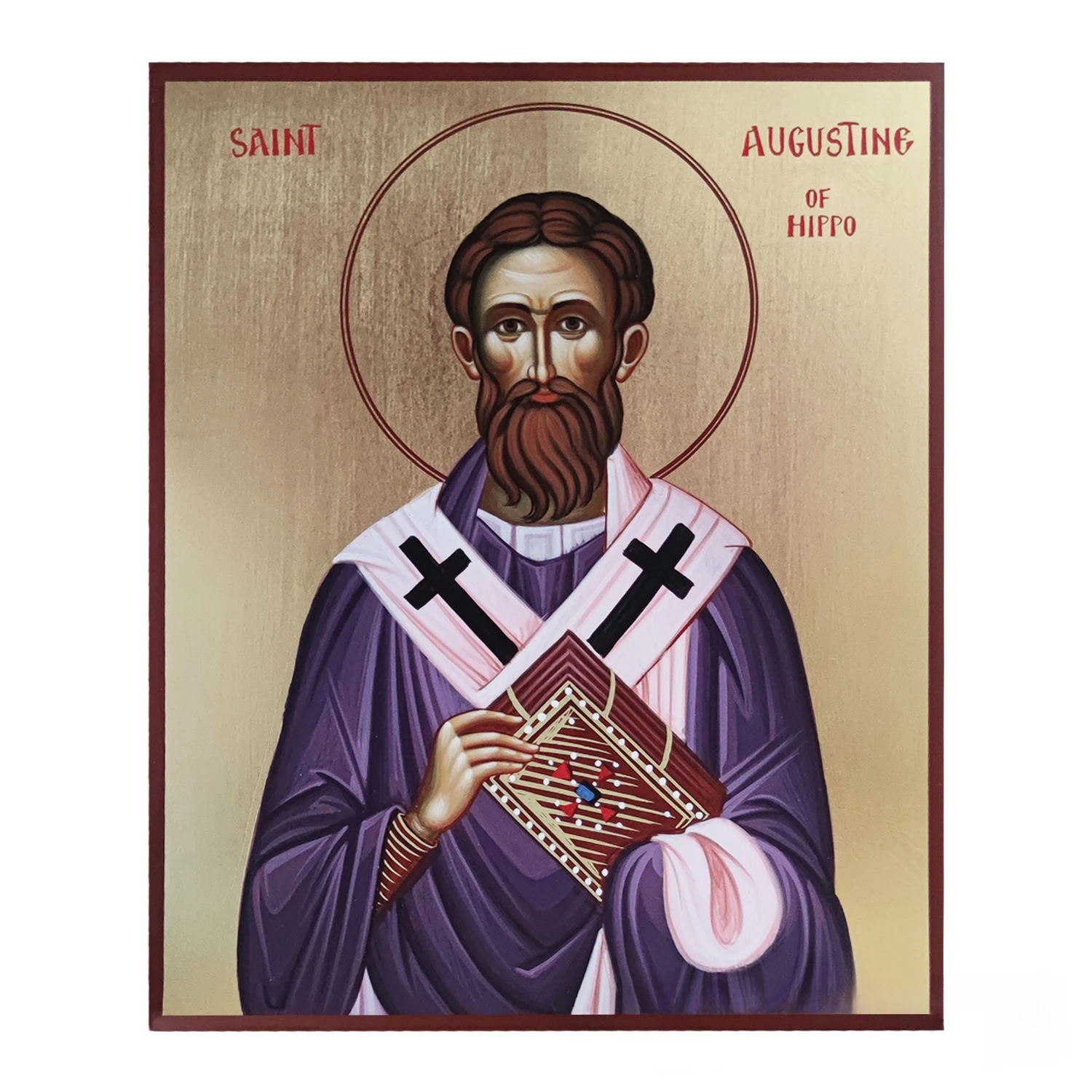
One of the things I’ve come to admire in Augustine of Hippo (354-430) is his remarkable candor. You read it in his “Confessions” (which, if you haven’t read, you ought to) and in his “Retractiones” or Retractions. Historian Philip Schaff writes: “In his last years he [Augustine] took a critical review of his literary productions, and gave them a thorough sifting in his Retractations.” Philip Schaff and David Schley Schaff, History of the Christian Church (New York: Charles Scribner’s Sons, 1910), 994.
Upon growth, maturity and further reflection, the great theologian found he needed to refine many of the positions he had taken earlier in his life as a Christian. Most are nuances and refinements, while others are significant shifts. I’ll let you read “Retractions” to pick those up for yourself. But Schaff goes on to note that “the fundamental architecture of his theology remained consistent from his conversion onward.”
I don’t know about you, but I know for myself that I’ve had to work through a number of retractions theologically over the years as well. Refining thoughts on everything from spiritual gifts, the atonement, eschatology and the relationship between the New Covenant Believer and the Mosaic Law – have all be subjects for much refinement. For the better I believe. Shading and nuancing to bring thoughts more in line with a larger and more comprehensive digest of Scripture.
Now a number of years ago, in an effort to help cement foundational Biblical concepts for our congregation, we began weekly to recite the Apostle’s Creed in gathered worship. In the process, I also thought that modernizing the language some would be helpful, as well as expanding the section on the Holy a bit. He seems to get a bit of a short shrift in the Confession. And, due to our geographic location and its history as the epicenter of Mormonism – we wanted to strengthen the trinitarian concept as well.
As a result, we ended up with the following:
I believe in the one true God of the Bible, eternally existing in three persons; in God the Father, Almighty, creator of heaven and earth; — in Jesus Christ, His only Son, our Lord, who was conceived by the Holy Spirit, born of the virgin Mary, suffered under Pontius Pilate, was crucified, He died, and was buried; — the third day He rose again from the dead; He ascended into heaven, and sits at the right hand of God the Father Almighty, from there He shall come to judge the living and the dead; — and I believe in the Holy Spirit, sent from the Father and the Son Baptizing Believers into Christ Jesus, indwelling and empowering them and remaining as the very presence of God within; Joining us together as the universal Church of Christ — I believe in the communion of saints, the forgiveness of sins, the resurrection of the body, and the life everlasting.
Alas! Here comes my “retraction.”
Upon much further reflection and study, it appears that while the phrase regarding the Holy Spirit – that he baptizes Believers into Christ Jesus – would be accepted by most, it is not the Scripture actually presents the concept. We see the difference in the way John the Baptizer speaks of Christ’s ministry in Matthew 3:11 (ESV) — “I baptize you with water for repentance, but he who is coming after me is mightier than I, whose sandals I am not worthy to carry. He will baptize you with the Holy Spirit and fire.”
The one baptizing is Christ Jesus, not the Spirit. The Spirit is instead the “element” into which (or better, into whom) the Believer is baptized. As Jesus will one day come and baptize all unbelievers in the fire of judgment, so it is upon belief, he baptizes Believers unto himself in the giving of the Spirit at conversion – upon the new birth.
Don Carson, commenting on 1 Cor. 12:13 “For in one Spirit we were all baptized into one body—Jews or Greeks, slaves or free—and all were made to drink of one Spirit” writes: “Christ as the agent does the baptizing, and the Holy Spirit is the medium or sphere in which we are baptized. Moreover whenever the verb baptize is used in the New Testament, it is the medium of the baptism—water, fire, cloud, and so forth—that is expressed using this preposition ἐν (en), not the agent.”D. A. Carson, Showing the Spirit: A Theological Exposition of 1 Corinthians 12–14 (Grand Rapids, MI: Baker Book House, 1987), 47.
I think Carson (along with most) is correct here.
So it is, I would propose an amendment to the previous formulation to something more like:
and I believe in the Holy Spirit, sent from the Father and the Son With whom Jesus baptizes Believers as his own; indwelling and empowering them and remaining as the very presence of God within; Joining us together as the universal Church of Christ
I should prefer a touch more eloquence in the phrasing – and perhaps you might have a suggestion for something better. And if so, I’ll be glad to retract yet again!
In any event, I think it wise for Believers to think and re-think deeply on what we hold, how we hold it, and to clarify, sharpen, refine and refocus as we grow.




 ResponsiveReiding