From Matthew 9:1-8 / “Your sins are forgiven” – Matthew, Mark and Luke all record this event. It is not hard to discern why this is so. What can be more important than to know that Jesus has the authority to forgive sins? This is the obvious emphasis of the passage. Yes, the man leaves healed of his paralysis as well, but that is shown to be secondary. Yet, I wonder if we were in the paralyzed man’s condition, which one we would think more important in the moment?
Now there are several things to note here.
1 – Note that forgiveness of sins and physical healing are not so interconnected as to assume they must always go together. How many people did Jesus heal, who left without such a pronouncement regarding their sin? And how sad that is. Imagine, it is possible that we might be miraculously touched by the hand of God, and yet leave still dead in our trespasses and sins. Simply seeing or even personally experiencing a miracle says nothing about our reconciliation to God. And yet how many seek Christ only for what they might receive in the physical or natural?
2 – Note Jesus’ rhetorical question to the scribes? Which is easier to say, your sins are forgiven, or rise and walk? They could do neither. He could do both. And He says that He did this this way so that they might know something. That He could heal? No. That He had the authority to forgive sins. In the grand scheme of things, this is what is eternally and spiritually important. This is what He is after in communicating.
3 – Note how fixated we are on the temporal versus the eternal. I don’t know about you, but if I was that man, I would probably have thought I’d been shortchanged at first. Carried to where Jesus was by friends. Dramatically let down through the roof of Jesus’ own house. There, in front of a huge crowd, displayed in all my weakness, only to hear Him say: “Your sins are forgiven.” Did it dawn on him that moment? Would it have dawned on me, that the greater miracle, the greater need was met in His first act? I fear not. I fear that I, that we are so focused on our perceived need, that we are blind to our real and greatest need. That in our unregenerate state, we are paralyzed from following Christ, working for Him in any way. And left that way, we enter eternity only to step into judgment. Beloved, our greatest need is what He can do, HAS done regarding our sin.
4 – Note that Jesus could forgive sins, but not like the “ollie, ollie oxen free” of hide and seek. He knew full well that this power would rest solely in His own impending death on the Cross. Forgiveness isn’t a simple wave of the hand. Justice must be done. Sin must actually be atoned for. When Jesus said to the man “your sins are forgiven” – He was saying “I will die for you, taking the just wrath of God you deserve upon myself, so that you can be reconciled to God and have eternal life.” Now, His question takes on real teeth – which is easier to say?
5 – We are to carry all of our needs to Him. Every one. No matter how great or how small. But we are to do so, knowing His wisdom, power and love will first and foremost meet our greatest need. For if He can and will do that, everything else is truly secondary – as blessed as it might be. As Jesus will say in another context later (though the principle still holds) “it is better for you to enter life crippled or lame than with two hands or two feet to be thrown into the eternal fire.” (Mt 18:8.) Praise God, He does the lesser often, the but the greater – for all who call upon Him in faith.
From Matthew 8:28-34 / Be Careful What You Pray For – Ryle notes that this passage is “deep and mysterious.” And we want to be careful not to build doctrine out of passages that are wholly unique, and are not meant to establish norms in the Church. That said, there are some lessons to be learned as we see the great authority of our Christ and King manifested in His commanding even the demon spirits; which must obey Him as well as the wind and waves He previously rebuked. Nothing is outside His authority.
Whatever the final disposition of these demonic entities, while they know they are already cast down and awaiting an end – it is not yet. They are obviously terrified of their final end, and they recognize Jesus as the One who will mete that judgment out in due time. Sometimes the demons respond more appropriately to Christ than we who are made in the very image of God. (James 2:19)
One wonders if upon hearing their request – and knowing what the result would be – Jesus kind of said to Himself – “OK idiots, if that’s what you want, have it.”
And one wonders how often His grace has interceded on our behalf in NOT giving us our requests when made in equal foolishness and with a lack of understanding the consequences. How gracious He is to us in His refusals. How tragic it would be if He just gave us whatever we asked for. He would be treating us, like He does the demons, rather than as sons and daughters of the Kingdom.
We have this question – why give them their request? If nothing else, then at least as an object lesson for the herders to carry back to the townspeople.
In 33, the herdsmen fled back to the town and told them what happened. And what had happened? The cost of rejecting Jesus was destruction.
The demons didn’t want Him and in pleading to be allowed to have their own way, to be granted their own desires was to be given over to their own destruction.
But did the townspeople learn? No. They plead that He might depart too. And He did so. He gave them over to their own desires too. To their own eternal destruction.
He could demonstrate it on the demons who had no hope of salvation. But what a tragedy for these who might have the Savior who stood before them.
Note then how great is this day of grace in which we live. What or who is more despicable and liable to judgment than the very demons of Hell? Yet the day of judgment has not yet come. Even the demons find reprieve from their immediately just due. And if they find Christ so willing to stay His hand in their case, then how much more those made in the image of God, yet still bound in their sins?
There is grace to be had. The hand of The Lord has been withheld by grace. And all who hear may come now, still. But the day will come when such hope is withdrawn. How we need to hear and respond in this extraordinary season of the Gospel. If you are reading this, it is not too late to cry “do NOT leave me alone – SAVE ME!”
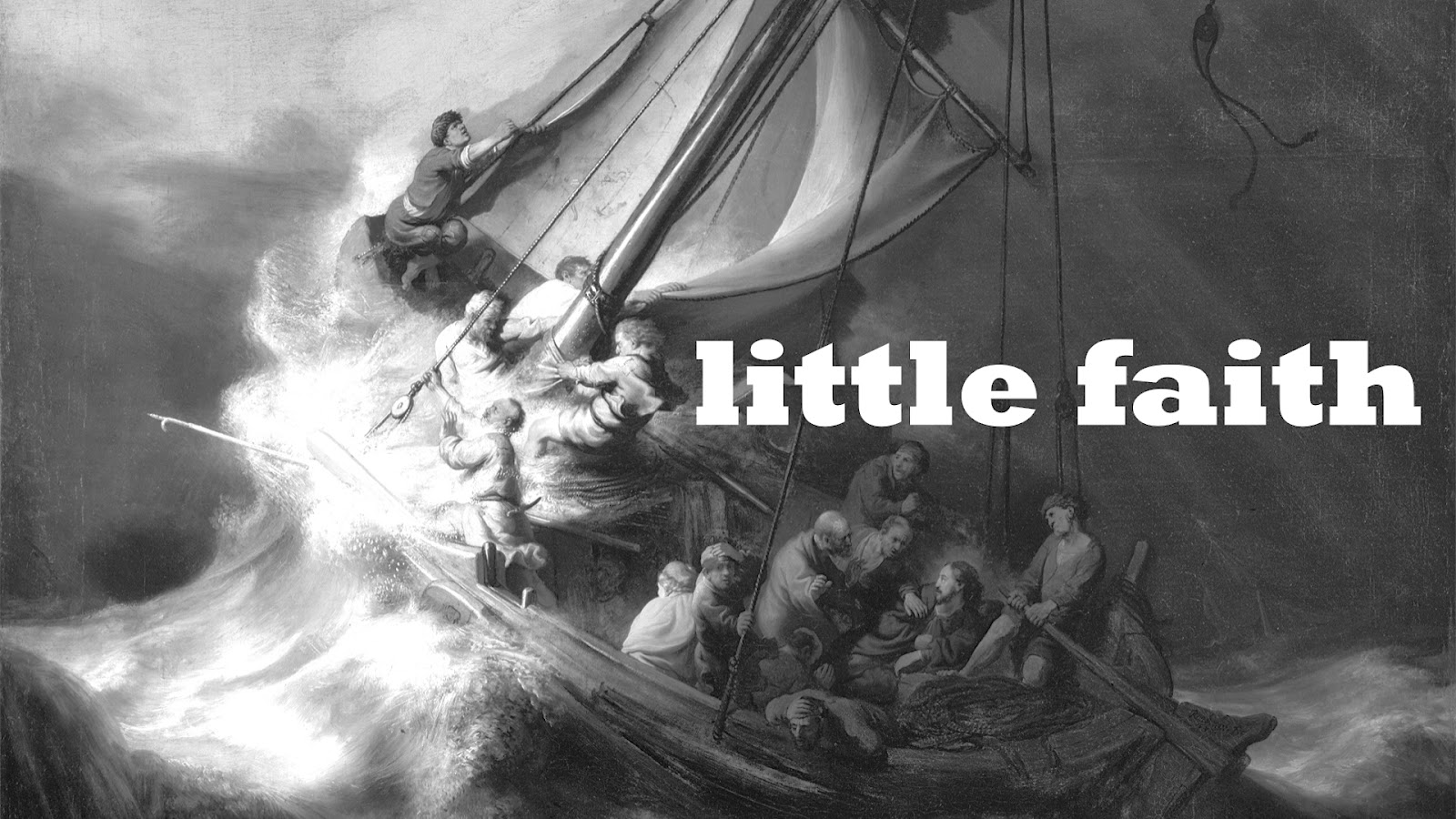
From Matthew 8:23-27 / Little Faith – We must be careful readers here. The idea in this narrative isn’t that the Disciples should have had some kind of confidence in their own safety, but confidence on the basis of who and what Jesus was, and what He had come to do. He could not perish. Thus, they were safe too.
Matthew gives this account on the heels of the healing of the Centurion’s servant. He is using the connection of the 2 to show how they did not yet have the kind of faith the Centurion is commended for. Again, not faith to believe the storm could be quelled, but faith in the person and authority of Jesus. This is what they were missing. They begin to get there when we see their response in vs. 27. At last, they are asking the right question: What sort of man is this that even the winds and sea “OBEY Him?” His authority is what is being highlighted.
Additionally, without a clear understanding of the plan of God – which cannot fail, we will fail to live in the faith of knowing His plan cannot fail and so certain things must happen, and certain others cannot. In this case, had they understood His mission to die at Calvary, they would have known (and been comforted) that He could not die in the boat. But our faith cannot extend beyond what we know of God’s word, and believe accordingly.
How many times have we heard someone sound the alarm at the real decline of Christianity in some time or place, as though if something is not done by us, the Church will utterly be snuffed out of existence? If we believed His Word, His promises, His revealed plan for His Church and its end – we could respond rightly by pleading for reformation and revival, but not faithlessly as though the Church will not survive. Jesus Himself stated categorically that the Church He is building both can and will withstand even the very gates of Hell. That doesn’t mean there are not dangerous and threatening times – like the storm the Disciples were in in this passage. It does not mean some local expressions of the Church may cease. It does not mean we do not cry out “Lord save us!” in such hours. But it DOES mean we really MEAN it when we call Him Lord in that plea. That we appeal consciously to the one we know of a certainty is Lord over all. And with the assurance that His plans and purposes cannot fail.
Note too that though Jesus remarks about their little faith, He does not fail to answer because of it being little. How good He is! Yes, He can point out that it needs improvement, but little as it was (and in my case often is) He still hears, still answers and still blesses. He does not deny us because we are frail. Even the littlest faith, gets the response of omnipotence. Freely. J. C. Ryle writes: “We have great reason to thank God that Jesus, our great High-priest, is very compassionate and tenderhearted. He knows our frame. He considers our infirmities. He does not cast off His people because of defects. He pities even those whom he reproves. The prayer even of “little faith” is heard, and gets an answer.11 Ryle, J. C. Expository Thoughts on Matthew. Robert Carter & Brothers, 1860, p. 80.
From Matthew 8:18-22 / Walking in Truth – Just why it is Jesus decided to go to the other side of the Lake upon seeing the crowds isn’t clear. Perhaps He was already perceiving a hint of their wanting to promote and follow Him simply as a miracle worker or leader. When in John 6 He saw that some wanted to take Him and make Him king, He did a similar thing by immediately withdrawing. He was clear on His mission even if those around Him were not. And He would not be used for purposes other than why He came – to fulfill the Father’s redemptive plan culminating in the Cross. He would not allow Himself to be deterred. He knew and stuck to the truth about Himself and His mission.
This is a lesson that we as His redeemed need to take in well.
Do we have a Biblically informed sense of who we are and why we are here? Do we know HIs purpose for us? The mission He has assigned to us? Are we living as light and salt in the midst of this crooked generation? Are we about the business of making His glories known to the World, by both our lips and our lives? How do we contribute to the mission of the Church at large in making disciples of men in all the nations?
Not everyone preaches. Not everyone teaches. Not everyone is a gifted evangelist. But all can study to know and live in the truth. And all can find a place of service in the Church so that those with their varying gifts are supported and enabled. Each of us has a sphere of influence we can touch. We can give. We can pray. We can comfort. We can encourage. We can bless according to our resources and opportunities. We can weep with those who weep and rejoice with those who rejoice. We can take the mundane duties of life and consciously enter into them so as to offer them up as service to our King with integrity, honesty, industry and humility. We can walk in truth.
Then we see how Matthew includes two short vignettes to follow in which Jesus calls to men to face and live in the truth.
When the Scribe comes to Him, He wants the man to know just what following Jesus is NOT. Following Christ is not to be seen or sold as the pathway to gain earthly advantages. And woe to us when we present or believe the Gospel that way. We are not walking in truth, but in a wretched illusion.
In 1 Tim. 6, Paul inveighs heavily against those who imagine “that godliness is a means of gain.” Godliness with contentment IS great gain, but godliness is not a way to gain earthly advantages. And those who promote the Gospel in such a way are “people who
are depraved in mind and deprived of the truth.”
They are not walking in the truth.
Strong words indeed. And Jesus disabused this Scribe of that foolishness right out of the gate.
Christ is not the means to earthly advantages.
And lastly, we see the truth that the call to follow Christ is urgent. This is the truth.
When we have come to know something of Him and heard His call, we must act and make our decision to separate from the mere ordinariness of life to be His – now. Not down the road. Not when it is more convenient. Not when those who might disapprove are gone out of the way. Not when we have more time or better circumstances. Now.
Living in the truth requires that we reckon with the reality of Christ’s demands right now, right this hour. For not one more minute is promised to any of us. And eternity hangs in the balance.
Maybe you are one who has hesitated today. You’ve said in your hear that you’ll get “serious” about spiritual things at some point down the road. But this man was faced with the reality right before His eyes – Jesus was about to get into a boat and leave. And either he went with Him now, or he might never.
And so if that is you today, I would plead with you, make the decision. Do not hesitate. Now is the day of grace. Who knows what might befall you or the world in the next 30 minutes let alone the next 30 years. Come to Jesus now. For the truth is, you are condemned in your sins right now, and only He can redeem you from your lost condition.
This passage is turned to by many to establish that as part and parcel of the atonement, physical healing is promised to all Believers. Of course then the question remains, if physical healing is the automatic extension of our salvation, then why aren’t all God’s people perpetually healed? Some would answer, that such healing (like salvation itself) is dependent upon our faith. So if we do not have faith to be healed, we will not be. But the 3 healings in this chapter seem to militate against that conclusion.
Note in the first case, the Leper’s faith only extended to Jesus’ ability to heal, “if you will”, and not that he had confidence Jesus would heal him. In the second case, the ill person’s faith is totally irrelevant, it was the Centurion that believed Jesus could heal. And once again, he only believed Christ COULD, not that He would. And in the 3rd case, we read nothing of Peter’s mother-in-law’s faith at all. Jesus simply healed her. So the faith theory does not seem to hold up – here at least.
But what do we do with the quote from Isa. 53? How does what happened here filfill the prophecy that “he took our illnesses and bore our diseases?”
In the first place we note that whatever it means, it happed prior to the Cross, not as an effect of the Cross. Such healing seems to be connected with the atonement in 2 main ways. 1 – In the atonement, Jesus would do all that was needed to reverse sin’s effects. So there is the promise of total physical healing for all who are His – to be realized fully in the resurrection. 2 – The healing we need above all others, is that of our souls. To be delivered from sin’s effects there. Many commentators locate the entire weight of the healing in Isaiah’s prophecy then only in the spiritual sense. But even there, we have to reckon with the reality of the remnants of indwelling sin. The old adage that we have at present been delivered from the penalty of sin, are in the process of being delivered from the power of sin, and in the end will be delivered from the very presence of sin is true.
In regard to both of the above, what we see is that there are parts of the fullness of Christ’s “healing” both physically and spiritually now, but there is a fullness yet to come. We indeed ought to pray for one another in terms of healing (physically AND for one another’s souls) because God is merciful and gracious and countless times we have seen Him heal and deliver from sins. These are indeed privileges of the saved. What we cannot do is assume a stance of “healing on demand.” We have many gracious foretates of what is to come by His grace.
Lastly, and perhaps most overlooked in this passage, is that in all 3 healings, they share the common thread that each was ceremonially unclean, and yet 2 cases, Jesus still touched them. In Judaic thought, to touch and unclean person, was to make oneself unclean – in a manner to take their uncleanness upon oneself. Only Christ could take on our uncleanness, and not become unclean Himself. Instead, He makes us clean and righteous with His rightouesness. A total reversal of how it worked prior to His incarnation.
W.G.T. Shedd said that as a sunbeam can shine on the most putrid substances, warming them and affecting them, but the beam itself is never soiled. So it is with the Son of God – the Light of the World – He can shine on us, touch us, have the most profound effects upon us in our defilement, and yet remain in His perfect, unsullied holiness. What a Savior!
From Matthew 8:5-13 / Jesus Marveled. It is noted only twice in the Gospels that Jesus is said to marvel at anything, here, at the Centurian’s faith, and in Mark 9 at the unbelief of those in His hometown of Nazareth.
Now what makes the Centurian’s faith something for Jesus to marvel at, is not that as a Gentile he HAD faith at all.
It is true that if any should have had faith it should have been His fellow Jews. Afterall, He was fulfilling prophecy, preaching powerfully and performing miracles one after another. In our parlance we would say that believing in Him would be a no-brainer. Obvious. So obvious in fact, that Jesus Himself looks at their unbelief as something not even credible – especially in the face of the flimsy reasons Mark gives for their rejecting Him. In truth, the reasons for those who reject Him today remain just as flimsy. The main one being, if He is who He said and demonstrated He is, then we would need to cast ourselves upon Him for mercy and to be reconciled to God the Father. And we don’t want to give up our personal righteousness nor submit to anyone else but self.
But what of this Gentile? Why is His faith as marvelous as the Jews’ unbelief? The text reveals it. It was more than that Jesus had the ability to perform the miracles and healings that had been reported – it was rather that the Centurian grasped something of who Jesus really was over and above what He could do.
The Centurian lets the cat out of the bag when he says that it is obvious Jesus is a man of authority even as he is. And that Jesus was “under” authority – acting on someone else’s behalf. In other words, the man recognized Jesus was acting at God’s behest. Jesus was God’s true agent. And even Jesus’ closest allies at this moment hadn’t gotten that far in their own thinking about Him. The Centurian’s faith was for all intents and purposes already more mature than that of His own disciples. More mature than many self-confessed Christians even today. Marvelous indeed.
Here then is something of great importance for us. Where we tend to desire power, the ability to do things, make things happen – Jesus’ power, like His Father’s, rests not in brute strength, but in His absolute authority. He need only “speak the word” and whatever He speaks will come to pass. It takes us back to Genesis, where in creating the heavens and the earth, it required only that “God said.”
Indeed, we can take that a step further. For God, as we know, has no body like ours. He has no lips, no vocal cords. He didn’t have to verbally articulate the words “let there be” for all to come to pass. He merely needed to will it so. With His absolute authority, that’s all it took. And so it is in our passage. Jesus never says: “servant – be healed!” He just says to the man, go, it’s done. He willed it so, and it happened.
This then is where our faith is to rest if we are to truly grow in grace. What do we rest in? That the One who saved us by His grace and substitutionary atonement, has all authority in Heaven and on earth, and therefore, every one of His promises to us HAS to come to pass. It will be as He promised that we will remain His until He comes, that sin and death will be overcome, and that we will one day fully bear His image. Because He has willed it. And He has the authority to bring it to pass, irrespective of any resistance, opposition, lack of cooperation or attack by the Enemy. Beloved, He cannot fail you.
One wonders, what was it this man heard in this great sermon, that sparked faith in him to ask for healing? Jesus didn’t speak of healing, nor do we have some miracle immediately before this. Either here in Matt. nor in Luke.
I think it is best understood that it was Jesus Himself which impressed him. As ch. 7 closes noting that Jesus was teaching them with unprecedented authority – it seems this man grasped that Jesus had the authority to cleanse leprosy as well.
Note then that an absolute act of His will is all that is necessary to heal – just as in creation. “God said” is the simple equivalent to “God willed”. It does not require something audible.
Sin:
Disables from working for the kingdom
Disfigures from the image of Christ
Deadens the conscience
Defines one by its most prominent feature
Defiles from purity
Is incurable by man
Is systemic – it defiles the whole
The Cure:
Not a method
Not a program – 12 step or otherwise
Not a philosophy
Not a creed
Not a religion
Not by an act of the will
Not by personal merit
Not by personal effort
Only: “Lod, if you are willing.”
How gracious our Savior is. Let it be noted that He never turned one away who came in such a manner. Even the Syro-Phoenician woman who came for her daughter, found her need met when she sued by faith. And her situation we see was prior to the church being charged to take this message to all nations and peoples. Her’s was a unique circumstance in time and place. The Gospel now is sent to all indeed.
Perhaps it is just our culture, and then again, perhaps not – but I cannot ever recall being preached to about the blessedness of meekness. I think that for most, meekness is automatically confused with or equated to – weakness. They sound too much alike. And yet, here is Christ enjoining meekness such that its possession is tied to the eternal inheritance of the saints.
I will gladly own that Christians must be bold and uncompromising. Many of us are far too possessed of a spirit of cowardice today. On the other hand, bravery and boldness are not to be confused with brashness and harshness any more than meekness is to be confused with weakness.
In Alexander MacLaren’s sermon of meekness in his series on the beatitudes – he makes so many powerful comments on meekness, that I feel compelled to share just some of them.
What is below are just a few snippets from that sermon. I pray you will consider them, especially in the context of the present combativeness of some Church leadership and Christians striving for their way – whether it is God’s or no, and the tenor of public discourse in our land.
And if you do not have time to peruse them all – PLEASE, read except 6. It is as powerful as it is timely.
1 – Now, the ordinary use of the word is to describe an attitude, or more properly a disposition, in regard to men, especially in regard to those who depreciate, or wrong, or harm us. But the Christian conception of meekness, whilst it includes that, goes far deeper; and, primarily, has reference to our attitude, or rather our disposition, towards God. And in that aspect, what is it? Meek endurance and meek obedience, the accepting of His dealings, of whatever complexion they are, and however they may tear or desolate our hearts, without murmuring, without sulking, without rebellion or resistance, is the deepest conception of the meekness which Christ pronounces blessed.11 MacLaren, Alexander. Expositions of Holy Scripture: Matthew 1–8. Logos Bible Software, 2009, pp. 126–27.
2 – The ox that kicks against the goads only does two things thereby; it does not get away from them, but it wounds its own hocks, and it drives the sharp points deeper into the ragged wounds. Let Him strike, dear friend, for when He strikes He cuts clean; and there is no poison on the edge of His knife. Meekness towards God is, first, patient endurance of His Will.11 MacLaren, Alexander. Expositions of Holy Scripture: Matthew 1–8. Logos Bible Software, 2009, p. 127.
3 – And, in reference to Him, it is, next, unquestioning docility and obedience. Its seat is in the will. When the will is bowed, a man is far on his road to perfection; and the meaning of all that God does with us—joys and sorrows, light and darkness, when His hand gives, and when His hand withdraws, as when His authoritative voice commands, and the sweet impulses of His love graciously constrain—is that our wills may be made plastic and flexible, like a piece of wrought leather, to every touch of His hand. True meekness goes far deeper down than any attitude towards men. It lays hold on the sovereign will of God as our supreme good, and delights in absolutely and perfectly conforming itself thereto.11 MacLaren, Alexander. Expositions of Holy Scripture: Matthew 1–8. Logos Bible Software, 2009, pp. 127–28.
4 – The truly meek heart remains unprovoked amidst all provocation. Most men are like dogs that answer bark for bark, and only make night hideous and themselves hoarse thereby. But it is our business to meet evil with good; and the more we are depreciated, the more we are harmed, the more we are circled about by malice and by scorn, the more patiently and persistently to love on.11 MacLaren, Alexander. Expositions of Holy Scripture: Matthew 1–8. Logos Bible Software, 2009, p. 128.
5 – sure I am that the one thing that puts out the fire of antagonism and wrath and malice in those who dislike or would harm us is that we should persistently shine upon, and perchance overcome, evil with good. Provoked, we remain, if we are truly meek, masters of ourselves and calm and equable, and so are blessed in ourselves. Meekness makes no claims upon others. Plenty of people are sore all over with the irritation caused by not getting what they consider due respect. They howl and whine because they are not appreciated. Do not expect much of men. Make no demands, if for no better reason than because the more you demand the less you will get; and the less you seem to think to be your due, the more likely you are to receive what you desire.11 MacLaren, Alexander. Expositions of Holy Scripture: Matthew 1–8. Logos Bible Software, 2009, pp. 128–29.
6 – But there is another thing to be taken into account in the description of meekness. That grace, as the example of our Lord shows, harmonises with undaunted bravery and strenuous resistance to the evil in the world. On our own personal account, there are to be no bounds to our patient acceptance of personal wrong; on the world’s account, there are to be no bounds to our militant attitude against public evils. Only let us remember that ‘the wrath of men worketh not the righteousness of God.’ If contending theologians, and angry philanthropists, and social reformers, that are ready to fly at each other’s throats for the sacred cause of humanity, would only remember that there is no good to be done except in this spirit, there would be more likelihood of the errors and miseries of mankind being redressed than, alas! there is to-day. Gentleness is the strongest force in the world, and the soldiers of Christ are to be priests, and to fight the battles of the Kingdom, robed, not in jingling, shining armour or with sharp swords, nor with fierce and eager bitterness of controversy, but in the meekness which overcomes. You may take all the steam-hammers that ever were forged and batter at an iceberg, and, except for the comparatively little heat that is developed by the blows and melts some small portion, it will be ice still, though pulverised instead of whole. But let it get into the silent drift of the Arctic current, and let it move quietly down to the southward, then the sunbeams smite its coldness to death, and it is dissipated in the warm ocean. Meekness is conqueror. ‘Be not overcome of evil, but overcome evil with good.’11 MacLaren, Alexander. Expositions of Holy Scripture: Matthew 1–8. Logos Bible Software, 2009, pp. 129–30.
7 – Now, there is a sharp test for us Christian people.
If I have learned myself, and have penitently received God’s pardon, I shall be meek with God and with man. If I am not meek with God and with man, have I received God’s pardon? One great reason why so many of you Christian people have so little consciousness of God’s forgiving mercy, as a constant joy in your lives, is because you have so little obeyed the commandment, ‘Be ye imitators of God, and walk in love, as God hath forgiven and loved us.’1
8 – There is a present inheritance of the earth which goes, as certainly as the shadow with the sunshine, with the meekness spoken of in our text. Not literal, of course, for it is not true that this Christian grace has in it any tendency whatever to draw to itself material good of any sort. The world in outward possession belongs to the strong men, to the men of faculty, of force and push and ambition. If you want to get through a crowd, make your elbows as sharp, and your feet upon the toes of your neighbours as heavy as you can, and a road will be made for you; but, in the majority of eases, the meek man on the edge of the crowd will stop there.11 MacLaren, Alexander. Expositions of Holy Scripture: Matthew 1–8. Logos Bible Software, 2009, p. 133.
From Matthew 7:24-29 / Hearing the Word of The Lord – As we come to the end of this glorious and most important sermon, Jesus Himself leaves us with the closing admonitions.
And might I say at the outset, that if you are one who seeks to “hear the word of the Lord” – start here. Until you have mastered what He HAS said and preserved for us in His Word, do not occupy your time with trying to hear some esoteric, ethereal or mystical “word.” Know this. Imbibe this. Dwell on this. Ask the Spirit to illuminate this – His Word. Pour over, meditate on, study and steep yourself in the Bible. And you will hear His voice on every page, His breath in every syllable. You will hear more from Him than you will be able to fully digest and live on. You will be full in hearing the Lord.
Note first, true faith, saving faith always has these aspects to it:
a. WHAT is believed. In this case, “these words of mine”. Faith must always and only rest in what we can verify God has actually said, and in His character. Faith is not faith when it is based upon mere desires, hopes, false or imagined information. We must know what God has said.
b. True saving faith is belief that terminates in ACTION – “everyone one who hears these words of mine and DOES them”. Action that is in obedience to “these words of mine” – not whatever they please. It is from this that James can write later: “faith apart from works is dead.” If we truly believe what He has said, then we order our thoughts and actions accordingly. The signal proof of the false professor is the claim of belief without a lifestyle that accords with it.
Note secondly, how hopeless those are who simply have a raw belief which is not connected to their lives. Life will eventually destroy them. According to Jesus, whoever lives today in preparation for the coming judgment and the Kingdom is the wise man. The one who ignores this dynamic, which is the underlying thread in all – will be swept away. Keep your eye on the coming Kingdom, and live today as on a trajectory toward that day. This is the only way to hear and do His words. Living only for today without the reality that Christ is returning and each of us will have to give and answer for our lives – is the height of foolishness. It is like building a house on sand. And when the winds of adversity and indeed, final judgment come, it will not stand.
Note lastly, how secure those are who set their hope in Christ. No matter what comes, they can and will endure. They will endure the same storms that destroy others. And most importantly, they will endure the day of His great wrath – for Christ has already endured it for them; on the cross. With what joy and confidence the one who is in Christ by faith faces the trials and tribulations of life. For we know that all these things are – in comparison to what is the be ours at His return – truly light and momentary afflictions. Circumstances do not define us – Christ defines us, as His, purchased with His blood, and destined for glory in His presence of all eternity.
And all this, He has said with His divine authority to seal it.
From Matthew 7:15-2 / Beware of False Prophets. As Jesus nears the end of this momentous sermon,. He must issue a dire warning which is vital in every generation – beware of false prophets.
Now we must note these key things:
1 – In recognizing and avoiding false prophets, the chief issue is not what they might preach or teach – though that is vital too – but Jesus’ focus here is on their fruit. What fruit? Not their signs or miracles. Their character.
A common misunderstanding in this passage, comes from something which in fact does not exist – that there is some sort of generic “tree” (which people are), and that this tree can produce either good fruit or bad or corrupt fruit. But this is not true either to Jesus’ simile nor to the thought. The comparison is between fruit trees, and thorn bushes. It is one of ontology – nature. One would’t expect a pear from a thorn bush under ANY conditions. His point isn’t about what people do or do not do, as much as it is regarding what people are or are not. We need to become new creatures. We come into this world thorn bushes. And we need to be transformed into fruit trees. Something which can only be done by His amazing grace and power. It cannot be done by the reformation of actions.
This is what the following account of coming judgment reveals. So what if they did this or that miracle or great work? Were they His? Were they – are we – other than how we were born. And, as per vs. 23 – what is the nature of their “lawlessness”? Is it not simply that they are not Christ’s servants? That He is not their Lord? They serve self. Not Him, and not the interests of His kingdom.
You will not get sweet things from sour people. They are not showing the fruit of pursuing the kingdom – but of pursuing self and the world. True fruit is in accord with the nature of the tree.
Thorns & Thistles: Can attach themselves to you easily. Always make their presence known. Stimulate action, but not by persuasion to higher things.
Fruit: Nourishes. Refreshes. Sustains life.
2 – Giftedness is not the same as grace. This is truly vital for us to learn. Someone prophesies, and what they say comes to pass. So what? Demons may be genuinely cast out. So what? Mighty works might be done in His name. So what? So they can preach like Spurgeon and sway the masses. So what? None of these say a single thing about the actual spiritual state of the individual.
As Paul would argue later in 2 Cor. 11 – if they do not come in the Spirit of Christ – in His sacrificial love, joy, engendering peace with God and one another, longsuffering, gentleness – especially toward detractors, uprightness in character, faithfulness to the truth, kind and self-controlled – refuse them. If they come in greediness and sensuality – reject them.
3 – When all is said and done, false prophets will inevitably camp on refusing Christ as the true Lord of their lives, so as to live according to their own dreams, visions and new revelations. The WORD, will never be enough. Ultimately they are – lawless. (See 2 Peter and Jude).
Watch out for such. If their character cannot be observed and tested, so as to manifest the character of Christ – look elsewhere. Don’t be fooled by supernatural manifestations. Look for the Spirit of Christ in holiness, humility, and what is best for men’s souls before God.
Jesus, the Good Shepherd, is here at this moment, guarding His sheep. Protecting us. Warning us. O how we need to listen to Him! Look for His Spirit lived out.