Category: Movie Review
-
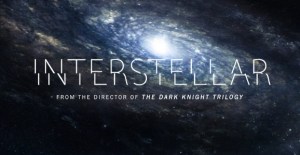
Summary without the spoilers: Interstellar’s message is, that the indefinable reality of human love is so powerful, it can transcend time, space and all other dimensions, so that mankind can be its own savior.
Now if you do not want to read about the details of the plot – stop here. Whether or not my summary statement above makes the movie more or less attractive is up to you.
WARNNG: SPOILER ALERT. BIG SECRETS REVEALED BELOW.
I love Science Fiction. Blend that with an apocalyptic storyline (the two are usually together tho not always) and I’m ready to make tracks to the theater. Hence writer/director Christopher Nolan’s (The Dark Knight; The Dark Knight Rises; Batman Begins; Inception) Interstellar had me from the get go.
The apocalyptic problem – earth is suffering from an irreversible blight on vegetation which is about to wipe out its last remaining crop – corn. The whole planet is turning into a giant dust bowl.
The Sci-Fi solution – find a new habitable world (Plan A). And if there is no way to get back and move the remaining population there – start a new human colony with a whole batch of frozen embryos (Plan B).
A series of previous explorers had already been sent out years before searching for habitable worlds. NASA (now working undercover since the Government feared reprisals from the populace if it were discovered they were spending money on space exploration instead of solving the blight problem) is ready to send out its Plan A/B ship to one of the worlds which they’ve received promising data back from. They have 3 which are particularly promising.
Matthew McConnaughey is the former crack pilot turned farmer who obviously is the best one suited for the job. His getting into the mission is a bit convoluted and in some ways poorly written. The dialog makes giant leaps.
Anne Hathaway is the scientist daughter of McConnaughey’s former professor, Michael Caine, who is head of the entire operation. She’s mission ready.
Jessica Chastain will eventually be McConnaughy’s grown daughter, also a scientist by then, who as a little girl cannot understand her father’s leaving her to go on this mission.
As it turns out, Plan A was a sham all along, known only to Michael Caine (whose brainchild the mission was) and Matt Damon, who they find in stasis on one of the reportedly habitable worlds – which is nothing but a giant ice ball.
Why did Caine and Damon keep it a secret? Because no one else could deal with the moral dilemma of realizing there was no hope for those still on earth. Flatly, these all needed to be abandoned so that humanity as a species could survive as the embryos who were to be reconstituted on the new planet. Actually, the entire scene on that frozen planet is oddly confusing and useless in my opinion.
All of the above considered, I do want to mention the spectacular array of special effects. The visuals in Interstellar are in some cases truly exciting. The water world waves in particular were very powerful and the perspective shots around Saturn were staggering.
Of course, the biggest problems in interstellar travel are time and distance. To get to another galaxy with possible habitable worlds means only one thing – going through a wormhole. A wormhole which has mysteriously appeared near Saturn. One which will require the crew to enter stasis and travel at speeds which will cause time to alter in their case, keeping them young. However, time will not be standing still on earth. When they reach the water world for instance, Hathaway notes each hour there will be approximately 7 years on earth. Kind of a twist on dog years.
The wormhole it seems was a created one. Created by a mysterious “They”. A “They” who also used gravity to transcend space and time to communicate with McConnaughy’s daughter when she was just a little girl, getting her to involve her Dad who then figured the coordinates to the secret NASA base where he was recruited to become the mission captain. I know. Just see the movie. It’ll make more (if not actual) sense there. But as with almost all time-travel scenarios, one cannot postulate cause and effect events without creating an endless time loop. So we go forward (or backward) in time to impact an event which will end up being the solution to a problem which has to be met only if someone goes forward or backward in time. Endless cause and effect. But I’ll leave that problem to the time travel aficionados.
It turns out, the “They” is actually us! Who knew? McConnaughy had promised his daughter he would return, and so he did – but somewhere locked in a new dimension. In this new dimension, he can use gravity to communicate with his little girl to get the coordinates she and he needed, back before the actual mission, to find the secret NASA base. And, to communicate with his grown daughter (since time is transcended in this dimension) that he is still there and she can get data on the wormhole by means of his manipulation of the second hand on a watch he gave her as a little girl. Whew!
By means of this data which he in his new dimension gathered along with his robot Tars (voiced pleasingly by Bill Irwin who sounds eerily like Alan Cumming playing Eli Gold) Jessica Chastain gets the secrets to wormholes and is the force behind getting space colonies launched saving the lives of many on earth.
By some means unexplained, McConnaughy returns to real time and space, still about the same age as he left, only to awake on the artificial “Cooper Colony” (named for his daughter) who is now the aged Ellen Burstyn. McConnaughy gets to see her as she is dying. He kept his promise to his little girl.
He then steals a space ship and heads out into the universe to find Anne Hathaway who is burying her former love – the commander of one of the original expeditions, on what was apparently a truly habitable planet.
And once again the – as I said above – message is: Tho human love is indefinable, it transcends space and time, and will someday prove to be the means whereby mankind can be its own savior from extinction. Lovely.
Sadly, Johnathan Lithgow, Topher Grace, Matt Damon and William Devane are basically wasted in this movie. Though Lithgow the least of the four.
As a side note, and I have but my faulty memory to go by here – I do not recall the word “god” ever used in the entire film, even as an expression (e.g. “Oh god!”). I would love to read the screen play to verify that. Perhaps someone else will watch the movie looking for that and let me know for certain. But in that sense, it is truly Godless. And plainly, there is an attempt to theorize (at least) that there is nothing at all supernatural in the universe period. Only altered states. Other dimensions. Facets of time and space not yet discovered or harnessed. All there is (as Carl Sagan was wont to say) is the universe itself.
Sad.
-
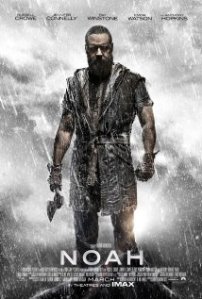
I’ll admit it, I’m a sucker for post-apocalyptic movies and books. The Mad Max series, The Book of Eli, The Omega Man, Twelve Monkeys, Waterworld – you name it. From pitiful entries like Zardoz to classics like the 1933 release of “Deluge” – whatever the reason hidden deep in my dark and twisted psyche, that genre has always intrigued me and still does. It’s been that way since I was a kid. But I never considered the Genesis account of Noah and flood as being in that category. Apparently, writer and movie director Darren Aronofsky does, as his much publicized cinematic spectacle “NOAH” makes abundantly clear. Upon reflection, I can see why.
Most reviewers I’ve read (pro or con) already make much of Aronofsky’s use of this platform for his unapologetic environmentalism. So be it. In his imaginative narrated preface beginning the film, he makes it clear that by the time we encounter Noah, humankind has so over-industrialized the earth that it is little more than a global strip-mining pit. Noah and his little family are eco-isolationists eking out a bare existence with so little plant life that Noah rebukes his young son for plucking even one flower merely for its beauty. Reprimanding the lad he exhorts that we can only take just what we can use – no more. Sermon ended. This makes the movie an odd post-human apocalypse / followed by a God-judgment apocalypse, post-apocalypse movie. OK, that hurts my head. But I must move on.
Two quick side notes:
1. No thinking Christian objects to our needing to be good stewards of planet earth as committed into humankind’s care. Though discussions rightfully range on what that ought to look at. I’ll leave the rest of that discussion for another time.
2. To be honest, the re-pairing of Russell Crowe as Noah with Jennifer Connelly as his wife made me keep wondering if we were going to find out that all of this was just a figment of John Nash’s “beautiful mind”. Alas, that would have made a more entertaining movie. But at least Crowe didn’t sing this time.
Back to more important stuff.
Despite both Aronofsky’s and Crowe’s public claims of fidelity to the Biblical text, other than a flood, a big boat and characters by the same names, the movie bears little in common with the Bible’s narrative. This is as one would expect from one who is a non-Believer in the “Christian” sense. Wikipedia notes: He said of his spiritual beliefs in 2014, “I think I definitely believe. My biggest expression of what I believe is in The Fountain“.”
To get at what it is that Aronofsky “believes”, I watched The Fountain before writing this review. “The Fountain” is an earlier Aronofsky production (written and directed by him) where a medical researcher struggling frantically to find a cure for his beloved wife’s fatal tumor, ultimately loses her to the disease but comes to realize she goes on living as part of the universe, even as he one day will and so no one really dies, they just transform. Hence Aronofsky’s version of “believing.” He believes in something bigger than life as we know it, and that it is all connected.
That said, I should in all fairness mention that I appreciated number of things in Noah.
I want to say that Aronofsky has obviously spent a lot of time thinking about the themes of sin, original sin, God’s judgment and redemption. True, he does not conceive of them in the Biblically defined categories so that the necessity of the incarnation and the Cross emerge and produce any truly salvific view – but I always appreciate people who interact with these realities in a thoughtful way. So many today tend to bury their heads in the sand and not wrestle with these ideas at all. His conclusions are not Biblically informed, but his questions are Biblically generated – and that is good.
I appreciated the attempt to get the Ark right in proportion and visually. It was probably the most “realistic” Ark I’ve seen. That was fun.
Most of all I appreciated the attempt to imagine the emotional and intellectual upheavals that must have attended Noah in some ways as he contemplated the magnitude and the reality of all that was comprehended under the idea of a global – humanity-destroying cataclysm. He certainly would not have been stoical and indifferent. Even though Aronofsky paints a dark and brooding Noah, he at least does not re-create him as the detached, Pollyanna super-saint of much Sunday School curricula. For Aronofsky, he is a Noah who acknowledges his own sinfulness (albeit sadly without understanding grace at all) and that he deserves judgment too. So he is spared in the flood not because he is good, but because he is a useful and obedient tool. In fact in the film, he assumes his own judgment in death (and that of his family – Japheth will be the last “man”) after he saves all the animals from destruction – so God can start creation over without us pesky humans. Comparatively, for many Sunday Schoolers, Noah is spared because he is relatively good compared to his violent and sinful neighbors. Both of these Noahs are inventions and devoid of seeing that Noah was spared because “he found grace in the eyes of the Lord.” Was he better (humanly speaking) than some of his peers? No doubt. Was he an obedient and useful servant? Yep. But are these one-dimensional portraits sufficient? No on both counts.
Who Noah isn’t in any way, shape or form in this film is “a herald of righteousness” (2 Pet. 2:5) for 120 years. Anything but. He is a grim, fatalistic man who agrees with God’s need to judge the world, and has no hope for himself or anyone else, no desire to see any saved, and proclaims nothing to his neighbors since he wants nothing to do with them anyway. He has self-righteously isolated himself from all others but his family to try and keep them un-contaminated from the rest of the sinners. Though one wonders why the isolation if he truly believes he is as much to be judged as they.
Aronofsky displays his view of salvation in spiritual terms, in the case of the fallen angels, which he equates with the Nephilim. Some Evangelical thinkers do the same, so that in and of itself I’m not commenting on (tho one really has to explain how the Nephilim reappear in Numbers 13 if in fact they were either embodied fallen angels or the offspring of the fallen angels co-habiting with human women and were supposed to have all died in the flood designed to wipe them out. I’ll leave that for other theologs to argue about.)
These fallen angels in Aronofsky’s account fell due to misguided nobility. They simply wanted to protect Adam from falling in the Garden, and since their intervention (no matter how well intended) was outside their purview, God sentenced them to be encased in rock. Hence they are sort of giant rock beings with a chip on their collective shoulder (no pun intended) against helping humans any more. A soft-hearted one however convinces the rest to help Noah build the Ark. When they defend Noah and the Ark from an attack led by Tubalcain (who in fact sneaks on later only to be killed by Ham in a fight with Noah) they are overrun by the masses and killed. One cries out “Creator, forgive me!” and is loosed from his rock prison by death, ostensibly returning to Heaven (remember Aronofsky’s theology from The Fountain?) Whereas the Bible clearly states that there is no redemption for the fallen angels and that: “God did not spare angels when they sinned, but cast them into hell and committed them to chains of gloomy darkness to be kept until the judgment” (See 2 Peter 2:4 and Jude 6).
Noah’s “salvation” is left for after the flood. Unable to kill his twin granddaughters on the Ark (see the movie, I won’t explain it here – it’s just all fabrication) Noah turns to drink to drown his sense of having failed God by letting more humans live. Since he was sure God’s plan was to end the human race after Noah’s last son died. More humans complicates the issue. However, he is told by his wife he really did do well, because in the end, he chose love. O.K. Salvation is choosing love. Got it.
So what do we say to all of this? Just two things really.
1. As is typical, don’t go to movies – even supposedly “faith-based” movies to get Biblical or theological truth. Go to the Bible for truth. If you want to know about God, you have to go to where He has revealed Himself – in the Bible, and most explicitly in the person and work of Jesus Christ. Believe me, the real God is far more spectacular than any God ANY film-maker can conjure up. To list all of the factual errors in the film would require more space than this review and then some. There’s no sense in pursuing it. Read your Bible. It’s better. Not only true, but truly more entertaining. The facts are more intriguing than Aronofsky’s fiction.
2. View films which purport to communicate Biblical accounts with a healthy dose of skepticism that let you enjoy the movie as entertainment, and nothing more. Don’t let the images overly inform you.
That said, I really didn’t enjoy Noah, and really wanted to. Like I said, that genre tickles me somewhere. But this one is just so dark and filled with so many poor and confusing concepts of God and how He deals with mankind that it became too off-putting for me.
If you see it, just see it for what it is – an imaginative, FICTIONAL re-telling of the Flood, with nothing of truth about it other than the reality of the cataclysm itself, and a bunch of people with the same names as those who were really there.
-
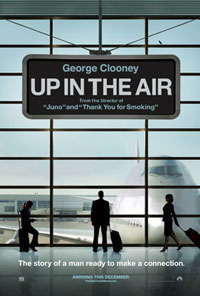 Up In The Air is the new smash “comedy” hit starring George Clooney and Vera Farmiga.
Peter Travers in the December 2K Rolling Stone wrote: “Up in the Air is a defining movie for these perilous times.”
That is about the most tragic statement about “these perilous times” I can imagine.
The message of the movie simply and grievously is:
Life is pointless. That being the case, you may as well not go through it alone.
That’s it.
A dreadful trek into 21st century version of existential despair.
Waste neither your time nor your money on it.
’nuff said.


 ResponsiveReiding