 “The object of preaching is the salvation of the soul; and that salvation consists in a redemption from the guilt, love, and practice of iniquity. The instrument of this redemption is God’s truth, as he has revealed it. “Sanctify them through thy truth.” The preacher is most explicitly called a herald; that is, the deliverer of a message. Now, the herald does not make his message, he merely transmits it. He has nothing to do with judging its wisdom or fitness; let him simply proclaim it as it is given to him. This was God’s command to an ancient preacher: “Arise, go unto Nineveh, that great city, and preach unto it the preaching that I bid thee.” (Jonah 3:2.)”
Category: Uncategorized
-
-
1 Peter Part 15
Armed and Ready
1 Peter 4:1–6

AUDIO FOR THIS SERMON CAN BE FOUND HERE
In the 3 chapters that have come before, Peter has laid out a number of foundational truths for his suffering readers.
Let’s review a number of them quickly, and then we will go on to the text before us today, and tease out a number of tools – or as I will call them – WEAPONS that Christ has provided for us in what is a true BATTLE for Christians living in this World.
- Reckoning with their/our Dual status as Elect, and yet Exiles. And that these are not mutually exclusive categories. 1 Peter 1:1–2 Peter, an apostle of Jesus Christ, To those who are elect exiles of the Dispersion in Pontus, Galatia, Cappadocia, Asia, and Bithynia, 2 according to the foreknowledge of God the Father, in the sanctification of the Spirit, for obedience to Jesus Christ and for sprinkling with his blood: May grace and peace be multiplied to you.
For Peter’s first readers – these dislocated and marginalized Believers in a very hostile environment – being mindful that their situation is not only not CONTRARY to God’s working – but PART of God’s working His good will and pleasure in them is of vital importance.
It is for every Believer in every age. Contrary and difficult circumstances are not hindrances to our Spiritual growth, but in fact essential to it!
- Remembering the “Blessed Hope” that awaits the Believer irrespective of current circumstances. 1 Peter 1:15–16 but as he who called you is holy, you also be holy in all your conduct, 16 since it is written, “You shall be holy, for I am holy.”
- To not stop Practicing their Priesthood, and living lives that accord with that call: 1 Peter 2:9–10 But you are a chosen race, a royal priesthood, a holy nation, a people for his own possession, that you may proclaim the excellencies of him who called you out of darkness into his marvelous light. 10 Once you were not a people, but now you are God’s people; once you had not received mercy, but now you have received mercy.
- Seeing every relationship through the lens of redemption and manifesting Christ’s Spirit in the world. 1 Peter 2:13–15 Be subject for the Lord’s sake to every human institution, whether it be to the emperor as supreme, 14 or to governors as sent by him to punish those who do evil and to praise those who do good. 15 For this is the will of God, that by doing good you should put to silence the ignorance of foolish people.
- Responding to persecution and marginalization in the Spirit of Christ as our “calling”: 1 Peter 3:9 Do not repay evil for evil or reviling for reviling, but on the contrary, bless, for to this you were called, that you may obtain a blessing.
These things said, Peter knows still that ever since the Fall in Gen. 3 – mankind has been plagued with an inward sin principle that wants to live contrary to the way of life just described in the preceding 3 chapters.
The Believer is a “new creation” as Paul says in 2 Cor. 5:17 – but we are not yet all that we are destined to be.
Peter is thinking the same way his fellow Apostle John does: 1 John 3:2–3 Beloved, we are God’s children now, and what we will be has not yet appeared; but we know that when he appears we shall be like him, because we shall see him as he is. 3 And everyone who thus hopes in him purifies himself as he is pure.
We are in what theologian George Eldon Ladd labeled: “The already, but not yet” state.
Or to use Paul’s words in Philippians: 1:6 And I am sure of this, that he who began a good work in you will bring it to completion at the day of Jesus Christ.
The work has been begun in us, but it is not yet completed. And that work as Romans 8:29 states it is: “For those whom he foreknew he also predestined to be conformed to the image of his Son, in order that he might be the firstborn among many brothers.”
If you are born again today, this is what God is about in you.
He is both calling you, and ordering the circumstances of your life around this work of conforming you to the image of the character of Jesus Christ. Till that is what you are like too – in all His perfections.
In the meantime however, you are at war – at war with the remainder of the sin within you that resists that conformity. That still wants to rebel and to be your own god – living for your own plans and purposes irrespective of God’s.
The Biblical writers all agree in this: This condition leaves us at war with our own sinfulness. This, in place of the once losing war we were at with God – over who has the right of supremacy over our lives.
But Christ has purchased you out of this bondage, to walk in the freedom of those who belong to His Kingdom. And as citizens of His Kingdom, we find there is still a warfare to be waged.
This warfare is part of the absolute substance of the true Christian life. J. C. Ryle writes: There is a vast quantity of religion current in the world which is not true, genuine Christianity. It passes muster; it satisfies sleepy consciences; but it is not good money. It is not the real thing which was called Christianity eighteen hundred years ago. There are thousands of men and women who go to churches and chapels every Sunday, and call themselves Christians. Their names are in the baptismal register. They are reckoned Christians while they live. They are married with a Christian marriage-service. They mean to be buried as Christians when they die. But you never see any “fight” about their religion! Of spiritual strife, and exertion, and conflict, and self-denial, and watching, and warring, they know literally nothing at all. Such Christianity may satisfy man, and those who say anything against it may be thought very hard and uncharitable; but it certainly is not the Christianity of the Bible. It is not the religion which the Lord Jesus founded, and His Apostles preached. It is not the religion which produces real holiness. True Christianity is “a fight.”[1]
Let us consider well these propositions. Let us take care that our own personal religion is real, genuine, and true. The saddest symptom about many so-called Christians, is the utter absence of anything like conflict and fight in their Christianity. They eat, they drink, they dress, they work, they amuse themselves, they get money, they spend money, they go through a scanty round of formal religious services once or twice every week. But of the great spiritual warfare,—its watchings and strugglings, its agonies and anxieties, its battles and contests,—of all this they appear to know nothing at all. Let us take care that this case is not our own. The worst state of soul is “when the strong man armed keepeth the house, and his goods are at peace,”—when he leads men and women “captive at his will,” and they make no resistance. The worst chains are those which are neither felt nor seen by the prisoner. (Luke 11:21; 2 Tim. 2:26.)[2]
It is this “fight” language that finds its way into the first vs. of the 4th chapter and that helps frame what Peter is after here.
But before we look at that, we need to be aware of a danger here to look out for. For if you are going to fight ANY war, you have to define the enemy you are fighting with precision.
Christians may be easily diverted to the wrong fight!
Exam. 1 – We may be at war with the culture, and try to make it and those in it, into something we prefer.
Exam. 2 – We might be diverted to the political war raging so violently in our own society today. Confusing that for this spiritual battle.
Exam. 3 – We may wage war against other people’s sins rather than our own.
Exam. 4 – We might be fighting the losing war of trying to exterminate sin from our souls altogether, which is a false war since sin doesn’t die – instead, we learn to die TO it – To its inward urgings, bents and compulsions. Rom. 6 makes this abundantly clear.
Exam. 5 – And we might be engaged in the imaginary war of ease or comfort. Thinking the battle ground is to somehow avoid any pain, dis-ease or discomfort in life – because the “victorious” Christian life (we falsely believe) is one where everything goes our way, and nothing too bad ever troubles us.
Exam. 6 – Prosecuting a war against Science as though true Biblical faith and science are mutually exclusive.
What IS the actual war then, and HOW do we fight it?
The actual war is one against living with the same values and desires as the culture and society around us, against a life lived for “self” and against inward desires incompatible with the character of Christ Jesus having full sway within us.
Fighting THIS battle, will make us truly stand out in contrast to the culture around us.
And it takes a highly specialized approach. For it is an inward battle.
One which this opening portion of the 4th chapter Peter lays before us in wonderfully clear terms.
1st Weapon: Christ our Example and Encouragement. 1 Peter 4:1a-b / Since therefore Christ suffered in the flesh, arm yourselves with the same way of thinking,
Think as Christ did – that suffering in the Christian is to be expected and not treated as aberrant.
2nd Weapon: Keeping our eye on the immediate goal. 1 Peter 4:1c- 4:2
/ for whoever has suffered in the flesh has ceased from sin, 2 so as to live for the rest of the time in the flesh no longer for human passions but for the will of God.
Flesh = “sarki” not “soma” (body) i.e. in this earthly or present life.
When we deny ourselves sinful attitudes and actions – it is a painful exercise. Face it. And learn that the more uncomfortable I am willing to be by not indulging sinful desires, the more I cease from sinning period. These are in direct proportion to one another.
3rd Weapon: Re-exploring the bankruptcy of sin. 1 Peter 4:3 / For the time that is past suffices for doing what the Gentiles want to do, living in sensuality, passions, drunkenness, orgies, drinking parties, and lawless idolatry.
Haven’t you had enough of sin already?
Do you really want to go back to the guilt?
Back to the seaminess?
Back to the bondage?
4th Weapon: Expecting to be misunderstood and maligned. 1 Peter 4:4 With respect to this they are surprised when you do not join them in the same flood of debauchery, and they malign you;
Karen Jobes writes: Pagans of the first century viewed Christians as killjoys who lived gloomy lives devoid of pleasure. The pleasures from which Christians of the first century typically abstained were the popular forms of Roman entertainment: the theater with its risqué performances, the chariot races, and the gladiatorial fights with their blood and gore. Christian lifestyle also condemned the “pleasures” of an indulgent temper, sex outside marriage, drinking, slander, lying, covetousness, and theft. These attitudes toward contemporary Roman customs and morals, combined with the Christians’ refusal to burn incense to the emperor—a gesture of civic gratitude intended to assure the well-being of the empire—earned Christians the reputation of being haters of humanity and traitors to the Roman way of life.[3]
Paul Achtemeier in his commentary adds: “It is a problem that will recur whenever Christians are forced by their faith to oppose cultural values widely held in the secular world within which they live.”[4]
5th Weapon: Remembering the end of those outside of Christ. 1 Peter 4:5 but they will give account to him who is ready to judge the living and the dead.
6th Weapon: The Promise of Everlasting Life. 1 Peter 4:6 For this is why the gospel was preached even to those who are dead, that though judged in the flesh the way people are, they might live in the spirit the way God does.
It is in using these powerful weapons at our disposal, that we begin to live the Christian life in earnest.
And I must be clear here, those who are not fighting in such a way, so as to bring the mind into conformity with Christ’s plans and purposes and means – are either living deluded, defeated lives as Christ counts life – or are still not born again, and are living with the delusion of salvation altogether.
So the great question before us today is: Is this MY life?
Am I in this battle, and fighting it God’s way?
Or am I living woefully below the Gospel?
And perhaps not a Christian at all?
If you are a Christian and not living on the front lines of this battle – Hear His call to you today to wake up, and take up arms and begin at once. There is no time to lose.
And if you find in fact that you are not a Christian today – which is why you are not fighting this battle – Hear His call to run to Christ for the forgiveness of sins and reconciliation to the Father!
There is a Heaven to be gained and a Hell to be shunned. There is a real battle. And none but those on the side of Christ and His Kingdom will be spared.
[1] Ryle, J. C. 1889. Holiness: Its Nature, Hindrances, Difficulties and Roots. London: William Hunt and Company.
[2] Ryle, J. C. 1889. Holiness: Its Nature, Hindrances, Difficulties and Roots. London: William Hunt and Company.
[3] Jobes, Karen H. 2005. 1 Peter. (Baker Exegetical Commentary on the New Testament). Grand Rapids, MI: Baker Academic.
[4] Jobes, Karen H. 2005. 1 Peter. (Baker Exegetical Commentary on the New Testament). Grand Rapids, MI: Baker Academic.
-
Psal. 73:25. “Whom have I in heaven but thee?” If it could be supposed (saith one) that God should withdraw from the saints in heaven, and say, Take heaven, and divide it among you; but as for me, I will withdraw from you; the saints would fall a weeping in heaven, and say, Lord, take heaven, and give it to whom thou wilt; it is no heaven to us, except thou be there: Heaven would be very Bochim to the saints without God. In this, our glory in heaven consists, to be ever with the Lord, 1 Thess. 4:17. God himself is the chief part of a saint’s inheritance; in which sense, as some will understand, Rom. 8:1. they are called heirs of God. -

The balance (scales) of Justice is seen outside France’s national assembly in Paris October 16, 2008. REUTERS/Charles Platiau (FRANCE) – RTX9MO1 2 Corinthians 4:17–18 (ESV) For this light momentary affliction is preparing for us an eternal weight of glory beyond all comparison, 18 as we look not to the things that are seen but to the things that are unseen. For the things that are seen are transient, but the things that are unseen are eternal.
It is a reality, that those who have suffered, are often best equipped to others who are suffering. Especially if their sufferings are somewhat similar.
However, we also know that a doctor need not have suffered from the identical illnesses or conditions we might have, in order to effectively alleviate our suffering. Not every surgeon has had that same surgery we face. That does not disqualify him or her from operating upon us with the best of success. One need not have been poor, to know how to help someone whose finances are in disarray, nor must a doctor have had a baby in order to deliver one.
Nevertheless, there are times when someone’s experience with our particular suffering can be of particular use.
I once knew a pastor who was truly gifted in preaching and teaching God’s Word, and was a truly good and godly man. However, he had hardly ever been ill in his life – and until stricken with an unusual infection, lacked a bit in compassion toward others in their illnesses. He had always been sympathetic, but through his experience become empathetic. But in truth, the spiritual comfort he gave still issued from the very same source – the Word of God under the ministration of the Holy Spirit.
Now it is also true that sometimes, we Believers can be guilty of tossing a passage like the one above at some suffering saint, in a most careless and matter of fact manner. We can try to remind them that that their affliction is but “momentary”, and thus “light.” But if we forget that the Apostle’s point here is that our afflictions are “light” and “momentary” in COMPARISON, to the eternal weight of glory about to be ours – if that contrast is lost, the words can be felt more like an insult if not a downright denial that we are truly suffering at all.
So my first point is that we need to maintain the context here, and use such portions of God’s Word as they were given, if they are to offer the maximum benefit. To use them in such a way that they are not dismissive of the very real and present pain one might be enduring. And then to help them, gently, to try and weigh the present distresses, against the coming glories.
That said, it might also be well for us to remember – and this is my second point, that the one who penned the above passage also penned this: 2 Corinthians 11:23–33 (ESV) Are they servants of Christ? I am a better one—I am talking like a madman—with far greater labors, far more imprisonments, with countless beatings, and often near death. 24 Five times I received at the hands of the Jews the forty lashes less one. 25 Three times I was beaten with rods. Once I was stoned. Three times I was shipwrecked; a night and a day I was adrift at sea; 26 on frequent journeys, in danger from rivers, danger from robbers, danger from my own people, danger from Gentiles, danger in the city, danger in the wilderness, danger at sea, danger from false brothers; 27 in toil and hardship, through many a sleepless night, in hunger and thirst, often without food, in cold and exposure. 28 And, apart from other things, there is the daily pressure on me of my anxiety for all the churches. 29 Who is weak, and I am not weak? Who is made to fall, and I am not indignant? 30 If I must boast, I will boast of the things that show my weakness. 31 The God and Father of the Lord Jesus, he who is blessed forever, knows that I am not lying. 32 At Damascus, the governor under King Aretas was guarding the city of Damascus in order to seize me, 33 but I was let down in a basket through a window in the wall and escaped his hands.
In other words, the one who wrote the first passage, knew suffering well. In a variety of ways few of us will ever experience. And at that, he knows well the sufferings of His Savior Jesus. And this man, so well acquainted with such suffering, is the one who gently brings us back to weigh our present sufferings in the light of the coming, eternal glories. Not as a disinterested promulgator of religious platitudes, but as a fellow sufferer – and one who shares this comfort with us – because it is the comfort he himself has taken advantage of so liberally.
Minister the Word to one another beloved – with tenderness and mercy, and in a balance that soothes the wounds rather than exacerbating them. This is the Spirit of Christ.
-
1 Peter Part 14c
1 Peter 3:13-22
Baptism Saves You?

AUDIO FOR THIS SERMON CAN BE FOUND HERE
Last time we were together, we really had to put our thinking caps on to sort out the difficult ideas in vss. 18-19 / 1 Peter 3:18–19 “For Christ also suffered once for sins, the righteous for the unrighteous, that he might bring us to God, being put to death in the flesh but made alive in the spirit, 19 in which he went and proclaimed to the spirits in prison,”
You will remember the idea here appears to be that The Spirit that raised Jesus from the Dead – the Holy Spirit, was at work even back in Noah’s day. That we could say Jesus was preaching through Noah to those who were about to enter the Flood, and that even though the results were very little – only 8 souls were saved – it was still God at work and WE can take great comfort in our day when the Gospel seems to have little impact.
Peter has been making this point over and over; that HOW we respond to persecution and marginalization by the culture – is once again a means of preaching the Gospel by the power of the Spirit – and that we ought not to lose heart even when we don’t see lots of results. God is still at work!
And in making that argument, Peter is going to enlarge our understanding of how the Gospel works in one of the most graphic similes in the Bible. It is a powerful and useful picture.
And by virtue of how Peter places this before us, I want to speak especially to you here today who have not yet come to the saving knowledge of Jesus Christ. For this is a Gospel saturated passage and one the I pray will open the eyes of any here who might still be lost in the face of Christ’s coming judgment upon mankind for sin.
The text: 1 Peter 3:18–22 “For Christ also suffered once for sins, the righteous for the unrighteous, that he might bring us to God, being put to death in the flesh but made alive in the spirit, 19 in which he went and proclaimed to the spirits in prison, 20 because they formerly did not obey, when God’s patience waited in the days of Noah, while the ark was being prepared, in which a few, that is, eight persons, were brought safely through water. 21 Baptism, which corresponds to this, now saves you, not as a removal of dirt from the body but as an appeal to God for a good conscience, through the resurrection of Jesus Christ, 22 who has gone into heaven and is at the right hand of God, with angels, authorities, and powers having been subjected to him.”
Once again we have to be careful in not letting a difficult verse become the basis for a doctrine all on its own. Sadly, this verse has been used by many to claim that water baptism is necessary in order for someone to be saved. Or, that baptism itself – somehow saves.
However, a careful reading of the text, and seeing what point Peter is making and how he makes it, clearly rules out the idea that this is what the passage is teaching.
6 Observations:
- 1. (19-20) In the Spirit, Christ preached to those who refused the message, and remained disobedient to it “when God’s patience waited in the days of Noah.”
- 2. (20) As a result of this only “a few, that is, eight persons, were brought safely through water.”
- (21) Baptism, “corresponds to this”. Corresponds to what?
What is the THIS, that baptism corresponds to?
“THIS”, is the scenario Peter just outlined from the Genesis flood account.
Somehow – Water Baptism corresponds to the key factors that were at play in Noah’s day – while God waited 120 years to send the flood, and while Noah preached (righteousness – 2 Pet. 2:5) and built the Ark.
We can easily tease out 4 key facts in that scenario:
- To a message of judgment preached
- That message being believed,
- Responding appropriately – Noah responded and built the Ark
- Being spared from the judgment
Hebrews 11:7 (ESV) “By faith Noah, being warned by God concerning events as yet unseen, in reverent fear constructed an ark for the saving of his household. By this he condemned the world and became an heir of the righteousness that comes by faith.”
- Baptism isn’t about “a removal of dirt from the body” it is NOT a physical thing – but about having “a good conscience” – having heard the Gospel and responding in faith – faith which acts by putting trust in the message.
- “Through the resurrection of Jesus Christ” – As Rom. 4:25 notes, Jesus was “raised for our justification”
This is how we arrive at a good conscience before God – because Jesus was raised up from the dead, proving our sin was atoned for and that we can have a conscience devoid of condemnation over past sin.
More – He has endured the judgment, and risen again, and if we are IN HIM, we are saved.
So the simile Peter uses plays out to its fullest: Jesus is the “Ark” of our salvation.
- In being resurrected, He ascended into Heaven with ALL THINGS in the universe having been “subjected to Him”.
All of this then is a most wonderful picture of how salvation works – AND, of a dreadfully missing component in the Gospel message so often neglected in our day – JUDGMENT.
Romans 2:12–16 (ESV) For all who have sinned without the law will also perish without the law, and all who have sinned under the law will be judged by the law. 13 For it is not the hearers of the law who are righteous before God, but the doers of the law who will be justified. 14 For when Gentiles, who do not have the law, by nature do what the law requires, they are a law to themselves, even though they do not have the law. 15 They show that the work of the law is written on their hearts, while their conscience also bears witness, and their conflicting thoughts accuse or even excuse them 16 on that day when, according to my gospel, God judges the secrets of men by Christ Jesus.
This aspect of being delivered from God’s just wrath is absolutely central to the Gospel presentations in the NT. And it is often neglected, if not completely absent from much of modern preaching of the Gospel. We try to declare good news (Gospel) without any BAD NEWS! Guilt and sin and shame.
Acts 17:29–31 (ESV) Being then God’s offspring, we ought not to think that the divine being is like gold or silver or stone, an image formed by the art and imagination of man. 30 The times of ignorance God overlooked, but now he commands all people everywhere to repent, 31 because he has fixed a day on which he will judge the world in righteousness by a man whom he has appointed; and of this he has given assurance to all by raising him from the dead.”
Just as the Spirit of Christ preached that same coming judgment and God’s means of salvation through His preacher in the days of Noah
Just as that message, both of judgment and salvation has been preached by the Spirit of Christ in every generation after
And just as Paul preached that coming judgment in his day, as we have it in this text
So it is we today must declare to the world that this judgment of God is yet to come upon all mankind.
2 Corinthians 5:10 (ESV) For we must all appear before the judgment seat of Christ, so that each one may receive what is due for what he has done in the body, whether good or evil.
Matthew 12:36 (ESV) I tell you, on the day of judgment people will give account for every careless word they speak,
Hebrews 4:12–13 (ESV) For the word of God is living and active, sharper than any two-edged sword, piercing to the division of soul and of spirit, of joints and of marrow, and discerning the thoughts and intentions of the heart. 13 And no creature is hidden from his sight, but all are naked and exposed to the eyes of him to whom we must give account.
You see, this is the great dilemma of all mankind – this is what makes the Cross of Jesus necessary, and rational: “For ALL have sinned…”Romans 3:21–25 (ESV) But now the righteousness of God has been manifested apart from the law, although the Law and the Prophets bear witness to it— 22 the righteousness of God through faith in Jesus Christ for all who believe. For there is no distinction: 23 for all have sinned and fall short of the glory of God, 24 and are justified by his grace as a gift, through the redemption that is in Christ Jesus, 25 whom God put forward as a propitiation by his blood, to be received by faith. This was to show God’s righteousness, because in his divine forbearance he had passed over former sins.
What is our great sin? We fall short of the glory of God in it.
We were created to reflect Him and all His perfections
We were made “in His image”
And we must ask – Is God in all of His divine glory and perfections seen in me without flaw?
For that is the purpose for which we were created and the lofty place from which we’ve fallen.
Is my every action one that displays His holiness?
Is my every word one which declares His holiness in perfection?
Is my every thought in perfect submission to His plan and purposes?
Is the foremost love in my heart love of Him and His glory?
Do I serve Him consciously and joyfully and perfectly more than myself?
If not – Then how can I hope to be spared His wrath?
How can I possibly be reconciled to Him since I have spurned His love and lived for myself and for my own desires and have become so separated from Him in every way?
Hear the message – there is judgment coming – yes!
But there is also salvation to be had in His Ark – in faith in Jesus Christ!
I must believe that He has made a way and that way is to trust His Son as my sin bearer on Calvary – that He endured MY judgment there. That I deserved what He took.
And putting my faith in Christ and Christ alone – I now follow Him.
So it is in Baptism, I declare that Jesus was crucified in my place, rose up from the dead and ascended in Heaven above all powers and authorities.
He went THROUGH the judgment safely, and if I am IN HIM, so will I!
And my conscience is cleared by His having satisfied my debt to the Father – I am now reconciled to The Father through The Son, and with all who believe.
This is what Baptism signifies.
And though comparatively few are saved in this way – that in no way diminishes that this salvation is real and magnificent and full of mercy and grace that is unfathomable.
(21) Baptism, “corresponds to this”. Corresponds to what?
- To a message of judgment preached – Have I heard?
- That message being believed, – Have I believed?
- Responding appropriately – Have I responded by putting my faith in God’s “Ark” in Christ Jesus and His death, burial and resurrection?
- If so, then I will be spared from the judgment
Hebrews 11:7 (ESV) “By faith Noah, being warned by God concerning events as yet unseen, in reverent fear constructed an ark for the saving of his household. By this he condemned the world and became an heir of the righteousness that comes by faith.”
So, as our key text tells us:

Baptism which corresponds to this – To Noah having heard the Word of God and being saved from God’s wrath by believing and acting up it –
now saves you
Not through the removal of dirt from the body – NOT THROUGH THE PHYSICAL ACT OF BAPTISM
But an appeal to God for a good conscience – Having heard, believed and acted upon the message ourselves
Through the resurrection of Jesus Christ – by testifying to our faith in Jesus who has undergone God’s wrath against sin, so that if we are IN HIM – we might remain safe.
-

In this election year, one cannot read or hear anything about the Presidential hopefuls and their constituents without hearing about the “evangelical” voting block.
Some candidates want to take the label to themselves, in order to identify with this block, and others want to eschew it. It a matter of both guilt by, and vindication by – association.
But if you were ask most people what an Evangelical actually is, my guess is – it would run the gambit from fanatic and bigot, to anyone who is simply not Roman Catholic, Jewish, Muslim, or the member of any other recognized or organized religion.
But the term Evangelical once was both very powerful, and well defined. Powerful most likely, BECAUSE it was well defined. However, in all cultures, words and terms come to be redefined through usage, misusage, and sometimes even deliberate recasting.
So Michael Jackson could sing “I’m Bad, I’m Bad” meaning hot, or cool, or awesome. It’s hard to tell which (or maybe all) since as each of those descriptive words also suffer from cultural morphology.
We as a local, independent Church, call ourselves “Evangelical.” The Evangelical Church of Fairport. The question is – what do WE mean by that? And the second necessary question is – what do other people think when they hear that name?
The term Evangelical has a rich historical heritage. And we consciously take the label upon ourselves. Tho I do begin to wonder if it fails to communicate much of anything positive to those who have no clue as to its meaning, beyond its amorphous cultural distortions.
So what IS an Evangelical? Or maybe better, what ought to define one as an Evangelical? We need to poke around in Church history to get a clear view.
In our search for the earliest mention of someone being referred to as “evangelical”, the honor seems to rest withJohn Wycliffe (1320-1384), often described as the “Morningstar of the Reformation”, and also – doctor evangelicus.

The term gained popularity early in the Lutheran side of the Reformation and spread from therewith the awakening of the Gospel across Europe.
Those men wanting to be identified with the recovery of the gospel in terms of its central doctrine of justification by faith called themselves evangelici viri – evangelical men.

Luther liked and used the expression in German as die Evangelischen.
The direct connection in each case was the idea of the gospel – the “evangel”, or “good news.”
“Evangelical continued to gain popularity, and achieved its widespread use during the 18th century in the revival movement associated with Wesley and Whitefield. (See: John Stott’s excellent little book – Evangelical Truth).
The preamble to the Cambridge Declaration, a modern evangelical statement reads: “In the course of history words change. In our day this has happened to the word “evangelical.” In the past it served as a bond of unity between Christians from a wide diversity of church traditions. Historic evangelicalism was confessional. It embraced the essential truths of Christianity as those were defined by the great ecumenical councils of the church. In addition, evangelicals also shared a common heritage in the “solas” of the sixteenth century Protestant Reformation.”
In John R. W. Stott’s “Evangelical Truth, A Plea for Unity, Integrity and Faithfulness”, he cites J. I. Packer’s “anatomy of evangelicalism” (from his monograph – “The Evangelical Anglican Identity Problem” – 1978″ where he he lays out the foundation in four general claims, and six particular convictions.
The four general claims of historic evangelicalism are:
- Evangelicalism is PRACTICAL Christianity. A lifestyle of total discipleship to the Lord Christ.
- It is PURE Christianity. Since you cannot add to the Christian faith without in the end subtracting from it.
- It is UNITIVE Christianity. Seeking unity through a common commitment to gospel truth.
- It is RATIONAL Christianity. Over and against the popular preoccupation with mere experience.The six fundamentals would be as follows:1. The supremacy of the Holy Scripture (Because of its unique inspiration)
- The Majesty of Jesus Christ (the God-man who died as a sacrifice for sin)
- The Lordship of the Holy Spirit (who exercises a variety of vital ministries)
- The necessity of conversion (a direct encounter with God effected by God alone – being born again)
- The priority of evangelism (Witness being an expression of worship)
- The importance of fellowship (the Church being essentially a living community of believers)To go back to elucidate the 5 great solas of the Reformation which form the substrata of all true evangelicalism – these are: (I’ll quote the affirmations from the Cambridge Declaration)Thesis One: Sola Scriptura / We reaffirm the inerrant Scripture to be the sole source of written divine revelation,which alone can bind the conscience. The Bible alone teaches all that is necessary for our salvation from sin and is the standard by which all Christian behavior must be measured.We deny that any creed, council or individual may bind a Christian’s conscience, that the Holy Spirit speaks independently of or contrary to what is set forth in the Bible, or that personal spiritual experience can ever be a vehicle of revelation.Thesis Two: Solus Christus / We reaffirm that our salvation is accomplished by the mediatorial work of the historical Christ alone. His sinless life and substitutionary atonement alone are sufficient for our justification and reconciliation to the Father.We deny that the gospel is preached if Christ’s substitutionary work is not declared and faith in Christ and his work is not solicited.Thesis Three: Sola Gratia / We reaffirm that in salvation we are rescued from God’s wrath by his grace alone. It is the supernatural work of the Holy Spirit that brings us to Christ by releasing us from our bondage to sin and raising us from spiritual death to spiritual life.
We deny that salvation is in any sense a human work. Human methods, techniques or strategies by themselves cannot accomplish this transformation. Faith is not produced by our unregenerated human nature.
Thesis Four: Sola Fide / We reaffirm that justification is by grace alone through faith alone because of Christ alone. In justification Christ’s righteousness is imputed to us as the only possible satisfaction of God’s perfect justice.
We deny that justification rests on any merit to be found in us, or upon the grounds of an infusion of Christ’s righteousness in us, or that an institution claiming to be a church that denies or condemns sola fide can be recognized as a legitimate church.
Thesis Five: Soli Deo Gloria / We reaffirm that because salvation is of God and has been accomplished by God, it is for God’s glory and that we must glorify him always. We must live our entire lives before the face of God, under the authority of God and for his glory alone.
We deny that we can properly glorify God if our worship is confused with entertainment, if we neglect either Law or Gospel in our preaching, or if self-improvement, self-esteem or self-fulfillment are allowed to become alternatives to the gospel.
So it is on these foundation that we continue to call ourselves The Evangelical Church of Fairport
That’s it in a nutshell. Though a whole lot could be cited to differentiate historical evangelicals from fundamentalists and fundamentalism – but that will have to wait for another day.
Let me also recommend D. Martin Lloyd-Jones’ superb little treatment titled: “What is an Evangelical.”
Evangelicalism has deep historical roots and a fairly definitive theological framework.
Historically, these foundational truths are the things that make for being an Evangelical.
But to be an Evangelical in the historical sense, includes the idea that one must also be a Christian. So we need to ask that question as well – What is a Christian?
I believe, if we take the Biblical categories responsibly, we come to see that there a number of things – which no doubt are almost (if not entirely) missing from modern conceptions of what a Christian is. From that Biblical standpoint we can at least say the following:
A Christian is one who believes God exists, and that He created all things.
A Christian is one who believes what God has said is true and orders their lives accordingly.
That God created humanity in His image.
That through rebellion as a race we sinned against God and are lost.
That the world is the way it is because of these things.
A Christian is one who has come to see the reality of their personal guilt and ruin before God, and their need of a Savior.
A Christian is one who has believed that Jesus Christ is the God/man, and that He died on the Cross historically to bear the just punishment for sin due to fallen mankind.
A Christian is one who has personally trusted in Christ’s death at Calvary as their substitute, and God’s only means to be reconciled to Him – through faith in that death.
A Christian is one who is now living their lives in loving gratitude and service to Jesus Christ as their Lord, proclaiming the grace and mercy that saved them, to others.
A Christian is one who is ever moving toward Heaven as their final home and their highest joy in being with God and Christ Jesus eternally.
If these ideas hold true – then when I hear that Evangelicals are supporting some candidates with rabid fervor – I have to ask, by what definition are they indeed – Evangelicals?
Something to ponder.
-

1 Peter Part 14b
The Fellowship of His Suffering
1 Peter 3:13-22
AUDIO FOR THIS SERMON CAN BE FOUND HERE
Before we even get into the text in detail this morning, it might be good to acknowledge the 800# gorilla in the room.
What I mean by that, is that we need to think just a bit about the unique statements Peter makes in vss. 19-20:
1 Peter 3:18–20 “For Christ also suffered once for sins, the righteous for the unrighteous, that he might bring us to God, being put to death in the flesh but made alive in the spirit, 19 in which he went and proclaimed to the spirits in prison, 20 because they formerly did not obey, when God’s patience waited in the days of Noah, while the ark was being prepared, in which a few, that is, eight persons, were brought safely through water.”
What in the world is going on here?
Some of you will remember our series in the book of Daniel.
In that series, we talked about dealing with certain portions of Scripture which are difficult to understand – in that case, Biblical Prophecy. What needs untangled.
And you will recall that we set out a little grid for dealing with difficult passages.
We consider obscure passages in 3 ways. We major on:
1. What is CERTAIN in the passage.
We treat carefully –
2. What may be REASONABLE to infer.
And for the most part, we avoid camping on –
3. What is SPECULATIVE.
We noted then, as we need to do with today’s passage, to be sure we major on what is CERTAIN above all else.
There may be some reasonable inferences we can draw, but we do not base any doctrine upon them.
And, there may be ideas which we might speculate upon, but once again, we do not want to base our conclusions on those ideas – but focus upon what is certain.
Why do I bring that up here?
Because, as one commentary I consulted on vss. 18-20 noted: There are no less than 18 major interpretations of what precisely is meant here. (Holman Bible Commentary)
So we have a real need to tread lightly.
It is obvious we cannot treat all 18 of those possible interpretations today, but let me lay out the 4 most prominent, and why I personally hold to one particular view – while leaving the door slightly open to one other.
At the same time, let me add that should you disagree with me in some of the particulars in the precise interpretation here, I’ll not wrestle you to the mat over it, as long as we all confine ourselves to keeping the CERTAIN points in view.
So difficult are these several verses that Martin Luther wrote, “A wonderful text is this, and a more obscure passage perhaps than any other in the New Testament, so that I do not know for a certainty just what Peter means.”[1]
Tom Schreiner – James Buchanan Harrison Professor of New Testament Interpretation and Professor of Biblical Theology (1997); Associate Dean of the School of Theology @ SBTS in Louisville KY helps us greatly here summarizing top 4 interpretations.
This passage is speaking of:
VIEW 1: Christ’s Spirit preaching through Noah in days before the Flood.
VIEW 2: Jesus, after death and before resurrection, preaching to the OT saints in Hades, and leading them to Heaven.
VIEW 3: Jesus, after death and before resurrection, preaching to those who perished in Noah’s Flood, offering them a 2nd chance.
VIEW 4: Jesus’ proclamation of His victory over the evil angels who co-habited with human women precipitating the Flood, and who are imprisoned forever in Hell. Maybe before resurrection, or after.
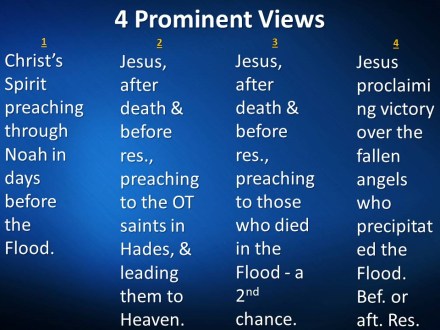
I must acknowledge here that the 4th seems to be most common today among conservative scholars.
The truth is, there are problems with each of the views here – mine included. Either on grammatical grounds, or a mixture of grammar, or in comparison with the rest of Scripture, and in the immediate context.
View #2 Seems to be ruled out because it is based on a view of Hades as a double compartmented abode of the dead, the righteous on one side and the wicked on the other.
But a careful study of how the words Hades and Hell are used in the OT demonstrate that this dual compartmented view comes from Pagan thought and not Bible teaching and fails at the outset.
View #3 Seems ruled out due to unambiguous Scripture statements such as: Hebrews 9:27 And just as it is appointed for man to die once, and after that comes judgment, The idea of a 2nd chance at salvation after death is not only not taught in the balance of Scripture, it is flat out denied.
View #4 In my estimation fails on 4 main fronts – tho as I said, it is the most common view today. While it offers the most in-depth grammatical solutions to the passage:
a. I believe it fails to follow Peter’s logic as carefully as it should leading up to this point.
b. It relies heavily on the extra-Biblical book of Enoch – which in my opinion falls into the category of Jewish myth.
c. It relies on a view of angelology which I believe Scripture does not support.
d. It presupposes Peter’s readers would have a working knowledge of this extra-Biblical material to draw from, take to be truth, and know how to apply it even though it is only mentioned in passing.
I think that stretches credibility a bit farther than I can go.
If you would like to discuss that in more detail, in a way I simply cannot this morning – then perhaps we can arrange a Wednesday night to do so.
In short – regarding this 4th view, we have no Biblical data supporting the idea that angels even CAN co-habit with human humans. At that, the Bible says they neither marry nor are given in marriage (Luke 20:35), and do not appear to be a race which propagates itself, but each are individual creations.
The idea that the offspring of such unions were the “Nephelim” of Gen. 6:4, seems disproved by the fact that Nephelim still exist after the Flood (Numb. 13:33) – which would create so many other exegetical problems as to be (in my opinion) impossible to overcome.
That said, this 4th view is held by many whom I would gladly sit under the feet of to learn. They are both godly and scholars in the highest degree, so I do not take their view lightly, even if I take issue with it.
So where does that leave us? With View #1. It seems most likely to me, that Peter is saying that the same Spirit which raised Christ from the dead, was active even back in Noah’s Day, preaching through Noah for 120 years – and that the example of Noah laboring so is to be an encouragement to Believers now.
That said, let’s get back to the start of this text and try to work it through.
Vs. 17 – You as one of Christ’s elect are suffering – so why is it “better” to suffer for righteousness if that should be God’s will?
Why does the Believer have SUCH hope, that our sufferings are “better” than those that our neighbors endure?
In short, because, above all else – we have the promise of not only suffering with like and with Jesus, but of also being raised with Him.
Our union with Him in our being born again is more than just a nice notion – It is a most powerful and living reality – Something we even taste a bit of now – Colossians 3:1 “If then you have been raised with Christ, seek the things that are above, where Christ is, seated at the right hand of God.”
So, 1 Peter 3:14 “even if you should suffer for righteousness’ sake, you will be blessed. Have no fear of them, nor be troubled”
What then can we take away from these portions in terms of what we can be certain of?
5 Great Certainties:
A. SUFFERING IS NOT SHAMEFUL: Because Christ also suffered under God’s will, this is nothing to be ashamed of should it happen – since it was even part and parcel of how Christ came as our substitute to die in our place.
In the culture where Peter’s first readers lived, humility in the face of adversity was NOT considered a positive trait. In fact, is was downright shameful.
Jesus’ willingness to go to the Cross without putting up a good fight would have been seen as gutless and the mark of an exceedingly weak character. The same would have attached itself to those who followed in Christ’s steps the way Peter is calling for.
But Peter is urging his readers – and us: Do not let the World make you ashamed of suffering for His name’s sake. Peter is building to a point he will reiterate in the next chapter: 1 Peter 4:12–16 Beloved, do not be surprised at the fiery trial when it comes upon you to test you, as though something strange were happening to you. 13 But rejoice insofar as you share Christ’s sufferings, that you may also rejoice and be glad when his glory is revealed. 14 If you are insulted for the name of Christ, you are blessed, because the Spirit of glory and of God rests upon you. 15 But let none of you suffer as a murderer or a thief or an evildoer or as a meddler. 16 Yet if anyone suffers as a Christian, let him not be ashamed, but let him glorify God in that name.
B. SUFFERING BRINGS EVANGELISTIC OPPORTUNITY: As Christ suffered “to bring us to God” – so too, as we’ve seen already in the whole argument up until now, HOW we suffer for His name in this present world, is a powerful apologetic to bring make Christ known in this present darkness, and to see them brought to saving faith.
2:5 – Our Priesthood in this present world
2:9 – The Proclamation of His excellencies
2:12 – Testimony to the persecutors which will be verified on the last day
2:15 – Putting to silence the ignorance of foolish people
3:1 – In winning the lost
C. SUFFERING FOR BELIEVERS ALWAYS TERMINATES FINALLY IN RESURRECTION: Should our suffering even bring us to death – remember that resurrection through the Spirit of Christ is ours.
The same Spirit who raised Christ from the dead (Romans 8:11 If the Spirit of him who raised Jesus from the dead dwells in you, he who raised Christ Jesus from the dead will also give life to your mortal bodies through his Spirit who dwells in you.)
The very same Spirit which raised Christ will raise us, and this same Spirit has always proclaimed forgiveness and deliverance from God’s judgement, even all the way back to the dark, dark days of Noah – days darker even than our own.
D. DISCOURAGEMENT NEED NOT SPOIL YOUR SUFFERING: If so few as only 8 responded to the preaching of the Gospel in face of coming judgment in Noah’s Day – do NOT be discouraged if you do not see many come to Christ as a result of your witness of suffering righteously for His sake.
Whatever else may be going on in these verses as regards preaching to the spirits in prison who did not obey in Noah’s time – whether the preaching referred to is the Spirit of Christ preaching through Noah then, or Jesus proclaiming to those imprisoned spirits after His death –
FEW LISTENED. And that is never reason to be discouraged, or to stop being those who endure suffering in this present age – in a way that makes the Spirit of Christ evident to our detractors.
Don’t lose heart!
We are about the business of fulfilling God’s eternal plan in Christ Jesus.
E. CHRIST RULES AND REIGNS OVER ALL EVIL SPIRITS. HE IS VICTOR!
As Tom Schreiner notes – who takes VIEW #4 by the way: Believers should not become intimidated in suffering but continue to sanctify Christ as Lord because the suffering of Christ was also the means by which he was exalted. Just as suffering was the pathway to exaltation for Christ, so also suffering is the prelude to glory for believers…the emphasis on Christ’s victory reminds believers that the troubles of the present time are temporary, that victory is sure because Christ has triumphed over evil powers. The theme of the text therefore is not the imitation of Christ, contrary to some scholars,265 but his victory over evil.[2]
All of this is wrapped up in this one great reality – That Jesus Christ has been raised up from the dead, and so will all of those who are His with Him, when He comes.
Paul summarizes Peter’s thought here, in Ephesians 1:15–23 (ESV) For this reason, because I have heard of your faith in the Lord Jesus and your love toward all the saints, 16 I do not cease to give thanks for you, remembering you in my prayers, 17 that the God of our Lord Jesus Christ, the Father of glory, may give you the Spirit of wisdom and of revelation in the knowledge of him, 18 having the eyes of your hearts enlightened, that you may know what is the hope to which he has called you, what are the riches of his glorious inheritance in the saints, 19 and what is the immeasurable greatness of his power toward us who believe, according to the working of his great might 20 that he worked in Christ when he raised him from the dead and seated him at his right hand in the heavenly places, 21 far above all rule and authority and power and dominion, and above every name that is named, not only in this age but also in the one to come. 22 And he put all things under his feet and gave him as head over all things to the church, 23 which is his body, the fullness of him who fills all in all.
[1] Schreiner, Thomas R. 2003. 1, 2 Peter, Jude. . Vol. 37. (The New American Commentary). Nashville: Broadman & Holman Publishers.
[2] Schreiner, Thomas R. 2003. 1, 2 Peter, Jude. . Vol. 37. (The New American Commentary). Nashville: Broadman & Holman Publishers.
-

In my sermon yesterday – finishing up our Proverbs series, I made mention of two “current” events as pointing to our need to be fearless in the rapidly changing culture here in America.Now if there is anything our Body @ ECF ought to be grateful for, and that blesses my heart as a pastor, it is that a wide variety of those in our Body, are awake, watching, and seeking out not just facts, but the WHOLE truth in facts that help us in dealing well with the cultural issues the Church in America is facing in light of our cultural decline.
Two notable examples come from Daniel Tomlinson and Sarah Shoots in reference to the two examples I used in yesterday’s sermon. And they are key to seeing how in 1 Peter, our upcoming series – we as Christians need to measure our responses in sober-mindedness.
Let me cite Daniel’s First. Wanting to be sure he had ALL the facts, and not just the surface facts which can bring us to knee jerk reactions – Daniel did some quick research on the $70 million dollar lawsuit against a Bible publisher. The lawsuit, brought by Lashawn Fowler against Zondervan and Thomas Nelson is not NEW news. His suit was not immediate fallout from the recent SCOTUS decision as has been reported by some, but is in fact an 8 year old case. The original article with proper dating can be found at the link below.
http://blog.mlive.com/grpress/2008/07/lawsuit_against_zondervan_comp.html
The good news is, that suit was subsequently dismissed. For this we are grateful. The bad news is, we might reasonably expect other such actions in the future.
In either case, we do not want to report as current, and respond to improperly, information that is not verified and accurate. This is an excellent example of how some – even among Christians – can use misinformation in a damaging way to the whole Body. We want to be awake and aware, but never alarmists.
Thanks again to Daniel for his excellent follow up.
The 2nd is regarding a Florida who were offended by a Church ostensibly seeking a cake to be baked which had an anti-gay message printed on it – and which service was refused.
In this case, we have a prime example of the very OPPOSITE of how 1 Peter will instruct us to respond to the culture when it is hostile to us.
“Evangelist” Joshua Feuerstein asked them to bake a cake with the slogan “We Do Not Support Gay Marriage.” He claims his point was to there is a double standard at work.
You can read the entire account at the link below:
Is there a double standard in our culture? Of course! We ought not to expect the World to operate on Christian or BIblical values.
But our response to such things is not to bait others, but as Peter will show us – it is to respond in love, kindness, and expecting to be discriminated against for Christ’s sake. No to cry about it to others, and aggravate others without cause.
1 Peter 4 addresses this directly: “Beloved, do not be surprised at the fiery trial when it comes upon you to test you, as though something strange were happening to you. 13 But rejoice insofar as you share Christ’s sufferings, that you may also rejoice and be glad when his glory is revealed. 14 If you are insulted for the name of Christ, you are blessed, because the Spirit of glory and of God rests upon you. 15 But let none of you suffer as a murderer or a thief or an evildoer or as a meddler.”
No, Christian business owners ought not to be forced, fined or penalized for refusing to violate their consciences before God, just as these folks should not be forced by Christians to act contrary to their consciences.
But let us think about how to respond to such inequities with the glory of Christ’s name, and the salvation of lost souls squarely in our sights.
Thank you Sarah!
-
 I began yesterday with a brief review of Rosemary Sullivan’s powerful biography of Svetlana Stalin. But there was a second book which occupied me during my recent vacation which I found also well worth a hearty recommendation. The book’s title is “Heaven Below: Early Pentecostals and American Culture.” It is by Duke University historian Grant Wacker, and it is a fascinating study to be sure.
Let me note that this particular study has a deep personal connection for me. For though Wacker focuses chiefly upon the 1st generation of the American Pentecostal Movement, from the late 1890’s into the 1930’s – my own heritage emerges from this context in the very next generation. I say this, for it was in 1935 that my Grandfather, George Shea founded Faith Tabernacle in Rochester, NY – later to become the still thriving Faith Temple.
That being the case, when Wacker cites Elim Bible Institute, the Rochester Bible Institute, and names like Ivan Q. Spencer, Susan Duncan (of the “Duncan sisters”), Stanley Frodsam and John Alexander Dowie and others – these are places and personages that formed part of my own consciousness growing up in that tradition.
The Author skillfully and painstakingly traces the inception of the movement with Charles Parham’s probable first exposure to speaking in tongues in “1900 at Frank W. Sandford’s Holy Ghost and Us divine healing compound in Maine.”
Dr. Wacker continues: “From these inauspicious beginnings the Pentecostal message spread slowly but steadily, mainly among old-stock whites-hard-working, plain folk. Initially it made news in the Kansas press, then shriveled and nearly died. In 1903 Parham salvaged the revival by returning to a divine healing ministry. Two years later he took the Apostolic Faith-as he called it-to Houston. There a black evangelist named William J. Seymour embraced the message and carried it to Los Angeles, where his preaching sparked the now famous Azusa Street revival in the spring of 1906.”
From there he investigates the formation of the Assemblies of God, its near demise over the “Oneness” issue, the founding of numerous Pentecostal denominations including the Foursquare Gospel Church under the aegis of the famous (or infamous – depending upon your view) Aimee Semple McPherson, and much much more.
As he says in his introduction: “By the end of the twentieth century more than 200 distinct pentecostal sects had established themselves on the American landscape.”
I was made aware of the book after hearing an interview Grant Wacker did with Dr. Al Mohler about it. It grabbed my attention from the outset and I was rewarded with a rich, fascinating, rewarding and insightful study.
Dr. Wacker writes as neither a detractor nor supporter. This is no “hit piece” nor is it hagiographa. He looks at the movement as a simple, matter of fact reality, comprising an important part of the Evangelical landscape in America.
Doing extensive research in as many of the primary sources he was able to comb, Dr. Wacker investigates not simply the formation and progress of the movement, but its varied manifestations, predominating demographics, unique features, prevailing attitudes toward things like war, the role of government, attitude toward non-Pentecostal denominations, race relations and the roles of men and women in leadership – to mention just a few. He truly strove to reconstruct as fully featured a portrait as might be possible. A portrait which I found hauntingly familiar to me, as well as one correcting some misnomers and presuppositions that may have been formed by myself, or in our little corner of the movement.
In analyzing his own research, Dr. Wacker arrives at a thesis. He brings it to us in the introduction, and then, very successfully sees it borne out in the study. He writes: “My main argument can be stated in a single sentence: The genius of the pentecostal movement lay in its ability to hold two seemingly incompatible impulses in productive tension. I call the two impulses the primitive and the pragmatic.”
By “primitive”, Dr. Wacker is not using that word as a pejorative, but as short hand for the Pentecostal’s desire to return to the “primitive” roots of the Church as exemplified in the “Pentecostal” outpouring of the Holy Spirit in Acts 2. And by pragmatic, he is not asserting any failure to look to the immediacy of The Spirit in their worship and lives, but simply, that as much as they sought the everyday experience of the divine as they understood it, they also lived in the real world and still lived in regular neighborhoods, held down regular jobs and took practical steps in regulating their worship and lives as needed. They weren’t (with a few exceptions) so “heavenly minded that they were no earthly good.” In fact, they very much fell into the mainstream of middle America as it was then.
Before I close, let me cite one more helpful quote from this important and fascinating book. It has to do with the Pentecostal self-identity. And I believe Dr. Wacker sums it up well when he writes: “So it was that just after the turn of the century one tiny band, meeting in a Bible school in Topeka, Kansas, grew particularly interested in the miracles described in the New Testament’s Acts of the Apostles. Led by an itinerant Methodist healer named Charles Fox Parham, the seekers read that on the Day of Pentecost Jesus’ followers experienced Holy Ghost baptism and “began to speak with other tongues, as the Spirit gave them utterance.” This simple story, which had fascinated Christians for nearly 1900 years, raised a question as disturbing ing as it was provocative. If speaking in tongues accompanied Holy Ghost baptism on the Day of Pentecost, why not now? Indeed, if then, why not always ways and everywhere? For the Kansas zealots the answer presented itself with the force of an epiphany: speaking in tongues always accompanied Holy Ghost baptism, first as an audible sign of the Holy Ghost’s presence, second as a tool for evangelism. This claim, unique in the history of Christianity, defined a relatively rare, relatively difficult physical activity or skill as a nonnegotiable hallmark of a fully developed Christian life. Not incidentally, it also defined believers who did not speak in tongues as second-class Christians. By definition they had not received the coveted baptism experience.”
Be you a continuist (believing that all the gifts of the Spirit can and do function today) or a cessationist (one who holds that all of the “sign” gifts ceased after the Apostolic generation) or somewhere along the continuum between the two, this book is important because of how much this movement impacted – and remains an influential aspect of – American Evangelicalism. For me personally, it helped frame much of my own familial and church milieu in far more cogent ways than I had previously understood.
And even if none of those things applies to you – it is a wonderfully engaging read. You’ll not be sorry you picked it up.
-

When I was first introduced to Jay Adams’ powerful polemic “Competent to Counsel” – my world changed. The idea, the reality, of soul problems rightly falling into the domain of the Church and other Believers not only made sense to me, Adams demonstrated Biblically why it was so.
And thus – the Biblical Counselling Movement took off with “impulse engine” force.
Not only did I read Adams as much as I could, I branched out into others, before the “Counselling Wars” began that is. Larry Crabb. Wayne Mack. Gary Smalley. Lou Priolo. Minnereth & Meyers. Paul David Tripp. Henry Cloud. Elyse Fitzpatrick, John Townsend. David Powlison, and even Puritans like Richard Baxter who wrote copious volumes. On and on – the list is endless. And I gobbled up literally dozens.
One thing began to agitate within me however.
Before long, Biblical counselling soon moved away from existing in the province of the Church, as part and parcel of the local Church Body acting Biblically and in love with one another, into its own school of professionalism.
Soon, Biblical Counselling was as intricate and professional IN the Church, as Psychological counselling was outside of the Church.
Now there were more intense and specialized curricula. Certification and degree programs abounded. And it seemed like every Church had to have “trained” Biblical counselors, and they did the counselling work – wresting it back out of the hands of Believer to Believer within the ordinary life of the Body – and into this newly created class of “Biblical Counselors.”
I want to be clear here – not all of that is bad.
In that the Church and the Seminaries began to more seriously and comprehensively lay out how the Bible was to be applied to more and more areas of life – we win. This is exactly what ought to be done.
The danger as I began to see it was that we began to develop a caste of counselors with some sort of specialized, if not downright secret, knowledge and training. And once again, we in the pew were no longer “Competent to Counsel”. Only the “professionals” were.
Enter Ed Welch’s breath of fresh air entitled “Side by Side.” Sub-titled “Walking with Others in Wisdom and Love.”
BOOM!
I cannot recommend this slender but clear and powerful volume enough.
What Welch has done here, is returned us to our core. He has taken us back to basics. Showing how to practically interact with one another in sound, Biblical, loving ways – that in my humble opinion, helps the local Church re-assume its role in “counselling” one another. Which in this case – rightly I believe – re-redefines (yes, that is re-redefines) counselling as “Walking with Others in Wisdom and Love.”
At only 176 pages, and easy to read pages at that, this book can be devoured in a very brief time. But don’t let that fool you. In an amazing economy of words Welch calls us back to be to one another what we ought to be – true Family in Christ. And in every instance gives the most clear and practical advice I’ve read given all of the authors above combined.
Divided into two main sections, the first portion (We Are Needy) focuses upon understanding our own weakness, sinfulness and brokenness and how Christ meets those things in us. It prevents us from being the accomplished professional talking down to the needy patient or client. It puts on the proper peer-to-peer footing we really are on before the face of God. Part 2 “We Are Needed”, moves to touching others out of the reality of knowing our own needs, and Christ meeting BOTH of us mutually. In love.
If you only read the 13th Chapter “Pray during trouble” – you will do yourself and others more practical good than you can imagine. How grateful I am the Author put so much emphasis upon, and gave so much clarity to – the practical means and role of prayer in this passage. If you read this alone – you will be a better friend in godliness to your brothers and sisters in Christ than you may have ever suspected you could.
Side By Side will stand alone as a handy manual on how Christians are to love one another in powerful, personal and practical terms for many years to come.
By it. Read it. Employ it. And read it again. You will do your own soul much good, and be well armed to do the souls of those you love in Christ much good as well.
Thank you Ed Welch. I am indebted.

 ResponsiveReiding