-

Remembering Our End
2 Peter 1:12-15
2 Peter 3:11-13
Rev. 21:1-22:5
AUDIO FOR THIS SERMON CAN BE FOUND HERE
As we start the new year, and as we jump back into our study of 2 Peter, 3 things keep rattling around in my brain.
First, is Peter’s commitment to make the truths he is leaving with his readers something they can easily recall.
This requires repetition. Much as we see Jesus doing in the 4 Gospels, and Paul doing in his letters to the Churches. Often, the same core material is repeated over and over again in the recognition that since the Fall in Eden, some part of man’s capacity to retain spiritual truth has been injured and requires us to hear these things again and again and again in order to retain them as part of our daily thought process.
Second, as Peter nears the end of this letter, he reminds them and us that central to the genuine Believer’s mindset is a conscious focus upon the return of Christ and what that will mean for all of us. He apparently takes his cue from Jesus once more – who especially in His last days on earth, spoke in great detail about His own death, but also of His return. Matthew 24-26 is a prime example.
Matthew 25:13 “Watch therefore, for you know neither the day nor the hour.”
The Christian life is one of loving anticipation of Jesus’ return. So Paul will conclude 2 Timothy by turning his reader’s attention that event: 4:8 “Henceforth there is laid up for me the crown of righteousness, which the Lord, the righteous judge, will award to me on that day, and not only to me but also to all who have loved his appearing.”
Note the reference to those who have “loved His appearing”. Those who are joyfully looking for that day are those who are rewarded. Those not believing in and anticipating His return as the consummation of all our joy and blessedness – will be rewarded. Those not – will not.
Third, is my own conviction that the Church as a whole has lost the emphasis of previous generations to be fixed on the hope of Jesus’ return, and what He has prepared for those who love Him and His coming.
We can discuss the various reasons for that – such as careless teaching about Jesus’ return which has over and over miscalculated what cannot be known – precisely WHEN He will return, which has had the effect of dampening people’s anticipation through disappointment after disappointment.
Whole denominations of Believers have fallen into this trap and have fallen into a distrustful malaise over the entire topic.
Another reason is how easy it is – especially in the aftermath of something last year’s intensive focus on the presidential race, to be so caught up in current affairs, that our future in Christ loses the power to impact how we live today.
So while I will break no new ground here today, I do hope by the Spirit’s enablement, to turn your eyes once again to the promise of what is before us in the return of our Lord and Savior.
The entire book of the Revelation was intended to buoy the hopes of God’s people in difficult times, and to refocus their hearts and minds so as to truly “love His appearing.”
Those of you who have been with us when visiting this passage in the past will recall that I like to point out the unique approach John takes in relating the information recorded here.
Because John is receiving a revelation of things truly unimaginable to his readers, he spends more time describing what the New Heavens and the New Earth is not – more than describing what it is.
This is because the wonder of what he beheld is quite simply, incomparable.
Years ago on a business trip to New Orleans, I was treated to some interesting street vendor fare. My boss said go ahead and get it, and if you don’t like it, I’ll eat it. So I ordered the “gator on a stick.”
And if you were to ask me what it tasted LIKE – I would be at a total loss to compare to any other known thing. It was AWFUL! And my boss did finish it. But it did not taste LIKE anything else I had ever tasted – or ever hope to taste again.
So John is so overwhelmed by this vision, that he notes 13 things that aren’t there in an attempt to give us some sense of the unspeakable glory and wonder God has laid up for those who are in Christ Jesus and love His appearing.
We start right off in 21:1 –
1 / 21.1 – No more SEA / Some have quipped that the reason John notes the absence of the sea, is because having been in exile on a barren island in the Mediterranean sea at the time, he could think of nothing better than to never see the sea again. It had filled his vision for so long, he wanted relief.
But more than likely there are 2 far more interesting reasons why he notes this reality first.
a. He is relating the fact that the New Heavens and the New Earth are so drastically different from our existence now, that there is a completely new economy even in terms of ecological life.
This is a wholly new existence. One not dependent upon the things we presently count as necessary to life on this planet.
b. In Biblical literature, and especially in previous chapters of this book, the sea always represents that which is turbulent. Things unknown and unstable and unsafe. So it is in Revelation 13:1 John writes: “And I saw a beast rising out of the sea, with ten horns and seven heads, with ten diadems on its horns and blasphemous names on its heads.”
The Beast which terrorizes God’s people and tries to conquer the earth, rises out of the sea!
But in the New Heavens and the New Earth, there will be nothing deep and dark anymore; nothing hidden; nothing threatening; nothing unstable, etc.
All is brought into the light and is full of blessedness rather than fear or mystery.
Instead of a sea – there are vss. 2-3: Revelation 21:2–3 “And I saw the holy city, new Jerusalem, coming down out of heaven from God, prepared as a bride adorned for her husband. 3 And I heard a loud voice from the throne saying, “Behold, the dwelling place of God is with man. He will dwell with them, and they will be his people, and God himself will be with them as their God.”
2 / 21.4 – No more DEATH: / No one and no thing shall ever die again. Imagine this if you can. IN our present state, death is so much a part of our frame of life, that an existence where there is no more death whatever, is truly beyond our comprehension.
John doesn’t say how it is he knows there is no more death except it is part of what the “Loud voice from the throne” announced to him in vs. 2.
In other words, this is a revelation from God Himself to cheer and fill the hearts of His people with wonder at how the death and resurrection of Christ will at last deal with everything sin introduced into the world in the Fall.
And not only is there no death – but “He” God, now dwelling with mankind in His unmediated presence – will personally wipe every tear from the eyes of His beloved Children.
He won’t have us do it to one another, nor and angel nor even an archangel – He personally will take away both our sorrow and its expression.
3 / 21.4 – No more MOURNING: / Not only no more death, but not even a reason ever again to mourn over ANYTHING!
One wonders just how this can be, when we stop to think that certainly most of us if not all of us will have loved ones who will not be there, and will in fact be tormented in an eternal Hell under the just judgment of God.
And I tell you, I do not know. But I know what the text says was revealed to John by the voice from the throne – and that we are being assured in that announcement that there will never again be any reason to grieve or mourn.
None.
4 / 21.4 – No more CRYING: / Think of all the things which produce weeping here (negatively), and each and everyone of them will be gone forever.
Can you even imagine never shedding a sorrowful tear ever again for all eternity?
I cannot. And if it were not revealed to us in God’s Word, we would have no reason to even hope that it might be so. But here it is.
And it is given to His Saints so that we might loosen a bit of the grip we have on this present life which is so distorted and damaged by sin that it lulls into believing this is the way it will always be.
But it will not.
I was talking with my Sister some time ago, and she reminded that we as a family have lost nearly 20 family members, near and distant in the past 10-15 years. Not to mention those of us in the ECF family in just the past few years.
But the day will come when not a tear will well up in our eyes ever again. Not only because death has been abolished, but for ANY REASON.
5 / 21.4 – No more PAIN: / As I look out at this congregation and I think of the personal stories of so many of you here, and how you have suffered great injuries over the course of your lives, and others who struggle every day with chronic pain and other conditions – I can only weep for joy today as I have the pleasure to announce to you on the authority of God’s Word that one day – there will be NO PAIN!
Neither by accident, disease, or any other cause,
Neither physical nor mental nor emotional pain of any kind.
Your God and Savior has heard your every moan and groan and creaking joint and He will remove all of it, from the smallest discomfort to the greatest incapacity – in a moment, in the twinkling of an eye at His return.
And knowing how unbelievable this all is – it is reinforced in the most emphatic way in Revelation 21:5–8 “And he who was seated on the throne said, “Behold, I am making all things new.” Also he said, “Write this down, for these words are trustworthy and true.” 6 And he said to me, “It is done! I am the Alpha and the Omega, the beginning and the end. To the thirsty I will give from the spring of the water of life without payment. 7 The one who conquers will have this heritage, and I will be his God and he will be my son. 8 But as for the cowardly, the faithless, the detestable, as for murderers, the sexually immoral, sorcerers, idolaters, and all liars, their portion will be in the lake that burns with fire and sulfur, which is the second death.”
Now to be perfectly honest with you, if this was all this passage had to reveal to us, I would be more than happy to go home one very happy camper.
But the truth is, our God is a God of abundance. He promises and provides for us far beyond anything that we can ask or think.
So, as though all of what we’ve seen so far is not enough, at this point in John’s account, the scene shifts dramatically.
Revelation 21:9–21 “Then came one of the seven angels who had the seven bowls full of the seven last plagues and spoke to me, saying, “Come, I will show you the Bride, the wife of the Lamb.” 10 And he carried me away in the Spirit to a great, high mountain, and showed me the holy city Jerusalem coming down out of heaven from God, 11 having the glory of God, its radiance like a most rare jewel, like a jasper, clear as crystal. 12 It had a great, high wall, with twelve gates, and at the gates twelve angels, and on the gates the names of the twelve tribes of the sons of Israel were inscribed— 13 on the east three gates, on the north three gates, on the south three gates, and on the west three gates. 14 And the wall of the city had twelve foundations, and on them were the twelve names of the twelve apostles of the Lamb. 15 And the one who spoke with me had a measuring rod of gold to measure the city and its gates and walls. 16 The city lies foursquare, its length the same as its width. And he measured the city with his rod, 12,000 stadia. Its length and width and height are equal. 17 He also measured its wall, 144 cubits by human measurement, which is also an angel’s measurement. 18 The wall was built of jasper, while the city was pure gold, like clear glass. 19 The foundations of the wall of the city were adorned with every kind of jewel. The first was jasper, the second sapphire, the third agate, the fourth emerald, 20 the fifth onyx, the sixth carnelian, the seventh chrysolite, the eighth beryl, the ninth topaz, the tenth chrysoprase, the eleventh jacinth, the twelfth amethyst. 21 And the twelve gates were twelve pearls, each of the gates made of a single pearl, and the street of the city was pure gold, like transparent glass.”
So on top of what we’ve heard, we now get this vision that is quite beyond our senses to grasp.
A city built of gemstones and as high and wide as it is long – perhaps a cube, somewhere in the neighborhood of 1300 -1500 miles in each direction. Completely unimaginable.
And from here I’ll pick up the pace some.
6 / 21.22 – No more TEMPLE: / All worship will be conducted face to face. We won’t go anywhere to worship, worship will be our state of being.
7 / 21.23 – No SUN or MOON: / No such thing as reflected light because of the nature of the glorious presence of God and the Lamb.
8 / 21.25 – No LIMITED ACCESS: / Going to and fro before the face of God always. How we long at times for nearness to God now – not then. All access, all the time.
9 / 21.25 – No NIGHT: / No darkness of any kind. Nothing hidden.
10 / 21.27 – Nothing UNCLEAN: / Perpetual, undefilable purity.
11 / 21.27 – No one DETESTABLE: / Never any kind of perversion of the truth and the communication of the Glory of God.
12 / 21.27 – No LIARS or LIES / – Nothing but the truth.
13 / 22.3 – No more CURSE: No more CURSE – Every last aspect of God’s anger with sin in RELATION to us is completely and forever banished in totality.
Everything we experience here and now in this present world – every discomfort, grief, pain, loneliness, disease, violence, distress, sorrow, worry, the unknown, fear, doubt, unbelief, besetting sin – committed by us or perpetrated upon us – is every single bit of it – temporary.
And it will all be swallowed up in the wonder and the glory of the unveiled presence of our Christ and King.
1 Corinthians 2:9–10 “But, as it is written, “What no eye has seen, nor ear heard, nor the heart of man imagined, what God has prepared for those who love him”— 10 these things God has revealed to us through the Spirit. For the Spirit searches everything, even the depths of God.”
Even at this, in our sin-broken state, we can only glimpse and comprehend but the smallest smidgen.
But He has promised it.
He has revealed it.
And it belongs to everyone who has surrendered their whole being to the Lord Jesus Christ – trusting in Him as their sin-bearer.
AMAZING!
Now I must ask you – are you one of those who will inherit this New Heavens and New Earth?
Do you know Christ as your sin-bearer?
Have you trusted in His atoning sacrifice on your behalf – and bent the knee to Him as your Sovereign and Lord?
If not, not a word of this applies to you. The Bible describes a far different end for you. Just as certain and eternal as this is for His saints.
But it can!
YOU can come to Him today. You can own your sin before Him and ask of His forgiveness, and by faith, receive the gift of eternal life and cleansing for all of your sin and rebellion against His right to rule you spirit, soul and body. You can become part of the Family of God as an adopted son or daughter.
Won’t you call upon Him to save you today?
-

From Luke 2:8–20 And in the same region there were shepherds out in the field, keeping watch over their flock by night. 9 And an angel of the Lord appeared to them, and the glory of the Lord shone around them, and they were filled with great fear. 10 And the angel said to them, “Fear not, for behold, I bring you good news of great joy that will be for all the people. 11 For unto you is born this day in the city of David a Savior, who is Christ the Lord. 12 And this will be a sign for you: you will find a baby wrapped in swaddling cloths and lying in a manger.” 13 And suddenly there was with the angel a multitude of the heavenly host praising God and saying, 14 “Glory to God in the highest, and on earth peace among those with whom he is pleased!” 15 When the angels went away from them into heaven, the shepherds said to one another, “Let us go over to Bethlehem and see this thing that has happened, which the Lord has made known to us.” 16 And they went with haste and found Mary and Joseph, and the baby lying in a manger. 17 And when they saw it, they made known the saying that had been told them concerning this child. 18 And all who heard it wondered at what the shepherds told them. 19 But Mary treasured up all these things, pondering them in her heart. 20 And the shepherds returned, glorifying and praising God for all they had heard and seen, as it had been told them.
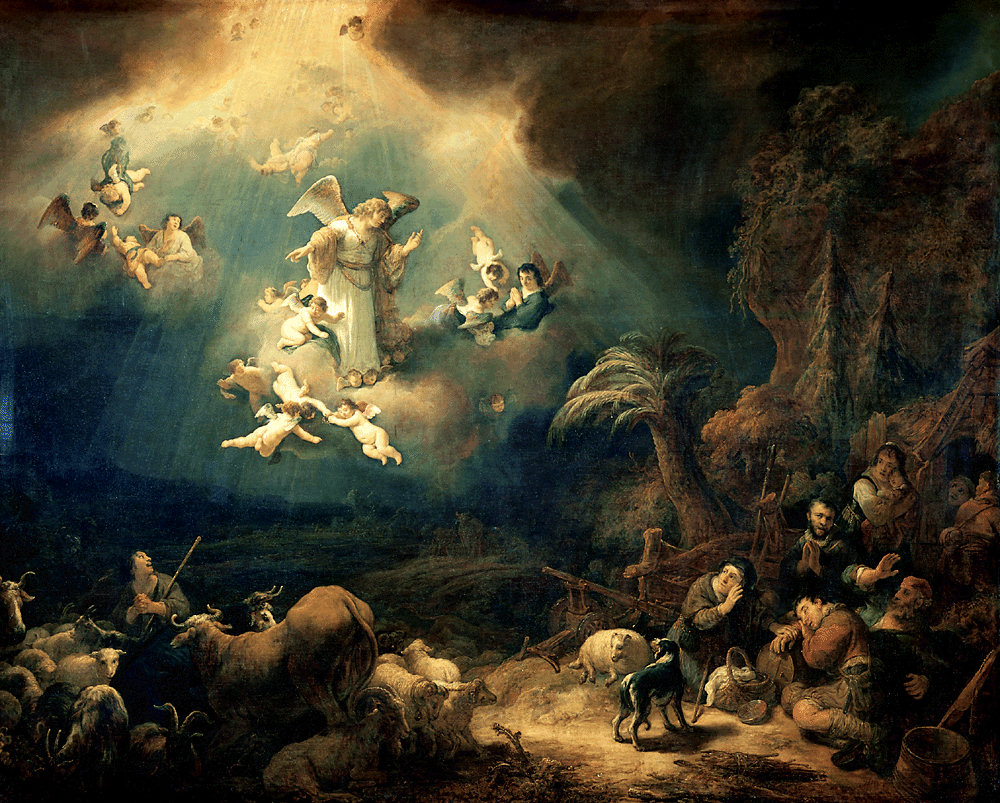
The Shepherds trembled helplessly
An Angel broke the night
Appearing in the cloudless sky
All robed in Heaven’s light
What can this be? They said in awe
As to the ground they fell
Fear not! The Angel said in haste
I’ve wondrous news to tell
For on this night in Bethlehem
Is born sweet Heaven’s Babe
‘Tis Christ the Lord, The Savior come
Lost people for to save
You’ll find Him in a manger near
All wrapped in swaddling clothes
In this, the fallen sin-cursed world
Our God, His Son bestows
And just as he had said these words
The Shepherds trembling still
An Angel host of myriads
Surrounded all the hill
And then the sound no man has heard
That only Heaven knows
This choir of Heavenly Messengers
Let Heaven’s music flow
“All glory to our God on high”
They sang with all their might
“And to the earth God’s Peace has come”
“The Child who’s Heaven’s Light”
And so they ran to Bethlehem
To see what they were told
And there they found the Baby
Who by prophets was foretold
In awe and joy returning
They went back to their sheep
But now, in glory praising
God who every promise keeps
And what can we but also do
On this new Christmas Eve?
But trust in all our God has said
Yes, trust Him, and Believe
Let all the skeptics raise their doubts
Let scoffers fling their scorn
To all who’ve seen His face by faith
We KNOW, The Son, was born
Tis not a myth or fairy tale
Tis not the stuff of lore
The sum of all God’s promises
Tis Christ, The Life, the Door
The King of Kings and Lord of Lords
The Savior, God and Man
This Babe born in the manger there
This Jesus – Christ, The Lamb
-

Jesus
Light of the World
A Christmas Eve Meditation
John 1:1-14
It is not at all surprising that John begins his Gospel with these multiple references to light.
7 Times in these opening 14 vss.
As the beginning of His Gospel parallels the Creation account in Genesis, so we are reminded that at the very beginning of all of God’s ways – His 1st act of creation was “Let there be light.”
In the symbol laden account of Creation we learn that in creating, God was first and foremost interested in bringing light or understanding – and that, in the highest – understanding of Himself.
Creation is the beginning of God’s glorious self-disclosure.
This is why Psalm 19 begins: “The heavens declare the glory of God, and the sky above proclaims his handiwork. Day to day pours out speech, and night to night reveals knowledge. There is no speech, nor are there words, whose voice is not heard.”
God isn’t just creating as something to do with His spare time – He is crafting the ultimate blessing for the creatures He is about to make in His own image – For what higher blessing can any creature have than to have the capacity to perceive and then truly know the fountain and source of all things?
As Jesus prays in John 17: 3 “And this is eternal life, that they know you, the only true God, and Jesus Christ whom you have sent.”
So it is in regeneration the first thing He does is bring light to the soul once more.
Light and understanding and His self-disclosure to souls bound in the darkness of sin – shut out from God Himself.
So God begins giving light. And this theme persists in Scripture.
In Ex. 10 – God separates the Egyptians from the Israelites by sending a darkness that could be felt – but there was light in the homes of God’s people.
In the Tabernacle and the Temple there is to be perpetual light burning.
In the Wilderness, God leads the Jews at night as a pillar of fire – light.
In Esther, when the machinations of Haman are completely overthrown, the text says: “The Jews had light and gladness and joy and honor[1]”
Ps. 27:1 begins: “The Lord is the light of my salvation”
And Isaiah’s prophecy of Christ’s incarnation declares: “The people who walked in darkness have seen a great light; those who dwelt in a land of deep darkness, on them has light shone. [2]”
We could cite dozens of places where this theme is visited over and over.
And so John tells us that this idea finds its ultimate fulfillment in Jesus.
And virtually closes his final revelation giving expression to it in Rev. 22:5 “And night will be no more. They will need no light of lamp or sun, for the Lord God will be their light, and they will reign forever and ever.[3]”
So it is not a one-off kind of thing to read in this passage: 6 There was a man sent from God, whose name was John. 7He came as a witness, to bear witness about the light, that all might believe through him. 8 He was not the light, but came to bear witness about the light. 9 The true light, which gives light to everyone, was coming into the world.[4]
And here is a very great and wonderful thing to contemplate – That Jesus is the TRUE light, of which all the other “lights” even that of creation itself is but a picture.
And just as the sun gives light to everyone on the planet, So Christ Jesus “gives light to everyone.”
But exactly HOW does He enlighten everyone?
I think C. S. Lewis’ famous statement begins to unpack that some. You will recall he said: “I believe in Christianity as I believe that the sun has risen: not only because I see it, but because by it I see everything else.”
Jesus gives light to everyone – Because in Him, in His person and work we see:
- All that mankind was created as. All that mankind ought to be.
The light of purpose and meaning comes through understanding how we were created in His image, and for His pleasure.
- In His person and work we see: All that mankind has fallen from.
- We see: All that mankind needs to be saved from.
- All that mankind needs to be restored to.
- What such a salvation requires. The Cross.
- What fullness of God is revealed. 2 Corinthians 4:6 “For God, who said, “Let light shine out of darkness,” has shone in our hearts to give the light of the knowledge of the glory of God in the face of Jesus Christ.”
- What both judgement on sin AND the mercy and grace of God look like.
Truly, He is the Light of The World. For in Him we glimpse both the manifest glory of God, and the substance of all reality.
- In His resurrection, we catch a glimpse of the glory of the Kingdom to come, and that which He has prepared for all those who love His appearing.
Lastly, as we light these candles together, we are reminded that while Jesus is this light in Himself – He also enlists Believers as part and parcel of seeing to it that light goes out to everyman.
So He can tell the Disciples in Matthew 5:14–16 “You are the light of the world. A city set on a hill cannot be hidden. 15 Nor do people light a lamp and put it under a basket, but on a stand, and it gives light to all in the house. 16 In the same way, let your light shine before others, so that they may see your good works and give glory to your Father who is in heaven.”
We share in this as:
- We are His City – the Place where He rules and reigns.
- In that we bless others because of how He has blessed us.
- In that we bless others in such a way, that through our testimony we do so, only BECAUSE we are in Christ – so that the Father is glorified.
[1] The Holy Bible: English Standard Version (Wheaton: Standard Bible Society, 2016), Es 8:16.
[2] The Holy Bible: English Standard Version (Wheaton: Standard Bible Society, 2016), Is 9:2.
[3] The Holy Bible: English Standard Version (Wheaton: Standard Bible Society, 2016), Re 22:5.
[4] The Holy Bible: English Standard Version (Wheaton: Standard Bible Society, 2016), Jn 1:6–9.
-
Peace on Earth
Luke 1:1-2:21
AUDIO FOR THIS SERMON CAN BE FOUND HERE
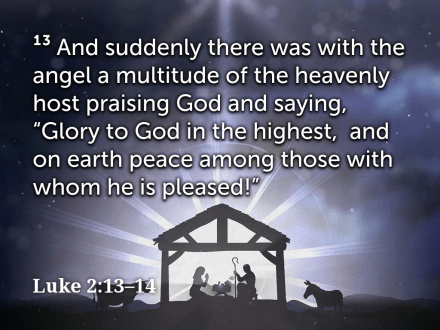
Luke 2:13–14 “And suddenly there was with the angel a multitude of the heavenly host praising God and saying, 14 “Glory to God in the highest, and on earth peace among those with whom he is pleased!”
It is these 2 verses I wish to call our attention to most this morning.
They record something most extraordinary.
And whenever God’s Word records the extraordinary, it bears our special scrutiny as one of the ways Our Lord brings emphasis to matters of highest importance.
Miracles for instance are designed for this purpose. If we pay attention only to the miracle itself, and ignore the fact that the miracle is but a vehicle of revealing something of great importance about God Himself – and especially in His revelation of Jesus Christ -we miss the point.
It’s a bit like being so enamored with the calligraphy and penmanship of the Declaration of Independence, that the concepts being communicated are lost altogether.
Such is the case with this text.
This scene is unlike any other in Scripture. But it isn’t the spectacular nature of the scene that holds the highest importance, even though – as we shall see – the spectacle itself is not to be ignored either.
So let’s take a moment to note the scene, and then use it to frame what it is God is saying to us through it.
- A SHOCKING APPEARANCE.
The overwhelming spectacle of scene this to a few lowly shepherds on a Judean hillside really defies description.
And what an impact it was intended to make.
Here are a few of the least in society. Shepherds were so low on the social scale, they were not even allowed to give testimony in a court of law.
Truly humble and of no account, they are suddenly confronted with an army – and not JUST an army, but an army of thousands of angels in the sky.
And I mean an “army” here. The Greek implies a massive number of angels. Lenski notes: “a multitude of the heavenly host” could more accurately be translated: “A Heavenly army host” – a great number – in the thousands.
And not only that, this was not a silent army.
Just imagine thousands of supernatural beings suddenly appearing to you in the night sky when you are out in the country and virtually alone – and then this army praising God!
For these few moments in time, these shepherds are allowed to see a glimpse of Heaven’s own response to what has just happened – the birth of Jesus Christ.
Note how wonderfully “wasteful” God is in blessing people. He did not give this revelation to artists and poets and those of high culture who could “properly” appreciate it. No. He “wasted” it on lowly shepherds. The way He “wastes” salvation on the chief of sinners.
At this moment, it is as though Heaven itself is so jubilant, so overcome with joy and anticipation at the wonder of the God/man being born into the world through this virgin – fulfilling the purpose and plan of God in the salvation of lost men – that the angels cannot contain themselves, and it spills over into the earthly realm.
Oh if we only grasped what they did at that moment.
Saying “Merry Christmas” wouldn’t be a social nicety, but an enraptured plea for the world to join in that which so delights those who are daily in the unveiled presence of God – that they cannot contain themselves.
Christ has come! And God is being given glory in the Heavens, as never before in all of history.
Heaven is overflowing, gushing, dancing with joy unspeakable and full of glory.
For the Son of God has come to earth, to give Himself a ransom for the lost sons and daughters of Adam.
Mercy and grace and love have reached their highest apex.
And it is all wrapped up in this Babe in Bethlehem.
All this, while we run about in our lives, and worry about getting the right gift, using the right wrapping paper, and giving and perhaps receiving things we imagine give joy. When Joy Himself has come.
What a magnificent scene this must have been.
Add to this the peculiarity of it even if considered in the natural.
When an army suddenly appears, it doesn’t sing. It doesn’t bring good news. It doesn’t comfort. It shows up to fight and to conquer and to bring destruction.
How absolutely contrary then this is to all normal reason.
A PEACE army.
An army that seeks to conquer through its message and not its might.
An army whose power rests not in swords or tanks or guns or missiles or bombs, but in a declaration of the love and goodness and goodwill of God toward His cosmic enemies.
This was a shocking appearance indeed.
2. A TRANSCENDENT ANNOUNCEMENT.
The announcement is 2-fold.
1st. They were announcing that glory is being given to God right now – in the highest places – in Heaven itself. It is as if they said: “We want you to know what is happening in Heaven right now. The Heavens are erupting.”
Angles are bursting with joy.
God is revealing Himself in heretofore unseen or unimagined wonder.
These angels who stand daily in the manifest presence of the Living God – whatever that must be like, are at this moment – so moved outside of themselves, and are sent to show us how Heaven views this event.
This, whether or not anyone on earth understands it even in the slightest.
One commentator noted: “This phrase, Glory to God in the highest”: means “The Heavens are glorifying God right now because of the sending of the Christ-child. Because of this pouring out of peace in the giving of the Prince of Peace.”
2nd, Is the announcement that peace has come among men, because God is pleased to extend it to them.
It is not extorted from Him, but freely given.
The One who can bless with the free blessings of God has come – and all who will, may receive.
Bishop Lightfoot says: “It is the revelation of the glory of God, and that, in the highest – that He has good will toward men, which will result in peace on earth in the person and work of Jesus. God’s glory is seen by us in its highest manifestation in His mercy toward guilty sinners, and grace in bestowing free salvation upon us in Christ. And this thought – causes the very angelic host to burst out in unrestrained praise!”
“14 “Glory to God in the highest, and on earth peace among those with whom he is pleased!”
Now if this is their message, then what a responsibility we have to soak it in and try to grasp it.
And we must ask ourselves, what then is this PEACE He brings?
Why is peace the announcement, and what of it?
The mind immediately recalls passages like Isaiah 9:6–7 “For to us a child is born, to us a son is given; and the government shall be upon his shoulder, and his name shall be called Wonderful Counselor, Mighty God, Everlasting Father, Prince of Peace. 7 Of the increase of his government and of peace there will be no end, on the throne of David and over his kingdom, to establish it and to uphold it with justice and with righteousness from this time forth and forevermore. The zeal of the Lord of hosts will do this.”
The child, this baby who was born – is none other than this Prince of Peace prophesied so many centuries before.
But in what way? How does that work? What does that look like?
1st. It is the announcement of a Temporary peace with all mankind during the Gospel age.
That God, the judge of all the earth, instead of coming to judge us all in our sins, has elected first to announce a day, a season, an epoch of GRACE! The Gospel age was inaugurated that night.
So glorious and amazing is this day of Gospel grace, that when mankind commits its most heinous act of cosmic sin in the crucifying of Jesus Christ the Lord of all – still even then, the Gospel is to be preached for the salvation of lost souls.
So it is Jesus will tell His disciples: Matthew 24:14 “And this gospel of the kingdom will be proclaimed throughout the whole world as a testimony to all nations, and then the end will come.”
Indeed, even after He is risen He reiterates this point to them: Mark 16:15–16 “And he said to them, “Go into all the world and proclaim the gospel to the whole creation. 16 Whoever believes and is baptized will be saved, but whoever does not believe will be condemned.”
The day of grace has extended to this very moment in time – but it will not remain forever.
And as this portion of Mark reports – “whoever does not believe WILL be condemned.”
But today there still remains an opportunity for everyone within the sound of the Gospel, whether here or anywhere else it is preached today.
Jesus Christ has come. God in flesh dwelt among us. And He gave His life in satisfying the wrath of God against human sin – that all who put their trust in Him might be forgiven, born again and reconciled to the Father.
This announcement is the declaration of that peace to all who will lay down their arms against the government and rights of God to rule them in Christ – and come to Him for mercy and forgiveness.
Today is the day of grace – do not squander it! Run to Him today!
2nd. It is the announcement that Jesus alone is the One who can bring peace with God through His atoning work on the cross, for all who believe.
So it is Isaiah writes in another place 53:5–6 “But he was pierced for our transgressions; he was crushed for our iniquities; upon him was the chastisement that brought us peace, and with his wounds we are healed. 6 All we like sheep have gone astray; we have turned—every one—to his own way; and the Lord has laid on him the iniquity of us all.”
How can we find peace with God when we have been at war with Him over who has the right of supremacy over our lives?
Only if One can atone for our treason, and reconcile us to Him.
So Jesus will tell us of His own ministry in Luke 4:18 “The Spirit of the Lord is upon me, because he has anointed me to proclaim good news to the poor. He has sent me to proclaim liberty to the captives and recovering of sight to the blind, to set at liberty those who are oppressed,”
3rd. It is an announcement of peace in the creation of and bringing together a people of peace who are to live at peace with all men if at all possible, and who are proclaimers of peace to those who are still God’s enemies in their self-government.
No neighbor of a Christian should ever fear that the Christian will harm or take advantage of them. We are called to manifest the peace of God in the world.
No family member ought ever to fear that a Christian will bring unnecessary pain or chaos or hardship in their household – for we are of Christ’s household and we are at peace with Him and He with us.
No nation should ever fear Christians invading them to conquer, subjugate or exploit them. We live to manifest the Prince of Peace and remain content with His provision – not needing to covet anyone else’s land or property.
Christian employees ought to be the most productive, loyal and trustworthy.
The separation and division that sin brought from the first moment of the Fall in the Garden until today is to be counteracted and healed by those whose breach with God has been healed in the forgiveness of sins and free grace.
4th. Because the Prince of Peace rules – the Believer can live in perfect peace over the providences of life.
1 Corinthians 2:12 “Now we have received not the spirit of the world, but the Spirit who is from God, that we might understand the things freely given us by God.”
Romans 8:32 “He who did not spare his own Son but gave him up for us all, how will he not also with him graciously give us all things?”
John 14:27 “Peace I leave with you; my peace I give to you. Not as the world gives do I give to you. Let not your hearts be troubled, neither let them be afraid.”
The old Puritan John Flavel writes: O then, why is my heart disquieted, because it cannot sometimes discern the way of the Lord, and see the connection and dependence of his providential dispensations? Why art thou so perplexed, O my soul, at the confusions and disorders that are in the world! I know that goodness and wisdom sits at the stern: and though the vessel of the church be tossed and distressed in times of trouble, yet it shall not perish. Is it not enough for me that God hath condescended so far for my satisfaction, as to shew me plainly the ultimate and general issue of all these mysterious providences? Unless I be able to take the height of every particular, shall I presume to call the God of heaven to account? Must he render a reason of his ways, and give an account of his matters to such a worm as I am? Be silent (O my soul) before the Lord, subscribe to his wisdom, and submit to his will whatsoever he doth. However it be, yet God is good to Israel; the event will manifest it to be all over a design of love. I know not how to reconcile them to each other, or many of them to the promise; yet are they all harmonious betwixt themselves, and the certain means of accomplishing the promises. O what a favour is this, that in the midst of the greatest confusions in the world, God hath given such abundant security to his people, that it shall be well with them.”
5th. Something else for the Believer is the peace Christ affords us in our consciences, since Christ cleanses them from their sin.
We may at times try to ignore our consciences, through activity, drugs, alcohol, whatever – but because of the perfect work of Christ – the man or woman who is in Christ Jesus can be freed from the sting of their conscience because the penalty for their sin has been paid – and the righteousness of Christ has been imputed to their account in faith.
So the Writer to the Hebrews notes: Hebrews 9:14 “how much more will the blood of Christ, who through the eternal Spirit offered himself without blemish to God, purify our conscience from dead works to serve the living God.”
John Newton once wrote:
The worst of all diseases, is light – compared with sin
On every part it seizes, but rages most – within
Tis palsy, poison, fever, and madness – all combined
And none but a Believer – the least relief can find
But oh the peace that belongs to those born again by the Spirit of Christ.
6th. Contrary to the whole World – Christ brings peace with death for the Believer, for it is no longer the terror of final judgment, but the entrance into a fuller reality of Christ’s kingdom.
For the promise, indeed the absolute ASSURANCE of the resurrection, because of Christ’s own resurrection, lets the Believer sing with Paul 1 Corinthians 15:54–57 “When the perishable puts on the imperishable, and the mortal puts on immortality, then shall come to pass the saying that is written: “Death is swallowed up in victory.” 55 “O death, where is your victory? O death, where is your sting?” 56 The sting of death is sin, and the power of sin is the law. 57 But thanks be to God, who gives us the victory through our Lord Jesus Christ.”
7th. It is the announcement that there will one day be Peace with all of creation in the new heavens and the new earth.
2 Peter 3:13 “But according to his promise we are waiting for new heavens and a new earth in which righteousness dwells.”
The eventual, absolute end of all sin and strife.
Perfect peace for all eternity in the presence of our God and King.
On top of all the other things John records will NOT be there in the New Heavens and the New Earth, like pain, suffering, tears, mourning, etc. – he adds this by revelation: Revelation 21:1 “Then I saw a new heaven and a new earth, for the first heaven and the first earth had passed away, and the sea was no more.”
In the ancient world, the sea was always representative of that which dark, dangerous, mysterious, unstable, tumultuous and fearful.
But the first thing John notes will NOT be there – there will be no more sea.
Nothing but perfect, eternal, blissful, unbroken and all consuming peace.
Because we will at last be in the bosom of the Prince of Peace Himself – Jesus the Risen Christ.
Luke 2:13–14 “And suddenly there was with the angel a multitude of the heavenly host praising God and saying, 14 “Glory to God in the highest, and on earth peace among those with whom he is pleased!”
-
Jesus Christ
Savior, Sovereign and Shepherd
Matthew 1:1-2:6
THE AUDIO FOR THIS SERMON CAN BE FOUND HERE
Passages like the one we just had read for us – at least the 1st 17 vss., are often skimmed over quite quickly, if read at all.
I want to argue this morning that running too quickly over genealogies is a mistake.
Yes, on the surface they seem boring.
But God is not a God of the superfluous.
If He has seen to it by His Spirit to inspire the original authors to include such lists, we ought not be quick to dismiss them without careful consideration.
I hope to give us a taste of that today.
But before we get there, I want us to notice 3 ways in which the person and work of this Baby born in Bethlehem 2000 years ago is identified in this passage and take note of what astounding good news it is to all who hear.
The narrative portion of this passage begins in vs. 18 of Ch. 1, and it is worth our time to look at the details a bit.
Matthew 1:18–23 “Now the birth of Jesus Christ took place in this way. When his mother Mary had been betrothed to Joseph, before they came together she was found to be with child from the Holy Spirit.
19 And her husband Joseph, being a just man and unwilling to put her to shame, resolved to divorce her quietly.
20 But as he considered these things, behold, an angel of the Lord appeared to him in a dream, saying, “Joseph, son of David, do not fear to take Mary as your wife, for that which is conceived in her is from the Holy Spirit. 21 She will bear a son, and you shall call his name Jesus, for he will save his people from their sins.” 22 All this took place to fulfill what the Lord had spoken by the prophet: 23 “Behold, the virgin shall conceive and bear a son, and they shall call his name Immanuel” (which means, God with us).
- SAVIOR: And here is the 1st designation that is given to Jesus, even before He is born: SAVIOR. “you shall call his name Jesus, for he will save his people from their sins.”
He was to be given a most unextraordinary family name – Jesus or Joshua was extremely common in Israel at the time He was born.
This is because He was to be identified with the common man, even though He was the very Son of God!
As the genealogy shows, Jesus was part of a family line that was quite diverse, but He was in the flesh – the flesh only being considered – truly just one of us.
He was to save those of whom He was a part – His People!
But as common as this name itself was in Israel at the time – He was to be the utmost fulfillment of it.
- C. Ryle: “The name Jesus means “Saviour.” It is the same name as Joshua in the Old Testament. It is given to our Lord because “He saves His people from their sins.” This is His special office. He saves them from the guilt of sin, by washing them in His own atoning blood. He saves them from the dominion of sin, by putting in their hearts the sanctifying Spirit. He saves them from the presence of sin, when He takes them out of this world to rest with Him. He will save them from all the consequences of sin, when He shall give them a glorious body at the last day. Blessed and holy are Christ’s people! From sorrow, cross, and conflict they are not saved. But they are saved from sin for evermore. They are cleansed from guilt by Christ’s blood. They are made meet for heaven by Christ’s Spirit. This is salvation. He who cleaves to sin is not yet saved.[1]”
To see Him only as a Teacher, an Example, a Wise Man, a Religious figure, a Sage or a Prophet or a Miracle worker – we miss His primary reason for becoming incarnate – He came to be a Savior!
To save His people from their sins!
And the great question each of us must answer is – are we His people?
Will we acknowledge we are the lost, the sinful, the rebellious, the condemned and unclean so that He might be our Savior and we might be His people?
Luke 5:29–32 “And Levi made him a great feast in his house, and there was a large company of tax collectors and others reclining at table with them. 30 And the Pharisees and their scribes grumbled at his disciples, saying, “Why do you eat and drink with tax collectors and sinners?” 31 And Jesus answered them, “Those who are well have no need of a physician, but those who are sick. 32 I have not come to call the righteous but sinners to repentance.”
The implication is clear: Would you know God?
Would you know salvation?
You must know your absolute and utter need of Him.
You must know your sin, your dreaded condition. You must hear the call, and respond in faith.
Nothing else will do.
If you have no need of Him, neither will you have Him at all.
He only saves sinners.
He only redeems lost men.
He only raises the dead and heals the sick.
Those who know nothing of their need, can know little or nothing at all of Him.
The angel told Joseph – You will call His name Jesus – for He will save His people from their sins.
And so the narrative continues: Matthew 1:22–25 “All this took place to fulfill what the Lord had spoken by the prophet: 23 “Behold, the virgin shall conceive and bear a son, and they shall call his name Immanuel” (which means, God with us). 24 When Joseph woke from sleep, he did as the angel of the Lord commanded him: he took his wife, 25 but knew her not until she had given birth to a son. And he called his name Jesus.”
Chapter 2 changes the scene: Matthew 2:1–2 “Now after Jesus was born in Bethlehem of Judea in the days of Herod the king, behold, wise men from the east came to Jerusalem, 2 saying, “Where is he who has been born king of the Jews? For we saw his star when it rose and have come to worship him.”
And it is here we encounter Jesus’ 2nd designation: KING, or
2. SOVEREIGN: Where is He who has been born “King of the Jews.”
Now because our culture has been so permeated by the idea of elected heads of state, or even in England, say of “Constitutional Monarchs” – we have little appreciation for what it meant in those days for someone to reign as King.
Kings were not figureheads. Kings had absolute rights of rule over those under them.
It is true that under the yoke of Roman oppression, Kings like Herod mentioned here, were somewhat constrained – but that was not typical throughout history.
When one became King – they ruled with absolute and unchallenged authority – and did so at the expression of their most fleeting and often wicked whims.
Kings were absolute dictators and despots.
And as we were contemplating last Sunday night around the communion table, the Passover sacrifice was to be fully consumed and none left over until the next day; so Jesus must be taken in all of His person and offices – Prophet, Priest & King – so here, as Savior, but also Sovereign!
We begin to see how this unfolds in John 3.
On the heels of Jesus’ discussion with Nicodemus where He tells the Pharisee that he must be born again or he cannot see the Kingdom of God – a dispute arises with some of John’s disciples over purification rights.
At that point, John starts to tell his followers, they need to listen to Jesus now. And Jesus Himself goes on to say about Himself:
John 3:31–36 “He who comes from above is above all. He who is of the earth belongs to the earth and speaks in an earthly way. He who comes from heaven is above all. 32 He bears witness to what he has seen and heard, yet no one receives his testimony. 33 Whoever receives his testimony sets his seal to this, that God is true. 34 For he whom God has sent utters the words of God, for he gives the Spirit without measure. 35 The Father loves the Son and has given all things into his hand. 36 Whoever believes in the Son has eternal life; whoever does not obey the Son shall not see life, but the wrath of God remains on him.”
Did you catch that last part?
The one who believes in The Son has eternal life – BUT – “WHOEVER DOES NOT OBEY THE SON SHALL NOT SEE LIFE, BUT THE WRATH OF GOD REMAINS ON HIM.”
Wow!
The ultimate life issue hangs not only on what one believes, but whether or not we OBEY The Son!
God has made Him Lord of all. Has “given all things into His hand” (v35)
And this is of the utmost importance – for if you are not reconciled to Christ so as to look to obey Him as your sovereign and Lord, then in fact you are still in your trespasses and sins, and still under the wrath of God!
Now is the time to flee to Him as your Savior, and to bend the knee to Him as your King with His absolute right of rule over you – soul, body and mind,
In fact, He calls you to Himself this very moment in the preaching of this sermon.
Perhaps you have played with Christianity – thinking you can be fine with God if you just subscribe to Christian truth and own a Christian Church as your Church, the Bible as your holy book and have Christian friends or relatives – but beloved, if you are still just being “A Christian” and not submitted to the Kingship of Jesus Christ in your life – you are still lost, outside the faith and standing every moment in danger of your eternal soul being lost!
As Savior He has declared an amnesty, full and free forgiveness for all and provided an actual atonement for all of your sin in His blood on the Cross – but He calls to you to be reconciled to Him as your Savior AND your King – and promises He WILL receive you when you repent and come to Him for mercy.
Will you? Today? This hour, this moment? Will you confess your sin and call upon Him to be saved and to be master of your Life?
Oh do it! Don’t wait. Don’t hesitate. The door is open, the call has been given and He calls, even more, He commands you to come to Him that you might be saved. Obey Him that you might be saved from the wrath of God coming upon the whole world.
SAVIOR was the designation from the Angel.
SOVEREIGN was who the Wise Men sought.
But our narrative is not over yet.
Matthew 2:3–6 “When Herod the king heard this, he was troubled, and all Jerusalem with him; 4 and assembling all the chief priests and scribes of the people, he inquired of them where the Christ was to be born. 5 They told him, “In Bethlehem of Judea, for so it is written by the prophet: 6 “ ‘And you, O Bethlehem, in the land of Judah, are by no means least among the rulers of Judah; for from you shall come a ruler who will shepherd my people Israel.’ ”
And here is the 3rd designation given to us, in the prophecy cited from Micah 5:2 about Bethlehem – that from that tiny and humble village would come a ruler who will SHEPHERD God’s people, Israel.
3. SHEPHERD: What a sweet and tender and blessed designation this is.
Our Shepherd. How the Scripture uses that picture to open up for us in so many places just how deeply He cares for His own, and protects and provides for us.
So David can cry in Psalm 28:8–9 “The Lord is the strength of his people; he is the saving refuge of his anointed. 9 Oh, save your people and bless your heritage! Be their shepherd and carry them forever.”
How Isaiah 40:11 notes: “He will tend his flock like a shepherd; he will gather the lambs in his arms; he will carry them in his bosom, and gently lead those that are with young.”
Ezekiel 34:15 has God declaring: “I myself will be the shepherd of my sheep, and I myself will make them lie down, declares the Lord God.”
And then Jesus Himself takes up the theme in John 10:7–17 “So Jesus again said to them, “Truly, truly, I say to you, I am the door of the sheep. 8 All who came before me are thieves and robbers, but the sheep did not listen to them. 9 I am the door. If anyone enters by me, he will be saved and will go in and out and find pasture. 10 The thief comes only to steal and kill and destroy. I came that they may have life and have it abundantly. 11 I am the good shepherd. The good shepherd lays down his life for the sheep. 12 He who is a hired hand and not a shepherd, who does not own the sheep, sees the wolf coming and leaves the sheep and flees, and the wolf snatches them and scatters them. 13 He flees because he is a hired hand and cares nothing for the sheep. 14 I am the good shepherd. I know my own and my own know me, 15 just as the Father knows me and I know the Father; and I lay down my life for the sheep. 16 And I have other sheep that are not of this fold. I must bring them also, and they will listen to my voice. So there will be one flock, one shepherd. 17 For this reason the Father loves me, because I lay down my life that I may take it up again.”
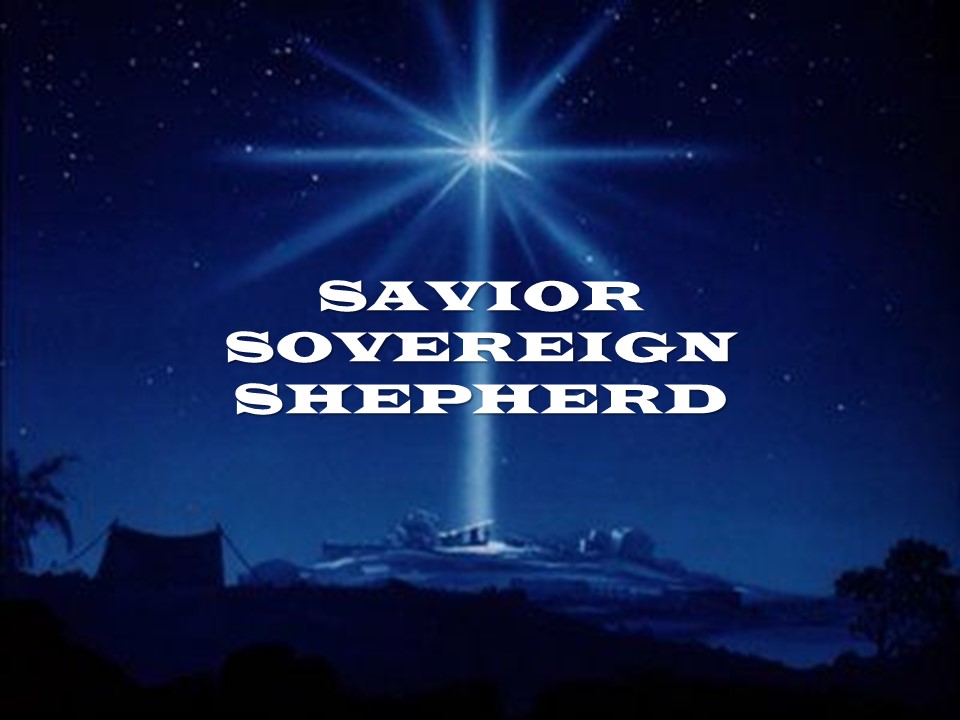
SAVIOR SOVEREIGN SHEPHERD
Can these be any more blessed ways of understanding who this Christ is who was born in that lowly manger in the little town of Bethlehem so long ago?
But what does all of that have to do with that long list of strange names at the beginning of Matthew’s Gospel? What’s the point?
Just this – in that list there are Kings and Scoundrels
Notables and Nobodies
Men & Women
Jews & Gentiles
Those who were faithful and many who were faithless
There’s a Prostitute
Nomads, Warriors, Prophets, Farmers, Statesmen, ordinary Joes
Those who lived in ease
Those who lived in poverty
Those who accomplished much
Those who left nothing behind but their names
The shunned and the accepted
The steadfast and the mercurial
The creative and the dull
Intellectuals and uneducated commoners
Christ Jesus came in the likeness and the lineage of fallen, broken, sin-cursed humankind.
So it is there are none who cannot be touched by Him, nor reconciled to the Father through Him.
This Savior can save anyone – even me, even you.
This Sovereign reigns over all and expects to be obeyed.
And this Shepherd, will guide, protect, provide for, keep and bring home all who are His – safe to their heavenly home.
This is the miracle of the incarnation.
This, is Christmas.
[1] J. C. Ryle, Expository Thoughts on Matthew (New York: Robert Carter & Brothers, 1860), 6.
-

Like many, I’ve been alerted to the recent semifinal performance of [The] Voice contestant Christian Cuevas. He sang the popular worship song, ‘To Worship You I live.”
And let me start off by affirming both Christian’s undeniable talent, and what I assume is his sincere desire to see his God glorified in the singing of a worship song in such a public venue. I do not question his motives for a moment.
But I do feel the need to address the wisdom of that choice, given the context of the show – The Voice – itself, and of the greater problem I see in present day popular Christianity. That of a seeming inability to keep some necessary and fitting distinctions as per places like Leviticus 10:10 “You are to distinguish between the holy and the common, and between the unclean and the clean.”
In the text just cited, the statement is being enjoined upon the Levitical Priesthood, and is spoken especially in connection with the Priests being careful to abstain from wine or strong drink when performing their duties. Why? Because there is something inherently evil in wine or strong drink? No. God condemns neither when used in their proper place and with proper constraints. The concern is one of protecting the faculty of clear judgment and discerning thinking. A principle which I believe applies here, even though intoxicants are not in play. It is the issue of sound judgement, and being able to distinguish between holy and common, clean and unclean.
Now let me note that to distinguish between holy and common does not necessarily mean that everything that is not “holy” in the sense of being specifically set aside for God’s use is sinful. Rather, there are things which belong to Him alone, and are not to be treated as “common” or for everyday use.
Two examples of this would be the special anointing oil the priests were to formulate and use only in ceremonies commanded by God, and, the special blend of incense to be burned on the golden altar by the curtain separating the holy place from the holy of holies. Both of these are addressed in Exodus 30. Both of these invite being cut off from God’s people should one take those formulae and compound the substances for personal use. Some things belong to God alone.
I would argue, worship is one of those things.
In other words, making worship of the living God an act of performance art, and that, for the entertainment of the unbelieving world, would appear to me to take what is holy, and ‘commonize’ or profane it. And I am uncomfortable with that.
Now if I haven’t offended some of you enough already, let me take this one step further.
The absolutely benign lyrics of the song chosen aside (there is nothing in the lyrics that has any reference to who or what is being worshipped or why – making it perfectly appropriate for any lover or idolater to use with equal ease) – the context here is what makes such a profound difference.
Christian, again, no doubt every inch sincere in his motivations (I don’t know but love calls me to assume so) in fact completely contradicted the intent of the song, by the use of it within that venue.
How so?
Because the message ‘To worship You I live’, is being sung, to advance his own career and win a contest. It is to use God’s name (though His name is conspicuously absent) to further his own desires to be performer. It is trading on the name of Christ for personal advancement. It is blending the sacred anointing oil, to wear as perfume. Intentionally? I’m sure not. But in practice. Indeed.
Note, there is nothing wrong with a Believer (which I assume Christian is) wanting to have a music career. Go for it! We need solid Christians in every stratum of society and the arts. And I am all in favor of his wanting to bear testimony to his God when and where he can. These are good things. But in this use – what belongs to God exclusively – worship, is co-opted both for the entertainment of the world, and the advancement of one’s career.
I do not condemn Mr. Cuevas in his action. But I do plead with the Church, to reckon with how we have turned ‘worship’ into performance art – which is no longer His and His alone, but is more of a consumer commodity. And ask us to rethink that trend.
How is it that our Christian culture, has produced this sad state of affairs?
Perhaps, just perhaps, we’ve been intoxicated by the spirit of the age in such a way, that even we, His royal priesthood, can no longer distinguish between the holy and the common, the clean and unclean. And we are called to just such a thing.
-

Deuteronomy 15:1–6 (ESV)
1 “At the end of every seven years you shall grant a release. 2 And this is the manner of the release: every creditor shall release what he has lent to his neighbor. He shall not exact it of his neighbor, his brother, because the Lord’s release has been proclaimed. 3 Of a foreigner you may exact it, but whatever of yours is with your brother your hand shall release. 4 But there will be no poor among you; for the Lord will bless you in the land that the Lord your God is giving you for an inheritance to possess— 5 if only you will strictly obey the voice of the Lord your God, being careful to do all this commandment that I command you today. 6 For the Lord your God will bless you, as he promised you, and you shall lend to many nations, but you shall not borrow, and you shall rule over many nations, but they shall not rule over you.
There is wisdom here regarding forgiveness of all kinds. When the offender is a brother or sister in Christ – at some time, whether there has been full satisfaction or not, forgiveness ought to be extended. We may even perhaps see a shadow of Church discipline here, in that those who are “foreigners” do not get the benefit of such a release. Not that we are prevented from it, but it is not demanded by God as it is of our brethren. Those now counted as outside the Body of Christ due to their unrepentance, do not enjoy the very same benefit of those to whom we are joined by one Spirit. Yet the overall tenor is to be generous in our forgiveness. Time may need to be a factor. Some wounds are deep indeed – and may need a large swath of time to heal. But we must let time in fact be taken into account. If you have a brother or sister in the Lord, and the days have been long without forgiveness between you, consider a “seventh year.” Set a termination point. And even if it is not settled – forgive. That we might show the love of Christ He has shown to us.
-
The Book I wanted to write – but BETTER!
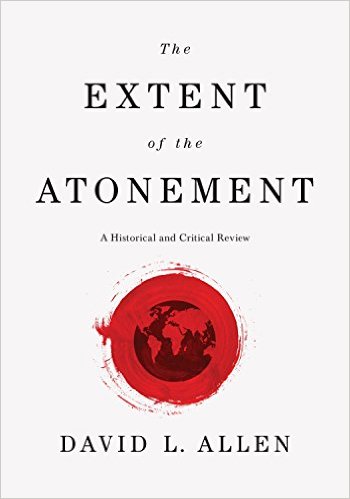
At the outset, let me say that this tome is a scholarly tour de force by one of the best friends a conscientious Calvinist can find anywhere.
David Allen serves as the dean of the School of Preaching, distinguished professor of preaching, director of the Southwestern Center for Expository Preaching and George W. Truett Chair of Ministry at Southwestern Baptist Theological Seminary in Fort Worth, Texas. He was previously Dean of the School of Theology from 2004-2016. He received the B.A. at Criswell College (1978), Master of Divinity at Southwestern Baptist Theological Seminary (1981), and Ph.D. in Humanities with a Major in Linguistics from The University of Texas at Arlington (1987).
And, in the interest of full disclosure, let me state up front that I am a recovering High-Calvinist. Lest that term confuse you, Dr. Allen gives some helpful definitions near the beginning of his massive and vitally important work on the extent of the atonement of Jesus Christ.
The main factions in the debate as he lists them in the introduction (noting also that each have nuances within their camps) are as follows –
Arminianism: Christ suffers for the sins of all mankind with an equal intent to save all people.
Classic/Moderate Calvinism: Christ suffers for the sins of all mankind, but with an unequal intent/will to save all people.
High Calvinism: Christ only suffers for the sins of the elect because of his singular intent.
Hyper-Calvinism: Christ only suffers for the sins of the elect because of his singular intent.
What separates the last two is brought out numerous places within the book, but has mostly to do with the latter rejecting the free offer of the Gospel.
That said – let me plunge in.
Part 1 of the book surveys the extent of the atonement in Church history. It is divided into 4 sections – covering all the major player who may have written on the topic in: 1. The Early & Medieval Era; 2. The Reformation Era; 3. The Post-Reformation Era; and 4. The Modern Era.
Part 2 is comprised of 3 chapters focusing on the extent of the atonement in the Baptist tradition. Once again surveying most of the key writers and preachers on the atonement among: 1. English General and Particular Baptists; 2. North American Baptists; and 3. Southern Baptists. Being a Southern Baptist himself, this is of particular interest to Dr. Allen, but by no means indicates a short shrift of the others.
Part 3 is in 2 parts. First is a detailed critical review of every chapter of the highly acclaimed Crossway volume “From Heaven He Came and Sought Her: Definite Atonement in Historical, Biblical, Theological, and Pastoral Perspective.” The 2nd is a concluding chapter titled: “Why Belief in Unlimited Atonement Matters.”
And let me tell you, that this book soars. It soars conclusively (in my estimation) in securing the reality that an unlimited atonement in extent, NOT application, has been the majority report throughout ecclesiastical history; the majority report among the early Reformers – including Calvin; and was the main expression on the question of the atonement until the encroachment of a strict limitarian view was espoused by Beza, and championed (perhaps) most by John Owen.
The historical evidence is so overwhelming that the Owenic view was not and never has been “The” Reformed view, as to be virtually incontrovertible. Now as Dr. Allen notes, counting noses isn’t how we do sound theology. We go back to the text of Scripture for that. But it does drive us to consider how so many for so long – solidly IN the Reformed tradition, rejected a strict either/or construct (Jesus either died for all OR for the elect) in favor of a both/and construct, speaking to an unlimited atonement when considered in and of itself, with the reality of a particularistic application of it by God’s sovereign choice.
Of particular interest in this line is how the extent of the atonement was the most hotly debated topic at the Synod of Dordt, and how both Dordt’s statements and the Westminster’s were written with a measure of intentional ambiguity to allow for those on both sides of this question to sign them in clear conscience.
All along the way in these chapters, Dr. Allen proves himself to be the consummate myth-buster. Strict limited atonement is THE Reformed position – busted. Amyrault was a heretic – busted. Amyraldianism is nor Reformed – busted. Strict limited atonement came first – busted. All of the Reformers held to strict limited atonement – busted. (You will be shocked to find out just how many of those you thought held to limited atonement – didn’t.) British hypothetical universalism was Amyraldian – busted. So-called 4-point Calvinism is Arminianism – busted. Universal or unlimited atonement must result in universalism – busted! On and on and on.
In fact, my own journey out of being a high Calvinist to becoming a Moderate/Classical Calvinist years ago, was one of being disabused of many of these myths as I went. Myths that when taken in composite can so jade and confuse, as to make you question sound exegesis simply on the force of how all these men can’t be wrong – even when repeating common errors over and over. How I wish I has had access then to “The Extent of the Atonement: A Historical and Critical Review” by Dr. David Allen. But I do now, and so do you.
So as to prevent this review from being as long as the book itself (a hefty 848 pages) let me point out what I think are the key strong points, and offer a suggestion for those who want a quicker handle on it all.
What the book does over and over and over again, is address the principle arguments for a strict limitarian view, both exegetically and logically – and examines how non-limitarians have addressed those same Scripture passages and logic. In the process, by virtue of its unique structure, you get hear dozens of Reformed voices argue against limitarianism. None, surrendering election, or particularization in the application of the atonement. All, in necessary and clarifying context.
Thus there is a constant reminder not to confound the accomplishment of the atonement with its application.
Repeated warnings not to buy into a mere instrinsic sufficiency in the atonement as opposed to extrinsic sufficiency.
Over and over again the negative inference fallacy is exposed, rejected and properly defeated.
The commercial and pecuniary foundation of so much of Owen’s thinking is debunked.
The weight placed by so many on the “distributive” versus universal use of “all” is demythologized and properly contexualized each in its proper place.
The fallacy in Owen’s famous trilemma is exposed and the illogic dismantled.
How the limitarian view severely discounts justification by faith in its proper place and time.
And in every place, the centrality of this to the right preaching of the Gospel take its rightful place front and center.
All this by voice after voice after voice among our Reformed brethren.
Now maybe you are not going to wade through all 848 – pages, and that with some chapters offering in excess of 800 end notes! I hear your cry. Though I bid you to do it anyway, both for your education and your soul.
But if you want the shortcut – here is my recommendation. If you only read the detailed refutation of John Owen’s The Death of Death in Christ, in the section bearing his name, and, the section on David Schrock, you will interact with all of the pertinent Scriptures and arguments from the strict limitarian view, and all of the key corrections in exegesis and logic in showing the error of that view. These two alone are worth the price of the book, and a couple of evenings in deep reading and reflection. They will change you.
David Allen has done an invaluable service to the Body of Christ as a whole, and to Calvinists especially in a critical time in American Christianity. As he said to me in a brief meeting at the recent ETS gathering in San Antonio – (paraphrasing) “I did not write this book against Calvinists, but to make my Calvinist brothers BETTER Calvinists.” That spirit breathes on every page of this book – and spoke to me that way before I ever met the good Doctor.
I had wanted to write this book every since my own study led me out of strict limitarianism. But I’m glad I didn’t. Because here, it is done so much better. May God be pleased to use it as a much needed corrective in the current swell of interest in Reformed theology. For some, it will give you the permission you’ve been seeking to preach the Gospel the way you know you should have, all along. To the glory of God and the good of His Church.
-

Many of us avoid large swaths of the Old Testament, because they just do not seem relevant to us. But as the Puritan John Flavel noted, the Old Testament serves as the illustration book to the more direct, doctrinal teaching of the New Testament. Seeing the New Testament principles fleshed out in the types, shadows and pictures of the lives and circumstances of God’s people in the OT, gives the Church a ready and uniform set of graphic explanations, that should become so common to us all – that we can readily call them to mind at any time.
One such place is where I was reading this morning in the book of Deuteronomy. I know, you probably haven’t blown the dust off of that one in a LONG time – if ever. But there are rich and valuable lessons there.
Take for instance the following: Deuteronomy 7:17–21 (ESV) 17 “If you say in your heart, ‘These nations are greater than I. How can I dispossess them?’ 18 you shall not be afraid of them but you shall remember what the Lord your God did to Pharaoh and to all Egypt, 19 the great trials that your eyes saw, the signs, the wonders, the mighty hand, and the outstretched arm, by which the Lord your God brought you out. So will the Lord your God do to all the peoples of whom you are afraid. 20 Moreover, the Lord your God will send hornets among them, until those who are left and hide themselves from you are destroyed. 21 You shall not be in dread of them, for the Lord your God is in your midst, a great and awesome God.”
Now the circumstance is evident. This portion is a part of the instructions that God is giving the Children of Israel as they are about to enter the Promised Land. It is a striking parallel to the Believer entering into the fullness of the Christian life, even as Israel’s deliverance from Egypt is a striking parallel to the Believer having been rescued from the slavery of sin to serve Christ.
With that picture in mind – note the instruction and encouragement God provides here. Couched in a necessary warning as well.
One of the mighty weapons in the Believer’s arsenal against indwelling sin, is to get a full orbed picture of just what God did in bringing us to salvation in the first place. Underestimating or forgetting the miraculous deliverance that brought us to justification, makes attacking indwelling sin seem larger and more impossible than it truly is. If He did so much in rescuing us from our sin initially – then what will He do in equipping us to root out and rout indwelling sin? Our sin lies to us and makes us imagine the cost is too great in being rid of it. It is too hard, and undoable. But rest assured, the same power that gave our blind eyes sight, opened our deaf ears and breathed life into our dead souls, is still at work to bring us fully into our inheritance. And as verse 21 indicates we are forbidden to fear ANY indwelling sin as too great to be conquered, or to be in dread of it – we are the Lord’s people. He has given us this land.
Great encouragement indeed!





-
Subscribe
Subscribed
Already have a WordPress.com account? Log in now.
 ResponsiveReiding