Skip to content
  • Home
  • About
  • Blog
  • Atonement
    • The Atonement: Read this first!
    • Confession of an ex-u0022Highperu0022 Calvinist
    • Revisiting the Substitutionary Atonement
    • Discussing the Atonement – a lot!
    • Lecture Notes on The Atonement
  • Sermons
  • ReviewsAll book and movie reviews
    • Books
    • Movies

ResponsiveReiding

  • Savior, Sovereign, Shepherd – A Christmas Sermon

    December 11th, 2016

    chr2016a

    Jesus Christ

    Savior, Sovereign and Shepherd

    Matthew 1:1-2:6

    THE AUDIO FOR THIS SERMON CAN BE FOUND HERE

    Passages like the one we just had read for us – at least the 1st 17 vss., are often skimmed over quite quickly, if read at all.

    I want to argue this morning that running too quickly over genealogies is a mistake.

    Yes, on the surface they seem boring.

    But God is not a God of the superfluous.

    If He has seen to it by His Spirit to inspire the original authors to include such lists, we ought not be quick to dismiss them without careful consideration.

    I hope to give us a taste of that today.

    But before we get there, I want us to notice 3 ways in which the person and work of this Baby born in Bethlehem 2000 years ago is identified in this passage and take note of what astounding good news it is to all who hear.

    The narrative portion of this passage begins in vs. 18 of Ch. 1, and it is worth our time to look at the details a bit.

    Matthew 1:18–23 “Now the birth of Jesus Christ took place in this way. When his mother Mary had been betrothed to Joseph, before they came together she was found to be with child from the Holy Spirit.

    19 And her husband Joseph, being a just man and unwilling to put her to shame, resolved to divorce her quietly.

    20 But as he considered these things, behold, an angel of the Lord appeared to him in a dream, saying, “Joseph, son of David, do not fear to take Mary as your wife, for that which is conceived in her is from the Holy Spirit. 21 She will bear a son, and you shall call his name Jesus, for he will save his people from their sins.” 22 All this took place to fulfill what the Lord had spoken by the prophet: 23 “Behold, the virgin shall conceive and bear a son, and they shall call his name Immanuel” (which means, God with us).

    1. SAVIOR: And here is the 1st designation that is given to Jesus, even before He is born: SAVIOR. “you shall call his name Jesus, for he will save his people from their sins.”

    He was to be given a most unextraordinary family name – Jesus or Joshua was extremely common in Israel at the time He was born.

    This is because He was to be identified with the common man, even though He was the very Son of God!

    As the genealogy shows, Jesus was part of a family line that was quite diverse, but He was in the flesh – the flesh only being considered – truly just one of us.

    He was to save those of whom He was a part – His People!

    But as common as this name itself was in Israel at the time – He was to be the utmost fulfillment of it.

    1. C. Ryle: “The name Jesus means “Saviour.” It is the same name as Joshua in the Old Testament. It is given to our Lord because “He saves His people from their sins.” This is His special office. He saves them from the guilt of sin, by washing them in His own atoning blood. He saves them from the dominion of sin, by putting in their hearts the sanctifying Spirit. He saves them from the presence of sin, when He takes them out of this world to rest with Him. He will save them from all the consequences of sin, when He shall give them a glorious body at the last day. Blessed and holy are Christ’s people! From sorrow, cross, and conflict they are not saved. But they are saved from sin for evermore. They are cleansed from guilt by Christ’s blood. They are made meet for heaven by Christ’s Spirit. This is salvation. He who cleaves to sin is not yet saved.[1]”

    To see Him only as a Teacher, an Example, a Wise Man, a Religious figure, a Sage or a Prophet or a Miracle worker – we miss His primary reason for becoming incarnate – He came to be a Savior!

    To save His people from their sins!

    And the great question each of us must answer is – are we His people?

    Will we acknowledge we are the lost, the sinful, the rebellious, the condemned and unclean so that He might be our Savior and we might be His people?

    Luke 5:29–32 “And Levi made him a great feast in his house, and there was a large company of tax collectors and others reclining at table with them. 30 And the Pharisees and their scribes grumbled at his disciples, saying, “Why do you eat and drink with tax collectors and sinners?” 31 And Jesus answered them, “Those who are well have no need of a physician, but those who are sick. 32 I have not come to call the righteous but sinners to repentance.”

    The implication is clear: Would you know God?

    Would you know salvation?

    You must know your absolute and utter need of Him.

    You must know your sin, your dreaded condition. You must hear the call, and respond in faith.

    Nothing else will do.

    If you have no need of Him, neither will you have Him at all.

    He only saves sinners.

    He only redeems lost men.

    He only raises the dead and heals the sick.

    Those who know nothing of their need, can know little or nothing at all of Him.

    The angel told Joseph – You will call His name Jesus – for He will save His people from their sins.

    And so the narrative continues: Matthew 1:22–25 “All this took place to fulfill what the Lord had spoken by the prophet: 23 “Behold, the virgin shall conceive and bear a son, and they shall call his name Immanuel” (which means, God with us). 24 When Joseph woke from sleep, he did as the angel of the Lord commanded him: he took his wife, 25 but knew her not until she had given birth to a son. And he called his name Jesus.”

    Chapter 2 changes the scene: Matthew 2:1–2 “Now after Jesus was born in Bethlehem of Judea in the days of Herod the king, behold, wise men from the east came to Jerusalem, 2 saying, “Where is he who has been born king of the Jews? For we saw his star when it rose and have come to worship him.”

    And it is here we encounter Jesus’ 2nd designation: KING, or

    2. SOVEREIGN: Where is He who has been born “King of the Jews.”

    Now because our culture has been so permeated by the idea of elected heads of state, or even in England, say of “Constitutional Monarchs” – we have little appreciation for what it meant in those days for someone to reign as King.

    Kings were not figureheads. Kings had absolute rights of rule over those under them.

    It is true that under the yoke of Roman oppression, Kings like Herod mentioned here, were somewhat constrained – but that was not typical throughout history.

    When one became King – they ruled with absolute and unchallenged authority – and did so at the expression of their most fleeting and often wicked whims.

    Kings were absolute dictators and despots.

    And as we were contemplating last Sunday night around the communion table, the Passover sacrifice was to be fully consumed and none left over until the next day; so Jesus must be taken in all of His person and offices – Prophet, Priest & King – so here, as Savior, but also Sovereign!

    We begin to see how this unfolds in John 3.

    On the heels of Jesus’ discussion with Nicodemus where He tells the Pharisee that he must be born again or he cannot see the Kingdom of God – a dispute arises with some of John’s disciples over purification rights.

    At that point, John starts to tell his followers, they need to listen to Jesus now. And Jesus Himself goes on to say about Himself:

    John 3:31–36 “He who comes from above is above all. He who is of the earth belongs to the earth and speaks in an earthly way. He who comes from heaven is above all. 32 He bears witness to what he has seen and heard, yet no one receives his testimony. 33 Whoever receives his testimony sets his seal to this, that God is true. 34 For he whom God has sent utters the words of God, for he gives the Spirit without measure. 35 The Father loves the Son and has given all things into his hand. 36 Whoever believes in the Son has eternal life; whoever does not obey the Son shall not see life, but the wrath of God remains on him.”

    Did you catch that last part?

    The one who believes in The Son has eternal life – BUT – “WHOEVER DOES NOT OBEY THE SON SHALL NOT SEE LIFE, BUT THE WRATH OF GOD REMAINS ON HIM.”

    Wow!

    The ultimate life issue hangs not only on what one believes, but whether or not we OBEY The Son!

    God has made Him Lord of all. Has “given all things into His hand” (v35)

    And this is of the utmost importance – for if you are not reconciled to Christ so as to look to obey Him as your sovereign and Lord, then in fact you are still in your trespasses and sins, and still under the wrath of God!

    Now is the time to flee to Him as your Savior, and to bend the knee to Him as your King with His absolute right of rule over you – soul, body and mind,

    In fact, He calls you to Himself this very moment in the preaching of this sermon.

    Perhaps you have played with Christianity – thinking you can be fine with God if you just subscribe to Christian truth and own a Christian Church as your Church, the Bible as your holy book and have Christian friends or relatives – but beloved, if you are still just being “A Christian” and not submitted to the Kingship of Jesus Christ in your life – you are still lost, outside the faith and standing every moment in danger of your eternal soul being lost!

    As Savior He has declared an amnesty, full and free forgiveness for all and provided an actual atonement for all of your sin in His blood on the Cross – but He calls to you to be reconciled to Him as your Savior AND your King – and promises He WILL receive you when you repent and come to Him for mercy.

    Will you? Today? This hour, this moment? Will you confess your sin and call upon Him to be saved and to be master of your Life?

    Oh do it! Don’t wait. Don’t hesitate. The door is open, the call has been given and He calls, even more, He commands you to come to Him that you might be saved. Obey Him that you might be saved from the wrath of God coming upon the whole world.

    SAVIOR was the designation from the Angel.

    SOVEREIGN was who the Wise Men sought.

    But our narrative is not over yet.

    Matthew 2:3–6 “When Herod the king heard this, he was troubled, and all Jerusalem with him; 4 and assembling all the chief priests and scribes of the people, he inquired of them where the Christ was to be born. 5 They told him, “In Bethlehem of Judea, for so it is written by the prophet: 6 “ ‘And you, O Bethlehem, in the land of Judah, are by no means least among the rulers of Judah; for from you shall come a ruler who will shepherd my people Israel.’ ”

    And here is the 3rd designation given to us, in the prophecy cited from Micah 5:2 about Bethlehem – that from that tiny and humble village would come a ruler who will SHEPHERD God’s people, Israel.

    3. SHEPHERD: What a sweet and tender and blessed designation this is.

    Our Shepherd. How the Scripture uses that picture to open up for us in so many places just how deeply He cares for His own, and protects and provides for us.

    So David can cry in Psalm 28:8–9 “The Lord is the strength of his people; he is the saving refuge of his anointed. 9 Oh, save your people and bless your heritage! Be their shepherd and carry them forever.”

    How Isaiah 40:11 notes: “He will tend his flock like a shepherd; he will gather the lambs in his arms; he will carry them in his bosom, and gently lead those that are with young.”

    Ezekiel 34:15 has God declaring: “I myself will be the shepherd of my sheep, and I myself will make them lie down, declares the Lord God.”

    And then Jesus Himself takes up the theme in John 10:7–17 “So Jesus again said to them, “Truly, truly, I say to you, I am the door of the sheep. 8 All who came before me are thieves and robbers, but the sheep did not listen to them. 9 I am the door. If anyone enters by me, he will be saved and will go in and out and find pasture. 10 The thief comes only to steal and kill and destroy. I came that they may have life and have it abundantly. 11 I am the good shepherd. The good shepherd lays down his life for the sheep. 12 He who is a hired hand and not a shepherd, who does not own the sheep, sees the wolf coming and leaves the sheep and flees, and the wolf snatches them and scatters them. 13 He flees because he is a hired hand and cares nothing for the sheep. 14 I am the good shepherd. I know my own and my own know me, 15 just as the Father knows me and I know the Father; and I lay down my life for the sheep. 16 And I have other sheep that are not of this fold. I must bring them also, and they will listen to my voice. So there will be one flock, one shepherd. 17 For this reason the Father loves me, because I lay down my life that I may take it up again.”

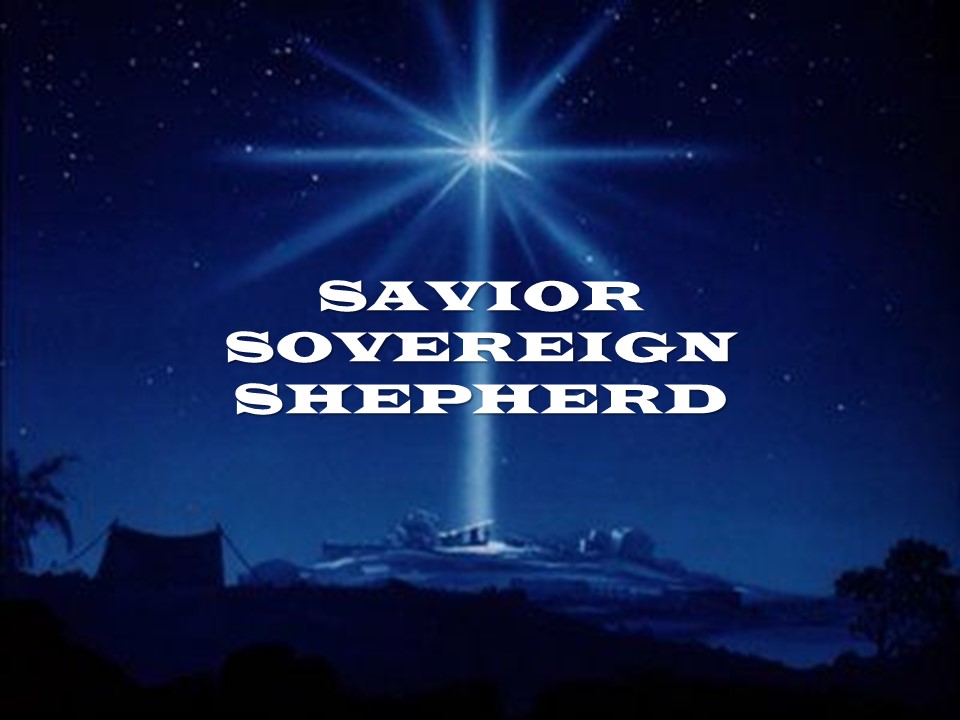
    SAVIOR     SOVEREIGN     SHEPHERD

    Can these be any more blessed ways of understanding who this Christ is who was born in that lowly manger in the little town of Bethlehem so long ago?

    But what does all of that have to do with that long list of strange names at the beginning of Matthew’s Gospel? What’s the point?

    Just this – in that list there are Kings and Scoundrels

    Notables and Nobodies

    Men & Women

    Jews & Gentiles

    Those who were faithful and many who were faithless

    There’s a Prostitute

    Nomads,  Warriors,  Prophets,  Farmers,  Statesmen,  ordinary Joes

    Those who lived in ease

    Those who lived in poverty

    Those who accomplished much

    Those who left nothing behind but their names

    The shunned and the accepted

    The steadfast and the mercurial

    The creative and the dull

    Intellectuals and uneducated commoners

    Christ Jesus came in the likeness and the lineage of fallen, broken, sin-cursed humankind.

    So it is there are none who cannot be touched by Him, nor reconciled to the Father through Him.

    This Savior can save anyone – even me, even you.

    This Sovereign reigns over all and expects to be obeyed.

    And this Shepherd, will guide, protect, provide for, keep and bring home all who are His – safe to their heavenly home.

    This is the miracle of the incarnation.

    This, is Christmas.

    [1] J. C. Ryle, Expository Thoughts on Matthew (New York: Robert Carter & Brothers, 1860), 6.

  • To be, or not to be – A Buzz-kill. Thoughts on Christian Cuevas and The Voice

    December 9th, 2016

    buzzkill_banner-01

    Christian Cuevas on The Voice

    Like many, I’ve been alerted to the recent semifinal performance of [The] Voice contestant Christian Cuevas. He sang the popular worship song, ‘To Worship You I live.”

    And let me start off by affirming both Christian’s undeniable talent, and what I assume is his sincere desire to see his God glorified in the singing of a worship song in such a public venue. I do not question his motives for a moment.

    But I do feel the need to address the wisdom of that choice, given the context of the show – The Voice – itself, and of the greater problem I see in present day popular Christianity. That of a seeming inability to keep some necessary and fitting distinctions as per places like Leviticus 10:10 “You are to distinguish between the holy and the common, and between the unclean and the clean.”

    In the text just cited, the statement is being enjoined upon the Levitical Priesthood, and is spoken especially in connection with the Priests being careful to abstain from wine or strong drink when performing their duties. Why? Because there is something inherently evil in wine or strong drink? No. God condemns neither when used in their proper place and with proper constraints. The concern is one of protecting the faculty of clear judgment and discerning thinking. A principle which I believe applies here, even though intoxicants are not in play. It is the issue of sound judgement, and being able to distinguish between holy and common, clean and unclean.

    Now let me note that to distinguish between holy and common does not necessarily mean that everything that is not “holy” in the sense of being specifically set aside for God’s use is sinful. Rather, there are things which belong to Him alone, and are not to be treated as “common” or for everyday use.

    Two examples of this would be the special anointing oil the priests were to formulate and use only in ceremonies commanded by God, and, the special blend of incense to be burned on the golden altar by the curtain separating the holy place from the holy of holies. Both of these are addressed in Exodus 30. Both of these invite being cut off from God’s people should one take those formulae and compound the substances for personal use. Some things belong to God alone.

    I would argue, worship is one of those things.

    In other words, making worship of the living God an act of performance art, and that, for the entertainment of the unbelieving world, would appear to me to take what is holy, and ‘commonize’ or profane it. And I am uncomfortable with that.

    Now if I haven’t offended some of you enough already, let me take this one step further.

    The absolutely benign lyrics of the song chosen aside (there is nothing in the lyrics that has any reference to who or what is being worshipped or why – making it perfectly appropriate for any lover or idolater to use with equal ease) – the context here is what makes such a profound difference.

    Christian, again, no doubt every inch sincere in his motivations (I don’t know but love calls me to assume so) in fact completely contradicted the intent of the song, by the use of it within that venue.

    How so?

    Because the message ‘To worship You I live’, is being sung, to advance his own career and win a contest. It is to use God’s name (though His name is conspicuously absent) to further his own desires to be performer. It is trading on the name of Christ for personal advancement. It is blending the sacred anointing oil, to wear as perfume. Intentionally? I’m sure not. But in practice. Indeed.

    Note, there is nothing wrong with a Believer (which I assume Christian is) wanting to have a music career. Go for it! We need solid Christians in every stratum of society and the arts. And I am all in favor of his wanting to bear testimony to his God when and where he can. These are good things. But in this use – what belongs to God exclusively – worship, is co-opted both for the entertainment of the world, and the advancement of one’s career.

    I do not condemn Mr. Cuevas in his action. But I do plead with the Church, to reckon with how we have turned ‘worship’ into performance art – which is no longer His and His alone, but is more of a consumer commodity. And ask us to rethink that trend.

    How is it that our Christian culture, has produced this sad state of affairs?

    Perhaps, just perhaps, we’ve been intoxicated by the spirit of the age in such a way, that even we, His royal priesthood, can no longer distinguish between the holy and the common, the clean and unclean. And we are called to just such a thing.


  • As I was reading today – A thought from Deuteronomy 14

    November 29th, 2016

    open-bible-pen

    Deuteronomy 15:1–6 (ESV)

    1 “At the end of every seven years you shall grant a release. 2 And this is the manner of the release: every creditor shall release what he has lent to his neighbor. He shall not exact it of his neighbor, his brother, because the Lord’s release has been proclaimed. 3 Of a foreigner you may exact it, but whatever of yours is with your brother your hand shall release. 4 But there will be no poor among you; for the Lord will bless you in the land that the Lord your God is giving you for an inheritance to possess— 5 if only you will strictly obey the voice of the Lord your God, being careful to do all this commandment that I command you today. 6 For the Lord your God will bless you, as he promised you, and you shall lend to many nations, but you shall not borrow, and you shall rule over many nations, but they shall not rule over you.

    There is wisdom here regarding forgiveness of all kinds. When the offender is a brother or sister in Christ – at some time, whether there has been full satisfaction or not, forgiveness ought to be extended. We may even perhaps see a shadow of Church discipline here, in that those who are “foreigners” do not get the benefit of such a release. Not that we are prevented from it, but it is not demanded by God as it is of our brethren. Those now counted as outside the Body of Christ due to their unrepentance, do not enjoy the very same benefit of those to whom we are joined by one Spirit. Yet the overall tenor is to be generous in our forgiveness. Time may need to be a factor. Some wounds are deep indeed – and may need a large swath of time to heal. But we must let time in fact be taken into account. If you have a brother or sister in the Lord, and the days have been long without forgiveness between you, consider a “seventh year.” Set a termination point. And even if it is not settled – forgive. That we might show the love of Christ He has shown to us.

  • The Extent of the Atonement by David Allen: A Review

    November 28th, 2016

    extent

    The Book I wanted to write – but BETTER!

    At the outset, let me say that this tome is a scholarly tour de force by one of the best friends a conscientious Calvinist can find anywhere.

    David Allen serves as the dean of the School of Preaching, distinguished professor of preaching, director of the Southwestern Center for Expository Preaching and George W. Truett Chair of Ministry at Southwestern Baptist Theological Seminary in Fort Worth, Texas. He was previously Dean of the School of Theology from 2004-2016. He received the B.A. at Criswell College (1978), Master of Divinity at Southwestern Baptist Theological Seminary (1981), and Ph.D. in Humanities with a Major in Linguistics from The University of Texas at Arlington (1987).

    And, in the interest of full disclosure, let me state up front that I am a recovering High-Calvinist. Lest that term confuse you, Dr. Allen gives some helpful definitions near the beginning of his massive and vitally important work on the extent of the atonement of Jesus Christ.

    The main factions in the debate as he lists them in the introduction (noting also that each have nuances within their camps) are as follows –

    Arminianism: Christ suffers for the sins of all mankind with an equal intent to save all people.

    Classic/Moderate Calvinism: Christ suffers for the sins of all mankind, but with an unequal intent/will to save all people.

    High Calvinism: Christ only suffers for the sins of the elect because of his singular intent.

    Hyper-Calvinism: Christ only suffers for the sins of the elect because of his singular intent.

    What separates the last two is brought out numerous places within the book, but has mostly to do with the latter rejecting the free offer of the Gospel.

    That said – let me plunge in.

    Part 1 of the book surveys the extent of the atonement in Church history. It is divided into 4 sections – covering all the major player who may have written on the topic in: 1. The Early & Medieval Era; 2. The Reformation Era; 3. The Post-Reformation Era; and 4. The Modern Era.

    Part 2 is comprised of 3 chapters focusing on the extent of the atonement in the Baptist tradition. Once again surveying most of the key writers and preachers on the atonement among: 1. English General and Particular Baptists; 2. North American Baptists; and 3. Southern Baptists. Being a Southern Baptist himself, this is of particular interest to Dr. Allen, but by no means indicates a short shrift of the others.

    Part 3 is in 2 parts. First is a detailed critical review of every chapter of the highly acclaimed Crossway volume “From Heaven He Came and Sought Her: Definite Atonement in Historical, Biblical, Theological, and Pastoral Perspective.” The 2nd is a concluding chapter titled: “Why Belief in Unlimited Atonement Matters.”

    And let me tell you, that this book soars. It soars conclusively (in my estimation) in securing the reality that an unlimited atonement in extent, NOT application, has been the majority report throughout ecclesiastical history; the majority report among the early Reformers – including Calvin; and was the main expression on the question of the atonement until the encroachment of a strict limitarian view was espoused by Beza, and championed (perhaps) most by John Owen.

    The historical evidence is so overwhelming that the Owenic view was not and never has been “The” Reformed view, as to be virtually incontrovertible. Now as Dr. Allen notes, counting noses isn’t how we do sound theology. We go back to the text of Scripture for that. But it does drive us to consider how so many for so long – solidly IN the Reformed tradition, rejected a strict either/or construct (Jesus either died for all OR for the elect) in favor of a both/and construct, speaking to an unlimited atonement when considered in and of itself, with the reality of a particularistic application of it by God’s sovereign choice.

    Of particular interest in this line is how the extent of the atonement was the most hotly debated topic at the Synod of Dordt, and how both Dordt’s statements and the Westminster’s were written with a measure of intentional ambiguity to allow for those on both sides of this question to sign them in clear conscience.

    All along the way in these chapters, Dr. Allen proves himself to be the consummate myth-buster. Strict limited atonement is THE Reformed position – busted. Amyrault was a heretic – busted. Amyraldianism is nor Reformed – busted. Strict limited atonement came first – busted. All of the Reformers held to strict limited atonement – busted. (You will be shocked to find out just how many of those you thought held to limited atonement – didn’t.) British hypothetical universalism was Amyraldian – busted. So-called 4-point Calvinism is Arminianism – busted. Universal or unlimited atonement must result in universalism – busted! On and on and on.

    In fact, my own journey out of being a high Calvinist to becoming a Moderate/Classical Calvinist years ago, was one of being disabused of many of these myths as I went. Myths that when taken in composite can so jade and confuse, as to make you question sound exegesis simply on the force of how all these men can’t be wrong – even when repeating common errors over and over. How I wish I has had access then to “The Extent of the Atonement: A Historical and Critical Review” by Dr. David Allen. But I do now, and so do you.

    So as to prevent this review from being as long as the book itself (a hefty 848 pages) let me point out what I think are the key strong points, and offer a suggestion for those who want a quicker handle on it all.

    What the book does over and over and over again, is address the principle arguments for a strict limitarian view, both exegetically and logically – and examines how non-limitarians have addressed those same Scripture passages and logic. In the process, by virtue of its unique structure, you get hear dozens of Reformed voices argue against limitarianism. None, surrendering election, or particularization in the application of the atonement. All, in necessary and clarifying context.

    Thus there is a constant reminder not to confound the accomplishment of the atonement with its application.

    Repeated warnings not to buy into a mere instrinsic sufficiency in the atonement as opposed to extrinsic sufficiency.

    Over and over again the negative inference fallacy is exposed, rejected and properly defeated.

    The commercial and pecuniary foundation of so much of Owen’s thinking is debunked.

    The weight placed by so many on the “distributive” versus universal use of “all” is demythologized and properly contexualized each in its proper place.

    The fallacy in Owen’s famous trilemma is exposed and the illogic dismantled.

    How the limitarian view severely discounts justification by faith in its proper place and time.

    And in every place, the centrality of this to the right preaching of the Gospel take its rightful place front and center.

    All this by voice after voice after voice among our Reformed brethren.

    Now maybe you are not going to wade through all 848 – pages, and that with some chapters offering in excess of 800 end notes! I hear your cry. Though I bid you to do it anyway, both for your education and your soul.

    But if you want the shortcut – here is my recommendation. If you only read the detailed refutation of John Owen’s The Death of Death in Christ, in the section bearing his name, and, the section on David Schrock, you will interact with all of the pertinent Scriptures and arguments from the strict limitarian view, and all of the key corrections in exegesis and logic in showing the error of that view. These two alone are worth the price of the book, and a couple of evenings in deep reading and reflection. They will change you.

    David Allen has done an invaluable service to the Body of Christ as a whole, and to Calvinists especially in a critical time in American Christianity. As he said to me in a brief meeting at the recent ETS gathering in San Antonio – (paraphrasing) “I did not write this book against Calvinists, but to make my Calvinist brothers BETTER Calvinists.” That spirit breathes on every page of this book – and spoke to me that way before I ever met the good Doctor.

    I had wanted to write this book every since my own study led me out of strict limitarianism. But I’m glad I didn’t. Because here, it is done so much better. May God be pleased to use it as a much needed corrective in the current swell of interest in Reformed theology. For some, it will give you the permission you’ve been seeking to preach the Gospel the way you know you should have, all along. To the glory of God and the good of His Church.

  • As I was reading Today

    November 28th, 2016

    Coffee cup and old book

    Many of us avoid large swaths of the Old Testament, because they just do not seem relevant to us. But as the Puritan John Flavel noted, the Old Testament serves as the illustration book to the more direct, doctrinal teaching of the New Testament. Seeing the New Testament principles fleshed out in the types, shadows and pictures of the lives and circumstances of God’s people in the OT, gives the Church a ready and uniform set of graphic explanations, that should become so common to us all – that we can readily call them to mind at any time.

    One such place is where I was reading this morning in the book of Deuteronomy. I know, you probably haven’t blown the dust off of that one in a LONG time – if ever. But there are rich and valuable lessons there.

    Take for instance the following: Deuteronomy 7:17–21 (ESV)  17 “If you say in your heart, ‘These nations are greater than I. How can I dispossess them?’ 18 you shall not be afraid of them but you shall remember what the Lord your God did to Pharaoh and to all Egypt, 19 the great trials that your eyes saw, the signs, the wonders, the mighty hand, and the outstretched arm, by which the Lord your God brought you out. So will the Lord your God do to all the peoples of whom you are afraid. 20 Moreover, the Lord your God will send hornets among them, until those who are left and hide themselves from you are destroyed. 21 You shall not be in dread of them, for the Lord your God is in your midst, a great and awesome God.”

    Now the circumstance is evident. This portion is a part of the instructions that God is giving the Children of Israel as they are about to enter the Promised Land. It is a striking parallel to the Believer entering into the fullness of the Christian life, even as Israel’s deliverance from Egypt is a striking parallel to the Believer having been rescued from the slavery of sin to serve Christ.

    With that picture in mind – note the instruction and encouragement God provides here. Couched in a necessary warning as well.

    One of the mighty weapons in the Believer’s arsenal against indwelling sin, is to get a full orbed picture of just what God did in bringing us to salvation in the first place. Underestimating or forgetting the miraculous deliverance that brought us to justification, makes attacking indwelling sin seem larger and more impossible than it truly is. If He did so much in rescuing us from our sin initially – then what will He do in equipping us to root out and rout indwelling sin? Our sin lies to us and makes us imagine the cost is too great in being rid of it. It is too hard, and undoable. But rest assured, the same power that gave our blind eyes sight, opened our deaf ears and breathed life into our dead souls, is still at work to bring us fully into our inheritance. And as verse 21 indicates we are forbidden to fear ANY indwelling sin as too great to be conquered, or to be in dread of it – we are the Lord’s people. He has given us this land.

    Great encouragement indeed!

  • Sermon notes for 2 Peter Part II

    November 27th, 2016

    2-peter-2-graphic-pptx

    2 Peter Part 2

    2 Peter 1:1-3

    Called to the Glory of Being Slaves

    AUDIO FOR THIS SERMON CAN BE FOUND HERE

    Last time, we noted 3 key things in reading, understanding and applying this short letter of 2nd Peter:

    1. Peter is nearing the end of his ministry – due to his impending martyrdom. 2 Peter 1:14 “since I know that the putting off of my body will be soon, as our Lord Jesus Christ made clear to me.”

    This would have put Peter in Rome at the beginning of the persecutions of Emperor Nero (37-68 AD) – as most history and tradition agree.

    2. Peter’s readers: As in 1 Peter, Jewish & Gentile Believers, banished from Rome to the backwaters of Roman outposts.

    1 Peter 1:1 “Peter, an apostle of Jesus Christ, to those who are elect exiles of the Dispersion in Pontus, Galatia, Cappadocia, Asia, and Bithynia,”

    2 Peter 3:1a “This is now the second letter that I am writing to you, beloved.”

    3. The Driving Concern in Peter’s mind: That he leave them a Memorable Legacy.

    Not a legacy wrapped up in remembering HIM well and fondly or in terms of greatness – but that they remember what he taught as the things of highest importance to the Believer in this world – all centered in the knowledge of the person and work of Jesus Christ.

    2 Peter 1:12–15 “Therefore I intend always to remind you of these qualities, though you know them and are established in the truth that you have. I think it right, as long as I am in this body, to stir you up by way of reminder, since I know that the putting off of my body will be soon, as our Lord Jesus Christ made clear to me. And I will make every effort so that after my departure you may be able at any time to recall these things.”

    Peter was laboring to see his readers established in Christ in such a way, that they would live for Jesus as Peter had – or better, as Jesus deserves. He wants the utter best for them, not this present world’s mere shadows.

    You get a good feel how he understands himself in this regard in his opening sentence: “Simeon Peter, a servant and apostle of Jesus Christ.”

    Yes, Peter is a sent one – which is what the word APOSTLE means – and specially ordained AS an apostle by Jesus (Mark 3) – but before he is an apostle, he identifies himself as a “slave”.

    As one commentator notes: “Peter calls himself a servant and apostle of Jesus Christ. The Greek word for servant is literally “slave,” which puts emphasis on being owned by Jesus Christ and being committed to follow and obey him completely.”

    Daniel C. Arichea and Howard Hatton, A Handbook on the Letter from Jude and the Second Letter from Peter, UBS Handbook Series (New York: United Bible Societies, 1993), 64.

    It is interesting to note how often even Christians want to be known by a label that gives them some standing among other Christians.

    Some want to be teachers, or preachers, or scholars etc. They strive after being recognized as pastors or elders or deacons or some other title. And, as has been true throughout Church history – there have even been those who sought to be called apostles as well – even after Jesus’ 12 and Paul passed off the scene.

    But this is not the Spirit of Christ who “though he was in the form of God, did not count equality with God a thing to be grasped, but emptied himself, by taking the form of a servant, being born in the likeness of men. And being found in human form, he humbled himself by becoming obedient to the point of death, even death on a cross.” Philippians 2:6–8

    Peter’s primary self-identification is “servant” of Jesus Christ. He is an apostle only in as much as he is a servant – a slave.

    Slave is WHAT he was. Apostle, merely a role he was assigned.

    In other words, he has given himself over to the authority of another.

    He has surrendered his personal rights of self-government and self-direction, to serve at the whim of another, and devoted to carrying out his Master’s will above all other things.

    Peter does not live in the mindset that he has a life HE wants to live, and now enlists God to help him live out his agenda – but rather he is a surrendered man.

    He views himself as no longer belonging to himself, but as truly OWNED by another – even his Lord and Master Jesus Christ.

    And we might say that everything else in this letter is informed by this mindset.

    So Peter goes on in these opening portions to explore that idea even more.

    2 Peter 1:1 “Simeon Peter, a servant and apostle of Jesus Christ, to those who have obtained a faith of equal standing with ours by the righteousness of our God and Savior Jesus Christ:

    I. So here is peter’s 1st point: SLAVE

    Having “obtained” – the word there meaning – having received the gift – of a faith that is equal to that of the apostles themselves – We need to ask: What do we do with that?

    How does that fact shape or impact our lives as Believers?

    Does that mean we are “apostles” too?

    No.

    But it does mean we get to be SLAVES as well. A faith that is of equal standing to that of the Apostles.

    The equality aspect, the text says, is due to the “righteousness of Christ”. We’re equal in this, because no one brings their own righteousness to the table – but we are all righteous before God because of Jesus’ righteousness imputed to us!

    As for apostleship – Jesus appointed only 12 and there are no more to be expected. The special case of Paul being carefully documented in Scripture – and the Church in the aftermath of the death of the Apostles, showing that they received no others as Apostles, and had to guard against those who falsely called themselves apostles from trying to hi-jack the Church. SEE: 2 Corinthians and Revelation 2 as they speak to that problem directly.

    But it DOES speak to the “calling” which rests upon every believer in Jesus Christ from that day until our own.

    We too are all slaves of Jesus Christ, as we are all partakes of his righteousness.

    We too are those who in coming to Him for salvation have surrendered our autonomy to Him as Lord and Master of our lives.

    In our recent Presidential election, many analysts have noted (without reference to the suitableness of the candidate) that the election was a repudiation of the elitism that had infected all sides of our political system.

    In like manner, the Believer repudiates the Fall in Eden when he or she comes to Christ.

    There, Adam and Eve took on an autonomy that sought to dethrone God.

    In their rebellion, they said to Him, “you have no right to tell us what is right and what is wrong for us – we will take that right to ourselves.” It was cosmic treason against the God who made them for Himself and for His purposes.

    Salvation is at least in part our recognizing of our OWN sinfulness in that rebellion, and seeking – by virtue of Christ’s substitutionary and atoning sacrifice, to reconcile us back to God  – to being back into right relationship with Him.

    We are to live at His behest, fulfilling His cause and purposes in the world. And above all – as we’ll see in v3 – we have a truly amazing call that is far higher than anything else in life we might imagine.

    I want to say a word more here about the nature of the Christian’s “slavery” to Christ.

    People can be slaves by virtue of any number of wretched things.

    As we saw in our own Antebellum America, there can be a slavery which demeans mankind. That degrades and abases him.

    Sources say that even today, the modern slave trade is a 35 billion dollar a year industry – where people are treated as chattel and less than human, to satisfy the wicked desires of others for labor, sexual gratification and other things. Globally, as many as 49 million people are enslaved under this abominable corruption today.

    And then there is the slavery of sin itself. Peter will speak more about this directly in chapter 2 where he says of the False Teachers that:  “These are waterless springs and mists driven by a storm. For them the gloom of utter darkness has been reserved.  For, speaking loud boasts of folly, they entice by sensual passions of the flesh those who are barely escaping from those who live in error. They promise them freedom, but they themselves are slaves of corruption. For whatever overcomes a person, to that he is enslaved.” 2 Peter 2:17–19

    We can be slaves of ignorance.  Not knowing the truth keeps people bound in all sorts of ways.

    So Paul warns in Colossians 2:8 “See to it that no one takes you captive by philosophy and empty deceit, according to human tradition, according to the elemental spirits of the world, and not according to Christ.”

    But there are kinds of slavery that in fact, are the very root of blessing!

    Like when 2 Corinthians 10:5 tells us we can bring every thought captive to obey Christ – so that we are freed from minds that obsess on foolishness, fear, lust, greed, pride, envy, or just run away with us so as to rob us of peace and trust in Christ Jesus.

    There is the slavery of AWE. Where we have seen that which is so transcendent and beautiful and glorious, that we are spoiled for the world – so that its temporary and shallow glitter is no longer binding – but frees us to think on Christ and glories unimaginable.

    And there is above all the slavery of LOVE. When one’s heart is so drawn out by love for another, that no other kind of chain or fetter could ever bind us so tightly. And that is a slavery of utter and complete freedom and joy – for we are bound to that which blesses and satisfies and delights and causes us to flourish and grow.

    This is Peter’s slavery to Christ.

    This is the slavery Peter wants his readers to enter fully into.

    To give up the slavery to one’s own sinful passions, to be slaves of the Christ who loves us so, that He gave His own blood to purchase us, that He might bless us for all eternity in ways we have not even begun to fathom.

    To give up our foolish grip on self – to have the glory of the Triune God in all of His unfathomable wonder.

    II. Peter’s 2nd point then is: KNOWLEDGE “2 May grace and peace be multiplied to you in the knowledge of God and of Jesus our Lord.”

    KNOWLEDGE

    That we might not just “get saved” and that’s it – but that grace and peace grow and continue in our lives. That grace and peace be MULTIPLIED.

    That we come to know more and more how wondrously we are favored and loved and desired and provided for by the God of all in Christ Jesus.

    So 1 Corinthians 2:9 reminds us: “What no eye has seen, nor ear heard, nor the heart of man imagined, what God has prepared for those who love him”—


    III. Peter’s 3rd point: “3 His divine power has granted to us all things that pertain to life and godliness, through the knowledge of him who called us to his own glory and excellence,”

    GRANTED  This must be done by virtue of God’s own power – not our own.

    That we have been granted by God – ALREADY – all that is needed to enter into this life as it is being described here.

    That the work of Christ on the cross did all that is necessary for our justification – for our reconciliation to – and right standing with – God the Father – through the sacrifice of His own blood for our sins.

    But in addition to that – He ascended into Heaven that He might send His own Spirit to indwell us and empower us for all these things.

    That we are not saved from sin, and left to our own devices to grow and live out life – but are partakes of more than we ever imagined.

    This is why Peter will keep hammering the idea that everything is wrapped up in the knowledge of Jesus Christ – in understanding all Jesus has done for us, and laying hold of it in experience.

    IV. Peter’s 4th point: 2 Peter 1:3 His divine power has granted to us all things that pertain to life and godliness, through the knowledge of him who called us to his own glory and excellence,

    All of this is wrapped up in our “CALLING”.

    Godliness: “In the Greek world this virtue pointed to appropriate relationships toward the authorities in one’s life: the gods, dead ancestors, and family/parents. Or, as Foerster puts it, “In addition to the gods, relatives, rulers, judges, oaths, the law, and the good may all be objects; enjoying divine protection, they must be respected and upheld.”

    Peter H. Davids, The Letters of 2 Peter and Jude, The Pillar New Testament Commentary (Grand Rapids, MI: William B. Eerdmans Pub. Co., 2006), 181.

    The life we have been called to in Christ, which is embodied in godliness.

    His divine power has not granted to us the ability to fix our cars, make more money, get better jobs or “succeed” in life the way the World counts success.

    But it HAS granted us the ability to live the CHRISTIAN life, and that – for the glory of God in the hope of Heaven.

    The misreading of this so as to make “life” here mean whatever kind of life I may choose to live – is wretchedly awry.

    He has called us to His own glory and excellence – to live empowered by the Spirit in carrying out the wishes, commands and purposes of God in this world, and NOT to enable me to carry out my personal desires.

    He doesn’t serve my purposes, but rather, in salvation, I am brought back into line with His eternal purposes.

    What does this look like? It looks like becoming a partaker of the divine nature, so as to escape the corruption of the world, centered in sinful desire! Nothing else!

    In other words, becoming more and more like Christ.

    To bear the image of His own glory and excellence without distortion or diminishment.

    The question to ask then- when my resources for facing life and living godly in this upside-down world seem scant is: Where am I lacking in my knowledge of Him? Intellectually and experientially?

    1. Do I understand the love that sought me? Even in the lowest parts of Hell?
    2. Do I understand the love that bought me at the cost of His eternal blood and glory?
    3. Do I understand WHO it was that did all of this?
    4. Do I understand what it truly means to be reconciled and adopted?
    5. Do I understand the reality of His gift of the indwelling Spirit?
    6. Do I truly grasp the promise of what lies ahead?
    7. Do I live as though I am called to glory and excellence, therefore seeking Him for those ends above all?

    This beloved is the wonder, the privilege, the glory – granted exclusively to the servants, the SLAVES of Jesus Christ.

    Oh how we settle for so little – seeking God to give us the stuff of this life – when He has prepared for us the stuff of His own eternal glory.

    Believing that and living like that – this is what the Bible calls living by faith.

    Now, may we begin to enter into it.

  • Sermon Notes for Introduction to 2 Peter: Parting Words

    November 16th, 2016

    parting-words

    PARTING WORDS

    A Study in 2 Peter

    Part 1

    Introduction & Overview


    The last words of people when they are about to die have always been of great interest to me.

    They tell you so much about what the person considers truly important.

    Such things can be as shockingly bankrupt as they might be blindly oblivious or stunningly blessed.

    Sometimes death comes unexpectedly and the last words of those who die in such a manner are often extraordinarily mundane.

    Others, who are aware of what is about to take place, demonstrate either their true grasp of it, or their unwillingness to face it and retreat to simply ignoring it.

    Tallulah Bankhead, actress of a previous generation simply said: “Codeine…Bourbon” – and perished as she had lived. A slave to those substances.

    Vittoria Accoramboni – a famous Italian noblewoman of the 16th century – had her husband murdered so she could marry another. Being murdered herself at the age of 28 blasphemously said: “Jesus, I pardon you.” As though God was responsible for her sin and its wages.

    Queen Victoria reported that her husband, Prince Albert said: “I have had wealth, rank and power, but if this were all I had, how wretched I should be.” And a few minutes later uttered: “Rock of Ages, cleft for me. Let me hide myself in thee.”

     John Bell, the last person executed in Britain under the age of 16, hanged at the age of 14 for murdering a 13 year old boy for 9 shillings – had a sudden moment of clarity: “Lord have mercy on us. All people be warned by me.”

     Aubrey Vincent Beardsley a 19th century artist who was mostly known for his obscene and sexually graphic art. Dying at the age of 25 of tuberculosis sent a note to his publisher that had the heading: “Jesus is our Lord & Judge.” And in it he wrote: “I implore you to destroy all copies of Lysistrata – by all that is holy – all obscene drawings.”

     Think of the unaware words of famous surgeon John Abernathy who simply cried out: “Is there anybody in the room?”

     Compare then last words of Joseph Bellamy, friend and student of Jonathan Edwards. Someone asked him as he lay dying, “If God should send you to Hell, what would you do there?” And he replied: “I will tell them forever that Jesus is precious.”

    I can tell you that out of the hundreds I’ve read, I’ve never come across ones like:

    I prayed too much.

    I gave up too many sins.

    I studied my Bible too much.

    I worshipped God far too often.

    I loved Christ and His people too much.

    Such sentiments never appear. Never. And it does not take much thought to figure out why not.

    Peter, like a good father to his children, under the direction of the Spirit is putting forth his last words to them in this letter.

    Before we begin to unpack some of that, it might be helpful to go back and get a feel for Peter’s situation as he wrote – and the situation of those he was writing to.

    1. Situation of Peter – about to be martyred. 2 Peter 1:14 “since I know that the putting off of my body will be soon, as our Lord Jesus Christ made clear to me.”

    This would have put Peter in Rome as the beginning of the persecutions of Nero – as most history and tradition agree.

    2. Situation of his readers: As in 1 Peter, Jewish & Gentile Believers, banished from Rome to the backwaters of Roman outposts.

    1 Peter 1:1 “Peter, an apostle of Jesus Christ, To those who are elect exiles of the Dispersion in Pontus, Galatia, Cappadocia, Asia, and Bithynia,”

    2 Peter 3:1a “This is now the second letter that I am writing to you, beloved.”

    3. Driving Concern in Peter’s mind: That he leave them a Memorable Legacy.

    Which legacy is not wrapped up in being sure they remember HIM well and fondly or in terms of greatness – but that they remember what he taught as the things of highest importance to the Believer in this world – all centered in the knowledge of the person and work of Jesus.

    2 Peter 1:12–15 “Therefore I intend always to remind you of these qualities, though you know them and are established in the truth that you have. 13 I think it right, as long as I am in this body, to stir you up by way of reminder, 14 since I know that the putting off of my body will be soon, as our Lord Jesus Christ made clear to me. 15 And I will make every effort so that after my departure you may be able at any time to recall these things.”

    So, he then organizes his thoughts around three things: And the chapters follow that outline fairly closely with just a smidge of overlap in places.


     Chap. 1 / The Foundation of the Believer’s Life and Thought.

    2 Peter 1:1 “Simeon Peter, a servant and apostle of Jesus Christ, to those who have obtained a faith of equal standing with ours by the righteousness of our God and Savior Jesus Christ:”

     Position  Provision  Program

    Drawing from his first letter, he is adamant once again to help the Believer establish in their own hearts and minds who they really are in Christ Jesus. A true, Biblical Christian identity.

    Then, he focuses upon what God has provided for us to live out this identity in a fallen and variously hostile world. All wrapped up in the supreme gift of Christ to the Church in His resurrection – that of the Holy Spirit.

    And lastly, that we keep in mind that God has a plan, a program for the ages that He is carrying out. Life is not just some random, pointless existence. God is moving all of human history toward a specific end, and only the one born again by the Spirit of Christ gets to live in that reality.

    This infuses every experience in life, every decision and life circumstance with meaning and potential to impact our eternal existence.


     Chap. 2 / A Forewarning of the most Formidable Challenge they will face.

     2 Peter 2:1 “But false prophets also arose among the people, just as there will be false teachers among you, who will secretly bring in destructive heresies, even denying the Master who bought them, bringing upon themselves swift destruction.”

    This warning is twofold:

    1. A warning against false teachers, and,
    2. A warning against the doctrines they espouse.

    It is common today to hear people say “I don’t want to hear about or learn doctrine, just give me Jesus or the Bible.”

    While that sounds spiritual, it is in fact quite naïve.

    Doctrine, is nothing more than what the Bible teaches, and certainly nothing less.

    And each of us HAS, whether we identify it as such or not – a “doctrine” of Jesus Christ: Who He was and is and what He came for, accomplished and rose again to do. And what that means for the future.


     Chap. 3 / A look at the Future they are to be Living and Striving for.

    This too is 2-fold:

    1. Future glory for the saints as motivation for how we live here and now.
    2. Future judgment for all of those outside of Christ.

     2 Peter 3:1–4 “This is now the second letter that I am writing to you, beloved. In both of them I am stirring up your sincere mind by way of reminder, 2 that you should remember the predictions of the holy prophets and the commandment of the Lord and Savior through your apostles, 3 knowing this first of all, that scoffers will come in the last days with scoffing, following their own sinful desires. 4 They will say, “Where is the promise of his coming? For ever since the fathers fell asleep, all things are continuing as they were from the beginning of creation.”

    That this present existence will in fact come to an end. Christ will return. This age will give way to the new heaven and the new earth as prophesied.

    The world will not just spin endlessly as it does now, and no one will simply cease to exist – but how and where and under what conditions we will spend eternity is fused together with how we lived here and now, most especially in relation to Jesus Christ as King.

    By means of a practical application, we might well ask ourselves what it is we are leaving those who come behind us?

    Both our own children and/or grandchildren, and the generations of the Church who will follow us should the Lord delay His return.

    To you parents and grandparents here – what will you leave your heirs with?

    What will you have passed on to them?

    Will that be simply material?

    If spiritual, what will that look like?

    What will they take away from having lived with you and watched you and listened to you as vital and important?

    Not what you SAID was important, but what you actually demonstrated by your commitment of time and money and pursuit.

    What captured your fondest attention?

    Did you give them any sense of what is worth pursuing and why?

    Have you told them why you lived as you live, and how you made the decisions you made?

    What will your legacy be?

    And will it be useful for the state of their everlasting souls?

    I am so grateful that I can look to the example of my own Mom & Dad in this regard.

    Oh, they were deeply flawed people – broken and marred by sin as all the rest of us.

    But the way they lived demonstrated to us that they had spiritual priorities that were to inform and direct everything else in life – in terms of serving the Christ who had saved them from their sins by His substitutionary death.

    They prayed – because they believed that as God’s adopted children, Father God heard.

    They read and studied and loved Gods Word because it was to them – God’s Word.

    They challenged sin in their lives because they wanted to be delivered from it as is commensurate with why they had been saved.

    They wanted to live as the saying is Coram Deo – before the face of God.

    And they lived anticipating Christ’s return, or going to be with Him in death.

    This is the legacy they left us as their children.

    The same legacy I trust I am leaving for my own daughter and grandchildren.

    And all of you!

    Not a legacy of religious perfectionism, but of the pursuit of holiness out of gratitude for salvation and the desire to live in concert with Christ’s goal of freeing me to be conformed to His image.


     The lyrics to Steve Green’s song ”Find us Faithful” come to mind.

    We’re pilgrims on the journey

    Of the narrow road

    And those who’ve gone before us line the way

    Cheering on the faithful, encouraging the weary

    Their lives a stirring testament to God’s sustaining grace


    Surrounded by so great a cloud of witnesses

    Let us run the race not only for the prize

    But as those who’ve gone before us

    Let us leave to those behind us

    The heritage of faithfulness passed on through godly lives


    After all our hopes and dreams have come and gone

    And our children sift through all we’ve left behind

    May the clues that they discover and the memories they uncover

    Become the light that leads them to the road we each must find

    CHORUS: Oh may all who come behind us find us faithful

    May the fire of our devotion light their way

    May the footprints that we leave

    Lead them to believe

    And the lives we live inspire them to obey

    Oh may all who come behind us find us faithful


    But the real force of this example is in how Peter emulates and brings attention to how it is Christ Jesus has provided for us.

    This is the heritage of the Christian. This is the wonder that Christ has secured for us.

    He has opened our eyes through the Gospel to our lost condition apart from Christ.

    His Word has informed us of how God created us for Himself, and how sin came and ruined mankind, separating us from the source of both physical and everlasting life – leaving the human race under the awful judgment of God.

    How Jesus, God in human flesh came, and died for our sin on the cross of Calvary – taking the just wrath of God against us upon Himself, that we might be reconciled to the Father, forgiven of our sin and guilt, and made new creations in Him.

    And promises that all who trust in His atoning sacrifice may be born again, adopted in the very family of God, and have everlasting life.

     A life that begins even now, living out the eternal plans and purpose of the One who created us for Himself – as 2 Peter 1:3 “His divine power has granted to us all things that pertain to life and godliness, through the knowledge of him who called us to his own glory and excellence”

    Beloved – what a heritage we have been left!

    Look how Jesus prepared for us in appointing Apostles to found and build the Church…

    Sending His Spirit to indwell us and empower us…

    Opening the door to the Father throne in unfettered prayer…

    Providing other Believers to walk with us…

    Preserving His Word that we might know His heart and mind every step of the way…

    Now, may we leave that same glorious Gospel to those who follow us – not in word only, but in lives lived in the these things being the central and absolute essentials of living in God’s reality in this universe.

    This is Peter’s emphasis. Seeing all that has been provided for us, ought to impact us in powerful ways.

    Since we are IN Christ, BY Christ, let us be occupied with His person and work until we are at last one WITH Christ in glory.

     2 Peter 3:11–13 “Since all these things are thus to be dissolved, what sort of people ought you to be in lives of holiness and godliness, 12 waiting for and hastening the coming of the day of God, because of which the heavens will be set on fire and dissolved, and the heavenly bodies will melt as they burn! 13 But according to his promise we are waiting for new heavens and a new earth in which righteousness dwells.”

     2 Peter 3:17–18 “You therefore, beloved, knowing this beforehand, take care that you are not carried away with the error of lawless people and lose your own stability. 18 But grow in the grace and knowledge of our Lord and Savior Jesus Christ. To him be the glory both now and to the day of eternity. Amen.”


  • Funky Hermeneutic

    October 26th, 2016

    THE VIDEO CAN BE FOUND HERE

    funkyslides

  • Sermon Notes for 10/23/2016 – What the Bible says about Reading the Bible

    October 24th, 2016

    slide1

    What The Bible Says About Reading The Bible

    Various texts

    Luke 24:13-49; 2 Tim. 2:15; 2 Tim. 3:14-17

    AUDIO FOR THIS SERMON CAN BE FOUND HERE

    Don’t pass up the “Special Music” link at the same page. I think you’ll really enjoy “Funky Hermeneutic”


    Hermeneutics: is a big word for – interpretation.

    When we talk about hermeneutics we are simply referring to the principles by which we read and rightly interpret what ANY text has to say – but especially the Bible.

    As you might imagine, over the centuries, scholars have assembled a number of principles for good interpretation, and they are quite commonsensical and useful.

    Do I know what the words themselves mean in their written languages?

      So if I read the word “bonnet” it matters if I am reading an American author who might be speaking about a lady’s hat, versus a British author who is probably referring to the hood of his car.

    Do I know what the words mean in relation to one another?

    Do I know what the author was trying to convey to his or her audience in their context?

    Do I have some sense of how the original reader would have understood it?

    Are there figures of speech, puns, hyperbole, colloquialisms, metaphors etc.?

    You and I employ these principles every day when we read everything we read. We do it automatically for the most part, without really thinking about it at all.

    When I was writing and producing radio and television commercials, we had an announcer who would sometimes miss his cues. He would often say: “That copy runs like a striped ape!”

    Now there are several problems with that statement, not the least of which there is – there’s no such thing as a striped ape. What he was saying, was that the script led him to speed up his speech to the point it became something else altogether – unrecognizable as normal speech and thus ran too fast.

    Virtually no one outside of our professional circles would have any idea what he was saying had this been printed – and especially if it were read by someone who did not speak English well.

    So one must bring those same basic skills to reading the Bible.

    Not only were our Bibles originally written in 3 different languages, Hebrew, Chaldean and Greek, it bears all same forms of speech we’ve just mentioned. Thank goodness for a several millennia of scholars to compare and interpret and get to the bottom of most of these issue so as to give us reliable and readable translations.

    My goal this morning, is simply to point out some of the ways the Bible itself demonstrates and counsels us to read it – so as to get the best benefit from it.

    1. Comprehensively: Colossians 4:16 “And when this letter has been read among you, have it also read in the church of the Laodiceans; and see that you also read the letter from Laodicea.”

    Rev. 2:7; 2:11; 2:17; 2:29; 3:6; 3:13; 3:22

    Even these readers were not to read only what seemed to immediately apply to themselves – but were to consider all God says to His people in all cases.

    It is easy for us to pay attention only to those places that are familiar to us, or seem the clearest or easiest to access. But the WHOLE Bible is the Word of God and reading it as a whole vastly improves our understanding of each part individually.

    This serves also as a caution against ABSOLUTIZING! How often, one verse on a topic is cited, as though that one verse says all there is to say on a topic, and then the Word of God is distorted and becomes harmful instead of a blessing.

      Example: NASB – Malachi 2:16 “For I hate divorce,” says the LORD, the God of Israel, “and him who covers his garment with wrong,” says the LORD of hosts. “So take heed to your spirit, that you do not deal treacherously.”

      Jeremiah 3:6–8 “The LORD said to me in the days of King Josiah: “Have you seen what she did, that faithless one, Israel, how she went up on every high hill and under every green tree, and there played the whore? 7 And I thought, ‘After she has done all this she will return to me,’ but she did not return, and her treacherous sister Judah saw it. 8 She saw that for all the adulteries of that faithless one, Israel, I had sent her away with a decree of divorce. Yet her treacherous sister Judah did not fear, but she too went and played the whore.”

    In Malachi God is addressing those who are unfaithful to their vows and getting out of a marriage to be with someone else.

    In Jeremiah He is addressing the spiritual adultery of Israel and why divorcing her is the right form of punishment.

      So that in Matthew 1:19 when Joseph finds out Mary is pregnant, the text says: “And her husband Joseph, being a just man and unwilling to put her to shame, resolved to divorce her quietly.”

    How does the whole of Scripture deal with a topic? So we must read comprehensively if we are to form mature and fully orbed understandings.

    1. Intelligently: Nehemiah 8:5–8 “And Ezra opened the book in the sight of all the people, for he was above all the people, and as he opened it all the people stood. And Ezra blessed the LORD, the great God, and all the people answered, “Amen, Amen,” lifting up their hands. And they bowed their heads and worshiped the LORD with their faces to the ground…the Levites, helped the people to understand the Law, while the people remained in their places. They read from the book, from the Law of God, clearly, and they gave the sense, so that the people understood the reading.”

    Note the 2-fold action – It must be read CLEARLY, and, we must understand the SENSE of what is read.

    The Bible is not to be approached mystically like it is a code book.

    God is rational, and He communicates rationally and logically.

    We must ask “WHAT DOES THIS MEAN?” before we ask, “what does this mean to me?” Without reading the Bible as though the author was intending to get ideas across to the original readers given their circumstances and situations, we cannot arrive at a legitimate application for ourselves.

      2 Peter 3:15–16 “And count the patience of our Lord as salvation, just as our beloved brother Paul also wrote to you according to the wisdom given him, 16 as he does in all his letters when he speaks in them of these matters. There are some things in them that are hard to understand, which the ignorant and unstable twist to their own destruction, as they do the other Scriptures.”

    Just because someone uses a Bible verse, it does not automatically mean they are using God’s Word correctly.

    I have often said that the single must underutilized spiritual gift God has given us is grey matter!

    One way we read intelligently, is not making the unique events in Scripture the normative.

    Miracles are miracles for instance, precisely because they are not the norm.

    Manna was but temporary – and never meant to be normative

    The Pillar of cloud and fire – meant only for a time and in a unique place

    Only ONE ax head was made to float – and that – only once

    There was only one Samson

    Not many were raised from the dead

    Paul had a Macedonian vision – but not a vision to each and every place

    Gideon’s “fleece” was not repeated by others

      2 Timothy 2:15 “Do your best to present yourself to God as one approved, a worker who has no need to be ashamed, rightly handling the word of truth.”

    It takes intelligent, thoughtful labor to study and understand God’s Word well. 

    1. Christologically: John 5:39–40 “You search the Scriptures because you think that in them you have eternal life; and it is they that bear witness about me, 40 yet you refuse to come to me that you may have life.”

    To look at the Bible as a book of good information, even moral or ethical information, apart from Christ, is to misuse and abuse the book.

    This is why we must be careful not to proof-text, and use individual verses out of their context to prove a point or beat someone over the head with.

    I must ask “what does this say about who Christ is and what He has done?” And this is especially true of the Old Testament which Jesus was speaking about here.

    Remember the portion we had read for us from Luke at the beginning? It is describing Jesus meeting two travelers on the road to a city called Emmaus after His resurrection.

    As their discussion continues, note the 3-fold reference to the Scriptures:

      After questioning them about their mindset and experiences Jesus says: ” 25 And he said to them, “O foolish ones, and slow of heart to believe all that the prophets have spoken! 26 Was it not necessary that the Christ should suffer these things and enter into his glory?” 27 And beginning with Moses and all the Prophets, he interpreted to them in all the Scriptures the things concerning himself.”

    His concern here is that they did not understand what had happened in the crucifixion, because they did not understand and BELIEVE their Bibles! In this case, the OT.

      Then after He reveals Himself to them, we read: 31 And their eyes were opened, and they recognized him. And he vanished from their sight. 32 They said to each other, “Did not our hearts burn within us while he talked to us on the road, while he opened to us the Scriptures?”

      Later still, when these 2 return to the Apostles we read: 44 Then he said to them, “These are my words that I spoke to you while I was still with you, that everything written about me in the Law of Moses and the Prophets and the Psalms must be fulfilled.” 45 Then he opened their minds to understand the Scriptures, 46 and said to them, “Thus it is written, that the Christ should suffer and on the third day rise from the dead, 47 and that repentance for the forgiveness of sins should be proclaimed in his name to all nations, beginning from Jerusalem.

    Notice how Jesus did not give them some new revelation at this point, but opened their minds to understand their Bibles!

    1. Reverently: Daniel 10:10–11 “And behold, a hand touched me and set me trembling on my hands and knees. 11 And he said to me, “O Daniel, man greatly loved, understand the words that I speak to you, and stand upright, for now I have been sent to you.” And when he had spoken this word to me, I stood up trembling.”

      Isaiah 66:1–2 “Thus says the LORD: “Heaven is my throne, and the earth is my footstool; what is the house that you would build for me, and what is the place of my rest? 2 All these things my hand has made, and so all these things came to be, declares the LORD. But this is the one to whom I will look: he who is humble and contrite in spirit and trembles at my word.”

    This opens up the need for prayer in our study. Recognizing that this is God speaking regarding eternal realities that are contrary to the World and our fallen natures – and how prone we are to misread, misconstrue and misapply them if we are not careful.

    God’s Word is never to be approached lightly and carelessly, as though it has been corrupted and is no longer reliable.

      So Jesus can remind His listeners Matthew 5:18 “For truly, I say to you, until heaven and earth pass away, not an iota, not a dot, will pass from the Law until all is accomplished.” Not the smallest particle will be lost.

      And when debating with the Sadducees in Matt. 22, His entire point is built upon the present tense of a word being used in the Scripture versus the past tense. Matthew 22:31–32 “And as for the resurrection of the dead, have you not read what was said to you by God: 32 ‘I am the God of Abraham, and the God of Isaac, and the God of Jacob’? He is not God of the dead, but of the living.”

    1. Conclusively: Revelation 22:18–19 “I warn everyone who hears the words of the prophecy of this book: if anyone adds to them, God will add to him the plagues described in this book, 19 and if anyone takes away from the words of the book of this prophecy, God will take away his share in the tree of life and in the holy city, which are described in this book.”

      With this – do not try to go beyond it. Deuteronomy 29:29 “The secret things belong to the LORD our God, but the things that are revealed belong to us and to our children forever, that we may do all the words of this law.”

      Deuteronomy 13:1-  “If a prophet or a dreamer of dreams arises among you and gives you a sign or a wonder, 2 and the sign or wonder that he tells you comes to pass, and if he says, ‘Let us go after other gods,’ which you have not known, ‘and let us serve them,’ 3 you shall not listen to the words of that prophet or that dreamer of dreams. For the LORD your God is testing you, to know whether you love the LORD your God with all your heart and with all your soul. 4 You shall walk after the LORD your God and fear him and keep his commandments and obey his voice, and you shall serve him and hold fast to him.”

    Where the Bible speaks, it has the last word on that topic.

    This was a key issue in the Reformation and why we hold to “sola Scriptura”. The Bible is the final authority on what it addresses, not synods, councils, Popes, and least of all – culture!

    That doesn’t mean we’ve always interpreted it correctly, but it DOES mean that what it says, what it teaches, is binding truth on all people, everywhere and at all times.

    1. Obediently: Ezra 7:10 “For Ezra had set his heart to study the Law of the LORD, and to do it and to teach his statutes and rules in Israel.”

      Psalm 119:9 “How can a young man keep his way pure? By guarding it according to your word.”

      Deuteronomy 11:13–25 “And if you will indeed obey my commandments that I command you today, to love the LORD your God, and to serve him with all your heart and with all your soul, 14 he will give the rain for your land in its season, the early rain and the later rain, that you may gather in your grain and your wine and your oil… Take care lest your heart be deceived, and you turn aside and serve other gods and worship them; 17 then the anger of the LORD will be kindled against you, and he will shut up the heavens, so that there will be no rain, and the land will yield no fruit, and you will perish quickly off the good land that the LORD is giving you. 18 “You shall therefore lay up these words of mine in your heart and in your soul, and you shall bind them as a sign on your hand, and they shall be as frontlets between your eyes. 19 You shall teach them to your children, talking of them when you are sitting in your house, and when you are walking by the way, and when you lie down, and when you rise. 20 You shall write them on the doorposts of your house and on your gates, 21 that your days and the days of your children may be multiplied in the land that the LORD swore to your fathers to give them, as long as the heavens are above the earth. 22 For if you will be careful to do all this commandment that I command you to do, loving the LORD your God, walking in all his ways, and holding fast to him, 23 then the LORD will drive out all these nations before you, and you will dispossess nations greater and mightier than you. 24 Every place on which the sole of your foot treads shall be yours. Your territory shall be from the wilderness to the Lebanon and from the River, the river Euphrates, to the western sea. 25 No one shall be able to stand against you. The LORD your God will lay the fear of you and the dread of you on all the land that you shall tread, as he promised you.”

    The things God promises to bless us with, in this case the material blessings He promised Israel as foreshadows of the spiritual blessings we may enjoy in Christ – are tied proportionally to our obedience to His Word.

    We cannot expect His blessings, when we ignore His will for us.

    1. Memorably: Psalm 119:11 “I have stored up your word in my heart, that I might not sin against you.”

    What is teaches must be really taken in and laid to heart if it is to have a transformative effect in the soul.

    We have often talked about the “noetic” effects of sin. How that ever since the The Fall. Al Mohler lists them as:

    Ignorance; Distractedness; Forgetfulness; Prejudice; Faulty; perspective; Intellectual fatigue; Inconsistencies; Failure to draw correct conclusions; Intellectual apathy; Dogmatism; Intellectual pride; Vain imagination – thinking about things we ought not; Miscommunication; Partial knowledge.

    Now deliberate memorization is a great tool here, but in truth, simple repetition is truly effective. The more one reads it, reads in larger portions and takes time to actually think about what’s read, the more it is ingested.

    And the more it is taken in, the more it shapes how we think and what occupies our chief thoughts.

    1. Comprehensively Not in isolated bits and pieces.
    2. Intelligently – Engaging our God given intellect in its highest faculties.
    3. Christologically – The person and work of Christ as the center-point of all of God’s plans and purposes with creation.
    4. Reverently – The Bible isn’t good advice or a collection of religious and moral myths, it is God speaking.
    5. Conclusively – Taking God’s Word as our final authority.
    6. Obediently – Not substituting mere knowledge for actual possession.
    7. Memorably – Enough so as to inform our opinions, and shape our thoughts and desires.

    And why all of this? That we might know Christ, and the fullness of the salvation He has provided for us in His substitutionary death, burial and resurrection.

  • Walking in the Power of the Spirit: Sermon Notes

    October 16th, 2016

    walk-in-the-spirit-logo

    Walking in the power of the Spirit

    Luke 3:21-22; 4:1-15

    Galatians 5:13-26

    AUDIO FOR THIS SERMON CAN BE FOUND HERE

    WikiPedia: “Popular psychology (sometimes shortened as pop psychology or pop psych) is the concepts and theories about human mental life and behavior that are purportedly based on psychology and that find credence among and pass muster with the populace.”

    Psychology Today Magazine – Mar. 25, 2013: 4 Things Psychology gets wrong – Alice Boyes, Ph.D.

    Four experts to point out psychology advice they’ve read or heard in the popular press that they disagree with (or where the research points to more nuanced recommendations).

    Visualizing Having Achieved Your Goals. “Research has found that imagining you already have achieved a goal weakens your motivation to work towards it because when you feel like you already have something it’s natural to feel like nothing more needs to be done.

    Personal Empowerment. “True personal empowerment is not about having a feeling, it’s about having a real impact on our environment and the people in it. Studies show that acquiring real personal empowerment involves a process of taking actions that demonstrate real world results.

    Change Happens When You’re Ready?…In my more than 20 years of experience, I’ve come to understand that “ready”–or the tipping point of change–often means ‘when the consequences of our behavior outweigh the value of that behavior to us’. In other words, when the pay out (consequence) becomes greater than the pay back (value) we are prompted by circumstance to change what we are doing.

    Positive Thinking “I’ve seen the harm it’s done to people who live with chronic pain or illness. When they’re repeatedly told that if they’d just think positively, they’d get better, they then blame themselves when that fails to happen.

    I am sure Dr. Smith can tell us loads about Pop-Medicine. Like this poor guy who bought into the colloidal silver trend, and after 4 weeks developed irreversible argyria. No, he is not a Smurf – but I’ll bet he feels like one.

    But Christianity and Biblical Theology suffers from the same ailment: Concepts and theories about the spiritual life, that gain widespread traction among Christians, which may be rooted in little or no true Biblical exegesis.

    One of the places where this occurs is when we begin to talk about what it means to walk in the Spirit, or be led by the Spirit, etc.

    Often, the teaching on that subject is drawn more from some people’s experiences and what may be their correct or incorrect analysis of those experiences, than what the Bible actually teaches on the subject.

    It is into those troubled murky waters I want to wade – if only a bit today. And that, by drawing first from what Jesus modeled for us in the Gospel of Luke, and then comparing that with what Paul taught in Galatians chapter 5.

    Let me be clear at the outset, this study today is not about the gifts of the Spirit. That will be the subject of another sermon or two down the road.

    Today is about living a Spirit filled, or Spirit led life. And it may be far different than many of us have conceived.

    We must see it NOT in terms of popular Christianity – what has passed into the zeitgeist of the Church but may not actually be Biblical – and instead see it as modeled in Jesus in Luke 3-4 and, explicated by Paul in Galatians 5.

    Let’s look at the passage in Luke 1st.

    4 things in a progression.

    1. The Holy Spirit descended on Jesus (Luke 3:22)
    2. Jesus, full of the Holy Spirit, returned from the Jordan (Luke 4:1a)
    3. He was led by the Spirit in the wilderness for 40 days, being tempted by the devil. (Luke 4:1b-2a)
    4. It is after this – “Jesus returned in the power of the Spirit to Galilee.”

    Compare Galatians for a similar pattern –

    1. “And because you are sons, God has sent the Spirit of his Son into our hearts, crying, “Abba! Father!” (Gal. 4:6)
    2. Walk by the Spirit, and you will not gratify the desires of the flesh. (Gal. 5:16)
    3.  But if you are led by the Spirit, you are not under the law. (Gal. 5:18)
    4. And so Paul’s concluding statement on the topic: “If we live by the Spirit, let us also keep in step with the Spirit. (Gal. 5:25)

    There is an implication here which will become more clear as we go; that keeping in step with the Spirit implies the Spirit has an agenda and some place He is wanting us to go – and that walking in Him requires letting go of trying to get the Spirit to bless our agendas and activities, and living out His.

    Which I would argue is the equivalent to Eph. 5:18 “And do not get drunk with wine, for that is debauchery, but be filled with the Spirit,

    And this, is virtually parallel to the statement that after having been led by the Spirit into the wilderness, Jesus returned in the power of the Spirit.

    Summary:

    1. We receive the Spirit at regeneration…
    2. But we need to be consciously growing in deliberate dependency upon the Spirit so that we are FILLED with Him (be being filled – Eph 5:18), so that He becomes the chief influence in our lives…
    3. So that we might walk in the Spirit
    4. In which power…we conquer.

    Now it is reasonable to ask why it is Christ had to receive and be filled with the Spirit since He was God incarnate? This is a key factor in the incarnation: That in His incarnation, He lived setting aside His divine prerogatives – tho not His divinity – and living in dependence upon the Spirit the same way He expects us to.

    As John Owen points out in his works: “The Holy Spirit, in a peculiar manner, anointed him [Jesus] with all those extraordinary powers and gifts which were necessary for the exercise and discharging of his office on the earth: Isa. 61:1, “The Spirit of the Lord GOD is upon me; because the LORD hath anointed me to preach good tidings unto the meek; he hath sent me to bind up the broken-hearted, to proclaim liberty to the captives, and the opening of the prison to them that are bound.” It is the prophetical office of Christ, and his discharge thereof in his ministry on the earth, which is intended. And he applies these words unto himself with respect unto his preaching of the gospel, Luke 4:18, 19; for this was that office which he principally attended unto here in the world, as that whereby he instructed men in the nature and use of his other offices.”

    John Owen, The Works of John Owen, ed. William H. Goold, vol. 3 (Edinburgh: T&T Clark, n.d.), 171.

    Or think of Jesus’ own words in 12:28 where He says that is it by the Spirit of God that He casts out demons. A denial of which is the unpardonable sin.

    So it is WE are taught in the NT to seeking after a life lived in the same Spirit.

    But here, we must take notice of the special or primary focus of being Spirit-filled and/or Spirit led: Jesus was LED by the Spirit into the wilderness, to do battle with temptation – and return in power of the Spirit.

    Galatians calls us to walk in the Spirit, to be led by the Spirit and to LIVE in the Spirit – that we might not FULFILL THE LUSTS OF THE FLESH!

    A Spirit led life is not one filled with mystical experiences, but first and foremost one that confronts the temptations of the Devil, in the environment of this hostile, fallen world, and, the desires of our sinful nature – and conquers all 3 in love.

    This is why we seek to be always about the business of being filled with the Spirit – that we might walk with Him and be led into all holiness – JUST AS JESUS!

    So Jesus in Luke:

    1. The Spirit poured out on Him
    2. The Spirit leading Him (full, under His influence supremely)
    3. Returning in the power of the Spirit

    For us: The Spirit is constantly leading US back into these confrontations until we too learn to conquer in Him – as Jesus did.

    So this leads us to look at 2 things principally:

    I. What this Spirit-led life looks like out of Galatians

    And

    II. 3 keys central to acting it out in the power of the Spirit in Luke.


    I. The Life Lived: Galatians 5


    We have two contrary lists in the text, and need to see how they impact one another.


    The principle we need to grasp is: Galatians 5:16 “But I say, walk by the Spirit, and you will not gratify the desires of the flesh.”


    The text DOES NOT say, walk in the Spirit and you’ll receive secret messages or impulses about all kinds of extraneous matters – but that when you do indeed walk in the Spirit, you’ll not fulfill the lusts of the flesh.


    This is the emphasis – the primary point to grasped.


    As a side note here, when people think about seeking the power of the Spirit – we do have to ask WHY? Why do we think we need the Spirit’s power? To preach the Gospel? NO. Romans tells us that the Gospel itself IS the power of God unto salvation.


    Some think we mean by it that we ask for this power for success in our ministrations – but look at both Jesus and Paul, and the rest of the Apostles. Was Jesus NOT walking in the power of the Spirit when the crowds left Him? Was Paul not preaching in the power of the Spirit when he was persecuted and stoned? Or Stephen when he was martyred? These are not the success stories we think of when we seek to be filled with the Spirit.


    Or, it is power to work wonders or miracles? That falls into the category of the gifts of the Spirit.


    We DO need the Spirit to make our efforts on the Gospel’s behalf successful, but that’s not the same as walking in the power of the Spirit.


    In the Gospel’s case, we most often need the power of the Spirit to overcome our own fleshly cowardice and reluctance in sharing the Gospel with others – but not to have more power in delivering it.


    The power of the Spirit is not to be able to give witness per se, it is to BE witnesses, to be living examples of lives energized and influenced by the Spirit so as to live and walk as one renewed by the Spirit of God so as to resist the Devil, deny the flesh and love not the world!


    Let’s map it out as practically as we can the way the Scripture does.


    Galatians 5:19–21 “Now the works of the flesh are evident: sexual immorality, impurity, sensuality, 20 idolatry, sorcery, enmity, strife, jealousy, fits of anger, rivalries, dissensions, divisions, 21 envy, drunkenness, orgies, and things like these. I warn you, as I warned you before, that those who do such things will not inherit the kingdom of God.


    It is only the Spirit-filled life that can conquer the expressions of these things in us.


    Galatians 5:22–24 “But the fruit of the Spirit is love, joy, peace, patience, kindness, goodness, faithfulness, 23 gentleness, self-control; against such things there is no law. 24 And those who belong to Christ Jesus have crucified the flesh with its passions and desires.”


    In simple terms, the first group, are crucified or put to death, by the second – which is the life of the Spirit lived out in the Believer.


    How does one overcome sexual immorality, impurity and sensuality?


    Through goodness, faithfulness and self-control.


    Idolatry and sorcery are divested of their power by love toward God, joy in what He has provided, and faithfulness toward Him as Lord.


    Enmity, strife, jealousy, fits of anger, rivalries, dissensions, divisions cannot rule in one who is filled with love, joy, peace, patience, kindness, gentleness and self-control.


    Just as joy, peace, goodness, kindness and self-control leave no room for envy, drunkenness, and, orgies.


    The Spirit-filled life is not a life of personal direction and secret messages from God, it is a life that confronts and conquers sin! Which can ONLY be done in the power of the Spirit.


    Yes, the Believer lives in a state of what John Newton so aptly calls “secret communion with God” – a life lived in the awareness of His presence and of interaction with Him all the time. But the purpose of this life is to live in holiness! Not to pursue urgings and promptings regarding things that have nothing to do with growing in grace and and being conformed to the image of Christ.


    Newton counsels: I apprehend that we lose much of the comfort which might arise from a sense of our continual dependence upon him, and, of course, fall short of acknowledging as we ought what we receive from him, by mistaking the manner of his operation. Perhaps we take it too much for granted, that communications from himself must bear some kind of sensible impression that they are his…yet it is very possible that we may be under his influence when we are least aware: and though what we say, or write, or do, may seem no way extraordinary; yet that we should be led to such a particular turn of thought at one time rather than at another, has, in my own concerns, often appeared to me remarkable, from the circumstances which have attended, or the consequences which have followed…This gracious assistance is afforded in a way imperceptible to ourselves, to hide pride from us, and to prevent us from being indolent and careless with respect to the use of appointed means; and it would be likewise more abundantly, and perhaps more sensibly afforded, were our spirits more simple in waiting upon the Lord. But, alas! a divided heart, an undue attachment to some temporal object, sadly deadens our spirits (I speak for myself), and grieves the Lord’s Spirit; so that we walk in darkness and at a distance, and, though called to great privileges, live far below them. But methinks the thought of him who is always near, and upon whom we do and must incessantly depend, should suggest a powerful motive for the closest attention to his revealed will, and the most punctual compliance with it; for so far as the Lord withdraws, we become as blind men; and with the clearest light, and upon the plainest ground, we are liable, or rather sure, to stumble at every step.[1]


    As it is not always easy to distinguish between the temptations of Satan and the workings of our own evil hearts; so it maybe equally or more difficult to distinguish these assistances from the effects of gracious principles abiding in us, or from the leadings and motions of the Holy Spirit. [2]


    And I would add that to occupy ourselves with trying to do is to go on a fool’s errand.


    Now let’s go back to Luke to see some absolutely critical keys in all of this.


    II. The 3 Keys LUKE 4:1-14 – If we would walk in “the power” of the Spirit…


    We look at Jesus’ 1st temptation and how he overcame.


    And here is the lesson –


    1. (1-4) There is no discomfort or pain that excuses or justifies any sin:


    Living in the power of the Spirit allows us to serve God, not our desires and needs.


    Jesus could not let the temporary but present and urgent sense of desire and need, allow Him to act contrary to what He knew was the Father’s will.


    The spirit of the age is to pursue our “passions”. How often we hear that even in the Church. How about pursuing Christ’s passions for us?


    When we let the culture dictate what is right or wrong, political correctness, our feelings or anything else but the Word of God – we will be powerless to confront sin in ourselves or anywhere else.


    1. (5-8)  We must abandon all attempts to arrive at God’s promises without pain and the cross:


    Placing His will (His goal of conformity) above our own is how we die to self.


    If we are married to an idea of Christianity that is rooted in our comfort and desires being rights which it is God’s responsibility to see to – we will look at all suffering and self-denial as wrong and aberrant and we will act to alleviate our discomforts at any cost.


    Matthew 10:38 “And whoever does not take his cross and follow me is not worthy of me.”


    Our cross quite simply is anywhere our will conflicts or “crosses” His. We cannot battle sin apart from embracing the pain of self-denial.


    1. (9-13)  We must abandon all need for ANY perceived status in the eyes of any but God Himself:


    God’s opinion of us is the only one that ultimately matters.


    We see it in the fearlessness of Jesus in refusing to be influenced either by the smiles or frowns of any or all but His Father.


    How we personally court the favor of some and fear the displeasure of others.


    And when Christians court the favor of the world, or fear it when we appear politically incorrect, irrelevant, old fashioned or lacking in coolness or whatever – we can no longer battle sin, for we are seeking the Worlds’ blessing above the Father’s. We’ve become idolaters.


    Jesus is going to face these same 3 again isn’t He?


    On the cross, how He would be tempted to stop the pain of His crucifixion – if He were not resolved to do the will of the Father, regardless the discomfort and pain.


    He will have to pray in the Garden – not my will, but yours be done.


    And He will have to endure the temptation cast at Him by His mockers: If you are the Son of God – come down from there and save yourself. Prove who you really are!”


    If Jesus were not walking in the Spirit, these contradictions would overcome Him – even as they often do us. But when we set this aside, we find ourselves living in a power far beyond our own.


    Let me close with this one thought.


    We have often used the phrase around here that the Christian life is meant to be lived, indeed only CAN be lived, in conscious, constant, deliberate dependence upon the Holy Spirit.


    It is what Jesus purchased for us, and, what He afforded us in His resurrection and sending the Spirit for us.


    But just as with anything else we are given, we must take advantage of it in order to have the benefit of it.


    It does no good for a starving man to have a warehouse full of food, if he won’t enter it, unpack it, prepare it and eat it.


    The Believer must be aware of his/her need, and consciously look to and call upon the Spirit to live in His power, in living out the love that is His fruit in order to crucify the lusts of the flesh.


    There is no other way. He does not animate us like puppets. We lean upon Him in actuality – and find Him sufficient in looking to Him by faith.


    This, is the heritage Christ has left us in His ascension.

    [1] John Newton, Richard Cecil, The Works of the John Newton, vol. 1 (London: Hamilton, Adams & Co., 1824), 506–508.

    [2] John Newton, Richard Cecil, The Works of the John Newton, vol. 1 (London: Hamilton, Adams & Co., 1824), 418–419.

←Previous Page
1 … 105 106 107 108 109 … 201
Next Page→

Blog at WordPress.com.

Loading Comments...
  • Subscribe Subscribed
    • ResponsiveReiding
    • Join 409 other subscribers
    • Already have a WordPress.com account? Log in now.
    • ResponsiveReiding
    • Subscribe Subscribed
    • Sign up
    • Log in
    • Report this content
    • View site in Reader
    • Manage subscriptions
    • Collapse this bar