Joshua 4 carries the account of a very important transition in Israel’s history – the conquest of Jericho. Bundled with this foray into the Promised Land, come several profound changes, which if we are not careful readers, can get by us.
The first we note is the curious mention in Joshua 4:13: “About 40,000 ready for war passed over before the Lord for battle, to the plains of Jericho.” Don’t miss the word “before.” Previously, throughout the 40 years in the wilderness, the Ark of the Covenant always preceded the steps of the Israelites. The Cloud over it led them. Even here, the Priests carrying the Ark enter the Jordan first. But the Priests and the Ark stand still in the midst of the river – and the men ready for war passed over “before” the Lord for battle. Then, in the days following, the Priests proceed in front of the Ark blowing trumpets, while the Ark follows. From this point on, the Ark never takes the lead again. In fact, the last mention of the Ark until Judges 20 is in Joshua 8, where the Covenant with God is reaffirmed. But it ceased to lead them anymore.
Concurrent with that change, is the cessation of the daily manna in 5:12. Another major transition. Having left the wilderness and come into Canaan, they were no longer to be sustained by the obvious supernatural gift of manna, but were to eat the produce of the land they were going to have to plant, harvest and process for themselves.
In both of these instances we see an interesting principle emerge: As God’s people come increasingly nearer to their promised destiny, they less they are led and sustained by God’s remarkable means, and instead by His more usual means. It doesn’t mean they were not to look to Him in constant dependence. But it does mean, they were to depend on Him more in the ordinary, than in the extraordinary.
And so it is with Christians today.
Before I apply that, let me note one other parallel. As you read the Old Testament, you will note that the times when the prophets were most active and vocal in Israel’s history, were not when Israel was on track and serving God well, but the times when they had forgotten God and strayed. When they abandoned living by His Word, God sent prophets to call them back to the revelation and the Word they already had.
Now it is true, when we go anywhere, even in the natural, we want clear directions. Haven’t we become virtually dependent upon our GPSes? No question. And it is true in our Christian lives that we want solid direction too. But how often do we want some supernatural “sign”, rather than walking by the Biblical principles already at our fingertips in our Bibles? And that we imagine getting manna from the sky is somehow more spiritual than sowing, reaping and processing in the Promised land.
For the rest of the Canaanite conquest, the Ark no longer leads them. Why? Because they know what it is they are to be about. They know where to go – to seize the land. And why no more manna? Because God had brought them to a better place than the wilderness. To live daily lives carried out by ordinary means. Still in complete dependence upon Him (for rain, good crops, etc.), but minus the overt (and let’s face it, more exciting) supernatural.
Yet how many in the Church today are longing for, seeking after, frantically pursuing – the leading of the Ark, the supernatural manna and the voice of the prophets rather than taking up the Word; and being about the business of living out the wisdom and call of the revelation already given to us in it?
We don’t need prophets to tell us to repent of sin and follow Christ. If we do, we acknowledge our dreadful spiritual decline. We don’t need the Ark to go before us to know we are to challenge sin and bring every thought captive to Christ. We don’t need a supernatural Word from God, when we can open that Word right now, whenever we want, and hear His voice clearly – and in a way that we can study it, learn it, memorize it and go back to it – unambiguously.
The closer we come to our full inheritance, the less we need the overtly extraordinary, and learn to live in constant dependence upon the God who supernaturally superintends – the ordinary. The supernatural ordinary of God’s people.
Serve Him in what you can access in His Word. And trust Him, with what He hasn’t revealed, rather than trying to divine the hidden things He has kept to Himself. He is the God of everyday. The God of the ordinary. The God of all of life. Trust Him. Don’t make Him jump through hoops to satisfy your curiosity, or supplant what He has already revealed in his Word.
Romans 10:4-13 / For Christ is the end of the law for righteousness to everyone who believes. For Moses writes about the righteousness that is based on the law, that the person who does the commandments shall live by them. But the righteousness based on faith says, “Do not say in your heart, ‘Who will ascend into heaven?’ ” (that is, to bring Christ down) “or ‘Who will descend into the abyss?’ ” (that is, to bring Christ up from the dead). But what does it say? “The word is near you, in your mouth and in your heart” (that is, the word of faith that we proclaim); because, if you confess with your mouth that Jesus is Lord and believe in your heart that God raised him from the dead, you will be saved. For with the heart one believes and is justified, and with the mouth one confesses and is saved. For the Scripture says, “Everyone who believes in him will not be put to shame.” For there is no distinction between Jew and Greek; for the same Lord is Lord of all, bestowing his riches on all who call on him. For “everyone who calls on the name of the Lord will be saved.
We love secrets. We especially love thinking we have secrets no one else does. Virtually every false teacher, cult or false religion traffics on its “secrets.” And sadly, secrets have become the currency of much pop-Christianity too. Just scan the titles in your local Christian bookstore, or the offerings of the host of media ministries – and see how many of them portend to offer some secret or other to cure your illnesses, make more money, succeed in business, get the house, spouse, kids and career you want. And even more – secrets of Heaven itself. Spiritual secrets to a Spirit “activated” life, increased giftedness, more powerful prayers, the ability to command nature, marshal angelic hosts, get gold teeth and… – you name it.
Now in this text from Romans, Paul is making a point which he borrows almost verbatim from Deuteronomy 30. And he does so with the very same intent Moses had when he uttered it back then.
The idea for Israel was simply this – there is no secret to serving God and living in His favor, and it was not rocket science; it was no secret. God said – I call you to: A. Seek, know, obey and walk with Me. B. When you fail, repent, and I will restore. C. Know that steadfast refusal to repent brings great hardship. D. I am a most loving, merciful and forgiving God. A covenant keeping God.
Deut. 30:11-13 / “For this commandment that I command you today is not too hard for you, neither is it far off. It is not in heaven, that you should say, ‘Who will ascend to heaven for us and bring it to us, that we may hear it and do it?’ Neither is it beyond the sea, that you should say, ‘Who will go over the sea for us and bring it to us, that we may hear it and do it?’ But the word is very near you. It is in your mouth and in your heart, so that you can do it.
The “secret” of serving God is no secret. It is not hidden in Heaven. You don’t have to scour the earth for it – I’ve revealed it. You’ve heard it. You’ve affirmed it with your own lips. Stick to what is written.
So when we get to Romans, we are hearing the very same thing when it comes to the New Covenant and salvation in Christ: There is no secret. It is not rocket science. No one has to ascend into Heaven to bring it down – it’s already here. No one has to descend into the dark recesses of the unknown to dredge up some secret truth about Christ. What God has said, He has said plainly and out in the open. You’ve all heard it before and know it: If you confess with your mouth that Jesus is Lord and believe in your heart that God raised Him from the dead – you WILL be saved.
No secret formulas. No hidden or esoteric rituals. You don’t need a single secret to have your sins forgiven, to walk with God, to inherit eternal life or to walk in the Spirit as reconciled to the Father. You need to submit to Jesus Christ as Lord (master over you) and believe the truth that God raised Him from the dead after dying a substitutionary death on the Cross.
Stop looking for and chasing after secrets of the Christian life. If you have Christ, you have all the fulness of God – in Him. Walk in it. Stick to what is written. And leave the “secret” stuff – to Him. “The secret things belong to the LORD our God, but the things that are revealed belong to us and to our children forever, that we may do all the words of this law.” (Deut. 29:29)
As most Christians are wont to do on Easter weekend, I found myself rereading the account of Jesus’ last days before His murder. Then I went on to the crucifixion account itself, and the events following, culminating in His resurrection and subsequent appearances before His final ascension. Then something caught my eye. All four Gospels carry their accounts of the crucifixion. They record how Joseph of Arimathea (John includes Nicodemus) saw Him wrapped and buried in the tomb. And then – silence. Silence until at the conclusion of the Sabbath, the 2 Marys went with spices and ointments to tend even more to His hastily buried body.
It is the silence which intrigues me. Not a word from the Apostles. Not one. No record of what they did. No account of what they were thinking at that point. Not even a hint of what they felt.
If the crucifixion had happened today, there would have been a news crew stationed outside of where either one or more of them could have been found. The paparazzi would have haunted every side street and the places they were known to frequent. Some group would have been stationed outside of Peter’s door for sure. And we all know the first questions which would have been asked had an interview been granted: “What did you feel when you saw Him brutalized? When you saw Him on the Cross? When He died? How do you feel about all of this now?”
But Scripture doesn’t address these things at all.
Silence.
Truth be told, many a Christian even today might hear a sermon with a similar query. Or maybe a small group studying these things in this season would find the members asked or asking that same question – “how do you feel about all of this?”
And given today’s contest, we surely would have expected a spate of books – biographical or autobiographical with titles like: “3 Dark Days”, “The Hours of our Deepest Pain”, “How I overcame despair – The Memoir of a Disciple.” Etc. We look for such documents in vain. Not just extra-Biblically, but among the pages of Holy Writ itself. Why do we hear nothing of this span of time from the pen of John, or Peter, or Peter’s probable amanuensis Mark? Nor from the carefully researched history of Dr. Luke? Why nothing of it even in Peter’s epistles?
Short answer? Because it doesn’t matter.
It doesn’t matter.
What they felt in those hours – both to THEM, and to the Holy Spirit, was and is utterly and completely irrelevant. As irrelevant as our feelings about it too.
If we just glance quickly at Peter’s post resurrection writings, what we come away with is this – what matters is: That it was Jesus who came. It was Jesus who suffered. Jesus who was Crucified. Jesus who died. Jesus who was buried. Jesus who rose from the dead. Jesus who ascended to the Father and Jesus who is coming back again to judge the world in righteousness.
So it is Paul can write to the Corinthians: “For I delivered to you as of first importance what I also received: that Christ died for our sins in accordance with the Scriptures, that he was buried, that he was raised on the third day in accordance with the Scriptures, and that he appeared to Cephas, then to the twelve.” (1 Cor. 15:3-35)
And Peter: “May grace and peace be multiplied to you in the knowledge of God and of Jesus our Lord. His divine power has granted to us all things that pertain to life and godliness, through the knowledge of him who called us to his own glory and excellence.” (2 Peter 1:3)
You see, grace and peace are multiplied to us through “the knowledge of God and of Jesus our Lord”, not by what we feel about them. It is through knowing Him, not sympathizing with His sufferings. Loving Him, not weeping at the brutality. Obeying Him, not feeling overwhelmed at the physical pain. Any normal human being can be moved by the spectacle of what took place. But being moved, and resting the whole of our hope for the forgiveness of sins, reconciliation to the Father and eternal life are two very different things. We can grieve and mourn and feel horrible for such things if they had happened to anyone. Our feelings about it do not save us. Our faith in His accomplished atoning work there does. “And this is eternal life, that they know you, the only true God, and Jesus Christ whom you have sent.” (John 17:3)
The question is this – not how do you feel about His death, burial and resurrection – but do you know Him as you sin-bearer in His death burial and resurrection? If you do know Him savingly, it will impact your feelings and emotions. But do not confuse feelings which are evoked by the impact of the truth of the Gospel upon your soul, with feelings simply aroused by the brutality and physicality of Jesus’ crucifixion. Countless numbers have done the latter, who have never reckoned with the former. One is salvation. The other is not.
So as you contemplate the wondrous realities this weekend occasions us to recall so pointedly – put the focus where it belongs: On Him, and what He did in dying on the Cross and rising from the dead. Not on yourself, or your feelings about it.
All glory, laud, and honor to you, Redeemer, King, to whom the lips of children made sweet hosannas ring. You are the King of Israel and David’s royal Son, now in the Lord’s name coming, the King and Blessed One.
The company of angels is praising you on high; and we with all creation in chorus make reply. The people of the Hebrews with palms before you went; our praise and prayer and anthems before you we present.
To you before your passion they sang their hymns of praise; to you, now high exalted, our melody we raise. As you received their praises, accept the prayers we bring, for you delight in goodness, O good and gracious King!
“To speak of hell is to speak of things so overwhelming that it cannot be done with ease. While the exegetical case for annihilation, made by some significant evangelical leaders, seems to me to be inadequate, every right-minded Christian should surely have a deep sympathy with John R.W. Stott’s comment on everlasting punishment: “Emotionally, I find the concept intolerable.”.. The thought of hell, then, can carry no inherent attraction to the balanced and coherent human mind.”
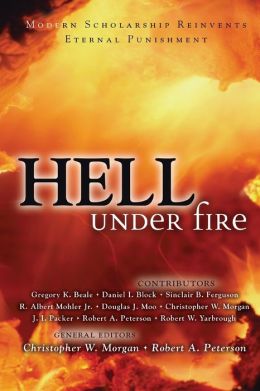
So writes Sinclair Ferguson in his chapter in the much needed and difficult book: “Hell Under Fire: Modern Scholarship Reinvents Eternal Punishment.”
He is right of course. The thought of a literal Hell as eternal punishment for sin cannot possibly carry an inherent attraction to a balanced and coherent mind. And yet, Scripture unmistakably and unambiguously articulates the reality of Hell. Of Divine judgment against sin and unrepentant sinners after this present life is over. It is a truly frightening and disturbing concept. But there it is. And found more frequently on the lips of none other than Jesus Himself in the Gospels than any other place.
As the subtitle to this book notes, modern scholarship has tried repeatedly to greatly modify if not eradicate completely the notion of Hell. In our day, even in large swaths of Bible-believing Evangelicalism, Hell is rarely if at all preached or taught about. And when it is, it is often (perhaps even MOST often?) done apologetically, as though we are somehow ashamed of the Bible containing such a doctrine. Don’t get me wrong, the notion of a state of eternal torment for even the worst of sinners is shocking to our sensibilities. And in a day when what we feel often trumps or defines truth, it seems that in this case at least, our modern sensibilities seem to outstrip those of the Bible and thus God Himself. We can be found weighing His divine pronouncements and justice on the scales of our fallen logic, preferences, tastes and feelings. We sit in judgment upon Him. The very highest height of idolatry – where we know and act better than He. Where Biblical truth must bend to us, rather than we to it.
Though the doctrine of eternal punishment has always had its detractors, our generation has seen an upswell of vocal opposition ranging from such stalwarts as John R. W. Stott, to Clark Pinnock, Rob Bell, Brian McLaren, Edward Fudge and others. But even before it suffered the full frontal attack it is seeing now, Albert Mohler cites historian Martin Marty as saying “Hell disappeared. No one noticed.” It simply slipped from the Church’s view. Mohler again in his very useful and insightful Chapter 1 (“Modern Theology: The Disappearance of Hell.”) quotes David Lodge from his “Souls and Bodies.”: “At some point in the nineteen-sixties, Hell disappeared. No one could say for certain when this happened. First it was there, then it wasn’t. Different people became aware of the disappearance of Hell at different times. Some realized that they had been living for years as though Hell did not exist, without having consciously registered its disappearance. Others realized that they had been behaving, out of habit, as though Hell were still there, though in fact they had ceased to believe in its existence long ago.… On the whole, the disappearance of Hell was a great relief, though it brought new problems.”
It is into this situation, where the modern Evangelical Church finds itself in regard to the doctrine of endless punishment, that co-author/editors Christopher W. Morgan and Robert A. Peterson bring this profoundly needed volume.
Comprised of 10 chapters with a very useful Introduction and then Conclusion, Morgan & Peterson enlist some of the very best of modern, conservative scholarship to address both the basic doctrine itself, and the various objections to it. Objections ranging from a simple denial of any Hell at all, to the view that Hell is redemptive and all in it will one day be reconciled to God (even the Devil himself in some cases); the idea that Hell is only temporary; that human souls are only conditionally immortal and thus their suffering will one day end by virtue of annihilation – and other iterations of each view.
Chapter 1 is penned by Albert Mohler and is meant as an historical overview both of the doctrine of endless punishment and the historical debates surrounding it. He traces the discussion from Origen on through today.
Chapter 2 by Daniel Block is a study on what the Old Testament contains concerning Hell. Block is an Old Testament scholar and is Gunther H. Knoedler Professor of Old Testament at Wheaton College.
Chapter 3 is an in-depth study of Jesus’ teaching on Hell in the Gospels. It is carefully and extensively explicated by New Testament scholar Robert Yarbrough of Covenant Seminary in St. Louis.
Chapter 4, “Paul on Hell” comes from the hand of Douglas Moo, New Testament scholar and Professor of New Testament at Wheaton Graduate School. Author of the magisterial commentary on Romans.
Chapter 5 enlists Gregory K. Beale, biblical scholar and currently Professor of New Testament and Biblical Theology at Reformed Theological Seminary in Dallas, Texas to survey all the book of Revelation has to say on the subject.
Chapter 6, Biblical Theology: Three Pictures of Hell comes from Morgan – (Ph.D., Mid-America Baptist Theological Seminary), and Associate Dean and Associate Professor of Theology, California Baptist University.
Chapter 7 is penned by co-author Robert A. Peterson (Ph.D., Drew University), and Professor of Systematic Theology, Covenant Theological Seminary. Systematic Theology: Three Vantage Points of Hell.
In Chapter 8, the universally regarded J. I. Packer addresses the question of “Universalism: Will Everyone be Saved?”
Chapter 9 is by Morgan once again and deals with Annihilationism. “Will The Unsaved Be Punished Forever?”
And as cited above, chapter 10 was written compassionately and thoughtfully by Sinclair Ferguson, (Ph.D., University of Aberdeen), Professor of Systematic Theology, Westminster Theological Seminary.
In fact, I might suggest that many readers begin by reading Ferguson’s chapter first, so as to see how it is that right-minded (Biblically-minded) Believers approach this doctrine with nothing even hinting at the perverse glee some have charged defenders of the doctrine with holding. And I wish I could say no one in fact has ever taught the doctrine wickedly, but alas it is not so. There are dreadfully misanthropic, misinformed and coarse men who over the years have preached the doctrine hatefully and perversely in the name of Christ. Of them, we ought to be rightly ashamed.
This book is not the product of mere opinionists or mere doctrinal devotion. It is the fruit of careful and thoughtful exegesis of the Scriptures. Each contributor wrestles with the questions so many raise: How can this be the product of a loving God? Is it truly just? Does the punishment really fit the crime(s)? Doesn’t this make God cruel? Isn’t this just the product of unenlightened religionists? Don’t we know better today? etc.
If you or someone you know is wanting to understand the doctrine of endless punishment historically and Biblically, or have the very questions (and others) I’ve just mentioned – it is a must read. Is it an easy read? No. Not due to unclear, overly technical or poor writing, but due to the difficulty of the subject matter itself. We are not meant to be comfortable with the notion of Hell. It is supposed to be disturbing. But, as you will see when you read the book – it is also a doctrine which, when rightly understood, reveals God in glory and grandeur in ways we can easily lose.
So reads Deuteronomy 14:1a. And it begs a most important question.
In context, this statement prefaces a whole host of things God set out regarding the behavior of the Israelites. We tend to look at all the dietary peculiarities God prescribed for them, the strict rules and regulations surrounding worship, the feasts and festivals, etc., and look for “practical” reasons for them. e.g. Why the prohibition on eating pork? We answer, well, with no refrigeration the danger of something like trichinosis is very real. Perhaps so. But far above and before reasoning our way through such answers – behind it all stands this simple reality: They were “the sons of the LORD” their God. And He said so.
And that ought to be sufficient.
God marked His people out in any number of ways: How they farmed; how they dressed; how they worshiped, sacrificed, conducted business, treated their spouses – lots and lots of ways.
And so I ask myself today, and invite you to do the same: What are the kinds of things I do, or do not do, simply because I am His? Not because it is a “law.” Not because in and of itself it is right or wrong. Not because it is countenanced or discouraged by the culture around me, in or outside of the Church. Just because I grasp that I am not my own. (1 Cor. 6:19) That I was brought with a price. That I do not belong to myself, but to some one else – and live for their plans, purposes and desires, and not my own.
American Evangelicalism suffers from the influence of an Americanism that is entrenched and committed to living as fiercely independent and belonging to no one. And it is a lie.
Beloved, if you have been born again by the Spirit of Christ, you must reckon each and every day with whose you are, even more than who you are. For there is no such thing as an identity severed from all relationship. Indeed, all identity is rooted in relationship. I must find my identity in terms of the God who created me, the bloodline I hail from, the relations near and far I share that bloodline with, nationality, ethnicity, and even spiritual life in Christ. And most important of all – to Whom I belong.
Whose are you today? And what does that mean in terms of what you say, how you reason, how you treat others, how you worship, spend your time, spend your money, etc.? And not in some “legal” sense, but in true relationship. As belonging to my wife in marriage, that belonging both precludes and requires certain things of me. And certainly no less is true when it comes to being a child of God.
Now the problem with this line of thought – due to our sin – is that our minds will almost certainly run to the negative, what I can’t do because I am His, rather than what is mine because I am His.
As writes Alexander MacLaren on Eph. 1:7: “Now that word ‘grace,’ I have no doubt, sounds to you hard, theological, remote. But what does it mean? It gathers into one burning point the whole of the rays of that conception of God, with which it is the glory of Christianity to have flooded and drenched the world. It tells us that at the heart of the universe there is a heart; that God is Love, that that love is the motive-spring of His activity, that it comes and bends over the lowliest with a smile of amity on its lips, with healing and help in its hands, with forgiveness for all sins against itself, with boundless wealth for the poorest, and that the wealth of His self-communicating love is the measure of the wealth that each of us may possess. God gives ‘according to the riches of His grace.’ You do not expect a millionaire to give half-a-crown to a subscription fund; and God gives royally, divinely, measuring His bestowments by the abundance of His treasures, and handing over with an open palm large gifts of coined money, because there are infinite chests of uncirculated bullion in the deep storehouses. ‘How great is Thy goodness which Thou hast manifested before the sons of men for them that fear Thee. How much greater is Thy goodness which Thou hast laid up in store.’ But whilst He gives all, the question comes to be: What do I receive? The measure of His gift is His measureless grace; the measure of my reception is my, alas! easily-measured faith. What about the unearned increment? What about the unrealised wealth? Too many of us are like some man who has a great estate in another land. He knows nothing about it, and is living in grimy poverty in a back street. For you have all God’s riches waiting for you, and ‘the potentiality of wealth beyond the dreams of avarice’ at your beck and call, and yet you are but poorly realising your possible riches. Alas, that when we might have so much we do have so little. ‘According to the riches of His grace’ He gives. But another ‘according to’ comes in. ‘According to thy faith be it unto thee.’ So we have to take these two measures together, and the working limit of our possession of God’s riches comes out of the combination of them both.”
From time to time, a book falls into my hands that is outside of my ordinary pool of reading resources. Such is the case with Ronald Rolheiser’s The Passion And The Cross. It comes with glowing reviews from the likes of Walter Brueggemann and Richard Rohr. And so as you may have guessed by that, Rolheiser is a Roman Catholic priest. He serves with the Missionary Oblates of Mary Immaculate. As the blurb on the back of the book states: He “is an internationally renowned speaker and spiritual writer.”
Let me note at the outset that in reflecting upon the book, after reading it all – some parts several times over, I come away with the impression that if I were to meet this guy, I would really like him. He oozes compassion and obviously wants to bless people. I particularly enjoyed a number of his insights into Christ’s sufferings in Ch. 1. I was challenged to reflect on those sufferings more pointedly in terms of Christ’s own humanity; an oft neglected factor in modern Evangelicalism where the emphasis can be overloaded on the divine side to the neglect of His humanity. This imbalance was one of the first heresies the early Church had to face. It is called: Docetism.
That said, I did come away with a number of very serious concerns. Concerns which do not at all stem directly from the author’s Catholicism. The bigger problem(s) which I’ll endeavor detail some below – are shared by much current Evangelical Protestant writing as well. Hence my heightened alarm.
I would break my concerns down to 4 primary areas, and will give you some examples below, and why they are problematic to me. And I would ask all of my brothers and sisters in Christ to be on the alert for the very same issues I cite here, in so many popular Evangelical books, podcasts, teaching series and even preaching. My reading this book made me want to sound the alarm afresh for those in our own camp.
So, the 4 areas I had issues with are:
1 – His general handling of the Scripture, where he often uses a verse or phrase (even just a word) as a jumping off point, without considering it in context. Once again this is a serious problem in much popular Protestant and Evangelical preaching, teaching and writing today too. It is as though a verse, passage or even word is used to buttress an idea he wants to get across, rather than endeavoring to simply teach what the Bible itself is trying to teach.
2 – His understanding of redemption or salvation. (Here, his Catholicism may be a factor) The Gospel.
3 – His understanding of the character of God and its implications.
4 – His complete lack of any reference to judgment for sin or for a call to repentance and faith in Christ’s atoning death on the Cross.
1 & 2 – Handling of Scripture. There are several ways this plays out. And this will necessarily overlap with #2. So I won’t treat #2 separately.
He uses Biblical words like redemption, sin, “exousia” etc., but imbues them with his own definitions, seemingly without regard for how Scripture itself uses them. So he can say in the preface that our sufferings are “redemptive.”
Redemption in the Bible always (in Hebrew and Greek) carries the idea of something (or someone) being “bought back.” Slaves are redeemed when they buy their freedom back. It is used repeatedly in the OT in reference to God redeeming Israel from its slavery in Egypt. We can redeem the time when we stop wasting it and use for Christ’s service (Eph. 5:16 – KJV ).
But of the 9 times it is used in the NT it is used most and specifically in terms of our salvation. In Gal. 3:13 – Christ has redeemed us from the curse of the Law. Gal. 4:5 – God sent His Son to redeem those who were under the law (Jews) so that they might receive adoption as sons. In Titus 2:14 – Christ was given to redeem us back from lawlessness. Heb. 9:15 – He redeems us from our transgressions of the Law. And 2 times in Rev. it refers to the Believer being redeemed out of the human race to be God’s possession.
So I do not know how he means it when he uses it. If it is in the generic sense of redeeming the time like in Eph. 5, good enough. But an explanation would have helped. If he means that we have some part in our salvation from sin – then we have a real problem. But he simply uses a very important, Bible specific word without reference to what he means, or how the Bible uses it.
So too with the word “salvation.” In Matt. 1:21, Jesus is named Jesus because He will “save His people from their sins.” The overarching use is in terms of being rescued from our alienation from God due to our sins, and the need to be rescued or “saved” from God’s wrath. Typical of the NT usage is Romans 5:9-11 “Since, therefore, we have now been justified by his blood, much more shall we be saved by him from the wrath of God. For if while we were enemies we were reconciled to God by the death of his Son, much more, now that we are reconciled, shall we be saved by his life. More than that, we also rejoice in God through our Lord Jesus Christ, through whom we have now received reconciliation.”
He nowhere references salvation in this way, when in fact it is central to how the NT refers to salvation. This is central to Gospel itself and why I find it so disturbing. When John the Baptizer comes on the scene in Matt. 3 – his issue is who told the Scribes and Pharisees to flee “from the wrath to come?” Rom. 1 tells us that in the Gospel, the wrath of God is revealed against all sin. Eph. 2 says that before we were born again, we were all by nature “children of wrath.” And in John 3 Jesus Himself says that “Whoever believes in the Son has eternal life; whoever does not obey the Son shall not see life, but the wrath of God remains on him.” Of its 9 uses in the book of Revelation, it is the wrath of God which is most often in view. And in 6:16 – people actually cry out to be delivered from “the wrath of the Lamb” which is Christ Himself.
These concepts which are so essential to an understanding of the Gospel are completely missing from Rolheiser’s approach. Men are nowhere called to repent of their sins and come to Christ for forgiveness, cleansing and the new birth. The Gospel is absent. He treats everyone as though they are already reconciled to God, which Scripture absolutely denies.
“Exousia” as vulnerability. His very use of the word shows he has familiarity with the underlying Greek text. The problem is, he completely ignores what the word means in any Greek dictionary you might like to use, and just invents his own definition to suit his point. We cannot use the Word of God this way without utterly corrupting it.
There is a reason this word is most often translated as “authority.” And it is the very same Greek word in the translation he used – NRSV. I’ve included below a representation of all the places in the Bible where exousia is translated. It is never, never used to convey vulnerability. Most often “authority” or “power”, and you can see the rest in the chart.
So as I said is true with many today in Evangelicalism as well – he uses select portions of Scripture – without reference to context, to buttress what he wants to say, rather than teaching what the Scripture actually teaches. It is very, very sad. And it is why we need to read our entire Bibles to see what the whole Scripture teaches on any subject. When we pluck just one mention and use it to interpret all other places where it is used, we completely misuse the Bible.
Sin: Pages 43-45: He cites a letter from woman who never sinned for 40 years. So he elaborates on all sorts of actions being wrong but not sinful. Once again, we need to ask – how does Scripture define sin? Because of his disregard for what the Bible calls sin, he can agree with the woman’s letter and then add: Page 44: “There’s more jealousy, hatred, anger, murder, adultery, slander, lying, and blasphemy at God in our world than there is sin.” In fact, these are the very things Scripture calls sin! So we read in Romans 1 the catalogue of sins God will judge: “For the wrath of God is revealed from heaven against all ungodliness and unrighteousness of men, who by their unrighteousness suppress the truth… Therefore God gave them up in the lusts of their hearts to impurity, to the dishonoring of their bodies among themselves…For this reason God gave them up to dishonorable passions. For their women exchanged natural relations for those that are contrary to nature; and the men likewise gave up natural relations with women and were consumed with passion for one another, men committing shameless acts with men and receiving in themselves the due penalty for their error. And since they did not see fit to acknowledge God, God gave them up to a debased mind to do what ought not to be done. They were filled with all manner of unrighteousness, evil, covetousness, malice. They are full of envy, murder, strife, deceit, maliciousness. They are gossips, slanderers, haters of God, insolent, haughty, boastful, inventors of evil, disobedient to parents, foolish, faithless, heartless, ruthless. Though they know God’s righteous decree that those who practice such things deserve to die, they not only do them but give approval to those who practice them.
Or consider Ephesians 5: “But sexual immorality and all impurity or covetousness must not even be named among you, as is proper among saints. Let there be no filthiness nor foolish talk nor crude joking, which are out of place, but instead let there be thanksgiving. For you may be sure of this, that everyone who is sexually immoral or impure, or who is covetous (that is, an idolater), has no inheritance in the kingdom of Christ and God. Let no one deceive you with empty words, for because of these things the wrath of God comes upon the sons of disobedience. Therefore do not become partners with them; for at one time you were darkness, but now you are light in the Lord. Walk as children of light (for the fruit of light is found in all that is good and right and true), and try to discern what is pleasing to the Lord. Take no part in the unfruitful works of darkness, but instead expose them. For it is shameful even to speak of the things that they do in secret.”
These things are indeed “sins”, and God’s wrath will be poured out on those who do them and do not repent. So how he can make the statement above truly boggles my mind. It shows either serous confusion about what God says on the subject, or a deliberate denial of what the Bible teaches to make his point. This is serious.
In this regard, we need to recall John’s statement in 1 John 1 – “If we say we have no sin, we deceive ourselves, and the truth is not in us.” I have every sympathy with the gal in the letter. But our sympathies cannot e used to redefine what Scripture defines, and come to the light of our real situation.
3 – His understanding of the character of God and its implications.
This comes come out in a number of places, but we get our first hint when on Page 29 he states that capital punishment contrary to the Gospel. I have no ax to grind when it comes to the debate over whether or not we ought to use CP in our society. There is no doubt that it tragically, improperly implemented in our current system and its use desperately needs to be reformed.
That said, we do have to ask ourselves, who instituted capital punishment? And we find in Genesis 9 that it is none other than God Himself: “And for your lifeblood I will require a reckoning: from every beast I will require it and from man. From his fellow man I will require a reckoning for the life of man. “Whoever sheds the blood of man, by man shall his blood be shed, for God made man in his own image.” CP was built into the Mosaic Law as God gave it to Israel. And it is even reiterated in Romans 13:4 – Government does not bear the sword in vain – the instrument of death.
So if we take Rolheiser’s statement at face value, he has God instituting what is both contrary to the Gospel and to His own character. God contradicts Himself. This is a problem we can’t get around. But of course all of this grows out of the statement he makes on Page 35: “God is absolutely and utterly nonviolent.”
We then have to ask ourselves, how does this square with the report of Scripture throughout? What about Noah’s flood? The destruction of Sodom and Gomorrah? The conquest of Canaan? Nadab & Abihu? Uzzah? Korah’s rebellion? Etc. And even God’s final disposition of sinners? These are judicial acts by God, and incorporate divine violence in the carrying out of justice. Jesus Himself gives a stunning account of some of what is to be expected at His return in Matt. 24: “Therefore you also must be ready, for the Son of Man is coming at an hour you do not expect. “Who then is the faithful and wise servant, whom his master has set over his household, to give them their food at the proper time? Blessed is that servant whom his master will find so doing when he comes. Truly, I say to you, he will set him over all his possessions. But if that wicked servant says to himself, ‘My master is delayed,’ and begins to beat his fellow servants and eats and drinks with drunkards, the master of that servant will come on a day when he does not expect him and at an hour he does not know and will cut him in pieces and put him with the hypocrites. In that place there will be weeping and gnashing of teeth.” These are not non-violent images.
It is true God condemns all unrighteous violence. But it is equally true that His judgments are often violent in His righteousness.
It is Rolheiser’s misconception of God in this absolute way, that leads him to see Timothy McVeigh as a Christ figure suffering as a scapegoat, instead of receiving the just consequence of his murderous acts. And then to go one and state on Page 35 that God is not “the great avenger of evil and sin.”
In fact, Scripture affirms the exact opposite. Scripture says He IS the avenger of evil and sin. So we read in Hebrews 10: “For if we go on sinning deliberately after receiving the knowledge of the truth, there no longer remains a sacrifice for sins, but a fearful expectation of judgment, and a fury of fire that will consume the adversaries. Anyone who has set aside the law of Moses dies without mercy on the evidence of two or three witnesses. How much worse punishment, do you think, will be deserved by the one who has trampled underfoot the Son of God, and has profaned the blood of the covenant by which he was sanctified, and has outraged the Spirit of grace? For we know him who said, “Vengeance is mine; I will repay.” And again, “The Lord will judge his people.” It is a fearful thing to fall into the hands of the living God.”
Or again in Eph. 5 – “But sexual immorality and all impurity or covetousness must not even be named among you, as is proper among saints. Let there be no filthiness nor foolish talk nor crude joking, which are out of place, but instead let there be thanksgiving. For you may be sure of this, that everyone who is sexually immoral or impure, or who is covetous (that is, an idolater), has no inheritance in the kingdom of Christ and God. Let no one deceive you with empty words, for because of these things the wrath of God comes upon the sons of disobedience.”
Page 50 – “God did not want and script Jesus’ death as payment, in pain, for Adam’s sin and ours. In the Gospels, Jesus never speaks of His death as a payment for sins, but rather always as a gift of love.”
This is to deny all the types and shadows of the Old Testament about the need for a substitutionary atoning sacrifice for our sins. Shockingly, it is a complete repudiation of the Gospel.
First we have to understand that Jesus’ death for us was indeed the Father’s “script”. In fact, this truth made it into every account of NT preaching we have in the book of Acts. Acts 2 – “Men of Israel, hear these words: Jesus of Nazareth, a man attested to you by God with mighty works and wonders and signs that God did through him in your midst, as you yourselves know— this Jesus, delivered up according to the definite plan and foreknowledge of God, you crucified and killed by the hands of lawless men.”
Acts 4 – “for truly in this city there were gathered together against your holy servant Jesus, whom you anointed, both Herod and Pontius Pilate, along with the Gentiles and the peoples of Israel, to do whatever your hand and your plan had predestined to take place.”
Acts 13 – “Brothers, sons of the family of Abraham, and those among you who fear God, to us has been sent the message of this salvation. For those who live in Jerusalem and their rulers, because they did not recognize him nor understand the utterances of the prophets, which are read every Sabbath, fulfilled them by condemning him.”
Or consider Jesus’ own words in John 12 – “Now is my soul troubled. And what shall I say? ‘Father, save me from this hour’? But for this purpose I have come to this hour.”
Nor is this a NT nuance. That famous chapter Isa. 53 spells this out in detail: “Who has believed what he has heard from us? And to whom has the arm of the Lord been revealed? For he grew up before him like a young plant, and like a root out of dry ground; he had no form or majesty that we should look at him, and no beauty that we should desire him. He was despised and rejected by men, a man of sorrows and acquainted with grief; and as one from whom men hide their faces he was despised, and we esteemed him not. Surely he has borne our griefs and carried our sorrows; yet we esteemed him stricken, smitten by God, and afflicted. But he was pierced for our transgressions; he was crushed for our iniquities; upon him was the chastisement that brought us peace, and with his wounds we are healed. All we like sheep have gone astray; we have turned—every one—to his own way; and the Lord has laid on him the iniquity of us all. He was oppressed, and he was afflicted, yet he opened not his mouth; like a lamb that is led to the slaughter, and like a sheep that before its shearers is silent, so he opened not his mouth. By oppression and judgment he was taken away; and as for his generation, who considered that he was cut off out of the land of the living, stricken for the transgression of my people? And they made his grave with the wicked and with a rich man in his death, although he had done no violence, and there was no deceit in his mouth. Yet it was the will of the Lord to crush him; he has put him to grief; when his soul makes an offering for guilt, he shall see his offspring; he shall prolong his days; the will of the Lord shall prosper in his hand. Out of the anguish of his soul he shall see and be satisfied; by his knowledge shall the righteous one, my servant, make many to be accounted righteous, and he shall bear their iniquities. Therefore I will divide him a portion with the many, and he shall divide the spoil with the strong, because he poured out his soul to death and was numbered with the transgressors; yet he bore the sin of many, and makes intercession for the transgressors.”
Page 54 – Jesus doesn’t pay our debt, but transforms it. This is simply never the teaching of Scripture. And, completely ignores passages like Isaiah 53 cited above. It denies the entirety of the types and shadows of the sacrificial system under the Old Covenant, and denies 1 Peter 2 – He himself bore our sins in his body on the tree, that we might die to sin and live to righteousness. By his wounds you have been healed.”
And then we have to consider too – Heb. 9:28; 1 Pet. 3:18; Rom. 3:25; Rom. 4:25; 2 Cor. 5:21; Heb. 9:12; Gal. 3:13; 1 Cor. 15 – “For I delivered to you as of first importance what I also received: that Christ died for our sins in accordance with the Scriptures, that he was buried, that he was raised on the third day in accordance with the Scriptures”
I could go on to deal with how he characterizes taking up our Cross, which Jesus defines as denying our own will and desires when it is contrary to God’s; his statement on Page 85 – “In a manner of speaking, we are betrayed even by our God? Jesus was not betrayed on the Cross. Betrayal implies breaking trust. God was placing our sin upon Him and He was bearing the wrath we deserved, which is separation from God. But Jesus also knew the Father and in His dying moment said “into your hands I commit my spirit.” He was NOT betrayed. And neither are we. WE, have betrayed Him.
His reference on Page 86 – The account of the young man fleeing and then appearing at Jesus’ tomb is utter fabrication. John 20 tells us these were angels.
On Page 87 he asserts “Jesus died in silence” while the Bible records the 7 sayings of Jesus on the Cross. This is imagination to make a point.
On the bottom of Page 98 – He articulates as clear a statement of the law of Karma as one is likely to read. Completely unscriptural. No wonder he likes Gandhi so much. He functions like a practical Hindu. Stunning.
Or his contention on Page 102 – “No sin is unforgivable, when Jesus says in Matt. 12 – “Therefore I tell you, every sin and blasphemy will be forgiven people, but the blasphemy against the Spirit will not be forgiven. And whoever speaks a word against the Son of Man will be forgiven, but whoever speaks against the Holy Spirit will not be forgiven, either in this age or in the age to come.”
4 – And then, he closes the book withChapter 5 on The Resurrection. He writes this entire, last chapter to say (as he quotes Julian of Norwich on page 103) “all will be well…and every manner of being will be well.” “Everything, including our own lives, eventually will end sunny-side up.”
All this – without addressing Jesus’ teaching to the very opposite. John 5 – “Truly, truly, I say to you, an hour is coming, and is now here, when the dead will hear the voice of the Son of God, and those who hear will live. For as the Father has life in himself, so he has granted the Son also to have life in himself. And he has given him authority to execute judgment, because he is the Son of Man. Do not marvel at this, for an hour is coming when all who are in the tombs will hear his voice and come out, those who have done good to the resurrection of life, and those who have done evil to the resurrection of judgment.”
To lull everyone who reads into a fiction that everything will just be all right in the end, when Jesus so starkly warns that there is a judgment to come and an eternal Hell to be avoided – is to me, unconscionable. It is to conform people in their sins. No call to repentance. No call to faith in Christ as their sin-bearer. No call to flee the wrath to come. This is horrific.
Sadly, there is more, but I do not want my response to be longer than the book itself. A tendency I have. But as a bottom line I simply have to say that little in the book is actually owing to the teaching of Scripture, but to Rolheiser’s concepts, which he then conscripted certain Biblical statements in service to. It is what theologians call eisegesis (reading something into the text) as opposed to exegesis (digging out what is in the text.) Bible teachers are called to be exegetes. Uncovering what is genuinely there. Tragically, this book does anything but. And if taken at face value, will lead every reader into believing everything will just be OK, whether they repent of their sin or not, or are reconciled to God through faith in the substitutionary death of Jesus on the Cross. And this, in a book about the Cross.
“It is not because you were more numerous than all the other peoples that the Lord favored and chose you—for in fact you were the least numerous of all peoples. Rather it is because of his love for you and his faithfulness to the promise he solemnly vowed to your ancestors that the Lord brought you out with great power, redeeming you from the place of slavery, from the power of Pharaoh king of Egypt.” Deuteronomy 7:7-8
In our day and age, it has become more and more prevalent to speak of our salvation in terms of what it says about us. How valuable we must be to Him that He would go to the lengths our redemption required. This is true in one sense, but not without qualification. For you see, if God saves us due to some worthiness in us – then grace ceases to be grace. And the Gospel is robbed of its most essential component.
Are we in any way worthy of God’s love? Only in this way: That because He created us in His image, He imbued us with value. Value that does not exist in us intrinsically, so that in some way, God was drawn to us first so as to decide to redeem us. He came to us ruined and undone. He was before us. He made us, we did not make ourselves, nor make ourselves attractive to Him in any way. He sought us in our sin, rebellion and defilement. Not because we – in and of ourselves – brought anything to the table to bless or add to Him. It is only the sad expression of our fallen egos that looks for something in ourselves that makes us worth saving.
We get another picture of this when God confronts Israel about its beginnings: Ezek. 16:2-6 “Son of man, make known to Jerusalem her abominations, and say, Thus says the Lord God to Jerusalem: Your origin and your birth are of the land of the Canaanites; your father was an Amorite and your mother a Hittite. And as for your birth, on the day you were born your cord was not cut, nor were you washed with water to cleanse you, nor rubbed with salt, nor wrapped in swaddling cloths. No eye pitied you, to do any of these things to you out of compassion for you, but you were cast out on the open field, for you were abhorred, on the day that you were born. “And when I passed by you and saw you wallowing in your blood, I said to you in your blood, ‘Live!’ I said to you in your blood, ‘Live!’”
We are not sought out and made His because of some worthiness in us. But because of the glory of mercy, grace and compassion that is in Him!
So we are at a place where we need to re-calibrate such thinking according to revelations like this one in regard to the Israelites. i.e. that we think of salvation not in terms of what it says about us – but what it says about Him. What it says about His love, His grace, His mercy, His condescension, His faithfulness, His compassion, His magnificence. To make salvation a matter of our worth, is to seek something of our own glory, rather than to seek it all in Him.
So the 3rd verse of Rock of Ages:
“Nothing in my hand I bring,
Simply to thy cross I cling;
Naked, come to thee for dress,
Helpless, look to thee for grace;
Foul, I to the Fountain fly;
Wash me, Saviour, or I die.”
Oh that our hearts would be captured once again by the wonder of His grace. That the congealed fountains of our hard hearts would be broken up afresh to gaze and the power, majesty, sweetness, and unfathomable mystery of such divine love that would make sinners such as I am His own.
Deuteronomy 6:4–6 (NET 2nd ed.) — “Hear, O Israel: The LORD is our God, the LORD is one! 5 You must love the LORD your God with your whole mind, your whole being, and all your strength. 6 These words I am commanding you today must be kept in mind,”
Oh precious Father, that this would be my heart. I hope that when the first hearers heard this, they melted at the impossibility of it and cried out for the working of the Spirit who alone can birth such a love in us. Whether they did or not Father, please make it so in me. I confess I have never, even for the smallest portion of a second so loved you. But that it one day may be so because of Christ. That by His saving grace, the impartation of your Spirit and the wonder of the resurrection I may at last come to this state. Fill me even today. Open and enlarge my heart to see you, know you, delight in you, and love you with my entire being, unhindered or lacking in any way. Every thought captive to Christ. My every action revealing your grace. And with all my might. Let it be.
My personality and constitution resists change. And that shows itself in me even more as I age. But our God doesn’t suffer from such a condition and He invites us always to find our only REAL permanence in Him – in His character, being, purposes and plans.
So it is the Christian life, just as all life, has many many stages to it. In Numbers 33, we are shown that during their 40 years in Wilderness, Israel had to break camp no less than 41 times. Is it any surprise then that both individual Christians and the Church too will undergo changes along our route to the Heavenly Zion?
Some of those changes are and will be exciting. And some will be filled with danger. Some are times of rest, and others times of attack. Some are times of peace and some times of raging war. There are pleasant places, dry places and seemingly empty places. Places where God meets with us, and places where He seems silent. Places of revelation like Sinai. Places of chastening. Places where we, like the Israelites tarry long and places where we like they move on quickly.
Childhood. Adolescence. Adulthood. Middle age. Old age. Singleness. Marriage. Bereavement. Joy. Career. Retirement. Perhaps divorce. Loss. Riches or poverty. And yes, massive interruptions to business or life as usual – like the advent of the Corona virus.
We will be living interrupted lives for a season – individually, and as a Church.
And so Numbers 33 offers us much to consider in our present season of uncertainty.
1. Our gracious God leads and attends us every step, and in every place. He never leaves us nor forsakes us. And His Church remains His Church every step. Though it may need to respond in new ways to new challenges.
2. It is a good reminder that we ought never to imagine the Christian life will be one of simple ease and rootedness. For this world is not our home. This is the wilderness, wrought by the Fall. Change is not just inevitable, it is sovereignly appointed – AND, attended.
3. No stage is the entire journey. We can easily begin to think where we are at this moment is the way it will always be. Not so. Some things may return to normal, or we may need to adjust to a “new normal” – temporarily or permanently in some ways. The never-changing normal is to be found in our never-changing God, and His every faithful care and Word.
4. Our Canaan is still the other side of Jordan. And we will have no permanent place until then. But we will “break camp” and re-camp together as His People and His Church as need be, until then.
5. At every stage in Israel’s Wilderness journey, there was God’s presence; God’s provision; and the reality that every step was part of God’s plan in bringing them home. That has not changed. It is just as much a reality for us – even as it was foreshadowed in passages like this one.
Travel in faith Christian. You are on the way to the celestial city. “For here we have no lasting city, but we seek the city that is to come.” (Heb. 13:14) “[T]o the city that has foundations, whose designer and builder is God.” (Heb. 11:10)
The only thing that is constant is change. Except for one. Thankfully, we serve a God who never changes. A Christ who is the same yesterday, today and forever.