As you know, I end each podcast saying “God willing, we’ll be back…” whenever. Well Providence intervened Friday and I was not able to be with you. But if you’ve kept up with reading, then we are brought to today’s passages: Jeremiah 17:19–21:10; Psalm 124; Luke 22:66–23:5; and 1 Peter 3:8–22 with a most interesting connection between Jeremiah and 1 Peter.
What do we do with passages like the dozen or so Psalms where the Writer calls on God to destroy or punish their enemies? Or like we see in Jeremiah’s prayer in 18:9-23? Especially in light of a passage like 1 Peter 3:91 Peter 3:9 “Do not repay evil for evil or reviling for reviling, but on the contrary, bless, for to this you were called, that you may obtain a blessing.”
What do we do with Scriptures that seem to just say “Get’em God!” How do we harmonize that with the Gospel?
That today on Through the Word in 2020.
I’m Reid Ferguson.
Poor Jeremiah. He’s not called “the weeping Prophet” for nothing. His heart is broken over the sins of his fellow Jews; broken at God’s word of judgment against his brethren; and broken at how he is persecuted for merely bringing God’s People God’s Word.
He can’t win.
And as we see in today’s reading, he is even beaten and imprisoned for speaking the truth. Leading him to pray: “deliver up their children to famine; give them over to the power of the sword” – and host of other ills.
And the first thing to note is: Jeremiah expresses his heart, but, BUT, then leaves the disposing of it to the Lord. “Deal with them in the time of your anger” is how 23 closes. He does not take matters into his own hands. He knows it is best to leave it with the Lord to dispose of as He sees best.
The 2nd thing to see is that God does not answer his prayer as prayed.
Jeremiah prays for judgment in reference to how he is rejected and persecuted. But in 19:4, God says there will indeed be judgment, but not for Jeremiah’s sake, but because of their sin against God. And this where things harmonize with 1 Peter.
We may well pray our imprecatory prayers knowing that God will only do what is right with them. We are free, indeed instructed to bring those things to Him. To express our true heart and mind at the time. And then, leave it with Him. He disposes as is best. We do not then take up our own revenge for the wrongs against us. We have taken our plea to the highest court – and He will do what is just concerning us, our persecutors, Himself and His Kingdom.
It is right to pray God’s judgment upon sins, even those against us – when we leave it to Him to act on as He sees fit, and we continue to bless our enemies in our actions. As in Jeremiah’s case, by not ceasing to still faithfully bring them God’s Word.
There is one exception to all this: Pray God’s judgment and unsparing wrath upon the Devil and the demon hosts that seek to hinder the Gospel, thwart the cause of Christ, tempt us to sin and torment the heirs of salvation. Feel free to unleash your most violent imprecations against the rulers, authorities, the cosmic powers of this present darkness and the spiritual forces of evil in the heavenly places.
But know again here too – this is of God’s disposing, not ours. He WILL avenge us on the enemies of our souls in due time. Tell Him your heart without restraint. And trust Him fully to do what is best.
For the audio Podcast of this and every episode, find us on Breaker, Google Podcasts, Overcast, Pocket Casts, RadioPublic, Spotify or HERE
If you’d like to join us in our journey reading all the way through the Bible this year, drop me a line at reid.ferguson@gmail.com, and I’ll be glad to email back a copy of the reading plan we are using.
Ever heard of George Fuechsel? Probably not. Popularly, he is credited with coining the phrase: Garbage in, Garbage out. Around 1958 or 1959 while teaching at class at IBM. We’ve all heard it.
As the age of the computer was beginning, it was quickly learned that you only get good data out, if you put good data in. In fact, the first time the term – which is so common to us today – was ever used in print was in the Times Daily of Hammond, Indiana – Nov. 10, 1957. Before anyone ever heard George say it.
But Scripture addressed that very same issue when it comes to our hearts and minds millennia before the Times Daily or George Fueschel.
I’m Reid Ferguson, and this is Through the Word in 2020.
In Luke 6:45, Jesus emphatically stated that out of the abundance of the heart, a person speaks. Lots of stuff comes out of us – especially in our communications with others. And it is worth the Christian’s effort from time to time to survey what’s been coming out of us. It may be a great indicator of what we’ve been taking in. And 1 Peter 2 demonstrates that dynamic.
vs. 1 sets it up: Put away all malice, deceit, hypocrisy, envy and slander. Now those things don’t exist in a vacuum. They are demonstrations of our inward corruption. But like cancers, they can be fed. And when fed, they grow more noticeable and are expressed more readily. The more you think on or repeat those thoughts or put them into action, the more frequent and natural they become. The more prevalent they will show themselves to be. So if we are used to caving into wickedness, deceit, hypocrisy, envy and – oh yeah – especially discourse about politics and other things with slander – guess what? That is what we’ll talk about most too. If we take in a diet comprised of those things – well – garbage in, garbage out.
So it is vs. 2 gives us the contrast and the cure. Instead of feeding our souls on stuff like recorded in vs. 1 – “Like newborn infants, long for the pure spiritual milk.” It is by that that we grow up into salvation. Not by drinking in the garbage stream of the World’s information sewer line.
Have you tasted the goodness of God? Then train your appetite to desire more and more of Him. And begin to go after it like newborns do their mother’s milk.
Milk in the Scripture is often a picture of God’s blessings. It’s why Canaan is referred to as the land of “milk & honey.” In 1 Cor. 3:2 Paul likens the Gospel to milk – it is the single, most basic life giving provision of God. In Heb. 5:12 milk is the “basic principles of the oracles of God.” And in 5:13 it is that upon which we as babes find perfect sustenance as we grow to take in the stronger “bread” of the Word which is not just the good news about Christ, but more of Christ Himself. That then also becomes our meat in due season.
Christ at the beginning. Christ as we grow. And Christ the fullness of God for us. This is John’s point in 1 John 2 where he writes to “little children”, young men” and “fathers.” We all grow in and by Christ. That never changes at any stage of life.
Let your hearts taste Him often and your souls be drawn out after Him. Let the taste of His sweetness spoil you for everything else.
Oh Father – feed us upon Christ every step of the way. Holy Spirit, break Him to us today as our daily portion – and let us be filled with Him!
For the audio Podcast of this and every episode, find us on Breaker, Google Podcasts, Overcast, Pocket Casts, RadioPublic, Spotify or HERE
If you’d like to join us in our journey reading all the way through the Bible this year, drop me a line at reid.ferguson@gmail.com, and I’ll be glad to email back a copy of the reading plan we are using.
I’ve heard it said that there are 3 crucial things to consider when it comes to real estate: Location, Location and Location. And there is a similar adage – no less true – when it comes to reading, understanding and interpreting the Bible: Context, Context and Context. The countless distortions of Scripture due to taking verses out of their context are just that – countless. And the value of reading things in their contexts is truly inestimable.
We’ll look at one important example of that today on through the Word in 2020. Reading 1 Peter 1:13-25, Jeremiah 8:18-12:17 and then Luke 22:35-46, we’ll see an often overlooked crucial dynamic for the Christian life in the words of Jesus.
I’m Reid Ferguson.
A conversation just last week reminded me of a favorite example of taking a verse out of context. There was a very popular worship song a number of years ago which was very upbeat and sung as a joyous refrain regarding God’s army gaining victory. The lyrics went:
They rush on the city, they run on the wall Great is the army that carries out His word
They rush on the city, they run on the wall Great is the army that carries out His word
The Lord utters His voice before His army
The Lord utters His voice before His army
Blow the trumpet in Zion, Zion Sound the alarm in My Holy mountain!
Blow the trumpet in Zion, Zion sound the alarm!
The words were taken from Joel 2. But “God’s Army” there was the plague of locusts God was sending upon Jerusalem because of their continued disobedience. It is not a happy song of God’s people gaining victory but of God’s judgment.
Can you spell – oops?
And it is context that also sheds great light on Jesus’ words to His Disciples in Luke 22:40 – “Pray that you may not enter into temptation.”
In context, that was more than just some isolated word of good advice. It was more like: “This is how I am going to be praying right now, so as to overcome temptation. So take note. Watch. Observe. This activity is not to be taken lightly. It is stepping on to the front line of the battlefield in confronting sin.”
When we see Jesus praying here, we cannot help but note that such prayer will be hard prayer, pleading and life or death prayer. Temptation is not overcome on a whim – it takes all you have, and that, only as God gives grace. This is absolutely crucial. Prayer to overcome temptation is massively important and consuming.
And what is the temptation He is referring to here? It is the fountainhead of all temptation: To pursue our preferences and desires, over the Father’s. Every temptation ultimately comes down to that. And perhaps it is this very scene the Writer to the Hebrews has in mind when he says: “In your struggle against sin you have not yet resisted to the point of shedding your blood.”
Here, Jesus’ agony in submitting to the Father was such that His sweat became like great drops of blood. Now the text relates that in this moment, an angel from heaven appeared to strengthen Jesus. Because of it, I am greatly encouraged to think that when we seek to serve God so earnestly and agonizingly in fighting sin, that the heavenly host are dispatched for us as well as heirs of grace. And at the very least – which in all reality is infinitely more – as our Savior prayed in this regard for Himself, so He who prayed so and overcame that night, is even now at the right hand of God interceding for all of His.
For the audio Podcast of this and every episode, find us on Breaker, Google Podcasts, Overcast, Pocket Casts, RadioPublic, Spotify or HERE
If you’d like to join us in our journey reading all the way through the Bible this year, drop me a line at reid.ferguson@gmail.com, and I’ll be glad to email back a copy of the reading plan we are using.
It’s a pretty observable phenomenon in our culture today that short-range thinking predominates. How can I get pleasure -now? What is the shortest track to success? Instant wealth. Even social connections via social media seem aimed at getting instant or immediate responses. Texts, emails, Tweets, news, you name it. Things like waiting in line are considered almost abusive. Currently the threshold of how long someone is willing to wait for a web page to load is 2 seconds. One report I recently read said that 53% of mobile site visits are abandoned if it takes any longer than 3 seconds to load.
Out of our 4 texts today Jeremiah 5:14–8:17; Psalm 122 and Luke 22:31–34 – 1 Peter 1:3–12 shows us that this tendency is nothing new. And calls us to consider again the long view. To wait for the glories of the Resurrection, of eternal satisfaction rather than immediate gratification.
More on that today on Through the Word in 2020. I’m your host, Reid Ferguson.
As Solomon once said, there is nothing new under the sun. It’s true. So it is Peter has to remind even 1st Century Christians that being born again is not the end. It is only the beginning. We are born TO – a living hope. Hope beyond this life, and stretching into the full eternity of the next. He has made us into new creatures that we might be inheritors of what He has stored up for us.
Sadly, it is easy for us to be influenced by the World’s grasping after having all we can get now – even as Christians.
The so-called Prosperity Gospel is nothing other than a baptized version of get rich schemes. And others get caught in a web of trying to bring about Heaven on earth. Trying to gain power in society, promoting some sort of Christian rule over the secular world. And this sort of thinking proliferates whenever we feel powerless or marginalized. We hate feeling helpless. And the pinch of the immediate robs us of our vision for what God has called us to place more before our eyes.
So Peter writes to a people who are both elect in Christ, and exiles on earth. He sees no contradiction in those twin realities. For we are both of those, according to the foreknowledge of God the Father, as part of how we are set apart from the World by the Spirit, so as to obey Christ above all, and to know His cleansing from our sin in His blood.
So if we can’t necessarily look for power or prosperity in our present lives – what can we look forward to? To a living hope, secured by the resurrection of Jesus Christ from the dead. So that we might one day obtain an inheritance that is:
IMPERISHABLE – Can NEVER die or end. Has no temporariness to it.
Is UNDEFILED – possessed of absolutely no corruption whatever – nothing which makes it less than absolutely perfect in every way.
And is UNFADING – perennially fresh and new. Never losing its luster and shine.
And what else about this inheritance – whatever it might be? Well, it is kept in Heaven for all of us who by God’s power are being guarded through faith for a salvation ready to be revealed in the last time.
Hang on Believer. No matter how diminished you may be at present – this, Christ has guaranteed for you in His death and resurrection. It is waiting for you. Kept for you. Guarded for you. It is in Heaven, not here. And it will be yours in due time.
For the audio Podcast of this and every episode, find us on Breaker, Google Podcasts, Overcast, Pocket Casts, RadioPublic, Spotify or HERE
If you’d like to join us in our journey reading all the way through the Bible this year, drop me a line at reid.ferguson@gmail.com, and I’ll be glad to email back a copy of the reading plan we are using.
The sacrificial death of Jesus on the Cross for sinners, is the most climactic moment in human history. At the very moment when man was committing his most heinous crime – murdering the very Son of God – God was providing in that Son the means whereby humankind’s most heinous sins could be forgiven. It truly staggers the mind.
I’ve little doubt it will take all eternity for us to search out all the depths and implications of the Cross. But one aspect stands out especially in our reading today in Luke 22:14-30. It is significant that Jesus died on the Passover.
More on that as we consider our Luke passage as well as Jeremiah 2-5:13 and James 5:13-1 Peter 1:2. I’m Reid Ferguson, and this is Through the Word in 2020.
It is a curious thing to me that Jesus died at the Passover, rather than on the Day of Atonement. Some day, I hope to be able to unpack the reasons behind that more fully. To me, the Day of Atonement makes more sense. But to the all-wise God, Passover was more fitting. And in considering that fact, at least one glorious aspect of Jesus’ death gets spotlighted in a profound way. It’s wrapped up in the idea that The Lord’s Supper is typified in and built around the theme of – deliverance.
The death of Jesus Christ on the Cross not only addressed the matter of our guilt before God. Though that too is of supreme importance. But it also signaled the nature of the Believer’s deliverance. Even as the first Passover was all about deliverance.
In fact, the types and shadows go back even further. In Genesis 14 when Melchizedek met Abraham after his victory over the kings who had raided Sodom, they share a meal foreshadowing the Passover of Exodus 11. Why? Because there had been a great deliverance wrought – freeing Lot and his fellow citizens from capture.
Then we come to the 1st. Passover in Exodus 11. And there, the spotlight is on Israel’s deliverance from the slavery of Egypt.
It is on the anniversary of that deliverance that Jesus institutes The Lord’s Supper. Which calls us then to pick up on that deliverance theme in considering His dying as our Passover Lamb. As the One whose blood protected all who Believe even as the wrath of God was being poured out once again. On Christ.
And what is the nature of the Believer’s deliverance? At least 4 come immediately to mind.
1. Rom. 7:21-8:1 / Believers in Christ Jesus are delivered from the law of sin and death. We have been delivered from the dynamic of “sin and you will die” to “Believe and you will live.” And hence there is no condemnation to those who are in Christ by faith.
2. Col. 1:11-13 says that Jesus has delivered us from the domain of darkness and transferred us into the Kingdom of His Dear Son, in whom we have redemption, the forgiveness of sins.
3. 1 Thess. 1:9-10 tells us that when we turned to God from idols to serve the living and true God, and to wait for His Son from Heaven, whom He raised from the dead – this Jesus is the One who delivers us from the wrath to come. From God’s own final judgment on all sin.
4. Lastly, Heb. 2:14-15 reports that all those in Christ are delivered from the fear of death. Death cannot hurt us any more. It can only be the means to bring us to our full reward in Christ.
Ponder those today Believer. Delivered from the law of sin and death.
I was never a Boy Scout. My older brother was. I always thought the uniform and the mess kit and the other stuff was really cool. Not being much of a “belonger” myself, I nevertheless saw the attraction of a group taking on a certain identity and being bound by common bonds. And they had that really cool motto: “Be Prepared.”
In the 1908 “Scouting for Boys” handbook, Lieutenant General Baden-Powell, founder of the Scout Movement expounded that motto by saying it meant in full: “Be Prepared in Mind by having disciplined yourself to be obedient to every order, and also by having thought out beforehand any accident or situation that might occur, so that you know the right thing to do at the right moment, and are willing to do it.”
I have no idea if Baden-Powell consciously took his ideas from Biblical principles. But all 4 of our passages for today – Isaiah 66–Jeremiah 1; Psalm 121; James 5:1–6 and Luke 22:3–13 share something of the preparedness theme.
We’ll talk about that today on Through the Word in 2020. I’m Reid Ferguson.
When God called Jeremiah to be a prophet, He prepared him for the fact that he would face plenty of opposition. He’d be warning God’s people of impending judgment in the face of the amazing revival they were in the midst of. Psalm 121 is one of 15 Psalms carrying the title “A Song of Ascents.” These were Psalms recited especially in preparing the hearts of the worshiper in going up to the Temple at Feast times. James 5 is crafted to prepare the Christian heart and mind to meet God in the final day. And these all reflect the heart of Jesus as He was preparing Himself and His disciples not just for the Passover, but for His betrayal and impending murder.
Like Jeremiah in his day, Christians today need to be prepared. We should not be shocked that we will face not just indifference to our testimony and calling men and women to faith in and fidelity to Jesus Christ as Lord – but outright opposition. We have no “right” to be unopposed or even persecuted in God’s economy.
And how we need to actually prepare our own hearts and minds for genuine and fruitful worship each week. Merely stumbling into Church without any forethought or preparation in terms of purposefully honoring Christ as Lord publicly – and with rejoicing and thanksgiving – turns worship into a mere spectator sport. It neither honors Him rightly, nor truly feeds or encourages our own souls or those we worship with.
And then, when is the last time we gave serious thought to being prepared to face our God in death or Christ’s return. Are you ready Christian? What will you say should He ask why you should enter into the glory of Christ? Is your heart settled that it is because the righteousness of Christ has become yours by faith, and your sins have been fully atoned for in His blood?
I pray your heart is so prepared to meet Him in joy.
And then look again at our Savior. Still preparing. Still seeing to all the details of the moment, even while His own suffering is at hand. Fully aware that His passion is about to commence, He demonstrates how service to God is not curtailed in the least. He will eat with them. Wash their feet. Teach them still. And He and the Father had already prepared to send the Spirit to them when the time was right. How He modeled His trust in the Father by being unhurried, fretful or dismayed. Though He knows the Cross is just before Him.
He, was prepared.
He had made Himself ready.
And He has made full preparation for you and me in His Word, His Spirit, His Church and His promises.
If we look to Him and Him alone, we are truly prepared for anything.
As we come here this morning, my heart is burdened in that I am – both personally and in regard to you all – mindful of the turbulent, troubling, and disturbing time in which we find ourselves. As a nation, and as The Church.
The current complexities and debates surrounding Covid-19 and how it’s to be understood, managed and responded to;
Violence erupting all over the nation and not least of all here in Rochester itself;
Racial tensions at an all time high;
The dreadfully contentious Presidential election just before us, with last week’s spectacle;
Corruption and what appears to be ineptitude in every part of government: National, State and local;
Leaders acting like spoiled children;
Mixed signals from experts and agencies;
Morally failing leaders in Christian circles;
What Al Mohler often refers to as the moral insanity which has gripped our culture;
The truly unpredictable future of the way of life most of us grew up with and assumed would be passed on to those behind us;
Economic instability;
None of these even yet touching on the personal trials, tribulations and challenges each of us faces today.
And all these tensions can even foment divisions among Believers.
The internet is rife with Christians sniping at other Christians over every conceivable difference – destroying the genuine unity we are called to promote and work for.
Where is Christ in the midst of all this chaos?
How are Christians to think and respond to such a chaotic point in time?
And my goal this morning is not to try and formulate a “Christian” perspective or answer to each of the individual things we are facing right now.
It is to back us up for a moment, to gain some perspective. To view all of this through a quite different lens than mere, personal perception. To speak to us not as American citizens, but as Christians, as God’s people living in this present America as we await Christ’s return.
And hopefully to remind you all that God’s people in all the generations before us have faced wickedness, insanity, upheaval, disaster, national and even global chaos before.
That God has always had His people.
That He has been with His people in these places before.
That He will be with us as each of these unfold in our generation.
And that our hope and stability cannot be found in political parties, platforms or personages; nor in movements, legislation, judges, revolutions or even absolute unanimity on every point.
And I hope to do so by taking us back to a time when God’s people were under great judgment by God. And how the faithful among His people found their stability and means to live rightly and confidently before Him, in the midst of social, political, religious, moral and military chaos.
Back to the time of Daniel.
Who was Daniel and what was his situation?
Daniel was part of the Jewish nobility taken captive to Babylon in the siege of 605 B.C by Nebuchadnezzar. He is there with 3 close friends, as well as huge numbers of other Jewish people.
Now this downfall of Jerusalem was many years in the making.
They had endured a parade of yoyo leadership. Good kings followed by wicked kings followed by good kings – on and on.
But there had come a tipping point.
After the reign of a very good King, Hezekiah, who for the most part was a godly and powerful reformer in turning his nation back to God from idolatry and all sorts of sins – came his son Manasseh.
Scripture testifies that it was Manasseh’s sin that broke the proverbial camel’s back.
2 Kings 21:1-7
2 Kings 21:1–7 ESV
Manasseh was twelve years old when he began to reign, and he reigned fifty-five years in Jerusalem. His mother’s name was Hephzibah. And he did what was evil in the sight of the Lord, according to the despicable practices of the nations whom the Lord drove out before the people of Israel. For he rebuilt the high places that Hezekiah his father had destroyed, and he erected altars for Baal and made an Asherah, as Ahab king of Israel had done, and worshiped all the host of heaven and served them. And he built altars in the house of the Lord, of which the Lord had said, “In Jerusalem will I put my name.” And he built altars for all the host of heaven in the two courts of the house of the Lord. And he burned his son as an offering and used fortune-telling and omens and dealt with mediums and with necromancers. He did much evil in the sight of the Lord, provoking him to anger. And the carved image of Asherah that he had made he set in the house of which the Lord said to David and to Solomon his son, “In this house, and in Jerusalem, which I have chosen out of all the tribes of Israel, I will put my name forever.
After him, the King who led the best and most complete reforms in Israel arose – Josiah. But God had had enough. And even after all his reforms, we read: 2 Ki 23:26–27
2 Kings 23:26–27 ESV
Still the Lord did not turn from the burning of his great wrath, by which his anger was kindled against Judah, because of all the provocations with which Manasseh had provoked him. And the Lord said, “I will remove Judah also out of my sight, as I have removed Israel, and I will cast off this city that I have chosen, Jerusalem, and the house of which I said, My name shall be there.”
But there’s one more note on that. For the truth is, leaders never sin alone. They have a populace which goes along with their sin. And so it was in this case. Je 16:10–13
Jeremiah 16:10–13 ESV
“And when you tell this people all these words, and they say to you, ‘Why has the Lord pronounced all this great evil against us? What is our iniquity? What is the sin that we have committed against the Lord our God?’ then you shall say to them: ‘Because your fathers have forsaken me, declares the Lord, and have gone after other gods and have served and worshiped them, and have forsaken me and have not kept my law, and because you have done worse than your fathers, for behold, every one of you follows his stubborn, evil will, refusing to listen to me. Therefore I will hurl you out of this land into a land that neither you nor your fathers have known, and there you shall serve other gods day and night, for I will show you no favor.’
The people had become a people who held no law above themselves – even the Law of God. Instead, “every one of you follows his stubborn, evil will, refusing to listen to me.”
The plague of personal, human autonomy.
Sounds a bit like today doesn’t it?
Well this is what brought Daniel and his 3 compatriots along with the rest of the exiles into Babylon.
About 3 years into this captivity, the very pagan, brutal and despotic Nebuchadnezzar had a disturbing dream.
He was so distressed by it – he demanded that his counselors not only interpret the dream for him – but actually tell him what the dream was. If not, they would all be killed. Daniel and his 3 friends would be among those killed.
At this point Daniel asks for some time from the king to meet the demands.
And then Daniel & his 3 friends begin to pray to God for mercy to avert this slaughter, and as a result Daniel is made aware of the dream and its interpretation.
Daniel then tells the King his dream is about four world empires (Babylon being the 1st) which are to come. All four will at last be brought to extinction by the advent of another kingdom which is not man-made. That kingdom will last forever.
And all through the book there is a display of remarkable wisdom, nuance and instruction in the way Daniel and his companions responded to this extremely hostile environment into which they were thrust.
There is a passel of them we can’t unpack today. They would make a great study on your own. If you want that list – email me.
How Daniel manages this – and don’t miss this – this is the key point: How Daniel does this is uncovered for us in the prayer recorded for us as he was seeking God in the chaos. The key insights of which we get in here in ch. 2.
It all has to do with the all governing vision of God he had. That he saw and understood God and His ways. That his own thinking was so mastered by this vision of God – that he could be steadied and confident in the face of absolute, chaotic uncertainty.
Not a vision of God in the supernatural sense. The unshakable knowledge of the God of the Bible he has been exposed to in the Scriptures.
So we read: Daniel 2:17-18
Daniel 2:17–18 ESV
Then Daniel went to his house and made the matter known to Hananiah, Mishael, and Azariah, his companions, and told them to seek mercy from the God of heaven concerning this mystery, so that Daniel and his companions might not be destroyed with the rest of the wise men of Babylon.
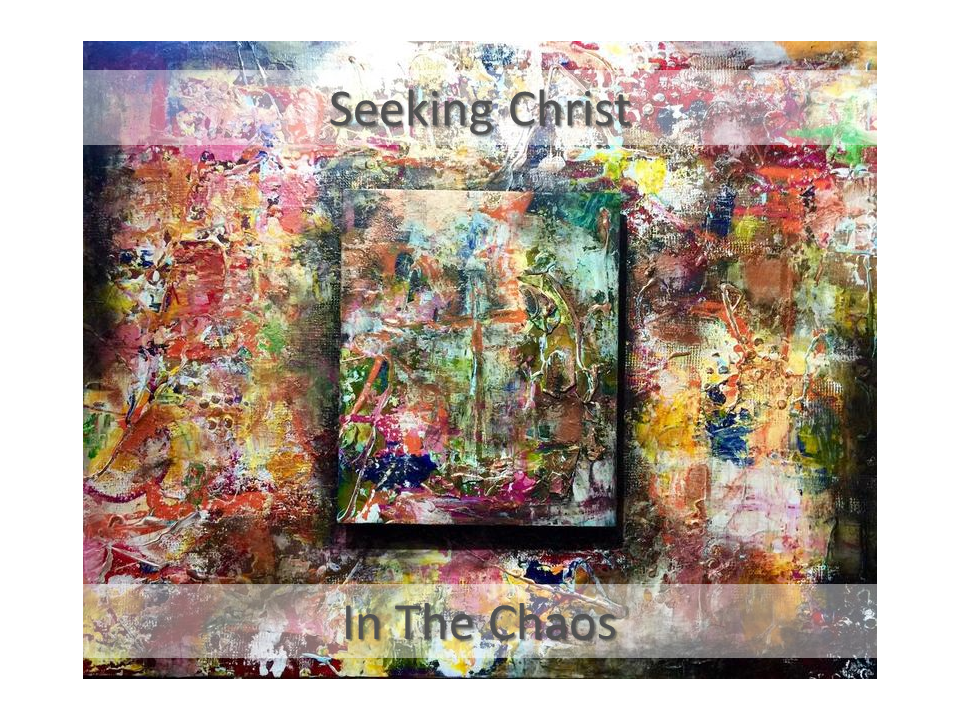
And when this prayer is answered, Daniel prays today’s text. This fabulous lesson of seeking Christ in the Chaos. IN a true emergency of life and death.
It is, if you will, a sort of 7 step circle, for it ends where it begins. And its insights could not be more useful for us today in the present chaos of our time and place.
One thought before we unpack the prayer.
You will note how Daniel asked his friends to seek mercy from God in this mystery – in the unknown – in the midst of their chaos.
As Daniel will pray again in Ch. 9 after he understands from Jeremiah’s prophecies that the 70 years is nearly up – although he was probably between 15-17 when captured – note how he owns the sin of his nation as his own: Daniel 9:5-15
Daniel 9:5–15 ESV
we have sinned and done wrong and acted wickedly and rebelled, turning aside from your commandments and rules. We have not listened to your servants the prophets, who spoke in your name to our kings, our princes, and our fathers, and to all the people of the land. To you, O Lord, belongs righteousness, but to us open shame, as at this day, to the men of Judah, to the inhabitants of Jerusalem, and to all Israel, those who are near and those who are far away, in all the lands to which you have driven them, because of the treachery that they have committed against you. To us, O Lord, belongs open shame, to our kings, to our princes, and to our fathers, because we have sinned against you. To the Lord our God belong mercy and forgiveness, for we have rebelled against him and have not obeyed the voice of the Lord our God by walking in his laws, which he set before us by his servants the prophets. All Israel has transgressed your law and turned aside, refusing to obey your voice. And the curse and oath that are written in the Law of Moses the servant of God have been poured out upon us, because we have sinned against him. He has confirmed his words, which he spoke against us and against our rulers who ruled us, by bringing upon us a great calamity. For under the whole heaven there has not been done anything like what has been done against Jerusalem. As it is written in the Law of Moses, all this calamity has come upon us; yet we have not entreated the favor of the Lord our God, turning from our iniquities and gaining insight by your truth. Therefore the Lord has kept ready the calamity and has brought it upon us, for the Lord our God is righteous in all the works that he has done, and we have not obeyed his voice. And now, O Lord our God, who brought your people out of the land of Egypt with a mighty hand, and have made a name for yourself, as at this day, we have sinned, we have done wickedly.
He recognizes that the chaos they find themselves in the middle of – is because of sin.
And that they need mercy for their sin.
And that it is ALL their sin. There is no finger-pointing or saying “but that was all before I was born!” It was their national sinfulness that brought them to such a place.
A massive consideration for our own situation today. One we need to unpack another time.
But oh what a God of mercy He is!
So how does Daniel pray in the chaos?
How can we pray best in the chaos? By praying to the same God revealed in Daniel’s prayer.
1. Worship – He begins with worship.
“Blessed be the name of God forever and ever, to whom belong wisdom and might.
God is ALWAYS worthy of praise. No matter what the circumstances.
Christians in the midst of chaos must never abandon worship. Must never stop reminding themselves that they are God’s and we are His and that He remains on His throne.
When this escapes our minds, we can’t help but be thrown by what is going on around us.
We desperately need to remind ourselves that He remains worthy of our praise over and over and over.
When we stop seeing and worshiping a God greater than our situation – we are at a loss to address the world with anything substantive.
We’ll panic like those around us, and fall back upon desperate, human measures to deal with what is at its base – a spiritual problem.
Daniel’s God is unchanged and worthy to be blessed in the midst of the chaos.
2. Ascription – He recalls key attributes of His God.
“to whom belong wisdom and might.”
This 2-fold ascription is absolutely necessary to a right mind in a world gone mad.
Our God is wise in ALL He allows and brings His people through. Even when our own sin is directly tied to our trials.
And God still has all the power to meet the circumstances. He is mighty.
To the naked eye, Daniel’s circumstance was absolutely beyond the reach of any conceivable answer.
But when they prayed and sought God for mercy, an answer came from the God who remains powerful in the face of the impossible.
Beloved this as true today for you and me in the midst of today’s madness.
Our God remains wise in having brought us to this hour, and He is mighty to work in it the fullness of His plan.
Remind yourself often passages like Proverbs 21:30
Proverbs 21:30 ESV
No wisdom, no understanding, no counsel
can avail against the Lord.
OUR plans, OUR desires, OUR thoughts of how things ought to go might go to ashes – but His cannot and will not.
Daniel entered into worship and ascribed to God the wisdom and power that belongs to Him even in Daniel’s present chaos.
3. Seasons – God appoints and controls the seasons of life in which we live.
“He changes times and seasons”
Kingdoms rise, and kingdoms fall.
Cultures rise and cultures fall.
Ideologies come and gain prominence for a time and then morph or disappear.
Experts divide human history into a number of epochs:
Pre-history – before writing systems.
The Stone Age with about 8 divisions like Paleolithic, Mesolithic etc..
Ancient History.
The Middle Ages.
Modern History and so on.
And God is God in all of them. Over all of them. Moving in all of them.
So much so that Paul on Mars Hill can say to his hearers then and to us now: Acts 17:26-27
Acts 17:26–27 ESV
And he made from one man every nation of mankind to live on all the face of the earth, having determined allotted periods and the boundaries of their dwelling place, that they should seek God, and perhaps feel their way toward him and find him. Yet he is actually not far from each one of us,
You and I live in this place at this time – in this Nation, State, City and especially at this moment in history with all of its strangeness and complexity specifically to facilitate our seeking out God to know and find Him.
He knows you and knows what is most ideal to drive you to seek Him.
This chaos isn’t random, it is in His hand to make you despair of this world so that you will find your hope and security in Christ and Christ alone.
Daniel had come to realize that his new experience of God was directly tied to his own exile, captivity, probable mutilation, forced service to a pagan King and the 70 year season of Israel’s judgment.
Who knows but that we too – as the Church might be living in the midst of God’s dealing with America for her sins? But that He is the one who changes the times and the seasons, that He is behind the shifts in epochs of human history – is without question.
And so we can trust Him as those who have gone before us did in their seasons.
As Ecclesiastes 7:10 says:
Ecclesiastes 7:10 ESV
Say not, “Why were the former days better than these?”
For it is not from wisdom that you ask this.
We lack the wisdom of knowing how God is the God of history – even our present history – when we imagine the mythical “good old days.”
You and I never lived at a better time than right now to seek the face of God.
Worship, Ascription, Seasons and…
4. Leaders – God appoints all those who come into political and governmental leadership.
“He removes kings and sets up kings”
Now we need to make no mistake here – so let me jump to the most direct application I can: No matter who wins this coming Nov. 3 – It is God who installs or removes leaders.
We campaign and dialog and vote and all of that – which is all right and good and well – but the ultimate outcome has to do more with God carrying out His ultimate plans and purposes than with our short-sighted, immediate understanding and agendas.
Whether that be for more general blessing, or in judgment. And I am in no position say which that is given either of the candidates. I just know God is at work. He never abdicates His position as ruling in the affairs of men in this regard.
As Paul reminds his readers regarding the governing authorities of his day: “there is NO authority except from God, and those that exist have been instituted BY God.” (Rom. 13:1 – Emphases mine).
And while we cannot unpack all of the complexities of how we today might interact with our own government, the basic principle here is both powerful and necessary for us to grasp.
On its face, Daniel’s statement needs no qualification.
He knew it well from Israel’s history. The people set up their kings – good and bad, but for Daniel, God was at work. He’s the one who removes and sets them up.
As you read your Bible, especially the Old Testament prophets, take note at how often God addresses the leadership not only of Israel but of many pagan nations.
Cyrus of Persia is called “God’s anointed.”
In Isaiah 10 – Assyria and its king Sennacherib are “the rod” of God’s own anger, though they haven’t a clue that’s so.
In 1 Kings 11, God anoints wicked Jeroboam King over Israel in its civil war against Judah.
In 2 Kings 9 Jehu – another wicked man is set apart by God to rule.
Jeremiah says that Nebuchadnezzer is the means whereby God Himself will fight against Judah in judgment.
And after his humbling Nebuchadnezzar declares: “the most high rules in the kingdom of men and gives it to whom he will and sets over it the lowliest of men.”
Jesus will tell Pilot that even Pilot’s authority came from God.
This is vital for us to grasp as we are in the midst of this confusing, rancorous, wildly chaotic Presidential election.
Whatever the outcome, God is at work. And we can trust Him in it.
Worship, Ascription, Seasons, Leaders…
5. Knowledge – We are never left without full counsel for what we are to be about.
“He gives wisdom to the wise and knowledge to those who have understanding”
Wisdom, God’s wisdom Proverbs 1:3 tells us is for the purpose of instruction in righteousness first of all.
God gives us wisdom and knowledge in accordance with how to be about seeking first the kingdom of God and His righteousness, irrespective of what is going on around us.
His chief concern is not wisdom for the voting booth, investments and the like – but in living righteously before Him in the weirdness of the days in which we find ourselves.
Our problem is, we are more interested in straightening out the culture, the political system and societal ills, than we are in growing in the likeness of Christ.
We have the Word of God so as to be taught in the truth as it is in Christ: reproved of our sin, corrected from our sinful errors, trained in walking righteously – defined as being equipped for every good work.
So as Daniel is working through navigating the totally foreign world of pagan captivity – his concern is how to serve God well there – not how to fix “there.”
And may it be so for us.
He gives wisdom. He gives knowledge. For what we need. For what we were designed for. For His ends and purposes.
I don’t assume He will give me the wisdom to understand Covid-19 and all of its ramifications – but I DO expect wisdom on how to be sure I am honoring Him in the strain the current situation brings into my life.
How to keep trusting Him. Resting in Him. Committing the outcome to Him. Worshiping Him. Serving Him. Rejoicing in Him. Growing in Him.
And avoiding contentiousness, resentment, foolishness, carelessness, fretfulness, comfort sins, enmity, strife, fits of anger, rivalries, dissensions, divisions and “whatever else is contrary to sound doctrine.” (1 Tim. 1:10)
The wisdom to place our priority on the spiritual, when the chaos of the day tries to drag us kicking and screaming into the arena of the temporal every second of the day.
Maybe you’re not as tempted to get all wrapped up in the current political madness as I am – to want to rise up and shout back at every idiotic post and news broadcast.
But He has made us for better things. Higher things.
Daniel got wisdom to: Avoid defiling himself with the King’s meat. How to approach his handler when the decree to execute the wise men came down. And above all – to seek God in the face of the impossible.
Worship, Ascription, Seasons, Leaders, Knowledge…
6. Illumination – Light for a reality that transcends the World.
“He reveals deep and hidden things; He knows what is in the darkness, and the light dwells with Him”
John says that Jesus is the true light, which gives light to everyone.
As we understand Him, His mission, His teaching, His plans and His purposes – He gives us light into deep and hidden things.
He knows what is in the darkness – and if you would really see clearly what is going in in the frenzy of this current moment – you must see it in the light of Him.
Light dwells with Him alone.
How do we explain the current state of affairs? Only as we understand a world in rebellion against God.
Psalm 2:1-3
Psalm 2:1–3 ESV
Why do the nations rage
and the peoples plot in vain?
The kings of the earth set themselves,
and the rulers take counsel together,
against the Lord and against his Anointed, saying,
“Let us burst their bonds apart
and cast away their cords from us.”
The word “rage” here includes being in tumult and commotion.
Rest of heart and soul and mind can’t be present while people continue to refuse the Lordship of Jesus Christ.
Beloved, don’t look for sanity from this world given this state of men’s hearts. We know what is at the root of the chaos. We know it is the darkness of soul that is the result of rejecting God in Jesus Christ. And we know our response to it all is to plead for the Gospel to have greater and greater effect until the Day Jesus returns.
And we know 2 Timothy 3:12-13
2 Timothy 3:12–13 ESV
Indeed, all who desire to live a godly life in Christ Jesus will be persecuted, while evil people and impostors will go on from bad to worse, deceiving and being deceived.
So what are we to do? Here is light: 2 Timothy 3:14-15
2 Timothy 3:14–15 ESV
But as for you, continue in what you have learned and have firmly believed, knowing from whom you learned it and how from childhood you have been acquainted with the sacred writings, which are able to make you wise for salvation through faith in Christ Jesus.
Now I want to be clear here – as Daniel closes his prayer he says: Daniel 2:23
Daniel 2:23 ESV
To you, O God of my fathers,
I give thanks and praise,
for you have given me wisdom and might,
and have now made known to me what we asked of you,
for you have made known to us the king’s matter.”
Don’t misread his point.
His rejoicing isn’t in just understanding the King’s dream. It is in understanding what the King’s dream meant.
For in the unfolding of the dream, Daniel comes to understand that God had already set out how there would be these four world empires which would come on the scene – the first of which they were in right then.
And then, regarding that last empire: Daniel 2:44
Daniel 2:44 ESV
And in the days of those kings the God of heaven will set up a kingdom that shall never be destroyed, nor shall the kingdom be left to another people. It shall break in pieces all these kingdoms and bring them to an end, and it shall stand forever,
Daniel understood that God was the God of all history – of all governments – of all world empires – and how it would all end in the conquering Kingdom of Christ.
The very same light you and I carry into this absolutely insane hour in which we live.
That Kingdom which was set up when Christ came shall never be destroyed. It shall never pass to some other people – i.e. it will never fall or be conquered. In fact, it will see the destruction of all the kingdoms of the earth.
The Kingdom which Jesus said even the gates of Hell cannot overcome.
The Kingdom to which everyone born again by the Spirit of Christ belongs.
And so, as Daniel will spend the rest of his life in captivity, and in the chaos of Babylon itself being conquered; of stranger and more wicked kings to serve under; and dangers like the lion’s den or his 3 friends going into the fiery furnace – he worships.
7. Worship
He comes full circle. His God is all wise and all powerful.
His God rules the times and the seasons of human history.
His God is the one who determines who will be in governmental authority at any given time.
His God gives him wisdom and knowledge to live uprightly even in captivity, serving a most pagan King.
His God gives him the light of truth in a dark and deceived world. In the very heart of darkness itself with no Temple, and no access to God appointed worship.
He knows where it is all going and how it will end.
And all these are ours too as we find ourselves in the whirlwind of the chaos of our day.
And so, for all those who are Christ’s, we come to the table that demonstrates so graphically these very truths in power.
We do what Jesus called us to in the face of the chaos that took Him to the Cross.
With these simple words as He bid us to take the bread and the cup in remembrance of Him.
He died in the vortex of human chaos – but in the perfect plan of the Father as the substitute sacrifice for our sins.
And He bids us remember that reality – until He comes. We do this as Scripture says to “proclaim the Lord’s death until He comes.”
Since He is the Lord of history – He will consummate it all when He returns. And we trust Him as the Lord of all times and places – to bring it to pass.
By faith in Him coming again at the right time, even as Romans 5:6 says: “at the right time Christ died for the ungodly.”
For the audio Podcast of this and every episode, find us on Breaker, Google Podcasts, Overcast, Pocket Casts, RadioPublic, Spotify or HERE
If you’d like to join us in our journey reading all the way through the Bible this year, drop me a line at reid.ferguson@gmail.com, and I’ll be glad to email back a copy of the reading plan we are using.
The Bible has a lot to say about God’s glory, about His name or His reputation. And in reading through chapters 46-49 In Isaiah, we read this remarkable portion in Isa 48:9-11Isaiah 48:9–11 ESV“For my name’s sake I defer my anger; for the sake of my praise I restrain it for you, that I may not cut you off. Behold, I have refined you, but not as silver; I have tried you in the furnace of affliction. For my own sake, for my own sake, I do it, for how should my name be profaned? My glory I will not give to another.
God takes His glory seriously. It seems only fitting that we do too. But what does that really mean? We’ll try to scratch the surface of that a bit today on Through the Word in 2020. I’m Reid Ferguson.
Along with our Isaiah passage this morning, we also have Luke 21:1–9 and James 2 to consider. But it is the Isaiah passage just cited that I’d like to highlight today. For the glorifying of God appears to be a topic of some confusion.
To some, it appears as though God has an ego problem. After all, He announces that the reason why He has been so patient in dealing with Israel’s sins is that He’s done so for His own sake, lest His name should be profaned. But ego isn’t the issue in any of this at all.
If God had a big ego, when you turned over a leaf it would have a little label on it “Designed by God.” He’d plaster images of Himself all over or in our day, certainly have a reality TV show. No, He is so humble that many claim they cannot perceive Him even in the display of His genius and power in Creation. Though in truth, they are denying the obvious.
The reason why God is so jealous for His name is because as the source of all good, and because He can bestow no higher good upon His creatures than Himself – love demands He be seen, grasped and rejoiced in for who and what He is. And this then dictates what it really means to “glorify” God.
Quite simply God is most glorified, where He is most revealed.
Glory is not something added to Him – it is the outshining of His being. When He speaks here of keeping Israel for His own name’s sake or glory, He is not saying “so I’ll look good”. He is saying, “I AM faithful. That is my nature. And I am determined to reveal that about myself. I will not go back on my promises or let them fall to the ground. I will be glorified (revealed) that all may know Me and trust Me for who and what I am.”
God doesn’t need a public relations team to make Him look good. He just needs to be seen as He is. And as we read in Hebrews 1:3, He is seen best in Jesus Christ. Because He is the “radiance of the glory of God, and the exact imprint of His nature.” And why 2 Cor. 4:6 tells us that the knowledge of the glory of God is found in the face of Jesus Christ.
Jesus revealed the Father fully. That is how He can say in John 17 that He had glorified the Father on earth. In doing all the Father’s will – He made the Father known. All of which finds its absolute apex in the Cross. When not just the faithfulness of God is seen in the fulfillment of His promise of redemption, but His holiness is seen in judging sin, His mercy in the atonement made in Jesus’ blood, and His grace in requiring it to be proclaimed to the world.
Glorify Him today Christian – make Him known. Declare His goodness and glory in the cross of Christ.
I’ll be away until next Thursday. Until then, keep reading!
For the audio Podcast of this and every episode, find us on Breaker, Google Podcasts, Overcast, Pocket Casts, RadioPublic, Spotify or HERE
If you’d like to join us in our journey reading all the way through the Bible this year, drop me a line at reid.ferguson@gmail.com, and I’ll be glad to email back a copy of the reading plan we are using.
According to the United Nations, there are 195 sovereign nations on Earth today. 54 are in Africa48 in Asia44 in Europe33 in Latin America and the Caribbean14 in Oceaniaand only 2 in North America.
And the Council on Foreign Relations says that there are at least 26 armed conflicts currently occuring globally this very minute.
Millions of people in all sorts of distress due to these conditions. And is God only God over a few? Our reading today in Isaiah 44:6-45 would tell us no. In an amazing display of God’s global involvement, we see something many simply do not realize.
Some chapters in the Bible stand out as containing insight into reality that from day to day escapes us. Such are Isaiah 44-45.
As you might expect, these portions are written primarily concerning Israel and God’s dealing with this singular nation. Singular because He set Israel aside for Himself. It is the only nation He established uniquely as His own. That, despite claims by many others that they are uniquely His. Over the centuries, England, the United States of America and others have claimed similar unique status for themselves. But Biblically Israel stands alone in this regard.
It is all the more surprising then that Isaiah 45 opens with God addressing someone named Cyrus.
Now who was he? Who was this man whom God said He anointed to subdue nations as God’s agent? Well, he was a pagan King – King of the Persian empire. A man God raised up over a foreign throne while the Jews were in captivity under his rule. And the man God used to send His people back to Judea at the end of their 70 years of captivity.
Now the point of all this is simply that no nation, no ruler, King, President, Premier, Prime Minister or despot occupies their role apart from God’s notice, and even His employment.
When Cyrus decreed the Jews could go back to Jerusalem to rebuild the Temple, he also sent captives from other nations under his power back to their lands to re-establish the worship of their gods too. It appears he was hoping to build up as much divine favor for himself as he could – no matter what the source. He wanted ALL the gods on his side. Not just the One True God of Israel. And yet, in that action, prophecy for Israel was fulfilled, and God’s people were restored.
God can and will use any and all to accomplish His will. Just because you do not see a leader as the one you would hope for – doesn’t mean God has left off His plan, is sidetracked, stymied or stifled. As Proverbs 21:30 reminds us: “No wisdom, no understanding, no counsel can avail against the Lord.”
Never forget our Global God Christian. We are His and He is ours. Bought with the precious blood of Jesus. And however God may deal with our own nation, in blessing or in judgment, His people will remain His, and His purposes will yet be accomplished.
Christians in every nation on the planet are called to look to and trust Him in all He is doing. He is absent nowhere. And He has abandoned His own – never. Keep seeking His face.
As Revelation 17:14 and 19:16 remind us – our Jesus is the King of Kings. He is the Lord over all Lords.
For the audio Podcast of this and every episode, find us on Breaker, Google Podcasts, Overcast, Pocket Casts, RadioPublic, Spotify or HERE
If you’d like to join us in our journey reading all the way through the Bible this year, drop me a line at reid.ferguson@gmail.com, and I’ll be glad to email back a copy of the reading plan we are using.
Misunderstanding things can lead to all sorts of misery.
There is the well know account of Martin Luther in an exchange with Johann von Staupitz, Luther’s confessor.
Before his coming to understand the Gospel and still bound up in the works/salvation Romanism of his day – Luther would confess sins for hours on end trying to rid himself of every little foible. One day, wearied by this behavior Staupitz told him to stop being this microscopic about every little thing and just love God. ‘Love God?’ Luther shot back – ‘I hate him.’
He hated God, because did not understand either God, nor the Gospel. And that misunderstanding tortured him day and night until he at last saw that Believers are justified by grace through faith – with the righteousness of Christ.
And as our readings today include Isaiah 42–44:5; Luke 20:27–40; James 1:2–18 and Proverbs 30 – we’ll find a misreading or misunderstanding in James that has frustrated and discouraged many a Child of God.
We’ll talk a bit about that today on Through the Word in 2020. I’m Reid Ferguson.
Count it all joy when you meet trials of various kinds counsels James 1:2. And a simple misreading here can make James’ point onerous and heavy rather than sweet and helpful.
Note first that the text does NOT say, consider trials in and of themselves joyous things. It is not a plea to become masochists and take pleasure in pain. He says count it all joy “when” – or, on the occasion of meeting trials of various kinds.
Many in misreading this have tried to do the impossible and make the trials themselves joyful, only to fail and then imagine themselves as having failed God in it. Soon they come to ignore, or even resent or hate such a passage. But the idea here is not to ignore the difficulty of any trial, but to see that upon entering trials, we have an opportunity before us which is joyous. And that opportunity is at least in part to use our weakness as a place to learn dependence, to experience the sustaining power of God, and to grow in the image of Christ as we look to His Spirit in it. That by His grace we can take advantage even of the most harrowing things.
So the call is not to somehow make pain itself pleasurable. It is to say that in Christ, everything can be redeemed for our good. And that each trial presents new opportunities for that.
Now how to do that in each case, takes a wisdom we do not natively have. But it is a wisdom God delights to give when we seek Him for it. Each trial may require some new insight, some new glimmer of wisdom peculiar to that particular trial. But if we are assured in our hearts that He loves us so and desires to meet us there, we will find the prayer for that wisdom answered in due course.
We must trust our God, His care, power and good will toward us in Christ.
Believer – keep looking to your Savior. He not only redeems your soul, but all of your experiences, trials, temptations and woes. Nothing is beyond His reach. Especially you yourself. And He holds you, in the palm of His nail-scarred hand.
And if you lack the wisdom to live there today – ask. He won’t chide you for it – but gives generously to all in this regard.

 ResponsiveReiding