• Home
  • About
  • Blog
  • Atonement
    • The Atonement: Read this first!
    • Confession of an ex-u0022Highperu0022 Calvinist
    • Revisiting the Substitutionary Atonement
    • Discussing the Atonement – a lot!
    • Lecture Notes on The Atonement
  • Sermons
  • ReviewsAll book and movie reviews
    • Books
    • Movies

ResponsiveReiding

  • Tuning the Heart Part 8

    January 9th, 2025
    This image has an empty alt attribute; its file name is image-4.png

    “And when you pray, do not heap up empty phrases as the Gentiles do, for they think that they will be heard for their many words. Do not be like them, for your Father knows what you need before you ask him. Pray then like this: “Our Father in heaven, hallowed be your name. Your kingdom come, your will be done, on earth as it is in heaven. Give us this day our daily bread, and forgive us our debts, as we also have forgiven our debtors. And lead us not into temptation, but deliver us from evil.” Matt. 6:7-13.

    We have been considering “The Lord’s Prayer” under the idea of using it to regularly re-tune the heart, not as a mere rote religious exercise. To go to this prayer and consider the massive implications of each phrase, as a means each time to re-tune the soul to God’s priorities; to those things He knows are best for us. So that we think with this scheme always in our minds – framing how we see reality.

    It begins by calling us to consider how holy, glorious and magnificent He is first, so that we have some sense of who it is we are praying to, before we even begin. And that in recognizing Him as He is afresh, seeing that the greatest cosmic need of all is that every knee bow, and every tongue confess, that Jesus Christ is Lord – to the praise and glory of the Father (Phil. 2″11). That His glory and reputation be restored among all sentient beings. And indeed, can we truly pray until WE are seeing Him as He is first?

    Secondly, Jesus tells us that the final answer to all the prayers of the saints culminate in this one grand petition – that His Kingdom would at last come. That all human and angelic rebellion against His perfect rule would at last be vanquished, and that Christ would rule unopposed both in our hearts and minds, and manifestly on earth – globally and cosmically.

    And thirdly, reframing our desires to coincide with His will in all things. For we so often do not even know what to pray for. So, the Believer, humbly submits his or her requests to Him for the review of His perfect wisdom and love. We trust Him to veto foolish things, grant better than we ask, answer when it is most advantageous and base His answers on what is best for our souls and growth in Christ – long term.

    Fourth, Jesus shows us that we need to look to the Father both for our simplest, basic needs, but above all that Christ would be the ultimately satisfying Bread of Life for our souls. That Christ would be broken afresh to us. That we would be satisfied in Him, above all earthly things.

    And it isn’t until this point – that He leads to treat the ideas of sin and forgiveness. I find that both curious and glorious.

    How often do our prayer lives begin with the confession of sin? That our starting point is far from His? That as Believers, justified by faith in Christ and His atoning work on our behalf, He is not as fixated on the sin problem as we still tend to be. We are this side of the Cross. Christ has died. He has paid the price for our sins. We come to The Father as children already, and not as groveling beggars. Not to do so is to come to Him as though Jesus’ work hasn’t already made the way. As though by obsequious shamefacedness, we now pave a new way to Him ourselves. It is as if having fallen, WE now have to do the re-set. Jesus made an initial way, but it is up to us to keep it or restore it. It is the opposite of grace, wherein we trust Christ’s righteousness as imputed to us, even as our sin was imputed to Him at Calvary.

    What does this do then? It frees us to confess freely and without having to deny any of our wickedness, nor to come to Him sheepishly. “For we do not have a high priest who is unable to sympathize with our weaknesses, but one who in every respect has been tempted as we are, yet without sin. Let us then with confidence draw near to the throne of grace, that we may receive mercy and find grace to help in time of need.” (Heb. 4:15 & 16) We can fully agree with Him regarding our failures and guilt, while at the same time pleading for a repentant heart, and all with the confidence that we are already fully accepted in Christ and face repentance, not man-crafted penance. We cast all of it on Him.

    “Forgive us our sins, as we forgive those who sin against us” tunes us most keenly to the Gospel wherein we stand. And, it fills us with the wherewithal to forgive others out of the abundance of what we’ve already received. It reminds us that no one has ever sinned against us as greatly as we have sinned against Him – and gives us a bottomless reservoir out of which to draw our own forgiveness for others.

    Of what a glorious salvation is ours in Christ Jesus – the Lamb slain for sin.

  • Lacking Wisdom

    January 8th, 2025

    One of the things which commonly happens with Christians, is that we take a verse – like this one – and toss it around as a general maxim without really considering it well in context. I hear this verse quoted all the time as a stand-alone. But when we do that, we can miss the real point of the portion when taken as a whole. Does God give wisdom in general? Sure. But is that what James is after here? I don’t think so.

    The context here is asking God for wisdom, regarding how to count it “all joy” when as Believers, we encounter all sorts of “trials of various kinds.” The application is intentionally narrow. And the caveat appended to it is that if we do not do so, we will find our faith quite unstable. How those fit together is essential in understanding James’ point.

    Note first then that James is after helping Believers grow in steadfastness. Steadfastness is remaining the same in regard to living rightly before God, irrespective of outward circumstances. It means having a frame of mind in trusting God, no matter what changes around us externally, or even how we feel.

    That being the case, the wisdom referred to here isn’t generic wisdom, but specifically related to facing trials – not only courageously, but profitably, by trusting in God’s providential care over His children. It is wisdom to take advantage of our trials in confidence that God will use them to help us mature and become complete, mature spiritually.

    If we do not have faith in His care and providential appointments in our trials, then we will have no real faith at all, and as a result will be unstable in everything we encounter in life. We will always be knocked off kilter by difficulties. We must trust our God, His care, power and good will toward us in Christ.

    That means then, that to “ask in faith” is to ask:

    1- Trusting God’s character.

    2- Trusting God’s love.

    3- Trusting His wisdom in bringing us to and through our trials.

    4- Trusting His sovereign appointments and care.

    5- Trusting The promises in His Word.

    Faith, true Biblical faith is ALWAYS rooted in His trustworthiness.

    If I have no faith in that, in His trustworthiness regarding His sovereignty over my life, I will never be stable, never gain endurance, and never grow in spiritual maturity.

    So today fellow Christian, if you are truly His, and you are enduring a hard place right now, He is saying to you – that if you will ask for wisdom as to how to use this trial, to co-opt it for steadfastness and growth in the image of Christ – He WILL, give it. He is faithful to do so. You can trust Him. And knowing our weakness here, He promises that He will not think little of us for needing more wisdom, but will freely, lovingly and joyfully grant it. He will not chide us for our lack. For He loves to be our great supply in such circumstances. He loves to have us call upon Him in our time of need. To know, that we are to keep coming back to Him over and over and over as the One on whom we truly rely.

    Oh what precious things such as these are ours because of Christ!

  • Edification requires Intelligibility

    January 7th, 2025

    The title to this post is not my own. It is a near constant reminder from my internet friend, scholar and Bible teacher – Mark Ward.

    When the Apostle Paul is giving corrective instructions to the Corinthian Church, he has to address the issue that even though the Holy Spirit may supernaturally enable someone to speak in a language unknown to them – nevertheless, unless that language is translated for the assembly. So he writes in 1 Cor. 14:7-12 “If even lifeless instruments, such as the flute or the harp, do not give distinct notes, how will anyone know what is played? And if the bugle gives an indistinct sound, who will get ready for battle? So with yourselves, if with your tongue you utter speech that is not intelligible, how will anyone know what is said? For you will be speaking into the air. There are doubtless many different languages in the world, and none is without meaning, but if I do not know the meaning of the language, I will be a foreigner to the speaker and the speaker a foreigner to me. So with yourselves, since you are eager for manifestations of the Spirit, strive to excel in building up the church.”

    Edification – building up – requires intelligibility.

    Or consider the example in Nehemiah 8 with those returning to Jerusalem from the Babylonian captivity. Many, did not even know their native Hebrew anymore. So we read that Ezra enlisted a group of men in the endeavor to restore the Word of God to the people. We read: “They read from the book, from the Law of God, clearly, and they gave the sense, so that the people understood the reading.” The word “clearly” there implying they gave an interpretation, paragraph by paragraph – and gave the sense too, not just the words.

    Edification requires intelligibility.

    Because we know this, and because we also know that most of us know neither Biblical Hebrew nor Greek, God has gifted men and women throughout the ages to study and translate the original languages into those spoken by others around the world. How grateful we must be for this.

    But even when that work is done, we recognize that languages themself change over time. Due to this reality, new and new Bible translations are needed, even in the very same language over time – to be sure the message of the Bible is not lost due to the way language morphs. A good example is the graphic above showing how The Lord’s Prayer would have looked to English readers around 100 A.D. And below, are several more examples.

    Thirteenth Century –  Manuscript in the Library of Cambridge University:
    Fader oure that art in heve, i-halgeed be thi nome, i-cume thi kinereiche, y-worthe thi wylle also is in hevene so be an erthe, oure iche-dayes-bred gif us today, and forgif us our gultes, also we forgifet oure gultare, and ne led ows nowth into fondingge, auth ales ows of harme.

    Fifteenth Century –   Manuscript  in the Library of  Oxford University:
    Fader oure that art in heuene, halewed be thy name: thy kyngedom come to thee: thy wille be do in erthe as in heuen: oure eche dayes brede geue us to daye: and forgeue us oure dettes as we forgeue to oure dettoures: and lede us nogte into temptacion: bot delyver us from yvel.

    Seventeenth Century –  The King James Version of 1611:
    Our father which art in heauen, hallowed be thy name.  Thy kingdome come. Thy will be done, in earth, as it is in heauen.  Giue vs this day our daily bread.  And forgiue vs our debts, as we forgiue our debters.  And lead vs not into temptation, but deliuer vs from euill: For thine is the kingdome, and the power, and the glory, for euer.

    (The 3 examples above are from a post at: http://www.livingwithfaith.org/blog/the-lords-prayer-through-the-centuries)

    Now a while back, a gal came to attend our congregation, with virtually no Bible background. She needed to be brought up to speed with Biblical language for sure, and especially the nomenclature which we – as Bible-believing Christians take for granted. We use a lot of unique words. We throw around words like regeneration, justification, sanctification and the like – but seldom take the time to define those terms for the uninitiated. Even a phrase as basic as “born again” needs to be unpacked for those who have had no previous exposure, or very limited familiarity.

    Coming back to the gal I just referenced – this issue popped up in a way I hadn’t remotely thought about before – even while trying to explain terms in my preaching and using a newer translation of the Scriptures like the ESV.

    The problem? My beloved hymns. Take for example vs. 2 of “Come Thou Fount of Every Blessing”, and its “Here I raise my Ebeneezer.” What in the world does that mean? Even to many raised in the Church today.

    Let me make it even more basic. For this gal, the simple “thees” and “thous” of Elizabethan English in the hymns proved to be a stumbling block to intelligibility. And this, from a college educated professional. Imagine what this might mean to those doing inner-city or far rural missions! The problem is compounded.

    Now for me as both a hack poet, and a child of the manse (who even knows what that means any more?) I am truly loath to give up the music and cadence of the words of sacred hymnody, let alone the melodies. I love the amazing turns of phrase and linguistic beauty of so many of the hymns that have fed my soul for all of my life.

    That said, if I want the truths which were meant to be communicated in those grand “songs of Zion” (does that phrase mean anything to anyone anymore?) to still serve the souls of those coming after – we may need to rethink, and re-work these sacred works of Gospel art.

    I offer up a modest attempt below. I’d love to know what you think. I labored to keep the intent of the lyrics while trying to remove anything which might hinder anyone, and yet retain memorability as well as intelligibility. May God raise up a number in our day who can take on such a project – that what can be preserved, is, and what can be modified rightly, may be, for the edification of many others in days to come.

    This, from “Joyful, Joyful, We Adore Thee”. The original appears at the bottom.

    I. Joyful, joyful, we adore You,

    God of glory, Lord of love;

    Hearts when warmed responding to you

    Turn to see the Son above

    Melt the clouds of sin and sadness,

    Drive our darkest doubts away;

    You Who give eternal gladness,

    Fill us with Christ’s light today

    II. All your works with joy surround You,

    Earth and Heaven reflect your rays,

    Stars and angels sing around You,

    Center of our highest praise.

    Fields and forests, valleys and mountains,

    Beautiful meadows, flashing seas,

    Singing birds and river fountains

    All sing of your majesty

    III. You are giving and forgiving,

    Always blessing, always blessed,

    Source of all the joy of living,

    Boundless sea of happy rest!

    God our Father, Christ our brother,

    All who abide in You are mine,

    Teach us how to love each other,

    Sharing in your joy divine

    IV. Come and join the happy chorus

    Angels long ago began;

    God the Father loving, saving,

    Sent in love the Son of Man.

    Always singing, marching to Heaven

    Spirit empowered to conquer strife,

    Joyful music leads us homeward

    By the power of Christ – our life.

    Joyful, joyful, we adore Thee,
    God of glory, Lord of love;
    Hearts unfold like flow’rs before Thee,
    Op’ning to the sun above.
    Melt the clouds of sin and sadness;
    Drive the dark of doubt away;
    Giver of immortal gladness,
    Fill us with the light of day!

    All Thy works with joy surround Thee,
    Earth and heav’n reflect Thy rays,
    Stars and angels sing around Thee,
    Center of unbroken praise.
    Field and forest, vale and mountain,
    Flow’ry meadow, flashing sea,
    Singing bird and flowing fountain
    Call us to rejoice in Thee.

    Thou art giving and forgiving,
    Ever blessing, ever blest,
    Wellspring of the joy of living,
    Ocean depth of happy rest!
    Thou our Father, Christ our Brother,
    All who live in love are Thine;
    Teach us how to love each other,
    Lift us to the joy divine.

    Mortals, join the happy chorus,
    Which the morning stars began;
    Father love is reigning o’er us,
    Brother love binds man to man.
    Ever singing, march we onward,
    Victors in the midst of strife,
    Joyful music leads us Sunward
    In the triumph song of life.

  • The Wisdom of William Jay

    January 5th, 2025

    Thanks to the largess of a friend, I am currently reading through the autobiography of William Jay. Jay (1769-1853) was a non-Conformist (Independent) preacher and pastor in Bath, England – where he pastored Argyle Chapel for over 50 years. He was a friend of John Newton.

    The autobiography is unusual in that it consists in 4 parts.

    Part one is comprised of 18 letters to his children, recounting his life, ministry and reflections on a whole host of associated issues.

    Part 2 is a supplement to part 1 regarding events of interest, celebrations, various personages with whom he interacted and other miscellanies.

    Part 3 contains 23 “Reminiscenses of Distinguished Contemporaries.” These range from the well-known John Newton, John Ryland, William Wilberforce and others of the like, to many whose names are wholly unfamiliar to me excepting in this volume.

    Part 4 is a wide-ranging selection of his voluminous correspondence.

    Of particular delight to me (so far) was letter 17 to his children. It contains some of his most useful reflections in my opinion. And of particular note are the few excepts I am about to give you. I hope they will whet your appetite to seek out and read this refreshing, informative and soul-useful volume. It really is quite a delight. Of particular interest will be his reflections on leaving churches for other churches, and why different denominations is not a negative. There is food for thought there both for pastors and congregants.

    Let me give you a few excerpts from the closing section in particular.

    Pg. 166 – “Divinity cannot be taught at the college without system, but, in preaching, it is better that many things should be assumed than technically discussed. It is better for the preacher to give way to his holy and fervent feelings, than to be chilled and checked by the apprehension of some supposed inconsistency. It is better to let the text speak its own language, naturally and glowingly, than to use coercive measures, and torture out the meaning, or bombard it into submission.”

    Pg. 166 – “In my considerable acquaintance with the religious world, some of the most exemplary individuals I have met with have been Calvinists. Of this persuasion were the two most extraordinary Christian characters I ever knew — John Newton, and Cornelius Winter. They held its leading sentiments with firmness; but their Calvinism, like that of Bunyan, was rendered, by their temper, milder than that of some of their brethren ; and they were candid towards those who differed from them; and esteemed and loved them as fellow-heirs together of the grace of life.”

    Pg. 167 – “Two grand truths have always seemed to me to pervade the whole Bible, and not to be confined to a few particular phrases, viz., that if we are saved, it is entirely of God’s grace ; and if we are lost, it will be entirely from ourselves. I know full well, a man may easily force me into a corner with things seemingly or really related to the truth of either of these affirmations ; but he will not shake my confidence in either, while I can read, ” O Israel, thou hast destroyed thyself : but in me is thy help.” The connexion is like a chain across the river; I can see the two ends, but not the middle ; not because there is no real union, but because it is under water. Lower the water, or raise the links, and I shall see the centre as well as the extremes.”

    Pg. 167 – “Paley observes that we should never suffer what we know to be disturbed by what we know not.”

    This last quotation spans the bottom of Pg. 167 and the top of 168. With it, he ends this letter. He notes that he had written this in the fly-leaf of the Bible he most studied from. I find it a gold-mine in miniature.

    “In reading this Book let me guard against four things —

    1 – The mysticism of the Allegorizer :

    2 – The contractedness of the Systematic:

    3 – The Dogmatism of the Bigot :

    4 – The presumption of the Rationalist.

    Let me tremble at God’s word, and let me in reading it keep three purposes in view :

    1 – To aid devotion rather than dispute.

    2 – To collect facts rather than form opinions :

    3 – To regulate practice rather than encourage speculation :”

    To which I will add my own AMEN!

  • Revisiting a Favorite from John Newton

    December 13th, 2024

    Every time I re-read this grand poem, my heart is stirred afresh to glory in my Christ and King – Jesus. Newton titled it: “The Good Physician”. Indeed.

    1. How lost was my condition,

    Till Jesus made me whole!

    There is but one Physician

    Can cure a sin-sick soul!

    Next door to death he found me,

    And snatch’d me from the grave,

    To tell to all around me,

    His wond’rous pow’r to save.

    2. The worst of all diseases

    Is light, compar’d with sin;

    On ev’ry part it seizes,

    But rages most within:

    ’Tis palsy, plague, and fever,

    And madness, all combin’d;

    And none but a believer

    The least relief can find.

    3.

    From men great skill professing

    I thought a cure to gain;

    But this prov’d more distressing,

    And added to my pain:

    Some said that nothing ail’d me,

    Some gave me up for lost;

    Thus ev’ry refuge fail’d me,

    And all my hopes were cross’d.

    4. At length this great Physician,

    How matchless is his grace!

    Accepted my petition,

    And undertook my case:

    First gave me sight to view him,

    For sin my eyes had seal’d;

    Then bid me look unto him;

    I look’d, and I was heal’d.

    5. A dying, risen Jesus,

    Seen by the eye of faith,

    At once from danger frees us,And saves the soul from death:

    Come then to this Physician,

    His help he’ll freely give,

    He makes no hard condition,

    ‘Tis only—look and live.

    Newton, John, and Richard Cecil. 1824. The Works of John Newton. Vol. 3. London: Hamilton, Adams & Co.

  • Ascribe Glory to The Lord

    December 2nd, 2024

    Why does the Scripture, why does our God call us to worship Him, and ascribe glory to Him?

    ‌The answer is not found in His ego. It is found in our need.

    ‌As the fountain of all that is good and holy and wonderful – we can receive no greater blessing than to have Him revealed to us in all of His ineffable glory. He can bless us with nothing higher than Himself. And so He bids us come and gaze in wonder that we might receive the highest, sweetest and greatest of all that He has to give – Himself.

    But o how we lose sight of what is really and truly the best for us. Sin twists our desires so and folds them in so wretchedly that we delight more in the dim and defaced reflection of His glory in ourselves than in the splendor of infinite goodness.

    ‌And so we are met with this first clause – Psalm 29:1–2 “Ascribe to the Lord, O heavenly beings, ascribe to the Lord glory and strength. Ascribe to the Lord the glory due his name; worship the Lord in the splendor of holiness.”

    ‌Now this opening address is to the angelic hosts; those who behold His glory more immediately than fallen humankind. But what happens in the process is that you and I are brought into that same throne room and invited to participate in angelic experience. It is truly remarkable. It is an exalted call. We are to join our voices with theirs here. Astounding.

    ‌Glory. No other word will do at the sight of God. Glory! is the divine expression. Rolled into it are simultaneous exclamations of:

    ‌ABSOLUTE PERFECTION!

    ‌PROFOUNDEST MAJESTY!

    ‌INFINITE INDESCRIBABILITY!‌

    UNSURPASSABLE TRANSCENDENCE!‌

    FATHOMLESS FORGIVENESS!‌

    UNBELIEVABLE HUMILITY!‌

    INCOMPARABLE BEAUTY!‌

    UNDEFILABLE HOLINESS!‌

    LIMITLESS, BOUNDLESS, MATCHLESS LOVE!‌

    UNFATHOMABLE MERCY!‌

    INCALCULABLE GRACE!‌

    MIND-NUMBING, UNSPEAKABLE WONDER!‌

    INVIOLABLE JUSTICE!‌

    INCOMPREHENSIBLE TRIUNITY!‌

    INDEFATIGABLE POWER!‌

    INEXAUSTIBLE PATIENCE!‌

    IMMEASURABLE SWEETNESS!‌

    And so very much more – GLORY!

    ‌1-2 / There is little that leaves us less prepared to deal with life, than when we have a small God. One who is inglorious. Impotent. Wishy-washy. Grim. Uncaring or distant.

    ‌The call here is for each of us to remember God as He is, by a worship that ascribes to Him the glory that is truly and rightly His. Such worship is for our own good. For it forces us to reckon with how good and great He is – that we might not faint in the days of adversity. Worship – to remember.

    ‌And it is why when we neglect the gathered worship of the saints we injure our own souls.

    ‌Remember, spiritual truth does not remain static in the heart and mind at all times, let alone grow, without attention.

    ‌Ever since the Fall, our ability to retain the great and glorious soul-renewing truths which sustain the heart and mind in trial has been rendered defective. We are like spiritual sieves in this regard. We need a steady influx of Biblical truth to maintain even basic health in Christ.

    ‌We must never forget that when it comes to spiritual health, we are much like one trying to ascend the down escalator – standing still will in fact find us going backward.

    ‌And even apart from the Fall – we must remember that as Christ is the Son (sun) – we are but moons, reflecting His glory. We do not generate it. The light we are to the World is light we reflect from being exposed to His. And without this exposure, we soon have no light to give, like the luminous hands and numerals on a watch face.

    ‌Take the time to ascribe to the Lord the glory due His name, and to worship Him in the splendor of holiness. His ego doesn’t need it, but your soul does.

    ‌And then, we are called to “worship the Lord in the splendor of holiness.”

    ‌And there is no place where His holiness is on greater display than in the Cross! Worship Him in the splendor of holiness revealed in the cross. Of righteousness fulfilled, sin judged, payment made, sentence carried out, grace made available.

    ‌From this point on in the Psalm, David focuses upon an aspect of God that overwhelms him, and it forms the foundation of the call to worship he issued in vss. 1-2 – The Voice of The Lord.

    ‌As it is portrayed here, and elsewhere, the voice of the Lord is that revealing and causative power of God in action.

    ‌3 – God communicates. His voice is upon the waters – ubiquitous and far reaching, even over that which is dark, dangerous and unstable.

    ‌3 – And God communicates loudly. It is not that God has not spoken in His creation, it is that we do not want to hear Him. We will ignore what He communicates loudly and ubiquitously so as to form our own opinions and understandings, apart from Him. The old adage that actions speak louder than words is true. His actions have declared who He is, what He has done and what He is about.

    ‌3 – Not only does God speak in this world, He is actually in this world. He is not far off from His creation, He is in the midst of it. He IS upon many waters. Not an absent landlord, but a present and ruling king.

    ‌4 – When God speaks, things happen. His voice is His will expressed and when God “says”, what He wills comes to pass.

    ‌And we must note here that God as incorporeal in His nature, He does not have vocal chords. This requires no audibility. When He said “let there be light” no sound was needed. The meaning of His speaking in power is nothing other than His willing X should come to pass, and so it does. Modern foolish interpretations which assign magical power to spoken words are ludicrous to say the least. God didn’t have to speak audibly in order to create the universe – He simply willed it to be. And it was.

    ‌4 – The Lord’s voice/will is not a mere opinion inserted into a world of voices. He speaks with supreme and inviolable authority, grandeur and glory.

    ‌5 – The strongest things on earth cannot resist His will when He exerts it. The cedars of Lebanon, famous for their majesty, strength, durability and as symbols of what is unbreakable, snap like mere twigs if and when He desires. Nothing can resist Him.

    ‌6 – Indeed, so great is the power of His will when exerted, whole regions and nations dance like playing calves before Him.

    ‌7 – God does the impossible. Who can single out or separate the tongues of flame in a fire? No one. None but our God. When He speaks/wills it – even that which is utterly inscrutable in human terms is done.

    ‌8 – When He decides, the entire earth must tremble before Him.

    ‌9 – It is by His decree the very forces of nature continue in their assignments. Not even the birth of livestock is outside His direct order.

    ‌9 – When He so desires, the very densest and most impenetrable of things are laid bare.

    ‌9 – Everything in all all creation declares His glory by their very existence – whether they know it or not.

    ‌10 – He is Lord over all, the permanent sovereign over all.

    ‌11 – And it is this Lord, whose word and will is over all, that alone speaks and gives peace to His people. The one who blesses all His own with a peace that is truly transcendent.

    ‌So how and where do we access this? It is in His speaking – in His Word.

    ‌This, is why we read, study, meditate upon, teach, memorize and love His Word.

    ‌Psalm 29:1–2 “Ascribe to the Lord, O heavenly beings, ascribe to the Lord glory and strength. Ascribe to the Lord the glory due his name; worship the Lord in the splendor of holiness.”

    ‌You cannot do a single thing better for your own soul, and that of others.

  • Tuning the Heart – Part 8

    November 21st, 2024
    This image has an empty alt attribute; its file name is image-4.png

    “Give us this day, our daily bread.”

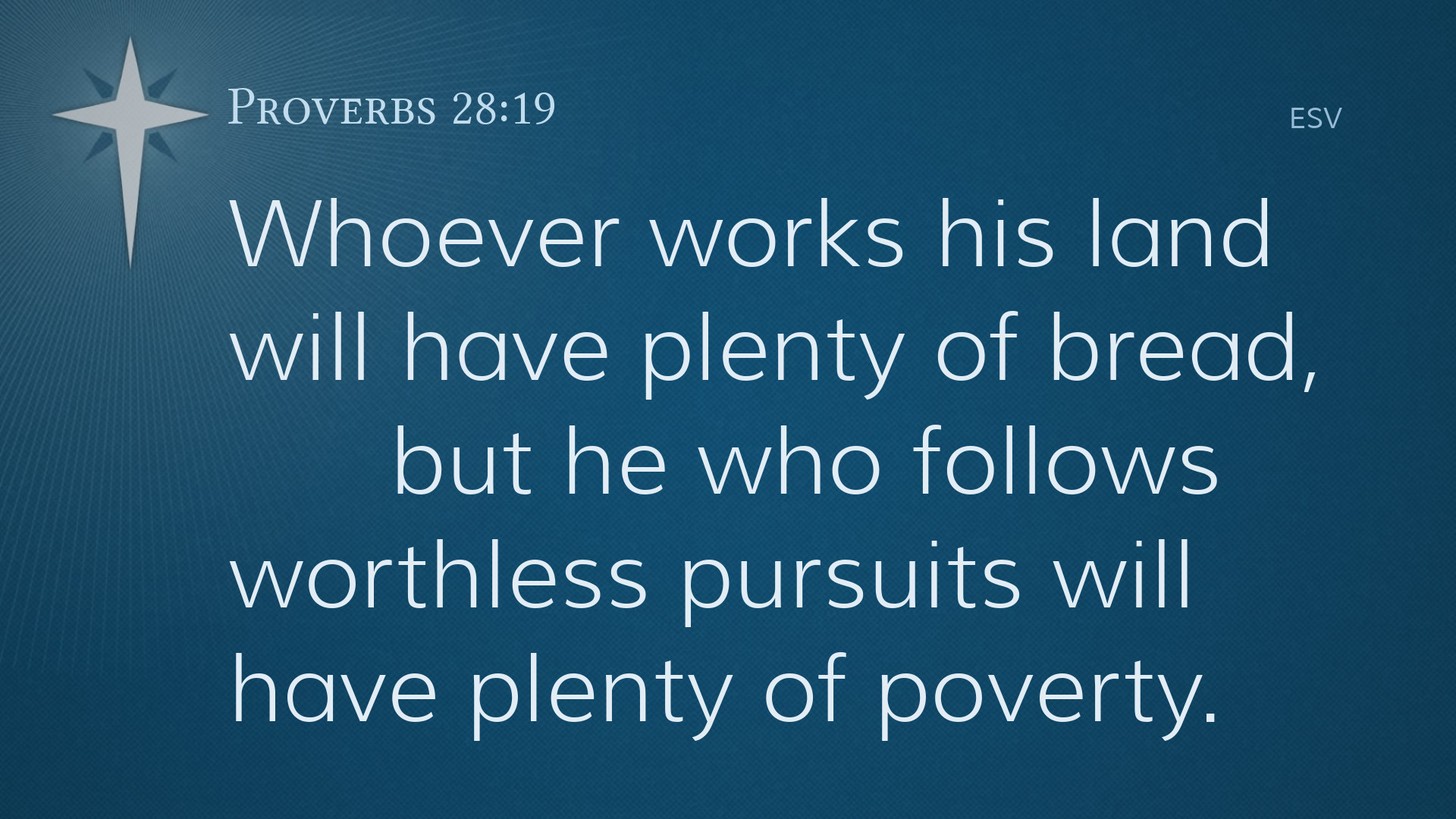
    ‌As we consider prayer from Jesus’ words in the Sermon on the Mount, we now come to the place where most think we are to make our petitions for daily provision known. And while that is not wrong per se, I think it misses the main aspect of Jesus’ intent. Why so? Because just a few verses later, Jesus tells us that the Father is already attuned to these basic issues of life. He in fact says ““Therefore I tell you, do not be anxious about your life, what you will eat or what you will drink, nor about your body, what you will put on. Is not life more than food, and the body more than clothing? Look at the birds of the air: they neither sow nor reap nor gather into barns, and yet your heavenly Father feeds them. Are you not of more value than they? And which of you by being anxious can add a single hour to his span of life? And why are you anxious about clothing? Consider the lilies of the field, how they grow: they neither toil nor spin, yet I tell you, even Solomon in all his glory was not arrayed like one of these. But if God so clothes the grass of the field, which today is alive and tomorrow is thrown into the oven, will he not much more clothe you, O you of little faith? Therefore do not be anxious, saying, ‘What shall we eat?’ or ‘What shall we drink?’ or ‘What shall we wear?’ For the Gentiles seek after all these things, and your heavenly Father knows that you need them all.” And why are these not to be our concern? Because if we “seek first the kingdom of God and his righteousness…all these things will be added to you.”

    ‌To pray in faith is to consciously say “I know you have my “daily bread” well in hand, so that I can focus instead on your kingdom and righteousness.” That is not to say we cannot or should not bring our immediate concerns to Him – but it is to say that we can exchange deep concerns over the regular needs of daily life for concerns about His priorities with complete safety and confidence that He already knows them and has made provision for them in advance. Yes, we bring them all, but not with anxiety – but trusting His love and care and concern even before we get there!

    ‌What then is He really after in this petition? I think it can be nothing more or less than the refreshing, renewing, delighting in and knowing more deeply and sweetly – the wonder of “The Bread of Life” – Jesus Himself. It is a plea for a new “taste” of Him if you will. To be satisfied in Him. To be filled with Him. To want that we desire nothing more than Him and consider knowing and partaking of Him our greatest and sweetest need. Our REAL need.

    ‌Give us as your people, as your children today, more insight into His person and work; more joy in His glory; more wonder at Him; more delight in Him – a deeply soul-satisfying partaking of Him that that spoils our appetite for the things of this world and the cravings of the flesh.

    ‌And why is this so important? Because “His divine power has granted to us all things that pertain to life and godliness, through the knowledge of him who called us to his own glory and excellence.” (2 Pet. 1:3) Did you get that? All things that pertain to true life and godliness come through the knowledge of Him!

    ‌Here is where get full. Here is where we get what is most important to true life. Here alone is where our deepest needs are truly met in the fullest possible way.

    ‌Our Father, you who rule and reign over all – be glorified and hallowed in us above everything. Expand your kingdom in and through us. We commit all to your perfect wisdom and unfailing love. Now Father, fill us up with Christ. Reveal Him to us increasingly as the fullness of all you have to give. Satisfy us in Him. Let our souls feast on Him today afresh. Fill us with your Son till we can contain no more. Pour out the realities of His person and work until they eclipse anything and everything else. Give us THIS day, our Daily – Bread.

  • Thar’s gold in themthar hills!

    November 20th, 2024

    1 Chronicles is not a book in the Bible I hear a lot of people running to for counsel comfort and instruction. Other than the rather fanciful and misguided “The Prayer of Jabez” written around a character in 1 Chron. 4, this book gets precious little recognition. Its seemingly endless lists of names and duties – hundreds of people mentioned nowhere else in the Bible and with no biographical information about them but for an exceptional few – makes it a portion most of us gloss over rather quickly, if we spend any time in it at all.

    ‌Yet, 1 Chronicles is as much God’s Word as Romans is. True, they do not fill the very same role. Not all of Scripture is equally applicable to the Christian life in the same way. Some treasures yield up their riches on first sight. Others, must be painstakingly mined.

    ‌Should your reading schedule take you thought this book sometime soon, here’s a few things that might be worth keeping in mind while perusing the lists and the great unknowns.

    ‌1 – Recapitulating the history of 1st and 2nd Samuel in survey form, 1 Chron. sees a number of gaps filled in – and a broader view and reminder of how God’s rule can never be replaced by fallen man’s, no matter how good, noble and upright the man may be. Man’s rebellion against God’s rule is always at the root of the violence which plagues mankind. And yet, in every place, the types and shadows of the coming King Jesus promise the fulfillment of God’s perfect plan in Christ.

    ‌2 – Always important when encountering unknown name upon name upon unknown name – is the reminder that God knows every single one in His Church – by name. They need not be men and women of great exploits. It only matters that they are His, and known by Him. None are superfluous. Their names are as much written in the eternal Word as those of Adam, Noah, Abraham, Isaac, Jacob, Joseph, David, Solomon etc. As are those of all who are in Christ by faith. Each are a vital part of His Kingdom. None dispensable to His design and purpose. Each in their place, with their purpose, with their individual personalities, talents, experiences and contributions.

    ‌In our day of celebrity pastors and ministries, when some are uniquely in the spotlight, and the culture lures each of us to make our mark – we forget the glory of the ordinary Christian. Made by God, for God, and set divinely in your place and time. God “made from one man every nation of mankind to live on all the face of the earth, having determined allotted periods and the boundaries of their dwelling place” (Acts 17:26). And that is as much true for you and me, as it was for the sons of Shemaiah: Othni, Rephael, Obed and Elzabad, whose brothers were able men, Elihu and Semachiah.” (1 Chron. 26:7)

    ‌3 – As the NET renders it, “David gave to his son Solomon the blueprints for the temple porch, its buildings, its treasuries, its upper areas, its inner rooms, and the room for atonement. He gave him the blueprints of all he envisioned for the courts of the LORD’s temple, all the surrounding rooms, the storehouses of God’s temple, and the storehouses for the holy items. He gave him the regulations for the divisions of priests and Levites, for all the assigned responsibilities within the LORD’s temple, and for all the items used in the service of the LORD’s temple.” It goes on.

    ‌The Church was the Father’s idea, not Jesus’ alone. When Christ says that He is building His Church and that even the gates of Hell cannot overcome it, He is fulfilling His Father’s plan and purpose. “In him you also are being built together into a dwelling place for God by the Spirit.” Eph. 2:22.

    The Temple was a symbol, a type and shadow of what the Father was all about from the beginning. David and Solomon and the nation of Israel itself then come into focus as types and shadows and not the endgame. We do not look for some rebuilt Temple in Jerusalem to come – we look for the perfecting of the Temple of God’s people completed in the New Jerusalem. And we see all this as planned by the Eternal Father, committed into the hands of His Son, and brought about through the indwelling power of the Spirit.

    ‌4 – And so we read David’s prayer upon committing all of these things to his Son Solomon to be about – and he prays like this: “For we are resident foreigners and nomads in your presence, like all our ancestors; our days are like a shadow on the earth, without security…O LORD God of our ancestors Abraham, Isaac, and Israel, maintain the motives of your people and keep them devoted to you.” (1 Chron. 29:15 & 18).

    What David could only pray for, Jesus fulfills in rising from the dead, ascending to the Father, and sending to Holy Spirit to do those very things – to maintain the motives of His people – and keep us devoted to Him: “for it is God who works in you, both to will and to work for his good pleasure.”

    ‌Next time you wander through this odd place called 1 Chronicles – remember that “All Scripture is breathed out by God and profitable for teaching, for reproof, for correction, and for training in righteousness, that the man of God may be complete, equipped for every good work. (1 Tim. 3:16-17) And take a little time to ponder, and ask for the Spirit’s aid in seeing Christ there.

    “Thar’s gold in themthar hills.”

  • The Wonder of the “Open Door”

    November 19th, 2024

    Occasionally, when one preaches, the substance of the sermon addresses the immediate experience of the preacher himself. In truth, the preacher should always be preaching to himself and striving to live within the fullness of the truths he is expounding every time he preaches. But sometimes, the two coincide in a far more acute way.

    ‌It was this way for me this past Lord’s Day.

    ‌By God’s grace and in His providence, I was filling the pulpit for a local Church where I’ve had a long-standing relationship with the congregation, and deep personal fellowship and friendship with the pastor. He was going to be away for 2 weeks and asked if I might cover both of those for him. I decided upon a two part series on Jesus’ letter to the Church in Philadelphia found in Rev. 3:7-13.

    ‌As you well know, this letter is written to a Church which was enduring much trial due to natural disasters, governmental overreach and mismanagement and direct persecution from the local Jewish community. The context paints a small church, with few resources and no real power to change their circumstances. Bereft of natural opportunity and ability, nevertheless Jesus says He has set before them “an open door which no one Is able to shut.”

    ‌What is that all about?

    ‌It is most typical to identify that “open door” as an opportunity for Gospel witness despite their straightened circumstances. And while that concept is certainly true, I’m not convinced by the context and the Old Testament allusion Jesus employs here that that is His main point. Rather, (and I will not exegete the passage here, you can hear the entire sermon at https://www.youtube.com/live/JqtaYBmlCm0?feature=shared) it appears the open door is more in reference to the saints unfettered access to the throne of God that Christ has opened for them, and for us, especially by the vehicle of – prayer.

    ‌What I wanted to press on my hearers was the wonder of this open door into the presence of God in prayer. And not pressing prayer in terms of set times and lengths – though that can be a useful tool, but more: A habitual frame of heart and mind which brings all things before the throne, informed by the Word and trusting His holiness, love and wisdom to answer as He deems best.

    ‌This requires no special words. No special posture. No special time of day or length. An air of the heart consistently turned to Him, believing He hears, knows, loves, sympathizes, and lovingly answers with infallible wisdom. In fact, it may not ever require words at all.

    ‌Let me explain.

    ‌Just before I preached the 1st sermon on this portion, I contracted a nasty cold. I struggled with congestion and a very sore throat the first week. In the meantime, the cold worsened and developed into a severe sinus infection with much pain and little ability to talk at all comfortably. The intervening week was miserable. Poor and very interrupted sleep. Difficulty breathing. Constant coughing. Not comfortable.

    ‌But it was during this time, waking up multiple times each night, that I experienced the joy and wonder of simply having my heart and mind turned toward the Lord, and opportunities to lift up the names and circumstances of any number of loved ones and situations before Him. Due this mostly being in the dead of night, and both with speech quite painful and considering my dear wife’s need for rest – these times of prayer were mostly silent. Like Hannah in1 Sam. 1, I was speaking in my heart, only my lips moved, but my voice was not heard. But my God did!

    ‌This! This was the reality and the joy of those physically distressing moments – that my God was attending, and His ear open to my silent but urgent pleas. At times, in exhaustion, even my lips failed to move. But every thought, ever care and concern that I inwardly brought before His throne, I know was heard. For you see in Christ, He has set before His saints, an open door which no one is able to shut. Which no circumstance is able to shut. A place of refuge which can be retreated to in the most straightened of times and places.

    ‌It was common to hear in my days growing up, that when schools stopped having public prayer – that prayer had been removed from the schools. Nonsense. There is no law, no circumstance, no prohibition by man, devil or demon which can shut the door to our Father’s throne. Jesus Himself has set it before us. O may we take continual advantage of it – knowing full well, that clothed in His righteousness and adopted into the Family, that we ever and always have access to our Father, God and Kind.

    ‌Praise Him!

  • Some Thoughts on Worship Music

    November 11th, 2024

    Three things occasion this brief post.

    First, in an hour long drive to a recent wedding with some friends, the issue of worship music entered our discussion. It was both pleasant and insightful. And, it brought back the memory of something my fellow elders and I tried to think through more carefully a few years ago, as a way of getting the congregation to think about music in a Biblically informed way – and as a guide for our worship leaders.

    The substance of our “Elder’s Perspective on Worship Music” will be found below, as a way to generate more thoughtful discussion.

    Second, was an extended period of listening to a contemporary Christian worship channel on the radio in my recent visit to Texas. What struck me after listening for quite a while, was not that the music was poor. Sadly, it actually was in some cases and not in others. The tunes were, ho-hum. Not memorable. Not the kind of thing I would find myself reflecting on outside of a context where it was being played or I was invited to sing along. And most (not all) were not at all suited for group singing. They were more suited to solo voices performing. They would not lend themselves to a congregational application any more than say Sandi Patti’s Via Dolorosa. There is a place for that for sure. But no one would think of using it for a congregation to sing together.

    But what stood out the most, were the lyrics. Not the words themselves considered in and of themselves. They we basically coherent and “Biblical” enough. It was that they seemed to be a mere collection of Christianese buzz-words and phrases, strung together rather haphazardly. Not memorable stanzas forming a cohesive whole. Like there was a list of words and phrases like: Blood, Wash, Holy, Delight, See, Desire, Hunger, Long, Jesus, God, I want to, please make me, make my heart, etc., and you just take them and paste them together in whatever order, and put them to a tune. There was no meat on the bones in terms of forming strong Biblical constructs for the heart and mind to really hang one’s hat on.

    Third, is a discussion my wife and I just had this morning. Sky, having grown up for years in a super-liberal Methodist Church that would have none of the “bloody religion” stuff – nevertheless still finds the hymns of that Church resonating with and feeding her soul even today. And she opined that an entire generation will be bereft of the benefit such music continues to bring to her.

    So, as I said above, in an effort to get our entire Church on the same page a number of years ago regarding music, we elders at ECF penned the following. And I pray it is useful to you in considering such matters for yourself, and for the Churches where you worship with your fellow saints.

    “Worship is the activity of glorifying God in His presence with our voices and hearts.” In this definition we note that worship is an act of glorifying God. Yet all aspects of our lives are supposed to glorify God, so this definition specifies that worship is something we do especially when we come into God’s presence, when we are conscious of adoration of Him in our hearts, and when we praise Him with our voices and speak about Him so others may hear. Paul encourages the Christians in Colossae, “Let the word of Christ dwell in you richly, teaching and admonishing one another in all wisdom, singing psalms and hymns and spiritual songs, with thankfulness in your hearts to God” ‘ ” (Col. 3:16)

    “In fact, the primary reason that God called us into the assembly of the Church is that as a corporate assembly we might worship Him. As Edmund Clowney wisely says: “God had demanded of Pharaoh, “Let my people go, so that they may worship me in the desert” (Ex. 7.16b)….God brings them out that he might bring them in, into his assembly, to the great company of those who stand before his face….God’s assembly at Sinai is therefore the immediate goal of the exodus. God brings his people into His presence that they might hear his voice and worship him.” ‘ “ (From Wayne Grudem’s Systematic Theology – page 1003).

    Fewer topics within the life of the Church generate more discussion, and often division, than Worship styles. This is true in our generation, as well as previous ones. It is a perennial hot spot.

    Some Biblical Parameters & Non-Negotiables

    Col. 3.16 – 16  Let the word of Christ dwell in you richly in all wisdom; teaching and admonishing one another in psalms and hymns and spiritual songs, singing with grace in your hearts to the Lord.

    Eph. 5.18  And do not get drunk with wine, for that is debauchery, but be filled with the Spirit, 19  addressing one another in psalms and hymns and spiritual songs, singing and making melody to the Lord with all your heart, 20  giving thanks always and for everything to God the Father in the name of our Lord Jesus Christ, 21 submitting to one another out of reverence for Christ.

    Passages like this one help us form a picture of the things Worship must incorporate in order to be Biblical. We’ve isolated 11 principles in these two passages which serve as the framework for our view of Biblical Worship here at ECF.

    a. “Let the Word” – Biblical Worship must be: Word or Scripture Based. Rooted in God’s revelation of Himself. Apart from that, we would worship in supposition, but not truth.

    b. “of Christ” – Biblical Worship must be: Christ centered. Jesus said in John 5.22 -23 “The Father judges no one, but has given all judgment to the Son, that all may honor the Son, just as they honor the Father. Whoever does not honor the Son does not honor the Father who sent him.” Here we see, God is not rightly honored, where Jesus is not rightly honored. Worship of God which omits a focus upon Jesus Christ and His saving work at Calvary fails to be genuine worship in God’s eyes.

    c. “wisdom” – Biblical Worship must: Create and reinforce a Biblical world view.

    d. “teaching” – Biblical Worship must be: Instructive in doctrine & life.

    e. “admonishing” – Biblical worship ought to be: Challenging, encouraging us to a more Christ glorifying life.

    f. “psalms, hymns, spiritual songs” – Biblical Worship must be: Broad in style and use (including prayer). Some music expresses right feelings of adoration, joy and thanksgiving. Other music admonishes. Some hymns or songs are prayerful. Still others are theologically instructive. Biblical Worship should embrace all of these – and possibly more.

    g. “filled with the spirit” – Biblical Worship must be aimed at: Engaging the whole man under the influence of the Spirit. Moving the emotions with Biblical truth and beauty.

    i. “making melody” – Biblical Worship must be: Joyful.

    j. “giving thanks” – Biblical Worship must be: Appreciative.

    k. “submitting” – Biblical Worship must be: Humble.

    l. “reverence” – Biblical Worship must be: Reverent, befitting our God and our right relationships to Him. Making much of His glory.

    I. The Chief goals we are after: We’ve identified five areas of special importance.

    1. CONSISTENCY: We do not want to develop or foster different styles or traditions in different services, but one broad approach, the same in all services.

    2. BREADTH: We would like to utilize a broad range of styles from all the ages of the Church.    

    a. New – Music of high quality both musically & doctrinally.

    b. Traditional – (Trinity Hymnal et al) Maintaining the best of this genre.

    c. Earlier Church – Pre 17th-20th century music.

    d. Original – Music growing out of this assembly and its expressions.

    There is nothing inherently right in being locked into any one or more of these genres. We are seeking to develop a much richer and broader worship environment both to expand the means we each use to glorify God, and to engage those in as many age groups and backgrounds as is reasonable.

    3. EXPRESSIONS: There are no Biblically ordained instruments versus non-Biblically ordained instruments. We will endeavor to harness all instruments in service to the right worship of God.  

    a. More musicians of varying kinds (Strings, Vocals, Percussion, Bass, Wind, Brass, Electronic, etc.)

    b. More styles.

    4. FLEXIBILITY: There is no Biblically ordained worship format. The number of songs, where they are placed, and how they may be interwoven with prayer, Scripture reading, Preaching and other elements is a matter of taste and function. We do not believe we need to be bound to any particular format as long as the necessary elements are present. 

    a. We would like to see more and varying opportunity for participant response (Readings, Prayers, Recitations, Poems, Solos, Duets, etc).

    b. More variation in when, where and how music is integrated. i.e. Not just front loading the music but sometimes more at the end, interspersing, etc.

    5. ACCESSIBILITY:   Music especially must be something which resonates with the worshipers. Though not all music will do so equally.

    a. We DO exist within a culture. While we are never free to allow the culture to define us, we also have a responsibility to reach the culture where God has providentially placed us. it. We have a delicate and important balance to maintain here – guarding against compromise with the culture, while at the same time not erecting needless roadblocks to communication and interaction with the culture. In Japan, we would need to speak Japanese. In our culture, we need to be able to speak the language, without sacrificing one iota of the message. We are charged to reach the people around us, not 18th or 19th century Englishmen.

    b. Worship is NOT only for us. 2 Chron. 6.32  “Likewise, when a foreigner, who is not of your people Israel, comes from a far country for the sake of your great name and your mighty hand and your outstretched arm, when he comes and prays toward this house, 33  hear from heaven your dwelling place and do according to all for which the foreigner calls to you, in order that all the peoples of the earth may know your name and fear you, as do your people Israel, and that they may know that this house that I have built is called by your name.

←Previous Page
1 … 6 7 8 9 10 … 196
Next Page→

Blog at WordPress.com.


Loading Comments...
 

    • Subscribe Subscribed
      • ResponsiveReiding
      • Join 419 other subscribers
      • Already have a WordPress.com account? Log in now.
      • ResponsiveReiding
      • Subscribe Subscribed
      • Sign up
      • Log in
      • Report this content
      • View site in Reader
      • Manage subscriptions
      • Collapse this bar