• Home
  • About
  • Blog
  • Atonement
    • The Atonement: Read this first!
    • Confession of an ex-u0022Highperu0022 Calvinist
    • Revisiting the Substitutionary Atonement
    • Discussing the Atonement – a lot!
    • Lecture Notes on The Atonement
  • Sermons
  • ReviewsAll book and movie reviews
    • Books
    • Movies

ResponsiveReiding

  • Margin Notes: From Judges 11

    June 19th, 2019

    30 Jephthah made a vow to the Lord, saying, “If you really do hand the Ammonites over to me, 31 then whoever is the first to come through the doors of my house to meet me when I return safely from fighting the Ammonites—he will belong to the Lord and I will offer him up as a burnt sacrifice.” 32 Jephthah approached the Ammonites to fight with them, and the Lord handed them over to him. 33 He defeated them from Aroer all the way to Minnith—twenty cities in all, even as far as Abel Keramim! He wiped them out! The Israelites humiliated the Ammonites. 34 When Jephthah came home to Mizpah, there was his daughter hurrying out to meet him, dancing to the rhythm of tambourines. She was his only child; except for her he had no son or daughter. 35 When he saw her, he ripped his clothes and said, “Oh no! My daughter! You have completely ruined me! You have brought me disaster! I made an oath to the Lord, and I cannot break it.” The NET Bible (Biblical Studies Press, 2005), Jdg 11:30–35.

    Jephthah is an interesting and tragic figure. The son of a prostitute, he was shunned by his 1/2 brothers and the community. Then, when it was expedient – because they all knew he was a pretty tough guy, these came back and contracted with him to defeat their enemies in exchange for recognition as their leader. Tough to refuse for a guy always struggling to legitimize himself.

    But there are 2 very important lessons (among others) to be learned in this odd account. As the text notes, Jephthah “made a deal” with God. If God gave him success in his military campaign, he would offer to God by way of sacrifice the first thing that came out of his door to greet him after victory. Sadly, it turns out that was his only child – his daughter. And apparently, he kept his vow.

    The first thing we need to note here is: Some vows we have no right to make at all since they (like this one) contradict the known will of God. God’s law strictly forbade human sacrifice. But either ignorance of God’s Word or in a callous disregard for it – Jephtha made and carried out this vow. Instead, he ought to have repented before the Lord and acknowledged his sin rather than fulfilling this travesty. As Proverbs 6:2–5 (ESV) notes: “if you are snared in the words of your mouth, caught in the words of your mouth, 3 then do this, my son, and save yourself, for you have come into the hand of your neighbor: go, hasten, and plead urgently with your neighbor. 4 Give your eyes no sleep and your eyelids no slumber; 5 save yourself like a gazelle from the hand of the hunter, like a bird from the hand of the fowler.”

    Maybe you’ve foolishly bound yourself to some “deal” with God you know now was foolish. Go to Him. Confess it, repent of it and move on. He is very gracious in the face of our foolishness. He would never have us bind ourselves to things which in the final analysis have no foundation in Scripture. No matter how pious it may have seemed at the time, God does not countenance our persistence in such things when they were in error to begin with. He cannot be bribed by such things anyway. So do not compound the offense the way Jephthah did.

    Secondly: As in this case, Jephthah makes an assumption that there is direct causation between his vow and the victory. This is SO important. We MUST beware making the coincidental the absolute arbiter of truth for us. Having not sought God’s counsel first, he puts himself in a very foolish and costly position, binding himself to what ought never to have been binding. And he assumes that the reason he gained his victory was the fact he made his vow. But God would not countenance such a vow. and to imagine that the 2 things were tied together made him err in a most horrible fashion. God’s providences cannot be read through the lenses of our superstitions. The tendency to assign a direct cause/effect principle to things can get us imagining God is either condoning or condemning all sorts of things when neither may be the truth. That one has an inner “peace” over a situation or circumstance is no true indication of God’s approval. Only the Word can give us that infallible direction. Just as unrest may be no indication that something is amiss. Jesus’ agony, wrestling, anxiety and consternation in Gethsemane was no means of ascertaining that He ought not to go to the Cross. He knew His mission. And He stuck to that. Sometimes our sinful desires can give us peace over wretched things, and make us uncomfortable when following the right course. “To the teaching and to the testimony!” Isaiah 8:0a. That is the only truly safe place. And if Jephthah had followed that, he would still have won his battle, and his daughter would have lived.


  • Margin notes: From Mark 5:38-43

    June 18th, 2019

    Mark 5:38–43 (ESV) — 38 They came to the house of the ruler of the synagogue, and Jesus saw a commotion, people weeping and wailing loudly. 39 And when he had entered, he said to them, “Why are you making a commotion and weeping? The child is not dead but sleeping.” 40 And they laughed at him. But he put them all outside and took the child’s father and mother and those who were with him and went in where the child was. 41 Taking her by the hand he said to her, “Talitha cumi,” which means, “Little girl, I say to you, arise.” 42 And immediately the girl got up and began walking (for she was twelve years of age), and they were immediately overcome with amazement. 43 And he strictly charged them that no one should know this, and told them to give her something to eat.

    I am continually challenged both by the tenderness of Jesus, and the completeness of His care for us. What a Redeemer is it we serve.

    One would think it enough that He raised this little girl from the dead. But look at how He is mindful of not turning her into a spectacle. He puts everyone out of the room except for her parents and 3 of His disciples. Jesus does none of His miracles like a circus act, like so many claiming these powers today. This is a little girl. The text says she is only 12. The last thing she needs when being raised is to be gawked at by a crowd who have no regard for her own feelings and the amazement which will fill her heart. She has been through the trauma of death, and then the glory of resurrection. But she is not turned into a spectacle. He protects her so tenderly.

    Look too at how he took her by the hand when He raised her. She was not alone in that startling moment, but touched by the hand of the One whose power holds the universe together and keeps the planets in their orbit. This sovereign, Master of all, takes her hand Himself. Tenderly and sweetly He provides assurance in this most confusing hour.

    And then note how Jesus is concerned for her immediate and basic need of food. He knows hers and our EVERY need. But this need He does not meet Himself. Instead He does it through the ministrations of others. How our Lord puts in our paths those who will supply at His behest, what we need. We may not see Him in the moment, but we can be sure He is the one behind our needed provision.

    He meets her spiritually, psychologically and physically. Nothing is left untouched. So too He is a complete Savior to us. He is mindful of everything which concerns us – and He is faithful to provide. Some things, He does absolutely by His own touch – and other things, He meets through the careful ministrations of others. But in all, He considers our every need, and leaves none of them unattended to.

    What a Redeemer it is we serve.

  • The Fear of The Lord Part 3

    June 17th, 2019

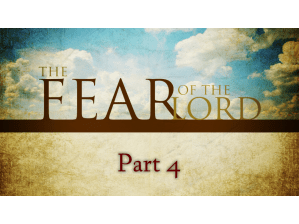
    The Fear of The Lord Pt. 3

    Audio for this sermon can be found here


    Sin distorts everything.

    Christians know this as axiomatic. We can see it everywhere – most in ourselves and the loss of the clear image of God reflected back.

    God’s natural state is one of love, joy, peace, patience, kindness, goodness, faithfulness, gentleness and self-control.

    But humankind – created in that image, now often distorts love into lust and blind indulgence; joy into mere temporal happinesses; peace into chemically induced oblivion; patience into blind indifference; kindness into insipid acquiescence; goodness into cultural morality; faithfulness into agreements of convenience; gentleness into spinelessness and self-control into – well, that’s just off the radar screen.

    We see it in art which is meant to elevate the soul and lift us up to the appreciation of beauty, purity and noble things – degenerate into depictions of chaos, ugliness, the profane and even the pornographic.

    Music, given as a gift of God to cheer the soul and draw us into joy and beauty and inspiration gets used to incite hatred, violence and expressions of animalistic emotions and desires.

    The physical intimacy of marriage which is meant to unify, comfort and delight in giving and receiving in the tenderest and most sacred and private of ways has been twisted into raw lust without regard for love, marriage, safety or sacredness. It has been made exploitative, public, harsh and cruel and rooted in self-gratification.

    Tragically this distortive tendency creeps into the best of all of God’s gifts to us. And no less so in the great truths and doctrines of the Bible as well.

    Think for a minute of the marvelous doctrine of election.

    The Bible unfolds election as a revelation of God’s goodness in securing salvation for some when all deserve eternal condemnation. And then how God works in us to bring us to Himself when our natural, fallen disposition is to reject Him. This is turned by some into a notion of a God who creates only to condemn – and thus make election out as a curse instead of a blessing.

    The very truth designed to give assurance to those who have come to Him that He has loved them always, is made abhorrent in our distortion of it.

    Or think of the doctrine of God’s sovereignty over all things.

    While we are meant to take supreme comfort in His loving superintendence over all circumstances and events for our good and His glory – this gets distorted either into some form of heartless and cruel fatalism or an attack upon individual freedom and will.

    It seems that in the Fall, nothing God has done in goodness and grace has been left undistorted in the human mind – until the Spirit begins to open our eyes afresh to read and understand God’s revelation of Himself in His Word more accurately.

    And nowhere is this more evident than it is in examining a doctrine like the fear of the Lord.

    In our fallenness and sin-distorted reasoning, we look at those words “the fear of the Lord” and import into them notions of ruthlessness, implacability, perpetual irritation, pettiness, unpredictability, volatility and harshness.

    Not a God to be awed at in His glory and wonder but cowered before.

    So that God must be approached as though surrounded by a cosmic minefield and that we had better be constantly careful that we don’t tick Him off lest He explode at us in inexplicable rage.

    And that, by keeping an endless list of revealed and even worse – secret and irrational rules regulations.

    We all know what the Mona Lisa by Da Vinci looks like.

    So when we see something like Botero’s “Fat Mona Lisa” – we recognize the distortion instantly.

    And we would never fall for one as messed up as this.

    But if we had never seen the original – we would easily take a distortion – no matter how bizarre – as accurate.

    And it is just this way both with concepts of God, AND certain Biblical truths – like the fear of the Lord.

    If we do not grasp them, if we do not see the World and truth through the lens of the Bible –  from God’s revelation of them – but instead through the lenses of myths, our own imaginations, lies or other distortions – no wonder people at times recoil from some Biblical truths.

    As a side note here I’ll put in a quick pitch for an excellent book on this topic: Misreading the Scripture with Western Eyes by Richards and O’Brien. Well worth your time and money.

    I hope by now in our study we’ve begun to disabuse you of some of the distortions that often accompany the doctrine of the fear of the Lord, if, you have suffered from them.

    As cataloged above from Galatians 5, the winsomeness and sweetness of God ought to inform us just as much as His power, greatness, glory and holiness. In fact they are as necessary a part of His holiness as His righteousness, justice, sovereignty etc. We dare not lose any of His attributes.

    This was manifested for us so wonderfully in the life of Jesus.

    How He received sinners to Himself so readily and graciously, yet never sinned nor excused sin. How He was easily approached and loved by children. How He never stretched out His hand in divine judgment upon those around Him during His incarnation. How He was exposed to opposition, misunderstanding, resistance, foolishness and sin of all kinds on every hand – and yet from the very cross of His murder could exclaim “Father, forgive them, for they know not what they do.”

    The fear of the Lord we are after is reverential awe of this Redeeming Savior – NOT the irrational terror of a quick tempered monster.

    As we have emphasized in our previous two visits to this topic – the fear of the Lord is primarily located in the idea of: Reverential awe.

    That the more we discover of Him in Creation, the Word and the Incarnation; the more we are taken by His immensity, eternality, power, wisdom, knowledge, administration of all things, holiness, love, mercy and yes – and even His judgment – the more we are overawed at the vision of it all.

    And then, that this God of all creation would come to this little planet in the middle of nowhere, take on the likeness of sinful humankind and die at our hands for our salvation!

    Reverential awe is the ONLY fitting response.

    As John Flavel would write: Behold the admirable condescension of Christ, that he would come into the heart of the vilest sinner, and not disdain to take his abode in that soul which hath been the seat of Satan, where he hath ruled, and every unclean lust hath been harboured!

    There are two things wherein the admirable condescension of Christ appears. (1.) In taking union with our nature after sin had blasted the beauty of it. This was a marvellous stoop indeed. But (2.) that Christ should also take union with our persons, and take his habitation and abode in our hearts, after Satan and sin had so long inhabited and defiled them; that he should accept those members as instruments of his service; that very tongue to praise him that had blasphemed him, &c. yet so he is willing to do, and commands us to deliver them up to him, Rom. 6:19.

    John Flavel, The Whole Works of the Reverend John Flavel, vol. 4 (London; Edinburgh; Dublin: W. Baynes and Son; Waugh and Innes; M. Keene, 1820), 160–161.

    In fact, where we will end up today is by locating the fear of the Lord in a most unsuspected place.

    I’ll come to that shortly, but let me remind you of the path we’ve been taking:

    Gaining the Fear of The Lord

    1. Creation b. The Word c. His Acts

    Our first look was at the wonder, expanse, order, beauty, symmetry and perhaps even the impossibility of the Creation in order to draw on the vastness, power and eternality of God.

    Then we visited Ps. 139 in gaining a look at His being: All powerful, All knowing, and Everywhere present at once.

    And so this morning we want to briefly rehearse some of His acts which ought to inspire this reverential awe – culminating in the Cross.

    Now when I speak of God’s acts, I think it is useful to break them down into a few categories:

    1. Acts of Power
    2. Acts of Judgment
    3. Acts of Mercy

    I won’t spend much time on Acts of Power since we already saw so much of that in Creation.

    I would only call your attention to some additional acts along the same lines:

    Especially His involvement in the affairs of mankind: Jer. 18:1-11; 2 Chron. 20:5-6; Job 12:9-25; Ps. 47:8; Isa. 14:24-27 are prime examples. But let me turn to only one of them: Job 12:9-25

    Job 12:9–25 ESV / Who among all these does not know that the hand of the Lord has done this? In his hand is the life of every living thing and the breath of all mankind. Does not the ear test words as the palate tastes food? Wisdom is with the aged, and understanding in length of days. “With God are wisdom and might; he has counsel and understanding. If he tears down, none can rebuild; if he shuts a man in, none can open. If he withholds the waters, they dry up; if he sends them out, they overwhelm the land. With him are strength and sound wisdom; the deceived and the deceiver are his. He leads counselors away stripped, and judges he makes fools. He looses the bonds of kings and binds a waistcloth on their hips. He leads priests away stripped and overthrows the mighty. He deprives of speech those who are trusted and takes away the discernment of the elders. He pours contempt on princes and loosens the belt of the strong. He uncovers the deeps out of darkness and brings deep darkness to light. He makes nations great, and he destroys them; he enlarges nations, and leads them away. He takes away understanding from the chiefs of the people of the earth and makes them wander in a trackless waste. They grope in the dark without light, and he makes them stagger like a drunken man.

    God is at work in the nations – not just His Church – in all of human activity.

    Second there is His provision for and the sustaining of all life – human and animal as so fully brought out in Job 38-39.

    And 3rd, His divine appointments in Providence which Paul makes much of in Acts 17:26-28

    Acts 17:26–28 ESV / And he made from one man every nation of mankind to live on all the face of the earth, having determined allotted periods and the boundaries of their dwelling place, that they should seek God, and perhaps feel their way toward him and find him. Yet he is actually not far from each one of us, for

    “ ‘In him we live and move and have our being’;

    as even some of your own poets have said,

    “ ‘For we are indeed his offspring.’

    Such an account of God’s all pervasive power being exercised in the affairs of mankind is staggering.

    But then we add to that, consideration of His various acts of judgment.

    1. Acts of Power
    2. Acts of Judgment
    3. Acts of Mercy

    Remember the expulsion of Adam and Eve from Eden. It is frightful.

    His cataclysmic judgment on human sin in the Flood.

    The confusion of languages at Babel; the fiery decimation of Sodom and Gomorrah; the overthrow of the 7 kingdoms in Canaan after the iniquity of those nations had finally reached their limit.

    Then we see individual outbreaks of His fury in all sorts of events, not the least of which is the striking down of Uzzah in 2 Sam. 6 when he dared to touch the Ark of the Covenant with his bare hand; The deaths of Nadab and Abihu for offering unauthorized fire before the Lord; the deaths of Ananias and Sapphira in the book of Acts for lying to the Holy Spirit; the striking of Herod with deadly worms for failing to give God glory for the response to his oration and the blinding of Elymas in Acts 13 for trying to buy the power to give the Holy Spirit to others.

    In each of these we see glints of what God SHOULD be doing in judgment constantly – but what in His patience and forbearance He refrains from doing as He holds forth the opportunity for all to repent and believe the Gospel.

    And in all of these we’ve not yet mentioned the pronouncements of the coming final judgment told to us by Jesus and enlarged upon the book of Revelation.

    These ought to make us abundantly aware that while God is good and patient and astoundingly forbearing – we do not know when that will end and when there will be no more time to repent – and Jesus “will tread the winepress of the fury of the wrath of God the Almighty.” Rev. 19:15c

    All of which leads us back to our final category:

    1. Acts of Power
    2. Acts of Judgment
    3. Acts of Mercy

    Here, let me call your attention to an astounding verse: Psalm 130:4

    Psalm 130:4 ESV / But with you there is forgiveness, that you may be feared.

    Now at first blush, one might wonder exactly how the concepts of God’s forgiveness and fear of Him come together.

    But in truth, it isn’t very hard to grasp once we begin to think about it and consider what the Bible has to tell us about the nature of sin, the holiness of God, and the nature of a holy and just God who cannot ignore sin or let it go unaddressed.

    As the verse directly preceeding this one states: Ps. 130:3

    Psalm 130:3 ESV / If you, O Lord, should mark iniquities, O Lord, who could stand?

    If God were to call us into account for our sins just as the matter nakedly is: No one would come out alive. No one. Who could possibly remain standing when confronted by the blast furnace of His ineffable holiness?

    So in what way does God’s forgiveness create a right fear of Him? Let me suggest 7.

    With God there is forgiveness that He may be feared because:

    1. Forgiveness is an act of free grace, not an obligation

    Beloved, this is so vitally important to grasp: God is under no obligation to forgive anyone, any of US, our sins.

    Their is no law or principle He is bound to outside of Himself. Nor is there anything in His being which requires it.

    Forgiveness is a personal choice, not a legal requirement.

    God forgives sin solely at His own discretion. For you see all are guilty before Him and all of us justly deserve His holy judgment upon our sin.

    So we read in Romans 3:10-18

    Romans 3:10–18 ESV / as it is written: “None is righteous, no, not one; no one understands; no one seeks for God. All have turned aside; together they have become worthless; no one does good, not even one.” “Their throat is an open grave; they use their tongues to deceive.” “The venom of asps is under their lips.” “Their mouth is full of curses and bitterness.” “Their feet are swift to shed blood; in their paths are ruin and misery,
    and the way of peace they have not known.” “There is no fear of God before their eyes.”

    God would be completely just in consigning all of mankind to an eternal Hell – but for His willingness to forgive and redeem.

    We ought to tremble at the thought of it.

    If you are a Christian here today it is not because God owed you forgiveness – it is owing singly and entirely to His sovereign discretion in loving you so as to forgive you.

    And at that, a forgiveness He offers to the World though the shed blood of Jesus Christ.

    God owes no one forgiveness.

    And yet so many have it today – only because of His mercy and grace.

    With God there is forgiveness that He may be feared because:

    1. In His holiness, He cannot pervert justice

    Once again we need to reckon with the fact that salvation is NOT, is not and never has been a cosmic version of ally ally in free.

    Because He is infinitely and inviolably holy and just, He cannot simply dismiss or overlook sin. Justice MUST be done.

    Yes, He forgives personally, but He is also the judge of all the earth. Bound by His own holiness and justice.

    Say you were to rob a store of its cash: 2 Things have occured, you have sinned against the store owner, AND you have a committed a crime against the State.

    And while to Owner may forgive you personally, that does nothing to satisfy the law and the State. Forgiven, you may still be subject to a just penalty.

    In God, He is both the personally offended AND the judge of all the earth – the King of His Kingdom. And justice must still be met somehow.

    This is why the cross becomes of infinite importance. For apart from justice being satisfied on our behalf, we may be forgiven – but still liable. Forgiveness does not erase or mitigate guilt.

    Only in the Cross, only in Jesus paying the just penalty for our sins may we find relief from our guilt and just judgment.

    God cannot – due to His holy nature simply ignore sin, even as He may personally forgive our offenses against Him.

    And so in His infinite wisdom, grace and mercy He devised the plan to make sure His justice could be satisfied as well as our being forgiven – that we might be restored to Him – reconciled to Him – with the crimes of our sin fully met.

    Tremble at the thought beloved – the impossible was made possible: 2 Cor. 5:21 only in Christ on the Cross.

    2 Corinthians 5:21 ESV / For our sake he made him to be sin who knew no sin, so that in him we might become the righteousness of God.

    With God there is forgiveness that He may be feared because:

    1. Our sin is so great

    Being as we are, we love to make light of our sin. We love to use phrases like: “Nobody’s perfect” and “I’m just human” or to borrow from Alexander Pope: “to err is human.”

    We say “we’re all sinners” as though the universality of our sin somehow makes it less vile than it really is. As though if everyone in the world had the same fatal disease, that would somehow make it less fatal.

    But how serious is sin really?

    We never truly understand it until we look at the Cross. Until we realize that sin brings us under the just wrath of the Almighty God who cannot excuse it on any level – and who made the all-encompassing pronouncement: “the wages of sin is death.”

    And not just physical death – death to God. Death to everything good and holy and blessed – because all goodness comes only from and in connection to – Him.

    Hear to voice of torment crying out from the Cross in supreme agony of soul and body: “My God! My God! Why have you forsaken me?”

    The One who had known only perfect, utter and infinite bliss in union with His Father – bearing the weight of our guilt and our shame in His death.

    That’s what sin costs.

    And to have that penalty not just erased but utterly reversed in the granting of eternal blessings ought to make us tremble in awe.

    With God there is forgiveness that He may be feared because:

    1. Of what it to took atone for our sin

    What did it take to atone for, to pay the penalty for your sin and mine?

    Nothing less than the brutal death of the eternal Son of God in our place.

    No animal sacrifice could do what was needed.

    No amount of good works by us could possibly make up for our rebellion, since we had owed Him total love and allegiance from the very beginning. To live perfectly would only be to do what OUGHT to be done – that can make up for nothing.

    No angel could interpose himself.

    No, our salvation required nothing less than a sinless, infinite sacrifice to deal with the depths of our sin and iniquity.

    We ought to be struck with a holy awe that there was nothing other than the death of The Incarnate Son of God in our place that could do what was needed to save us.

    And how do we know that for certain?

    By Jesus own thrice repeated prayer in the Garden: “My Father, if it be possible, let this cup pass from me; nevertheless, not as I will, but as you will.”  Mt 26:39.

    With God there is forgiveness that He may be feared because:

    1. What love there was in the Father to send His Son for us

    Ought it not send a holy gasp through our souls to contemplate what love the Father must have for us that He would devise and carry out such a plan for those who hated Him, rebelled against Him and still fail Him every moment of the day?

    That so great is His love, that He would send His only begotten Son, that whoever would believe in Him would not perish, but have everlasting life.

    Thank on it Believer. Think on it and stand in awe of a love like that.

    What kind of love must that be? There is none like in all of humanity. None.

    Stuart Townend’s words begin to make the inquiry:

    “How deep the Father’s love for us,
    How vast beyond all measure,
    That He should give His only Son
    To make a wretch His treasure.
    How great the pain of searing loss –
    The Father turns His face away,
    As wounds which mar the Chosen One
    Bring many sons to glory.

    Robert Murray McCheyne: “Learn the intense love of God for sinners. He spared not his own Son. Herein is love. He loved the happiness of his Son; but he loved the salvation of sinners more. He loved to have his Son in his bosom; but he loved more to have sinners brought into his bosom. He cast out his Son, in order to take us in. Oh! sinner, how will you escape, if you neglect so great a salvation?”

    Astounding!

    With God there is forgiveness that He may be feared because:

    1. What love and humility there was in the Son to come and die

    What is the nature of Christ Jesus’ love for us, that He would submit Himself to this plan that we might be reconciled to the Father and made His own?

    It’s transforming when we muse on it enough to fill us with awe once again.

    That was the case with Samuel Trevor Francis as he stood on London’s Hungerford Bridge contemplating suicide. When all at once thoughts of the great love of Christ came flooding in only to send him off to pen the words:

    “O the deep, deep love of Jesus, vast, unmeasured, boundless, free!
    Rolling as a mighty ocean in its fullness over me!
    Underneath me, all around me, is the current of Thy love
    Leading onward, leading homeward to Thy glorious rest above!

    O the deep, deep love of Jesus, spread His praise from shore to shore!
    How He loveth, ever loveth, changeth never, nevermore!
    How He watches o’er His loved ones, died to call them all His own;
    How for them He intercedeth, watcheth o’er them from the throne!

    O the deep, deep love of Jesus, love of every love the best!
    ‘Tis an ocean vast of blessing, ’tis a haven sweet of rest!
    O the deep, deep love of Jesus, ’tis a heaven of heavens to me;
    And it lifts me up to glory, for it lifts me up to Thee!

    With God there is forgiveness that He may be feared because:

    1. What glories are ours vs the eternal torments we deserve

    When we contemplate our sin, and the reality of our guilt before this holy God, and the display of His wrath poured out upon Jesus on the Cross – and THEN, go on to contemplate that no eye has ever seen, no ear has ever heard, no man has ever been able to even imagine the things God has prepared for those who love Him – except to know that there is no suffering in this present life that is worthy to be compared to the glory about to be revealed to us – by faith, we stand in fresh awe.

    If this does not engender reverential awe in us, we are not yet born again.

    We have not understood God’s holiness nor our sin aright.

    But if by grace your heart has been moved in the consideration of these things this morning – then I plead with you to come and bow before the throne of the truly awesome God and His Christ – to confess your sin before Him, and cast yourself upon the mercy offered to you in the substitutionary death of Jesus on the Cross.

    And my dear fellow Believer – commit today to strive to keep these things ever before your own eyes. To not let the reverential awe of this God and His salvation leave your thoughts.

    For the fear of the Lord is the very beginning of wisdom.

    Psalm 103:11 ESV / For as high as the heavens are above the earth, so great is his steadfast love toward those who fear him;


  • Margin Notes: Reading Joshua 22

    June 14th, 2019

    Joshua 22:9–30 (NET) — 9 So the Reubenites, Gadites, and half-tribe of Manasseh left the Israelites in Shiloh in the land of Canaan and headed home to their own land in Gilead, which they acquired by the Lord’s command through Moses…and built there, near the Jordan, an impressive altar.11 The Israelites received this report: “Look, the Reubenites, Gadites, and half-tribe of Manasseh have built an altar at the entrance to the land of Canaan, at Geliloth near the Jordan on the Israelite side.” 12 When the Israelites heard this, the entire Israelite community assembled at Shiloh to launch an attack against them…15 They went to the land of Gilead to the Reubenites, Gadites, and the half-tribe of Manasseh, and said to them…‘Why have you disobeyed the God of Israel by turning back today from following the Lord? You built an altar for yourselves and have rebelled today against the Lord…You are rebelling today against the Lord; tomorrow he may break out in anger against the entire community of Israel…don’t rebel against the Lord or us by building for yourselves an altar aside from the altar of the Lord our God…21 The Reubenites, Gadites, and the half-tribe of Manasseh answered the leaders of the Israelite clans..we decided to build this altar, not for burnt offerings and sacrifices, 27 but as a reminder to us and you, and to our descendants who follow us, that we will honor the Lord in his very presence with burnt offerings, sacrifices, and tokens of peace. Then in the future your descendants will not be able to say to our descendants, ‘You have no right to worship the Lord.’28 We said, ‘If in the future they say such a thing to us or to our descendants, we will reply, “See the model of the Lord’s altar that our ancestors made, not for burnt offerings or sacrifices, but as a reminder to us and you.” ’29 Far be it from us to rebel against the Lord by turning back today from following after the Lord by building an altar for burnt offerings, sacrifices, and tokens of peace aside from the altar of the Lord our God located in front of his dwelling place!” 30 When Phinehas the priest and the community leaders and clan leaders who accompanied him heard the defense of the Reubenites, Gadites, and the Manassehites, they were satisfied.

    Barely had the Israelites taken possession of Canaan then they faced civil war. And over what? One group assuming they knew the motives of another group, and interpreting their actions according to their misunderstanding.

    Things haven’t changed much, have they?

    Of all the lessons in the Christian life I’ve needed to learn personally, this one certainly falls into the top 5 if not the top 3. I do not know, I CANNOT know the motives of other people’s hearts. And how desperately I need to reserve judgments until ALL the facts are in.

    This scenario is a simple albeit tricky, and nearly disastrous one. After all 12 tribes of Israel had fought to so hard to take possession of Canaan, the 2 & 1/2 tribes who had been assigned their inheritance east of the Jordan, finally went home to live in it. And as the text notes, when they got to the Jordan – they built a large, conspicuous altar there. Moses had made it abundantly clear that God was going to choose a place in Israel where He would have the one official altar built – the single altar where sacrifices for sin and worship would be located. At that place alone, all the males in Israel would have to appear 3 times a year according to God’s command. No other such altar was authorized. And now, the tribes of Reuben, Gad and 1/2 of Manasseh had built this altar. What to do? The text says that as soon as the others heard about it – they “assembled at Shiloh to launch an attack against them.” Nobody asked any questions. No one sought for clarity first. They just strapped on their weapons, got on their horses and full of their righteous indignation – got ready for the massacre.

    How much like me.

    Fortunately, the 2.5 tribes didn’t just say “bring it on” – but took the time to explain themselves. And when they did, the war was averted. And the text says the 9.5 tribes “were satisfied.”

    How careful we must be here Believer. How easily we can assign motives to actions before we’ve ever bothered to really ascertain the truth. And how often Christians throughout the centuries both on the Church level, and personally – have waged needless, bloody and divisive conflicts all because we were absolutely sure we knew the motivations lurking in the hearts of others. Father forgive us.

    The truth is, some things can take on a very sinister appearance at first glance, which when investigated more fully, could actually be the very opposite. What appears to be sin or rebellion to the naked eye, may in fact, be careful devotion.

    Beware. None of us knows the motives of others hearts until they are revealed in thoughtful dialog and disclosure. Base no decisions on why you “think” or “feel” someone did or said what they did. Brother to brother, seek them out and ask. And who knows but that your union will be all the greater for having disposed of unwarranted suspicions.

    Father help us. Help us to live in love, and not baseless suspicion of hearts and motives we cannot possibly know.

  • Margin Notes: Reading Joshua 17

    June 13th, 2019

    Joshua 17:14–18 (NET) — 14 The descendants of Joseph said to Joshua, “Why have you assigned us only one tribal allotment? After all, we have many people, for until now the Lord has enabled us to increase in number.”15 Joshua replied to them, “Since you have so many people, go up into the forest and clear out a place to live in the land of the Perizzites and Rephaites, for the hill country of Ephraim is too small for you.” 16 The descendants of Joseph said, “The whole hill country is inadequate for us, and the Canaanites living down in the valley in Beth Shean and its surrounding towns and in the Valley of Jezreel have chariots with iron-rimmed wheels.”17 Joshua said to the family of Joseph—to both Ephraim and Manasseh: “You have many people and great military strength. You will not have just one tribal allotment. 18 The whole hill country will be yours; though it is a forest, you can clear it and it will be entirely yours. You can conquer the Canaanites, though they have chariots with iron-rimmed wheels and are strong.”

    We can imagine our inheritance as too difficult to attain, and thus get sidetracked seeking an easier way. But there is no other inheritance appointed for us other than conformity to Christ’s image. And there is no shortcut around confronting and rooting out the remnants of our indwelling sins to arrive there.

    There will always be those in the Body of Christ (and I among them) who complain that they did not get enough, and are in more difficult circumstances than everyone else and thus deserve something more or something other than what has been appointed. Indeed, they are somehow being put upon much more than all others and should have special consideration. Not so. These are the very ones who need to be challenged to pursue what has been their lot.

    And how often this has been my own wicked heart. Telling God that what He has appointed for me in life are things I do not want, and are too hard for me. The sins I have to wrestle with, the circumstances which are adverse and sometimes seem to overwhelm, the blessings I’ve not enjoyed; on and on and on. All of it, basically accusing Him of not loving me enough, or not being as wise as He ought to be in my case.

    Father forgive me. Help me to see that you have proscribed for me nothing but the best in that glorious path toward being conformed to the image of your Son. That you always provide by your Spirit and your Word all that I need to face what is too great for me in the natural. Sanctify my thoughts. Correct my vision and my attitudes. Teach me how to submit graciously and sweetly, resting in your infinitely loving divine appointments and assignments. Give me the mind of Christ.

  • As I was reading today: A Thought from Joshua 11

    June 12th, 2019

    “So Joshua took the whole land, according to all that the Lord had spoken to Moses. And Joshua gave it for an inheritance to Israel according to their tribal allotments. And the land had rest from war.” ESV Jos 11:23.

    One of the most difficult aspects of the Christian life to wrap our heads around is: How much has changed, and how much hasn’t? We read passages like 2 Cor. 5:17 “Therefore, if anyone is in Christ, he is a new creation. The old has passed away; behold, the new has come.” and we say to ourselves, “ALL things new? I still have so much of the old hanging on!” And confusion over this state can lead to times of near despair. You are not alone.

    Fortunately, portions like the book of Joshua are meant – by means of their graphic descriptions of the invasion and conquering of the Canaan – to give us pictures of the Christian struggle as well.

    So here, we have a pretty categorical statement: “Joshua took the whole land.” And if that’s all we read we think “wow! That’s it! It’s all done!” But in truth they were very, very far from “done” in terms of all God had called them to. Yes, they had entered the land. Yes, they had come to a place of dominance over the whole territory. Yes, they had rest from the necessary first invasion wars. But then we remember that the verse right before this one noted they had not been able to expel all of the Anakim – like those in Ashdod, Gaza and Gath; The very place where later, a descendant of the Anakim, Goliath of Gath would arise to challenge God’s armies. Nor have we read yet: Joshua 13:1 “Now Joshua was old and advanced in years, and the Lord said to him, “You are old and advanced in years, and there remains yet very much land to possess.”

    Well which is it? Had they taken the whole land, or was there “yet very much land to possess”? Yes! It is an issue of what has been called “the already, but not yet” principle.

    The idea here isn’t that the territory was entirely free of Canaanites, or that every inch of land was fully occupied. Rather, the whole was under Israel’s control. This is the same with the Believer and indwelling sin. Christ has won all of the territory of “self” for us. We now live in it so to speak – but not all sins are gone. Not every area of life is fully subdued as it ought to be and one day will be. But by God’s grace, we have entered the land and the decisive victory has been – even though there is massive work to be done.

    Don’t be discouraged or downhearted Christian – if you are Christ’s – all things are indeed new – but not as new as they one day will be. Keep at the work. Keep battling sin. Keep looking to and trusting Christ , for one day, unlike the Israelites, you WILL be fully conformed to the image of Christ. Already new, justified, but not yet glorified. But you WILL be! By God’s good grace.


  • As I was reading today: A thought from Matthew 17

    June 11th, 2019

    24 When they came to Capernaum, the collectors of the two-drachma tax went up to Peter and said, “Does your teacher not pay the tax?” 25 He said, “Yes.” And when he came into the house, Jesus spoke to him first, saying, “What do you think, Simon? From whom do kings of the earth take toll or tax? From their sons or from others?” 26 And when he said, “From others,” Jesus said to him, “Then the sons are free. 27 However, not to give offense to them, go to the sea and cast a hook and take the first fish that comes up, and when you open its mouth you will find a shekel. Take that and give it to them for me and for yourself.” English Standard Version  Mt 17:24–27.

    There is a really striking balance in Jesus here. When it came to truth, especially the truth of the Gospel or about God, Jesus didn’t hesitate to offend anyone or everyone. He was no shrinking violet.

    But when it was not such a matter, here, in what is nothing more than a social custom, Jesus is concerned not to give any needless offense.

    This is greatly instructive to us. For we are ever needing to be clear which hills are those to die upon, and which are not so grave.

    It also gives us occasion to be reminded that in the whole of the New Testament, neither Christ nor His Disciples are ever recorded as having been offended or taking offense themselves. And they were most certainly ill-treated. The tendency to take offense at everything it seems is found only in their opposers.

    I wonder at how easily, I, we, in this generation make so much of offenses. Perceived or real ones. We imagine ourselves wounded at almost every turn. Something conspicuously absent both in our Lord and those who suffered with Him. Perhaps the ease of our circumstances, the “rights” upon which our society prides itself, the general acceptance we have as Christians – which opens us to precious little true persecution – has made us imagine the world (and people in general) owe us some level of courtesy and regard. Our skins grow exceedingly thin. Every bump is considered battery. Every slight, real sin. But this is not the Biblical model. Like Jesus, we are to be more concerned with not giving unnecessary offense to others, than whether or not they may offend us.

    We, are about to inherit eternity. And will we wrangle with one another over momentary sensitivities?

    Father forgive me for this being all too often true in my own life.

  • As I was reading today: Thoughts from Joshua 1

    June 10th, 2019

    5 No one will be able to resist you all the days of your life. As I was with Moses, so I will be with you. I will not abandon you or leave you alone. 6 Be strong and brave! You must lead these people in the conquest of this land that I solemnly promised their ancestors I would hand over to them. 7 Make sure you are very strong and brave! Carefully obey all the law my servant Moses charged you to keep! Do not swerve from it to the right or to the left, so that you may be successful in all you do… 9 I repeat, be strong and brave! Don’t be afraid and don’t panic, for I, the Lord your God, am with you in all you do.” 10 Joshua instructed the leaders of the people:…16 They told Joshua, “We will do everything you say. We will go wherever you send us.
    17 Just as we obeyed Moses, so we will obey you. But may the Lord your God be with you as he was with Moses!
    18 4Any man who rebels against what you say and does not obey all your commands will be executed. But be strong and brave!”

    Biblical Studies Press, The NET Bible First Edition; Bible. English. NET Bible.; The NET Bible (Biblical Studies Press, 2005), Jos 1:5–18.

    The news media thrives on generating fear – It is how they keep viewers glued. Politicians thrive on generating fear- It is how they garner attention and votes. Drug companies thrive on generating fear – It is how they increase sales. Every Activist group thrives on generating fear about some threat, loss or coming woe – It is how they make money and gain power.

    Fear is the way of the World. But it is not the way of the Kingdom of Christ.

    In this passage, Isreal is in a time of great transition. And so it is a society ripe for fear mongering. What will we eat when the manna stops? Will Joshua lead us like Moses did? How well armed are our enemies? Can we really defeat them all? How long wit it take? Do we have enough soldiers? Do we have the right strategies? The territory is unfamiliar. We are not warring people but a wondering one. What if we fail?

    And for Christians facing onslaughts by the World, our own flesh and the Enemy can find us running in fear as well. Will the government persecute us? WIll my sins overtake me? Will Satan deceive me? Will the Culture overwhelm me or make a pariah of me?

    And God’s counsel remains the same for us as we seek to conquer the territory of our inward sins as it did for Joshua – “Be strong and brave!”

    1. Be strong and brave because we are called to lead. We are called by God to demonstrate to the World what it means to follow Christ above everyone and everything else. He has called us to this day – and because He has called us to it, He will equip us for it. But we must guard our hearts and remain brave in the face of whatever opposition – internal or external confronts us. Have confidence in God’s call to make you like Jesus.
    2. Be strong and be brave in hearing and adhering to God’s Word. When we are single-minded in pursuing the goal of being conformed to the image of Christ, and do not swerve to the right or the left for any other life governing goal in life – He is with us. Be strong and brave in commitment to His Word above all else.
    3. Be strong and be brave, don’t be afraid and don’t panic: “for I, the Lord your God, am with you in all you do.” We are not alone! Fighting indwelling sin is must more frightening than anything the Wolrd can throw at us – but He has promised to be with us every step of the way. And if He be with us, and for us – who or what can be against us?
    4. Be strong and be brave for the sake of other Believers. One of the most neglected ministries we have toward our fellow Christians is to bolster and increase their faith and courage, and never to undermine it. It does not mean we ignore hard truths. It DOES mean we are required to examine those truths in light of God’s Word, power, love, purposes and promises.

    “For you can all prophesy one by one, so that all may learn and all be encouraged” ESV 1 Co 14:31.

    God is still on His throne, and we are His beloved in Christ.

  • As I was reading today: A Thought from Matthew 15

    June 6th, 2019

    Matthew 15:32–33 (ESV) — 32 Then Jesus called his disciples to him and said, “I have compassion on the crowd because they have been with me now three days and have nothing to eat. And I am unwilling to send them away hungry, lest they faint on the way.” 33 And the disciples said to him, “Where are we to get enough bread in such a desolate place to feed so great a crowd?”

    This is commonly referred to a Jesus feeding the 4,000. It comes pretty close on the heels of His feeding the 5,000 a short time before. And in it, I see my own faithlessness mirrored in the disciples.

    How much like me these men are.

    They had been in this position once before. Not long before either. And yet they repeat what they did the first time – they sputter to themselves about what they cannot do. One would have thought they would turn to Jesus once again first instead. But no. Like me they went through the ritual of personal helplessness first rather than running to Christ first. They rehearsed and bemoaned their lack, when the very Fountain of all life stood before them.

    Oh Father, help me to seek your face before I get into a dither about what I can’t do. Seeing every situation, make my first thought to run to you.


  • As I was reading today: Matthew 7

    June 5th, 2019

    Matthew 7:7–8 (ESV) — 7 “Ask, and it will be given to you; seek, and you will find; knock, and it will be opened to you. 8 For everyone who asks receives, and the one who seeks finds, and to the one who knocks it will be opened.

    We are all familiar with this passage. But unfortunately, it seems most often to be applied with the idea that if I want something from God, I must simply dun Him for it in prayer until I receive it. But I do not believe that is what Jesus is really after here. The context is the key.

    I cannot help but think this admonition refers especially to coming to know our Father so as to have Him hallowed in our own hearts and minds…etc.. In other words – its main application is in encouraging us to trust that the petitions taught to us in the prayer of 6:9-13 – will indeed be ours if we set ourselves unswervingly upon them.

    But why ask (and keep on asking), seek (and keep on seeking), knock (and keep on knocking)? Why the perpetuation of these three? Because we tend to think that God’s graces come to us as a once-for-all bestowment, rather than a continual supply which must be continually looked for in ongoing dependence upon Him.

    So for instance, one cannot just ask and seek and knock for deliverance from some sin – thinking all the while that someday (in this life), we’ll just have absolute freedom from that temptation and not have to face it any longer. This is not the reality of the Christian life. I must ask continually, because I will face the same challenge continually. I must seek Him continually because each day brings distractions from Him. I must knock continually because sin closes up my heart and mind and spiritual eyes and ears continually. I must rely on His grace continually that I might experience the ongoing supply of that grace.

    We want once-for-all solutions. But the once-for-all, is realizing that He is the once-for-all source and fountain – which must nevertheless be appealed to and relied upon constantly.

    This dynamic remains the reality regarding every grace from God we desire. Victory over sin, and the receipt and manifestation of every fruit of the Spirit. No one has a “gift” of longsuffering. We can only be sustained in it.

    Keep seeking Him Christian. Ask for His name to be hallowed, His kingdom to come and His will to be done in this earth as it is in Heaven. Keep looking to Him and Him alone for your daily bread, the forgiveness of sins, a forgiving heart and deliverance from the Devil’s schemes. For it all and always rest in Him and Him alone. What a great and glorious God we serve.

←Previous Page
1 … 85 86 87 88 89 … 197
Next Page→

Blog at WordPress.com.


Loading Comments...
 

    • Subscribe Subscribed
      • ResponsiveReiding
      • Join 419 other subscribers
      • Already have a WordPress.com account? Log in now.
      • ResponsiveReiding
      • Subscribe Subscribed
      • Sign up
      • Log in
      • Report this content
      • View site in Reader
      • Manage subscriptions
      • Collapse this bar