Nothing seems sadder to me, than that the simplicity, beauty and profundity of Jesus’ institution of communion, should be the source of endless debates and division. Transubstantiation, Con-substantiation, mere memorial or remembrance, means of grace, etc., etc., etc.
All other discussions aside, nothing should more stimulate and make real to the heart and the mind of the Believer what Christ has done for us in respect to our sins – than this act together with others bought be grace, regenerated and indwelt by His Spirit.
Let us then in simple humility and inexpressible gratitude, partake – if we believe. And rest our souls in the finished work of the Cross. For only faith in His finished work satisfies, nourishes, refreshes, sustains and cheers the soul. He “loves us and has freed us from our sins by his blood and made us a kingdom, priests to his God and Father, to him be glory and dominion forever and ever. Amen.” (Rev. 1:5-6) Need we say more?
From John 11:39-44 – “Then Jesus, deeply moved again, came to the tomb. It was a cave, and a stone lay against it. Jesus said, “Take away the stone.” Martha, the sister of the dead man, said to him, “Lord, by this time there will be an odor, for he has been dead four days.” Jesus said to her, “Did I not tell you that if you believed you would see the glory of God?” So they took away the stone. And Jesus lifted up his eyes and said, “Father, I thank you that you have heard me. I knew that you always hear me, but I said this on account of the people standing around, that they may believe that you sent me.” When he had said these things, he cried out with a loud voice, “Lazarus, come out.” The man who had died came out, his hands and feet bound with linen strips, and his face wrapped with a cloth. Jesus said to them, “Unbind him, and let him go.”
Three things we are commanded to do for those Christ is to raise up:
a. Remove the stone(s).
First, even before the day of resurrection, take away the stone(s). Clear the way. Remove any obstacles that men may encounter unnecessarily.
This is a profound need for both apologetics – where there are legitimate questions which need answered, AND the crying need for the Church to avoid placing obstacles in the way of those the Spirit is quickening by the voice of Christ.
Do not require them to be clean first.
Do not make them fit into a preconceived cultural framework.
Several years ago I had a conversation with a friend who evangelizes in predominately Muslim countries. When I asked him about the key “stone” he needs to clear away for those hearing the Gospel, it he told me that they feared they had to become Americans in order to be Christians. His BIG work was to disabuse them of that concept.
We need to help take away the objections their own fallen minds, the world and the enemy have placed in front of them as best we can.
And arrest all of their doubts by pointing exclusively to the Cross, to Christ! To faith in Him and His atoning work, and to nothing else.
We must labor to take away the stones.
And, we need to be sure not to put stones in front of them ourselves.
Don’t make them victims of Christian-speak.
Don’t connect their coming to Christ with a political point of view.
Don’t require anything of them Christ does not require.
I fear that right now in American Evangelicalism, we are making it seem (if not actually saying it) that one must be a Republican or a Trump supporter – or at the very least, a Biden/Democratic hater – in order to be a Christian.
God forgive us for such a conflation and for placing this monumental stumbling stone in front of the graves Christ is calling them out of.
b. Unbind, unwrap them.
People come to Christ with their old grave clothes still clinging to them. Some former sins still drag on them, and they need help getting extricated from them. They have the smell of death still on them.
They are bound in hand – for they do not yet know how to praise, nor how to work for the Lord. They are bound in their feet: How to walk with Him is still beyond them, even though they’ve taken the few feeble steps to exit the tomb. And their faces are wrapped in a cloth: They cannot yet see very well. The truth of God’s Word must be taught to them that they might truly know this Christ and His wonders.
c. Release them. Let them go.
Do not make them bound now to you – but make them free to follow Christ wherever He goes.
You did not raise them – Jesus did.
They do not belong to you, they belong to Him.
As long as they follow Him and serve Him and love Him, no matter that they leave you. Let them go.
Last evening, I had the privilege of speaking to 13 participants in the Pastoral Residents program hosted by Emanuel Community Church in Elmira NY. This is under the leadership of Matt and Mitch Bedzyk and the other elders at ECC.
My assignment was to spend time unpacking 2 Timothy 3. Others had already addressed the earlier chapters.
Below are the contents of my notes. I pray they may be of some use to others.
By this time, you’ve already been steeped in the material of 2 Tim. And hopefully, you’ve seen how important and informative it is for those in ministry.
Over the years, this letter has been my most cherished go-to when challenges, discouragement and and other “fainting fits” as Spurgeon called them – troubled me.
I could come back here to resharpen my focus, and get back to the grounding in what pastoral ministry is all about from God’s perspective, rather than models imposed upon me by the outside – by the Church gurus, growth experts and current trends.
What does God want me to be about in seeking to minister to men’s souls in the context of the local assembly?
Then, no matter what else may be happening, growth, decline, overwhelming cultural moments, trends, etc., I can make sure I have solid footing for maintaining and moving forward.
So in turning your attention to Paul’s 2nd letter, and to this 3rd chapter particularly, I am well aware I’m covering well trodden – tho still hallowed ground.
At the same time, I am reminded that one of the severest of the noetic effects of the Fall is how leaky our memories are when it comes to Spiritual and Biblical truth.
I once penned in the flyleaf of my Bible, that “it is in the aftermath of God’s manifested grace in a trial, that I craft a more accurate theology, which I promptly forget the next time I’m in trouble.”
Someone may have mentioned it already in this study, I am aware that some today argue that Timothy was not actually a pastor, but instead, an apostolic representative when this was written to him.
So be it.
But if the key directions we see here cannot be absolutely applied to those in pastoral ministry, then I am at a loss as to what instruction in the Scripture would be more finely useful than these powerful chapters.
That is not to say they do not have broader application to all in Christ – but in my estimation, they have a unique force of argument on pastors as we function as sheep leading other sheep.
As your handout shows, I once arranged a study of the whole letter around 20 imperatives contained in the text. Obviously, the list is not exhaustive. It grew out of times when I was questioning how I was to frame all of my pastoral ministry, and served as a useful organizing principle.
Perhaps you’ll find it so as well.
I might recommend for your own study, John R. W. Stott’s arrangement in his commentary “The Message of 2nd Timothy” as exceedingly useful:
Chapter 1: The charge to guard the gospel.
Chapter 2: The charge to suffer for the gospel.
Chapter 3: The charge to continue in the gospel.
Chapter 4: The charge to proclaim the gospel.
Tonight, even though chapter 3 neatly divides itself into two sections – 1-9 and 10-17, I am going to add a 3rd subsection.
In the process, hoping to point out some things which have stood out to me, and refreshed, clarified and reinforced my own soul in times when my pastoral focus grew fuzzy, my heart grew faint, and when putting out fires claimed more of my attention than bringing the light of God’s glory to bear for those under my care.
Section 1: Recognize the Times –2 Timothy 3:1–9 – Recognize the Times / “understand this” so you don’t get disheartened or discouraged.
The simple truth is, that in ministry, difficult, or “dangerous” times will come. They are to be expected.
I would imagine that most of you here agree that the “end times” began with Jesus crucifixion and ascension, and stretch until His return. At least that is my understanding of Matt. 24 and other places. So we should neither be surprised, nor disheartened by what is cataloged here.
What is the chief characteristic of these difficult times of concern to Paul?
The Economy? The Culture? Ecology? Geo-political upheaval? Politics Pandemics?
None of the above. PEOPLE! Perhaps, all of the above can be rolled into that one word – people.
When men are lovers of self – and especially affluent so as to indulge self – they will be proud & self-congratulatory at every turn – just watch the preoccupation with selfies;
arrogant – If you are at all active on social media, you know in reading the comments, that no one can possibly be wrong about, anything – especially political pundits. We arrogantly imagine we can discern everyone else’s motives.
abusive – the same word as slanderous below – but more likely toward God here, blasphemous and arrogant toward God. Judging Him.
disobedient to their parents and all authorities;
ungrateful because spoiled;
unholy because self is god;
heartless, more literally unfeeling – toward all who are not them;
impossible to make happy – utterly unappeasable if offended in any way; Hence the rise of the ubiquitous Kevins and Karens –
quick on the draw to slander anyone and everyone – especially behind the anonymity of a keyboard;
slanderous of others. They cannot just disagree, they must paint all others as evil.
utterly given over to their lusts and desires;
utterly brutal to any who oppose them – savage. Look at the rise in blood-sports and the proliferation of even Christians joining venues like mixed martial arts competitions. And note how many women are now engaged in that as well.
Look at the riotous responses to real or imagined social injustices.
having no natural affection for good – probably the public good is meant here;
treacherous – devoid of genuine loyalty;
reckless – impetuous, thoughtless, rash;
swollen with conceit – distorted by their own self-image;
seeing pleasure apart from any reference to God as the chief good above all other things;
(v19) And all this – even in people who proclaim themselves to be spiritual or even Christians – but utterly without the Spirit of God within them.
The $64,000 question is – what are we to do with such people who will in time bring trouble upon the Church?
And in short, Paul’s answer is – AVOID THEM!
Avoid them.
This is a favorite admonition of Paul’s in no less than 6 places: Rom.; 1 & 2 Tim.; Titus.
Do not spend hours and hours engaging them, avoid them.
I really would have expected some tactic to combat them. But no.
The chief tactics if any are – prayer and the preaching of the Gospel and thereby demonstrating that we do not have truck with those attitudes and traits.
Look at what Paul says in 8 – in citing the account of Jannes and Jambres – 2 Timothy 3:8–9 / “Just as Jannes and Jambres opposed Moses, so these men also oppose the truth, men corrupted in mind and disqualified regarding the faith. But they will not get very far, for their folly will be plain to all, as was that of those two men.”
We glean 3 things from this –
1 – This is nothing new. As long as people are people, we’ll be facing this.
2 – These are not the traits of Christians, so do not align yourself with them in the Church. They are disqualified regarding the Faith. Right now, the rise of the pugnacious preacher is much in vogue. Don’t get sucked in.
3 – They won’t get very far. They will be exposed in due time.
Summarizing this portion might look something like this in 5 statements regarding those he’s referring to –
1 – Note Their CHARACTER: (1-5) 19 Traits – culminating in: “having the appearance of godliness, but denying its power = Void of the Spirit’s influence. The Last one: They are even Religious! Or “Spiritual” as many have it today.
Verse 13: calls them “Imposters”
2 – Note Their TACTICS:(6) 2 Insidious methods.
a. “Creep” Slyly, not openly. b. “Capture” Take captive, not deliver.
3 – Note Their PREY: (6-7) 4 Descriptive terms.
a. “Weak women” – Weak WILLED. His point is not that they are weak willed BECAUSE they are women, but merely that women who are weak-willed are easy prey.
b. “Burdened with sins”.
Either: Loaded with them and wanting relief, but not content with the Gospel – or: Loaded with them and wanting an excuse not to abandon them.
Either way – Looking for something other or more than – the Gospel.
c. “Led astray by various passions” Making decisions by feeling rather than truth. “Sensual” in Peter and Jude as well.
d. “Ever learning – never arriving”. The pursuit is the constant titillation of one new thing after another. No satisfaction – No constancy / Just like the Athenians of Acts 17:21.
This COULD be the source of the worst kind of discouragement:
“HOWEVER” – Paul lays out a powerful and clarifying portrait doesn’t he?
Keep these focii in mind – you know:
1 – What I believed and taught (doctrine – Biblical truth)
2 – Was the basis for how I lived (conduct)
3 – It informed my goal(s) (aim)
4 – Fueled my faith (faith)
5 – Gives me (patience)
6 – Gives me (love)
7 – Gives me (steadfastness)
8 – Even in persecutions and sufferings.
And we’re right back to something Paul has raised several times already – you’ve seen how I suffered.
6 times Paul brings up suffering in this connection, and we need to learn it well. Back in Ch. 2 he admonished Timothy to “share in suffering”. To not become soft.
And if you are anything like me, sometimes, we grow weary in our work even if we are not weary of it.
Spurgeon remarks: “a minister, wherever he is, is a minister, and should recollect that he is on duty. A policeman or a soldier may be off duty, but a minister never is. Even in our recreations we should still pursue the great object of our lives; for we are called to be diligent “in season and out of season.” There is no position in which we may be placed but the Lord may come with the question, “What doest thou here, Elijah?” and we ought to be able at once to answer, “I have something to do for thee even here, and I am trying to do it.” The bow, of course, must be at times unstrung, or else it will lose its elasticity; but there is no need to cut the string. I am speaking at this time of the minister in times of relaxation; and I say that even then he should conduct himself as the ambassador of God, and seize opportunities of doing good: this will not mar his rest, but sanctify it.” Spurgeon, C. H. Lectures to My Students: A Selection from Addresses Delivered to the Students of the Pastors’ College, Metropolitan Tabernacle. Passmore and Alabaster, 1875, pp. 181–82.
And just as it pertains to spiritual growth for all God’s children, that there is no such thing as stagnancy – it is like climbing up the down escalator; the moment we stop, we actually go backward – so it is especially for we in ministry.
I know you’ve already covered it, but let me remind of that section in Ch. 2 again.
Paul draws on 3 similes there.
vs. 3: “Share in suffering”: a. As a good soldier.
No solider is in the army by him or herself, we serve together. Both with fellow ministers, AND with our people.
So the unique word he uses here emphasizes suffering WITH others, not just suffering generically.
Not only is suffering to be expected, we need to remember that we do not suffer alone, nor do those we minister to.
And part of our suffering, is entering into the suffering of others, the way Jesus entered into ours.
Additionally, it takes much to remain a single-minded soldier, set on serving the commander and prosecuting His battle amid all the distractions that come our way.
But that’s the point.
Our people are fighting those battles too and must strive against the World, the Flesh and the Devil the same as us. And we, the same as them.
Being in ministry offers no exemptions. Just the opposite, it opens us up to even more.
I have a dear pastor friend (who shall remain nameless) – who in a moment of passive-aggressive weakness, frustrated with some in his congregation who didn’t show up at services regularly because too much of life got in the way – did the following.
He stepped into the pulpit, dressed in greasy work clothes and announced: “There will be no sermon today. This week our washer broke down, and I’m still waiting on the part to fix it; I needed to put new brakes on my wife’s car; we needed to take one of the kids to emergency when he fell off his bike – so you’ll just have to do without.”
Maybe you’ll be tempted to do something similar too. I know I have. Obviously I recommend this to no one.
I wonder what would have happened if he had stepped in the pulpit and commiserated with his people in that moment – told them he knows how they struggle because he struggles too, and comforted them with the comfort the Lord comforted him with in those difficult times?
Could he instead have pointed to the exhausted Jesus in Mark 4? That our great Redeemer knows just how whipped we can be at times?
And then turned their attention to the God of Ps. 121 who never sleeps nor slumbers and who will not break the bruised reed nor snuff out the faintly burning wick?
Are there times for rebuke? Sure.
But it is helpful to remember that we are ALL serving our commander, from the greatest to the least of us – and to suffer WITH one another – even as Christ in His incarnation suffered with us.
Of course, Paul’s solider metaphor is aimed at this ultimate point: If we are going to really serve well, we will have to willingly give up those extraneous things which might hinder us from single-mindedness.
The Enemy deploys one of his most potent weapons by means of simple distraction. Distraction especially from remembering that we are in a perpetual war.
Battle, nearly constant battle, is to be expected.
b. As an athlete.
The self-disciplined athlete Doesn’t just want to participate or run, he looks to win. He sets his mind wholly on it. Frames his entire life, including his personal habits around being ready to compete. He has a goal.
And here, the lack of ministerial metrics rises to the surface once more – We suffer with some ambiguity in measuring our ministries.
So our goals have to be clear. Goals I would advance as chiefly 2: Personal growth in the character and image of Christ and assisting others in the same.
It’s what I hear Paul alluding to when he says self-referentially later: He has kept the faith. Faithful to follow, faithful to press on.
c. As a hard working farmer.
The picture is of one who is hands-on in the dirt (if I can say it that way) but who also looks for a reward based upon what he grows – i.e. spiritual rewards for spiritual labors.
In all three there are these things:
Give up thoughts of “career” – Even in ministry
Give up thoughts of “civilian life” where you don’t have to be on the forefront of defending Scripture truth, being an apologist for Christ, pouring over Scripture, not worrying about having a great private life filled with recreations and lots of pass-times and fringes. Give yourself to this work.
This triad emerges:
The soldier battles the enemy – The Devil and his minions.
The athlete battles himself – The flesh.
The farmer battles the environment which threatens the crop. And he does so rigorously on every front.
Ministry is WAR!
And might I add one side note here in terms of a debate about whether or not as preachers, we should ever be self-referential in our sermons.
Without wading into those waters too deeply – I think one application of suffering together with our people is to let them know from time to time how it is we suffer too – not for sympathy’s sake – but so that we can more directly comfort them with the comfort wherewith we have been comforted. To let them know how He has met us in our sorrows and trials.
I am reminded of how Spurgeon closed one of his sermons: “I wish I could have spoken worthily on such a topic as this, but a dull, heavy headache sits upon me, and I feel that a thick gloom overshadows my words, out of which I look with longing, but cannot rise. For this I may well grieve, but nevertheless God the Holy Ghost can work the better through our weakness, and if you will try and preach the sermon to yourselves, my brethren, you will do it vastly better than I can; if you will meditate upon this text this afternoon, “Of him, through him, and to him are all things,” I am sure you will be led to fall on your knees with the apostle, and say, “To him be glory for ever;” and then you will rise up, and practically in your life, give him honour, putting the “Amen” to this doxology by your own individual service of your great and gracious Lord.” Spurgeon, C. H. “Laus Deo.” The Metropolitan Tabernacle Pulpit Sermons, vol. 10, Passmore & Alabaster, 1864, p. 312.
Personally, I am stunned every time I read the account of Jesus in Gethsemane in Matt. 26:37-38 “And taking with him Peter and the two sons of Zebedee, he began to be sorrowful and troubled. Then he said to them, “My soul is very sorrowful, even to death; remain here, and watch with me.””
What self-disclosure! And from the very Son of God!
And yet we sometimes feel the need to put on a front that makes people think we are impervious to the same things they face. No, we do not want to set ourselves forward as shining examples as though we never flag or have some sort of spiritual superiority. Nor do we want to give the impression that we have become hopeless.
But rather, let them see how we personally and truly depend upon grace in our own lives, the way we ask them to.
Think of 2 Corinthians 1:8-11 “we do not want you to be unaware, brothers, of the affliction we experienced in Asia. For we were so utterly burdened beyond our strength that we despaired of life itself. Indeed, we felt that we had received the sentence of death. But that was to make us rely not on ourselves but on God who raises the dead. He delivered us from such a deadly peril, and he will deliver us. On him we have set our hope that he will deliver us again. You also must help us by prayer, so that many will give thanks on our behalf for the blessing granted us through the prayers of many.”
Paul personally wants them to be very aware of what he had faced. He did not fain invincibility.
Stott also advances that in today’s parlance, Timothy might well have been classified as an introvert.
Sharing that trait with Timothy, I also know how that leads me to flee confrontation, and at times even to cave into cowardice.
“Preachers are tempted to moral cowardice more almost than to any sin. Too many ministers, says Bernard, are “men pleasers, not the servants of Christ…he that fears his people’s faces is the man that is most likely to murder their souls.” Cook, Paul. “The Life and Work of a Minister according to the Puritans.” Puritan Papers: 1956–1959, edited by J. I. Packer, vol. 1, P&R Publishing, 2000, p. 185.
So I feel the prick of this particular admonition quite keenly, and have had to revisit this place at times when I have been quite tempted to shrink back from necessary confrontation.
All this given, it’s no wonder then that Paul immediately moves to calling us to really think these things over – AND, so quickly injects the next section:
You’ve known my –
a. Teaching / It was consistent, plain and always in accord w/extant Biblical truth.
b. Conduct / Public, not sneaking into houses – Synagogues, Mars Hill, Market Place, Public Prayer (Lydia)
c. Aim / Announced, never covert – anchored in The Great Commission – Remember him before Agrippa? Acts 26:29 “And Paul said, “Whether short or long, I would to God that not only you but also all who hear me this day might become such as I am—except for these chains.””
Even there he was clear about his aim.
d. Faith / Whom I believe – WHO it is I’ve trusted all along.
e. Patience / Forbearance w/others.
f. Love / How I consider my ministry to have been betrothing other to Christ and not myself – 2 Cor. 11:2.
g. Steadfastness / No deviation. I’ve stuck to the main things.
h. Persecutions / No compromise.
Remember how in Antioch – I was driven out by the Jews?
Then in Iconium – how I was driven out by the Jews & Gentiles together?
And then in Lystra – How I refused to be worshiped AND as a result was stoned?
i. Remember the example of my own endurance / How? No sinful response to any who mistreated me.
Paul has certainly served up a full plate of counsel thus far, but he’s not quite done yet.
The Holy Spirit does not just spin out maxims, platitudes and raw data. Our Great Shepherd Jesus, through His Spirit in Paul is ever about supporting us to the full.
So we move to our last 5 considerations in this text.
To me they are so encouraging and refreshing because they are so focused and concise.
These are the true metrics by which we can measure ourselves in ministry.
Are we faithful to our Master in these? Then we will be fulfilling our call no matter what anyone else may think.
And rightly we can look at this last portion as some keys to remaining faithful in the face of all.
1. Teaches us what we OUGHT to believe and live out.
2. It offers Reproof – telling us what we ought NOT to believe and not to live out.
3. It corrects us – Fixing what we believe WRONGLY and live out wrongly.
4. And all this so that we might live RIGHTEOUSLY. How it prepares us to meet our God.
SO:
1 – DON’T GET DISCOURAGED / Leadership needs to be aware that there will ALWAYS (until Christ comes) be such dangerous seasons.
They may come and go – but they will not cease to come and go.
2 – DON’T BE DECEIVED / Profession & Character must always go hand in hand.
No matter how righteous some may appear, if they do not teach rightly – do not regard them.
Isa. 8:20 “To the teaching and to the testimony! If they will not speak according to this word, it is because they have no dawn.”
And no matter how orthodox they may appear, if they do not walk in holiness, they have disqualified themselves from the faith. 2:8.
Christ came to save us FROM our sins, not to leave us IN them.
Where Christian character does not accompany a profession of faith – something is wrong: 2 Cor. 11:4 provides a wonderful 3 fold test of who we receive as teachers, leaders, etc.
A – Do they bring us the Jesus of Scripture? Son of David? Born of a Virgin Sinless? Crucified – Dead – Risen? Coming again? God in human flesh?
B – Do they come in the Spirit of Christ? Is the pursuit of the character of Christ evident both in how they live, and what they teach? He is not called the HOLY Spirit for nothing. It is His chief characteristic, and it is the chief characteristic of those under His influence.
C – Do they bring the Gospel of Christ? Grace alone, through faith alone, because of Christ alone?
3 – SO – DON’T GET DISTRACTED
Fighting and correcting these types will be a never ending temptation.
Stick to the Word.
Aim at betrothing men to Christ.
Help the Saints grow in grace – in Christ’s character.
Help men become Heavenly minded.
These are the AIMS of Scripture
DON’T GET DISCOURAGED
DON’T BE DECEIVED
DON’T GET DISTRACTED
This is what RETAINING THE ESSENTIALS does – They will keep us on solid ground
We might take a page from The history of the English Reformation in regard to Retaining the Essentials, while also maintaining a goodly breadth of fellowship with other men of God. From D. Martin Lloyd-Jones’ 1969 Lecture on the Puritans – The Puritans, Their Origins and Successors, pages 234-235.
“In 1654 Oliver Cromwell – with his idea of Toleration – and the Parliament called upon the divines to define what should be tolerated or indulged among those who profess the fundamentals of Christianity. If effect they said, we have all these division and sects and groups; what are the fundamental of Christianity on which we can have fellowship together? So a committee was set up and the members of the committee were these: Mr. Richard Baxter, Dr. John Owen, Dr. Thomas Goodwin, Dr. Cheynel, Mr. Marshall, Mr. Reyner, Mr. Nye, Mr. Sydrach Simpson, Mr. Vines, Mr. Manton, Mr. Jacomb. As I said earlier, Baxter tried to short-circuit the whole proposal at the beginning by saying that nothing was necessary but the Apostles’ Creed, the Lord’s Prayer, and the Commandments. But that was rejected. Then they proceeded to work, and they produced 16 Articles which they felt stated the fundamentals on which, and on which alone, true fellowship is possible between Protestant Evangelical people. Here they are –
1 – That the Holy Scripture is that rule of knowing God and living unto Him which whoso does not believe cannot be saved.
2 – That there is a God who is the Creator, Governor and Judge of the world, which is to be received by faith, and every other way of knowledge of Him is insufficient.
3 – That this God who is the blessed Creator is eternally distinct from all creatures in His Being and Blessedness.
4 – That this God is One in Three Persons or subsistences.
5 – That Jesus Christ is the only Mediator between God and Man without the knowledge of whom there is no salvation.
6 – That this Jesus Christ is the true God.
7 – That this Jesus Christ is also true man.
8 – That this Jesus Christ is God and Man in one Person.
9 – That this Jesus Christ is our Redeemer, who by paying a ransom and bearing our sins has made satisfaction for them.
10 – That this same Lord Jesus Christ is He that was Crucified at Jerusalem, and rose again and ascended into Heaven.
11 – That this same Jesus Christ being the only God and Man in One Person remains forever a distinct Person from all saints and angels notwithstanding their union and communion with Him.
12 – That all men by nature were dead in sins and trespasses, and no man can be saved unless he be born again, repent and believe.
13 – That we are justified and saved by grace and faith in Jesus Christ and not by works.
14 – That to continue in any known sin upon what pretence or principle soever is damnable.
15 – That God is to be worshipped according to His own will, and whosoever shall forsake and despise all the duties of His worship cannot be saved.
16 – That the dead shall rise, and that there is a day of judgement wherein all shall appear, some to go into everlasting life and some into everlasting condemnation.
”They were the 16 points. We have the authority of Richard Baxter for saying that it was Dr. John Owen who worded those Articles, that Dr. Reynolds was the scribe and that Mr. Marshall, a sober, worthy man did something, but the rest were little better than passive.”
”Now these Articles were designed and intended to exclude not only Deists, Socinians and Papists, but also Arians, Antinomians, Quakers and others. What I am asking is this: Cannot we accept those as fundamentals? Are those not sufficient? We remember, of course, that bishops, deans, etc., etc., had been abolished at hat time, and therefore did not need to be mentioned; and also that they did not have to contend with a ‘higher critical’ attitude to the Scriptures. They were agreed also in their attitude toward ‘tradition’, Their object was to define the irreducible minimum on which evangelical people could work together. We, today, need to elaborate some of these statements in view of our peculiar circumstances; but, still, I suggest, we should seek the minimum definition and not the maximum. Then, united on that basis, we can as brethren work together, and meet together for discussion of the matters on which we differ, and for our mutual edification.”
Section 1: Recognize the Times
Section 2: Remember My Example
Section 3: Retain the Essentials / “continue in what you have heard” – Don’t move from the Scriptures!
(Out of Spurgeon’s Devotional Bible, Based upon Deut. 33:25)
Afflicted saint, to Christ draw near Thy Savior’s gracious promise hear, His faithful Word declares to thee, That as thy days thy strength shall be.
Let not thy heart despond and say “How shall I stand the trying day?” He has engaged by firm decree, That as thy days thy strength shall be.
Thy faith is weak, thy foes are strong, And if the conflict should be long, The Lord will make the tempter flee, For as thy days thy strength shall be.
Should persecution rage and flame, Still trust in thy Redeemer’s Name; In fiery trials thou shalt see, That as thy days thy strength shall be.
When called to bear thy weighty cross, Or sore affliction, pain, or loss, Or deep distress or poverty, Still as thy days thy strength shall be.
From Matthew 26:17-25 / A Study in Sovereignty and Personal Responsibility
The doctrine of the absolute sovereignty of God in all things, is the fundamental building block of the Biblical Worldview – of reality. Real, reality as Francis Schaeffer used to call it. There is reality – in terms of all we perceive empirically and experientially – and then there is the truth behind it all which we only receive by means of the special revelation of God’s Word.
I can know the physical universe exists by feeling it, touching it, living in it, smelling it, investigating it, etc. But I cannot know why the universe exists apart from the One who created it revealing His intent. He must speak. And He does so in His Word. It is there alone that we are shown that all things have come from Him, and they exist for Him, and will one day be shown to have served all His plans and purposes.
On top of that basic truth, we find out that all His plans and purposes have to do with eternal things like: “making known to us the mystery of his will, according to his purpose, which he set forth in Christ as a plan for the fullness of time, to unite all things in him, things in heaven and things on earth.” (Eph. 1:9-10)
And there are other such like comprehensive statements in His self-revelation.
Starting with an unprovoked creation of all things – His purposes lying only within Himself – He goes on to reveal that His sovereignty extends to all things. Even us. So we read in a place like Daniel 4:34-35 “At the end of the days I, Nebuchadnezzar, lifted my eyes to heaven, and my reason returned to me, and I blessed the Most High, and praised and honored him who lives forever, for his dominion is an everlasting dominion, and his kingdom endures from generation to generation; all the inhabitants of the earth are accounted as nothing, and he does according to his will among the host of heaven and among the inhabitants of the earth; and none can stay his hand or say to him, “What have you done?”’”
It is here we confront a mystery. How is it that God can be so absolutely in control of all things, and yet humankind, made in His image, still be morally responsible creatures, making and carrying out our own decisions?
In truth, God’s revelation does not tell us HOW it is so that both of things are true – it only tells us that both things ARE true. The mechanics behind this dual reality are not given to us. But that this is the truth, was so important to the Biblical writers, that the Scriptures are replete with examples. Not the least of which examples find a place in the earliest teaching of the Apostles. And, in a passage like the one before us.
A useful Old Testament example can be drawn from Isaiah 10. There, God has told Israel that He will use Assyria to punish Israel for their infidelity to Him. The language is remarkable. “Isaiah 10:5–7 “Woe to Assyria, the rod of my anger; the staff in their hands is my fury! Against a godless nation I send him, and against the people of my wrath I command him, to take spoil and seize plunder, and to tread them down like the mire of the streets. But he does not so intend, and his heart does not so think; but it is in his heart to destroy, and to cut off nations not a few.”
What is happening? God is pronouncing woe against pagan, rapacious Assyria for its decimation of Israel. But what does God call Assyria? “The rod of my anger, the staff in their hands is my fury.” Astounding. God is using them. He sends them against Israel, which He calls a “godless nation.” That He Himself appointed them to “take spoil and seize plunder, and to tread them down like the mire of the streets.”
And then we are met with a most amazing insight. Vs. 7 – “But he does not so think.” Assyria is not carrying out this campaign because they are consciously serving God’s purposes. No. It is simply “in his heart to destroy and cut off nations not a few.” i.e. Assyria is acting by its own sinful will, and yet in God’s providence, their sinful actions carry out God’s plan. They are still responsible for acting upon their sinful impulse are morally responsible agents, even as God’s necessary plan is carried out.
So we come to Peter’s preaching at Pentecost: “this Jesus, delivered up according to the definite plan and foreknowledge of God, you crucified and killed by the hands of lawless men.” (Acts 2:23)
And: Acts 3:17 – “And now, brothers, I know that you acted in ignorance, as did also your rulers. But what God foretold by the mouth of all the prophets, that his Christ would suffer, he thus fulfilled.”
Yet again: Acts 4:27-28 – “for truly in this city there were gathered together against your holy servant Jesus, whom you anointed, both Herod and Pontius Pilate, along with the Gentiles and the peoples of Israel, to do whatever your hand and your plan had predestined to take place.”
You can see how central this concept is in the earliest preaching of the Church, so that 2 things are perfectly preserved: God, sovereign over all, and Humankind, morally responsible for their decisions and actions.
From a slightly different angle, there is the story of an old, poor woman, who was always trying to communicate her faith to her wicked landlord.
One day, the landlord passed by her window, and heard her praying earnestly for just some bread. She had nothing to eat. And he sought the opportunity to overthrow her faith.
The landlord went to the bakery, purchased a loaf of bread, and retuned which she was still on her knees. Without her knowledge, he tossed the loaf onto her bed from the window.
Later, in conversation, the landlord prodded the woman about her faith, and she told him the wonderful news that even while she was praying that day, a loaf of bread miraculously appeared on her bread in answer to her prayer.
“Hah!” scoffed the landlord. “God didn’t hear your prayer, I did. And I went and purchased bread and threw it in through your window. What do you think of your God now?”
The old woman blinked and said: “Why He’s even more wonderful than I imagined! For not only did He hear my prayer for bread, He used the very hand of the Devil to provide it!”
So it is we come back to our text today. “The Son of Man goes as it is written of Him, but woe to that man by whom the Son of man is betrayed! It would have been better for that man if he had not been born.”
Jesus had to die for our sins, that we might be redeemed from the curse of Adam and reconciled to the Father. And, Judas’ betrayal was not some forced action against His will. He acted out of His own sinfulness. Thus his actions, no matter how used by God, are not mitigated because of God’s sovereignty over his free actions. Judas remains fully, personally, and singly responsible.
So do you and I. God’s sovereignty is never an excuse for our sins either.
Praise God then for the gift of repentance and the forgiveness of sins, for all who take complete responsibility for their sins – and come to Him with no excuses.
“Then”, is a sometimes a very important word. And in this case, monumentally important.
What is it that seems to finally push Judas Iscariot over the edge? What so offended his personal sensibilities that he was ready to kick Jesus to the curb?
John gives us the needed insight.
He thought the money Mary had just “wasted” on anointing Jesus was too much. And, if it had been sold and put into the Disciple’s coffer instead, he could have gotten his cut; by theft. 30 pieces of silver would have been a little over 3 month’s wages. Only 1/3 of what Mary’s perfume probably cost. No one would miss it given their habit of giving to the poor. And it didn’t seem like anyone kept track of how Judas administrated the purse.
Judas just wanted his due – and not for everything to be about and expended upon Christ. He had a bad case of “hireling syndrome.”
You know the tinge of this yourself don’t you? I know I do. I’ll serve Christ and His people, but good golly, I want my share of the praise and recognition. After all, it isn’t ALL about Jesus, is it? Don’t I deserve my pat on the back? The occasional “well done” by others, before the one I’m to receive on the last day? I mean, I’m not just a servant you know, not a slave. I deserve my cut too. I know Jesus is God and all, and He’s deserving of His glory – but not ALL the glory -right?
This is a particularly dangerous temptation for those of us who preach and teach.
None of this is to ignore the fact that as those ministered to by others, we ought to give them proper recognition. Paul writes to Timothy “Let the elders who rule well be considered worthy of double honor, especially those who labor in preaching and teaching. For the Scripture says, “You shall not muzzle an ox when it treads out the grain,” and, “The laborer deserves his wages.”’”
But there is a vast difference between our recognition of others, and our “need” to be somehow recognized by others.
By the time we get to this point in the Gospels, Jesus had already said this to His Disciples: ““Will any one of you who has a servant plowing or keeping sheep say to him when he has come in from the field, ‘Come at once and recline at table’? Will he not rather say to him, ‘Prepare supper for me, and dress properly, and serve me while I eat and drink, and afterward you will eat and drink’? Does he thank the servant because he did what was commanded? So you also, when you have done all that you were commanded, say, ‘We are unworthy servants; we have only done what was our duty.’ ” (Luke 17:7-10)
Judas wasn’t having it. Not all the way.
Now is all this to somehow suppress or devalue Christ’s servants? Not in the least! We know His value and regard for us as we gaze upon the Cross. He has set a value upon us that is not intrinsic, due to us, but due to His simple, sovereign love.
It is a marvel to contemplate.
But oh how sin has reversed the tables, and somehow caused us to set some certain value upon Him, based on our personal sensitivities, upon our fallen, self-focused self-love. And can any value we place upon Him be quantified in any way? Obviously not.
Mary had said in effect – “nothing is too good or too much to lavish upon Him.”
Judas had said in effect – “He is wonderful, but only – this much – if it costs me in the process.”
So we ask ourselves – how do we value Jesus? What is our cutoff point, where we’re not getting our fair share?
As I’ve oft quoted before from old John Flavel: “It is a special consideration to enhance the love of God in giving Christ, that in giving him he gave the richest jewel in his cabinet; a mercy of the greatest worth, and most inestimable value, Heaven itself is not so valuable and precious as Christ is: He is the better half of heaven; and so the saints account him, Psal. 73:25. “Whom have I in heaven but thee?” Ten thousand thousand worlds, saith one,* as many worlds as angels can number, and then as a new world of angels can multiply, would not all be the bulk of a balance, to weigh Christ’s excellency, love, and sweetness. O what a fair One! what an only One! what an excellent, lovely, ravishing One, is Christ! Put the beauty of ten thousand paradises, like the garden of Eden, into one; put all trees, all flowers, all smells, all colours, all tastes, all joys, all sweetness, all loveliness in one; O what a fair and excellent thing would that be? And yet it should be less to that fair and dearest well-beloved Christ, than one drop of rain to the whole seas, rivers, lakes, and fountains of ten thousand earths. Christ is heaven’s wonder, and earth’s wonder.
Now, for God to bestow the mercy of mercies, the most precious thing in heaven or earth, upon poor sinners; and, as great, as lovely, as excellent as his Son was, yet not to account him too good to bestow upon us, what manner of love is this!1
There are few who argue that this passage is not interesting, wonderful and not easy to apply.
It is interesting in the details.
They are gathered in the house of a leper, Simon by name. The company appears to be Mary, Martha, Lazarus, the Disciples and Simon – with perhaps Simon’s family.
To have gathered there, one of two things had to be true: Either this man had been notably cleansed of his leprosy by Jesus; or, the entire group were tossing off convention in favor of being with him. The latter seems unlikely, especially given the way the Disciples respond to the Woman’s breaking of convention. It is most likely that this was a man who had known the mercy and grace of Christ in a most extraordinary way.
It is interesting to see Mary so powerfully moved at this moment, so as to lavish something valued at around a year’s wages on Jesus. How deeply she must have felt at this moment.
It is interesting to hear the Disciple’s objection. As Craig Blomberg notes: “Many people with social consciences find the disciples’ objection the same as their own. Those preoccupied with the oppressed and needy of the world often quarrel with any lavish expenditure of monies for church architecture, pageantry, worship, or celebration, however well-intentioned and honoring to Christ they may be. There are in fact times and places for all of this extravagance. So also with M’Neile, “To the few who today spend themselves mainly on worship and meditation (whom Mary again exemplifies in Lk. 10:39–42) active ‘workers’ are warned not to say ‘To what purpose is this waste?’ ” Or with Beare, “The beauty of uncalculating generosity is not to be measured by the yardstick of utility.”11 Blomberg, Craig. 1992. Matthew. Vol. 22. The New American Commentary. Nashville: Broadman & Holman Publishers.
As a pastor I’ve confronted this same mindset several times, especially over discussions surrounding buildings. A strange form of Evangelical asceticism suddenly arises and eclipses any notion of wanting to see things done in Christ’s name done with excellence, in favor of appearing humble. But can we ever really be too extravagant when extolling the wonder of Christ’s sacrifice for sinners? J. C. Ryle writes here: “We can never attach too much importance to the atoning death of Christ. It is the leading fact in the word of God, on which the eyes of our soul ought to be ever fixed. Without the shedding of his blood, there is no remission of sin. It is the cardinal truth on which the whole system of Christianity hinges. Without it the Gospel is an arch without a key-stone, a fair building without a foundation, a solar system without a sun. Let us make much of our Lord’s incarnation and example, His miracles and his parables, His works and His words, but above all let us make much of His death. Let us delight in the hope of his second personal coming and millennial reign, but let us not think more even of these blessed truths, than of the atonement on the cross. This, after all, is the master-truth of Scripture, that “Christ died for our sins.” To this let us daily return. On this let us daily feed our souls. Some, like the Greeks of old, may sneer at the doctrine, and call it “foolishness” But let us never be ashamed to say with Paul, “God forbid that I should glory save in the cross of our Lord Jesus Christ.” (Gal. 6:14.)11 Ryle, J. C. 1860. Expository Thoughts on Matthew. New York: Robert Carter & Brothers.
The text is clear, Jesus perceived this as a testimony to His death. And how can we celebrate that death too extravagantly? What can we rightly withhold in worship making His life, death and resurrection known?
It is wonderful in Jesus’ explication of what Mary had done. She had done what she had to “prepare me for burial.”
No, the question is – was she really cognizant of that reality? Or did Jesus put it so? We cannot be sure, but it is reasonable to assume she was acting in some real way aware.
It is quite possible she had heard Jesus announce His impending death as did the other Disciples. If in fact she had been made privy to His announcement that His death was just 2 days hence as recorded in vs. 2 – then what makes her so remarkable here – and what elicits Jesus’ declaration regarding her in vs. 13 is simply this – she really and truly took Him at His word. She believed Him. In a way the Disciples did not.
What is to be declared everywhere the Gospel is preached? That men believe it! That they believe it so as to order their lives around its reality. That they respond in faith. Just as Mary. The Gospel is not just to be heard, it must be believed. And when it is believed, people act on that belief as life-encompassing truth. Those who hear, and say they believe but act as though nothing is different because of glory of Jesus substitutionary death, burial and resurrection – then they have nothing but Jame’s faith without works – which is dead.
Not Mary. Her faith is living, vital, real. And it moves her. She believes her Savior. She learned to do so at the tomb of her brother. And she would never doubt Him again, even if she couldn’t parse out the details. Wherever and wherever this Gospel is proclaimed, what she did, how she received His Word, believed it and acted upon – is to be told as a supreme example of true, saving faith.
We now come to the end of Jesus’ public teaching on the end times. It is both a sour and a hopeful note. Which, depends upon your relationship to Him in faith. J.C. Ryle writes: “There are few passages in the whole Bible more solemn and heart—searching than this. May we read it with the deep and serious attention which it deserves.” Ryle, J. C. 1860. Expository Thoughts on Matthew. New York: Robert Carter & Brothers.
Note first, that we must beware of turning an analogical statement into a full orbed theological and doctrinal construct. This is a common error in our Bible study and interpretation, and an easy one to fall into. Jesus’ simple point is, that on the final day, He will separate Believers from unbelievers, and each will receive appropriately from His hand.
Some, mistakenly, have turn this parabolic statement into a construct of ontology. They see it as though the world is made up of people who are as fundamentally different by nature, as sheep are from goats. One confused soul even said to me once: “I was never a goat, I was always a sheep.” This is just confused.
Yes, the one who is saved by grace has become a dwelling place of the Holy Spirit, born again by His grace and adopted into the Family of God. But we must never forget Paul’s words in Eph. 2 when marking out what ALL of us used to be: “And you were dead in the trespasses and sins in which you once walked, following the course of this world, following the prince of the power of the air, the spirit that is now at work in the sons of disobedience— among whom we all once lived in the passions of our flesh, carrying out the desires of the body and the mind, and were by nature children of wrath, like the rest of mankind.” (Eph. 2:1-3)
Did you catch that last sentence? We were all, “by nature” children of wrath like the rest of mankind. There was no ontological, no constitutional difference between all human beings before salvation. We are all drawn from the same, fallen lump of Adam’s race.
As Don Carson is wont to say, we cannot make every simile, analogy or parable “walk on all fours.” We can over-interpret this way and end up distorting Scripture.
Note second: In the same vein as above, be careful to see that there is no attempt on Jesus’ part to turn “sheep” into believers everywhere sheep are mentioned in Scripture and “goats” everywhere they are mentioned into unbelievers. Sometimes, sheep are just sheep, and goats are just goats. All that is said here is that the Son will separate the believers from the unbelievers, in the same way a shepherd separates sheep from goats. The issue is separation, not ontological assignation.
Once again, if we press Jesus’ analogy too far, we’ll be at a real loss to deal with things like the Passover meal when instituted in Ex. 12; where the Israelites could select their Passover sacrifice from either the sheep or the goats, without distinction.
Note third: That the judgment for these two groups is different. One is rewarded for what they DID do, the other, punished for what they DIDN’T do. It is a most interesting dichotomy.
The Believer is rewarded according to his good acts, and the Unbeliever punished for his wicked acts.
Nothing that is holy but neglected will go undiscovered. Nothing done in earnest to serve Christ will go unnoticed either.
Note fourth: Both the terror and the glory of this one thing – It is Christ Himself who will sit as judge. Many a religionist fails to recognize that Jesus Himself is the judge. Yes, He is The Savior. Yes, He is the substitute. Yes, He is the Lamb of God who takes away the sin of the world. And yes, He will be our final judge. The omniscient, Son of God. The God who walked in human flesh and knows every heartache, every temptation, every opportunity, every obstacle, every circumstance we all have faced in this life. He, will judge us all. With the unsparing scrutiny of His omniscience. He is the Living Word, who discerns even the thoughts and intents of the heart.
Nothing will serve as a justifiable excuse for failure to reckon with the demand of the Gospel to find forgiveness and grace in Christ. He knows us. He knows all we face. He knows all of our circumstances. And no one will be able to exempt themselves from His all-seeing examination.
By the same token, nothing that any who are His have done because they are His, no matter how small, how seemingly insignificant, how unknown by any other human eye or ear – will go unrewarded.
Note fifth: Because of who He is – because He is God, and perfectly holy, He can neither over-punish, nor under-punish sin. He knows what the penalty of sin costs personally. He endured it on the Cross. And for the very same reasons, He can neither over-reward nor under-reward His saints in judgment. And yet, He is free to pour out of His limitless grace, infinitely more than our just rewards, for He makes Himself our inheritance. His eternal limitless self. The fountain of all goodness, grace, love, wonder and joy.
1 Pet. 1:3-9 “Blessed be the God and Father of our Lord Jesus Christ! According to his great mercy, he has caused us to be born again to a living hope through the resurrection of Jesus Christ from the dead, to an inheritance that is imperishable, undefiled, and unfading, kept in heaven for you, who by God’s power are being guarded through faith for a salvation ready to be revealed in the last time. In this you rejoice, though now for a little while, if necessary, you have been grieved by various trials, so that the tested genuineness of your faith—more precious than gold that perishes though it is tested by fire—may be found to result in praise and glory and honor at the revelation of Jesus Christ. Though you have not seen him, you love him. Though you do not now see him, you believe in him and rejoice with joy that is inexpressible and filled with glory, obtaining the outcome of your faith, the salvation of your souls.”
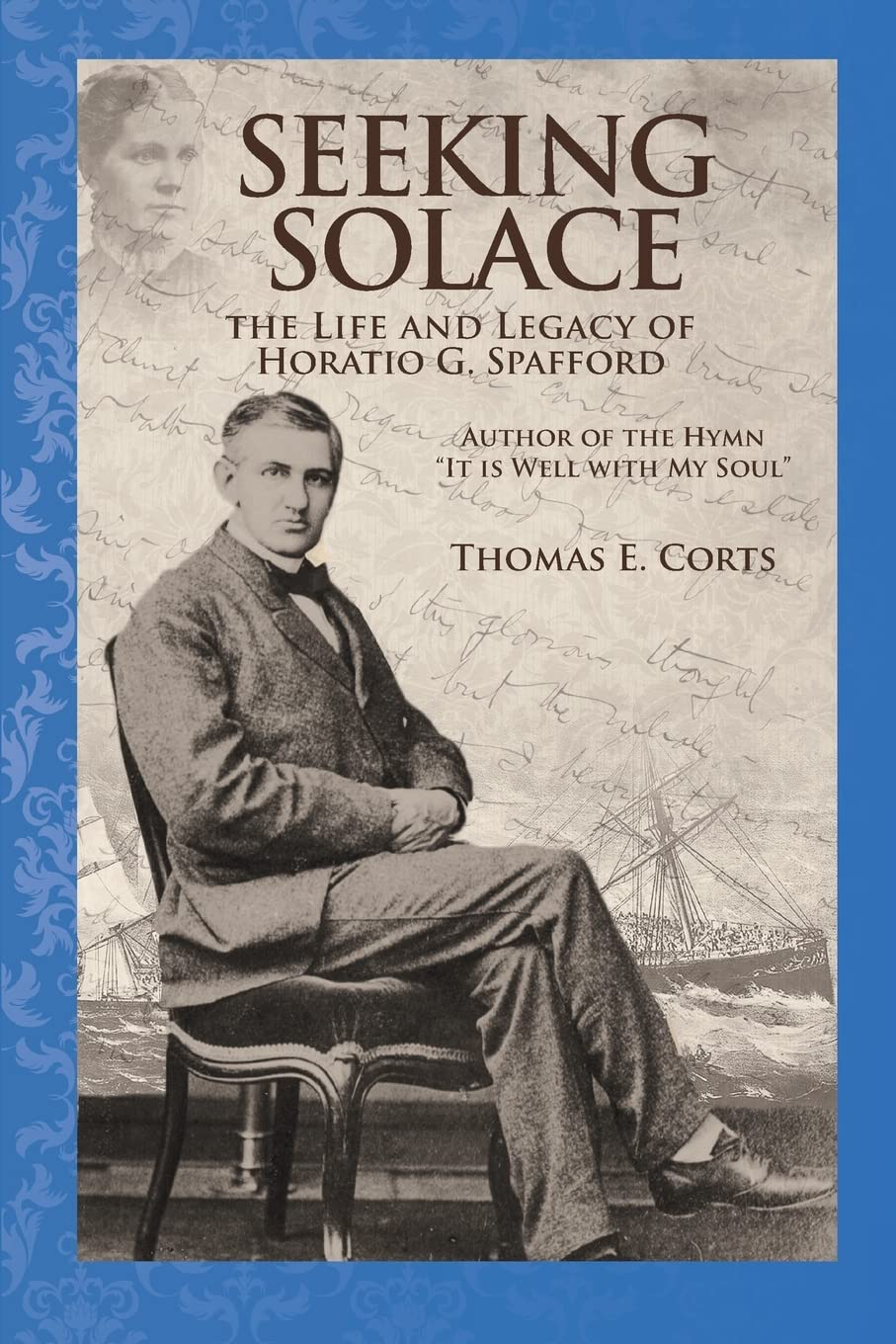
Horatio G. Spafford: The Man, The Myth, The Tragedy. A brief review of Thomas E. Corts’ “Seeking Solace, The Life and Legacy of Horatio G. Spafford”.
Cort’s impeccably and thoroughly researched biography of Spafford is a book I wish I hadn’t read, but find necessary that I did.
Throughout my life, the name Horatio Spafford was one I came to revere and admire.
To all who have imbibed the popular story behind Spafford’s composition of the words to “It is well with my soul”, he holds a cherished place in our hearts. As does his suffering wife, Anna. The account of losing nearly everything in the Chicago fire of 1871, followed by the unimaginable loss of his four daughters in a collision at sea between their passenger ship the Ville du Havre, and another ship, the Loch Earn – instinctively draws from our hearts the deepest sense of loss and compassion. Rightly so. But, with some of those central facts still intact, there remains yet much mythology that in the pursuit of truth, needs to be brought into the light.
Such de-mythologizing is painful. And I feel it keenly. But it is a necessary part of maturing. We often need to be dis-illusioned; freed from our illusions so that we can live in truth. And Corts’ fine biography does just that.
Warning: If you can’t handle seeing what may have been a hero to you examined in the bright light of reality, then do not, I repeat, DO NOT read this book. Go your blissful way with your image of Spafford unsullied and intact. But even at that, it is worth getting all the facts straight about the key points no matter what else you may learn.
We are all well aware that our heroes have flaws. Some more serious than others, but there are no super-saints among us. Some have flaws that are mere quirks of personality. Some are undergirded or exacerbated by mistaken understandings of Scripture. Some are located in a historical context very different from our own and ought not to be judged by present day sensibilities and cultural bents. Others, are truly disqualifying. Sadly, Spafford’s fall into the latter.
Let me lay out some of the chief myths Corts disabuses us of, and then fill in some additional information. I do not want to give a Cliff’s Notes version of the book. Rather, as you see some key facts, reading the book yourself will fill in the much-needed details.
Myth 1 – The Spafford’s lost everything in the Chicago fire. Untrue. Spafford was an attorney of some note, with an office and law library in Chicago which he indeed lost. The family lived, however, in a very fashionable suburb which suffered no damage by the fire whatever.
Myth 2 – Horatio penned the words to “It is well with my soul” while aboard a ship sailing over the place where his daughter’s drowned. Untrue. Ira Sankey – D. L. Moody’s close associate and Gospel singer remembered clearly it was not until 3 years after the tragedy. Philip Bliss who wrote the music for it and first sang it in public recalled the same. In fact, there is no record of Horatio ever placing any specific significance on the poem, or even referring to it. It was just one of many of his compositions.
Myth 3 – Upon her survival, Anna Spafford sent a simple 2-word cable home: “Saved alone.” Untrue. For many years, Sankey said Horatio had the original cable framed and hanging in his office. The cable operator listed the contents as 29 words.
Myth 4 – After their tragic loss, and the subsequent death of another child due to scarlet fever, the Spaffords were drummed out of their Church in Chicago. Untrue. Sadly, Horatio led a faction of the Church in accusing the pastor of financial impropriety. When the books were examined and the charges proved to be unfounded, Horatio led a group out and started a house church of sorts in his own home, later named the “Overcomers.”
Myth 5 – Moved by philanthropy and a burden for the Jews, the Spaffords moved to Jerusalem to start a missions work there. The most untrue and saddest of all. For years, it was unclear where Horatio was getting the money to finance his lifestyle, and even the 2 year trip abroad they were on when his daughters perished. Documents and court records show that given the executorship of 3 estates, he defrauded those he was to provide for, as well as running up mortgages on properties he owned. He fled from what was almost certain prosecution and perhaps prison.
Some random facts.
1 – Once the Overcomers were in swing, Horatio’s widowed sister (Margaret Lee) arrived, and praying to be filled with the Spirit, began getting direct words from the Lord on a whole host of topics and Biblical interpretations. Anna followed in this behavior, and soon the two women, seen as prophetesses ran everything.
2 – The move to Israel was due to a revelation in 1881, to Anna, that Christ would return on Mt. Zion within a month or 2. The Spaffords and a number of others immediately left for Israel, and clad in white robes waited on the Mt. But Jesus never came. Starting charitable ministry was plan “b” after the failed prophecy.
3 – In an 1881 interview he showed how he had totally split from Moody, Sankey and that ilk when stating: “Moody and his followers are all wrong, as well as all the Churches.” Consider that carefully, “all the churches.”
4 – Over time, under the strict command of Margaret and Anna, demanding celibacy even among the married in their group, denying the need for communion, the Lords’ Supper and other oddities, Horatio just became a sort of kindly old man, rambling about looking at flowers, teaching English occasionally and doing little else.
There is so very much more to the entire story you simply must read for yourself.
As I read the whole, I came to the conclusion that an unquenchable thirst for definitive answers to the “why” behind the inexplicable – especially in regard to personal tragedy – rather than dependence upon God’s character and His revealed Word, led to fanciful and dangerous journeys into mystical confusion.
That said, Corts, in extending every kindness he possibly can – points to the untold millions of people who have found true Biblical solace in the words to It is well with my soul. And Spafford’s sins, flaws and failings, do nothing to diminish that. God has used it. That is enough.
We looked first at an overview of Chapter 24, and then Jesus’ parable of the 10 virgins. But He is not done. He has two more major exhortations to make.
In 24 – The basic theme was: Don’t be fooled, lots of bad stuff is going to happen before I return, and there will be lots of Messianic imposters too. When I come, you won’t be able to miss it. With a bottom line that undergirds all four sections: Personal anticipation of and readiness for – Jesus’ return.
Men can argue all they want about signs of the times, world events, blood moons, eclipses, earthquakes, wars, yada, yada, yada – but none of it means a thing if I am not personally invested in His return, facing the full impact of what that will imply, and seeking to be ready to meet my King. None of it.
Sadly it seems, the enemy of our souls has done more damage by getting us fixated on trying to discern secret details about His return, than being about the truly central things. Peter put it most succinctly when he wrote by the Spirit: “But grow in the grace and knowledge of our Lord and Savior Jesus Christ. To him be the glory both now and to the day of eternity. Amen.” (2 Pet. 3:18)
Right now, the “apocalyptics” (to coin a term) are all about being “preppers.” This is true of nearly every Christian cult, and even in Evangelicalism. Store up food! Get guns and ammo! They’re coming for us! (whoever “they” are) and let’s all fight the one-world government! Of course, if the Bible says that’s going to happen anyway, I don’t know what you hope to accomplish. Antichrist will arise and there is precious little said in any portion of Scripture regarding trying to prevent it. No, not precious little – nothing. How can we possibly stop something inextricably tied to His return? It makes no sense.
All of this turns us away from Christ to news outlets and barking pundits. To sub-culture movements and obscurantists. Would you know all about the end times? Hear Christ! Read these portions. Seek first the Kingdom of God and His righteousness. And live in accord with His stated plan for everyone who is in Christ – being increasingly conformed to the image, the character of Christ, informed by the Word and empowered by the Spirit. Grow in the grace and knowledge of the person and work of Christ! That is the only real thing you can do in preparation for His return.
And so it is we have today’s text.
Note first: It is impossible to miss the picture Christ paints. He pictures Himself as one who has gone on a long journey, from which He will return.
In 1 Thess. 1, Paul sets out four marks of the truly born again: 1 – They turn FROM their idols. 2 – They do so to SERVE the living and true God. 3 – And they do these in an attitude of anticipation – waiting for His Son from Heaven. 4 – Looking to Jesus who delivers us from the wrath to come at His return. In this sense, all true Christianity is eschatological. The Christian to BE a genuine Christian, must be looking for Jesus’ return, and that His return includes the coming wrath of God. We live in the light of these truths. They inform our entire mindset. If not, we are not living as Christians.
Note second: Our King has put something of the improvement of His kingdom within us, into our hands.
Christians are not passive in our growth in Christ. True, such growth is not left up to our natural abilities. As the parable notes, He grants us His grace, His gifting to work from. But that we are called to use that grace and to (as the Puritans used to call it) “improve” that grace. Use it. Grow in it. Exercise it. Take on more and more of the likeness of Christ by the Spirit.
The old Puritan pastor Richard Baxter (1615-1691) used to meet with every congregant at least once a year. He used a simple diagnostic tool to probe. He asked first: “Have you grown spiritually in the past 12 months?” If they replied “yes”, then he would ask – “how do you know?” What are the indicators that is so? If they replied “no”. He asked – “why not?”
What if we were each to take such diagnostics on ourselves? Not to become Evangelical naval-gazers, but to take an honest look at our own spiritual condition from time to time.
What is apparent in Jesus’ parable here, is that He gives us something of His grace, and expects a return on it when He returns.
Does such a thoughts even enter the mind of the average Evangelical in America today? I fear not. Yet look at the emphasis Christ puts upon it here.
Note third: God does not require the same thing from each of us – only to be faithful according to what He has apportioned us.
Our God never requires us more than He supplies for us. Not everyone is gifted to counsel, preach, teach, evangelize, write, give etc. Each serves according to their sovereignly given capacity – hence we can never judge ourselves by others, nor anyone else by ourselves. While it may be useful to be challenged by seeing how others have employed what’s been given them, Paul will remind us that “But when they measure themselves by one another and compare themselves with one another, they are without understanding.” We dare not go there.
What has God given you? Use that. Employ that. It may seem small in your eyes, but if it His appointment, it is all He requires. He doesn’t expect children to do adult tasks, the physically impaired to jump through hoops, the poor to give as the rich, the slave to serve as though free, nor the ill to rise up off their beds as the hale and hearty.
Seek Him. Seek to grow in His likeness. Love and serve His people and your gift(s) will emerge naturally. And when they do, be about them as best you can.
Note fourth: The one who had but one talent here, wasn’t judged because he had little, but because he had no interest in his Master’s business, but only in how these matters impacted himself. This self-focus in the Kingdom, not caring for Christ’s agenda and plans and purposes, but only for our own, is the mark of one who knows not The Master.
The man’s argument was: “I didn’t become evil, I just didn’t grow in grace, I made no spiritual progress. Isn’t it enough that I just stayed and OK person?”
And Jesus’ answer is – no. That’s not enough.
Some measure of grace has been given to and shown to all – the redeemed and the lost. And each will have to answer for what happened with that grace in our lifetime.
Note lastly: How richly He delights to reward His own. We deserved no grace to begin with. We only did what was fitting with what we had. And yet He multiplies it when we have sought to be faithful.
From Luke 10:1 – “After this the Lord appointed seventy-two others and sent them on ahead of him, two by two, into every town and place where he himself was about to go.”
When I was growing up, the image above was the cultural picture of the modern street prophet. His message was taken from Amos 4:12c. And it was widely criticized, scoffed at and denigrated.
And yet, there is some truth in it, isn’t there?
Enter Luke 10:1.
There may in fact be no more succinct description in all of Scripture regarding the breadth and nature of true Gospel ministry than is given in Jesus’ words in this verse.
What is it we are to be doing above all other things? Preparing people for the arrival of Jesus.
We do this in preaching the Gospel of justification by grace alone through faith alone in Christ alone – so that they might enter the Kingdom and be reconciled to God.
And we teach those who believe how to walk with God, informed by the Word, empowered by the Spirit – to grow in the likeness of Christ that they may be welcomed by Him at His return.
Preachers, teachers, brother and sisters in Christ: Go into all the world, where Jesus Himself is about to arrive – and prepare all who hear you for His arrival. Reconcile to the lost to Him so that they might anticipate His arrival. And strengthen, encourage and assist Believers in their growth in His image, that they might be all the more ready to receive Him in due time.