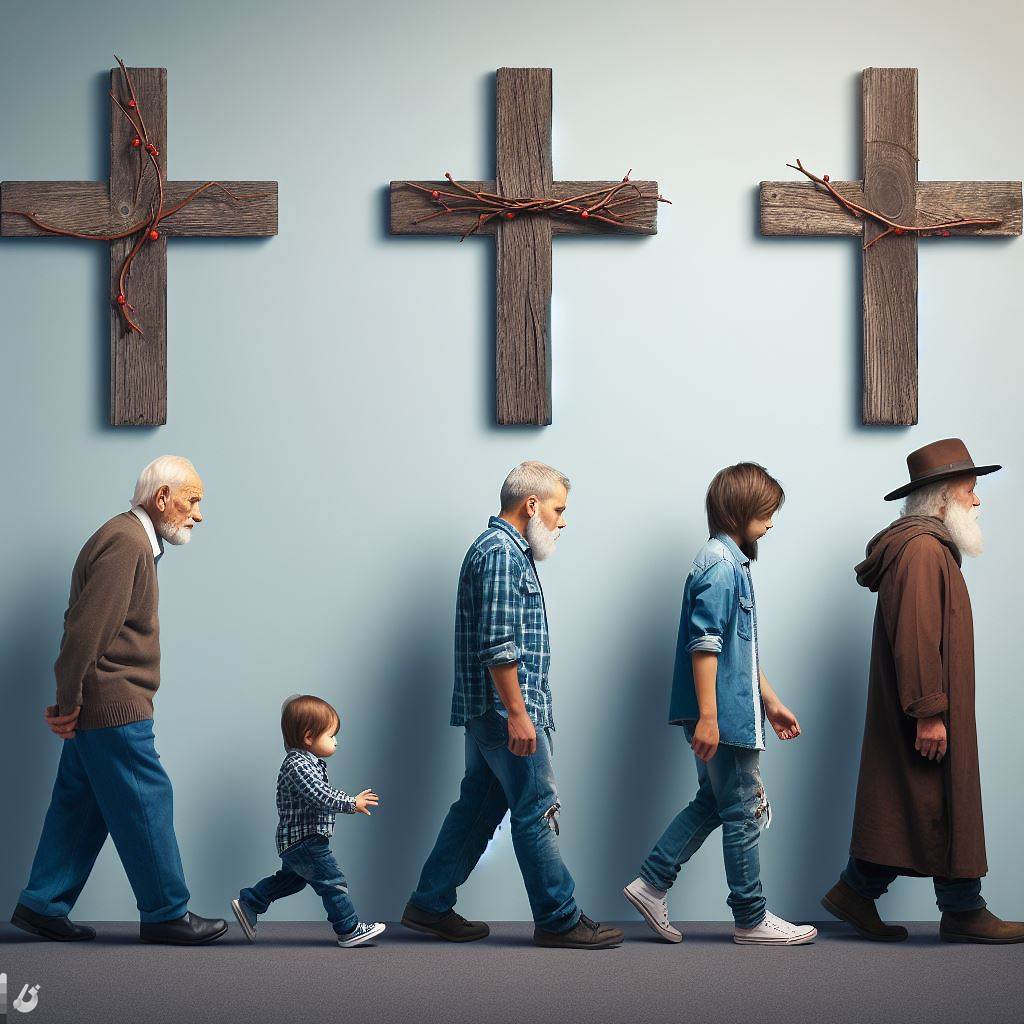
From Luke 10:1 – “After this the Lord appointed seventy-two others and sent them on ahead of him, two by two, into every town and place where he himself was about to go.”
When I was growing up, the image above was the cultural picture of the modern street prophet. His message was taken from Amos 4:12c. And it was widely criticized, scoffed at and denigrated.
And yet, there is some truth in it, isn’t there?
Enter Luke 10:1.
There may in fact be no more succinct description in all of Scripture regarding the breadth and nature of true Gospel ministry than is given in Jesus’ words in this verse.
What is it we are to be doing above all other things? Preparing people for the arrival of Jesus.
We do this in preaching the Gospel of justification by grace alone through faith alone in Christ alone – so that they might enter the Kingdom and be reconciled to God.
And we teach those who believe how to walk with God, informed by the Word, empowered by the Spirit – to grow in the likeness of Christ that they may be welcomed by Him at His return.
Preachers, teachers, brother and sisters in Christ: Go into all the world, where Jesus Himself is about to arrive – and prepare all who hear you for His arrival. Reconcile to the lost to Him so that they might anticipate His arrival. And strengthen, encourage and assist Believers in their growth in His image, that they might be all the more ready to receive Him in due time.
The lesson from this simple passage is sweet, and necessary: Don’t fence God. He needs no body guards.
Note first: Christians need not be God’s protectors as many in Islam violently protect Mohamed. When our God needs defending by us rather than we needing defending by Him – things are upside down. Ultimately, it is the product of human hubris – even though it may flow from a personal sense of reverence.
It is true we are to pray and work for the fame of the name of God to be restored; for the whole of sentient creation to hallow, revere, respect and honor Him for who and what He is. When Jesus taught us to pray, He put this issue as the very first among all things we are to pray for. Nothing was dearer to His own heart than to see His Father’s reputation restored. To see all love and cherish and delight in the Father as He Himself did. But that is not done by swatting down those we think deficient, unworthy or even blasphemous. It is done by trusting Him, praising His name, walking in such a way as to reveal His character, preaching His Gospel and walking in truth.
He is our great defender, we are not His.
Note second: There are none more worthy than others to seek Him than others.
Young, old, hale, infirm, educated, ignorant, accomplished, indigent, intellectual or challenged. He came to seek and save “the lost”, not humanly created sub-sets of humanity.
Jonathan Edwards recounts the case of Phebe Bartlet who at the age of 4 began to manifest evidences of the Spirit moving in her soul. By 5 she was truly remarkable in her pursuit of God. John the Baptizer was filled with the Spirit even in his mother’s womb. And I can add that of myself, having my eyes opened to my sinfulness before God, and my heart opened to embrace Christ and the Cross at the age of 8.
When people show any interest in spiritual matters, we need to take it seriously. This is especially true with children, who do not take such an interest at all naturally.
Note third: How quick Jesus was always ready to bless.
And should we imagine Him any different today? Were these children displaying some interest in Him themselves, or was it only that their parents sought something on their behalf – He loves to receive and bless. Here, it says they specifically wanted Him to pray for these little ones. To speak to the Father on their behalf.
What an encouragement then for parents today to seek Christ that He might intercede on behalf of our children, grandchildren and others. In this, we never see a refusal. Instead, we see Him admonishing any who would hinder it.
Be encouraged to seek Him for your loved ones. He is far more gracious and ready and willing than we dare believe.
At first blush, these two verses seem exceedingly incidental. Really, why bother? But I think there is something still worth noting here.
Note first: Back in 17:22, Jesus spoke – the most clearly to that point in time – about the immediate future. He said He was going to be delivered into the hands of men, killed, and then raised up three days later. This greatly distressed them the text says. But then the events of everyday life seem to push this revelation into the background. First there was the 2 drachma tax controversy, then the discussion over who was greatest in the Kingdom of Heaven. And this led to Jesus’ extended discourse on humility and forgiveness.
And so it can be with us even now. The promises of Christ’s return, the resurrection, the new heavens and the new earth can easily be lost by us as having continuing importance in the ordering of our lives. As staggering as those realities are, they can be overshadowed by the stuff of everyday life. But not Jesus. He takes His sidestep to deal with the immediate, but as soon as He is finished with those, He is right back on track. He is still undeterred from His path to Jerusalem.
And I wonder in myself, am I so mindful of my own path to the Celestial City? Am I a traveling partner with Bunyan’s Christian? Yes, many things require our attention from all sides each and every day. But are we on our way home? Or has that idea been pushed so far back in our minds that it no longer informs our thoughts, actions and decisions?
Am I, are you – consciously proceeding toward Heaven? Is that our course? Are all other things dealt with, experienced and contexualized by where we are headed? For to lose sight of where we are going, is to wander aimlessly through life. And is this not behind the despair of so many – even professed Christians?
Are we consciously going home to be with Jesus? And do we remain aware that the only way there is through the cross?
Note second: No matter where Jesus is, or whatever else is going on, pouring our mercy and grace on others is never neglected.
Large crowds were following Him. And He was neither deterred by them, nor unmindful of them.
He might have been consumed in Himself with what was about to happen to Him. But no. Or, He might have been tempted to stop His journey to enjoy the attention of the crowds. But neither is true. He met them, and He continued on His way.
Note third: His ministry to these crowds, is a ministry to a throng of the unnamed. The common folk. There are no mentions of the healing of notable people. No mention of class, station nor even the particulars of the healings. It is simply recorded that this is what He did. They, unmindful of what awaited Him, were simply desiring their needs to be met. And in typical Jesus fashion, He just blessed them. He gave them what He had without pomp, ceremony or self-reference.
How sweet and how gracious and how willing to bless our Lord is.
And if He is not too busy, too distracted, too fixed on the Cross to stop and heal this nameless crowd, then how much more is He ready to hear the prayers and meet the needs of His people from His place beside the Father even today.
Oh Christian, come to Him with your needs.
Oh lost one, come to Him with your sin.
He is no further away than the cry of your heart .
This is now the 4th part of Jesus’ reply to the questions: “Who will be the greatest in the Kingdom of Heaven?” And in it, Jesus makes a glorious appeal to understanding The Father’s tender care for the humble. Let men vie for position and status. It will be their downfall. But if you would know unbounded care and the most tender ministrations from the hand of God – it is found in His regard for the humble.
Note first: The command to not disregard the humblest of those who believe in Him.
As Paul would later instruct us by the Spirit: “consider your calling, brothers: not many of you were wise according to worldly standards, not many were powerful, not many were of noble birth. But God chose what is foolish in the world to shame the wise; God chose what is weak in the world to shame the strong; God chose what is low and despised in the world, even things that are not, to bring to nothing things that are, so that no human being might boast in the presence of God. And because of him you are in Christ Jesus, who became to us 1wisdom from God, 2righteousness and 3sanctification and 4redemption, so that, as it is written, “Let the one who boasts, boast in the Lord.” (1 Cor. 1:26-31)
These are our brethren. This is the host of the redeemed. Not the intelligentsia. Not the elite. The common man. The poor in this world’s eyes. He came to those who are weak and foolish and low and despised. For we who are nothing in ourselves.
Why then would we try to create some sort of new spiritual elite by comparing ourselves to one another?
It is a wickedness wholly antithetical to the Gospel.
This skewed reasoning is why the Church clamors after every celebrity who makes any claim to something like Christianity. Because we want to be thought of as something other than weak, low and foolish in the eyes of the world – which attitude inherently bleeds over into status seeking in the Kingdom as well.
Note secondly: Jesus’ use of the word “despise” here.
In modern parlance, we tend to read the word despise with the connotation of true and virulent hatred. But more often, it refers to hatred in the sense of total disregard. Treating someone as though they simply do not matter. Worthless in the eyes of God and man. Not worth paying attention to.
So it is, the command here is to guard our hearts from treating any of the weakest, lowest, most broken, as though they are not worth our time or ministrations. For He came for these. Indeed, when everything of self-illusion is stripped away, this is the YOU and ME He came for. And if we will not see ourselves as just a low, just as weak, just as worthless in the eyes of the world, then we inject some measure of pride into our salvation. That somehow we were worth more than others and that is why we were saved.
Note third: That in the parable which follows, Jesus emphasizes in no uncertain terms how precious each and every one of His sheep are to Him. Without distinction.
Now there have been no end of conjectures as how to precisely understand the metaphor here. But among them all, I have grown fond of that slant which Epiphanius (Bishop of Salamis – c. 315-403) suggests. He conjectures a most charming way of getting away from the questions which take us away from the meat and refreshing fruit of this passage. It would seem he makes his conjecture due to the way this parable reads in Luke 15.
He suggests that the picture is that of the Son of God leaving Heaven and the righteous angels in the presence of God, to come and die. To seek out the “lost sheep.” It is a picture of the incarnation. In other words, the very oddity of the scenario is meant to suggest to us something we wouldn’t ordinarily consider.
The 99 represents the majority of all of God’s Creation which has NOT strayed from Him, especially the righteous, unfallen angels. And the one sheep, is that one small part of Creation which has strayed – fallen mankind. Jesus leaves the 99 in Heaven, safe, secure and righteous, and comes seeking we lost, foolish and rebellious ones. And finding us, what does He do? He places us upon His own shoulders, with the full weight of all of our guilt and sin. He takes us up upon Himself, since we have no means to return to the fold ourselves. And carrying us to the Heavenlies on His scourge-scarred shoulders, He presents us blameless before His glory with great joy. (Jude 24) So it is Jesus notes it is joy “in Heaven” over the repentant sinner, above the righteous angelic host who need no repentance. And how they rejoice with Him in the fulfilling of His redemptive work.
And so we come to that closing thought: there will be more joy in heaven over one sinner who repents, than over the 99 – the angelic host – who have no need of repentance. And we are humbled to think how such a salvation, such a Savior can be ours.
Glorify Him Christian – He values your soul more than all the holy angels in heaven. No wonder the Psalmist must gasp: “What IS man, that you take notice of him?”
What was begun in vs. 1, will continue down through vs. 14. And seldom is the great subject matter of this discourse considered well and in its context.
As we saw already, what prompts these words of Jesus is the question by His Disciples: “Who is greatest in the kingdom of Heaven?”
Note first: How we may give the benefit of the doubt in hope that none of them were using this as a veiled inquiry as to their personal standing, but the opposite seems true. Peter, James and John had just come down from the Mt. of Transfiguration where they had seen the most amazing display of Christ in His glory. Were they inquiring as to whether or not a prophet like Elijah might have a higher place than even Moses – or something of the like? Possibly. But it seems more likely, especially given Jesus’ extended answer, that they were concerned with their own standing. Especially the three among the rest, and perhaps one among the three.
Jesus wastes no time in addressing the wickedness of one seeking position in Christ’s kingdom. In seeking self-aggrandizement. The One who knew it was no robbery for Him to be equal with God, and came in the likeness of sinful flesh, finds this tendency so abhorrent, so destructive, that He must denounce it in the most emphatic terms.
Note second: The perniciousness of pride is a special temptation among those who consider themselves servants of God.
These are Christ’s own here. His unique Apostles. And what evidently had crept in was some sort of thought regarding how they were to be honored above others. We are so wont to think of ourselves as “special”. And it is astonishing to see what degree this now comprises much of American Evangelical emphasis in preaching, and in the celebrity status sought after, and lavished in by many prominent ministers and ministries.
Turn on “Christian” TV, go to YouTube, go to a Christian bookstore, and there will be no end of tales of supposed “Transfiguration” type experiences being related, and then capitalized upon as though such experiences confer unique authority upon the dreamer. It is not just a lie, but as Jesus demonstrates here, such self-celebrity and self-aggrandizement is damnable.
Note third: How Jesus turns the tables. First and foremost, we are to receive the humblest and simplest of saints who believe in Him, as receiving Christ Himself. Humility is prized, not self. A holy lack of self-awareness. A total absence of even thinking on the category of how one might be regarded in comparison to others in the Kingdom of Christ.
In contradistinction to the Disciples’ thoughts at the moment, they were to show respect to those who are aware of their need of grace. These are the ones we embrace, not those who appear great in men’s eyes. And in effect He says – whatever you do, do not look down on them for their weakness and humility, or make that a cause of shaming them or hindering them. For I will not take it lightly.
Note fourth: Once more, using the import of Jesus’ response, He is saying in effect – Whatever you do, do not drag others into this ego-driven paradigm that seeks greatness in this way. Should this be the case, it would be better to be tossed into the sea with a millstone around your neck than to do such a thing.
This is of such grave importance to us all, but especially to we in the ministry of the Word. If you find yourself creating or feeding this mentality of seeking greatness (in the eyes of men) in others – take violent action against it. If your work labors to that end, or your walk takes you in that direction, if your eye is enticed by it – do everything you can to stop it. It is the path to Hell.
For nothing can be further from the character and perfections of Christ, then to be filled with pride of self over others. If we would see Him, prize Him, know Him, delight in Him, truly love Him, we must marvel at His humility. And seek the work of the Spirit to thrust His holy sword through any appearance of such contrary pride in us. Adore Him in His humility.
In this most remarkable account, Jesus turns common thinking on its head. For in the world, vying for place, position or recognition is not just sought after, it is celebrated. It is the essence of competitive sports. It is how we seek promotion on the job. It fuels academicians to be sure they publish as often as they can. Even actors strive foe the Emmys, BAFTAs and Oscars even as muscians want Grammys, advertising execs Clios. How many Facebook, Instagram of TikTok followers? Even Pastors can seek status based upon congregation size, sermon videos watched etc.
Pride is a pervasive evil.
Don’t get me wrong, striving for excellence is good and right. Feeding off of the recognition is not. But we are a pride-based race. Humility is not prized. Status is.
Note first: What is it about these children? Simple, being great in the Kingdom isn’t even on their radar screen. They are just about the business of being – children. Some sort of ranking in Heaven or the Kingdom to come isn’t even glint in the far reaches of their sub-conscious. Status in the Kingdom is absolutely meaningless to to them.
And so it ought to be with us.
Yes, Scripture speaks of properly seeking rewards in Heaven – but never status. Ever.
Note second: The child was set in their midst by another, not by him or herself.
How is it that we are even in the Kingdom at all? By sovereign grace. Period. We must be set there by His sovereign hand. We have no merits to earn it; no power to accomplish it; no means to even recommend ourselves to it.
As Jesus took this little child, calling the child to Himself and putting the little one in their midst, so it is with our salvation.
Status has no place in the equation anywhere.
Note third: The child is humble. Not assuming he or she has anything to add, but looking to be added to.
More, for a child’s humility is best seen in utter and absolute dependence. And unless we are humbled to the very same degree of absolute dependence, we will not even be IN the kingdom. So, who might be the greatest in the Kingdom is just plain the wrong question.
Greatness in the kingdom is a matter of one’s realization of need of grace. Those are greatest in God’s eyes, (not man’s) who know their need the most, and look only to Him.
Note first: What a most striking balance there is in our Lord in this account.
When it came to truth, especially the truth of the Gospel or about God, Jesus didn’t hesitate to offend anyone or everyone.
But when it was not such a matter, a Gospel matter, here, in what is nothing more than a social custom, Jesus is concerned not to give any needless offense.
This is greatly instructive to us. It is of Kingdom important that we are clear which hills are those to die upon, and which are not so grave. Especially in our interaction with un-Believers.
As in this account, we are reminded that in the whole of the New Testament, neither Christ nor His Disciples are ever recorded as having been offended or taking offense themselves. And they were most certainly ill-treated. This tendency to take offense it seems is found only in their opposers.
I wonder at how easily, I, we, in this generation make so much of offenses. Perceived or real ones. We imagine ourselves wounded at almost every turn. Something conspicuously absent both in our Lord and those who suffered with Him.
Perhaps the ease of our circumstances, the perceived “rights” upon which our society prides itself, the general acceptance we have as Christians – which opens us to precious little true persecution – has made us imagine the world (and people in general) owe us some level of courtesy and regard. Our skins grow exceedingly thin. Every bump is considered battery. Every slight, real sin.
But this is not the Biblical model.
Given the New Testament examples, it would appear we are to be more concerned with not giving unnecessary offense to others, than whether or not they may offend us. We, are about to inherit eternity. And will we wrangle with one another over momentary sensitivities?
Jesus flexes with those around Him as far as He can as long as it does not touch the Gospel.
Is this tax right? No.
Is it fair? No.
Is it wrongfully enforced? Yes.
Is it costly? Yes.
Is it an example of what we hear so much about today – “Government over-reach? Yes.
It was in fact a Jewish tax imposed by the corrupt Sadducean religious leadership and didn’t even have the backing of Roman law. It was just expected.
You would have thought Jesus would use this as a platform on which to denounce corruption in the “Church” leadership.
But He does not such thing.
Is it worth getting into a snit about? No.
Why not?
Because it has nothing to do with the Gospel.
So in the end, so what?
As Christians we might face all kinds of places both in and outside of the Church where what might be unfair and even costly might be imposed upon us.
So what?
What do we gain for the Kingdom by getting our noses out of joint over things which in the end, have no real eternal significance?
Note second: Once again, we are struck by this juxtaposition between the wonder of Jesus’ transfiguration and His being drawn back into the world of pettiness and the mundane.
Captured here is the bane of every preacher’s existence isn’t it? And yet our Savior navigates it without a whisper.
First, He is on the mount and transfigured before Him. Then he is confronted with the demonized boy and his father, and the inability of His key men. And then dragged into the most meaningless controversy about this petty tax. How His spirit must have groaned in being jerked about from the divinely sublime to the most ridiculous. But He bears it all without a flutter. What a Savior.
May we learn to do the same with such utter reliance upon our God’s sovereign providences.
When bandied about from the sublime to the ridiculous, may we submit as easily to The Father’s appointments.
This account comes right on the heels of Jesus’, Peter, James and John descending the Mount of Transfiguration. That context helps us understand the depth of Jesus’ cry in v.17 “how long?”
Note first: What an expression of Jesus’ personal grief over the ravages of sin in the human race emerges here.
And can you imagine the jolt of this scene on His humanity? He has just been glorified before 3 of His disciples, and in communion with Moses and Elijah in this glorified state – only to plunge back into a context where sin has brought demonic torture to a little boy, and the state of His own disciple’s faith is so poor, they are unable to offer any help.
I wonder if we share the same when we see such suffering?
But we need to drill down and really grasp what grieves Him so. He tells us plainly: Unbelief. That men are faithless, denying God, refusing to believe His truth and the Gospel of the Kingdom.
I fear that we are (I am) more grieved by the results of faithlessness (like what produces such aberrations as demon possession, war, rape, murder etc.) than we are by faithlessness itself.
As long as faithless people don’t bother us, we don’t seem to mind their faithlessness.
We ignore the most tragic part of their condition – while He grieved it above all else.
What does He call this condition? Twisted or perverse. Because to be oriented this way is to be upside down from the heart and mind of God.
PRAYER: Oh Father, make me grieve the unbelief of men more than the mere acts which vex me most. Give me your heart and mind. For it will drive my energies to see the Gospel is preached more than any other approach to society’s ills. Yes, Jesus healed the boy, but what of those around? And what is healing if we are left in eternal darkness from the face of God in Jesus Christ. Keep us from putting temporal band-aids on the eternally terminal cancer of the soul. Let your glory in Jesus be known. Let your Gospel be preached. Let me be a messenger who boldly, clearly and endlessly proclaims the forgiveness of sins in Jesus’ name – and reconciliation to you through the Cross.
He grieves. Deeply. And sighs out His exasperation in the moment. It is stunning.
Note second: We must never let the doctrine of God’s impassibility (that God is not driven by external impacts upon His emotions) bleed over into imagining God is unfeeling altogether. Mercy and compassion are not stoical. God is not emotionless, but neither is He driven by or subject to His emotions. He is Lord over Himself. As Paul teaches us by the Spirit in Galatians 5, one fruit of the Spirit is self-control – which must be in perfect form in the One in whose image we are made.
And it is why some branches of Christianity err so greatly in thinking the Spirit brings a lack of self-control – like being “drunk in the Spirit”. He makes us more like the Redeemer, not less. And Jesus was never, ever, under any consideration, out of control.
Note third: We are wont to think of faith in terms of quantity. Perhaps we think this way because we conceive of Jesus’ word regarding “little” faith – as though that is quantitative. Here, Jesus dispels that idea completely.
It is not that the disciples needed greater faith, they (and we) only need faith but the size of the tiny mustard seed -that will do. It is rather that faith must be exercised, rested fully upon God. Indeed, the word rendered “little” here is more often translated “few” in the New Testament.
Some commentators note that the idea is that their faith was poor. It’s size was irrelevant. It’s quality was the issue.
In this case (as is often true of ours) faith was not utilized everywhere it could be.
We believe for this, but not for that. We trust God in some things, but not in all things. We only believe in a few areas, not in many. Oh Father, grant that our eyes might be opened, to trust you in everything, everywhere, at all times. For it is not our faith in and of itself that accomplishes anything – but the One we have faith in – You.
Note fourth: The idea here of moving mountains is simply a figure of speech, a euphemism for doing the impossible. What is normally impossible, may be possible when we believe God and obey accordingly.
It should be noted that neither Jesus, an apostle nor any others after them ever moved a single mountain. Physical mountains are not the point.
Note too, how this has to do with carrying out Christ’s commission, not miracles on demand for our own purposes. In doing His work, furthering His cause, carrying out His will, we have unbounded ability, if we will but trust His promises – trust Him.
Lenski differentiates between saving faith – which is permanent – and “charismatic faith” which would be that of those in Matt. 7 who will prophesy, cast out demons and do other mighty works, but who in the end will be found to not be “known” by Christ as His after all. Such “faith” may come and go. And it is not inherently salvific.
How we need to be sure we are Christ’s agents carrying out Christ’s work according to Christ’s means and methods. Then, in serving Him believing His will will prevail, we can go forward trusting that He can move mountains indeed.
For the audio Podcast of this and every episode, find us on Breaker, Google Podcasts, Overcast, Pocket Casts, RadioPublic, Spotify or HERE
If you’d like to join us in our journey reading all the way through the Bible this year, drop me a line at reid.ferguson@gmail.com, and I’ll be glad to email back a copy of the reading plan we are using.
For a period of time when I was younger, I lived and worked in a funeral home. My labors were in exchange for rent. And one of my duties was to stand “calling hours” – to greet and assist people as they came to pay their respects to the one who died and sympathize with their family. One thing which was evident was the vast difference in the atmosphere of those gatherings when the deceased had known Christ and when that was not so.
Both groups grieved. But the Christian groups grieved with genuine hope. There was loss, but the sure knowledge of the resurrection and reunion around the throne of Jesus. Others ranged from a nebulous religious optimism, to nothing but loss. Why such a disparity? The difference is between genuine Biblical faith, and what often passes for it.
I’m Reid Ferguson, and we’ll talk a bit more about that today on Through the Word in 2020.
Of our 3 reading sections today – Nehemiah 5–7; Luke 9:57–10:12; 1 Timothy 1:3–20 – I’d like to consider the last one.
As Paul writes to Timothy who is ministering in Ephesus, he urges him to challenge and charge the folks in the Church there not to teach any other doctrines than what they had received when Paul had been with them, and to be sure not to give any weight to myths or genealogies. His concern is this: Faith, genuine saving and sustaining faith cannot be fostered by: untruth, myths or genealogies.
In short, he’s telling us what real faith does require: 1. It must be rooted in truth, God-revealed Biblical truth. Understanding what the Bible really teaches. 2nd, it must be based on historical, Biblical fact. The reality of the incarnation, and Jesus’ life, death and resurrection. And 3rd, it is dependent upon a personal connection with God through Jesus, by the Holy Spirit.
You see, un-Biblical doctrines or teachings, myths and putting your trust in being related to someone who supposedly has a connection to God (that’s the idea in genealogies) can only promote mere speculation. They make salvation an issue of guesswork. A “hope so” proposition. Speculation is not, and must not be confused with genuine faith.
Faith always appeals to the sound and clear teaching of Scripture. Not feelings. Not opinions. Not imagination. It is not the stuff of “I think”, “I feel” or “I heard.” It is the “I know” because this is what God has revealed in His Word.
Once, while standing calling hours, a gal told me she was confident in the deceased’s state because he had several family members who were priests, and others who were nuns. She then purchased a prayer card to enroll him in a society which promised to add his name to their daily prayers to lessen his time in Purgatory. Her confidence (which she expressed for herself as well) was based upon doctrines not taught in the Bible, a genealogical connection and a myth. A present day demonstration of the very thing Paul was writing about to Timothy.
So what is your hope and faith rooted in today? The Apostle John wrote to a group of disciples: “I write these things to you who believe in the name of the Son of God, that you may know that you have eternal life.” That my friend is faith. Knowing, based on God’s Word.
And if you’re trusting Christ as your sin-bearer, as having taken God’s just wrath due to you on the Cross of Calvary, that His righteousness might be accounted to you – you can KNOW you have eternal life too.
As Jesus prayed in John 17: Father…you have given me authority over all flesh, to give eternal life to all whom you have given me. “And this is eternal life, that they know you, the only true God, and Jesus Christ whom you have sent.”
Find us on Breaker, Google Podcasts, Overcast, Pocket Casts, RadioPublic, Spotify or HERE
If you’d like to join us in our journey reading all the way through the Bible this year, drop me a line at reid.ferguson@gmail.com, and I’ll be glad to email back a copy of the reading plan we are using. It’s never too late to start.
But I’d like us to briefly look focus on the account of Jesus calming the storm in Mark 4.
In reading this account I am reminded first that Gal. 5:6 says “Faith works by love.”
Our faith, our trusting God is directly proportionate to our perception of His love toward us. When we are sure of how greatly and how perfectly He loves us, we have great faith equal to it – that He will meet our needs.
When we have little sense of His love, our faith will be likewise little.
This is why faith comes through the preaching of the Gospel – it is an announcement of God’s love toward us and His willingness to receive us and forgive us based upon the sacrifice given – Jesus Christ on the Cross.
So it is here the Disciple’s statement “do you not care that we are perishing?” is the root behind their little faith. And, the root behind our own.
They questioned His care for them. His love for them. They thought Him indifferent and thus did not trust Him.
The key to great faith then, is to gain a greater and greater sense of His great love for us. And if we do not see it in the Cross – where will we see it?
And, if we call into question God’s love for men, how can we then ask them to believe the Gospel? Such preaching is counterproductive, and contrary to God’s own design.
We must give them reason to believe His love for them, and then we have made a great inroad into seeing saving faith arise in their hearts. As
Rom. 10:17 says, this is the product of hearing the “word of Christ.” If our Gospel, the “word of Christ” does not contain an announcement of His great love – it fails to be the Gospel in full.
Back to the Disciples: They do not see their own lack here and a lot of the time neither do I.
Think about it, Jesus had just given them numerous parables about the Kingdom; How it would grow, it’s longevity and it’s simple beginnings but great end.
But all they can see is the immediate storm.
The far off reality of the promises yet to be fulfilled are all eclipsed by the present trial.
May the Father, forgive us for our short-sightedness. For our profound lack of faith in His unfailing Word by forgetting the surety of His promises in the midst of present storms or trials.
Lastly – and we really need to see this because this is where there is SO much confusion about what faith is and how it works – the faith they lack at this point is not some subjective faith that in storms they will be OK. The faith they lack is that in the prophesied Word that told of Jesus’ crucifixion and resurrection.
They had no faith in His person and work based upon the Scriptures.
Due to their lack of understanding their Old Testament, they neither really knew Him, nor His mission.
And so they could not put their present circumstance into that context. Real faith requires the Word of God, not mere conjecture, feeling or desire.
Theirs was the same problem Nicodemus had in John 3.
This is why studying God’s Word is absolutely vital. For if we neglect His self-revelation there, then we will be ill-equipped to see Him with the eye of faith as He Shepherds us in everyday life. We too will be quick to cry out: “Do you not care that we are perishing?”
Oh Christian, His care for us greater than we can conceive. Stop and look at the Cross again today.
Truly let that soak into your soul Beloved.
God bless, and God willing, we’ll be back tomorrow.