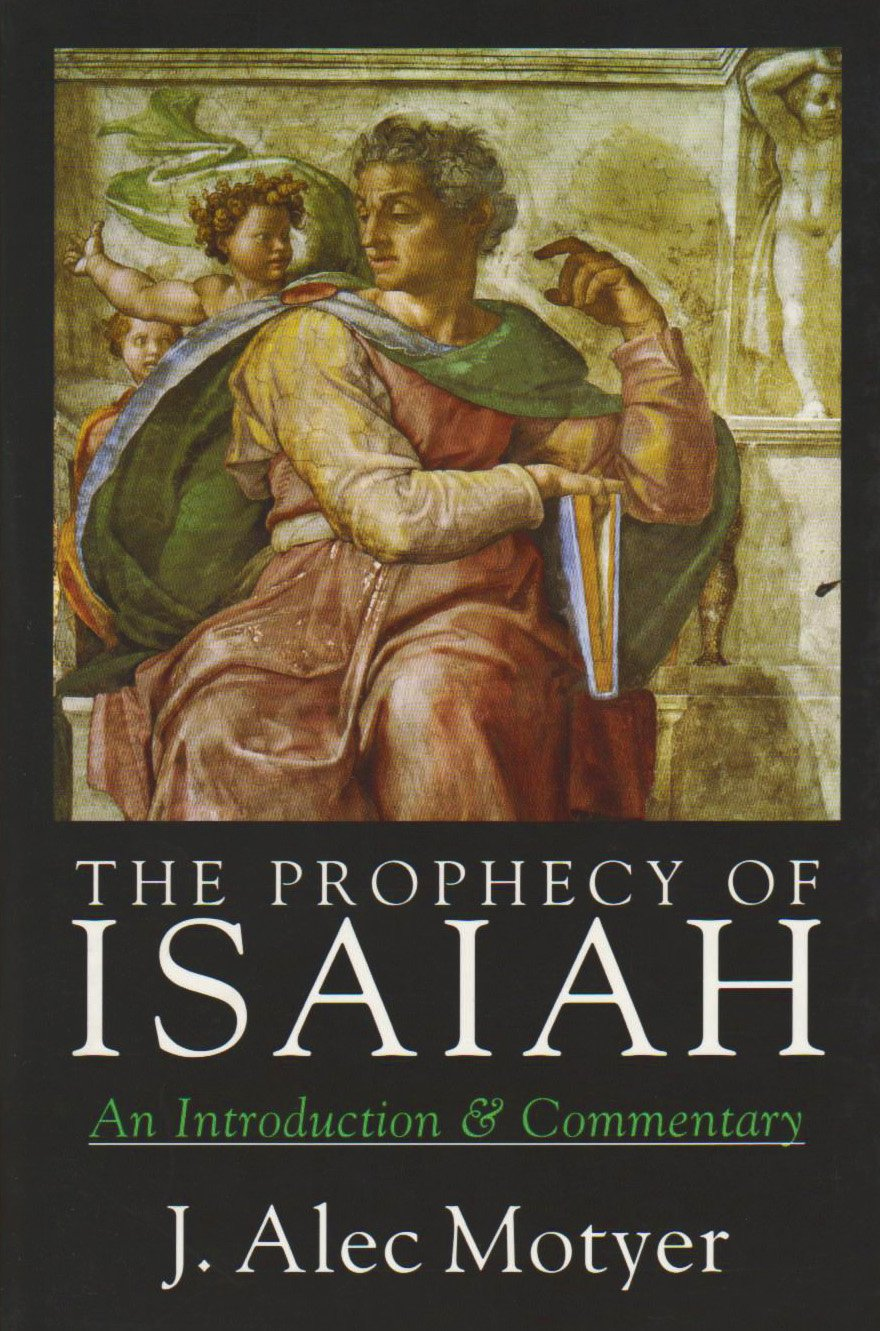
I am currently reading through the book of Isaiah at a slow pace. Purposely so. Because as I read, I am taking each section and reading Alec Motyer’s wonderful commentary along with it. And I want to argue that such a practice is an incredible tool which I think would yield much to all of us who seek to know God’s Word – and thus God Himself – better.
Now what led me to this particular practice at this time, was the challenge of a conversation with my good friend and pastor – Tony Bartolucci.
Sometime ago, he told me in his daily devotions, he was reading all of the ESV Bible Study notes along with the passages for the day.
The light came on.
Daily time with God is must for all of us if we would grow in Christ. Time in the Word. Time in prayer. Apart from these our spiritual tanks run on empty. As Al Mohler notes regarding the noetic effects of the Fall, one of those is how spiritual truths can slip from our static consciousness if they are not continually renewed. A form of spiritual forgetfulness. Something Motyer in his Isaiah commentary brings up as problematic for God’s people when they were being assaulted by Assyria.
Motyer writes: “Failure in memory is the cause of spiritual disaster.” How so? When we fail to remember and then stand upon God’s promises in His Word, and/or fail to recall how He has met us in the past – we look for new (and typically human) solutions rather than running back to, and trusting in – God. For Ephraim at this time, they turned to idolatry and military alliances, instead of calling out the Lord and looking for His deliverance.
It ended in disaster.
Back to my key topic.
When Christians fail to take advantage of good commentaries – typically under the guise of “all I need is the Holy Spirit”, we actually reject the Holy Spirit in the process.
How so?
Because we forget that some of the Spirit’s gifting, is in giving us teachers! “God has appointed in the church first apostles, second prophets, third teachers, then miracles, then gifts of healing, helping, administrating, and various kinds of tongues. Are all apostles? Are all prophets? Are all teachers? Do all work miracles? Do all possess gifts of healing? Do all speak with tongues? Do all interpret?” (1 Cor. 12:28-30)
So if I (in my arrogance and self-reliance) reject God given teachers to the Church, I say that I have no need of the Spirit’s gifts to me. For as the text plainly asks rhetorically – “are all teachers?” With the implied answer – No. Obviously not.
So I want to argue that when we reject these teaching gifts to the Church, we cut off our noses to spite our faces. It sounds spiritual, but it isn’t. We need every gift the Spirit has to give to the Church – through these He has supplied in His wisdom.
As I am reading Motyer, I am seeing how in his gifts of language, and analysis and decades of study in areas I have no exposure to, he brings light to bear on passage after passage I would never glean on my own.
I am fully aware all commentaries (and other helps) are not equally valuable. I get that. Some are as dry as desiccated dust. And yet…and yet, there are often buried treasures even in the least attractive if we will take the time to dig around a bit.
Then again, there are commentaries like this one by Motyer, that are as devotional as they are precise, rooted in the original languages, and analytical of broad structures. And such, are pure gold.
Let me encourage you to try out reading a commentary, bit by bit, along with some of your daily Bible reading, and see if it does not make your time all the richer – and enjoyable. Particularly as difficult or obscure passages are unpacked.
How do we find good commentaries to trust? Web sites like Ligonier Ministries, Tim Challies, The Gospel Coalition and Best Commentaries (which subtitles itself – Rotten Tomatoes for Biblical Studes) are good places to start. On the last, especially check out the section of recommendations by Don Carson. These are invariably solid and useful.
Look for those with some devotional aspect to them. Ask your pastor or someone else you know who gives some extra effort to study.
And if you’ve ever been intimidated by an OT book like Isiah – I cannot recommend Motyer enough. I found out about it through Carson’s recommendation. And in every section have found insight and application for my personal life, and even for understanding global, geo-political movements as under the sovereign hand of our glorious God.
The Bible has a lot to say about how we think, as well as what we think. Passages like – Eph. 4:23 “that you be renewed in the spirit of your mind,” and Rom. 12:2 “And do not be conformed to this world, but be transformed by the renewing of your mind” are typical examples.
We can be preoccupied with mere information, and not enough with HOW TO THINK – How to think according to God’s understanding of the universe.
That kind of thinking, the Bible calls – WISDOM!
Enter Proverbs. W.G.T. Shedd wrote: “The Book of Proverbs is the best of all manuals for the formation of a well-balanced mind. The object of Solomon in composing it seems to have been to furnish to the church a summary of rules and maxims by which the Christian character, having been originated by regeneration, should then be educated and made symmetrical.”
It’s one reason why I’ve become a self-confessed Proverbs addict.
If you never had a godly Dad, or even if you did, Proverbs is like God as your Father, mentoring you personally in how to think and reason the way God does.
There’s a problem however. Something Theologians refer to as “the noetic effects of The Fall.”
The word “noetic” comes from a Greek word which means “mind.”
The Fall shows its effects even in our minds.
Al Mohler for instance lists 14 of these effects – here’s 4.
1. Ignorance: The fall has clouded our ability to see these things as they really are, as God sees them.
2. Distractedness: every single human being has theological “attention deficit disorder.”
3. Forgetfulness: Especially of spiritual truth. We do not keep even central Biblical truths static at all times in our thinking.
14. Partial knowledge: we know only in part, and sometimes we do not even know how partial our knowledge is.
And it is why we need to immerse ourselves constantly in the Scriptures. Some things we just do not retain well.
Proverbs 3 is Solomon’s 3rd and longest talk with his son.
We really should treat the chapter as a whole, but for today, I want to focus on just verses 5 & 6.
Before that though, by way of of context, we should note that this chapter, as well as several others, are specifically aimed at Solomon preparing his son to take the throne of Israel one day.
He wants his son to be a successful, good and wise leader. He also knows for certain – his son is going to face all kinds of trials, tribulations and confusing and complex circumstances which he’ll not be equipped for.
Which is what makes this portion so applicable to us – Welcome to your life and mine.
Life throws us curves.
Stability in life is hard sometimes. Even for Christians.
We get hurt.
We suffer loss.
Disappointment comes.
Loved ones die.
Some close to us remain far from Christ.
A particular sin constantly strives to gain control.
The world around us is chaotic.
And even those we love and respect in the Church, fail.
Wisdom escapes us.
Sadness surrounds us.
Joy eludes us.
Seasons of dryness and distance from God frighten and unnerve us.
What are we to do?
Some say – just hold tight.
Grin and bear it.
“Praise the Lord in all things.”
All things we’ve said to others at times. I know I have.
Things which while true, rarely equal real counsel.
Not when you’re the one suffering.
So how DO we remain stable and balanced in such times? What are the anchors for the soul in such storms?
Where do we go for safety and rest?
Fortunately God’s Word is replete with counsel, like what’s in this text before us today.
It’s profound, counsel.
A place of ultimate safety for the heart and mind.
Weary Christian, God is speaking to you here.
He wants you to know there is help.
Not milk-sappy sentiments.
Real, solid, life sustaining, God-prepared, provision.
Help. When there is none to be found in all the advice and inventions of man.
These 2 verses break down into 4 thoughts:
A WORD OF EXHORTATION – Trust in the Lord with all your heart
A WORD OF WARNING – And do not lean on your own understanding
A WORD OF COUNSEL – In all your ways acknowledge Him
A WORD OF PROMISE – And He will make straight your paths
A. A WORD OF EXHORTATION / Trust in the Lord with all your heart – Trusting in the trustworthy One.
And let me warn you at the outset that I am going to develop this point far more than others. So when I’m done with it, don’t panic, the other 3 points will NOT be as long.
2 Things.
1.NOTICE 1st, We are being asked to trust some ONE, not to simply have blind faith or trust in trust.
This is the very starting point of saving faith, and we must remain in it all the days of our lives.
This is NOT mere naked or religious optimism.
It is not the vague hope that everything will just turn out OK.
It is not Bobby McFerrin’s just “don’t worry, be happy.”
It is a personal trust in the person and work of Jesus Christ at Calvary.
Trust in WHO He is.
Trust in His atoning sacrifice.
Trust in His Word and Promises.
Trust in God’s own character.
As John wrote in 1 John 1:5 “This is the message we have heard from him and proclaim to you, that God is light, and in him is no darkness at all.”
CAREFUL! You can believe every word of the Bible is true…And still perish in a Christ-less eternity.
For it is not merely that we give mental assent to the truthfulness of these things – this, the Devil and all the demons in Hell can and do – James 2:19 “You believe that God is one; you do well. Even the demons believe—and shudder!”
It is even more than believing that Christ died for our sins…
It is actually and personally turning away from every other hope in religion, goodness, works, doctrine or anything else – and resting your entire hope on His sacrifice in your stead.
When I ment Jerry Bridges years ago, I asked him what he had been the biggest change he’d seen in evangelism on college campuses?: “We needed to stop asking people if they are Christians or even Believers, we now ask: Is Jesus Christ your sin-bearer?”
It’s still the question before every one of us this morning: Is Jesus your sin-bearer?
For if you cannot answer that in all honesty and reality – you are not yet a Christian no matter what you may profess.
And the rest of this passage is of no use to you.
Personal Trust in the Person and Cross-work of Jesus Christ.
Nothing else is saving faith.
We must trust in the LORD with all our hearts.
Again, we are being asked to trust some ONE, not simply to have blind faith or trust in trust.
2. 2nd Implicit in this exhortation is: THAT WE NEED TO KNOW THE ONE WE ARE BEING ASKED TO TRUST.
You cannot truly trust anyone you do not know.
And our trust must be in the Christ of the Bible, and not an imaginary one or a fake one.
If you were to need an operation, you’d want a real surgeon to do it, and not someone who plays a surgeon on TV.
It’s vital that we put our trust in the REAL Christ, the Jesus of the Bible, and not the Jesus fabricated by false religions, cults OR, our own imaginations.
The Jesus of Mormonism for instance is the spirit brother of Satan – and was a man who became a god even as God the Father was once a man and became a god.
That is an abominable and soul damning invention.
The Jesus of Jehovah’s Witnesses is an angel – the Archangel Michael and not God. A kind of secondary divine being.
The Jesus of Christian Science is just a man who demonstrated what they call the “Christ ideal.”
In Scientology Jesus is just a human teacher who realized his potential.
In Islam he was merely one of the prophets, superseded by Mohammed, and in Baha’ism He’s just one more manifestation of God but not God.
The old Puritan John Owen wrote: “the ancient Christians told [others] the truth,—namely, that “as they had feigned unto themselves an imaginary Christ, so they should have an imaginary salvation only.” (Owen, John. The works of John Owen. (Ed.) William H. Goold. . Vol. 1. Edinburgh: T&T Clark.)
The one we are to trust in with all our hearts – must be the Lord Jesus Christ of the Bible if we are to have a true salvation, and, true help in our time of need.
Running to the wrong Jesus is as helpful as getting the time from a wrist watch tattoo.
It may have the appearance of the real – but in the end, it is an utter fake.
The Jesus we need is the Jesus of the Bible – so magnificently above all the fakes as the heavens are above the earth.
And He is magnificent!
In J.C. Ryle’s incomparable book: “Holiness: Its Nature, Hindrances, Difficulties and Roots” – Ryle makes the observation that: “It would be well if professing Christians in modern days studied the four Gospels more than they do. No doubt all Scripture is profitable. It is not wise to exalt one part of the Bible at the expense of another. But I think it would be good for some who are very familiar with the Epistles, if they knew a little more about Matthew, Mark, Luke, and John…
I say it because I want professing Christians to know more about Christ. It is well to be acquainted with all the doctrines and principles of Christianity. It is better to be acquainted with Christ Himself. It is well to be familiar with faith, and grace, and justification, and sanctification. They are all matters “pertaining to the King.” But it is far better to be familiar with Jesus Himself, to see the King’s own face, and to behold His beauty. This is one secret of eminent holiness. He that would be conformed to Christ’s image, and become a Christ-like man, must be constantly studying Christ Himself.
Now the Gospels were written to make us acquainted with Christ. The Holy Ghost has told us the story of His life and death,—His sayings and His doings, four times over. Four different inspired hands have drawn the picture of the Saviour. His ways, His manners, His feelings, His wisdom, His grace, His patience, His love, His power, are graciously unfolded to us by four different witnesses. Ought not the sheep to be familiar with the Shepherd? Ought not the patient to be familiar with the Physician? Ought not the bride to be familiar with the Bridegroom? Ought not the sinner to be familiar with the Saviour? Beyond doubt it ought to be so. The Gospels were written to make men familiar with Christ, and therefore I wish men to study the Gospels.” Ryle, J. C. Holiness: Its Nature, Hindrances, Difficulties and Roots. William Hunt and Company, 1889, pp. 278–79.
Spurgeon preached: “Depend upon it, there are countless holy influences which flow from the habitual maintenance of great thoughts of God, as there are incalculable mischiefs which flow from our small thoughts of him. The root of all false theology is belittling God; and the essence of true divinity is greatening God, magnifying him, and enlarging our conceptions of his majesty and his glory to the utmost degree.”
Listen to how old John Flavel writes of the Biblical Christ: We ought dwell often on the glories of His divine nature.
“It is a special consideration to enhance the love of God in giving Christ, that in giving him he gave the richest jewel in his cabinet; a mercy of the greatest worthy, and most inestimable value, Heaven itself is not so valuable and precious as Christ is: He is the better half of heaven; and so the saints account him, Ps. 73:25. “Whom have I in heaven but thee?” Ten thousand thousand worlds, saith one,* as many worlds as angels can number, and then as a new world of angels can multiply, would not all be the bulk of a balance, to weigh Christ’s excellency, love, and sweetness. O what a fair One! what an only One!
what an excellent, lovely, ravishing One, is Christ! Put the beauty of ten thousand paradises, like the garden of Eden, into one; put all trees, all flowers, all smells, all colours, all tastes, all joys, all sweetness, all loveliness in one; O what a fair and excellent thing would that be? And yet it should be less to that fair and dearest well-beloved Christ, than one drop of rain to the whole seas, rivers, lakes, and fountains of ten thousand earths. Christ is heaven’s wonder, and earth’s wonder.
Now, for God to bestow the mercy of mercies, the most precious thing in heaven or earth, upon poor sinners; and, as great, as lovely, as excellent as his Son was, yet not to account him too good to bestow upon us, what manner of love is this! (Flavel, John. 1820. The Whole Works of the Reverend John Flavel. . Vol. 1. London; Edinburgh; Dublin: W. Baynes and Son; Waugh and Innes; M. Keene.)
In trouble, trial and tribulation, we need the glorious,stupendous, magnificent Christ of the Bible.
Do you remember that great confession of Nebuchadnezzar after God restored him from his humiliation?
Daniel 4:34–35 “At the end of the days I, Nebuchadnezzar, lifted my eyes to heaven, and my reason returned to me, and I blessed the Most High, and praised and honored him who lives forever, for his dominion is an everlasting dominion, and his kingdom endures from generation to generation; all the inhabitants of the earth are accounted as nothing, and he does according to his will among the host of heaven and among the inhabitants of the earth; and none can stay his hand or say to him, “What have you done?””
This is The Lord we are being exhorted to trust in – and He is worthy of such trust.
You will not read Christ exalting words like these in any religion or cult, and you would certainly never invent them yourself.
THIS, is the Jesus of the Bible.
Trust HIM with your salvation.
Trust HIM in all His promises and that the rewards of Christ are greater than any pleasure of sin.
Trust HIM in His holiness, faithfulness, power, goodness, grace, mercy and love.
Trust the LORD, with all your heart. Trust Him as God eternal – one with the Father.
If you are not a Christian today – this is the one you must trust in order to be saved from the wrath of God for your sin: Acts 4:12 “And there is salvation in no one else, for there is no other name under heaven given among men by which we must be saved.””
And Believer – there is no one else you can absolutely trust with every care, burden, need, concern and trial: Psalm 112:6–8 “For the righteous will never be moved; he will be remembered forever. He is not afraid of bad news; his heart is firm, trusting in the Lord. His heart is steady; he will not be afraid, until he looks in triumph on his adversaries.”
Beloved, this is so vastly important, let me to labor it a bit more. Again, I will make make remaining points very short – but I need to be sure we do not let this need to know Christ in His fullness pass by without pressing it.
Everything hangs on it.
I am reminded of that vision John received on Patmos in Revelation 1:10–19
He saw Jesus in a long robe down to His feet and with with a golden sash or belt around His chest.
1. Long robes with sashes like that were indicative of 3 things in John’s day:
– Royalty: Royalty wore long robes with sashes that showed their high standing. 2 more times in this book Jesus will be referred to as: “Kings and Lord of Lords.”
– Authority: In the Roman army, the longer the robe, the higher the rank. His is full length.
– Priesthood: The robe and sash combination is particularly reminiscent of the High Priest’s clothing in ancient Israel.
Here, Jesus is being pictured as our great High Priest. His Kingship, His authority over The cosmos and High Priesthood to His Church are powerfully imaged – Christ, the royal, supremely authoritative High Priest over all.
2nd. “The hairs of his head were white, like white wool, like snow.”
Indicating Christ’s ETERNALITY: That as the Ancient of Days in Da. 7 – This Jesus ALWAYS WAS. The Son of God is eternal, and existed before His incarnation.
He is not less than God. He is not some newcomer. He too, is the ancient of days. “Before Abraham was I AM” He’ll declare in John 8.
3rd. He saw that Jesus’ eyes were like a flame of fire.
Signifying His OMNISCIENCE: How He needs no outside source to see and perceive and know – He knows all from His own light. It is flaming, piercing and powerful. All searching.
As in Hebrews 4:13: “And no creature is hidden from his sight, but all are naked and exposed to the eyes of him to whom we must give account.”
4th He saw Jesus’ feet were like burnished bronze, refined in a furnace
A bracing symbol of HOLINESS & MORAL PURITY. Historical sources tell us this burnished bronze – was of such exceptional quality, it was considered more valuable than gold.
5. Revelation 1:15b “his voice was like the roar of many waters.”
IMPOSING, INESCAPABLE WONDER: Massive – and all pervading. Inescapable. Think – the cave behind Niagara Falls.
6. Revelation 1:16a He saw that in his right hand he held seven stars
PERSONAL GUARDIANSHIP OF HIS CHURCH AND EVERYONE IN IT:
7th. That from his mouth came a sharp two-edged sword
CHRIST AS JUDGE OF ALL: Judgment is rendered at His word. And it cuts both ways. Unsparing and sure.
This is seen again in Revelation 19:15 where we read “From his mouth comes a sharp sword with which to strike down the nations, and he will rule them with a rod of iron. He will tread the winepress of the fury of the wrath of God the Almighty.”
One can’t help but think of Jesus’ words in John 12:48 “The one who rejects me and does not receive my words has a judge; the word that I have spoken will judge him on the last day.”
8th. Jesus’ face was like the sun shining in full strength.
CHRIST AS THE OUTSHINING OF GOD’S GLORY: So glorious – so overwhelming, He cannot be directly looked upon.
It should bring Believers back to Isaiah 6:1–3 Isaiah “saw the Lord sitting upon a throne, high and lifted up; and the train of his robe filled the temple. Above him stood the seraphim. Each had six wings: with two he covered his face, and with two he covered his feet, and with two he flew. And one called to another and said: “Holy, holy, holy is the Lord of hosts; the whole earth is full of his glory!””
Now it is in the context of this overpowering vision of the resurrected Christ that Jesus then tells John: So write this all down.
“Therefore” – i.e. Based upon what you have just seen of me – WRITE!
Don’t keep this to yourself. Let others know what it is like to encounter Me in all of My unveiled glory.
It is staggering.
Because I am both the King and the High Priest of my people…
Because I am the Ancient of Days…
Because I am the One who sees all by my own light so nothing can be hidden…
Because I am the thrice holy one in all moral purity…
Because it is MY voice which informs, fills and upholds all of creation…
Because the whole of the Church is supernaturally superintended in MY hand…
Because I am the One who will personally utter judgment on everyone in creation in due time…
Because I am so glorious I cannot be fully beheld or comprehended – WRITE WHAT I SAY. And omit NOTHING!
John – Send them a vision of me that is so shattering, that it shakes them out of lethargy, compromise and the fear of life’s circumstances, such that the awe-filled fear generated by the vision can only be alleviated by Me personally extending my grace to them – purchased at the cost of my own blood.
And tell them what awaits them in encountering Me! What only the Believer can safely witness and rejoice in.
This is the Lord we are to trust with all our hearts!
This is the Lord we so desperately need in times of trouble.
Let me mention some practical things here.
When we go through seasons of trial, we need to be reminded of the goodness and greatness of God as two giant pillars of support.
Rehearse the history of His provisions in your own life in past days, and that in the lives of other saints.
Read biographies of the Saints, both in Scripture and outside of it.
Listen to how David does it Psalm 42:5–6 “Why are you cast down, O my soul, and why are you in turmoil within me? Hope in God; for I shall again praise him, my salvation and my God. My soul is cast down within me; therefore I remember you from the land of Jordan and of Hermon, from Mount Mizar.”
Why does he remember Jordan? It was the place where God brought His people over into the Promised Land at last.
And why does he think back to the heights of Hermon? Because it is where God defeated Sihon King of the Amorites and Og King of Bashan at the beginning of Israel’s conquest.
But what about Mizar? Interestingly, there is no other mention of Mizar in all of Scripture.
Evidently, this was some place where God met David in a needed time. It was a private time of God meeting him. And he recalls it to support himself in the present trial.
Oh what short memories we have of God’s past blessings to us and our brothers and sisters throughout the ages.
But secondly, recount His promises so you can know for certain what kinds of things you can trust Him for.
Psalm 121:3 “He will not let your foot be moved; he who keeps you will not slumber.”
Hebrews 13:5b “for he has said, “I will never leave you nor forsake you.””
Matthew 28:20b “behold, I am with you always, to the end of the age.”
1 Corinthians 10:13 “No temptation has overtaken you that is not common to man. God is faithful, and he will not let you be tempted beyond your ability, but with the temptation he will also provide the way of escape, that you may be able to endure it.”
Psalm 18:30 “This God—his way is perfect; the word of the Lord proves true; he is a shield for all those who take refuge in him.”
Psalm 34:22 “The Lord redeems the life of his servants; none of those who take refuge in him will be condemned.”
Psalm 25:3 “Indeed, none who wait for you shall be put to shame; they shall be ashamed who are wantonly treacherous.”
Psalm 115:11 “You who fear the Lord, trust in the Lord! He is their help and their shield.”
We can trust both in WHO He is, and WHAT He has promised.
And beyond that, we leave everything in His hands.
There is no assurance of tomorrow, or a better diagnosis, or the salvation of a loved one beyond what His Word says.
But as Paul by the Spirit writes in 2 Timothy 1:12 “which is why I suffer as I do. But I am not ashamed, for I know whom I have believed, and I am convinced that he is able to guard until that day what has been entrusted to me.”
B. A WORD OF WARNING / And lean not on your own understanding – Truth vs. Perception
As I mentioned earlier about the noetic effects of the Fall.
1 – Our understanding is always limited, His is not – Isa. 46:10 – He declares the end from the beginning.
2 – Our understanding is often defective, His is perfect – 1 Cor. 13:12– “now we see through a glass darkly”
EXAMPLE: Attraction at Darien Lake
3 – Our understanding is ours, not His – i.e. Centered in ourselves, not Him – Isaiah 55:8–9
We are not even to lean on our own understanding when it comes to things hard to be understood in His Word.
Trinity
The hypostatic union of Christ – how He was both very God and very man.
Salvation by grace alone through faith alone in Christ alone.
The resurrection.
The New Heavens and New Earth.
Do not over scrutinize your circumstances as tho you are living in a tit-for-tat universe where everything can be tied together in an immediate cause-effect relationship.
Do not lean on your own understanding – but believe His Word – even where it is hard.
And we need to make something vital clear here – contrary to so many, faith, is NOT exercised apart from logic and reason.
I know that is a popular trope but it is untrue.
I’ve said many times over the years that the single most neglected spiritual gift is the gift of grey matter.
God is a rational God. He is not arbitrary nor random. He is the very foundation of reason – and so we are born to it.
The warning here is not to rely on our own understanding, apart from the divine revelation of His Word.
I know perfectly well that some will not be able to understand our reasoning, because having not been born again, they simply do not know truth the way the Believer does.
In Christ, and informed by His Word – we understand the whole of life in a way those with the key missing piece to reality – the purposes and plans of God in the person and work of Christ – simply cannot have.
Actions can seem illogical to others who are missing certain information.
Comedian Brian Regan has a routine about things that make you look stupid to others. His prime example is walking into a spider’s web.
People who can’t see it but watching you from a distance see you flailing around like a mad-man and wondering if you are insane. You see and feel it, but they have no idea.
So Scripture says: 1 Corinthians 2:14–15 “The natural person does not accept the things of the Spirit of God, for they are folly to him, and he is not able to understand them because they are spiritually discerned. The spiritual person judges all things, but is himself to be judged by no one.”
I am reminded of the great anonymous poem:
When God wants to drill a man, And thrill a man, And skill a man, When God wants to mould a man To play the noblest part; When He yearns with all His heart To create so great and bold a man That all the world shall be amazed, Watch His methods, watch His ways!
How He ruthlessly perfects Whom He royally elects! How He hammers him and hurts him, And with mighty blows converts him Into trial shapes of clay which Only God understands; While his tortured heart is crying And he lifts beseeching hands!
How He bends but never breaks When his good He undertakes; How He uses whom He chooses, And with every purpose fuses him; By every act induces him To try His splendour out— God knows what He’s about.
Trust in the LORD with all your heart
And lean not on your own understanding
C. A Word of Counsel / In all your ways acknowledge Him – Totally living before Him
1 – Seeing everything IN Him – Luke 12:6–7 “Are not five sparrows sold for two pennies? And not one of them is forgotten before God. Why, even the hairs of your head are all numbered. Fear not; you are of more value than many sparrows.”
He is aware of the smallest aspect of everything which concerns you. And He is with you in it: Hebrews 13:5c “For He Himself has said, “I will never leave you nor forsake you.””
2 – Confessing everything TO Him – Fear, Doubt, Failure, Sin, Wrong Attitudes, Grief, Shame, Concern, Weakness, Wrong desire, EVERYTHING!
Psalm 62:8 “Trust in him at all times, O people; pour out your heart before him; God is a refuge for us. Selah”
3 – Laying every plan BEFORE Him – Psalm 37:5 “Commit your way to the Lord; trust in him, and he will act.”
4 – Casting our whole confidence UPON Him – 1 Peter 5:7 “casting all your anxieties on him, because he cares for you.”
D. A Word of Promise/ And He Will make straight your paths –
1 – HE – Not “IT”, Not “things” / God Himself promises to direct your steps, even when you can’t see six inches in front of you.
This is something He does personally.
He does not even leave it to His highest trusted angels.
The text says HE will make your paths straight.
2 – He WILL – Not “He can”; Not “He might” / God Himself promises to do this.
3 – He will MAKE – Not just watch; Not hope you’ll walk the right way / He actually performs.
4 – He will make straight YOUR paths – This is not a generic. “one size fits all.”
He knows you. Your strengths. Your weaknesses. Your particular needs.
He knows your unique circumstances and needs.
5 – He will make your PATHS – Not just this one thing; Not just this one time / He promises and performs in bringing your whole course of life under His watchful, wise and loving care.
And He promises and performs this so that having walked, you can look back later and know that the way He took you was right.
So Isaac Watts penned:
Firm as the earth thy gospel stands,
My Lord, my hope, my trust;
If I am found in Jesus’ hands,
My soul can ne’er be lost.
His honor is engaged to save
The meanest of his sheep;
All that his heav’nly Father gave
His hands securely keep.
Nor death nor hell shall e’er remove
His favorites from his breast;
In the dear bosom of his love
They must for ever rest.
Watts, Isaac. 1998. The Psalms and Hymns of Isaac Watts. Oak Harbor, WA: Logos Research Systems, Inc.
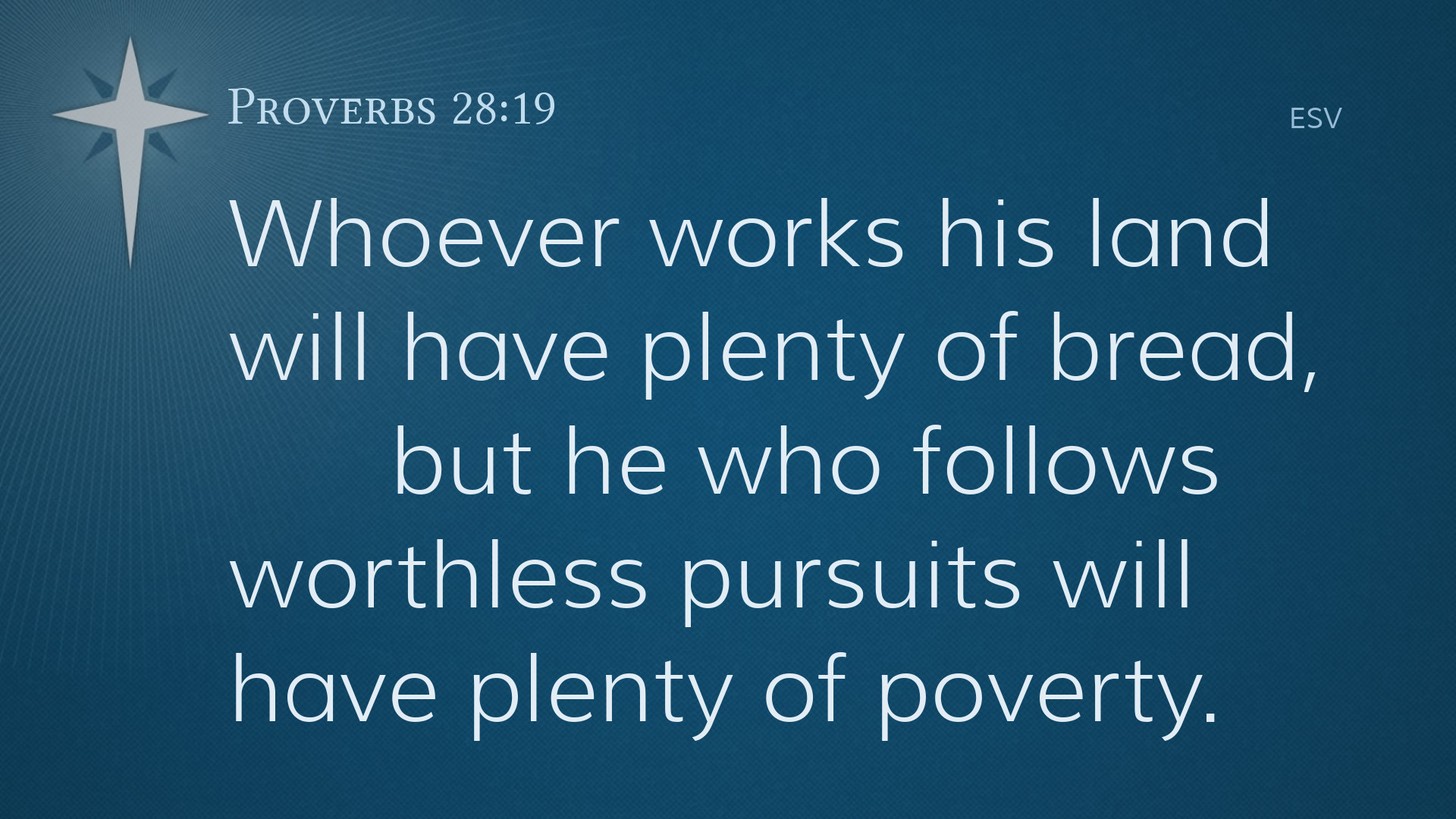
19-20 / Get rich schemes are anything but. They are contrary to God’s normative means of giving us prosperity WITH character. To want to be rich by means of a shortcut, is to reveal our greed. To want to waste our time in things which hold no true value – is to prevent our own selves from the very things we need and desire. These two always go hand in hand.
But this is not restricted to material things. It is just as true in spiritual matters. The one who will not apply him or herself to know the Word and seek God’s face will have a lean soul – period. We cannot ignore spiritual disciplines, and then hope to walk in the benefits of such as though they are somehow just dropped upon us from the sky. If we work hard at it, we’ll enjoy the fruit. If not, we will be impoverished.
Now the caution here against worthless pursuits can apply equally to those simply in pursuit of earthly riches, security, fame etc., and those who even as Christians pursue doctrine and spiritual experiences like hobbies.
I once knew a man, a good and earnest man, who loved the Lord and longed to teach His Word, but who also gave himself to countless hours trying to connect the Great Pyramid of Egypt to Biblical truth. Endlessly looking for hidden signs and symbols. Fascinated with arcane and supposed prophetic tie-ins. And in the meantime, paying less attention to understanding The Word better, and seeking to grow in the image of Christ. It all had the veneer of “spiritual” pursuit, but it ended in nothing of true value for the soul. In the end it was fruitless curiosity.
How many Believers today are immersed in seeking out secret conspiracies, shadow governments and hidden, nearly all-powerful cabals? Looking for secret prophetic knowledge. Investing all sorts of time, energy and angst prying out information they can ultimately do nothing about, and have no eternal, spiritual reward whatever.
How we need to re-calibrate our hearts and minds to be fixed on the truth of God’s Word, and anchored in His plans and purposes. Investing ourselves in the pursuit and building of His Kingdom. “Seek first the kingdom of God and His righteousness.” Once we’ve mastered that, then maybe we can move on to curiosities of all sorts. But until then, let us be about knowing and pursuing the Father’s business.
Work with what God HAS given to you, rather than pining after and chasing what He hasn’t. There is fruitfulness in His appointments.
And there is unfathomable fruit and blessing in pursuits that have eternal benefits.
Seek Christ! Col. 2:1-3 “For I want you to know how great a struggle I have for you and for those at Laodicea and for all who have not seen me face to face, that their hearts may be encouraged, being knit together in love, to reach all the riches of full assurance of understanding and the knowledge of God’s mystery, which is Christ, in whom are hidden all the treasures of wisdom and knowledge.”
        The plans of ethe diligent lead surely to abundance,
  but everyone who is hasty comes only to poverty. Proverbs 21:5
Let me share a painful truth with you: There is no shortcut to spiritual maturity.
None.
I know I want it to be otherwise. But this is the plain truth.
As is so often the case in Proverbs, some axioms are repeated over and over, and in different ways. So with this one. And in this case, there is an added dimension.
In the natural, I was what was termed in my day “a late bloomer.” And this brought problems with it.
Although I was somewhat bright (simply “precocious” might be a better word – I’m sure I thought I was brighter than I was) I was also emotionally very immature, even for my age.
Because I was a bit snappy, I started school what was probably a year too early. My parents should have kept me back a year. Though I think I was enrolled early to save my Mother’s sanity at home. One more year of me in the house would have driven her up the wall!
But I was bored. I didn’t see the relevance of anything I was being taught. And my report cards regularly bore the comment: “Reid is not working up to his potential.”
Yeah. My grey matter was sufficient. But my emotional maturity was too far behind to make a good mix.
School wasn’t fun.
I always wanted to be – or at least treated – older than I actually was. Which led me to inserting myself into conversations and situations above my paygrade. It made me a Grade A pain in the neck to my friends and family. Not to mention my teachers.
Maybe you too can remember back to when you wanted to be older than you were? Wanting to be big enough to ride certain rides at the amusement park. Anxious to get that driver’s license. Being old enough to stay home alone without a baby-sitter. Wanting to make your own decisions, etc.
Well that same phenomena replicates itself in the life of the Believer too.
We come into the spiritual life when we are born again, and we look around at those who were saints before us, and we want their experiences, their insights, their impact on others, and their seeming grasp of God, the Word and spiritual matters.
The problem is, there is only one way to get “older.” Time.
But, as I said above, there are no spiritual shortcuts to growth. Only time and the natural process will avail – and only these are desirable. So it is with our souls.
In fact, spiritual growth spurts are not even something to be desired – to grow in sudden, huge leaps.
Time with God, time letting the soul in Christ mature and let every aspect fully develop in balance and harmony. Time to learn God’s Word so as to handle it responsibly. Time to analyze your own heart in the light of the Scripture by the illumination of The Spirit. Time to reflect on past decisions. To consider what makes for spiritual maturity. Time to learn how to begin to master oneself in the power of the Spirit. Time to walk with God consistently so as to know His ways and providence. To cultivate spiritual habits and disciplines that lend themselves to solid growth.
Time.
If you are running from ministry to ministry and seminar to seminar hoping to have some instant miraculous experience which catapults you into spiritual maturity – stop! There is no such thing. You must walk the entire path with Him, you cannot simply be conformed to His image in a moment.
By the age of 12, Jesus Himself, the very Son of God, was more than able to hold His own with the teachers and the rabbi’s in the Temple. But He still remain under His parent’s authority, and didn’t enter into any kind of “ministry” until around 30.
So as Luke 2:52 reminds us: “And Jesus increased in wisdom and in stature and in favor with God and man.”
Yet how many new-Born Believers want instant ministry? And how many of us who have walked with the Lord, as still discouraged at our slow rate of growth?
One does not gain spiritual maturity by bestowal – it is by growth. One learns the Word by study, not osmosis. Faith grows in testing, not ease. Age, even in Christ comes by way of time, not sudden leaps forward. Diligence is what leads to abundance. Faithfulness is what perseveres long enough to reap the harvest. Yearning for Heaven makes a man order his steps to get there. Those who imagine they have it all now, or can get it all in a flash are fooling themselves. Such hastiness will only come to poverty.
Yes, it is true the writer to the Hebrews can chide some of his readers for not contributing to their own growth, and needing to get on the stick. At the same time, we are reminded of how patient Jesus was with His own disciples and their slow growth.
How much more with you and me?
Walk WITH Christ, do not try to cross the finish line while you are still in the starting gate.
In due time, you too will fully bear that image. You will “grow up into Him.” (Eph. 4:15)
In J.I. Packer’s excellent little book “God’s Plans for You” he opens Ch. 6 “How God Leads Us” like this: “Evangelicals differ from most Roman Catholics and liberals in that they are constantly uptight about guidance. No other concern commands more interest or arouses more anxiety among them nowadays than discovering the will of God.”
Packer then goes on to quote Joseph Bayly in a 1968 monograph: “If there is a serious concern among Christian students today, it is for guidance. Holiness may have been the passion of another generation’s Christian young men and women. Or soul-winning. Or evangelizing the world.… But not today. Today the theme is getting to know the will of God.” Packer, J. I. 2001. God’s Plans for You. Wheaton, IL: Crossway Books.
It is my experience that Packer and Bayly are both right. This is a huge issue. And maybe, just maybe, more than it ought to, or need to be.
In that regard then, I’d like us to briefly consider the events of Acts 15 and the Council at Jerusalem.
The setting is clear. vs. 1 says that some men from Judea, had gone to the largely Gentile church in Antioch telling the new Believers that unless they were circumcised in conformity to the Mosaic law, they couldn’t be saved.”
Naturally, this created quite the concern. Not simply due to the practical realities, but what impact this had on the Gospel. Paul and Barnabas vigorously confronted the issue. The text says there was “no small dissension and debate.” A right proper brouhaha broke out. With the result that Paul and Barnabas were sent to Jerusalem to put the matter before the apostles and elders there.
This is where what went on in the Council becomes interesting and I believe instructive to us.
Let’s recap the Council. It has a lot to say about the natural progression of spiritual maturity.
So, how did this group proceed to ascertain the Lord’s mind and leading on what was before them?
1 – (v 6) The apostles and elders got together to consider it.
2 – (vss 7-9) Peter stands up and appeals to his being led to preach to the Gentiles, but does not see even his extraordinary vision as definitive. What he does appeal to is the providential outpouring of the Spirit that attended his ministry at Cornelius’ house.
3 – (vss 10-11) Peter argues theologically and with reason. He especially notes the unbearable burden of salvation by obeying the Law, and then appeals to the Gospel of grace they’ve all been preaching.
4 – (v 12) Paul and Barnabas reinforce the nature of God’s providential work among the Gentiles.
5 – (vss 13-21) First, James reasons from Peter’s and Paul’s activity, and then, how this confirms or fulfills the Old Testament prophecies. His appeal to Scripture is important. He then adds that the Word will still have its impact on Believers.
6 – (vss 25 & 28) They write a group letter to the Antiochene church. The letter appeals to 3 things. a. Their arriving at consensus after discussion & debate; b. Examination of God’s providential acts; c. The verification of the Scriptures. This is termed as seeming “good to the Holy Spirit and to us.”
Now hold on to your hat. Because what is missing here is as important, maybe even more so, that what is included.
What is missing?
No vision. Here is this most important issue, striking at the very heart of the Gospel itself, and no one among the apostles, prophets and elders – gets a vision to settle the matter. No one.
No “leading”. No one just stood up and said “I feel led.” And the whole group then saying “o well then, if you feel led – let’s…”
There was no supernatural sign. No attesting miracle or anything of the like from anyone EVEN THE MOST EMINENT APOSTLES. No one said: “God told me” as definitive.
Note then, how as the church matures, calling upon God given reason informed by the Scriptures, with the counsel of others operating similarly, and confirmed in providence becomes the norm above immediate impressions or revelations.
This is vitally important. Let me repeat it.
Calling upon God – given reason informed by the Scriptures – with the counsel of others – and confirmation in providence – THIS becomes the norm over immediate impression or revelations.
Note also that the Bible does not record a litany of individuals being “led” supernaturally in personal matters – but only where there is something pivotal regarding redemptive history for the Church. It simply is not the Biblical pattern. Where key events in the Redemptive history and progress of the Church at large are at stake, yes, visions like Peter’s on the roof in Joppa occured. But here, we’re told how that event was central to opening Gospel mission to the Gentiles. It wasn’t an every day occurrence, nor was it repeated.
Note how such leadings decline the more the Word is ingested and people reason in wisdom out of God’s Word, in conference with God’s people, and in concert with providential markers. These grow fewer and fewer as the narrative of Acts proceeds.
And note too how impulses are never to be given the force of a MANDATE. To do so, puts them on par with Scripture and creates new sins which the Bible knows nothing about. For if someone fails to do what is mandated by God, such failure can be nothing other than sin, but one not applicable to any other but yourself. An entirely new category of sin is created. The individual “God told me” but I did not obey – which is not applicable to the Church at large.
Note lastly: The more a relationship matures, the less directives are needed, and the more communication shifts to fellowship.
The better I know my boss’s goals and desires, the less I have to ask for specifics, and the more I can carry out his business freely.
The better a child knows the ways and desires of the parent and matures in terms of what is good versus what is bad or harmful, the less rules are needed, and the more the child lives on the principles. We move from precept to principle as we mature. It is this way in sanctification, and this way in growing in the Spirit.
Things like God’s manifestations on Sinai are for the immature and again at pivotal moments. Once things are spoken there, the less He speaks in the same way. Once the Law was given, the Israelites did not need to go to Mt. Sinai every morning for fresh revelations. They had what He had written.
The pillar of cloud and fire disappear once they come into the promised land. They are no less led, but know that their mandate is to conquer – they are no longer wandering. Such leading signs are indicative of immaturity, earlier stages in growth and wandering, not maturity and entering into what God has sent us to do.
The supernatural manna ceases as soon as they enter the promised land, and now they are to cultivate food and feed themselves. They are no less dependent upon God, but have entered into a more mature relationship which assumes they be about God’s business, rather than looking for new leadings.
As Deuteronomy 29:29 reminds us: “The secret things belong to the Lord our God, but the things that are revealed belong to us and to our children forever, that we may do all the words of this law.”
Does the Spirit prompt and guide? Surely. But first and foremost through His Word, then in Providence, God given propensities, wise counsel, etc. Believers are not doomed to live constantly trying to divine God’s secret will for their individual circumstances. We are so much freer than that.
There is so much more to say, but I’ll leave it here for now. Give yourself to what God has revealed already, and trust Him in what He hasn’t.
It has been my experience, that I most often find out I’ve been “led” in the aftermath of something when it has come to pass – not before. It just might be that way most often period. After all, we walk by faith, not by sight. Needing a leading, is needing some form of sight.
“Let your eyes look directly forward, and your gaze be straight before you. Ponder the path of your feet; then all your ways will be sure. Do not swerve to the right or to the left; turn your foot away from evil.” (Prov. 4:25-27)
When contemplating any course of action, it only makes sense to ask: “Where will this take me? What is the end of what I am contemplating?” In either word or deed.
But of course, this also begs the question of whether or not I am on my way to anywhere at all?
If one were to pursue a career as a lawyer – they would plot out a course that would take them there. The right undergraduate courses in college, and then Law School. Then setting their sights on passing the Bar, and then – only then – the practice of Law itself.
It is the same with anything in life. To be a teacher, a race car driver, an electrician – name it.
But, as the old saying goes, if you aim at nothing, you’ll hit it – too.
Setting a course in the natural is one thing – but how many actually contemplate setting a course toward Heaven?
Do we imagine we will just stumble in there someday? That “being” a Christian is the end game, the goal itself? Do we forget Jesus words: Matthew 7:13–14 (ESV) — “Enter by the narrow gate. For the gate is wide and the way is easy that leads to destruction, and those who enter by it are many. For the gate is narrow and the way is hard that leads to life, and those who find it are few.”
Nobody just wakes up in Heaven someday and says “whew! I made it.”
Why do so few find it? Why do so few enter in? Because so few are actually looking for it and seeking to enter in.
If you are aiming at entering heaven, keep your eyes on that destination, and make the decisions which coincide with going there. Keep looking for the door of that Great City. Keep your eyes fixed on what you intend to do and be there – and who you are longing to spend eternity with.
No one will get there by accident. Only those who inquire as to The Way – Jesus – and who order their lives to go there to be with Him and the Father.
Where are you headed?
In this case, Siri can’t help you. Only Jesus can. For as He told us: “I am the way, and the truth, and the life. No one comes to the Father except through me.” (John 14:6)
Where was He going? To the Father. By way of the Cross.
What is the way so we can go too? Through Him. Only through Him.
Matt. 16:24: “Then Jesus told his disciples, “If anyone would come after me, let him deny himself and take up his cross and follow me.”
And by grace, He is still issuing that call today.
About 20 years ago, I had the joy of teaching some classes in a Christian school on Worldview. I really had fun. Along with my classes – which were mostly seniors – I got to speak in chapel from time to time to the entire student body. One of those times was especially memorable to me.
I chose as my topic for that chapel, how to “Cult-proof” yourself. Five things which if you stick to, will keep one from being sucked into actual cults (i.e. Jehovah’s Witnesses, Mormonism, Children of God, etc.); cultish or cult like Christian Churches or ministries; and all false religions to boot.
A pretty high claim I know. But I still stand by it.
What were those 5 things? The simple and so-called “Five Solas” of the Reformation. I didn’t invent them. But they have stood the test of time, and are as relevant now as ever. Maybe more so in an age of the wild proliferation of religious sects, and organizations like NXIVM, Scientology, Multi-level-marketing schemes, extreme breast-feeding (yes, it’s a real thing), separatists and Preppers, on and on.
1 – Sola Scriptura: Standing on the Word of God as the final authority in all matters of life and faith, especially in opposition to dreams, visions, experiences teachings and writings as located in one’s self, or another’s person or personality.
Sola Scriptura does not mean we ignore Church history, nor the teachers and preachers God has gifted His Church with throughout the ages. But it does mean we sift everything through the careful, systematic sieve of the Bible’s teaching. That we and those we listen to are held to the scrutiny of sound principles of Biblical interpretation. Requiring that doctrines and teachings are neither contrary to “the faith that was once for all delivered to the saints.” (Jude 3) Note – already in place by the closing of the New Testament canon; nor invented out of whole cloth, privately interpreted or dependent upon wild or unique applications of obscure passages.
All those claiming to have some new or secret revelation are to be dismissed out of hand. “To the teaching and to the testimony! If they will not speak according to this word, it is because they have no dawn.” (Isa. 8:20)
It is in the Scriptures alone, that we find that we are saved by –
2 – Sola Gratia – grace alone.
Every false group, EVERY false group, no matter how seemingly orthodox, will make salvation and reconciliation to God, dependent in some way on receiving their unique teaching or brand and some form of human merit as prescribed by them. Performance in their eyes. Not the reception of free grace. Do this, don’t do that, in order to make yourself worthy as they imagine it.
Run! You can do NOTHING to make yourself worthy of salvation in the least bit. As Luther once said, we bring absolutely nothing to the table but the sin that makes our salvation necessary. Salvation has nothing to do with our worthiness, but of Christ’s. He saves the unworthy. Only the unworthy. When we inject any personal worthiness into the equation – we either say that Jesus’ righteousness imputed to us is not enough, or that we can somehow do something He couldn’t. It is a lie. Eph. 2:8-9 “For by grace you have been saved through faith. And this is not your own doing; it is the gift of God, not a result of works, so that no one may boast.”
3 – Sola Fide – by Faith alone. The Bible also teaches us that salvation and right standing with God is received by faith alone, apart from any human effort. We always receive it as opposed to making it happen. We can never do enough. But every aberrant group will have you jumping through hoops – and never answering the question “how much is enough?”
As the passage just quoted says – “by grace you have been saved through faith.” Believing what God has said in His Word is true, and obeying the Gospel by believing and resting upon Christ and His finished work on our behalf. When those in John 6 asked Jesus what they must be doing to do the works of God – He answered: “This is the work of God, that you believe in Him whom He has sent.”
On the “mount of transfiguration”, the voice of the Father was heard as Jesus stood with Moses (representative of the Old Testament Law) and Elijah (representative of the Old Testament prophets), the text says: “He was still speaking when, behold, a bright cloud overshadowed them, and a voice from the cloud said, “This is my beloved Son, with whom I am well pleased; listen to him.” (Matt. 17:5) He is the fulfillment of all the Law and the Prophets, so that Paul can write: “Indeed, I count everything as loss because of the surpassing worth of knowing Christ Jesus my Lord. For his sake I have suffered the loss of all things and count them as rubbish, in order that I may gain Christ and be found in him, not having a righteousness of my own that comes from the law, but that which comes through faith in Christ, the righteousness from God that depends on faith.” Phil. 3:8-9.
4 – Solus Christus – We are saved by Christ alone. We are not saved by a doctrine, a creed, nor an association with any group or person other than being found in Christ by faith. He alone saves us from the wrath to come on all human sin.
He is the one who died in the place of sinners. He alone atoned for human sin. He alone was God incarnate. He alone fulfilled all the Law required. He alone fulfilled the Scriptures. He alone died, was buried, rose again and stands at the right hand of the Father on high. He alone has the power to forgive sins. He alone will come to mete out final judgment on those who remain in their rebellion against Him, and reward the saints who have put their trust in Him. He alone will raise us from the dead.
5 – Soli Deo Gloria – All of this is to the glory of God alone.
Nothing was more important to Christ Jesus than that the cosmos would come to honor, love and revere the Father as He did. So it is when teaching us to pray, the first thing on His mind is that we seek that His name be hallowed, be restored to its rightful place. God has done all things for His own glory.
And what is this glory? Is it some sort of divine ego trip? No! God can bless us with nothing greater than revelations of Himself – for He is the source of all goodness, beauty, justice, glory, sweetness, wonder, pleasure and holiness. He can give us nothing higher than Himself. And all He needs to be glorified, is to be revealed. And where is He best revealed? “For God, who said, “Let light shine out of darkness,” has shone in our hearts to give the light of the knowledge of the glory of God in the face of Jesus Christ.” 2 Cor. 4:6.
After the chapel where I shared this, a young man, dressed in all black, complete with a full-length leather coat and stegosaurus spiked hair came up to me, holding up his hand with the five fingers splayed said “Cool!” He had written one sola on each finger in permanent marker. Then, make up and all he said: “I’ll bet you sing hymns in your church, don’t you.” I said yes. And he said: “I wish they did at my church.” Then he turned and walked away. He was so hungry. But he was not being fed this kind of truth in his home Church.
We’ve been examining the Lord’s Prayer of Matthew 6, under the picture of tuning a six stringed instrument – the heart. And we’ve seen how these all resonate with one another so that the whole man is brought into harmony with God’s glorious nature, plans and purposes. Nothing is of greater use in this regard. It is the epitome of being “godly minded”. As Romans 8:6 tells us – “to set the mind on the flesh is death, but to set the mind on the Spirit is life and peace.” This is the most wonderful means of setting the mind on the Spirit, leading to life and peace.
In this last installment – let me play off of the tuning metaphor just a bit more. For at the very beginning of the prayer are 2 words, that act (if you will) as the two prongs of the tuning fork to serve as our key reference point. 2 words of such power, grace and wonder, that sometimes, having prayed just these – one has prayed astonishingly: “Our Father.”
Our Father.
Can there be anything more amazing to the Believer (and make no mistake, these words can only be uttered in truth by one who has been born again by the power of the Spirit) than these two realities in framing prayer?
First, “Our.”
As you’ve no doubt noted, every pronoun but those specific to the Father in this prayer is in the plural. Our, Father, not just “my” Father. Give “us” this day. Forgive “us” our debts as “we” forgive. Lead “us” not into temptation. Deliver “us” from evil.
Prayer is never a wholly solitary thing, because we have been joined together with all those in Christ by faith into one body. We are a mystically unified whole. I cannot sin without it impacting the whole, nor can you. And I cannot pray or grow in Christ’s likeness without it impacting the whole. We are part of one another, and what affects and impacts us singly, reverberates throughout. It is why we pray with one another in mind: Romans 12:5 “so we, though many, are one body in Christ, and individually members one of another.”
When we pray these things beloved, we are entering into ministry to all our brothers and sisters in Christ. Never alone. This is a most sweet and wonderful reality. It will change all of your praying forever.
But secondly in this first word, is not only that we are one with each other in Christ – the “our” here includes Jesus Himself! Think on this for a moment. By virtue of the new birth, and the wonder of adoption into the family of God, Jesus teaches us to pray “Our Father” – His and mine. His and yours. His and ours. We pray as true children of the living God, with as much right of access and guaranteed as much a hearing as the very Son of God Himself.
Prayer isn’t some mere earthly religious activity – it is cosmic glory!
O that we could just soak in that for a while, but I must press to finish.
The second prong of the tuning fork then, as already hinted at is bound up in the word “Father.”
Our – Father.
There is no need to heap up multiple adjectives to try and butter up a distant deity. In Romans 8, Paul tells us that we have been given the Spirit of sonship. Romans 8:12–21 “So then, brothers, we are debtors, not to the flesh, to live according to the flesh. For if you live according to the flesh you will die, but if by the Spirit you put to death the deeds of the body, you will live. For all who are led by the Spirit of God are sons of God. For you did not receive the spirit of slavery to fall back into fear, but you have received the Spirit of adoption as sons, by whom we cry, “Abba! Father!” The Spirit himself bears witness with our spirit that we are children of God, and if children, then heirs—heirs of God and fellow heirs with Christ.”
When we pray, we come to a loving, gentle, kind, merciful, patient, perfect Father. Creator God indeed, but also our true Father.
As Sinclair Ferguson writes in his book “The Holy Spirit”: “The fact is that the Christian’s own spirit does display an awareness of sonship, as the rest of the New Testament makes clear (e.g. 1 Jn. 3:1ff.), amazing though this is. The problem is that this awareness is often weakened, and God’s children may even find themselves doubting their gracious status and privileges. What Paul is saying, however, is that even in the darkest hour there is a co-operative and affirmative testimony given by the Spirit. It is found in the very fact that, although he may be broken and bruised, tossed about with fears and doubts, the child of God nevertheless in his need cries out, ‘Father!’ as instinctively as a child who has fallen and been hurt calls out in similar language, ‘Daddy, help me!’ Assurance of sonship is not reserved for the highly sanctified Christian; it is the birthright of even the weakest and most oppressed believer. This is its glory.”
Our, Father.
This is the bedrock of all true prayer. Children coming to the one they know loves them best, who cannot err in judgement, who binds up all their wounds, who gave His own Son to die in their place that He might purchase them back from their slavery to sin, whose compassion and patience and love are beyond all knowing.
Just sit and meditate on those two words for a minute or two before seeking Him for anything else, and see if your heart is not melted, and if you are not assured that He already knows you deepest cares and concerns – and has designed to meet them with infallible wisdom and in perfect time.
If, as a true believer, the only thing you can gasp out is “Our Father” – you have prayed well, in that you have looked to Him and trusted Him with all, in true relationship – because of Christ.
The Lord’s Prayer. It is no mere side-note that Jesus includes this section in His “sermon on the mount.” The entire sermon is built around the essentials, the foundations of The Kingdom. We could outline it one way like this:
1 – 5:1-12 / The Citizens of the Kingdom – Blessed
2 – 5:13-16 / The Role of the Citizens of the Kingdom in this present age – Salt and Light
3 – 5:17-48 / The Character of the Kingdom and its Citizens – The Righteousness of God (not their own)
4 – 6:1-24 / The Life of Service in the Kingdom – Living unto the Father, not men
Alms / Fasting / Prayer / Treasure in Heaven
5 – 6:25-34 / The Sufficiency of the Kingdom – Delivered from the anxiety of this present age
6 – 7: 1-5 / The Humility of the Kingdom – Uncritically, Brother with brother
7 – 7:6 / The Otherness of the Kingdom – Preciousness and Contrariness
8 – 7:7-12 / The Privilege of the Kingdom – Access to the Father
9 – 7:13, 14 / The Entrance to the Kingdom – The Narrow Way & Gate – Christ
10 – 7:15-27 / The Integrity of the Kingdom – Doers and Hearers
Prayer then is an integral and necessary part of living the Christian life as unto God – while in the World. We are to be people of compassion regarding the needs of those around us (alms); seeking the Lord in our being burdened over sin’s destructive impact, and exercising the self-control of The Spirit (fasting); and bringing the whole of our hearts and minds into harmony with the purposes and plans of God – prayer.
And in fleshing out a fully orbed prayer life, we consider the greatest of cosmic needs – the restoration of the Father’s name and dignity; the desire for His rule and reign in Christ over all to be manifest; His will to be done as the sweetest of all possible outcomes; utter dependency upon Him; continual cleansing from the defilements of sin so as to maintain the closest, unimpeded fellowship with Him and others in our own forgiveness; and seeking to be led only in paths of righteousness for His name’s sake.
It is this last petition we consider today: “Lead us not into temptation, but deliver us from evil.”
While some have read this as a guard against the possibility that He might lead us into sin if we do not pray so – that is certainly not the thought here. We know this due to passages like James 1:13 “Let no one say when he is tempted, “I am being tempted by God,” for God cannot be tempted with evil, and he himself tempts no one.”
What then is this petition about? It is about mistrust of self. Of recognizing that we are weak, and that we stumble so easily into sin, that we need His constant watchfulness and deliverance, or we will be given over to our sins in a moment. For as Proverbs 21:2 reminds us – “Every way of a man is right in his own eyes.”
Even Believers tend to trust our own impulses and judgments. We seldom are very thoughtful in examining our own motives and perspectives. We tend to always give ourselves the benefit of the doubt. The benefit we tend to deny others.
Unfortunately, in present day American Evangelicalism, the “God wants you to achieve your dreams” mentality has crept in so that He has almost become an assistant to us, and not we His servants. If I have a dream, a desire, an aspiration, it is automatically baptized as good and right, and it is only fitting that God should help me get there. Whether or not that dream is best for me, more – best for His Kingdom, plans and purposes – seems at best, incidental. What it might have to do with conforming me to the image of Christ is not even considered.
But here, at the end of this majestic and glorious way of praying, Christ enjoins us to stop and consider our weaknesses, shortsightedness and sin-impacted reasoning. To submit all to Him that we might walk only in what is in perfect harmony with His own righteousness. To come again to the foot of the Cross, boasting in nothing but His mercy and grace, and recognizing the tendency so aptly put in the 3rd stanza of Come Thou Fount:
Prone to wander, Lord, I feel it;
Prone to leave the God I love:
Take my heart, oh, take and seal it
With Thy Spirit from above.
Rescued thus from sin and danger,
Purchased by the Savior’s blood,
May I walk on earth a stranger,
As a son and heir of God.
For we are never more in tune with our God, than when we live in the reality of: “Nothing in my hands I bring; simply to thy cross I cling.”
From: Matthew 6:12 “and forgive us our debts, as we also have forgiven our debtors.” and 6:14–15 “For if you forgive others their trespasses, your heavenly Father will also forgive you, but if you do not forgive others their trespasses, neither will your Father forgive your trespasses.”
Forgiveness isn’t a simple matter.
No one who has ever been truly hurt by another or betrayed knows this well. Hurts remain. Sometimes they are but bruises which heal in time, and sometimes they are deep wounds which leave big, ugly scars. How do we forgive the unrepentant? DO we forgive the unrepentant? What do either of those look like? Does forgiveness remove all personal responsibility? Does forgiveness mean we just ignore the past? Does forgiveness mean we extend unexamined trust in the future?
Like I said, forgiveness isn’t a simple matter.
All that needs to be said about forgiveness isn’t unpacked in these few verses either. But what is here, we need to consider carefully. Because as Jesus’ words indicate, for the Believer, our experiences of forgiveness and of being forgiven are tied together in some capacity.
Let’s consider some of the implications laid out for us here.
1 – Note first in context, that this need for forgiveness of others is directly connected to being led out of temptation.
The petition to be spared from temptation in vs. 13 comes directly on the heels of asking for forgiveness. That’s not an accident.
I don’t know about you, but if there is any place where I am weak and fall so easily into temptation, it is in the area of letting offenses go – of forgiving others.
If the truth be told, many of us like to hold on to our grievances. We want to stay hurt – and to hold something against those who sin against us. In our twisted sinfulness, it gives us a perverse sense of power over the other. They hurt us and we had no power to defend ourselves – so we’ll hang on to their guilt and not let them off the hook for anything.
It makes no sense. Our lack of forgiving them doesn’t actually hurt them back. It doesn’t even the score. It just makes us miserable and bitter. But it deceives us into thinking we have some sort of power over those who injured us. It is a lie.
And what comes along with our unforgiveness is this: Nothing kills the true spirit of prayer more than a hard heart toward others while we are seeking God’s tenderheartedness toward us. Such is the heart of hypocrisy.
As J.C. Ryle noted so rightly on this point: “The plain object of it is, to remind us that we must not expect our prayers for forgiveness to be heard, if we pray with malice and spite in our hearts towards others. To pray in such a frame of mind is mere formality and hypocrisy. It is even worse than hypocrisy. It is as much as saying, “Do not forgive me at all.” Our prayer is nothing without charity. We must not expect to be forgiven, if we cannot forgive.” (Ryle’s Expository Thoughts on Matthew, 6:9-15)
How often, we’d rather hang on to our hurt than be disabused of our hypocrisy. We’d rather muse on their sins against us, than wonder at the glory of our sins forgiven in Christ. We’d rather lick our wounds, than feast at the table of His abundant grace.
Stupid. But then, sin always is.
2 – Second, law cannot forgive, law can only mete out justice.
At times the law may pardon, but it cannot forgive, because forgiveness is personal. Jesus is calling us to forgiveness, not just pardon.
In a pardon, the perpetrator walks free, but there is no concern for personal reconciliation. You go your way and I’ll go mine, and never the twain shall meet.
Now don’t get me wrong, sometimes true reconciliation can’t be accomplished. Rom. 9 calls us to live at peace with others, as much as it depends upon us. But some do not want to live at peace with us. So be it. We’re not responsible for how others respond. But there is always a desire in the heart of the Believer that a true peace between us can be reached, even if there are extenuating circumstances which will not allow for things to go back the way they were. An abandoning spouse who goes and marries another, can never return to the one they left at first. But there can be peace between them.
3 – Forgiveness is not forgetfulness.
This is so often misconstrued by absolutizing a verse like Isaiah 43:25 ““I, I am he who blots out your transgressions for my own sake, and I will not remember your sins” – as though God is possessed of some form of divine amnesia.
We know that isn’t what the passage is saying, when we consider that it is part of a pronouncement where God is recounting Israel’s sins! The sins of many of the saints fill the pages of Scripture.
The idea here is that in reconciliation, He no longer remembers our past sins against us. That He remits His right of recompense. For He was recompensed for our sins, fully, in Jesus.
Two parties may pardon one another but still not be reconciled. But in forgiveness, personal reconciliation is the goal. And in absolute justice, a declaration of innocence is indispensable.
In Christ, all of these are met. He takes our sin and we His righteousness. The Father personally forgives. In His sovereign authority He pardons. And in grace He imputes righteousness that we may be rewarded.
3 – Third, we must be aware that God does not forgive at the expense of justice, and thus He does not require us to do more than that and forgive without regard to justice either. When He forgives, He does so on the basis of the atonement made in Christ where justice is meted out in full.
So it is, when we forgive, we give up our right to prosecute the matter on our own behalf, surrendering the justice needed into the hands of the Father. We do not deny justice altogether but willingly suffer a particular loss in treating the individual as no longer an offender, while committing justice into the Father’s hands.
Yet, while forgiving sets aside any personal vengeance, it does not ignore what might be needed in loving our neighbors as ourselves and protecting them, and, if needed, getting the authorities involved.
Forgiveness only has reference to my right and requirement to be made whole in the aftermath of being sinned against. But I cannot forgive for others. I have no right to leave my neighbor in danger if the perpetrator I’ve forgiven is still at large and still poses a danger to them. My love for my neighbor requires I act in their best interest.
4 – Fourth, note too as above, that some offenses are purely personal – and others have several dimensions to to them.
Some offenses cross over into crimes and are sins against the State or others as well. I have no right to usurp the State’s, nor anyone else’s authority and forgive on either’s behalf. The offender may well still need to face that reality beyond my sphere of forgiveness.
Overstating forgiveness is as dangerous as understating it.
I must forgive when it is in my power and within my sphere, but I cannot and must not usurp that issue on behalf of any other entity. I can only forgive for myself alone. And I do so, committing it all to the Father’s just disposal.
On the cross, Jesus can forgive His tormentors for Himself, but note how He prays that the Father would forgive them. For He cannot overstep in the issue of His Father’s offense. This, He appeals to the Father for. And when we forgive, we do well to follow suit. We too can pray – “Father, lay nothing to the charge of their account on my behalf.” How He may deal otherwise is up to Him.
5 – Fifth, note too how Jesus cannot and will not usurp the Spirit’s own sphere and pretend to forgive blasphemy against Him.
The unpardonable sin as it is called – is against the Holy Spirit. And Jesus simply says it will not be forgiven. Ever. He does not say it cannot, but that it will not. God refuses.
6 – Lastly, note how there is a difference between forgiveness in restoring relationship, vs. simple offenses from strangers where there is no relationship to restore. And how it is Christ does all of this in regard to our sins against Him. For if you forgive others their trespasses, your heavenly Father will also forgive you, but if you do not forgive others their trespasses, neither will your Father forgive your trespasses.
We must always remember that Believers forgive out of the boundless ocean of the forgiveness we have received in Christ.
Ps. 103:8-14 “The LORD is merciful and gracious, slow to anger and abounding in steadfast love. He will not always chide, nor will he keep his anger forever. He does not deal with us according to our sins, nor repay us according to our iniquities. For as high as the heavens are above the earth, so great is his steadfast love toward those who fear him; as far as the east is from the west, so far does he remove our transgressions from us. As a father shows compassion to his children, so the LORD shows compassion to those who fear him. For he knows our frame; he remembers that we are dust.”





 ResponsiveReiding