“Swinging for the fences” is a baseball term. It embodies the idea of the batter swinging the bat with all his might every time he steps up to the plate – always aiming at hitting a home run if possible. In baseball, I suppose it is a useful and universally true maxim. But it might not be the best metaphor in other places – such as preaching.
In both my own experience and in conversation with others – those of us who preach and teach come to realize pretty quickly in our endeavors that this preaching thing is a very strange beast to ride.
Most men I know want to do it well. We study. We critique ourselves (I hope). We seek outside critique (I hope even more). We prepare as best we can. We listen to others who we think do it well. We strive after maximum impact every time we step into the pulpit. We try hard. So far so good.
But this idea of swinging for the fences when we preach might need some examination.
For instance – what is our actual aim when we preach? And how are we measuring our success, or lack of it, in preaching? Compliments? Tears? “Whoosh” moments? Personal vigor? Congregational response while in the act? Email follow ups? Conversions? If we’ve swung for the fences, how do we know when we’ve hit the home run? How do we even define the home run?
All of us can probably remember a sermon or two, that looking back over time, have stuck with us. They’ve had a singular and lasting effect on us. They stand out. And we can want to preach that kind of sermon too. That’s not bad in and of itself in that we always hope to be effective. But I want to argue that if we locate our effectiveness in hitting sermonic home runs – we might need to rethink some things. Not the least of which is – especially as pastors – preaching and teaching the same congregation year in and year out. Unless there is an unusual move of God, extraordinary actually, our people are not going to leave each week saying “Wow! That’s the best thing I’ve ever heard – my life is changed forever.”
Not gonna happen. Not gonna happen.
May I suggest to you that the fences we need to be swinging for are located more in faithfulness to the text, than in anything else. That we hit the home run when we best preach what the text is getting at. When the Biblical point of the passage is brought home with as much clarity as possible. And that, irrespective of the subjective responses – our own OR other’s. Feelings aside.
In fact, what I am driving at most in this short missive is the idea that Jesus pressed on Peter in John 21:15-17 – “feed my lambs, tend my sheep, feed my sheep.”
In other words, our ministrations in the Word are first and foremost wrapped up in the daily, weekly, year after year – common feeding God’s people his provided means for their spiritual health and welfare.
Neither Anthony Bourdain (when he was alive), Wolfgang Puck, Rachael Ray, Giada De Laurentis, Bobby Flay, Jamie Oliver nor Gordon Ramsay ever imagines they will cook up and serve up a meal so transcendent that the ones eating it will never need another meal again as long as they live. It will instead be eaten, hopefully enjoyed, digested, and not to be indelicate – cast out into the draught.
So it is with our sermons. The home runs are not in singular sermonic events, but in the faithful preparing of that which nourishes the soul on a consistent and regular basis – a sound, spiritual diet. That alone sustains the soul. It is in the regular care and feeding of souls in the exposition of God’s Word that the game (if you will) is won.
My dear brother – feed his lambs, tend his sheep, feed his sheep. Take the superstar pressure off of yourself. Get up to bat in the pulpit each week swinging for these fences.
Be more concerned about regular scriptural and spiritual meals at home, than making a fast break for home plate.
In Jermiah 8:22, the prophet is groaning over the suffering of God’s people as a result of their sin. To make matters worse, he knows the cure to their ills, but they won’t take the physic.
Sometimes it is a hard pill to swallow, this medicine called repentance.
Jeremiah isn’t wondering out loud to God as to whether or not there is help to be found. No, he is crying out to his people to remember that there IS help to be found. That God delights to forgive and restore. There is indeed a balm, a soothing medicine for their woes. “Wake up! Is it because God hasn’t provided a balm for us that we smart so? Isn’t there help in what he has already given us in faith and repentance – in Gilead?” In the proverbial place that represents God’s lush and full promises.
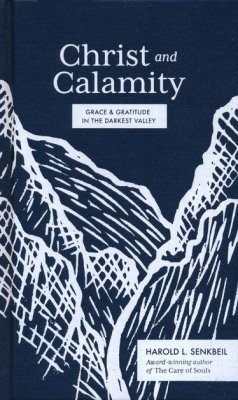
We however, use this phrase differently most times. We tend to cry it out in times of suffering and distress. After long seasons of suffering, pain, confusion, doubt and trial, we might question – “do you see and feel my pain God? And is there no healing medicine to be found?” I’ve been there. Maybe you have been too. Maybe you are there right now. And it is why I recommend this little but powerful book to you – Christ and Calamity: Grace & Gratitude in the Darkest Valley by HAROLD L. SENKBEIL
Harold Senkbeil, former pastor and Associate Professor of Pastoral Ministry and Missions at Concordia Theological Seminary has written one of the sweetest, Christ centered and useful books for Christians in calamity I’ve ever read. I will read it again. And I will send copies of it to a number of people.
Senkbeil does not write from an ivory tower. Chapter 1 begins this way: “Calamity is everywhere around us. But recently it came home to roost at my house. My wife, Jane, whose health had been declining for decades, was hospitalized twice in the middle of the covid pandemic, and then she was released on home hospice care. For the next fourteen months our lives became a slow slog toward the inevitable end. It wasn’t all horrible. We had the help of a caring hospice team, and we had each other. Best of all, we had the promises of a very gracious God.”
The book is brief, and can be easily be consumed in one or two sittings. But I would counsel you not to do that.
The very short 11 chapters are meant to be read more like a series of meditations. One a night seems best. For although his writing style is extremely accessible, the depth of each portion is hidden deceptively under his easy prose. But he is keenly aware that the soul in crisis cannot easily take in huge chunks of deep counsel. Sometimes medicine needs to be easy to sip rather than to gulp.
The contents run as follows:
Invitation to the Reader
Prayer in Time of Affliction
i Your Calamity
ii When You Are Faithless, Christ Is Your Faithfulness
iii When You Cry Out, Christ Is Your Advocate
iv When You Are Afflicted, Christ Is Your Comfort
v When You Bear Your Cross, Christ Is Your King
vi When You Are Weak, Christ Is Your Strength
vii When You Are Sad, Christ Is Your Joy
viii When You Are in Darkness, Christ Is Your Light
ix When You Are Alone, Christ Is with You
x When You Are Dying, Christ Is Your Life
xi Christ Is Your Victory
Invitation to Prayer
Prayer for Any Time
Prayer for Morning
Prayer for Evening
“Jesus, Priceless Treasure”
If I were to highlight the key features, the words which come most readily to mind are:
Readable.
Realistic.
Christ-centered.
Gentle.
Biblical.
Healing.
If you are one who is in crisis, or know someone who is, please minister to yourself or them by securing this exceptional work.
There is indeed a balm in Gilead. His name is Jesus. And Christian, he is with you in the midst of your storm.
Christ and Calamity: Grace & Gratitude in the Darkest Valley
Let’s revisit something we’ve considered somewhat before.
Sometimes when reading the Bible, we can be dismissive of things like genealogies and other things which seem to be of no importance. It is true, not every part of Scripture holds equal importance. Israel’s dietary laws don’t have quite the accessible impact of Genesis 1:1 or Rom. 1:16-17 “For I am not ashamed of the gospel, for it is the power of God for salvation to everyone who believes, to the Jew first and also to the Greek. For in it the righteousness of God is revealed from faith for faith, as it is written, “The righteous shall live by faith.”
But just because we do not catch the use of something right away doesn’t mean God was careless in including it. It just means we don’t get it yet. He does not speak superfluously.
So it is with this opening chapter of Matthew. In it, Matthew is establishing some foundational truths about the identity of Jesus that inform everything else in his Gospel. We don’t want to miss them.
Let me suggest just a few things here.
In the first place, Matthew is establishing Jesus’ authentic Jewishness.
In the 2nd place, Jesus’ lineage makes Him fit to sit on the throne of David, to be King of The Jews should they recognize Him as such.
So Matthew’s aim in this entire 1st chapter is to answer the question – Who is Jesus?
1 – vs. 1 / a. He is the King of Israel. God’s perfect ruler.
b. The Fullness of the promise given to Abraham in person.
2 – vss. 2-16 / In every way a partaker of our humanity. And yet without sin.
3 – vs. 17 / a. The Promise of the Father.
b. God’s Presence with us in our exile.
c. The Accomplish-er of our Salvation – our Messiah.
4 – vs. 18 A participant in our shame, without sin or shame of His own.
5 – vs. 19 / Undesired.
6 – vs. 20 / Unaccepted apart from divine revelation.
7 – vs. 21 / Savior.
In the third place, we see Jesus as descended from kings, scoundrels, nobodies, men, women, Jews, Gentiles, faithful, faithless, a prostitute, nomads, warriors, prophets, farmers, those who lived in ease, those who lived in poverty, those who accomplished much, those who left nothing behind but their names. The shunned and the accepted, the steadfast and the mercurial, the creative and the dull, intellectuals and uneducated commoners.
Christ Jesus came in the likeness and lineage of fallen, broken, sin-cursed humankind. There are none who cannot be touched by Him, nor reconciled to the Father through Him. The miracle of the incarnation. What a Savior!
A fun little musing on something we can’t know, doesn’t really matter, but might be somewhat useful.
We are curious critters. Sometimes that’s great, and sometimes it is a waste of time. And this is no less true for those of us who read and study and labor to understand the Scriptures. Especially when we spend too much time wondering about questions the Bible never sees fit to give us answers to.
What DID Jesus write on the ground in John 8 when the woman caught in adultery was brought to him?
What did Lazarus see or experience during his time in the grave?
What were the things Paul said he heard when he was caught up into paradise which “cannot be told, which man may not utter”?
And of course the main point we need to fix on is that if such things were necessary for us to know, no doubt our gracious Heavenly Father would have recorded them for us. He didn’t. So while we might find our curiosity a bit too piqued over such matters, we can confidently lay them aside until all will be revealed later.
But let me toss one more out to you. In the process, perhaps I might suggest a way we can make good use even of such nagging inquiries. The text that grabbed my thoughts today was Revelation 21:14 “And the wall of the city had twelve foundations, and on them were the twelve names of the twelve apostles of the Lamb.”
John is seeing this extraordinary vision of the New Jerusalem coming down out of heaven. In the process, he notes that at the 12 gates of the city, he saw inscribed the names of the 12 tribes of Israel. Then, he sees the 12 foundation stones on which were inscribed, the names of the 12 apostles of the Lamb. The inscriptions actually recorded 12 names, not just a reference to the 12.
So here’s the question: Was Judas’ name found on one of the stones? Or was his name perhaps replaced by Matthias as elected to take his place in Acts 1? Or was it perhaps Paul – as one “untimely born” (1 Cor. 15:8)?
Of the commentators who decide to weigh in on the question, most make no guess as to who it is, but tend to assert that it cannot be Judas for sure.
Here’s the fun part. But why not Judas? Why can’t Judas’ name be there?
The argument against his inclusion is obvious – he betrayed Jesus! He was an evil man! A satanically inspired traitor! We won’t have it.
OK, so think with me for a moment.
What of the 12 Tribes? Which of those stand out for their fidelity to God and his covenant? Who can even point to the piety of the 12 men from which the tribes derive their names? Were they good and upright and faithful? Didn’t the majority of the tribes end up irretrievably decimated by the Assyrians? And the other 2 – sent off into the Babylonian captivity. Were they some sterling examples?
I think not.
And what of the other apostles?
Impetuous, thrice-Christ-denying Peter. Doubting Thomas. The raging sons of thunder. Simon the Zealot? Yes, all but Judas recovered to serve their King magnificently. But even then, Peter’s little dust up in Antioch wasn’t exactly a shining moment.
Now am I suggesting that the others deserved this honor in a way Judas did not?
No.
What I am suggesting is that God makes trophies even out of his enemies. That by his grace and power, he uses even the most heinous and grotesque and wicked acts of men, to serve his great plans and purposes in Christ.
That in no wise justifies or excuses them, nor their actions in any way, shape or form. But what it does signal, is that in his sovereign glory, he could use the most singularly wicked man in all of history, to accomplish his pure, holy and wondrous ends in redemption. So much so, that he can demonstrate his holy supremacy by not having to sweep Judas under the rug – but permanently use him to memorialize his wonder, power and glory – his triumph over all.
Judas was there at the beginning. He was a part of the founding apostolic college. He was as much chosen as the others. He was sent out like the others. Jesus used him as much as the others. He was one of “the twelve.” And Christ is as glorified in his triumph over Judas’ wicked machinations as he is in triumphing over all sin and wickedness. And Judas’ name there, lets none of us forget how great Christ’s glory truly is, over all sin and darkness – even when manifested in its highest degree.
Is Judas’ name there? I don’t know. No one does. But if it is, what an eternal testimony to overcoming power of Christ in redeeming us. His kingdom is founded on his triumph over sin.
The word abomination as used in the Bible, refers to something that is loathsome, polluting, detestable. It is most often associated with the pagan religious practices of the nations God drove out before Israel. In the New Testament, especially in the Revelation, abomination is connected with the woman who rides “a scarlet beast”. She is denominated as “Babylon the great, mother of prostitutes and of earth’s abominations.” Babylon being the embodiment of the world system in opposition to God’s righteous rule – and all that comes from that opposition and rebellion.
But seldom do we see present day, practical and tangible examples of such abominations. Enter, my tenure serving as a local funeral home for several years in my younger days.
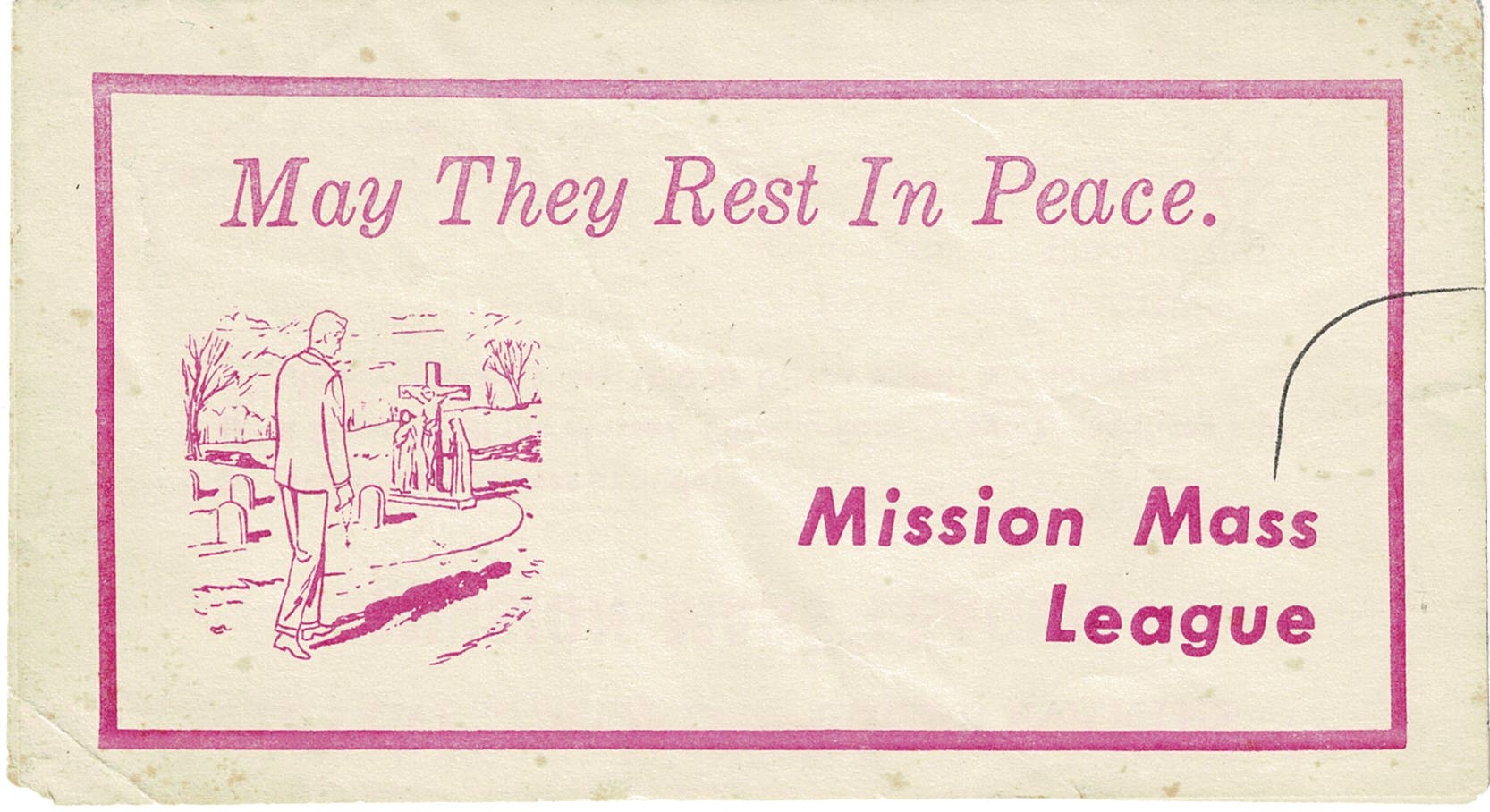
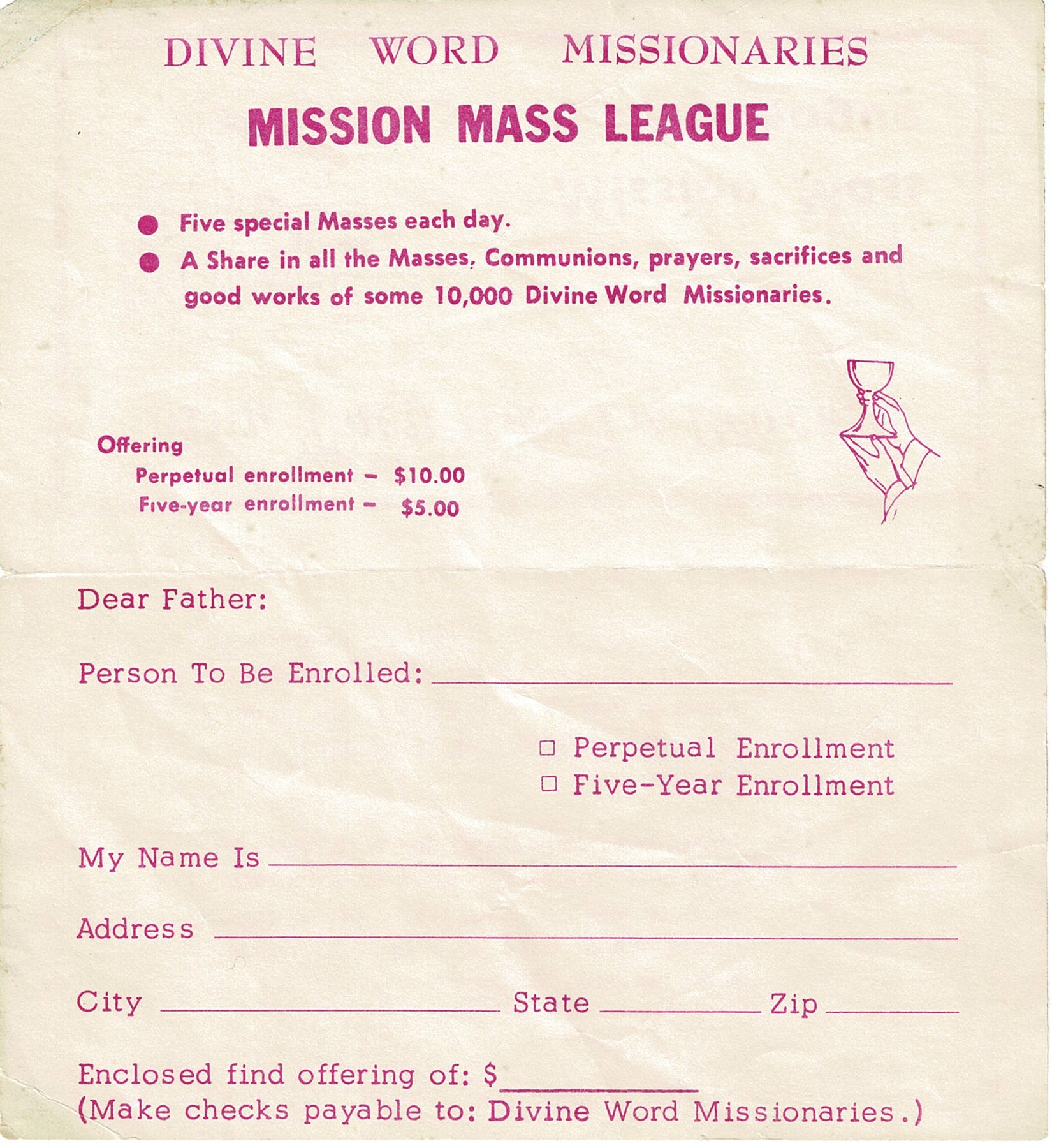
One of my responsibilities when working “calling hours” was to help people of a certain religious persuasion, process “Mass Cards.” These instruments, in varying denominations were secured with a donation to the society or group desired in the name of the deceased. Once “enrolled” – certain rites or services were then to be carried out either for a certain amount of time, or perpetually on behalf of the deceased.
Because few people from my background believed me when I made certain claims about this practice – the blatant selling of blessings for dead people – I had to provide proof. I give you just one example below.
Now at first blush, one might label this as mere Roman Catholic bashing. Not true. Many in Evangelicalism today sell blessings too. Mostly to the living, but who knows? Whoever does it, the abomination is the same.
Cover image:
Interior:
Disclaimer:
Did you catch that underlined portion? If they don’t get the money, “the use of this folder is spiritually void and of no benefit to anyone.”
And they say the selling of indulgences and the like is dead. Not so. You can actually void the spiritual benefits you want for your deceased loved one, because you didn’t pay up.
That my friends, is what an abomination looks like. And I do not care under what banner such horrors are peddled.
Oh that we would look to Christ and Christ alone. And remember that salvation is all of grace. And that we can say on the authority of God’s Word alone, irrespective of any institution or personage: “Blessed be the God and Father of our Lord Jesus Christ, who has blessed us in Christ with every spiritual blessing in the heavenly places, even as he chose us in him before the foundation of the world, that we should be holy and blameless before him.”
Our spiritual blessings are in Christ – and are already ours in Him. No one needs to pay one red cent beyond the priceless blood of the Lamb of God.
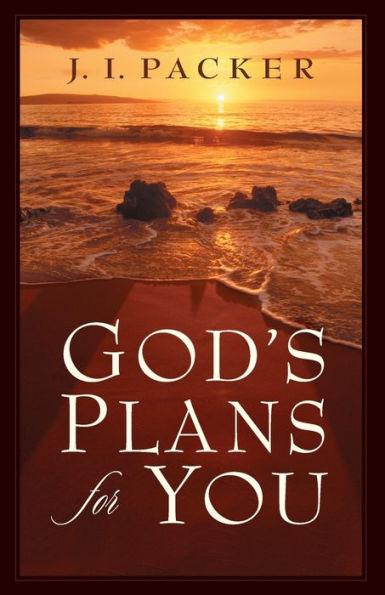
Many are familiar with J. I. Packer’s magnificent book “Knowing God.” It is a classic which stands alone in modern Evangelical writing. Having sold well over a million copies in North America alone, many have found it a foundational source of sound, Reformational and Biblical theology.
With all I owe to that book as formative for myself when I first read it in the early 1970’s, Packer’s God’s Plans for You – should be on the bookshelf of every Christian. Better, it ought to be read by every Christian. More than once.
When make my poor attempts at writing poetry, I have a device I refer to constantly. Usually down the left column of a yellow legal pad, I write the alphabet. One letter on each line. I refer to it constantly in finding rhyming words. A primitive but useful tool for me. And it reminds me also each time – that every word written in the English language is comprised of those same 26 letters. They are the most basic building blocks of communication. Nothing is written apart from them. We need them and refer to them in every word we speak, read or write. They are indispensable.
Now there are certain truths which occupy a similar role in our thought processes. Fully aware of them or not, there are foundational concepts which form the lens through which we view and interpret everything. This is true in the world around us, and, more importantly, in regard to our understanding of God and his relationship to this world, ourselves and all of life.
What Packer’s exceptional volume – God’s Plans for You – does, in my humble opinion, is serve as a sort of theological alphabet of Biblical Christianity.
I first read this treasure several decades ago, and just finished (perhaps) my 3rd reading of it today. And I am more convinced of its usefulness now than in my previous journeys through its profound pages.
Laying down the essentials of Biblical Christianity in a most thoughtful, concise and clear fashion, I would plead that individuals would pick it up afresh and read it thoughtfully and carefully. More. I would l really encourage church leaders to begin study groups around it. I cannot think of something more useful for new Christians in building a Biblical mindset and worldview.
I’ve got a problem. I am increasingly grieved by 2 things in the realm of communications issuing from and to Christians.
In addressing these, I want to leave room for the fact that I am child of the 50’s, and the cultural milieu of that era. No, Leave it to Beaver was not reality. It was a thin veneer over the gross corruption that was (and always has been) just below the surface. But even in that, there was some sense, even in the World, that some things were a shame to talk about or drag about in public – or in “polite company” as we used to say. A sense of what was acceptable for public consumption and what was not. And I mourn the loss of that feature.
But now we are in the 21st Century. Starting with the like of Phil Donohoue, perversions of all kinds became mainstream curiosities to be gawked at and talked about everywhere. We went swiftly downhill toward Maury Povich, Jerry Springer and a host of others – making the seamiest acts and attitudes of humanity fodder for entertainment.
Aside from our cultural plummet – what troubles me more is how these things have seeped into Christianity. This, in a host of ways – but only 2 of which I want to consider here.
As I read afresh this morning in Paul’s letter to the Colossians: “Walk in wisdom toward outsiders, making the best use of the time. Let your speech always be gracious, seasoned with salt, so that you may know how you ought to answer each person.” (Col. 4:5-6)
It seems that for the Apostle writing under the inspiration of the Spirit – salty speech isn’t risque – it is wise and useful in making Christ known.
So here’s my 2 areas of concern.
1 – The way crude words have become more and more acceptable even among Believers.
The street slang for body parts, biological functions, expletives and curses (mild to extreme) seem to be almost as popular in the everyday parlance of Christians as in the World. Such speech lacks grace. It shows favor to no one. It especially shows no favor toward the Christ we serve as one who is above the gutter.
I’ve watched this trend with increasing horror since the early 80’s. Back then, singing with my wife and our wonderful pianist Cecil Van Houten, we were asked to participate with several other Gospel musical groups at an outdoor festival. Lots of good, Gospel music.
After our set, a singer from one of the other groups came up to compliment us. He was especially enamored with Cecil’s keyboard skills. And forgive my recording his words verbatim here – I do so only to illustrate this issue: he said to me: “Man! Your keyboard player is bitchin!”
It was seriously jolting to me. In a Christian gathering, where we were all there to lift up the name of Christ in song – unblinkingly, and thinking it was an appropriate approbation – this young Christian thought nothing of it.
I, was wounded. It was so unfitting. It is not the language of Zion, as my generation was wont to say.
I won’t belabor this. I know certain words and expressions come in and out of vogue and popular use – even in the Church. But I do make a plea for us to consider passages like the one above to draw us each to consider whether or not our speech patterns communicate – or fail to communicate – Christ and how he has translated us out of the kingdom of darkness into his domain.
Are we different in our speech? Should we be? I believe so.
2 – Is how we converse in person and online especially.
I get it. Folks love to point to Luther’s sometimes crude language to justify their own. As though someone else’s foibles should ever be an excuse to adopt them for ourselves. And yes, in one place Paul used σκύβαλον, once. But these are not patterns to emulate.
Sometimes shocking language is needed for the sake of confronting and stirring the soul.
What differentiates that from what Paul is guarding us against here is found in Jude 9.
And, we need to remember that Jesus as God CAN speak in ways we cannot. He is God’s appointed judge of mankind.
The idea in our text seems to be that we are not to use words in an attempt to punish others – with the aim of hurting them by virtue of what we say. Lange says this refers to “giv[ing] a sentence of condemnation against one.”
2 Peter 2:11 – (Lange) “words of insult, anger, or words of satire and mockery.”
More to the point here, is how our speech is to be guided when around unbelievers. They need to be exposed to soundness and grace, not our roughness and rancor.
Christians who are crass and abrasive and who are always criticizing government officials, other Christians and the such, leave no place to give the lost a reason to hope – nor any evidence that WE do.
May we (as a theme of Colossians emerges) seek to walk more and more “worthily” of our place and calling.
How would you choose to speak to others before the throne of God? For that is exactly where we all are even at this very moment – corem deo.
“Let your speech always be gracious, seasoned with salt, so that you may know how you ought to answer each person.” Some who cannot divide between meekness and weakness will think this milk-soppy. So be it. But may we labor to reveal Christ, and not our spleens.
At the time of the Great Evangelical Awakening in the 18th century – there is no question that among the incredible preachers God raised up then, George Whitefield takes 2nd place to none. God used him most extraordinarily – preaching at times up to 5 times in a day. And, it is estimated that he preached on the text of John 3 and “You must be born again” around 3,000 times.
When asked why it was he kept preaching on that same text over and over, he replied “Because you MUST be born again!”
It occurs to me more and more, especially as I see the state of our nation, and the state of the broader church in our nation, that a Biblical sense of what being a Christian is – is seldom as informed by the Bible itself, as it is by opinions, feelings, culture, and religious systems. That the need for men and women to be truly born again – is once again at a critical point – even in places where people have some sort of profession of faith – but have never experienced the internal transformation that without which – one cannot see the Kingdom of God.
What do we even mean by it? – being born again, being a Christian that is.
And let’s begin first by differentiating between two things:
1 – The Biblical DEFINITION of a Christian, and
2 – A Biblical DESCRIPTION of a Christian.
Many have argued (rightfully so) that a Christian is one who has been supernaturally regenerated – born again and indwelt by the Spirit of God;
Raised from a state of spiritual deadness to life, and given sight – Sight in terms of the reality of God and the Bible and Jesus Christ in His substitutionary atoning work;
A vision of their own sinfulness; the justness of God’s coming wrath upon that sinfulness; That their sin has separated them from God and that Jesus Christ alone can satisfy God for their sin, in such a way as to see the sinner and God reconciled.
In short, a Christian is: One who being regenerated by the Spirit God – and having heard the Gospel of Jesus’ death, burial and resurrection for sinners; Believed that Gospel as true and trusted themselves and their salvation to Christ and His finished work on Calvary alone.
So BEING a Christian is not a matter of joining a particular church or group, or even simply subscribing to a set of truths – even though that is involved – but in a true, fundamental inward change supernaturally wrought by the Holy Spirit.
Unquestionably there are a host of other things that accompany these essentials, but it is absolutely certain this change is at the core.
J.C. Ryle the great 19th century Bishop preached: “Sinner, man or woman, mark that! no salvation without this new birth! Christ hath done everything for thee; He paid the price of our redemption, lived for us, died for us, rose again for us; but all shall avail us nothing, if there be not this work in us: we must be born again.” Ryle, J. C. The Christian Race and Other Sermons. Hodder and Stoughton, 1900, p. 16.
It’s of eternal importance for us to have clarity on this point – to know conclusively whether or not we are truly “born again.”
We have it in the words of Jesus Himself when conversing with Nicodemus in John 3:3 “Jesus answered him, “Truly, truly, I say to you, unless one is born again he cannot see the kingdom of God.””
Let me quote Ryle once more: “To be born again is as it were to enter upon a new existence, to have a new mind and a new heart, new views, new principles, new tastes, new affections, new likings and new dislikings, new fears, new joys, new sorrows, new love to things once hated, new hatred to things once loved, new thoughts of God and ourselves and the world and the life to come and the means whereby that life is attained. And it is indeed a true saying that he who has gone through it is a new man, a new creature, for old things are passed away,—behold, he can say, all things are become new! It is not so much that our natural powers and faculties are taken away and destroyed; I would rather say that they receive an utterly new bias and direction. It is not that the old metal is cast aside, but it is melted down and refined and remoulded, and has a new stamp impressed upon it, and thus, so to speak, becomes a new coin.” Ryle, J. C. The Christian Race and Other Sermons. Hodder and Stoughton, 1900, pp. 22–23.
So it is I ask everyone of you within the sound of my voice today whether or not you know something of what has just been described to you?
Nothing in all the world – this one or the next – is as important as how you answer that question.
Moving beyond the mere definition, it is also good to look at a sound description of what a Christian is.
After all, this it seems is where even more confusion arises; for the culture, individuals, various religious and even secular groups – virtually all have some idea of what a Christian ought to look like.
In our current society, that is often associated with political affiliation; stands on certain social causes; behaviors that may or may not be directed by Scripture etc.
While there may be SOME truth in that, to be clear one can be pro-life without being a Christian.
One can be conservative, or liberal, and not be a Christian.
One can hold to the existence of God, special creation, gun control or not, abortion or not, big government or not, teatotalling or not, homeschooling or not, common core or not, tattoos or not, King James only or not, or a million others, and not be a Christian.
Being a Christian will certainly impact how you stand on one or all of these things – but standing on a particular side of such things does not make one a Christian.
Well then, what kind of objective evidence, Biblical evidence might be safely marshalled to help us answer this question?
Fundamentally, all other things aside, what does a Biblical Christian (that is actually a redundancy) look like in the eyes of God? In the Bible?
It is that which brings us to the text we have today in 1 Thess. 1, specifically vss. 9-10.
Some background is helpful here. Thessalonica was a large and cosmopolitan city of 100K- 200K people. Acts 17 records Paul’s visit there, the riot that ensued and how he and Silas had to scurry away just to stay alive. Later, Paul sent Timothy back to Thessalonica to check on the new believers. And is it Timothy’s report which notes the key things we want to look at today.
How were the Christians doing?
What marked them out AS true Christians in this large, cultural center with lots of competing religions, philosophies and ideas? What set Christians, Believers apart from moral and faithful Jews, and other groups? What could Timothy tell Paul which would set Paul’s mind at ease that these had truly become Christians?
Four things: Paul records that Timothy told him – They had –
1 Turned TO God, FROM idols.
2 To SERVE the Living God.
3 And to wait for His Son from Heaven who He raised from the dead.
4 Jesus, who delivers us from the wrath to come.
4 Powerful descriptors that for the Apostle, assured him that these were now genuine Believers – true, Biblical, Christians.
Let’s look at each one individually.
1. They turned TO God, FROM idols.
Now this needs some unpacking. For in truth, as Acts 17 records, not all those who heard Paul preach on the 3 consecutive sabbaths he did there, were idolaters in the sense of serving literal pagan idols.
Paul’s preaching was done in the Synagogue at least primarily.
So as Acts 17:4 reads: “And some of them were persuaded and joined Paul and Silas, as did a great many of the devout Greeks and not a few of the leading women.” It was a rather mixed crowd.
History tells us that wealthy women of the day had a tendency to seek out and attach themselves to various religious groups, even funding them. Many did this with Judaism as with other religions.
Some were pagan, Gentile women intrigued with religious trends and concepts. It was a hobby of sorts, bred out of curiosity.
But if all this started in the synagogue, how did the issue of idols become front and center?
The answer is: because in essence, anything that takes the place of God in any way in our lives – is itself a “false” god – an idol – even God’s own Judaism itself.
And in truth, this is still the primary issue today.
If you were to ask me: What is the biggest problem facing the Church today, let me assure you it is NOT:
Gay Marriage. Terrorism. Islam. Homosexuality. Transgenderism. The LGBTQ+ agenda. Socialism. Evolution vs Creationism. Pornography. Divorce. Un-wed mothers. Abortion. Worship Styles. Or Gender inclusive Bible Translations.
The single biggest problem the Church is facing today is: IDOLATRY
Let me elaborate.
Idolatry comes in a number of different forms.
a. PURE or FORMAL Idolatry. Pagan worship with god substitutes represented by images of different kinds.
This is what most of think of first when we hear the term idolatry. Worship of pagan gods. The Bible names many of these especially in the OT – Molech, Baal, Ashtoroth, Rephan, etc. And some in the NT like those you can read about in the Revelation in like Emperor worship or like that of Diana in Ephesus and others.
This form of idolatry has a – not so obvious – but very interesting subset – Atheism.
For in Atheism, man makes himself the measure of all things. He worships his own desires, dreams, purposes, etc.
The idol is self. The ultimate false god.
b. MIXED Idolatry. This was especially attractive to some pagans because in its 2 varieties.
First, you simply add Christ to your existing god or gods.
This became very common during the conquest of the Mayans, Incas and other people groups in South America when the Roman Catholic missionaries tried to convert them.
They found if they let them keep their existing gods, they were pretty willing to add Jesus to them. And so the missionaries claimed success in converting them, when in fact they had just obscured Christianity and reinforced the false worship of the idolaters.
The second variety is when you in some way come to Christ but also add another god or gods to Him as valid as well.
Another term for it is syncretism.
Yes, I’m a Christian, but then there is ancient Chinese wisdom, and reverence for pagan philosophies, things like “The Secret” or “A Course in Miracles” etc.
c. DISGUISED Idolatry. This is the idolatry of the religious – like the Jews Paul was preaching to.
This is serving the God of the Bible, but doing so as though He is a pagan god. That shows itself in a number of ways.
One way is serving God, SLAVISHLY like He is a harsh task- master and needs human appeasing through our sacrifices and rituals. We have an example of this in Micah 6:1-8
Micah 6:1–8 “Hear what the Lord says: Arise, plead your case before the mountains, and let the hills hear your voice. Hear, you mountains, the indictment of the Lord, and you enduring foundations of the earth, for the Lord has an indictment against his people, and he will contend with Israel.
“O my people, what have I done to you? How have I wearied you? Answer me! For I brought you up from the land of Egypt and redeemed you from the house of slavery, and I sent before you Moses, Aaron, and Miriam. O my people, remember what Balak king of Moab devised, and what Balaam the son of Beor answered him, and what happened from Shittim to Gilgal, that you may know the righteous acts of the Lord.”
“With what shall I come before the Lord, and bow myself before God on high?
Shall I come before him with burnt offerings, with calves a year old?
Will the Lord be pleased with thousands of rams, with ten thousands of rivers of oil? Shall I give my firstborn for my transgression, the fruit of my body for the sin of my soul?”
He has told you, O man, what is good; and what does the Lord require of you but to do justice, and to love kindness, and to walk humbly with your God?
God just needs me to jump through certain hoops, and if I perform the prescribed set of rites and rituals, all is well.
Truth be told, there are many who would call themselves Christians today who serve God this way. And He rejects it.
A 2nd kind of DISGUISED idolatry is serving God SUPERSTITIOUSLY
This shows itself in things like thinking God must be addressed in Elizabethan English or your not using the right magic phrases; putting superstitious emphases on certain Postures in prayer; adding requirements God never did like requiring certain amounts of time in prayer or Bible reading where if you don’t meet the quota, you’re sinning. Adopting a special “Prayer voice”. Making deals with God. Etc.
God warns against it quite plainly in Deut. 18:9-14 “When you come into the land that the Lord your God is giving you, you shall not learn to follow the abominable practices of those nations. There shall not be found among you anyone who burns his son or his daughter as an offering, anyone who practices divination or tells fortunes or interprets omens, or a sorcerer or a charmer or a medium or a necromancer or one who inquires of the dead, for whoever does these things is an abomination to the Lord. And because of these abominations the Lord your God is driving them out before you. You shall be blameless before the Lord your God, for these nations, which you are about to dispossess, listen to fortune-tellers and to diviners. But as for you, the Lord your God has not allowed you to do this.”
A 3rd kind is like that of Nadab & Abihu in Lev. 10 – where they just decided to get real innovative with God’s prescribed form of worship and in offering strange fire before God He had not commanded. They were killed by God for it. SELF-ORIGINATED worship.
The 4th we might call SELF-CENTERED WORSHIP (Matt. 15:9). Where we craft Church after the likes and dislikes of the people, without seeking to see what God says worship ought to be like from the Scriptures.
In these last 2, worship itself becomes an idol.
At the bottom of all of these, is a man-centered approach to God, and it is as much idolatry as is outright paganism.
And this was surely where most of Judaism was in Paul’s day – where it was superstition about God’s name, following rites and rituals rather than worrying about a heart which is right before God by God’s appointed means.
And it is from all of these types of idolatry that Timothy told Paul – the Believing Thessalonians had turned FROM, and turned TO God instead.
In a word, this is the idea wrapped up in the word repentance: Turning away from one thing and to another.
Away from sin to righteousness.
Away from rites and rituals to faith in the finished work of Christ.
Away from self-centeredness to Christ-centeredness.
Away from superstition to the true and living God.
Let me tease this out just a tad more for our use today.
For as I said already, an idol is anything that takes God’s rightful place in our hearts and minds. And there is a simple test we can use for hunting out possible idols in our own lives.
Let me give you a simple self-diagnostic in the form of a few questions. I give you 5 here. Which unfortunately we can’t expand upon right now.
1 – What do I FEAR most? Matt. 10:26-28 – “So have no fear of them, for nothing is covered that will not be revealed, or hidden that will not be known. What I tell you in the dark, say in the light, and what you hear whispered, proclaim on the housetops…And do not fear those who kill the body but cannot kill the soul. Rather fear him who can destroy both soul and body in hell.”
2 – What do I VALUE or DESIRE most? Matt. 6:21 “for where your treasure is, there your heart will be also. i.e. what elicits my greatest devotion
What fills in the box when I say: “If only X THEN, I would be happy”?
Or better, without X_ I cannot be happy.
As long as you are looking for that thing to make you happy, then your attainment of it will be dissatisfying. It will leave you unhappy and discontented.
If my ultimate and supreme happiness isn’t in Him, then I am trading “creatures” for the Creator.
3 – What do I seek my ultimate JOY in? 1Pet. 1:8 “and though you have not seen Him, you love Him, and though you do not see Him now, but believe in Him, you greatly rejoice with joy inexpressible and full of glory.”
Ps. 16:11 “You will make known to me the path of life; In Your presence is fullness of joy; In Your right hand there are pleasures forever.”
God in His goodness has given us countless things we may freely enjoy – but all of them are only meant to be tokens of Him – in whom we are to seek our supreme joy. Especially when we see how fleeting earthly joys are.
4 – What DICTATES my BEHAVIOUR most? Jer. 7:23-24 “But this command I gave them: ‘Obey my voice, and I will be your God, and you shall be my people. And walk in all the way that I command you, that it may be well with you.’ But they did not obey or incline their ear, but walked in their own counsels and the stubbornness of their evil hearts, and went backward and not forward.”
The juxtaposition of self-determination vs. love for God-determination.
How do I make up my mind about what is right or wrong to do in any given situation? My own opinion? Feelings?
Simply what is considered legal or illegal according to the laws of the land?
5 – What do I place my HOPE in? What is my hope for the future? What is my hope for right standing w/ God?
Is my hope informed by passages like 1 Peter 1:13 “Therefore, preparing your minds for action, and being sober-minded, set your hope fully on the grace that will be brought to you at the revelation of Jesus Christ.”
What is the source of my peace of mind? What do I look to for a sense of well-being? What is my comfort in the hard times?
a. What do I FEAR most?
b. What do I VALUE or DESIRE most?
c. What do I seek my JOY in most?
d. What DICTATES my BEHAVIOR most?
e. What do I place my HOPE in?
Answer these, and you will know what your god or gods are.
And the 1st mark of the truly converted soul is that one seeks to turn away from those gods – to the true and Living God.
Nor is this done just once – but it becomes a lifestyle of turning from those false gods to the God of the Bible over and over and over.
Choosing this way of thinking and life over and over every day.
With that established we can work through the balance of these much more rapidly.
2 The genuine Christian turns from idols to God – To SERVE the Living God.
The genuine Christian now realizing all that has been done for them in Christ – seeks to serve this merciful, gracious, loving, pardoning, holy God.
You’ve saved me for yourself – now use me! How can I serve your ends, your agenda, your plans and purposes, your kingdom?
If your Christianity is all wrapped up in God just being a blessing dispenser, without any regard for what it means to be His servant, saved for His purposes, you need to ask yourself if you have truly come to faith.
Coming to Christ is not a ticket to earthly and worldly pleasures, but the gift of eternal bliss in the service of the King!
One of Christ’s harshest rebukes in the NT is couched in a parable in Luke 19.
The Nobleman in the parable (an allusion to Jesus Himself) was to go into a far country to be given final title to a land and a people. When he left, the Nobleman gave 10 servants money to invest on his behalf while gone. Startlingly, the text says: Luke 19:14 “But his citizens hated him and sent a delegation after him, saying,
‘We do not want this man to reign over us.’”
What was the problem? They liked the money but they hated Him – and watch this closely – in that they did not want Him to REIGN over them.
It was fine and well to take his gifts, but they rejected his right of authority over them.
So Jesus adds after settling with those who took the money – Luke 19:27 “But as for these enemies of mine, who did not want me to reign over them, bring them here and slaughter them before me.’ ”
Many is the professed Christian who wants Jesus as a gift giver, a forgiver of sins, a healer and Savior – but if they do not want Him to reign over them – He counts them His enemies, and they will not escape His wrath.
These are profoundly sobering words.
Especially to all of us who take the name Christian to ourselves today. Do we want Him to reign over us?
If not, if we have imbibed the popular but false notion that we can have Jesus as Savior but not as Lord – we are sadly and tragically mistaken.
Those who do not want Him to rule over them, are counted as His enemies. Nothing else.
The genuine Christian turns from idols to God – To SERVE the Living God… A N D
3 To WAIT for His Son from Heaven who He raised from the dead.
The genuine Christian lives a life of expectancy and hope located in the return of Jesus either to translate us or resurrect us to be with Him forever. And this hope is fueled by the conviction that Christ was raised from the dead already as the first-fruits of God’s people.
Scripture places the historic fact of Jesus’ physical resurrection from the dead as a core essential of the Gospel message to be believed. Apart from believing it, ( along with some other central revelations) one cannot be considered a Christian at all.
1 Corinthians 15:1–4 “Now I would remind you, brothers, of the gospel I preached to you, which you received, in which you stand, and by which you are being saved, if you hold fast to the word I preached to you—unless you believed in vain. For I delivered to you as of first importance what I also received: that Christ died for our sins in accordance with the Scriptures, that he was buried, that he was raised on the third day in accordance with the Scriptures,”
Paul then goes on to argue that if this is not true – we have an utterly worthless religion.
At the risk of overusing my source – let me quote Ryle one last time on this, when he comments on those who have no desire for Heaven: “By nature we are altogether unfit for Christ’s kingdom in glory. The lives which we are in the habit of leading, and the practices we are fond of indulging, and the tastes we are always seeking to please, and the opinions we hold, are all such as prove we have no natural [suited-ness] for the inheritance of the saints in light. They do not follow after holiness in all their walk and conversation. Then what place can they occupy in that blessed abode where there shall enter in nothing that defile[s], nor whatsoever work[s] abomination?—how shall they stand in His presence, who charge[s] even His angels with folly, and in whose sight the very heavens are not pure! They do not take pleasure in the exercise of prayer and praise on earth; and how could they enjoy the employments of that glorious habitation, where they rest not day nor night worshipping and crying “Holy, holy, holy, Lord God Almighty, which was, and is, and is to come.” [If] They do not count it a privilege to draw nigh to God through Jesus Christ, to walk with Him, to seek close acquaintance with Him; [then] where would be the comfort to them of dwelling for ever in the presence of the Lord God and the Lamb? [If] They do not strive to walk in the steps of holy men of old, [and] they do not take example from the faith and patience of the saints; [then] with what face then would they join the society of just men made perfect?—with what salutation, after a life spent in pleasing the devil and the world, would they greet Abraham and David and the Apostles and all that blessed company who have fought the good fight? Alas! beloved, a natural man in heaven would be a miserable creature,—there would be something in the air he could not breathe, the joys, the affections, the employments would be all wearisome to him, he would find himself unfitted for the company of the saints, as a beast is unfitted on earth for the company of man; he would be carnally minded, they would be spiritually minded, there would be nothing in common. I know there are vain dreamers who fancy death will work an alteration, that they may die sinners and rise again saints; but it is all a delusion, there is no work nor device nor knowledge in the grave; if we die spiritual we shall rise spiritual, if we die carnal we shall rise carnal, and if we are to be made fit for heaven our natural hearts must be changed now on earth. Ryle, J. C. The Christian Race and Other Sermons. Hodder and Stoughton, 1900, pp. 20–21.
Christians are those living now, with their eternity in view, and have stopped living for just today or the foreseeable future. They say with Paul: 2 Timothy 4:8 “Henceforth there is laid up for me the crown of righteousness, which the Lord, the righteous judge, will award to me on that day, and not only to me but also to all who have loved his appearing.”
Beloved, if you are not one who loves His appearing, and is longing and looking for it, you need to ask if you ever been truly born again?
The genuine Christian turns from idols to God – To SERVE the
Living God and to WAIT for His Son from Heaven who He raised from the dead …
4. Jesus, who delivers us from the wrath to come.
Christians are living these ways, because they have a sense of the wrath of God which was due them, and the wonder of knowing they’ve been delivered from God’s coming wrath on all the world through the death, burial and resurrection of Jesus. All of this is wrapped up – not in religion or a system – but in Jesus Christ.
Christians know – know in their very bones, God in His holiness and justice must one day set the universe to rights.
And they have a true sense of the reality of that coming day, and have run to Christ for shelter.
They have run to the cross to have His blood plead on their behalf as having washed away their guilt and the stain of their sins.
And they keep running to Him in every failure, with every sin, with all of their brokenness, for they know that they know that they know on the authority of God’s Word, that no one can deliver them but the Lamb of God who takes away the sins of the world.
So let me bring all this down to you once again:
Have you turned and continue to turn TO God, FROM idols? Is this an ongoing part of life?
Have you turned, so as to SERVE the Living God? Seeking to be of use to Him in His plans and purposes?
Are you consciously waiting for His Son from Heaven who He raised from the dead?
Are you trusting in this Jesus alone, as the One who alone delivers you from the wrath to come?
If so, you rightly call yourself a Christian today.
If not, no matter what your religion, or profession or to use the modern parlance – your self-identification – you are still dead in your trespasses and sins, and need to be born again by the Spirit of God. The wrath of God still remains on you as Jesus said in John 3:36.
And let me be careful here – I am not asking if this is the whole of your reality – as though there is some magical amount of this that saves. We do all we do imperfectly while still in these fallen bodies and in this fallen world.
The question is – do these things have a place at all in your daily reality? And if that is not so – beloved hear me – you are in a seriously dangerous place. Your eternal soul may well be lost.
But it is not too late! You can come to Him today!
You can a call upon Him for forgiveness, and to have your guilt expunged by His blood and to be made His own and reconciled to the Father.
Won’t you come to Him today?
Plead with Him to give you the new birth. You have the warrant in Jesus’ own words: John 6:37 “All that the Father gives me will come to me, and whoever comes to me I will never cast out.”
Salvation is directly aimed at delivering us from being the product of or living under the influence of the wisdom, values and worldview of our (this) evil age. We are saved so as to live distinctly other than the way our contemporaries do in this regard. And, it is the will of God that we do so.
At the same time, we must beware the seduction of the cloister. Our separation from the world is not accomplished by a lack of physical proximity or personal interaction with people – it is in staying separate in our worldviews. It is internal. It will impact how we act externally, but it is a false and deceptive separation to imagine that somehow staying away from unbelievers is how this is accomplished. If physical separation were the key, The Son would never have been incarnate.
The art and skill of swimming cannot be learned by determining never to go in the water. It can only be accomplished by being IN the water. And like it or not, we are born into this world, not outside of it. Now Christians need to be sure we don’t drink in the world. That is drowning. But navigating its waters – that is part of our call. May we learn to trust in Christ’s indwelling Spirit to keep us afloat, his Word to instruct us, and his accomplished work on Calvary and his indwelling Spirit rescue both ourselves and others in the process.
2 Corinthians 4:7-11 “But we have this treasure in jars of clay, to show that the surpassing power belongs to God and not to us. We are afflicted in every way, but not crushed; perplexed, but not driven to despair; persecuted, but not forsaken; struck down, but not destroyed; always carrying in the body the death of Jesus, so that the life of Jesus may also be manifested in our bodies. For we who live are always being given over to death for Jesus’ sake, so that the life of Jesus also may be manifested in our mortal flesh.”
This portrait of the Christian life is so foreign to our Americanized Western Christianity.
Here, the picture painted is of a people constantly or at least repeatedly brought to the end of themselves by circumstances of every kind, SO THAT, His supernatural sustaining power might be demonstrated through us – IN us.
It is interesting to note that people often quote: “. On no soul doth [God] Place a burden greater than it can bear.” – or something to that effect. The problem is, that quote doesn’t come from the Bible, but rather is from Surah 2:286 from the Qur’an.
The truth is Believer, while we are alive in these bodies, we are always being given over to circumstances which would seem to destroy us. Things far too great for us to bear apart from God’s grace. Why? Because by means of it – he brings others to life. It is beyond our comprehension. And for at least this reason – that others may see us sustained beyond our capacities, in making him manifest. We become burning bushes so to speak. On fire, but not consumed. Supernaturally upheld.
Dear Saint, you who have been tested and tried and who have thought that it must mean God has abandoned you or is hanging you out to dry for some unknown reason – listen to this passage. As we experience these things not only in terms of deliberate persecution, but also in the simple trials of life, the breakdown of our bodies, sinful human interaction, our battles with indwelling sin, natural disasters and the like. Each of these individually and collectively trouble us but do not crush us; perplex us but do not drive us to despair; knock us down, but do not destroy us. Because of Christ Jesus.
Ease, success, plenty and no adversity are not the presupposed norms of the Christian life. It is just the opposite. And those who would tell you different, are not reliable. This reality remains unknown to them.
You in Christ who are standing today in the midst of severe trial, and know full well that you are not doing it by means of even the smallest ability of your own – He is manifesting Himself to the rest of us in your mortal flesh.
The “treasure” is v-6, the knowledge of the glory of God in the face of Jesus Christ – doesn’t shine through except by virtue of our cracks. Through the stress fractures that trials bring. Through cracks, that irrespective of their severity, allow us to bear the glory of the risen Christ without loss.
Crackpots by the score will tell us that the “abundant life” is one of supernatural ease, prosperity and uninterrupted bliss. But we know the supernatural wonder of being cracked pots, in whom dwell the glory of Christ – beaming out while we are inexplicably sustained.
The world doesn’t need to see self-confident heroes. It needs the Christ of self-doubting sinners, trusting the Savior alone and putting no stock in circumstances pleasant or adverse. To see us endure the unimaginable by the invisible glory that holds us together; the indwelling presence of the Living Lord.
Don’t be afraid of being weak. Be afraid when you begin to think you can stand no matter what, rather than relying upon him for every breath. Our Lord, never lets his own go – no matter what.








 ResponsiveReiding