Our pastor Matt Fletcher is currently preaching through the book of Esther. As we gathered in his home last evening for our “Growth Group” – our other “Matt” who led the discussion, had us consider Ps. 73 in light of the conflict between Mordecai and Haman in Esther 3.
Considering that powerful Ps. penned by Asaph, it drew me back to muse on the grand themes it explores, and jogged my mind once again. Below is the Psalm couched in verse. I pray it is blessing to you as you ponder it afresh today.
Surely the Lord our God is good Good to all his people Good to the mighty and the strong Good to the weak and feeble
But as for me, I almost fell Unsure my steps near stumbled My eyes were fixed on the arrogant On the wicked never humbled
It seemed to me they feared not death They dined, their hearts content And free from lives of burdened care Toward wickedness all bent
They wore their pride like jewelry And violence like robes Prosperous in iniquity With every blessing clothed
Their sinful thoughts ran unrestrained They mock and speak with scorn And threaten any they oppose Oppress, harass and warn
They speak against the heav’nly things Tongues strutting o’er the earth And justify among themselves Their careless life of mirth
In wickedness they dare to ask Can God know what we do? Do any think he knows our ways? He deigns our sins to view?
Considering this spectacle My heart was led to doubt Why had I walked in righteousness And sought my sins to rout?
What sense was there in keeping pure? Why turn from sin’s dark stains? Why suffer godly discipline? Why bother taking pains?
And yet I knew if thus I spoke That others may be harmed If by my doubts they strayed from God And by deceits were charmed
My mind still reeling, ill at ease Confused and not at rest I went to seek the face of God Would he my doubts address?
And there in prayer before his throne At last my eyes did see ‘Tis not the present circumstance That frames what’s yet to be
For these who walk without a care Forgetting God is there Are surely in a slippery place How will they finally fare?
The day will come when all are judged Both great and small will stand To give an answer for their lives Did they love God’s commands?
How suddenly they’re laid to waste All who reject God’s rule In judgment’s terrors swept away At last be proved the fool
How then my heart was pained within How senseless I had been With no more reason than a beast Deceived by my own sin
And then The Spirit reassured God’s hand held fast in mine His truth is truest counsel sure One day, with him I’ll dine
Oh Lord, whom do I have but you? In heaven or on earth? It’s true my heart and flesh may fail But you are all my worth
Those far from you will surely die The wicked you’ll destroy But you are my true refuge Lord Proclaiming you - my joy!
Of the 26 verses in this Psalm, the statement that God’s steadfast love endures forever, occurs in every one of them. So if you didn’t get the message the first time, you should, we should – by the end.
What is of particular note, is the variety of contexts in which His enduring, steadfast love is being evoked.
In verse 1, it is simply because God is good. In His steadfast love enduring forever, we realize then that His goodness endures forever – as a manifestation of His steadfast love.
In verse 2, it is His supremacy as the God of gods – or his being absolutely supreme over all which invokes a remembrance of his steadfast love. It is a supreme love.
In 3, we have a Lord above all other lords with whom we may have to do – and his steadfast love endures forever.
In 4, he is the one who does great wonders.
In 5 the God is the one who made the heavens by a thoughtful, purposeful design.
In 6 he was wise in separation of earth and water, and in 7, how he appointed the cycle and characteristics of day and night.
Once again, we are asked to consider all of these as products of an everlasting and enduring love.
Even when fleeing from our enemies, or being delivered from them by miraculous means, when there is judgment poured out, and when provision is made. In every act, under all circumstances, in the deepest depths and in the highest heights, he is a God who is so full of love, so steadfast and sure, that his love will endure to all generations, and prevail in every circumstance.
Dark days attended God’s people, both in Israel’s past and our own. But God did not change. Mighty upheavals and changes occurred. But still he always remained the same. In his rescuing the Jews from Egypt, and we from our sin – in every place and at all times, no matter how extreme or mild, pleasant or unbearable – Our God’s steadfast love endures forever.
It can never be shaken. And it is never to be interpreted as less than it is because of outward or inward turmoil of any kind.
Seasons change. Circumstances change. We change. Our feelings, hopes, aspirations and reasoning changes. But His steadfast love endures forever.
Maybe if we hear it 26, 27 or 27,000 times – we’ll finally get it.
Maybe, if he repeats it enough, it will finally sink in.
But whether we get it or not – the truth remains dear one: his steadfast love, endures – forever.
This is all the Christian’s hope and joy in Christ.
Why does the Scripture, why does our God call us to worship Him, and ascribe glory to Him?
The answer is not found in His ego. It is found in our need.
As the fountain of all that is good and holy and wonderful – we can receive no greater blessing than to have Him revealed to us in all of His ineffable glory. He can bless us with nothing higher than Himself. And so He bids us come and gaze in wonder that we might receive the highest, sweetest and greatest of all that He has to give – Himself.
But o how we lose sight of what is really and truly the best for us. Sin twists our desires so and folds them in so wretchedly that we delight more in the dim and defaced reflection of His glory in ourselves than in the splendor of infinite goodness.
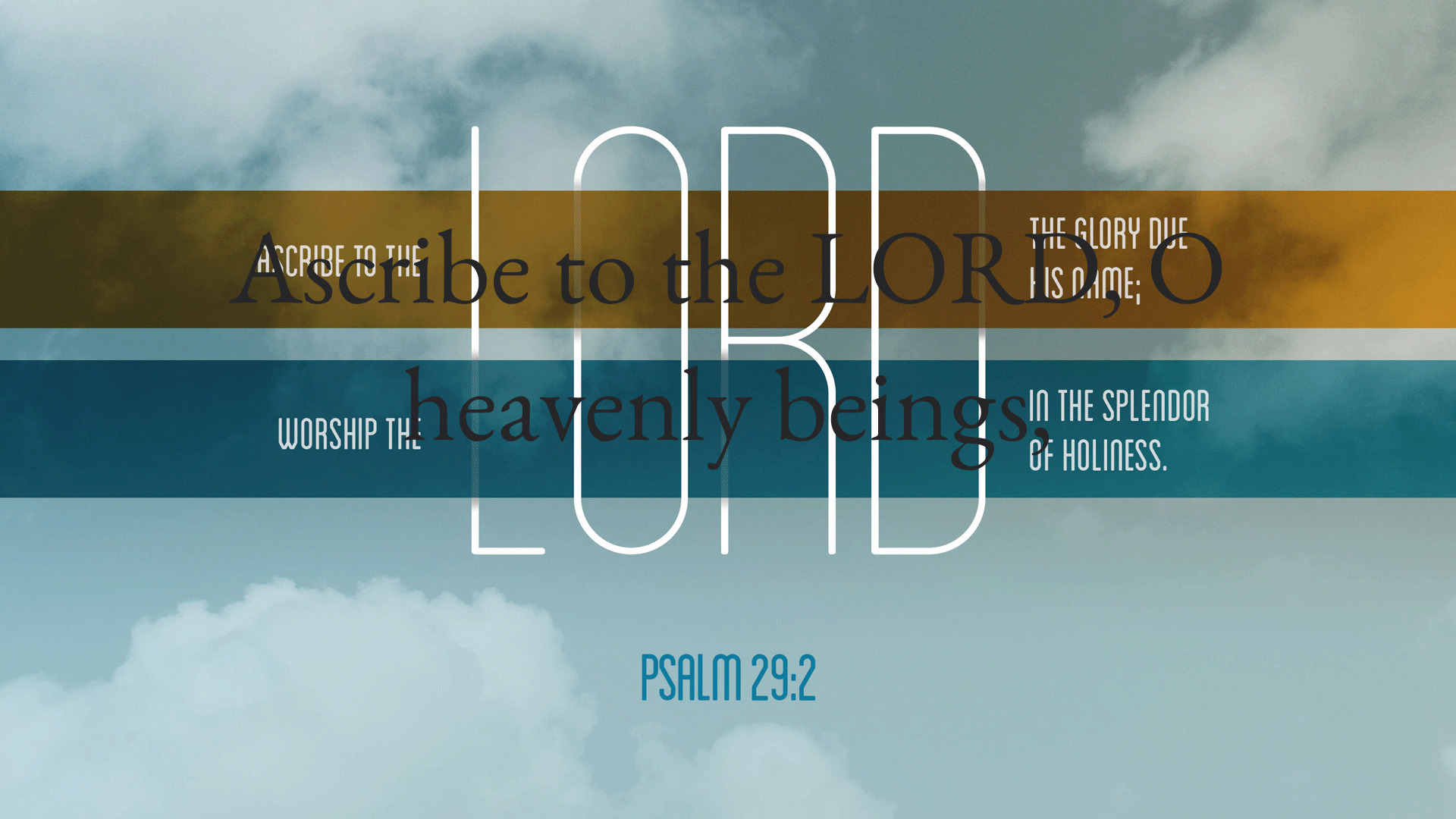
And so we are met with this first clause – Psalm 29:1–2 “Ascribe to the Lord, O heavenly beings, ascribe to the Lord glory and strength. Ascribe to the Lord the glory due his name; worship the Lord in the splendor of holiness.”
Now this opening address is to the angelic hosts; those who behold His glory more immediately than fallen humankind. But what happens in the process is that you and I are brought into that same throne room and invited to participate in angelic experience. It is truly remarkable. It is an exalted call. We are to join our voices with theirs here. Astounding.
Glory. No other word will do at the sight of God. Glory! is the divine expression. Rolled into it are simultaneous exclamations of:
ABSOLUTE PERFECTION!
PROFOUNDEST MAJESTY!
INFINITE INDESCRIBABILITY!
UNSURPASSABLE TRANSCENDENCE!
FATHOMLESS FORGIVENESS!
UNBELIEVABLE HUMILITY!
INCOMPARABLE BEAUTY!
UNDEFILABLE HOLINESS!
LIMITLESS, BOUNDLESS, MATCHLESS LOVE!
UNFATHOMABLE MERCY!
INCALCULABLE GRACE!
MIND-NUMBING, UNSPEAKABLE WONDER!
INVIOLABLE JUSTICE!
INCOMPREHENSIBLE TRIUNITY!
INDEFATIGABLE POWER!
INEXAUSTIBLE PATIENCE!
IMMEASURABLE SWEETNESS!
And so very much more – GLORY!
1-2 / There is little that leaves us less prepared to deal with life, than when we have a small God. One who is inglorious. Impotent. Wishy-washy. Grim. Uncaring or distant.
The call here is for each of us to remember God as He is, by a worship that ascribes to Him the glory that is truly and rightly His. Such worship is for our own good. For it forces us to reckon with how good and great He is – that we might not faint in the days of adversity. Worship – to remember.
And it is why when we neglect the gathered worship of the saints we injure our own souls.
Remember, spiritual truth does not remain static in the heart and mind at all times, let alone grow, without attention.
Ever since the Fall, our ability to retain the great and glorious soul-renewing truths which sustain the heart and mind in trial has been rendered defective. We are like spiritual sieves in this regard. We need a steady influx of Biblical truth to maintain even basic health in Christ.
We must never forget that when it comes to spiritual health, we are much like one trying to ascend the down escalator – standing still will in fact find us going backward.
And even apart from the Fall – we must remember that as Christ is the Son (sun) – we are but moons, reflecting His glory. We do not generate it. The light we are to the World is light we reflect from being exposed to His. And without this exposure, we soon have no light to give, like the luminous hands and numerals on a watch face.
Take the time to ascribe to the Lord the glory due His name, and to worship Him in the splendor of holiness. His ego doesn’t need it, but your soul does.
And then, we are called to “worship the Lord in the splendor of holiness.”
And there is no place where His holiness is on greater display than in the Cross! Worship Him in the splendor of holiness revealed in the cross. Of righteousness fulfilled, sin judged, payment made, sentence carried out, grace made available.
From this point on in the Psalm, David focuses upon an aspect of God that overwhelms him, and it forms the foundation of the call to worship he issued in vss. 1-2 – The Voice of The Lord.
As it is portrayed here, and elsewhere, the voice of the Lord is that revealing and causative power of God in action.
3 – God communicates. His voice is upon the waters – ubiquitous and far reaching, even over that which is dark, dangerous and unstable.
3 – And God communicates loudly. It is not that God has not spoken in His creation, it is that we do not want to hear Him. We will ignore what He communicates loudly and ubiquitously so as to form our own opinions and understandings, apart from Him. The old adage that actions speak louder than words is true. His actions have declared who He is, what He has done and what He is about.
3 – Not only does God speak in this world, He is actually in this world. He is not far off from His creation, He is in the midst of it. He IS upon many waters. Not an absent landlord, but a present and ruling king.
4 – When God speaks, things happen. His voice is His will expressed and when God “says”, what He wills comes to pass.
And we must note here that God as incorporeal in His nature, He does not have vocal chords. This requires no audibility. When He said “let there be light” no sound was needed. The meaning of His speaking in power is nothing other than His willing X should come to pass, and so it does. Modern foolish interpretations which assign magical power to spoken words are ludicrous to say the least. God didn’t have to speak audibly in order to create the universe – He simply willed it to be. And it was.
4 – The Lord’s voice/will is not a mere opinion inserted into a world of voices. He speaks with supreme and inviolable authority, grandeur and glory.
5 – The strongest things on earth cannot resist His will when He exerts it. The cedars of Lebanon, famous for their majesty, strength, durability and as symbols of what is unbreakable, snap like mere twigs if and when He desires. Nothing can resist Him.
6 – Indeed, so great is the power of His will when exerted, whole regions and nations dance like playing calves before Him.
7 – God does the impossible. Who can single out or separate the tongues of flame in a fire? No one. None but our God. When He speaks/wills it – even that which is utterly inscrutable in human terms is done.
8 – When He decides, the entire earth must tremble before Him.
9 – It is by His decree the very forces of nature continue in their assignments. Not even the birth of livestock is outside His direct order.
9 – When He so desires, the very densest and most impenetrable of things are laid bare.
9 – Everything in all all creation declares His glory by their very existence – whether they know it or not.
10 – He is Lord over all, the permanent sovereign over all.
11 – And it is this Lord, whose word and will is over all, that alone speaks and gives peace to His people. The one who blesses all His own with a peace that is truly transcendent.
So how and where do we access this? It is in His speaking – in His Word.
This, is why we read, study, meditate upon, teach, memorize and love His Word.
Psalm 29:1–2 “Ascribe to the Lord, O heavenly beings, ascribe to the Lord glory and strength. Ascribe to the Lord the glory due his name; worship the Lord in the splendor of holiness.”
You cannot do a single thing better for your own soul, and that of others.
From Proverbs 3:1-3 “My son, do not forget my teaching, but let your heart keep my commandments, for length of days and years of life and peace they will add to you. Let not steadfast love and faithfulness forsake you; bind them around your neck; write them on the tablet of your heart.”
I so love coming back to this passage in my regular reading. I love being reminded to “keep” this commandment – to not let “steadfast love and faithfulness” be forsaken.
As His Bride, what sweeter thing can the Church do?
The idea here may be, to be sure to be a loving and faithful person as the Father’s commandments lead us. But some posit to think of it in terms of resting in the love and faithfulness of our God. The one who rests content here, who lavishes in knowing these graces are poured out upon them, will live a life far different than those languishing in the hopelessness that captures so many.
It is a pre-echo of “keep yourselves in the love of God.”
It is a call to never let the wonder, the mystery, and glory, the reality of God’s steadfast love and faithfulness toward you ever escape your consciousness.
When we imagine His love to be vacillating or indistinct – or when we doubt the absolute certainty of His commitment to see all of His promises to come to pass – faith suffers its most devastating blows.
We MUST see our God as constitutionally incapable of any of the defects of human love.
In the darkest of hours, He cannot love you any more, nor can He love you any less.
See Him as ontologically unable to fail to keep His word, or to break His promises. He does not merely carry out His promises faithfully, He IS faithful. This is the One with whom we have to do. This is our God. Loving and faithful beyond anything the human mind can imagine. This is the One in whom we place our trust.
Know for yourself Believer, and remind yourself often, of the steadfast love of the Lord, and of His faithfulness. That He cannot fail. And in that, you will become one of steadfast love and faithfulness yourself.
This belongs to all who are in Christ. And it is a treasure we begin to enjoy even here and now – part of the “downpayment” of the Holy Spirit that is ours.
The NKJV renders “steadfast love and faithfulness” – Mercy and truth. And what a glory this is. That our Father always knows the real truth about us, and always reveals the truth about Himself, and He alone knows the full truth about all things. But in knowing the truth about us, He still deals with us in unspeakable mercy. Nothing hidden even in the darkest recesses of our souls turns His heart of mercy against us. We are His – in truth and in mercy.
And of Zion it shall be said,
“This one and that one were born in her”;
for the Most High himself will establish her; The LORD records as he registers the peoples,
“This one was born there.” Selah Ps. 87:5-6
In human terms, it is common for us to both refer to and bear the marks of – our heritage.
I, am a native New Yorker. That brings peculiarities with it. When I am in the South, those things distinguish me. My accent, certain attitudes, etc.
Even more specifically, I am from Rochester – western NY. And that means I know what a garbage plate is, and until recently, Wegman’s (a local grocery chain) was uniquely ours. White hot dogs, the prominence of fish-frys on Fridays. NY pizza. Different from everywhere else. The Lilac Festival, what The Can of Worms was, and all sorts of other things mark me out. Not the least of which is the nasally way we say “Rahchester”.
In Matthew 26, when Peter was following Jesus to His mock trials, some bystanders marked Peter out as a Galilean due to his accent.
But what are the distinguishing marks of those born again into the new heritage of hailing from The City of God? What is our accent? How do our speech, our comportment, our attitudes, responses, values and motivations make us known as citizens of Zion?
Can people note something different about us? Like those in Acts 4:13, will people take note that we have “been with Jesus”?
Will they note what it is we love, and what it is we detest? Will they see us as a joyous people? Peaceful and seeking peace? Patient in trial in tribulation? Inherently kind? Upright in our dealings with others? Loyal and faithful to our Master and one another? Gentle in the face of opposition? And full of self-restraint?
Will they be able to know that we are filled with His Spirit because refuse to be drunk with wine and flee debauchery? Addressing fellow citizens of Zion with psalms, hymns and spiritual songs because we are forever making melody to the Lord in our hearts, and thus perpetually thankful to the Father in the name of Christ?
Bold but not brash. Steadfast but not unnecessarily rigid. Flexible but not compromising. Truthful and merciful at the same time. Seeking the best for the souls of others before the throne of God. Hopeful in the face of a disintegrating culture and world.
Will any be able to say after meeting us: “I know where they are from, they must have been born in Zion, the City of God?”
O may it truly be so. May our accent give us away every time.
For the audio Podcast of this and every episode, find us on Breaker, Google Podcasts, Overcast, Pocket Casts, RadioPublic, Spotify or HERE
If you’d like to join us in our journey reading all the way through the Bible this year, drop me a line at reid.ferguson@gmail.com, and I’ll be glad to email back a copy of the reading plan we are using.
We’re not in Acts 17 today, but rather in 1 Kings 14:19-15:32; Galatians 2:11-14; Mark 14:1-9 and Psalm 96. And yet, Psalm 96 and Paul’s address on Mars Hill have so much in common – one might think the same author was behind them both. That is the wonder of the unity of the Bible, having been inspired by the same Holy Spirit throughout. And we’ll look at that today on Through the Word in 2020. I’m your host, Reid Ferguson.
God’s people have a commission in Psalm 96:10. A message for all men. It is part and parcel with the Gospel. We have a command to proclaim it to the nations. To publish 3 things. 3 things Paul also majored on in his address in Acts 17.
1st. The Lord reigns. God is indeed sovereign. Man is not. Man is morally responsible for his self-determined actions, and yet there is a God who rules over all. Chaos does not reign. Evil doesn’t reign. Nor do randomness, politicians, tyrants, movements, pandemics or anything else. The Church needs to proclaim to itself – and to the World at large – as our text says: “Say among the nations, The Lord reigns.” They need to know the source of the Christian’s hope and confidence in troubled and uncertain times.
2nd. The earth shall never be moved. Man’s notion that he can destroy this world is nothing but fallen hubris. Another attempt at man declaring himself to be God. He is not. This is God’s world and it will remain until He is done with it. Yes, we will be responsible for failed stewardship of it. Yes, we need to pay attention to disasters we may bring upon ourselves through the misuse and abuse of this present earthly home. But do not imagine we can do so to the utter thwarting of God’s plans, nor the negation of His promises. Because God established the earth for His purposes, it shall never be moved until His purposes for it are finished.
3rd. He WILL judge the nations with equity. There is a judgment coming. Everyone will give an account for themselves, by the standard of God’s own righteousness. Russia and everyone in it will be judged. China and everyone in it will be judged. North Korea and everyone in it will be judged. Sweden and everyone in it will be judged. The United States and everyone in it will be judged. No nation, no person will escape.
Are you ready? For in that day, the question will not be – as we hear so often today “were you on the right side of history?” as we imagine it and as moral (or immoral) movements ask. It will be, “have you been reconciled to the God of all the universe through the substitutionary atonement His Son made for sin on Calvary?” Have you “you turned to God from idols to serve the living and true God, and to wait for his Son from heaven, whom he raised from the dead, Jesus who delivers us from the wrath to come?” 1 Th 1:9–10.
If not, your eternity will be the issue, not the 70 or so years you thought were the end-all here. Not your profession of what you believe, or think or imagine – but where you stand in relation to the Living God – either in Christ, or in your sin.
Turn to Him today.
Psalm 96:11–13 Let the heavens be glad, and let the earth rejoice; let the sea roar, and all that fills it; let the field exult, and everything in it! Then shall all the trees of the forest sing for joy before the LORD, for he comes, for he comes to judge the earth. He will judge the world in righteousness, and the peoples in his faithfulness.
That’s something to consider.
God bless. And God willing, we’ll be back tomorrow.
For the audio Podcast of this and every episode, find us on Breaker, Google Podcasts, Overcast, Pocket Casts, RadioPublic, Spotify or HERE
If you’d like to join us in our journey reading all the way through the Bible this year, drop me a line at reid.ferguson@gmail.com, and I’ll be glad to email back a copy of the reading plan we are using.
Mark 13:1–2; 2 Corinthians 13:11–14; Psalm 94; and 1 Kings 6:1–8:21 comprise our reading list for today. And of special note is the 1st part of Psalm 94:10 – which reads: “He who disciplines the nations, does He not rebuke?” Does God discipline the nations, and not just individuals? That’s our key topic today on Through the Word in 2020 – and I’m Reid Ferguson.
Modern Christianity, especially in the US in our generation, is almost completely focused on the individual. Make no mistake, God does deal individually with souls. As Paul preached in Athens, God “commands all people everywhere to repent, because He has fixed a day on which He will judge the world in righteousness by a man whom He has appointed.” And he leaves no question as to who is being referred to here – it is Jesus Christ – the judge whom God raised from the dead. Jesus Himself told us that on the day of judgement people will give an account for every careless word they speak. (Matt. 12:36) All of this shows just how individually responsible we all are – and how salvation itself is individual in that each of us is responsible to hear and believe the Gospel.
While all of that is true, what other Scriptures remind us of, is that God deals with nations as well as with individuals. That much we get pretty easily especially as we read of God’s judgments against various nations recorded in the Old Testament prophets, and in the book of Revelation.
But what does that look like? On what basis are the nations – each nation – to be judged? Verse 20 of Psalm 94 gives at least one aspect, and it is a stunner. Psalm 94:20-21
Can wicked rulers be allied with you, those who frame injustice by statute? They band together against the life of the righteous and condemn the innocent to death.
Zero in on verse 20 for just a minute. The question is, is it even possible to conceive that wicked rulers – government leaders can be allied with the purposes of God (as in consciously furthering righteousness and the Gospel) when they “frame injustice by statute”? In other words, when they make laws which legalize and further sin.
Abortion.
Easy divorce for any reason.
Same sex marriage.
Laws that protect rights of criminals above the innocent.
Laws that allow the wealthy and the well-connected to hide from prosecution.
A legal system that can be gamed by the savvy – and who can use it as a club against others.
Laws which are unequally applied on racial grounds.
That allow governments to trample on the individual or make performance of some regulations so onerous as to be impossible to comply with.
In our state, legalized gambling that directly targets the needy and those least able to afford it and most to be victimized by it.
Laws that oppress those who would seek to serve Christ, read His Bible, preach His Gospel or otherwise live for Him openly – whether in this country and certainly in a number of others around the world.
The lists could grow and grow and grow. And one wonders – will anyone ultimately be held responsible for such things? And the resounding answer is YES!
Once again we repeat vs. 10a “He who disciplines the nations, does He not rebuke?”
What a word of caution again to all those in leadership, be it civil or ecclesiastical. Framing injustice by statute, making laws which protect and “legalize” wicked actions, will not be ignored. God will judge.
I believe that in America right now, He IS judging.
Let that sink into your soul today Beloved. There is no immunity from this.
God bless. And God willing, we’ll be back tomorrow.
For the audio Podcast of this and every episode, find us on Breaker, Google Podcasts, Overcast, Pocket Casts, RadioPublic, Spotify or HERE
If you’d like to join us in our journey reading all the way through the Bible this year, drop me a line at reid.ferguson@gmail.com, and I’ll be glad to email back a copy of the reading plan we are using.
One of the most misunderstood concepts among Christians, is the difference between faith, and presumption. So in Ps. 19 David prays that he might be prevented from “presumptuous sins.” What does that look like and how do we get there from today’s readings?
You’re listening to Through the Word in 2020. And I’m your host – Reid Ferguson.
2 Samuel 18:1-19:15; Mark 11:26-33 and 2 Corinthians 9:6-15 are our selections for today. But it is the running style of a man named Ahimaaz in 2 Samuel that catches my eye – and a simple statement with an awful lot of theological importance when it comes to the practical reality of living the Christian life.
Ahimaaz is a relatively obscure character. His name only appears a few times. The son of Zadok, the high priest, he is portrayed as loyal to David during two attempted coups. In today’s passage he is noted as one of a pool of men who accompanied armies into battle. These men apparently had a talent for running great distances – and before the advent of communications technology, were used to carry messages back and forth from the front lines. Today – it was with the news that the attempted overthrow of David by his son Absalom had failed, and the battle – which tragically took 20,000 lives – was over.
As David awaited news from the front lines, his watchman sees first one runner then another on their way back. Then he makes this seemingly innocuous observation: “I think the running of the first is like the running of Ahimaaz the son of Zadok.” Just what was so distinctive about his running style we aren’t told. But it was something which others could readily see and identify.
Whether we know it or not, we are all known by how we “run” too. Or don’t run.
In 1 Corinthians 9 the apostle Paul asks rhetorically – “Do you not know that in a race all runners run, but only one receives the prize? So run that you may obtain it.” And here, is where these 2 passages play off of one another. Where a question of real importance is raised: Are you and I “running” in the race toward Heaven, in any recognizable way? Or do we presume on the grace of God – so that there is no deliberateness in the way we live – marking us out from from those who do not believe at all?
Can anyone look at us and say: “They run like they are striving for the prize?” If not, we may have crossed over from faith – which is believing God’s Word and ordering our lives accordingly – to presumption; which incorrectly relies on the the promises of God while failing to take the admonitions of Scripture seriously.
Therefore, since we are surrounded by so great a cloud of witnesses, let us also lay aside every weight, and sin which clings so closely, and let us run with endurance the race that is set before us,
The Christian life beloved is not a spectator sport. If we are not running so as to obtain what God has laid before us as important to strive after – it’s no wonder no one takes notice.
May the Lord be pleased to goad our hearts again into action if we’ve grown lazy in Christ, haphazard, or maybe even dropped out of the race altogether. Take a page from the obscure Ahimaaz. Seek to run toward Heaven in such a way – that even the most obscure among us, can be recognized for that.
And if we’ve sensed some loss in this – then let us cry with David in Psalm 119:32 – “I will run in the way of your commandments when you enlarge my heart.”
Heavenly Father – enlarge our hearts once more.
Let that challenge your soul today Christian.
God bless. And God willing, we’ll be back tomorrow.
For the audio Podcast of this and every episode, find us on Breaker, Google Podcasts, Overcast, Pocket Casts, RadioPublic, Spotify or HERE
If you’d like to join us in our journey reading all the way through the Bible this year, drop me a line at reid.ferguson@gmail.com, and I’ll be glad to email back a copy of the reading plan we are using.
Psalm 91 is one of the most comforting and reassuring of the Psalms. Many hold that it was penned by David after the severe chastening he had brought on Israel when against God’s command, he numbered the people in 2 Sam.
Regardless of the specific occasion, what overflows from it is the way God loves to make promises to those who put their trust in Him. How He delights to reassure and comfort us when we run to Him as our shelter in times of trouble. And the reality that we would spare ourselves terrible seasons of anxiety if we would just take Him at His word. In other words – if we would live by faith.
More on that in a moment in today’s edition of Through the Word in 2020 – I’m Reid Ferguson. Thank you for joining us.
Psalm 91 is neatly arranged into 4 major sections.
Vs.1 Contains: The Announcement
Those who “dwell”, not just visit from time to time but make it their business to live in the shelter of The Most High – will abide – will continuously know what it is like to live under His protection. In other words, nearness to Him brings safety.
Now the great assumption of this passage, and what is behind this announcement, is that we NEED “shelter”. That we instinctively know something is horribly wrong in the universe. And that left to ourselves, without shelter – we will all be cosmic victims.
V2 Then is: The Response
If what is announced in vs. 1 is true – then by golly I will respond to the Lord by calling Him my personal refuge; the fortress where I will live; and my God. But not just my God in name only – but my God in “whom I trust.” You see, apart from actually trusting Him, merely calling Him my God does nothing. Faith must exercise trust in the One it looks to.
Vss. 3-13 detail The Explanation of why this way of living makes sense.
To be exceedingly brief – there are two issues we face which cry out for the shelter announced to us in verse 1. Two things from which we need deliverance above all others:
a. There is a “fowler” – an enemy out there – an “evil one” who seeks our destruction. Who sets traps for us. A cosmic reality we oft times forget.
b. “Deadly pestilence” – which v. 8 defines as the “recompense” or reward of the wicked. i.e. God’s judgment on our sin. The ravages that the Fall has brought into this world. War, disease, death, violence, wickedness of every kind – natural disasters and more.
To those who trust in the Lord, while these remain realities, there are new dimensions to consider:
He covers us in it all. He remains faithful.
We need not fear the terror of the night – the unknown, nor the things which we can see that are harmful in plain sight.
While thousands all around us are consumed by these circumstances – the real damage they could do – to our souls – will not come near us. We’ll see it all for what it really is – the recompense for sin on the World – sin we’ve been forgiven of and justified from through the blood of Christ.
He even attends us with the invisible and imperceptible protection of the angelic host. And a final victory over it all is assured. Even the devil himself will one day be trampled under our feet.
Vss. 14-16 give us reassurance of all this in God’s Personal Promises
And once again, here is the nature of true faith: Trusting Him.
Listen to these 7 precious promises that fall from the lips of our God. Believe them. Look to Him. Trust him. Seek Him.
To those who look to the Lord as their refuge from a universe gone askew due to sin:
1. There WILL be God’s personal deliverance. His Kingdom WILL come.
2. There will be protection for our souls until that day comes. Jude 24
3. We will live in a state of knowing our prayers are heard and answered.
4. We will know His presence with us in every trial.
5. We will be rescued from His day of wrath that will come upon the whole world due to sin.
6. God Himself will “honor” those who trust in Him. Amazing! What must it be to have our God bestow honor upon us?
7. Eternal life – with the utmost of satisfaction in being allowed to delve into the mystery of God’s salvation. A vision of the secrets of His heart that are so overwhelming and glorious – we could never want for anything more.
Let that soak into your soul today Christian.
And trust Him.
God bless. And God willing, we’ll be back tomorrow.
For the audio Podcast of this and every episode, find us on Breaker, Google Podcasts, Overcast, Pocket Casts, RadioPublic, Spotify or HERE
If you’d like to join us in our journey reading all the way through the Bible this year, drop me a line at reid.ferguson@gmail.com, and I’ll be glad to email back a copy of the reading plan we are using.
Here is a thought to engage everyone of us – what of God’s steadfast love do we make known in such a way that the generations after us will hear of it?
The thought makes me want to pray: Lord, allow my legacy to be that those who come after me, for as long as Christ tarries, will hear of your goodness in the saving Gospel of Jesus Christ until His appearing. Let me leave that to them that they might be saved, and your glory made known.
As Psalm 89 progresses, watch how it begins contemplating God’s promises to David (and thus to His Kingdom) and how David in person does not see all those promises fulfilled – how One must yet come who will be THE David of whom David is but a type.
Then note how the author of this Psalm – Ethan – wrestles with how God will yet bring those promises to fruition which due to sin seem to be ruined. And how Ethan ends simply trusting that somehow, because God is faithful, all WILL yet come to pass. Whether we experience seasons which seem to contradict God’s promises or not, He will be faithful, and in time, they will come to pass. None will fail.
Now what is the device Ethan uses to encourage his own heart in this regard? As is stated elsewhere, “the heavens declare the glory of God, and day unto day utters speech”.
Here, the Psalmist reminds us that one way the created order “speaks” to us is in its amazing regularity. The sun rises and sets on its perfect schedule. The tides rise and fall. The orbit of the earth around the sun, the moon’s orbit around the earth and the earth’s rotation on its axis are all demonstrations of God’s faithfulness. How He can be counted upon to be always the same in His person and in His plans. The regular operations of the “the heavens” are undeniable testimonies of His faithfulness. Don’t let their reality just slip by you unnoticed.
When life seems random and skewed, remember that the sun will rise and set today right on time. The seasons will still come and go. A year will still be a year. Because God is running His universe. And you and I are in it.
Ethan then makes a powerful connection in reasoning this all out. He records God’s words: Even if the King’s children “forsake my law and do not walk according to my rules, if they violate my statutes and do not keep my commandments, then I WILL punish their transgression with the rod and their iniquity with stripes, but I will NOT remove from Him my steadfast love or be false to my faithfulness. I will not violate my covenant or alter the word that went forth from my lips. Once for all I have sworn by my holiness; I will not lie to David. His offspring shall endure forever, his throne as long as the sun before me. Like the moon it shall be established forever, a faithful witness in the skies.” Selah.” Vss. 30-37
Why will you endure Christian? Not because of your great faithfulness, but because of His. And Because Christ Jesus is your King to whom all these promises are sworn. If He is your King – all of this is divinely and eternally secure, and cannot be broken.
Let that soak into your soul today weary Christian. Christ is on His throne, and you are His.
God bless. And God willing, we’ll be back tomorrow.