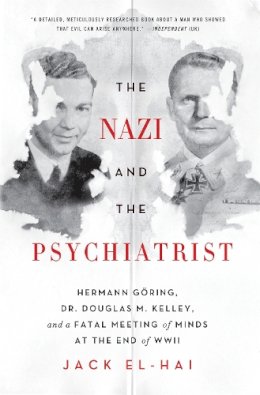
Recently I watched the movie Nuremberg starring Russell Crowe and Rami Malek. The movie is based on the book whose cover appears above. It is a fascinating and well-made movie in my opinion, worth the viewing. I followed up watching the film with the book. And it is a fascinating and penetrating study all its own. I can highly recommend both – but would really recommend the book.
The basic story is an historical one. At the close of World War II and the total defeat of Nazi Germany – for the first time in history, an international tribunal was convened charging many of the leading Nazis and their collaborators with war crimes. The Allies, led primarily by France, England, Russia and the USA undertook an unprecedented and colossal task. First to be prosecuted were 22 high ranking Nazis – the chief among them being Hermann Goering, Hitler’s handpicked successor. Goering was also the 16th President of the Reichstag (presiding officer of the German legislature); Supreme Commander of the Air Force (Luftwaffe); an aviator and architect of many of the oppressive laws governing how the Jews (along with others) found themselves not just disenfranchised but set on the path to extermination. He is played by Russell Crowe in the film.
The Psychiatrist (played by Malek) was Dr. Douglas Kelley. A native Californian, Kelley was a well credentialed practitioner with extensive experience in treating soldiers returning from war with various psychological maladies issuing from their battlefield experiences. And for around 5 months, he was the chief Psychiatrist tasked with analyzing, assessing and maintaining the mental fitness of the 22 Nazis to be first on trial at Nuremberg.
Kelley and Goering especially spent considerable time together. This relationship forms the core of both the book and the movie.
All of the very, very interesting facts and events aside, the account boils down to Kelley’s attempt to find some clue, some common trait among the 22 that could account both for their utter devotion to Hitler and the Nazi agenda – and (of course) their willing participation in the monstrous atrocities perpetrated by the Reich. His goal was to understand them, not judge them. He did indeed abhor and judge their actions. But he really wanted to understand why they did what they did. How they could justify their crimes – or even if they perceived them as crimes.
Kelley thought if he could pin-point “the” common cause, that such information could provide governments with the tools to prevent anything of the like ever happening again. If we could spot such men before they did such things, if we could head off their courses before they were set – what a boon that would be. And maybe such information could even be used domestically to identify and predict criminality of all sorts in advance. We could make ours and all societies safer in the future. Not to mention Kelley himself would gain global recognition. If he could just find the defect, the trigger, the trait. If only.
And here is where the theological implications get thick.
Kelley’s conclusion? There was nothing of the sort to be found. With only 2 real exceptions among the 22 (Ley and Hess), these men were mainly well adjusted psychologically. Not insane in the least. Highly intelligent, rational, educated, highly motivated, successful and even loving and devoted family men. To Kelley’s great dismay, they were just like you and me. They displayed no dominating or defining psychoses. They didn’t come from abnormal backgrounds or families. They were just good old normal folk found in every society. The types found in American politics, running corporations and living in suburbia. Businessmen. Doctors, lawyers, accountants, bankers, community organizers, and military men. Smart but average Joes.
Herein lay Kelley’s great dismay. If there was nothing to set these apart – the worst of the worst – then what prevents something like this happening all over again, anywhere? The answer, so utterly terrifying to him was – nothing. And so when his war-time labors were over and he returned to the States, he went far and near lecturing wherever he could – warning everyone he could that men just like these 22, walk among us here too. He just had no idea how really right he was. He was missing the facts that only the Bible can reveal regarding it all.
In the first place, Kelley had no category for the Fall, and the doctrine of the depravity of man. He believed in the innate goodness of most. And so he could never find an explanation for why anyone would do what these, and countless others have done. He was at a total loss. It terrified him. In time, he exhibited severe paranoid traits. He lived in fear even as he poured himself into more and more research that added nothing to provide him an answer.
In the second place, he began to wrestle with fact that he knew he had some of the very same traits as his subjects. And there was nothing he could do about it. He had recurrent bouts of rage, anger and depression. He drank too much. He tried to domineer others. He was a workaholic as he tried to disregard and bury his own eruptions of evil. He longed for the spotlight like Goering, and it drove him to extremes too. But still he found no answers. He had no concept of himself as a sinner needing grace. He was just someone who needed some sort of social or psychological adjustments.
Third, he tried to make his own son into a sort of super-man, the way the Nazis wanted to create their super-race. Forcing him to excel intellectually and academically, he drove his son to be an over-achiever at every turn. In this, he ultimately alienated his son and found him wanting to do just the opposite of achieve. He ruined their relationship in his incessant domination. He Nazi-ed his boy as he sought to revel in his own imagined superiority over others. And it failed too. We are made to bear the image of God, not of someone else. But fallen man seeks power. In the Garden, our first parents wanted to usurp God’s exclusive right to declare good and evil, to be our own de facto Creators (or at least seize the privileges thereof). We have never ceased from that impulse. Only the Christian informed by the Scripture can understand this iniquitous bent. Psychiatry and Psychology have no category for such a state.
Fourth, Kelley had no doctrine of Common Grace. He thought there was nothing to restrain men in their pursuits. So he lived in constant fear and outrage. He had no idea that God is constantly restraining evil. That the reason why everyone isn’t acting out their inner Nazi at all times, in all places and in every way is because our God is sovereignly preventing it. Holding it back. There are times when He withdraws and allows us some sense of how dire the human condition truly is. He does allow certain breaches in fulfilling His works among us. But the Believer can live knowing the one who loves them supremely can rebuke even the winds and the waves. That all of His are safe in Him, even in what He permits.
Lastly, Kelley didn’t know that ultimate justice will be done at the hands of Jesus Christ. That the Father has committed all judgment into His hands. That no one will escape either their just due or just reward. That there is a sure day of reckoning ahead. A day no human courts can ever even approximate. True justice.
Absent any of the answers that were at both his and our fingertips in the Word of God – Kelley continued to spiral inwardly. It agitated him that Goering ultimately committed suicide before he was to be hanged. He understood Hermann’s attempt to keep his own fate in his own hands and not be humiliated as a common criminal when he was – after all – the true German Head of State and was due high honor for all he had done. And in a fit of rage in 1958, Kelley took his own life, in front of his family, and in exactly the same way as Goering – cyanide.
We cannot psychologize, socialize or medicalize evil. Yes, there are times when all of those areas factor in to the heinous crimes of some. But ultimately, wickedness is a moral and spiritual issue. The Scripture is clear on it. And the remedy is to be found only in Jesus Christ. Only in reconciliation back to right relationship to our Creator and by that fact to one another. In the recognition of our sin and defilement before a holy God, and the provision He had made for us in the substitutionary death of His Son on the Cross – by faith in Jesus as Lord and Savior.
Only the genuine Christian can fully face the depths of their own sin (and that of others) without despair. For we know the truth of it all – and the remedy, the rescue – in Christ Jesus of Nazareth.
 ResponsiveReiding