Wrestling with questions like the age of the Universe and the Earth, the time of the Creation of Adam and Eve and events like Noah’s Flood, The Tower of Babel and other Biblical questions is nothing new. As long as humanity has possessed thoughts – we have sought to know more about the Creation, our origins and all of reality. As Prov. 25:2 reminds us: “It is the glory of God to conceal things, but the glory of kings is to search things out.” (ESV) We are meant to be exploring all of God’s revelation in Creation and His written Word. We are given the boundless gift of discovering the glories of the infinite. Of searching out God’s own infinite creativity. And to receive great joy in doing so.
In the process of this journey of discovery, we are met with two things: The “book” (as some have dubbed it) of Nature, and the Bible. And since both come from the hand of our glorious God, these two sources can never (at least in the final analysis) contradict one another. God’s revelations must always be consistent. Alas, our interpretations of these two – in tandem – are not always as consistent.
We are all familiar with what has come to be known as the Copernican Revolution. In the 16th Century, Nicolaus Copernicus proposed that the universe did not revolve around the earth – but rather that the earth revolved around the sun. Resistance to the good man’s assertion in moving from geocentrism to heliocentrism was rooted by many in what they believed was a contradiction between his scientific observations, and the Bible as the infallible Word of God. Not understanding the phenomenological language of the sun’s rising and setting, set many a Biblicists hair on fire. In fact, there was no real contradiction here. The problem was one of interpretation. A problem that may well still exist among us.
So it is debates over how to interpret the 6 days of Creation still rage among committed Christians. And I would argue (with Ted Cabal in his book “Controversy of The Ages”, which I previously reviewed), that we need charity with one another over these issues, and careful considerations of each other’s arguments as we seek both to understand the Science better, AND – to understand our Bibles more accurately.
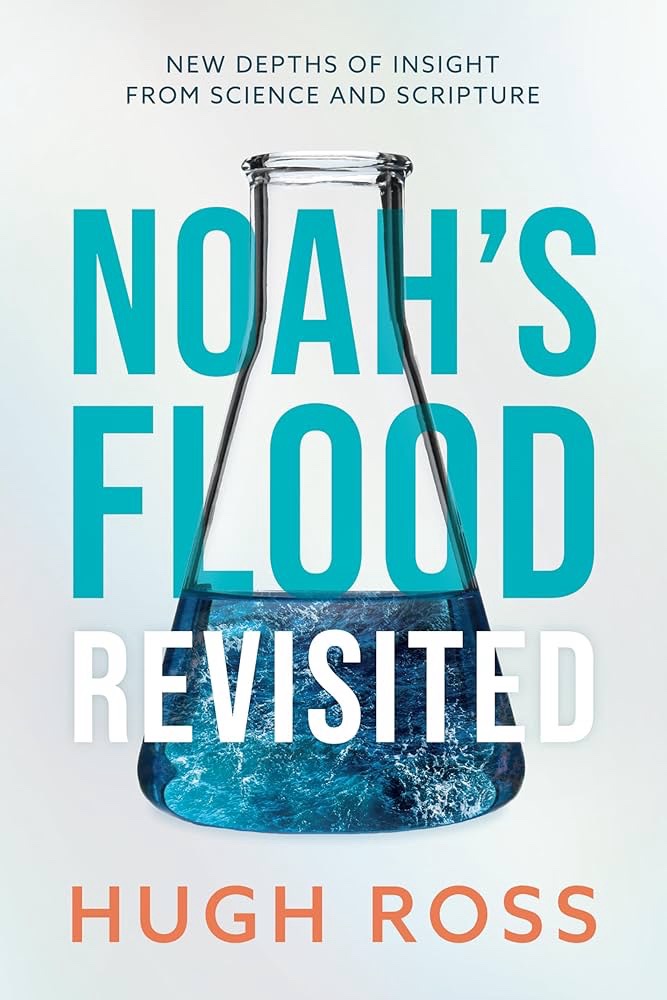
Enter Hugh Ross’s “Noah’s Flood Revisited.”
Ross, an astrophysicist and founder of Reasons to Believe, is a well known champion of old earth theory. As an avowed Christian, he believes the books of Nature and the Bible cannot contradict one another. He believes when they appear to, it is due to misinterpreting one or the other or both. But he is convinced of both the divine inspiration and infallibility of the Scripture, and the glory of God’s revelation in Creation. And he brings his vast learning in both arenas together in this very interesting and compelling read.
In short, Ross argues (ably in my opinion), that we must take both the historical certainty of Noah’s Flood and the Ark, and the Science which would seem to argue against a recent and global flood – seriously. He proposes instead a true massive flood – sufficient to wipe out all of sinful humanity but the eight preserved in the Ark – but not global and thus not singularly responsible for all the geologic features many attribute to that cataclysm.
Agree or disagree with Ross, his book is an earnest attempt to assemble a workable hypothesis for reconciling the Biblical facts and the ones he perceives as scientifically reliable. It argues from some necessary interpretive nuances in our reading of the Scriptures for sure. But he also strives to maintain a solid belief in the historicity of the Biblical Flood narrative, the dispersal of mankind on the earth and the Tower of Babel with the confusion of the languages.
I commend the book to you as worthy to consider carefully, whether you accept his views or not. They are not ill-considered, knee-jerk opinions nor attempts to undermine the authority of Scripture.
It is well worth your time in sorting out these complexities in a thoughtful and Scripturally honoring way.

