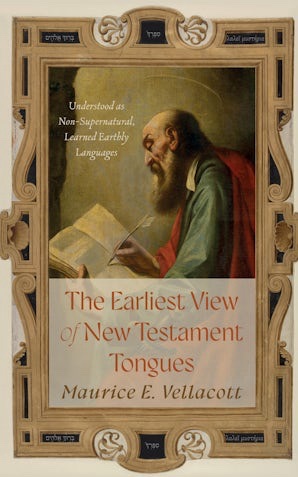
Very few books can honestly be labeled “paradigm shifting”, but Maurice Vellacott’s “The Earliest View of New Testament Tongues” is such a book. And whether one agrees with Vellacott’s thesis and proofs or not – this volume is weighty and requires an equally thorough and weighty response. I have no doubt there will be responses. But I seriously doubt if one worthy of being a true rejoinder will be forthcoming.
Bear with me, this will be necessarily a bit long.
What is this book all about? It is about the phenomenon we call “speaking in tongues.” As one raised in a Pentecostal context, “speaking in tongues” was normative in the Church. And, it was assumed tongues ought to be normative in the individual Christian’s prayer life.
I will not treat here how this has raised many a doubt and discouragement among those seeking but apparently never receiving “the gift” as expected. Such a situation can lead to cognitive dissonance, self-deception, guilt, mimicry and all sorts of other ills. Something for a later post.
What IS “speaking in tongues” you ask?
In the Pentecostal and Charismatic framework, it is believed the that Holy Spirit gives Believers the ability to speak in a language that they have never learned, as part and parcel of prayer and/or worship. Sometimes this ability may include speaking in a known, human language that one has never learned. This would be typical of how the Pentecost event in Acts 2 is understood. But most often (at least in my experience and how I have seen it practiced) the language is not a human language at all. Rather, it is something spiritual, unearthly, heavenly and supernatural. Indecipherable by normal means. Requiring an equally supernaturally endowed interpreter to bring to light what is being said. What is being said is ostensibly something the Holy Spirit is impressing on the speaker to express. And while this experience may (and often does) occur in gathered worship – especially in times of praise – it finds its primary exercise in private prayer. So it is “tongues” is often (perhaps most often) considered a special prayer language energized by The Holy Spirit.
Now the entire discussion of speaking in tongues and the interpretation of tongues is often debated between two camps: Continuationists and Cessationists.
Continuationists (all Charismatics and Pentecostals generally) believe the New Testament teaches that there are a number of supernatural gifts God has given to His Church which are to remain normative in every generation. Among these gifts would be speaking in tongues, the interpretation of tongues, words of wisdom, words of knowledge, prophecy, discerning of spirits, healing, working of miracles etc. These are taken from various passages of Scripture but especially 1 Corinthians 12:7-11 “Now to each one the manifestation of the Spirit is given for the common good. To one there is given through the Spirit the message of wisdom, to another the message of knowledge by the same Spirit, to another faith by the same Spirit, to another gifts of healing by that one Spirit, to another the working of miracles, to another prophecy, to another distinguishing between spirits, to another speaking in various tongues, and to still another the interpretation of tongues. All these are the work of one and the same Spirit, who apportions them to each one as He determines.” (BSB)
Cessationists by and large argue that while these supernatural gifts and abilities did exist in the early days of Christianity – once the canon of Scripture was completed, we no longer needed such aids and the era of their usefulness passed. As such we are not to look for their presence or exercise any longer.
The debate can run pretty hot and heavy at times.
To be fair, each camp has a spectrum of how all of this works. Some Continuationists are more reserved seeing how these matters can lead to all kinds of foolishness, excess and abuse. And some Cessationists allow for limited and qualified examples of one or more of those gifts appearing now and then.
So it is Pentecostal theologian Gordon Fee can say: “in general the Pentecostal’s experience has preceded their hermeneutics.” Fee, G.D. 1976. Hermeneutics and historical precedent. (In Spittler, R., ed. Perspectives on the new Pentecostalism. Grand Rapids: Baker. p. 118–132).
And at the same time, a Cessationist like Al Mohler can argue strongly for a subjective call to the ministry. An extra-Biblical, life-defining, Holy Spirit impetus. (See his contributions to “The Call to Ministry” – SBTS Press.)
Back to speaking in tongues.
As briefly as I can state it, Vellacott, taking a cue from the 4th-5th Century Bishop of Salamis, Epiphanius (310-403 A.D.) argues that neither the Acts 2 Pentecost event, nor the issue of speaking in tongues in the Corinthian congregation had anything to with ecstatic or supernatural speech. Instead, the issue always was one of speaking known languages by the speakers and easily understood by those who also knew the same languages.
As to the unique circumstances and contexts of Acts 2 and then the Church in Corinth, Vellacott goes on to extensive socio and religious contexts. He then dives into some very heavy exegetical Scriptural analysis in the original. It is NOT light reading. But it is in my opinion, careful, thorough, reasonable and ultimately – convincing.
As to why Epiphanius is so important in this regard, we are introduced to his background and qualifications.
The good Bishop was born in Judea, to Jewish parents. His knowledge both of Hebrew and the Jewish context of early Christianity enable him to analyze the Acts 2 event and the Corinthian problem from a unique and massively helpful perspective. In the process, he cogently demystifies how many of us have read and interpreted those passages. And it is, as I stated at the outset – paradigm shifting. Theological tectonic plates move to form new planes of understanding.
In the shortest possible way here, let me quote Vellacott’s summary of Epiphanius’ position on the real problem in Corinth Paul had to address: “Epiphanius implies that the γλῶσσαι/glṓssai conflict in Corinth was a problem of pompous people using the inscripturated Hebrew and the aforementioned Greek dialects in elevated manner to pridefully posture as superior to others in the assembly.” Maurice E. Vellacott, The Earliest View of New Testament Tongues: Understood as Non-Supernatural, Learned Earthly Languages (Eugene, Oregon: Resource Publications, 2024).
Let that idea sink in. And you’ll begin to read the entire section through a new (to us, not to Epiphanius) set of lenses.
I hear your “but…but”. Read the book and then raise the questions.
I am well aware that the average reader is not going to wade through 380+ pages of historical analysis and detailed New Testament Greek exegesis. What we desperately need from Dr. Vellacott is a popular version of this groundbreaking work for those like me – Joe and Jane Average Christian. But it is a start. A powerfully executed and most needful start. And if you have any vested interest in settling some of the most difficult questions of wading through the speaking in tongues issue, I implore you to dig in. Take your time. Read slowly. And digest. Vellacott’s treatment will bring clarity, sense and help in untangling what has become a gnarled theological mess in our generation since the days of Azusa Street.
I cannot adequately express my personal thanks for this volume. It is truly exceptional.
In closing, let me quote from the author’s own closing remarks.
“To reiterate and conclude this chapter on a practical basis, for the maximum edification of the congregants, Paul’s basic guidelines were:
1. Those whose first language is different from the majority language of the congregation, may, with competent translation by oneself or another, make valued speaking contributions in the assembly of believers (1 Cor 14:5).
2. Speaking in a foreign language, with translation, may be the offering of a song, a teaching, or a disclosure of truth (1 Cor 14:26).
3. Foreign language speaking should be restricted to two or three persons maximally (1 Cor 14:27).
4. If no translator is known to be available, in advance of speaking, then the person should quietly express himself to God in his thoughts, right there in the assembly (1 Cor 14:28).” Maurice E. Vellacott, The Earliest View of New Testament Tongues: Understood as Non-Supernatural, Learned Earthly Languages (Eugene, Oregon: Resource Publications, 2024).
If Epiphanius and Vellacott (and a host of others) are correct in this debate – the Continuationist vs Cessationist dynamic virtually disappears. Yes, in light of some movements like the NAR (preceeded by the Latter Rain Movement) have other issues, like modern day apostles and prophets and the like. But this study will impact those as well as its implications are teased out thoughtfully.
If I can borrow from Augustine’s famous conversion account “tolle lege”; take up and read. Don’t be afraid of doing the heavy lifting this volume will require. It will pay off whether you end up agreeing or not. It will make you think though how you understand certain passages of the Bible, and why you think that way. Such reflection is never without benefit.
I commend it to you most highly.
Thank you Dr. Vellacott.
Be blessed.

