Different books are important for different reasons. Some are essential for broader spiritual and theological foundations. J. I. Packer’s “Knowing God” for instance. Some for deeper theological understanding of a particular topic like my recently reviewed “The Earliest View of New Testament Tongues” by Maurice Vellacott. And we could add J. C. Ryle’s “Holiness”, Calvin’s “Institutes”, Charnock on the Attributes of God; Flavel, Owen, Bunyan’s Pilgrim’s Progress – the list goes on and on.
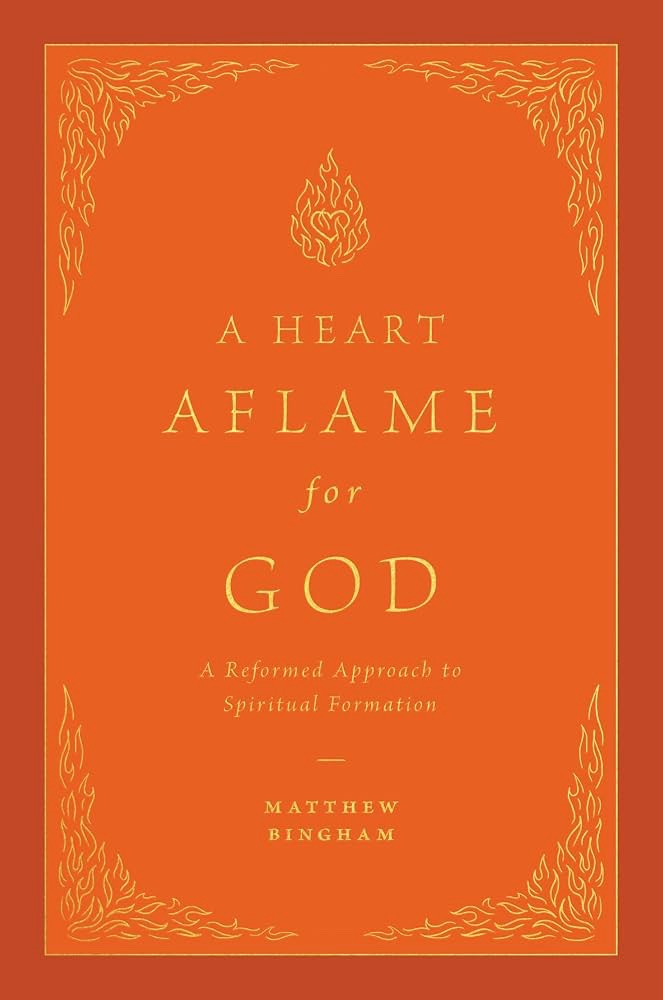
Then are books which come on the scene answering to a particular point in time in the history of The Church. Books which address a present crying need in our own context of American Evangelicalism. Books like Matthew Bingham’s “A Heart Aflame for God.” A book providing a deeply needed corrective at a critical moment. A book I wish every modern Believer would take up and read. A book essential to basic spiritual growth. A book I hope you buy, read and think deeply about. A book much needed. A book addressing a core spiritual issue which is often ignored by many, and at the same time pursued by others quite errantly.
More than a decade ago, I found myself preaching through Paul’s letter to the Ephesians. For me, Ephesians occupies a supreme place in the Scriptures. It is, to use modern parlance, the single best metanarrative provided by The Spirit for the Christian life and mind.
In 6 short chapters Paul probes the eternal mind and purposes of God before the world was even created;
moves us through the plan of God in the ages;
brings us to living out the implications of these truths in the world, the Church and down to our own homes;
equips us to wrestle with cosmic forces – and does all of this in the context of pointing us to the eternity before us.
No other book in the Bible comprehends so much in so little space.
The whole of God’s plans and purposes are laid before us in astonishing clarity and conciseness.
Every time we lose perspective, we can retreat here to gain the big picture once again. And what a breathtaking picture it is.
While preaching through Ephesians, I was captivated by Paul’s repeated motif of “Trajectory.” He refers to it almost everyplace he writes – but is perhaps best summarized in Romans 8 “For those God foreknew, He also predestined to be conformed to the image of His Son, so that He would be the firstborn among many brothers. And those He predestined, He also called; those He called, He also justified; those He justified, He also glorified. (Romans 8:29–30, BSB)
In other words, Paul, by The Spirit, is never at rest with people simply being saved or justified. We are saved for purposes – and especially for an end. As is repeated often in God’s dealing with Israel, that He brought them OUT of Egypt to bring the IN to Canaan; So it is Jesus brings sinners out of our death in trespasses and sins, to bring us unto, or into conformity to the image of Christ. To bring us into ultimate, manifest communion with Himself – face to face for eternity.
Being born again is just that – the new beginning. It is not the end. It is the starting point. Hence the entire Christian life is meant to be pursued on purpose in concert with the ends He has in store for us.
Sadly, for many, the Christian life seems to be stalled at the point of being justified. Growth in Christ, Peter’s sense that “Grace and peace” are to be “multiplied to you through the knowledge of God and of Jesus our Lord.” (2 Peter 1:2, BSB) appears almost absent. That there is no conscious attempt to “make every effort to add to your faith virtue; and to virtue, knowledge; 6and to knowledge, self-control; and to self-control, perseverance; and to perseverance, godliness; 7and to godliness, brotherly kindness; and to brotherly kindness, love.” (2 Peter 1:5–7, BSB)
Effort in the spiritual life seems to be a dirty word to some. As though intentionally living in concert with God’s purposes for us is somehow contradictory to living by faith.
Then again, we have (seemingly) scores of Christians (whether they actually are or not I’ll leave to a different discussion) pursuing a deeper spiritual life by swimming back across the Tiber to Rome or Eastern Orthodoxy. They have found the mere Christianity which stops at justification somewhat empty. And there is no trajectory in their spiritual lives. So they begin to look for it (as my Dad used to say) in “smells and bells.”
Perhaps they have rightly seen that some equate theological knowledge and orthodoxy with true spiritual growth. That being theological egg-heads equals spiritual maturity. Or perhaps they have found Christianity wanting because it is simply their religion of choice, having never been truly born again, and thus look for something(s) to fill the gap. I don’t know.
All that being said – there is much to be sought out and thought out regarding the nature of spiritual growth in Christ – or the lack thereof. It is to this need, and as a corrective against seeking such spirituality errantly, that Bingham’s book speaks so profoundly. And it does so by re-discovering how deeply previous generations of Reformed and Puritan thinkers and writers pursued the topic. It is a call and guide to intentionally pursuing true growth in Christ. It is a call to restore a fundamental component of genuine, Biblical Christianity. It is call to the Christian imperative to be seeking first the Kingdom of God and His righteousness – in the practicality of living unto God with purpose – daily and methodically.
I was reminded of Richard Baxter’s yearly visits with his own people when he would ask:
“Have you grown spiritually in the last 12 months?”
If they replied yes – he would ask, “how do you know? In what way?”
And if they replied no – he would ask “why not?”
Perhaps an inventory we would do well to take of ourselves on some regular interval.
While Bingham acknowledges the baggage which comes along with the term “spiritual formation” – he also defines it well: “Spiritual formation is the conscious process by which we seek to heighten and satisfy our Spirit-given thirst for God (Ps. 42:1–2) through divinely appointed means and with a view toward “work[ing] out [our] own salvation with fear and trembling” (Phil. 2:12) and becoming “mature in Christ” (Col. 1:28). (P. 34)
In arriving at this definition, he builds off of the Puritan John Flavel’s concept of “keeping the heart.” Something Flavel describes as “nothing else but this constant care and diligence of such a renewed man, to preserve his soul in that holy frame to which grace hath reduced it [i.e., led it back to], and daily strives to hold it. … [T]o keep the heart is carefully to preserve it from sin, which disorders it; and maintain that spiritual and gracious frame, which fits it for a life of communion with God. (Flavel’s works vol. 5:426)
O to be Christians in this mold!
In reading this volume, my own heart was challenged, cheered, excited, encouraged, directed, and made desirous of more of God.
If you have but one extra-Biblical book to read this year – make it this one.
You won’t be sorry.

