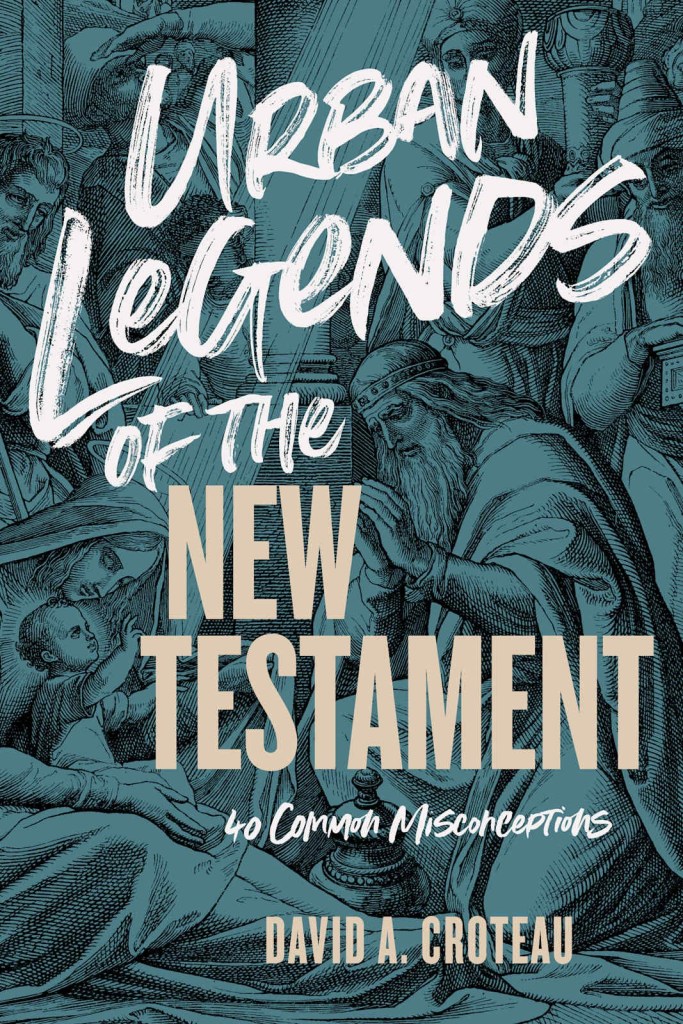
David Croteau’s Urban Legends of the New Testament is an easy book to recommend. And that, for anyone wishing to study, understand and apply their Bible better.
I don’t know that “Urban Legends” is the best description of what Croteau is addressing. Perhaps “common misconceptions” would be more accurate. Either way, it is a worthy read.
Starting with ideas like: Jesus probably wasn’t born in a stable as we might conceive it; that we have no idea how many “wise men” showed up (3 is an arbitrary number associated with the 3 gifts); on to – did the Philippian Jailor just “believe”? – the Gospel is “Dynamite” – Good works are optional for Christians – is tithing a New Testament command? Etc.. The author treats 40 such issues in all.
As someone who has taught and preached for over 50 years, the need to be sure I do my own homework, both in the original languages, the context of any given passage, and the historical and cultural contexts of passages, was refreshingly reiterated. No matter how long we have been in Christ, we must be constant (and growing) students of the Word, using all the tools at our disposal. It is all too easy to hear some idea about a portion of Scripture, whether a nuance of Greek or Hebrew, or an idea like whether or not Shepherds in Jesus’ day were really considered unreliable witnesses. It is important to search out details, and think through passages logically and carefully.
Now, if you are not a preacher or teacher, I can recommend this volume even more. The reason for that is – assuming you’ve not had the benefit of some solid seminary or Bible School training, this book becomes a really helpful “how to” guide for your own study. As you watch how Croteau handles each short study, you get an education in cultivating your own sound study and interpretive habits. You don’t have to be a scholar to dive in with greater accuracy and profit. But you CAN be a good student. And while there is labor involved, so is there great reward. And, the bonus of not being led down goofy side-trails by those who might attract admirers by virtue of novel interpretations and applications of The Word.
Each of the 40 chapters is pretty short. He begins with the common conception (or misconception), looks more deeply at the language, the larger Biblical context, the historical and cultural factors, and suggests a better understanding. Then, he tops off each unit with a lesson in application.
So whether you are a preacher/teacher wanting to sharpen your own skills in prep, or Joe or Jane Average Christian wanting to study, understand and apply your Bible better – buy the book.
You won’t be sorry.
You may get a preconceived bubble or two burst. That’s OK. It’s painless. And has a great pay-off.

