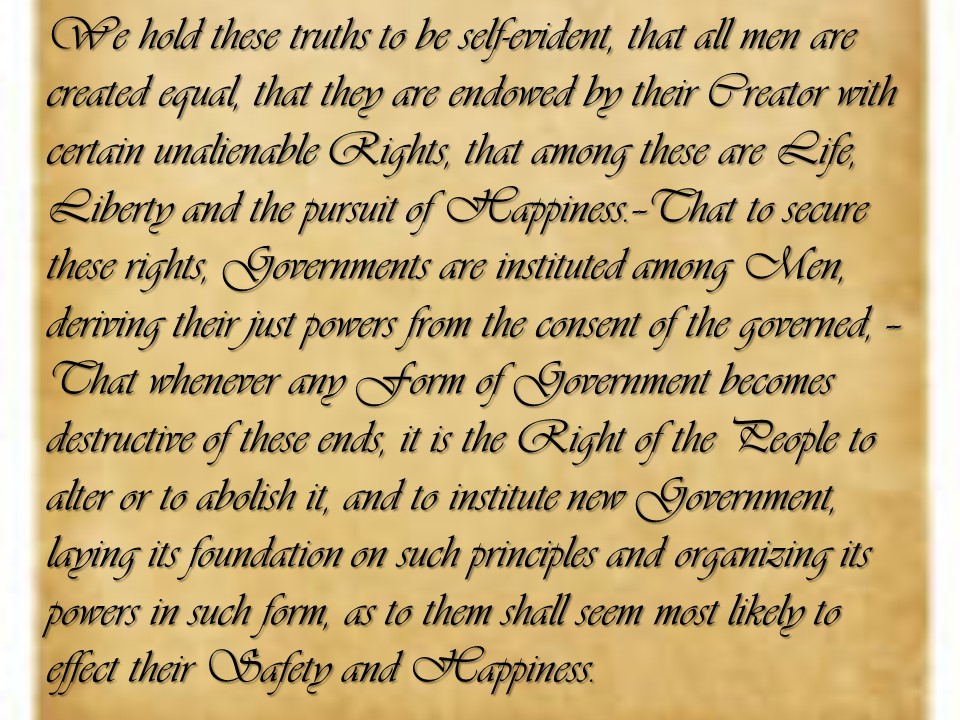
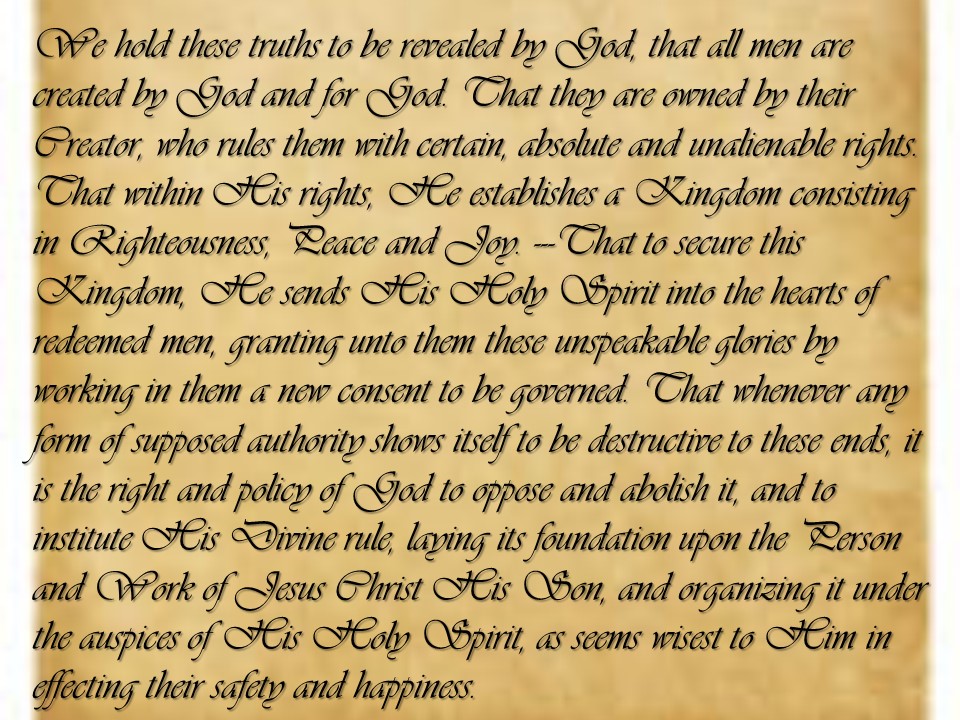
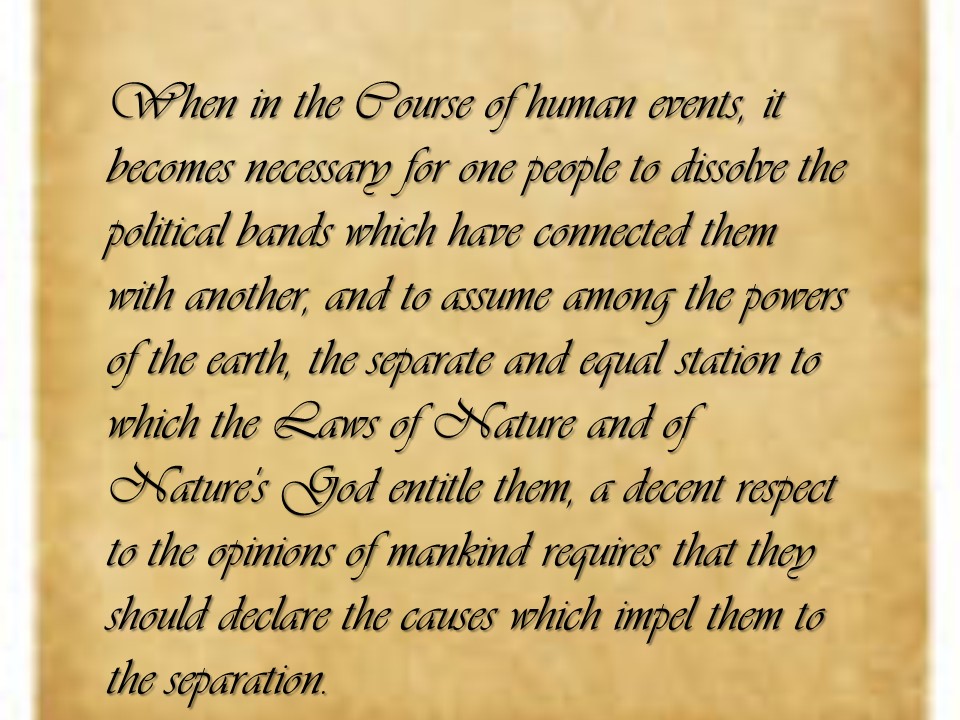
Last night as we gathered around the Lord’s Table, and given it was the 4th of July weekend, we thought some of how Jesus established the New Covenant in His blood at the table. And looking at that covenant as encompassing the “constitution” of the People of God, we compared the Declaration of INdependence, with how in Christ, at the Table, we ratify each time our Declaration of TOTAL Dependence. For we can contribute nothing to our salvation as it all rests in Christ alone. Following are the 4 slides we used. The 1st two drawing from what our earthly Founders penned, but then what a Declaration of Total Dependence might look like from the Lord’s People point of view. What a vast, infinite difference.
Category: Blogroll
-
Repentance is a common theme in the Bible. No one disputes that.
However, in our day of words taking on new meaning, what repentance actually is, is somewhat debated and, I think greatly misunderstood.
It is not uncommon for me to hear someone say they’ve “repented” of some particular sin. What they mean by that is they have felt sorry for it. Either for acting sinfully, or in the aftermath of having suffered the consequences of it – felt bad about it.
But this not how the Bible defines repentance.
Yes, repentance includes a realization that what one was doing is wrong in the sight of God, and feeling the pangs of distress that God has been offended, but there is more. It is also to change one’s understanding, belief and attitude toward sinful things, so as to alter one’s behavior.
If there is not a pursuit of renewed behavior, one has not repented. They’ve only gone ½ of the way.
Perhaps the most full bodied description of what true repentance looks like is found in 2 Corinthians 7:10–11
“For godly grief produces a repentance that leads to salvation without regret, whereas worldly grief produces death. 11 For see what earnestness this godly grief has produced in you, but also what eagerness to clear yourselves, what indignation, what fear, what longing, what zeal, what punishment! At every point you have proved yourselves innocent in the matter.” (ESV)
Irrespective of the particular sin cited in this passage, the pattern is remarkably clear.
- Godly grief. Grief at having offend God, not mere regret at having been caught or suffering the consequences of the sin.
- Earnestness in taking a new course.
- Eagerness to be clear of it in the future – to distance oneself from having countenanced the sin in the first place.
- Indignation that you allowed yourself to go that route at all.
- Fear of what continuing along that course would bring as opposed to the former brazenness.
- What longing after change in inward desires. To bless and serve God rather than to walk in contrariness.
- Zeal to put away the old and pursue the new.
- Willingness to accept right punishment. No attempt to confess and accept guilt as a tactic to escape what might be a just result. For example, the thief wants to let his or her responsibility go at saying “I’m sorry” while expecting to be exempted from having to make restitution. True repentance seeks to make things right among men if it in any way can, while knowing that making all things right with God is the exclusive province of the atonement of Christ. But it does not confuse the categories. It does not imagine that the free grace we can enjoy in Christ in no way destroys our responsibility toward those humanly whom we may have offended.
While each of these could be teased out and examined in deeper detail, for our purposes today, I think you get the point: Biblical repentance is far more than feeling bad about sin. It had a requisite aspect of changing course.
And that brings us to the real point of this short article. This displays what repentance looks like after sin. But we want to examine what repentance looks like – before the sin which has come to us in the germ of temptation brings forth its deadly fruit.
Here is the issue: As our model of sin becomes more and more “medical”, repentance loses its place altogether.
In other words, when we treat our sins as conditions or problems or defects to be treated, failing to accept the full weight of moral responsibility for them – we no longer repent. We say “I’m sorry”, to God and men (if other humans are included in the sin), but it ends there.
What takes the place of repentance? Helpless complaining. A fruitless and endless whining about how bad one feels about the sin, but a disinterest or half-hearted attempt at actually changing one’s thoughts, attitudes or actions.
The end result is a sullen Christian on an endless up and down sin-cycle, tainted with hopelessness.
What then is the answer? True repentance.
What does that look like?
- It takes a brutal, unwavering commitment to expose their sin to God every time it lures, coupled with a conscious reliance upon the indwelling Spirit of Christ to walk away.
The moment one senses their temptation stirring inwardly (and if you’ve been caught in a besetting sin for very long, you can see temptation on the horizon well before it becomes fully formed) praying. But the prayer must be as open and honest and graphic as possible. Something like “Father, you see what my heart wants right now. I want to __________. I know it is wrong, I know it is sin, I know it is an offense against you in the worst way, but I confess that I want it, and I will pursue it apart from the empowering of your Spirit. I am helpless against sin myself but bring to you right now. I really WANT this sin in myself, but am asking you for your gift of repentance through your Spirit’s work in me. Grant me grace to overcome.”
It is in the honesty of confessing our sin, owning our responsibility for it, and asking for the Spirit’s work to produce in us the likeness of Christ and the power to deny ourselves that we find Him supplying. Not bemoaning our failure in the aftermath but in fleeing to Him in them in full honesty before they become actions. Conscious, constant, deliberate dependence upon the Holy Spirit. Nothing else will do.
Sometimes, one will be praying like that 10, 20, 100, 1000 times a day. But this I know from God’s Word, that when we run to Christ in our helplessness, ripping off the mask of any self-righteousness and self-reliance – He answers. “God opposes the proud, but gives grace to the humble.” (James 4:6, 1 Pet. 5:5)
- It takes a willingness to identify the seemingly harmless precursors to actual sin, the things, places, people, attitudes, thoughts, etc. that through our repeated having fallen into sin are now familiar to us – and pleading for repentance then.
So there may be very legitimate things, things not sinful in and of themselves, but for you personally, you know to be gateways to certain sins, that you will need to avoid.
And I know the way sin argues. “But this is OK, there’s nothing wrong with it. Lots of other Christians do it all the time and with no problem.”
Yup. So what? You know that for you, this inevitably leads to something else that is sin.
Maybe it is entertaining criticism of others, which they may be deserving of, but for you ends up opening the floodgates of judgmentalism. Maybe it is a magazine or TV program that for you, soon blazes into lust. Maybe it is window shopping, which soon leaves you awash in a torrent of covetousness. Or the office pool that incites a deeper involvement in the thrill of habitual gambling with its lure of “just one more and I know I’ll strike it big!” Perhaps while ill, a little pampering by others feels so good, that the seeds of self-pity grow into a full crop that leads to the bottomless pit of depression. Or the joy of dabbling in politics that soon mushrooms into the sin of gripping anxiety over the state of affairs and plunges you deeper into despondency and other sinful heart states.
What we need is repentance. A heart that turns from those things, to find our needs met in Christ. To know ourselves well enough, honestly enough to recognize what easily leads into sinful paths, and to run to Christ at the first glimpse of them. To plead in our weakness, and to be willing to makes the changes we can make, so as prevent our presuming upon by grace, by plunging ourselves into temptation, and then complaining that we got soiled in the process.
- An increased delight in, and pursuit of those things which militate against sin arising in the heart.
One cannot cease from sin in a vacuum. If the heart does not take time to investigate, drink in, revel in, fill the heart and mind with the wonders, goodness, truth and blessings of God, one makes themselves an easy target for sin.
The more one is familiar with the highest and purest of things, the less they are satisfied with the lesser and more faulty. One who cultivates an eye and taste for fine art, loses their appreciation for velvet Elvises. The better things spoil you for the poorer. And the more you grow in the wonders of God’s truth and beauty, the less you will be tantalized by those things which are infinitely much less.
Repentance. Turning. Looking to Christ. Refusing the legitimate things that sometimes lead us there. And growing in the good things that truly nourish the soul.
Beloved, don’t treat your sins and sinful habits like disorders that just need the right medication or accommodation. Fight them – by seeking for true repentance from the Giver of repentance. He delights to bless His own.
-
I began yesterday with a brief review of Rosemary Sullivan’s powerful biography of Svetlana Stalin. But there was a second book which occupied me during my recent vacation which I found also well worth a hearty recommendation. The book’s title is “Heaven Below: Early Pentecostals and American Culture.” It is by Duke University historian Grant Wacker, and it is a fascinating study to be sure.Let me note that this particular study has a deep personal connection for me. For though Wacker focuses chiefly upon the 1st generation of the American Pentecostal Movement, from the late 1890’s into the 1930’s – my own heritage emerges from this context in the very next generation. I say this, for it was in 1935 that my Grandfather, George Shea founded Faith Tabernacle in Rochester, NY – later to become the still thriving Faith Temple.
That being the case, when Wacker cites Elim Bible Institute, the Rochester Bible Institute, and names like Ivan Q. Spencer, Susan Duncan (of the “Duncan sisters”), Stanley Frodsam and John Alexander Dowie and others – these are places and personages that formed part of my own consciousness growing up in that tradition.
The Author skillfully and painstakingly traces the inception of the movement with Charles Parham’s probable first exposure to speaking in tongues in “1900 at Frank W. Sandford’s Holy Ghost and Us divine healing compound in Maine.”
Dr. Wacker continues: “From these inauspicious beginnings the Pentecostal message spread slowly but steadily, mainly among old-stock whites-hard-working, plain folk. Initially it made news in the Kansas press, then shriveled and nearly died. In 1903 Parham salvaged the revival by returning to a divine healing ministry. Two years later he took the Apostolic Faith-as he called it-to Houston. There a black evangelist named William J. Seymour embraced the message and carried it to Los Angeles, where his preaching sparked the now famous Azusa Street revival in the spring of 1906.”
From there he investigates the formation of the Assemblies of God, its near demise over the “Oneness” issue, the founding of numerous Pentecostal denominations including the Foursquare Gospel Church under the aegis of the famous (or infamous – depending upon your view) Aimee Semple McPherson, and much much more.
As he says in his introduction: “By the end of the twentieth century more than 200 distinct pentecostal sects had established themselves on the American landscape.”
I was made aware of the book after hearing an interview Grant Wacker did with Dr. Al Mohler about it. It grabbed my attention from the outset and I was rewarded with a rich, fascinating, rewarding and insightful study.
Dr. Wacker writes as neither a detractor nor supporter. This is no “hit piece” nor is it hagiographa. He looks at the movement as a simple, matter of fact reality, comprising an important part of the Evangelical landscape in America.
Doing extensive research in as many of the primary sources he was able to comb, Dr. Wacker investigates not simply the formation and progress of the movement, but its varied manifestations, predominating demographics, unique features, prevailing attitudes toward things like war, the role of government, attitude toward non-Pentecostal denominations, race relations and the roles of men and women in leadership – to mention just a few. He truly strove to reconstruct as fully featured a portrait as might be possible. A portrait which I found hauntingly familiar to me, as well as one correcting some misnomers and presuppositions that may have been formed by myself, or in our little corner of the movement.
In analyzing his own research, Dr. Wacker arrives at a thesis. He brings it to us in the introduction, and then, very successfully sees it borne out in the study. He writes: “My main argument can be stated in a single sentence: The genius of the pentecostal movement lay in its ability to hold two seemingly incompatible impulses in productive tension. I call the two impulses the primitive and the pragmatic.”
By “primitive”, Dr. Wacker is not using that word as a pejorative, but as short hand for the Pentecostal’s desire to return to the “primitive” roots of the Church as exemplified in the “Pentecostal” outpouring of the Holy Spirit in Acts 2. And by pragmatic, he is not asserting any failure to look to the immediacy of The Spirit in their worship and lives, but simply, that as much as they sought the everyday experience of the divine as they understood it, they also lived in the real world and still lived in regular neighborhoods, held down regular jobs and took practical steps in regulating their worship and lives as needed. They weren’t (with a few exceptions) so “heavenly minded that they were no earthly good.” In fact, they very much fell into the mainstream of middle America as it was then.
Before I close, let me cite one more helpful quote from this important and fascinating book. It has to do with the Pentecostal self-identity. And I believe Dr. Wacker sums it up well when he writes: “So it was that just after the turn of the century one tiny band, meeting in a Bible school in Topeka, Kansas, grew particularly interested in the miracles described in the New Testament’s Acts of the Apostles. Led by an itinerant Methodist healer named Charles Fox Parham, the seekers read that on the Day of Pentecost Jesus’ followers experienced Holy Ghost baptism and “began to speak with other tongues, as the Spirit gave them utterance.” This simple story, which had fascinated Christians for nearly 1900 years, raised a question as disturbing ing as it was provocative. If speaking in tongues accompanied Holy Ghost baptism on the Day of Pentecost, why not now? Indeed, if then, why not always ways and everywhere? For the Kansas zealots the answer presented itself with the force of an epiphany: speaking in tongues always accompanied Holy Ghost baptism, first as an audible sign of the Holy Ghost’s presence, second as a tool for evangelism. This claim, unique in the history of Christianity, defined a relatively rare, relatively difficult physical activity or skill as a nonnegotiable hallmark of a fully developed Christian life. Not incidentally, it also defined believers who did not speak in tongues as second-class Christians. By definition they had not received the coveted baptism experience.”
Be you a continuist (believing that all the gifts of the Spirit can and do function today) or a cessationist (one who holds that all of the “sign” gifts ceased after the Apostolic generation) or somewhere along the continuum between the two, this book is important because of how much this movement impacted – and remains an influential aspect of – American Evangelicalism. For me personally, it helped frame much of my own familial and church milieu in far more cogent ways than I had previously understood.
And even if none of those things applies to you – it is a wonderfully engaging read. You’ll not be sorry you picked it up.
-
Vacation is a special time for me. I hunker down to read things I would not have the time for given my ordinary time constraints. And this vacation in particular found me reading (I should say devouring) two very different but powerful and enjoyable books. Both a bit lengthy, and both wonderfully rewarding. I wish to recommend them both, and whet your appetite for either just a tad.
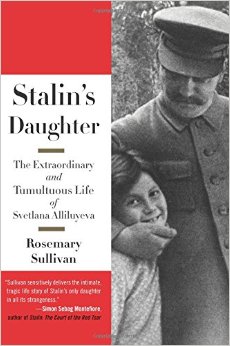
Though I was reading them simultaneously (along with snatches of 4 or 5 others) I began and ended first with the very recently released “Stalin’s Daughter: The Extraordinary and Tumultuous Life of Svetlana Alliluyeva” – artfully and captivatingly penned by Rosemary Sullivan.
As you might imagine, tracking down details and personages both in the former Soviet Union and in a number of other places around the globe was a monumental task. Collating that material in a narrative form that neither misses anything crucial nor allows itself to be bogged down in unnecessary detail must have been staggering. Staggering just to contemplate, let alone actually accomplish. Sullivan does it with a keen and insightful eye, sympathy without gloss and accuracy without judgmentalism nor cruelty. It is “reporting” of the first order. I could not put it down.
I grew to have a strong attraction to this wounded, but mostly undaunted and rare creature Svetlana. I wish so much that I could have known her. And that, in the full light that in her brokenness, she could often alienate those who delighted in her most. Not out of a native cruelty to others as much (at least as it seems to me) as a certain lack of emotional filters never allowed to be cultivated in her odd environment and collection of extreme circumstances.
The human soul craves. Just as we are born physically hungry, so our souls enter this world hungry. We are, I think, most hungry for 3 things: Affection, Affirmation and Accomplishment. When any or all of these are withheld, or meted out in spasmodic dribbles, they grow to overlap one another and become nearly indistinguishable. If imbalanced, we can unconsciously let them disproportionately take the place of each other – trying to fill the void. But because they are in fact discreet, they can move into each other’s room, but never actually occupy or fulfill the missing one(s).
In the beginning, the myopia of youth assumes the presence of these even if they are only there in shadow. As time removes the masks to expose the truth, the disillusionment can be so unsettling as to be almost impossible to recover from. Such is Svetlana’s story.
Brilliant, but daughter to a cold and distant idealog of a mother – who took her own life when Svetlana was but a little girl (a fact she never learns until she is 19 years of age), and an evil genius of a monstrous father who bears the responsibility for the deaths of 50 million souls (by some estimates) – that Svetlana survived or functioned at all is nearly beyond belief. But there she stood – the impossible by-product of this perverse union. And a testament to the wonder of what creatures made in the image of God can endure – even when He is denied and railed against. It makes you gasp.
Through her oh so many and painful relationships. Living in the artificial bubble of Soviet Socialist elite at its most ruthless and powerful. Coming to grips with total unpreparedness to live outside of that bubble when at last escaping to the West. Naïve in the most interesting ways, and yet equally wise in others. This force of humanity called Svetlana was shaped so profoundly by the fitful spurts and drops of affection, that she sought to fill that void over and over by any means she could. In time, she would accomplish much by her writing, and win the affirmation of many (whilst being excoriated by countless others), but those cannot replace true affection no matter what one does. And when you’ve been virtually starved for true loving affection – and when it has been used as a weapon or a means of control for so long – one wonders if you lose the capacity to ever take it in and feed upon rightly at all.
All I know is, I kept wishing that someone, anyone would take this little girl and scoop her up in their arms and show her simple, unqualified love and affection. I wished it time after time. Scene after scene. Decade after decade. And it seemed none but her own daughter ever really came close. But she needed it from someone other than her daughter as well. And I wept inwardly that it was never so.
That does not mean I left the book pitying her. I do not think that was Sullivan’s point at any time in her writing the book either. Indeed, I came away admiring her time after time. I just wanted more for her. Better for her. For she was throughout her life and in the end, a truly extraordinary human being. Both tragic and triumphant. But one whom I saw as having appendages of her soul that like undeveloped limbs never were allowed to function as fully as they ought. For all that, those were also part of what made her the amazing individual she was.
In the end, I think that is what Svetlana really wanted – to simply be her own person. To not have her individuality eclipsed by being Stalin’s Daughter. The Kremlin’s little girl. The United States’ prize defector. A mark for other’s plans and schemes to be played off of for their own purposes. Just to be. But it was not to be so.
Rosemary Sullivan is to be congratulated above all – for trying to make that a reality for Svetlana though it be posthumously.
This is a towering work of research and testament to one of the most enigmatic and powerful figures of our time.
Thank you Rosemary Sullivan – for bringing Svetlana Alliluyeva into my life.
-
Proverbs 31:1-9 Part 4
Revelation 17:14
Revelation 19:11-16
THE AUDIO FOR THIS SERMON CAN BE FOUND HERE
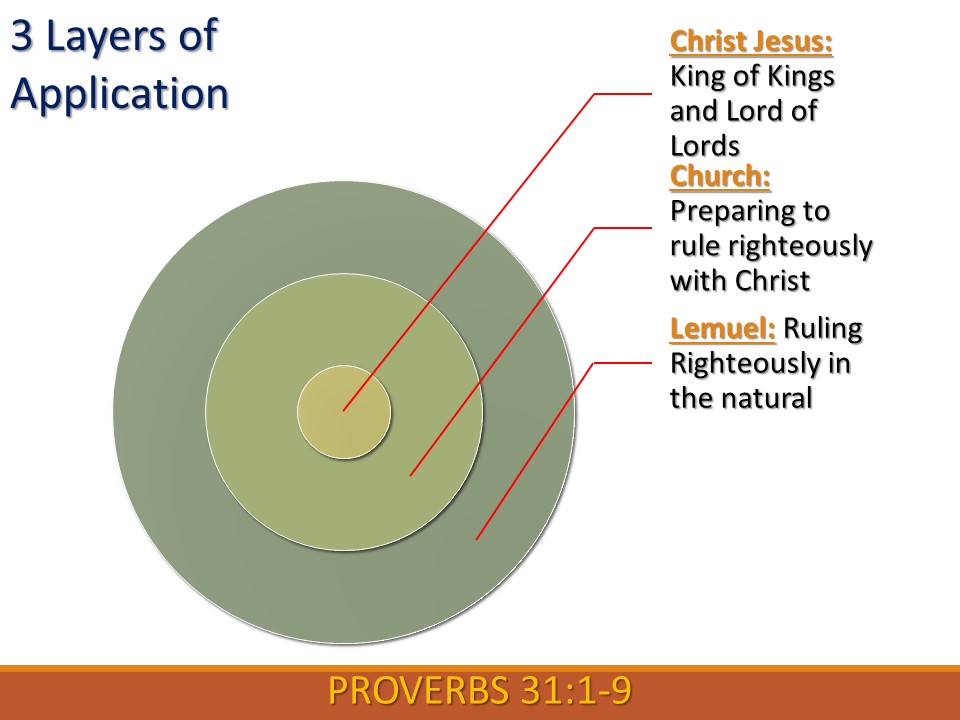
We’ve looked at these 9 verses exclusively from the vantage point of the Believer’s destiny to rule and reign with Christ. And therefore the call to live NOW with that royal glory as just before us. And that in 3 critical areas.
In fact, passages like this one need to be peeled, a bit like an onion.
In this case, in 3 layers.
The first layer
is that which most plainly lays on the surface – this portion is first of all the words of Lemuel’s mother regarding 3 key areas of his personal behavior regarding his ability to rule and reign as a GOOD king, righteously.The initial application then being to any who are given places of responsibility with authority over others.
In vss. 2-3 / One needs to have clear commitment to MORALITY. In this case specifically, sexual morality – since it is central to morality as a whole.
Secondly in vss. 4-7 / One needs to avoid those INFLUENCES which might skew their judgement. Specifically in this case – she cites intoxicating drinks.
Lastly 8 & 9, she admonishes him to not forget to guard the rights of those who cannot speak up for and defend themselves – the mute, destitute, poor and needy. To speak up for them and secure JUSTICE for them.
Now our work in interpreting such a passage is not done unless we move beyond mere moral and ethical considerations, and move into the spiritual application to the Church.
So we saw a (2nd Layer)
This we did by seeing how as Christians – the Redeemed, we have a destiny to one day rule and reign with Christ.Being destined for that exalted place one day, we wanted to see how these same admonitions apply to us.
What it means because of OUR royal calling.
To be a People who walk in moral uprightness – displaying Christ.
Being clear headed and sober-minded through the influence of the Holy Spirit instead of the myriad of earthly intoxicants or influences which might skew our judgement.
And last to be those who also seek justice in this world, while lifting up our voices in preaching to Gospel to and interceding in prayer for those who are spiritually mute, destitute, poor and needy.
How to conduct ourselves as Christ’s Church especially in this lost and broken world.
(3rd Layer) Today then we want to attempt to finish our look at these 9 verses by inquiring what they might reveal to us in terms of the person of Jesus Christ Himself.For we have never fully understood any passage until something of Christ and His glory is revealed to us.
We are reminded of Jesus’ own words in this regard: John 5:39 You search the Scriptures because you think that in them you have eternal life; and it is they that bear witness about me,
And again after His resurrection with the 2 on the road to Emmaus: Luke 24:27 And beginning with Moses and all the Prophets, he interpreted to them in all the Scriptures the things concerning himself.
One of the most destructive patterns that can creep into the Church is when we teach the Bible as collection of moral or ethical lessons, instead of digging deep enough to discover the revelation of Christ – the Glory of God in it.
The Bible is not a book of good advice, or even of simply “Christian” ethics – it is first and foremost God’s self-revelation, culminating in Jesus Christ.
If all the Bible is to you is good advice – you can learn every one of its ethical precepts and carry them out to the fullest – and still die and lose your soul in an eternal Hell.
This is absolutely vital to understand. A matter of literal life and death.
One more brief word of introduction.
One of the things the Bible often does is mix its metaphors.
It does this to tease out other and complimentary truths about the same thing.
EXAMPLE: Jesus is both the Lion of Judah, and the Lamb slain for sinners.
EXAMPLE: John 10: Jesus is the DOOR of the Sheepfold (7); He is “the Good Shepherd” (11); He enters BY the door (vs 2) but also IS the Door AND the Shepherd who enters.
When we do not allow for this mixing of metaphors, we run the danger of absolutizing them.
For instance, we know that Eph. 2 notes that sinners are DEAD in their trespasses and sins. And so they are. But not SO dead that they are not to be preached to, lived righteously before, reasoned with from the Scriptures and still morally responsible for their thoughts and actions.
So in this passage.
We’ve looked at how we are destined to be Kings ruling and reigning WITH Christ, but the Bible also uses a different metaphor to round out some of these ideas. One which will play a major role in the rest of this chapter – though we want to apply it in these 9 verses right now.
SO – While we ARE called to rule and reign with Him – The passage also piques our interest in considering the same three things we’ve already seen, and how they apply to Christ Himself in HIS kingly role.
- vss. 1-2 / Jesus Christ our King is Absolutely FAITHFUL to His Own.
He is not promiscuous with His love, but is EXCLUSVELY betrothed to and committed to – but ONE BRIDE, not many.
2 Corinthians 11:2 For I feel a divine jealousy for you, since I betrothed you to one husband to present you as a pure virgin to Christ.
This notion of Christ’s exclusive relationship with His Church – His people, begs 2 very important applications.
2 applications:
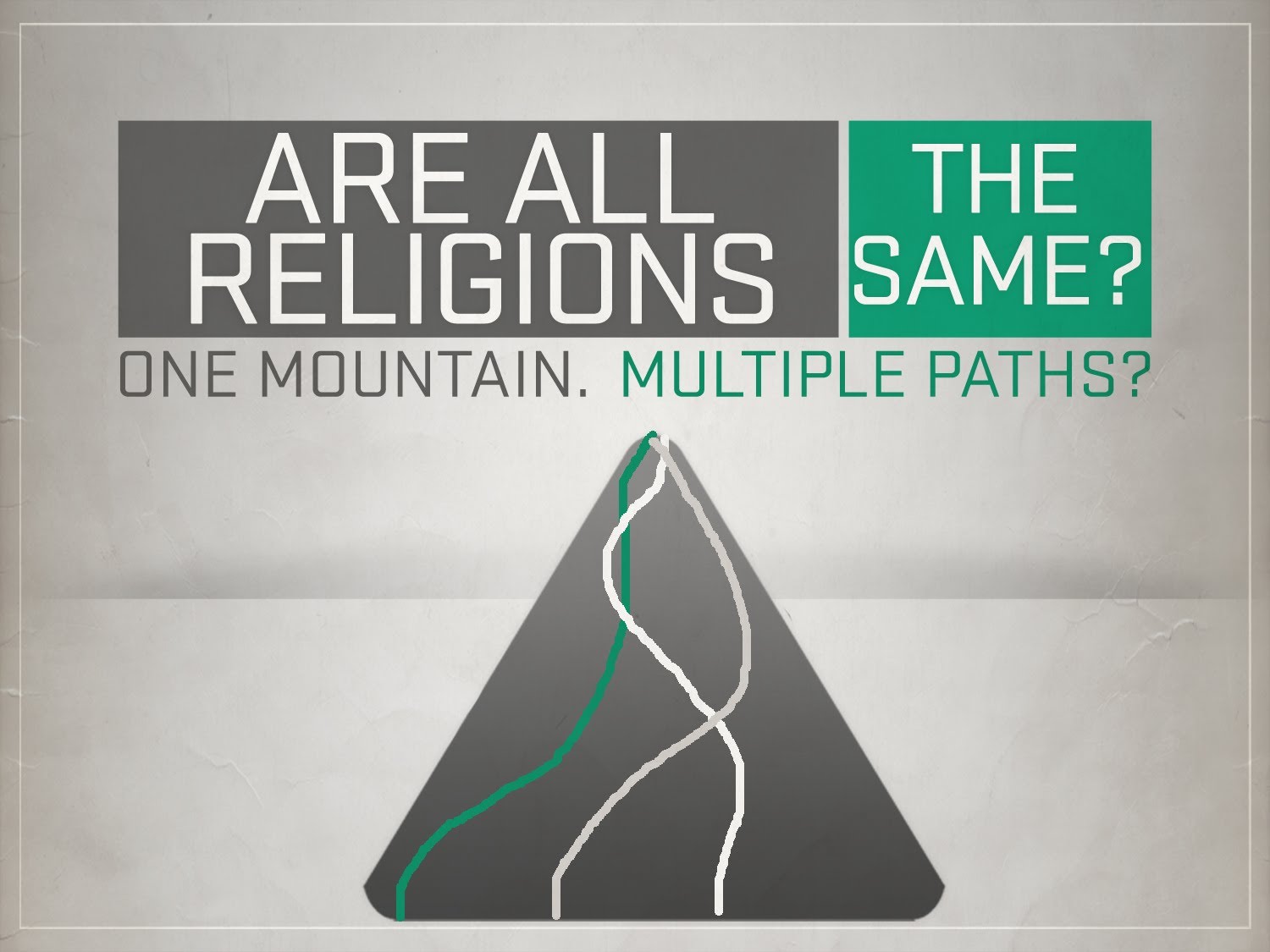
- It is common in our culture today to hear that all religions are basically the same.
In the cast of the old adage that “all roads lead to Rome” – so (some say) all religions lead to God or to Heaven.That God does not discriminate against any religion or approach to Him.
But this is not the testimony of Scripture.
And that Jesus makes VERY exclusive claims is beyond question.
Just before His betrayal, as Jesus was talking with His disciples He said:
John 14:2–4 In my Father’s house are many rooms. If it were not so, would I have told you that I go to prepare a place for you? 3 And if I go and prepare a place for you, I will come again and will take you to myself, that where I am you may be also. 4 And you know the way to where I am going.”
Thomas, in his guileless way says in response: John 14:5 “Lord, we do not know where you are going. How can we know the way?”
To which Jesus responds: John 14:6 Jesus said to him, “I am THE way, and THE truth, and THE life. No one comes to the Father except through me.
Where I am going is to God the Father.
And the Way to get to Him is BY ME – I AM The Way to Him.
The truth of all of this is wrapped up in ME.
The Disciples clearly understood this reality. For instance, Matthew notes Jesus saying in His Gospel: Matthew 11:27 All things have been handed over to me by my Father, and no one knows the Son except the Father, and no one knows the Father except the Son and anyone to whom the Son chooses to reveal him.
And John therefore records Jesus saying that everything had been given to Jesus by the Father,: John 5:23 that all may honor the Son, just as they honor the Father. Whoever does not honor the Son does not honor the Father who sent him.
And then later in his own epistle John writes: 1 John 2:23 No one who denies the Son has the Father. Whoever confesses the Son has the Father also.
To go to God, one must acknowledge His Son AS the Son, or remain lost.
- How He is faithfully committed to His own so that He will never leave us, lose us or fail to complete the work He has begun in us.
John 6:35–39 Jesus said to them, “I am the bread of life; whoever comes to me shall not hunger, and whoever believes in me shall never thirst. 36 But I said to you that you have seen me and yet do not believe. 37 All that the Father gives me will come to me, and whoever comes to me I will never cast out. 38 For I have come down from heaven, not to do my own will but the will of him who sent me. 39 And this is the will of him who sent me, that I should lose nothing of all that he has given me, but raise it up on the last day.
Philippians 1:6 And I am sure of this, that he who began a good work in you will bring it to completion at the day of Jesus Christ.
The Faithfulness of Jesus Christ is central to our salvation.
If you are a Christian today, you are one because He is faithful to complete the Father’s Will, which includes saving and preserving those given to Him by the Father.
- vss. 4-7 / Jesus Christ our King is UNERRINGLY Wise in all His dealings with us.
In Him dwells all the fullness of God bodily. (Col. 2:9)
He IS the very Wisdom of God Himself. (Col. 2:3)
He is never swayed by anything other than His own perfect knowledge, which in omniscience is absolutely comprehensive, and in His justice and perfection never fails to do what it perfect and upright and just.
Not a few Christians here have gone through trials and tribulations in their lives, where they wondered if there was any rhyme or reason to it.
And our assurance is that because Christ Jesus our Savior is sovereign over His universe, there is ALWAYS perfect wisdom behind the circumstances of our lives.
Even when the Enemy of our souls attacks us, we can know nothing can happen to us but by His divine permission, and that by His blood there is nothing He cannot and does not redeem for our ultimate, good, blessing and happiness if we will but trust Him in it.
Romans 8:35–37 Who shall separate us from the love of Christ? Shall tribulation, or distress, or persecution, or famine, or nakedness, or danger, or sword? 36 As it is written, “For your sake we are being killed all the day long; we are regarded as sheep to be slaughtered.” 37 No, in all these things we are more than conquerors through him who loved us.
Romans 8:28–30 And we know that for those who love God all things work together for good, for those who are called according to his purpose. 29 For those whom he foreknew he also predestined to be conformed to the image of his Son, in order that he might be the firstborn among many brothers. 30 And those whom he predestined he also called, and those whom he called he also justified, and those whom he justified he also glorified.
Note that first sentence – this we KNOW.
We don’t surmise it, or merely Hope it, – we KNOW it!
Not because “things” themselves just “always work out” but because the Christ who saved us by His blood is at work in us, bringing us safely to the Father, and that, so that we might one day appear without spot or blemish – but be completely conformed to His glorious image.
Some of that work in us is painful, difficult, complex and long term – but He will use all of Creation and every personality and circumstance around us to bring it to completion.
Oh what a mighty Savior we serve!
And how that flows right into this 3rd application.
- Jesus Christ our King is perpetually raising His voice in administrating justice, AND, interceding for His saints.
We do not have time to develop the nature of Jesus’ administration of justice this morning, if we are to look a little more carefully at His intercession – which I plan to do today.
Perhaps we can revisit this area another time.
So let’s note then the wonder of Christ’s intercession for His Redeemed Ones.
First notice how His blood is more than sufficient for all of our sins!
1 John 2:1–2 My little children, I am writing these things to you so that you may not sin. But if anyone does sin, we have an advocate with the Father, Jesus Christ the righteous. 2 He is the propitiation for our sins, and not for ours only but also for the sins of the whole world.
But then secondly, His pleading on our behalf.
Hebrews 7:22–25 This makes Jesus the guarantor of a better covenant. 23 The former priests were many in number, because they were prevented by death from continuing in office, 24 but he holds his priesthood permanently, because he continues forever. 25 Consequently, he is able to save to the uttermost those who draw near to God through him, since he always lives to make intercession for them.
He is our Great Advocate and Intercessor.
In our sinfulness we need an Advocate – one who can vouch for our righteousness because it is His own righteousness imputed to us.
And one who continues to pray for us, to intercede before the Father’s throne on our behalf.
Christian, have you ever stopped to think that you are the topic of discussion between God the Father and God the Son?
That in that discussion, Christ is your great champion, never ceasing to ask the Father for the riches of His grace to be poured out on you?
He is! This is a staggering truth.
If no one else in all the world is praying for you Believer, if you think yourself all alone and abandoned – remember this: Jesus Christ THINKS of you and ever lives to lovingly and personally carry you and your needs to God the Father – without ceasing.
Romans 8:34 Who is to condemn? Christ Jesus is the one who died—more than that, who was raised—who is at the right hand of God, who indeed is interceding for us.
When Jesus pleads for his people, his pleas are omnipotent, and God will never deny to his Son the reward of his soul-travail. I suppose that, in heaven, Christ pleads for his people vocally, but it is not at all needful that he should; for his very presence there is an irresistible plea. If someone were pleading before an earthly court, and if he had been an old soldier, and had rendered valiant service to his country, if he were to bare his breast, and show the scars of the wounds that he received in battle, he would not have to say much, for his scars would plead better than any words could; and Jesus in heaven lifts his hand and feet, and shows his piercèd side. His scarred person, still adorned with the marks of his passion and death, is an everlasting and overwhelming plea. If Jesus pleads for me, can his Father reject me? If so, he must also reject his Son, he must refuse the authoritative requests of his only-begotten and well-beloved Son he must deny to Jesus that which he well deserves; and that he never can do. O believer, if you still have any doubts about your acceptance in Christ, let them fly before this fourth mighty blow, “who also maketh intercession for us.”[1]
Jesus Christ our King is FAITHFUL to us in all He does
He sovereignly rules our lives and all of creation in perfect wisdom
And He intercedes for us with the Father – unceasingly and unerringly.
What a glorious King He is to His People!
[1] C. H. Spurgeon, The Metropolitan Tabernacle Pulpit Sermons (vol. 53; London: Passmore & Alabaster, 1907), 571.
-
Proverbs 31
Part 3
Living Like Kings
Proverbs 31:1-9; Deut. 10:17-22; 16:18-20; 2 Sam. 23:3-4
THE AUDIO FOR THIS SERMON CAN BE FOUND HERE
As mentioned the last 2 times, the language of this final chapter forces us to go back to the very beginning of the book.
These 1st 9 verses especially, addressing “KINGS”.
Once again we note that we actually come full circle in the book.
Solomon is preparing his son for the throne,
Lemuel’s mother is preparing him for the throne –
and The Holy Spirit is preparing all of Christ’s blood bought ones for the throne.
As we read in Rev. 5:9–10 And they sang a new song, saying, “Worthy are you to take the scroll and to open its seals, for you were slain, and by your blood you ransomed people for God from every tribe and language and people and nation, and you have made them a kingdom and priests to our God, and they shall reign on the earth.”
So far – we’ve seen 2 vital principles:
In the natural: I. 2-3 / KINGS CANNOT RULE WELL IF THEY ARE MORALLY COMPROMISED.
In the Spiritual: 1. The Church cannot represent the Gospel to the World if WE are a morally compromised Church.
In the natural: II. 4-7 / KINGS CANNOT RULE WELL IF THEIR PERCEPTIONS AND JUDGEMENTS ARE SKEWED BY UNHEALTHY INFLUENCES.
In the Spiritual: 2. The Church cannot represent the Gospel to the World if we are not sober in our perceptions and judgments.
So in vss. 8-9 we have our 3rd Principle: III. 8-9 / KINGS CANNOT RULE WELL IF THEY DO NOT RECOGNIZE RIGHTS & RESPONSIBILITES ABOVE THEIR OWN FIAT.
Proverbs 31:8–9 Open your mouth for the mute,
for the rights of all who are destitute.
Open your mouth, judge righteously,
defend the rights of the poor and needy.
Charles Bridges notes: Very soundly does the wise mother inculcate mercy in her royal son. This is one of the pillars of the king’s throne (20:28 [kjv]). He must be the father of his people, using all his authority to protect those who cannot protect themselves. No case of distress, when coming to his knowledge, should be refused his attention. Thus our law makes the judge the counsel for the prisoner who is unable to plead for himself. “Speak up for those who cannot speak for themselves.”[1]
In ruling well – It is the duty of Kings to protect, provide, & insure justice for, those, who by reason of age or defect cannot protect, provide or speak up for themselves.
This is true in every strata of authority from the home to the state to the Church.It is a popular misconception that part of the Hippocratic Oath which Physicians take states: “First do no harm.” Prob. A 19th century phrase.
But it fits well here.
Those in power must look out for those over whom they rule.
Their position of rulership is first & foremost a position of CARE.
To make decisions & to administrate justice in the way which is best for human flourishing for ALL under their care.
This is the rule in all ministry as well – & why those who function as elders & deacons (or any other role) are charged with protecting others from false doctrines which wound & kill the soul, as well as feeding them on the most healthful of all things – The Word of God.
This is how we can do you the most good!
- The Church cannot represent the Gospel to the World if we do not recognize rights & responsibilities above ourselves.
In this sense we realize the Church is NOT self-governing, but under the Lordship of Christ.
Colossians 1:18 And he is the head of the body, the church. He is the beginning, the firstborn from the dead, that in everything he might be preeminent.
It is the duty of Believers to protect, provide, & insure justice for, those, who by reason of age or defect cannot protect, provide or speak up for themselves.
The Church cannot serve as Christ’s vice-regents if we are not impartial and given over to justice and the rights of those who are poor and unable to defend themselves.There is no question that God was greatly invested in Israel being a nation that operated in administering justice to its people, instead of despotic fiat.
Lex Rex (before Samuel Rutherford – 1600’s) to Christus Rex – under the Lordship of God Himself was to guide their dealings.
The Church can do no less.
We are to be vitally interested in what is justice, especially for those who are poor or marginalized and helpless.
Those who cannot, either due to age or circumstances seek justice for themselves.
The Church is to be a champion of justice in the world.
We might say this is the first layer of application we must take from this passage.
But secondly, we have to see how this especially applies to “Opening OUR Mouths.”
Notice these words repeated twice: “Open your Mouth”
When we see our governments failing in these matters – it is our responsibility to speak up.When for instance, our government pursues the allowance of abortion in our society – it is The Church who has the 1st responsibility to decry it & protect the rights of those unborn babies who cannot speak for themselves, nor protect nor provide for themselves.
When policies like the promotion of state sponsored gambling which preys upon those least able to recognize the damage it does & wreaks havoc in the parts of society who can least sustain that damage – it is the Church who must speak up.
We must not be afraid to OPEN OUR MOUTHS.
We could site many, many others such concerns, like legalized prostitution, or same sex marriage – but there is a 3rd layer which is still more crucial to take in.
All that we have said thus far is true in the cultural realm, but I believe the text leads us to understand it even more so in the spiritual context.
Yet even before we unpack that 3rd layer – let us be reminded how it is that Christ will bring justice when He comes.
We need to constantly remind ourselves that Jesus will at last bring to right every wrong.
No one will escape.
Those countless millions who have suffered under tyrants, despots, systems, civil OR religious &/or individuals will one day see justice poured out.
No one escapes justice when they die.
Each will be resurrected to stand before the throne of God to give an account and to “receive” from Him, regarding those things done while they were alive in their bodies.
2 Corinthians 5:10 For we must all appear before the judgment seat of Christ, so that each one may receive what is due for what he has done in the body, whether good or evil.This is why we must be doubly careful not to seek revenge or retribution as Christ’s people – but entrust final justice in His hands.
Because He IS just, He cannot over-punish any, nor can He err and UNDER-punish any.
So what then is that 3rd layer which I think we need to give special attention to here?
In the twice repeated “open your mouth” do we not have the most urgent call to prayer?
For even if we cannot bring about justice in our age, we CANtake up the cause of those who cannot plead for themselves, who are either too young, or by defect of some kind unable – to plead for themselves.
After all, who are more unable to even perceive their own need than the lost?
Blind and deaf and insensible of their state.
Unable to cry out for themselves.
Are we not to intercede for them?
Are we not to take their cause before the Throne of Grace – to plead for their souls and that they might find justice in the cross of Christ rather than stand before it in themselves on the Day of Judgment?
If we haven’t done this for our cultural and governmental leaders who are apart from Christ – then all our other speaking up and into the society will have little or no effect!
We’ve only done ½ of our job if all we’ve done is decry sin & injustice – the texts calls us to open our mouths twice!
Decry – yes! But ALSO – plead on behalf of these still so lost they don’t even know to plead for themselves.
Isn’t this the heart of Paul in Rom. 3 when he cries that he wishes he might be accursed so that his brothers & sisters in Judaism might know the Redeemer
Romans 9:3 For I could wish that I myself were accursed and cut off from Christ for the sake of my brothers, my kinsmen according to the flesh.
Who are more mute before God, not even pleading their own cause than the lost?
Who are more destitute than those who are without Christ?
Who are more poor and needy than those who have none of the blood of Christ to cover their shame and their guilt, and have nothing of Christ’s Holy Spirit indwelling them?
As those destined to rule and reign with Jesus – the one whom says of Himself that He: “came to seek and to save the lost” – do we not take into account the great day of reckoning and in it plead now for an end to the violence on earth,
An end to war to rape & abuse & rage & injustice of all kinds?
Ought we not to be praying Father “THY will be done on this earth as it is in Heaven”
Can’t we open our mouths BOTH TO those perishing, in announcing the Gospel, & TO the Father to have mercy upon them & to free them from the grossest of cosmic injustices in having been lied to by the Devil and kept in their darkness by his machinations?
No where can we be a more impactful people than upon our knees – pleading.To open our mouths for those loved ones, sons, daughters, spouses, siblings, fathers, mothers, friends, relatives & strangers who still need the mercy of our Savior!
“Open your mouth” Lemuel’s mother tells him – “open your mouth” – cry out to the God who hears & answers and whose Gospel is to reach the farthest corners of the earth – to “every living creature” as Jesus told His disciples.
Mark 16:15 And he said to them, “Go into all the world and proclaim the gospel to the whole creation.
Matthew 9:37–38 Then he said to his disciples, “The harvest is plentiful, but the laborers are few; 38 therefore pray earnestly to the Lord of the harvest to send out laborers into his harvest.”
Open your mouth says Jesus that the Lord of the Harvest may send many workers into the field.
Open your mouth to plead for those who have sinned against you that they might not stand before the throne of Judgment naked without Christ’s righteousness.
For it is such a terrible & unthinkable end as to torment to our own souls that such – even as they – should perish in the Godless terrors of an eternal Hell – without any further hope of redemption.
Lastly – before we leave this text, we need to notice something more: The overarching context in which Lemuel’s mother speaks.
When she mentions “rights” in vss. 8 & 9 – she is appealing to some grand scheme of JUSTICE.
That justice & not Lemuel’s mere opinion or choice must guide him in ruling well.
Something above & outside of himself.
From which we take this idea of 1st importance: The Gospel itself is rooted in justice.
It is a grave mistake to think that salvation is the cosmic equivalent of olly olly oxen in free (possibly “All ye, all ye ‘outs’ in free,”, or from the German “alle alle auch sind frei” – everyone is also free)
God doesn’t just wave His hand and say “I forgive you.”
The plan of salvation – for God to redeem lost sinners to Himself required a means, one which would provide forgiveness for all who believe, while at the same time preventing the violation of His justice.
How can the Judge of all the universe, spare any sinner without violating His own nature, without being unjust?
He is by nature JUST. He must always act in perfect justice.
Justice requires that sin be paid for – the just sentence for the offender be carried out.
This is precisely why we need – and preach THE CROSS of Christ.
On the Cross, God can pour out His just wrath on the Willing Substitute – Jesus.
The Father willingly accepts His sacrifice, & on the basis of it can offer not merely forgiveness, but a pronouncement of “RIGHTEOUS” – “NOT GUILTY” on the accused.
Jesus takes our guilt upon Himself – pays our penalty – but then rises from the dead to give us eternal life.
Someone else – not guilty of any sin of their own steps up and says “I’ll Pay the Death Penalty.”
The God of the cross justifies the ungodly through Christ’s substitution so that His mercy is not expressed at the expense of His justice.
Lose this – & the Gospel ceases to make any sense.
Only if it is a means to clear the guilty & still preserve justice can we be saved.
Hence the false Gospel of today which says the death of Christ was not penal and substitutionary.
[1] Charles Bridges, Proverbs (Crossway Classic Commentaries; Wheaton, IL: Crossway Books, 2001), 280.
-
“If this work of grace had taken place then, they said, one great overriding result would follow, that is, the man would have a deep and continually deepening sense of sin.”[1]
The Christian life is one that includes a number is deep and powerful paradoxes. One which I encounter often in counselling others, has to do with the quote above by G. A. Hemming.
Somewhere, somehow in Church Culture, there has grown up among us, inherent to our Christian ethos – the idea that the more one grows in Christ – the LESS they feel and consciously need to grapple with their remaining sinfulness. That if we are really mature in Him, we’ll have less and less need to think about, wrestle with and confront the remnants of indwelling sin.
The Puritans knew better.
In their dealing with the souls of those under their charge, especially those troubled about the assurance of their salvation – they counted it as a foregone conclusion, that one “great overriding result” of genuine saving faith, is that the true Believer has a “deep and CONTINUALLY DEEPENING sense of sin.” (Emphases mine).
Did you get that?
The mature Believer doesn’t get LESS sin conscious, they get MORE sin conscious.
It is a plague among us that some who have professed faith in Christ, and claim to have walked with Him for many years, grow less sin-conscious. As though they have somehow actually killed some aspect of sin and no longer feel its pull or accede to its wishes.
This is nothing less than pharisaical self-delusion.
The closer one comes to light, the MORE their blemishes and spots appear, not less.
The more we walk with Christ, and the Word by the Spirit continues to re-train our consciences, the more aware we are that our sin is deeper, more covert and more deadly than we thought when we began.
Like peeling back the layers of an onion, the superficial sins which once troubled us so, may be shed, but the systemic remnant of sin is found to be far more acrid the deeper we go. Less observable from the outside perhaps, more subtle to the naked eye, but now seen as rooted in the sinful motivations, thoughts, opinions and frameworks that no one else can see – but the Holy Spirit alone.
It is why The Psalmist pleads that the Spirit search his heart. For his “hands” may be clean, when all the while, his soul is rife with bitterness, resentment, doubt, self-love, self-righteousness, self-reliance, malice, prejudice, blindness, and incorrigible lust, greed, envy and the such like.
Believer, if you are growing duller and duller toward your own sin – RUN! Run back to the unsparing eye of the Righteous Judge and plead that He may reveal your sinfulness to you, that you might acknowledge it, own it and be granted repentance from it.
Nothing is so insidious as the sin we are unaware of.
Believer, if your sin is becoming more and more evident to you – you are in a good place. Run in your naked foulness to the One alone who can clothe you with His righteousness.
Know that fresh realities of sin are fresh visitations of the Spirit as He labors to free you from the bondage of them.
The True Believer isn’t the one who has achieved some self-deluded level of Christian perfection.
But the one who is humbly bowed before the Cross continually – trusting in Jesus the Christ, who justifies the ungodly.
[1] G. A. Hemming, “The Puritans’ Dealings with Troubled Souls,” in Puritan Papers: 1956–1959 (ed. J. I. Packer; vol. 1; Phillipsburg, NJ: P&R Publishing, 2000), 132.
-
On March 31st of this year – I lost a friend.
I need to qualify that statement in 2 ways.
First, Cecil Van Houten was far more than the word “friend” can ever communicate. The word simply won’t bear the weight of what we shared.
Secondly, I have lost him, but temporarily. I knew him so as to know his heart for his Savior Jesus Christ. And so one day, together, we will rejoice around the throne of our Lord together. Without end. How wonderful that our God designs Heaven so that we not only fall at His feet and experience immediately (without anything between) but also still mediately – as shining through the infinite number of vessels He created to display His glory – i.e. His blood bought sons and daughters. So we drink in Christ forever in every conceivable way. And that, through those He shone through even in this life.
I will never forget meeting Cecil for the first time. It was in the auditorium of the very Church I now pastor so many many years later. In the room just above the office I sit in as I write this. And it was love at first listen.
Cecil was directing a group of young singers from churches around the area. He was their arranger, director, and accompanist.
The quartet I was part of – Mark IV was in need of talent like that. And I loved how he worshiped through his keyboard even more than his superb talent by itself. I couldn’t wait to meet him and ask to talk if he might be interested in the Quartet.
As we met again for coffee, and then with the other members and then in tryouts (believe me, it was WE who needed to try out for him – NOT the other way around) there was just this bond. This tie. This connection – that time, geography, circumstances and anything else, never severed. I will feel it until we meet again at the feet of Jesus.
C (as I called him, knowing how MUCH he hated CEE-cil, tho not Cecil) and I spent countless hours together over the 4+ years we were in Mark IV and then LifeSong together. We wrote music together. We prayed. We arranged. We wrote music. We recorded. We dreamed of lives lived doing nothing else but music in ministry. We talked Bible and life and girls (before we married) and music and philosophy and ministry and…we worshiped. Oh how he could worship His God through that keyboard. Never have I coveted anyone else’s ability to do anything more than I have that.
What a gift.
The hours we spent especially on music are so precious to me.
Many a time he would come and say “I’ve got this melody” – and then he would humbly allow me to try and add some lyrics. Or the times when I would come to him with lyrics that needed music – or even both music and lyrics that I could only sing to him in my lack musical ability. It was those times, when he could put into chords and progressions what only my heart and mind could imagine as I squeaked out my most imperfect melodies – that were nothing less than magical, in the right sense of the word.
Shortly after I received the news of Cecil’s passing, I wrote to a mutual friend of ours we lost touch with in the 70’s. That friend, an award winning composer and producer wrote back: “The two of you together were a powerful musical force and I can say without hesitation that you surely brought [each other] many moments of that singular transcendence peculiar to music – and particularly to song.” When I received it, I wept. Because he was right. And I had forgotten how much I missed that.
The groups broke up. Families grew and changed. Dreams morphed into other careers lived in other places with other people. Life happened.
Last year, I heard he was here, and ill. And I went to see him. And there it still was – that same tie. That same bond. Unfettered though stretched. And I drank it up like a thirsty dog.
No, we would never be “together” in those things again. But he was still my brother. Still my friend. Still – C.
I was hoping to get down to see him just a week or two before he passed. Circumstances didn’t allow. I grieve that.
Still.
As I pen this, and listen to the CD of Cecil his wife Connie so graciously sent a couple of weeks ago – I am filled with human nostalgia, human grief, and more than human joy – that leaps the crevasse of life and death because of Christ alone. For because of Christ’s great salvation – we will one day worship Him together again. With no fear of that ever being broken. And with unnumbered multitudes redeemed by the blood of the Lamb. Oh what music THAT will be!
So I grieve in my gratitude. And give thanks through my tears. And wait the grand reunion. When both of us will be even more enthralled with the Savior who gave us the gift of one another in this life – as part of His amazing grace. And that bond – will be more than we could have it here.
Good bye dear friend.
Soon.
In Christ.
-
Proverbs 31
Part 2
Living Like Kings
Proverbs 31:1-9; Leviticus 10:1-11
THE AUDIO FOR THIS SERMON CAN BE FOUND BY CLICKING HERE
As mentioned last time, the language of this final chapter forces us to go back to the very beginning of the book.
The 1st part of the chapter, is addressing “KINGS” & the 2nd part, what is often referred to as “THE VIRTUOUS WOMAN”.
In these, we actually come full circle –
In chap. 1 – Solomon is preparing his son for the throne,
Here: Lemuel’s mother is preparing him for the throne –
And by extension: The Holy Spirit is preparing all of Christ’s blood bought ones for the throne.
As we read in Rev. 5:9–10 And they sang a new song, saying, “Worthy are you to take the scroll and to open its seals, for you were slain, and by your blood you ransomed people for God from every tribe and language and people and nation, and you have made them a kingdom and priests to our God, and they shall reign on the earth.”
The First concern – Proverbs 31:2–3 What are you doing, my son? What are you doing, son of my womb? What are you doing, son of my vows? Do not give your strength to women, your ways to those who destroy kings.- 2-3 / KINGS CANNOT RULE WELL IF THEY ARE MORALLY COMPROMISED.
- The Church cannot represent the Gospel to the World if WE are a morally compromised Church.
The Second Concern: Proverbs 31:4–7 It is not for kings, O Lemuel, it is not for kings to drink wine, or for rulers to take strong drink, lest they drink and forget what has been decreed and pervert the rights of all the afflicted. Give strong drink to the one who is perishing, and wine to those in bitter distress; let them drink and forget their poverty and remember their misery no more.
- 4-7 / KINGS CANNOT RULE WELL IF THEIR PERCEPTIONS AND JUDGEMENTS ARE SKEWED BY UNHEALTHY INFLUENCES.
Eph. 5:18 And do not get drunk with wine, for that is debauchery, but be filled with the Spirit,
The idea here is to be aware of the influence of intoxicants.
Why? Intoxicants all have the same basic properties.
- Indulgence in it dulls the senses.
It robs one of the ability to think & reason clearly.
It temporarily dulls pain (which is often why it is so attractive – especially to those suffering inner turmoil & pain).
But in the process, it also dull happiness – for it is a mock happiness, brought on by a mere chemical effect & not on any true change in the inward state.
- It skews the perceptions. (Self portrait of Francis Bacon)
Reality is blurred. (Blurred picture)
It prevents one from perceiving either negative or positive things properly, & prevents clear reflection upon truth in any form.
It makes you prey to lies from others along with the propensity to believe the lies you tell yourself.
This may seem at first to make bad things less ominous, but it also makes good things less fulfilling.
It will justify unreasonable actions & opinions, while dulling the conscience as it calls to right action.
Like the volume control on a radio – you cannot use it to lower the volume on just one station.
When you use it, it lowers the volume on every station at the same time.
- It destroys inhibitions.
The God-given lines that we know we ought not to cross, suddenly disappear. Anything becomes possible.
Nothing is truly taboo.
It robs us of the ability to sense rightful shame over truly shameful things.
It gives us permission to sin without blushing.
- It allows anger to flow unfettered, and turns true love into meaningless sentimentality.
Outlandish statements will spew forth.
Control over the emotions will dissipate & passions will gain the ascendency – no matter what the aftermath – because emotions seldom allow us to see beyond them.
They take up our whole field of vision.
All these, & many more are the results of intoxication.
So it makes the utmost sense that Lemuel’s mother would want her son to be able to rule well – protected from these influences.
But there is a particular application to we who in Christ, are destined to rule and reign with Him.
- The Church cannot represent the Gospel to the World if we are not sober in our perceptions and judgments.
10 Times the NT calls Believers to be “sober-minded”
vs. 5 clarifies – it is in being under the influence of anything that leads us to forget God’s decrees, & then to pervert the rights of the afflicted.
And what greater perversion can we commit against those still afflicted by sin & guilt than distorting or depriving them of God’s Word?
If we are drunk on consumerism, drunk on trends, drunk on worldly wealth, drunk on self-importance, drunk on political power, etc.
The picture of drunkenness is one of the loss of clear perception & proper inhibition.
We have a startling example of this out of the Old Testament that is seldom linked to this exact problem.
The death of Nadab & Abihu – Leviticus 10:1-11
In their case, only 7 days into their being consecrated as God’s priests for God’s people, they imbibe in wine or strong drink enough, that forgetting the things God has just laid out for them in minute detail about how He is to be approached and worshipped – they cast it aside & innovate their own ways – and pay the ultimate price.
So with Christians: We cease being the Church in any effective sense when our judgments are skewed by anything blurring God’s reality.
For this reason – the Priests in the OT were not allowed to drink anything alcoholic when ministering.
This is critical to our role as Christ’s kingdom of PRIESTS on earth.
But lest we narrow this too much only to drunkenness in terms of alcohol – we need to remember that we can be so filled with many things, that the 4 things we noted above are true – whether alcohol is involved or not.
Revelation 17:1–5 – Drunk on immorality
Eph. 4:30–31 And do not grieve the Holy Spirit of God, by whom you were sealed for the day of redemption. Let all bitterness and wrath and anger and clamor and slander be put away from you, along with all malice.
And doesn’t this take us right back to what we saw last week? – how that these 9 verses in Prov. 31 serve as a sort of exposition of
1 Thessalonians 5:19 Do not quench the Spirit.
1 Timothy 3:8 reminds us that those in Church leadership (there, Elders & Deacons) are not to be “addicted to much wine”.
“Addiction” is word with a lot of freight due to its use in the mental health professions of the day. But it is also an apt word when understood properly and in this context.
The word for addicted here being a word used 24 times in the New Testament to communicate the idea of being focused upon, concerned about and occupied with.
It is most often translated “beware”, “pay attention to yourselves”, “watch”, “be careful.”
It evokes the image of something always claiming our thoughtful attention. Something of such importance that it needs to occupy a place in our normal consciousness.
Addiction to: SUCCESS
BITTERNESS
REVENGE
NOTORIETY or STANDING in other’s eyes
ATTRACTION TO another
NEED FOR anything which I perceive missing in life
FEAR
PLEASURE
VIDEO GAMES – Average gamer is the US is 30 years old
ACCEPTANCE BY SOME PERSON OR GROUP – the need to “belong”
Retreating into any form of anything that dulls reality and skews true perception and understanding from God’s point of view.
Blurring what Francis Schaeffer used to call “REAL REALITY”.
What then is the answer?
There is but one.
Something higher must take the place of our preoccupation.
Something more wonderful.
Something of greater beauty, higher benefit, sweeter joy, more complete satisfaction and more lasting fulfillment.
Thomas Chalmers: THE EXPULSIVE POWER OF A NEW AFFECTION.
“There are two ways in which a practical moralist may attempt to displace from the human heart its love of the world – either by a demonstration of the world’s vanity, so as that the heart shall be prevailed upon simply to withdraw its regards from an object that is not worthy of it; or, by setting forth another object, even God, as more worthy of its attachment, so as that the heart shall be prevailed upon not to resign an old affection, which shall have nothing to succeed it, but to exchange an old affection for a new one.”Not something merely to dull the “pain” of our fallenness, but what contains the hope of our eternal future.
Training the heart and the mind to find our deepest happiness and satisfaction in Jesus Christ.
To give ourselves over to searching Him out as our highest pleasure, until He displaces every other joy as a mere trifle.
When tempted to “take a drink” – to seek Him in prayer that moment by the Spirit, to be the answer to what our inner man is yearning for.
And to continue that course in faith believing that He will answer that pursuit with an ever increasing revelation of His goodness to our soul.
To find our all – in Jesus Christ who alone – as the Apostle Paul says: “fills all in all: Him.
And I find no more practical way to approach that, than in the things Paul mentions to us through the Spirit where he addresses this directly.
The reason why we go to this passage, is because here, The Holy Spirit has set “being drunk” side by side with “being filled with the Spirit” to give us the ultimate contrast.
Ephesians 5:15–21 Look carefully then how you walk, not as unwise but as wise, 16 making the best use of the time, because the days are evil. 17 Therefore do not be foolish, but understand what the will of the Lord is. 18 And do not get drunk with wine, for that is debauchery, but be filled with the Spirit, 19 addressing one another in psalms and hymns and spiritual songs, singing and making melody to the Lord with your heart, 20 giving thanks always and for everything to God the Father in the name of our Lord Jesus Christ, 21 submitting to one another out of reverence for Christ.
1. Walking: as “wise” people. Living in the light of God’s revelation in Christ – & let that influence your heart, mind and emotions more than anything else.
2. Understanding: what the will of the Lord is.
What is found first & foremost in His Word – not in our feelings. Grapple with what He has revealed to us.
Let that influence us above other things.
3. Addressing: one another.
Reiterating to ourselves & to each other the truth of God’s Word. So indulging in the truth as it is in Christ, that it become ours “song” – the thing we cannot get out of our heads.
And our joy – “making melody”.
4. Giving thanks: Dwell on the goodness of God in His gracious providences.
Remind yourself of His constant good will toward you.
Of your being clean from sin and guilt by the blood of Christ.
Of how He redeems everything in life so that it may be useful to know Him more, and to grow into His likeness.
Of the great promise of the resurrection and the World to come – that this present disordered world is only temporary and will give way to unthinkable glory!
5. Submitting: Being so humbled by His grace, that you find your delight in serving and submitting to one another in Christ.
Eph. 5:18 – And do not get drunk with wine, for that is debauchery, but be filled with the Spirit,
The “drunk” aren’t being Wise
The “drunk” have their understanding impaired
The “drunk” do not address others in a way glorifying/revealing Christ
The “drunk” are not filled with thanksgiving for Christ’s blessings
The “drunk” are not humble – but falsely bold!
In direct contrast – This is what the Spirit filled life looks like – the clear vision of the one filled with His Spirit instead of having the thoughts & perceptions skewed and impaired by other things.
This is a person walking in God’s World, God’s way.
This person understands life without distortion.
This is the gift promised to all who come to Christ by faith.
To every Believer.
Is this you? Then this is your privilege. Your Birthright. Settle for nothing less!
If this is not you – won’t you come to Him today?
Won’t you acknowledge the rebellion you’ve lived in all these years – refusing to serve Him, refusing to own your sinfulness and need of a redeemer?
Refusing to condemn yourself so that in turning to Him for mercy & grace you might be reconciled to God through the substitutionary death of Jesus on the cross for your sins?
Then – if you do – as Peter preached on the Day of Pentecost – this promise of the Spirit will be for you too!
-
SIGNS
Matthew 16:1-4
Matthew 16:1–4 And the Pharisees and Sadducees came, and to test him they asked him to show them a sign from heaven. 2 He answered them, “When it is evening, you say, ‘It will be fair weather, for the sky is red.’ 3 And in the morning, ‘It will be stormy today, for the sky is red and threatening.’ You know how to interpret the appearance of the sky, but you cannot interpret the signs of the times. 4 An evil and adulterous generation seeks for a sign, but no sign will be given to it except the sign of Jonah.” So he left them and departed.
Parable? Simile?
- Pharisees / Evangelical Fundamentalists and had great sway among the masses. Legalists – but also to the oral tradition.
- Sadducees / Liberals – the ruling Elite. Torah only (no other prophets, etc.) Rejected oral tradition. Steeped in ceremonial exactness. Josephus says they were boorish and vulgar. (A parallel to Hollywood – elite but vulgar) In league with the Romans.
Acts 23:8 – No resurrection, no Angels, no spirit. Body & soul dissolve @ death. God is not concerned with right or wrong doing.
- Essenes / Isolationists.
Pharisees & Sadducees: Both opposed Christ AND each other.
Both came to “test” Jesus by asking for a sign from heaven.
- There will always be those who demand that God prove Himself to their satisfaction or they will not believe.
This was central to the temptations of Jesus in the Wilderness, and it will be central to the temptations the Enemy still lays on the shoulder of the Church in our day.
This betrays a fundamental upside down reasoning on their part.God as Creator has every right to demand what He will from the Creature.
We have no right to demand anything of Him
The one “sign” which transcends all the rest, is His rising from the dead. The sign of Jonah.
But they will refuse to believe that.
- THERE IS NO EXTERNAL PROOF THAT WILL SUFFICE FOR THOSE WHO DO NOT WANT TO BELIEVE WHO CHRIST IS AND HIS GOSPEL.
SIGNS: Visit of the Wise Men (Matt. 2)
Response of Herod – butchering the children (Matt. 2)
Preaching and ministry of John the Baptizer (Matt. 3)
The voice from Heaven (Matt. 3:16-17)
Preaching, healing, delivering (Matt. 4:23-25)
Sermon on the Mount (Matt. 5-7)
Cleansing the Leper (Matt. 8:1-4)
Healing the Centurion’s servant (Matt. 8:5-13)
Mass healings @ Peter’s house (Matt. 8:14-17)
Calming the storm (Matt. 8:23-27)
Curing the Gadarene demoniacs (Matt. 8:28-34)
Healing and forgiving the sins of the paralytic at Jesus’ house (Matt. 9:1-8)
Raising the little girl from the dead (Matt. 9:18-26)
Healing 2 blind men (Matt. 9:27-31)
Healing the demon oppressed mute (Matt. 9:32-34)
John the Baptizer’s men (Matt. 11:1-6)
And Jesus answered them, “Go and tell John what you hear and see: 5 the blind receive their sight and the lame walk, lepers are cleansed and the deaf hear, and the dead are raised up, and the poor have good news preached to them. 6 And blessed is the one who is not offended by me.”[1]
Calling Himself Lord of the Sabbath (Matt. 12:1-8)
Restoring the withered hand (Matt. 12:9-14)
Blind and mute demoniac healed (Matt. 12:22-23)
Institution of the parables as judgment (Matt. 13)
Feeding the 5K (Matt. 14:13-21)
Walking on the Water (Matt. 14:22-33)
Healing many sick @ Gennesaret (Matt. 14:34-36)
Healing the Syro-Phoenecian woman’s daughter (Matt. 15:21-28)
Jesus heals”many” (Matt. 15:29-31)
Feeding the 4K (Matt. 15:32-39)
No less than 26 public instances of miraculous power and preaching.
Now Jesus says – WHAT MORE PROOF DO YOU NEED?
If you will deny the obvious, what WILL work? Nothing.
Luke 16:19-31 – If they will not believe Moses and the prophets, neither will they believe if one comes back from the dead.
- SUCH IS THE NATURE OF SPIRITUAL BLINDNESS, THAT PEOPLE POSSESSED OF GREAT KNOWLEDGE, WISDOM AND COMMON SENSE, WILL DENY THE PLAIN TRUTH ABOUT JESUS.
Unless the Holy Spirit opens their eyes, they remain in their blindness.
If someone can be intellectually convinced INTO the Kingdom, then they can be convinced OUT of it too.
1 Corinthians 2
This is one reason I put little stock in apologetics as a tool for evangelism.
No argument can make them Christians.
But it DOES greatly help the Believer so his or her faith is not shaken.
- WE MUST BEWARE THAT WE TOO CAN HAVE SUCH IRONCLAD WAYS OF UNDERSTANDING HOW GOD MUST WORK – THAT IN THE INTEREST OF PROTECTING OUR OWN SYSTEMS, WE CAN DENY THE OBVIOUS.
I worry about those who have so precisely determined how last days prophecy must play out. That just like the Pharisees, Sadducees AND the Essenes rejected Jesus because He did not fit their pattern – some of these too will reject what is right before their eyes.
“IF we don’t repent, America will be judged.”
America IS being judged.
The rapid moral revolution.
Why the rise of secular religion and spirituality that has nothing to do with Biblical Christianity.
The lack of common sense in government and Godless leadership.
These are judgments.
And what of us who have such minutely defined end-times schema? Will we refuse Him when He comes because He does not fit the paradigm we’ve invented? Such was the case with both the Pharisees and the Sadducees. Woe to us who cling to our constructs and schemes over clinging to Christ above all.
- UNBELIEF IS NOT SOMETHING TO BE OVERCOME BY OTHERS, BUT TO BE REPENTED OF BY THE UNBELIEVER.
Note how Jesus holds them morally responsible.
He calls them an evil and “adulterous” generation.
Why adulterous?
Because they claimed to be God’s people, but served themselves instead.
They said they were God’s, but they really served their own opinions. Self was their god – not the God of the Bible.
- Those who will not accept God’s testimony and proofs as given, will in the find themselves abandoned (Robert Gundry) by God.
He left them – they did not leave Him. And He departed.
The repetition strengthens it.
What a terrifying thought – that one can resist the truth to the extent that Christ Himself will withdraw, or as Gundry puts it – abandon.
[1] The Holy Bible: English Standard Version (Wheaton: Standard Bible Society, 2001), Mt 11:4–6.