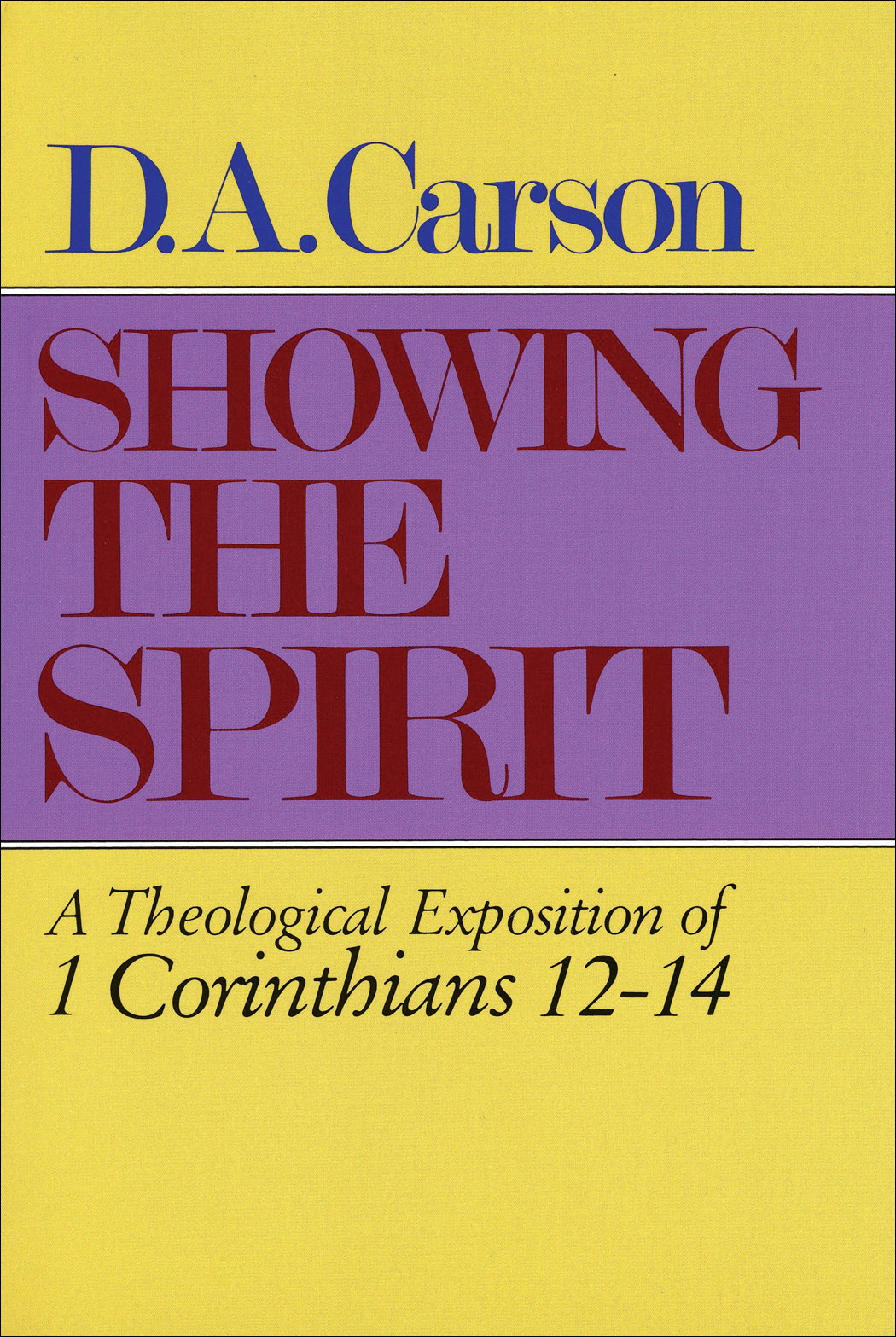
The topic of spiritual gifts is complex, controversial and important in every age of the Church. So when a volume is written from a trusted and proven theologian with no ax to grind, but armed with the willingness to search the Scriptures and take their teaching wherever that may lead – I listen. And I think you should too. Such is D. A. Carson’s “Showing the Spirit: A Theological Exposition of 1 Corinthians 12-14.”
I confess at the outset my love and admiration for Dr. Carson. Over the years, not only me but countless preachers, pastors and scholars have benefited from his bountiful gifts. Cambridge trained and pastorally experienced, Don Carson is Research Professor of New Testament at Trinity Evangelical Divinity School, where he has served on the faculty since 1978. He one of the founders and the current President of the Gospel Coalition, and has authored or edited more than 50 books. He is a globally recognized scholar in New Testament Greek.
Having read almost everything of his I could get my hands on over the years, my estimation of him grew and grew until I had the opportunity to have him here to speak at one of our conferences and at the church. Then my estimation exploded exponentially. For here was no ivory tower egg-head, but a man of staggering gifts who was also (and perhaps more predominately) deeply in love with his Savior and His Savior’s Church. A man with a passion for local assemblies and their leadership, and profoundly committed to the cause of Christ in every area he can touch. He blessed not only me, but all those present in those days immeasurably. I will never forget that weekend.
How then, this volume – published in 1987 and dealing with such a critical subject escaped my notice until now I haven’t a clue. But I thank my dear friend and Pastor of Sovereign Grace Baptist Church in Hornell NY – Nathan Ruble – for bringing it to my attention.
Showing the Spirit is an absolute must read for anyone interested in doing the heavy lifting behind understanding the Bible’s teaching on this subject with depth and clarity. Agree with him or disagree, you will not be left thinking any crucial part of the text has been treated superficially or carelessly. This is high octane reading for such a slight tome.
Roughly speaking, all of Evangelicalism is divided into two camps on the issue of spiritual gifts such as tongues, prophecy, a word of knowledge etc.: Cessationist (all of the sign or miracle or sensational gifts have ceased – hence cessation), and Non-Cessationists (any or all of the sign or miracle or sensational gifts may and still do operate today). Now there are clearly more variants in the second group – but for the purposes of this brief recommendation (not really an in-depth review) we need only note the two major branches. And given the recent Strange Fire Conference hosted by John MacArthur and his book bearing the same name – controversy over this topic has not just flared up again, it has blown up. Dr. MacArthur (another one of my heroes) is squarely and decidedly in the Cessationist camp. Dr. Carson squarely and decidedly is not. And this makes for interesting reading, reflection and discussion on both fronts. In fact, reading both MacArthur’s and Carson’s books back to back as I did is something recommend.
With his characteristic thoroughness in exegeting the text; his almost distracting (but invaluable) interaction with other scholarship on the key passages; his even-handedness in treating both sides fairly (regarding both their positives and negatives) and his courage in refusing to flinch from conclusions that would no doubt marginalize (if not demonize) him in the eyes of some very weighty peers – Dr. Carson won’t let the reader escape from the full on implications of his study any more than he seeks to dodge them himself. Like it or lump it, he argues (convincingly in my opinion) that there is no exegetical reason for saying the gifts have ceased in our day, and that there are many proofs to the contrary. At the same time, he refuses to let the Non-Cessationist camp run away with their views as though they need not submit to the very plain, apostolically authoritative rules and guidelines which are to govern the exercise of these gifts in the local Church. There is no place for mayhem and folderol. No loose canons. Nothing out of order. The bottom line is clear: no one gets to play at or with God’s Spirit given gifts. They are meant to serve the assembly in love, and anything less or other is out of bounds. Period.
I found myself needing to re-examine my own understanding in several critical places and as a result modifying it too. That is seldom comfortable. But if we want to follow Christ, ever coming to a clearer understanding of what His Word teaches on any topic is imperative. And change brought about by better understanding God’s Word, is always growth, no matter how uncomfortable.
No, this book is NOT easy reading. You will have to work at it, and wrestle with the text in ways you maybe never have before. That’s great! But do do it. Don’t shrink back into preconceived notions regardless of which side of the debate you find yourself. Let God’s Word speak. And tremble.






 ResponsiveReiding