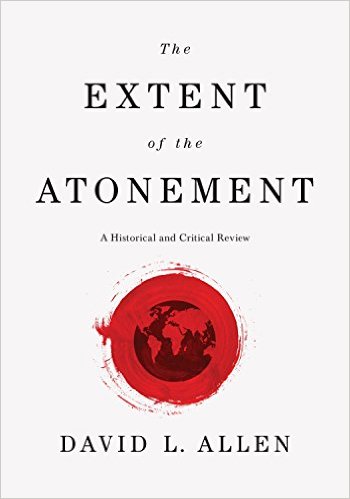
The Book I wanted to write – but BETTER!
At the outset, let me say that this tome is a scholarly tour de force by one of the best friends a conscientious Calvinist can find anywhere.
David Allen serves as the dean of the School of Preaching, distinguished professor of preaching, director of the Southwestern Center for Expository Preaching and George W. Truett Chair of Ministry at Southwestern Baptist Theological Seminary in Fort Worth, Texas. He was previously Dean of the School of Theology from 2004-2016. He received the B.A. at Criswell College (1978), Master of Divinity at Southwestern Baptist Theological Seminary (1981), and Ph.D. in Humanities with a Major in Linguistics from The University of Texas at Arlington (1987).
And, in the interest of full disclosure, let me state up front that I am a recovering High-Calvinist. Lest that term confuse you, Dr. Allen gives some helpful definitions near the beginning of his massive and vitally important work on the extent of the atonement of Jesus Christ.
The main factions in the debate as he lists them in the introduction (noting also that each have nuances within their camps) are as follows –
Arminianism: Christ suffers for the sins of all mankind with an equal intent to save all people.
Classic/Moderate Calvinism: Christ suffers for the sins of all mankind, but with an unequal intent/will to save all people.
High Calvinism: Christ only suffers for the sins of the elect because of his singular intent.
Hyper-Calvinism: Christ only suffers for the sins of the elect because of his singular intent.
What separates the last two is brought out numerous places within the book, but has mostly to do with the latter rejecting the free offer of the Gospel.
That said – let me plunge in.
Part 1 of the book surveys the extent of the atonement in Church history. It is divided into 4 sections – covering all the major player who may have written on the topic in: 1. The Early & Medieval Era; 2. The Reformation Era; 3. The Post-Reformation Era; and 4. The Modern Era.
Part 2 is comprised of 3 chapters focusing on the extent of the atonement in the Baptist tradition. Once again surveying most of the key writers and preachers on the atonement among: 1. English General and Particular Baptists; 2. North American Baptists; and 3. Southern Baptists. Being a Southern Baptist himself, this is of particular interest to Dr. Allen, but by no means indicates a short shrift of the others.
Part 3 is in 2 parts. First is a detailed critical review of every chapter of the highly acclaimed Crossway volume “From Heaven He Came and Sought Her: Definite Atonement in Historical, Biblical, Theological, and Pastoral Perspective.” The 2nd is a concluding chapter titled: “Why Belief in Unlimited Atonement Matters.”
And let me tell you, that this book soars. It soars conclusively (in my estimation) in securing the reality that an unlimited atonement in extent, NOT application, has been the majority report throughout ecclesiastical history; the majority report among the early Reformers – including Calvin; and was the main expression on the question of the atonement until the encroachment of a strict limitarian view was espoused by Beza, and championed (perhaps) most by John Owen.
The historical evidence is so overwhelming that the Owenic view was not and never has been “The” Reformed view, as to be virtually incontrovertible. Now as Dr. Allen notes, counting noses isn’t how we do sound theology. We go back to the text of Scripture for that. But it does drive us to consider how so many for so long – solidly IN the Reformed tradition, rejected a strict either/or construct (Jesus either died for all OR for the elect) in favor of a both/and construct, speaking to an unlimited atonement when considered in and of itself, with the reality of a particularistic application of it by God’s sovereign choice.
Of particular interest in this line is how the extent of the atonement was the most hotly debated topic at the Synod of Dordt, and how both Dordt’s statements and the Westminster’s were written with a measure of intentional ambiguity to allow for those on both sides of this question to sign them in clear conscience.
All along the way in these chapters, Dr. Allen proves himself to be the consummate myth-buster. Strict limited atonement is THE Reformed position – busted. Amyrault was a heretic – busted. Amyraldianism is nor Reformed – busted. Strict limited atonement came first – busted. All of the Reformers held to strict limited atonement – busted. (You will be shocked to find out just how many of those you thought held to limited atonement – didn’t.) British hypothetical universalism was Amyraldian – busted. So-called 4-point Calvinism is Arminianism – busted. Universal or unlimited atonement must result in universalism – busted! On and on and on.
In fact, my own journey out of being a high Calvinist to becoming a Moderate/Classical Calvinist years ago, was one of being disabused of many of these myths as I went. Myths that when taken in composite can so jade and confuse, as to make you question sound exegesis simply on the force of how all these men can’t be wrong – even when repeating common errors over and over. How I wish I has had access then to “The Extent of the Atonement: A Historical and Critical Review” by Dr. David Allen. But I do now, and so do you.
So as to prevent this review from being as long as the book itself (a hefty 848 pages) let me point out what I think are the key strong points, and offer a suggestion for those who want a quicker handle on it all.
What the book does over and over and over again, is address the principle arguments for a strict limitarian view, both exegetically and logically – and examines how non-limitarians have addressed those same Scripture passages and logic. In the process, by virtue of its unique structure, you get hear dozens of Reformed voices argue against limitarianism. None, surrendering election, or particularization in the application of the atonement. All, in necessary and clarifying context.
Thus there is a constant reminder not to confound the accomplishment of the atonement with its application.
Repeated warnings not to buy into a mere instrinsic sufficiency in the atonement as opposed to extrinsic sufficiency.
Over and over again the negative inference fallacy is exposed, rejected and properly defeated.
The commercial and pecuniary foundation of so much of Owen’s thinking is debunked.
The weight placed by so many on the “distributive” versus universal use of “all” is demythologized and properly contexualized each in its proper place.
The fallacy in Owen’s famous trilemma is exposed and the illogic dismantled.
How the limitarian view severely discounts justification by faith in its proper place and time.
And in every place, the centrality of this to the right preaching of the Gospel take its rightful place front and center.
All this by voice after voice after voice among our Reformed brethren.
Now maybe you are not going to wade through all 848 – pages, and that with some chapters offering in excess of 800 end notes! I hear your cry. Though I bid you to do it anyway, both for your education and your soul.
But if you want the shortcut – here is my recommendation. If you only read the detailed refutation of John Owen’s The Death of Death in Christ, in the section bearing his name, and, the section on David Schrock, you will interact with all of the pertinent Scriptures and arguments from the strict limitarian view, and all of the key corrections in exegesis and logic in showing the error of that view. These two alone are worth the price of the book, and a couple of evenings in deep reading and reflection. They will change you.
David Allen has done an invaluable service to the Body of Christ as a whole, and to Calvinists especially in a critical time in American Christianity. As he said to me in a brief meeting at the recent ETS gathering in San Antonio – (paraphrasing) “I did not write this book against Calvinists, but to make my Calvinist brothers BETTER Calvinists.” That spirit breathes on every page of this book – and spoke to me that way before I ever met the good Doctor.
I had wanted to write this book every since my own study led me out of strict limitarianism. But I’m glad I didn’t. Because here, it is done so much better. May God be pleased to use it as a much needed corrective in the current swell of interest in Reformed theology. For some, it will give you the permission you’ve been seeking to preach the Gospel the way you know you should have, all along. To the glory of God and the good of His Church.


 ResponsiveReiding