• Home
  • About
  • Blog
  • Atonement
    • The Atonement: Read this first!
    • Confession of an ex-u0022Highperu0022 Calvinist
    • Revisiting the Substitutionary Atonement
    • Discussing the Atonement – a lot!
    • Lecture Notes on The Atonement
  • Sermons
  • ReviewsAll book and movie reviews
    • Books
    • Movies

ResponsiveReiding

  • Facing the Apocalypse Part 2 – 1 Peter 4:8-11

    April 24th, 2016

    apocalypse

    1 Peter Part 17

    1 Peter 4:7-11

    Facing The Apocalypse Part 2

    AUDIO FOR THIS SERMON CAN BE FOUND HERE

      Last time we saw Peter’s thought process in vs. 7 that:  “the end of all things is at hand, THEREFORE”.

    We noted it is not that the end of the world was about to take place, but rather we have entered into the “end times” – which culminate in the final and complete UNVEILING – REVELATION – APOCALYPSE of the glory of God in Jesus Christ.

    And, that those who are in Christ are part of this apocalypse or unveiling now!  Philippians 2:14–15 Do all things without grumbling or disputing, 15 that you may be blameless and innocent, children of God without blemish in the midst of a crooked and twisted generation, among whom you shine as lights in the world,

    Christians, thinking and living like those genuinely translated out of the kingdom of darkness into Christ glorious kingdom of light, will stand out more and more in stark contrast to this present age.

    We are part of God’s “revealing” – His apocalypse.

     “the end of all things is at hand – THEREFORE:

    1. “Be self-controlled and sober-minded, for the sake of your prayers.”

    Self-controlled through the indwelling Spirit of Christ;

    Sober-minded as informed by the Word;

    And this – for the sake of our prayers. 

    Now we move on to the 2nd part of Peter’s THEREFORE in vss – 8-11 

    1. “Above all, keep loving one another earnestly, since love covers a multitude of sins.”

    And then he unpacks what this “loving one another” looks like.

    This would be especially applicable to Peter’s first readers.

    Experience shows us that when we undergo times of extreme or long term distress – for whatever cause – it is natural to turn inward and to stop thinking in terms of giving to others.

    Not only that, but as fallen, yet redeemed creatures, we are prone to think of ourselves in terms only OF ourselves, and forget that God’s plan in His revelation is a plan carried out THROUGH THE CHURCH.

    Remember Peter’s great confession in Matthew 16:15–18 “He said to them, “But who do you say that I am?” 16 Simon Peter replied, “You are the Christ, the Son of the living God.” 17 And Jesus answered him, “Blessed are you, Simon Bar-Jonah! For flesh and blood has not revealed this to you, but my Father who is in heaven. 18 And I tell you, you are Peter, and on this rock I will build my church, and the gates of hell shall not prevail against it.”

    Note what Jesus didn’t say: He didn’t say upon this rock I will build the mass of individual Christians – but “I will build my Church.”

    And from that point on as we progress through the NT, the focus is upon individual salvation bringing people into being part of the Family or People of God – which finds its expression in the local Church. We don’t get saved and remain alone or free agents.

    We are saved to be a part of His Body, His Church, His people.

    It is why Church membership is so important.

    Because we are not meant to live the Christian life alone, but committed to a group of God’s people as living and growing WITH God’s people – not in isolation.  

    Solomon says it well in Proverbs: Proverbs 18:1 “Whoever isolates himself seeks his own desire; he breaks out against all sound judgment.”

    Note how the NT is arranged, the letters are all written to gatherings of Believers.

    The Church at Rome.

    The Church at Corinth.

    The Church at Galatia, at Ephesus, at Philippi, at Colosse, Thessalonica, James – to the dispersed tribes – but in a community context, even Timothy and Titus are written to individuals as they organize and build up the Churches where they are.

    Philemon, as personal as it is, is written with a greeting which included to the Church which meets in his house.

    People gathered in local Churches is the great underlying presupposition of the entire NT – even as the land of Israel in the OT is to the People of God as His people.

    No one can read anything in the Word which is not addressed to a group larger than themselves alone – it is for people in the context of the Churches in which they live and function and grow and minister to others.

    But as we said above, in times of persecution and marginalization – it is easy to understand how some would say – “you know what? I don’t need the added aggravation of dealing with the tensions of personal disagreements and the sins of other Christians – I’ll just go it alone.”

    Peter then warns them that this must be guarded against.

    How?

    “Above all, keep loving one another earnestly, for love covers a multitude of sins.”

    In your distress…

    In these scattered little house Churches as these most certainly were…

    Don’t stop “apocalypting” – by failing to love one another, and not from afar, in theory only – but earnestly – which will necessarily involve  –  covering a multitude of sins.

    The Church is not seen as just that mass of unconnected, individual Christians, but the Church as gathered communities of Believers.

    Banded together to work and live as a group who together provide for a place for the public worship of God in society;

    For the proclamation of God’s truth in the preaching of His Word in society;

    For mutual prayer, counsel, comfort, confrontation and even conflict – so that we might learn how to grow in grace, since Christ’s goal for us is to be conformed to the image of Christ. 

    This, Peter locates in 2 things, the 2nd of which flows out of the 1st.

    1. (9) “Show hospitality to one another without grumbling.”
    2. (10) As each has received a gift, use it to serve one another, as good stewards of God’s varied grace:

    Which he then supplies us with several examples of in vs. 11.

     “Above all, keep loving one another earnestly, since love covers a multitude of sins.”

    What does it mean for love to “cover” sins here?

    What sins is he talking about that love “covers”?

    When most of us as Christians for any time think of the “covering” of sin, our minds go back to the imagery God gave us in the Holy of Holies, where the cover of the Ark of the Covenant is referred to as the Mercy Seat. Where the blood of the sacrificial lamb on the day of atonement is sprinkled and the sins of the Jews were “covered” for another year.

    The word for “atonement” in the OT comes from a word which means to cover with tar or pitch.

    It makes it first appearance in Genesis where Noah is told to seal the Ark with “pitch” – with this covering that allows the Ark to carry them safely through the outpouring of God’s wrath without harm from the flood. It implied making the cracks and the defects invisible behind this pitch.

    Then in the Tabernacle & Temple, the word is co-opted as blood is applied to the mercy seat or the cover of the Ark of the Covenant.

    Now that covering word itself is not used in the NT, but it does have a counterpart – PROPITIATION – as in Hebrews 2:17 “Therefore he had to be made like his brothers in every respect, so that he might become a merciful and faithful high priest in the service of God, to make propitiation for the sins of the people.”

    And there, it is not a repeated action – but something done once and for all so that the Believer can be permanently reconciled to God the Father through Jesus’ work on the Cross.

    But Peter’s word here is not the same. His idea of covering here is not in propitiating for sin the way Christ did.

    This word is more common and having to do with covering up other’s failures, so that they are not exposed to others. It is even used of burying, of being completely covered over.

    What is Peter after? Karen Jobes in her commentary says it well: What does it mean that love “covers” sins?..love’s covering is put in antithetic parallelism to “hatred stirring up dissension and quarrels”: “Hatred stirs up dissension, but love covers over all wrongs” (Prov. 10:12 NIV). Since “hatred” is the antonym of “love,” the phrase “covers a multitude of sins” in this antithetic parallel suggests that the sense of “covering” and “stirring up dissension” are also opposites…the love that covers sins is probably best understood as a forbearance that does not let wrongs done within the Christian community come to their fullest and most virulent expression. This was the way Clement of Rome understood 1 Pet. 4:8 in the late first century…The downward spiral is broken when someone in loving forbearance breaks the cycle of acting on hard feelings and doing wrong[1]

    Another commentator sums it up this way: [It is]“when a private personal injury has been done to him, [acting] as though nothing had occurred. In this way, by simply ignoring the unkind act or the insulting word, … he brings the evil thing to an end; it dies and leaves no seed…This consideration gives dignity and worth inestimable to the feeble efforts of the most insignificant of us to make love the controlling principle in our daily lives.[2]”

    And this kind of covering another’s sins in love, Peter says is to be done “earnestly” – i.e. pursued actively over and over again.

    Who can write the long sad tale of how Churches and Christians have been disrupted and divided because Christians have never learned to cover one another’s sins in love?

    Because we take slights and careless acts into ourselves and allow them to fester and grow and become malignant and destructive.

    Christians are not to be thin-skinned – thrown by every bruise.

    No, not EVERY sin can be dealt with this way.

    Where there is repeated sin which shows a true pattern or habit, we need to go to our brother or sister’s aide in helping them get free of it.

    Or when serious spiritual damage by leading others into sin or false doctrine, or when those things are public and are ACTUAL sins, and not just things we don’t like or aren’t our taste or are uncomfortable with – the Bible spells out courses of action which can be taken.

    But this is the FIRST course.    

    Let it go.

    Cover it.

    Ignore it.

    Move past it and on to more important things.

    This is the very nature of love: As per Paul in 1 Corinthians 13:4–7 “Love is patient and kind; love does not envy or boast; it is not arrogant 5 or rude. It does not insist on its own way; it is not irritable or resentful; 6 it does not rejoice at wrongdoing, but rejoices with the truth. 7 Love bears all things, believes all things, hopes all things, endures all things.”

    Did you catch those “love bears all things, believes all things, hopes all things, endures all things”?

    They’re not a cast offs. Love’s 1st assumption is that the other person is NOT out to hurt me.

    If you are the kind of person who gets angry when someone steps on your toe, rather than just saying ouch – you’re in trouble, and the Church with you. If you bear with nothing – you fail to love.

    Be careful, as the writer to the Hebrews warns: 12:15 “See to it that no one fails to obtain the grace of God; that no “root of bitterness” springs up and causes trouble, and by it many become defiled;”

    It is not the Spirit of Christ to prosecute every little offense – either formally or in our hearts!

    If Jesus had spent His time on earth fencing with everyone who slighted, slandered and poked at Him – He’d have had no time nor the frame of mind to minister so freely to everyone.

    And He certainly would have not been prepared – to say “Father, forgive them, for they don’t know what they are doing” on the Cross.

     “Above all, keep loving one another earnestly, since love covers a multitude of sins.”

    With everything else we’ve discussed, in these hard times – keep loving one another. Do it earnestly and persistently.

    It is seated in the recognition that the Church is comprised of broken people living and working with other broken people.

    And do it so as to cover a MULTITUDE of sins, not just one or two.

    Which shows itself in the Church in the next verse.

    1 Peter 4:9 “Show hospitality to one another without grumbling.”

    Since these tiny little Churches were forced to exist only in homes – the spill over is evident: Don’t stop doing Church, hosting worship and fellowship in your homes in light of these personal issues.

    Invite them still and without a grumbling heart.

    For to worship together and hear the Word taught together and to pray together is of the utmost importance.

    And in that – 10 As each has received a gift, use it to serve one another, as good stewards of God’s varied grace:” – don’t stop using the graces God has given you to bless one another.

    How hard our hearts can become – so that over the littlest things we can withdraw and not live to serve the Body of Christ with the gifts He has given us.

    I communicated with a pastor not long ago, who found himself surrounded by a core of people who – over disagreements about petty things – decided they would show their displeasure by simply defunding the Church – refusing to give as they formerly had, in order to punish the leadership.

    They let bitterness rise up in a situation where I know for a fact after investigating it personally – it was not serious sin which was at the root, but mere disagreements over procedures and preferences and power.

    And they covered no one’s sins – but did what they could to expose them – and that, after sometimes even inventing sins!

    They stopped receiving others but rather turned people away from the assembly.

    And they robbed the Church not only of their monetary gifts, but of any true means of ministering Christ to others – because they were ticked off. And the damage to the Church was horrific. Almost causing them to close their doors.

    And this, not as Peter’s readers, spread out in hostile foreign territories, but here in the midst of the relative ease and prosperity and freedom on our nation.

    Shameful in every way.

    NO! – Peter goes on to instruct – instead, “10 As each has received a gift, use it to serve one another, as good stewards of God’s varied grace: 11 whoever speaks, as one who speaks oracles of God; whoever serves, as one who serves by the strength that God supplies—in order that in everything God may be glorified through Jesus Christ. To him belong glory and dominion forever and ever. Amen.”

    Don’t stop serving one another with the grace God has given you.

    Whether it be in word or in deed (as vs. 11 is demonstrating) – continue to gather and to bless so that in EVERYTHING, God may be glorified – revealed, “apocalypted” through Jesus Christ – as you are His servants serving in His Church in this world.

    Why?

    Because to Him belong glory and dominion, forever and ever.

    And if it be forever and ever, NOW, falls right in the middle of that.

    Oh, to be truly His lights, shining in this dark place in lives committed to His glory in the Church.

    Or as Paul puts it in Ephesians 3:21 “to him be glory in the church and in Christ Jesus throughout all generations, forever and ever. Amen.”


    [1] Jobes, Karen H. 2005. 1 Peter. (Baker Exegetical Commentary on the New Testament). Grand Rapids, MI: Baker Academic.

    [2] Jobes, Karen H. 2005. 1 Peter. (Baker Exegetical Commentary on the New Testament). Grand Rapids, MI: Baker Academic.

  • As I was Reading Today – A Sermon from John Flavel

    April 20th, 2016

    flavel

    Some sermons are so full of wisdom and solid counsel, they far outlast the one-time use most sermons have. This is one such sermon.

    Yes, it is Puritanesque in length. I won’t apologize a bit for that. It is just too rich not to put her in full. Get a cup of coffee, sit down and drink deeply at this fountain.

    SERMON XVII

    Of the Kingly Office of Christ, as it is providentially executed in the World, for the Redeemed

    EPH. 1:22

    And hath put all things under his feet, and gave him to be the head over all things to the church.

    THE foregoing verses are spent in a thankful and humble adoration of the grace of God, in bringing the Ephesians to believe in Christ. This effect of that power that raised their hearts to believe in Christ, is here compared with that other glorious effect of it, even the raising of Christ himself from the dead: both these owe themselves to the same efficient cause. It raised Christ from a low estate, even from the dead, to a high, a very high and glorious state; to be the head both of the world, and of the church; the head of the world by way of dominion, the head of the church by way of union, and special influence, ruling the world for the good of his people in it. “He gave him to be the head over all things to the church.”
    In this scripture let these four things be seriously regarded.
    1. The dignity and authority committed to Christ; “He hath put all things under his feet;” which implies, full, ample and absolute dominion in him, and subjection in them over whom he reigns. This power is delegated to him by the Father: for besides the essential, native, ingenite power and dominion over all, which he hath as God, and is common to every person in the Godhead, Psal. 22:28. there is a mediatory dispensed authority, which is proper to him as Mediator, which he receives as the reward or fruit of his suffering, Phil. 2:8.
    2. The subject recipient of this authority, which is Christ, and Christ primarily, and only: he is the μρωτον δεκτικον, first receptacle of all authority and power. Whatever authority any creature is clothed with, is but ministerial and derivative, whether it be political, or ecclesiastical. Christ is the only Lord, Jude, ver. 4. The fountain of all power.
    3. The object of this authority, the whole creation; all things are put under his feet: he rules from sea to sea, even to the utmost bounds of God’s creation, “Thou hast given him power over all flesh,” John 17:2. all creatures, rational, and irrational, animate, and inanimate, angels, devils, men, winds, seas, all obey him.
    4. And especially, take notice of the finis cui, the end for which he governs and rules the universal empire; it is for the church, i.e.* for the advatage, comfort, and salvation of that chosen remnant he died for. He purchased the church; and that he might have the highest security that his blood should not be lost, God the Father hath put all things into his hand, to order and dispose all as he pleaseth. For the furtherance of that his design and end, as he bought the persons of some, so the services of all the rest; and that they might effectually serve the end they are designed to, Christ will order them all in a blessed subordination and subserviency thereunto. Hence the point is,

    Doct. That all the affairs of the kingdom of providence are ordered and determined by Jesus Christ, for the special advantage, and everlasting good of his redeemed people.

    John 17:2. “As thou hast given him power over all flesh, that he should give eternal life to as many as thou hast given him.” Hence it comes to pass, that “all things work together for good to them that love God, to them that are called according to his purpose,” Rom. 8:28.
    That Jesus Christ hath a providential influence upon all the affairs of this world is evident, both from scripture assertions, and rational observations, made upon the actings of things here below.
    The first chapter of Ezekiel contains an admirable scheme or draught of providence. There you see how all the wheels, i.e. the motions and revolutions here on earth, are guided by the spirit that is in them. And, ver. 26. it is all run up into the supreme cause; there you find one like the Son of man, which is Jesus Christ, sitting upon the throne, and giving forth orders from thence for the government of all: and if it were not so, how is it that there are such strong combinations, and predispositions of persons and things to such ends and issues, without any communications of councils, or holding of intelligence with one another? As in Israel’s deliverance out of Egypt, and innumerable more instances have appeared. Certainly, if ten men, from several places, should all meet at one place, and about one business, without any fore-appointment among themselves, it would argue their motions were secretly over-ruled by some invisible agent. How is it that such marvellous effects are produced in the world by causes that carry no proportion to them? Amos 5:9. and 1 Cor. 1:27. and as often, the most apt and likely means are rendered wholly ineffectual? Psal. 33:16. In a word, if Christ hath no such providential influx, how are his people in all ages preserved in the midst of so many millions of potent and malicious enemies, amongst whom they live as sheep in the midst of wolves? Luke 10:3. How is it that the bush burns, and yet is not consumed? Exod. 3:2.
    But my business, in this discourse, is not to prove that there is a Providence, which none but Atheists deny. I shall chuse rather to shew by what acts Jesus Christ administers this kingdom, and in what manner; and what use may be made thereof.
    First, He rules and orders the kingdom of Providence, by supporting, permitting, restraining, limiting, protecting, punishing, and rewarding those over whom he reigns providentially.
    1.* He supports the world, and all creatures in it, by his power. “My Father works hitherto, and I work,” John 5:17. “And in him (that is, in Christ) all things consist,” Col. 1:17. It is a considerable part of Christ’s glory to have a whole world of creatures owing their being and hourly conservations to him. The parts of the world are not coupled and fastened together as the parts of the house, whose beams are pinned and nailed to each other; but rather as several rings of iron, which hang together by the virtue of a loadstone. This goodly fabric was razed to the foundation when sin entered, and had tumbled into everlasting confusion, had not Christ stept in to shore up the reeling world. For the sake of his redeemed that inhabits it, he doth and will prop it by his omnipotent power. And when he hath gathered all his elect out of it into the kingdom above, then will he set fire to the four quarters of it, and it shall lie in ashes. Meanwhile, he is “given for a covenant to the people, to establish the earth,” Isa. 49:8.
    2. He permits and suffers the worst of creatures in his dominion, to be and act as they do. “The deceived, and the deceiver, are his,” Job 12:16. Even those that fight against Christ and his people, receive both power and permission from him. Say not, that it is unbecoming the most Holy to permit such evils, which he could prevent if he pleased. For as he permits no more than he will over-rule to his praise, so that very permission of his, is holy and just. Christ’s working is not confounded with the creature’s. Pure sun-beams are not tainted by the noisome vapours of the dunghill on which they shine. His holiness hath no fellowship with their iniquities; nor are their transgressions at all excused by his permissions of them. “He is a rock, his work is perfect, but they have corrupted themselves,” Deut. 32:4, 5. This holy permission is but the withholding of those restraints from their lusts, and denying those common assistances which he is no way bound to give them. Acts 14:16. “He suffered all nations to walk in their own ways.” And yet should he permit sinful creatures to act out all the wickedness that is in their hearts, there would neither remain peace nor order in the world. And therefore,
    3. He powerfully restrains creatures by the bridle of providence, from the commission of those things, to which their hearts are propense enough, Psal. 76:10. “The remainder of wrath thou “wilt restrain,” or* gird up; letting forth just so much as shall serve his holy ends, and no more. And truly this is one of the glorious mysteries of Providence, which amazes the serious and considerate soul; to see the spirit of a creature fully set to do mischief; power enough, as one would think, in his hand to do it, and a door of opportunity standing open for it; and yet the effect strangely hindered. The strong propensions of the will are inwardly checked, as in the case of Laban, Gen. 31:24. or a diversion, and rub is strangely cast in their way; as in the case of Sennacherib, 2 Kings 19:7, 8. so that their hands cannot perform their enterprizes. Julian had two great designs before him, one was to conquer the Persians, the other to root out the Galileans, as he, by way of contempt, called the Christians: but he will begin with the Persians first, and then make a sacrifice of all the Christians to his idols. He doth so, and perishes in the first attempt. O the wisdom of Providence!
    4. Jesus Christ limits the creatures in their acting, assigning them their boundaries and lines of liberty; to which they may, but beyond it cannot, go. Rev. 2:10. “Fear none of these things that ye shall suffer; behold, the devil shall cast some of you into prison, and ye shall have tribulation ten days.” They would have cast them into their graves, but it shall only be into prisons: They would have stretched out their hands, upon them all; no, but only some of them shall be exposed: They would have kept them there perpetually; no, it must be but for ten days, Ezek. 22:6. “Behold, the princes of Israel were in thee, every one to their power to shed blood.” They went as far as they had power to go, not as far as they had will to go. Four hundred and thirty years were determined upon the people of God in Egypt; and then, even in that very night, God brought them forth; for then “the time of the promise was come,” Acts 7:17.
    5. The Lord Jesus providentially protects his people amidst a world of enemies and dangers. It was Christ that appeared unto Moses in the flaming bush, and preserved it from being consumed. The bush signified the people of God in Egypt; the fire flaming on it, the exquisite sufferings they there endured: the safety of the bush, amidst the flames, the Lord’s admirable care and protection of his poor suffering ones. None so tenderly careful as. Christ as birds flying, so he defends Jerusalem,” Isa. 31:5. i.e. as they fly swiftly towards their nests, crying when their young are in danger, so will the Lord preserve his. They are “preserved in Christ Jesus, Jude 1. as Noah and his family were in the ark, Hear how a Worthy of our own expresses himself on this point*.

    That we are at peace in our houses, at rest in our beds; that we have any quiet in our enjoyments, is from hence alone, Whose person would not be defiled, or destroyed? whose habitation would not be ruined? whose blood almost would not be shed, if wicked men had power to perpetrate all their conceived sin? It may be, the ruin of some of us hath been conceived a thousand times. We are beholden to this Providence, of obstructing sin, for our lives, our families, our estates, our liberties, and whatsoever is or may be dear to us. For may we not say sometimes with the Psalmist, Psal. 57:4. My soul is among lions, and I lie even among them that are set on fire, even the sons of men, whose teeth are spears, and their tongue a sharp sword? And how is the deliverance of men contrived from such persons? Psal. 8:6. God breaks their teeth in their mouths, even the great teeth of the young lions. He keeps this fire from burning,—some he cuts off and destroys: some he cuts short in their power: some he deprives of the instruments whereby alone they can work: some he prevents in their desired opportunities, or diverts by other objects for their lust; and oftentimes causeth them to spend them among themselves, one upon another. We may say, therefore, with the Psalmist, Psal. 104:24. O Lord, how manifold are thy works! in wisdom hast thou made them all; the earth is full of thy riches.

    6. He punishes the evil doers, and repays, by providence into their own lap, the mischiefs they do, or but intend to do, unto them that fear him. Pharaoh, Sennacherib, both the Julians, and innumerable more, are the lasting monuments of his righteous retribution. It is true, a sinner may do evil an hundred times, and his days be prolonged; but oft-times God hangs up some eminent sinners in chains, as spectacles and warnings to others. Many a heavy blow hath Providence given to the enemies of God, which they were never able to recover. Christ rules, and that with a rod of iron, in the midst of his enemies, Psal. 110:2.
    7. And lastly, He rewards by Providence the services done to him and his people. Out of this treasure of Providence God repays oftentimes those that serve him, and that with a hundred-fold reward now in this life, Matth. 19:29. This active, vigilant Providence hath its eye upon all the wants, straits, and troubles of the creatures: but especially upon such as religion brings us unto. What huge volumes of experiences might the people of God write upon this subject? and what a pleasant history would it be, to read the strange, constant, wonderful, and unexpected actings of Providence, for them that have left themselves to its care?
    Secondly, We shall next enquire how Jesus Christ administers this providential kingdom.
    And here I must take notice of the means by which, and the manner in which he doth it. The means, or instruments, he uses in the governing the providential kingdom, (for he is not personally present with us himself), are either angels or men; “the angels are ministering creatures, sent forth by him for the good of them that shall be heirs of salvation,” Heb. 1:14. Luther tells us, they have two offices, superius canere, t inferius vigilare, “to sing above and watch beneath.” These do us many invisible offices of love. They have dear and tender respects and love for the saints. To them, God, as it were, puts forth his children to nurse, and they are tenderly careful of them whilst they live, and bring them home in their arms to their Father when they die. And as angels, so men are the servants of Providence; yea, bad men as well as good. Cyrus, on that account, is called God’s servant: they fulfil his will, whilst they are prosecuting their own lusts. “The earth shall help the woman,” Rev. 12:16. But good men delight to serve Providence; they and the angels are fellow-servants in one house, and to one master, Rev. 19:10. Yea, there is not a creature in heaven, earth, or hell, but Jesus Christ can providentially use it and serve his ends, and promote his designs by it. But whatever the instrument be Christ uses, of this we may be certain, that his providential working is holy, judicious, sovereign, profound, irresistible, harmonious, and to the saints peculiar.
    1. It is holy. Though he permits, limits, orders and overrules many unholy persons and actions, yet he still works like himself, most holily and purely throughout. “The Lord is righteous in all his ways, and holy in all his works, Psal. 145:17. it is easier to separate light from a sun-beam, than holiness from the works of God. The best of men cannot escape sin in their most holy actions; they cannot touch, but are defiled. But no sin cleaves to God, whatever he hath to do about it.
    2. Christ’s providential working is not only most pure and holy, but also most wise and judicious. Ezek. 1:20. “The wheels are full of eyes:” They are not moved by a blind impetus*, but in deep counsel and wisdom. And, indeed, the wisdom of Providence manifests itself principally in the choice of such states for the people of God, as shall most effectually promote their eternal happiness. And herein it goes quite beyond our understandings and comprehensions. It makes that medicinal and salutiferous, which we judge as destructive to our comfort and good, as poison. I remember, it is a note of Suarez†, speaking of the felicity of the other world: “Then (saith he) the blessed shall see in God all things and circumstances pertaining to them, excellently accommodated and attempered;” then shall they see that the crossing of their desires was the saving of their souls; and that otherwise they had perished. The most wise Providence looks beyond us. It eyes the end, and suits all things thereto, and not to our fond desires.
    3. The providence of Christ is most supreme and sovereign. “Whatsoever he pleaseth, that he doth in heaven and in earth, “and in all places,” Psal. 135:6. “He is Lord of lords, and King of kings,” Rev. 19:16. The greatest monarchs on earth are but as little bits of clay‡, as the worms of the earth to him: they all depend on him, Prov. 8:15, 16. “By me kings reign, and princes decree justice; by me princes rule, nobles, even all the judges of the earth.”
    4. Providence is profound and inscrutable. The judgments of Christ are “a great deep, and his footsteps are not known,” Psal. 36:6. There are hard texts in the works as well as in the words of Christ. The wisest heads have been at a loss in interpreting some Providences, Jer. 12:1, 2. Job 21:7. The angels had the hands of a man under their wings, Ezek. 1:8. i.e. they wrought secretly and mysteriously.
    5. Providence is irresistible in its designs and motions; for all providences are but fulfillings and accomplishments of God’s immutable decrees. Eph. 1:11. “He works all things according to “the counsel of his own will.”* Hence Zech. 6:1. the instruments by which God executed his wrath, are called “chariots coming from betwixt two mountains of brass,” i.e.† “the firm and immutable decrees of God.” When the Jews put Christ to death, they did but do what “the hand and counsel of God had before determined to be done,” Acts 4:28. so that none can oppose or resist providence. “I will work, and who shall let it?” Isa. 43:13.
    6. The providences of Christ are harmonious. There are secret chains, and invisible connections betwixt the works of Christ. We know not how to reconcile promises and providences together, nor yet providences one with another; but certainly they all work together, Rom. 8:28, as adjuvant causes, or con-causes standing under, and working by the influence of the first cause. He doth not do, and undo; destroy by one providence, what he built by another. But, look, as all seasons of the year, the nipping frosts, as well as the halcyon days of summer, do all conspire and conduce to the harvest; so it is in providence.
    7. And lastly, The providences of Christ work in a special and peculiar way for the good of the saints. His providential is subordinated to his spiritual kingdom. “He is the Saviour of all men, especially of them that believe,” 1 Tim. 4:1. These only have the blessings of providence. Things are so laid and ordered, as that their eternal good shall be promoted and secured by all that Christ doth.

    Inferences
    Inference 1. If so, See then, in the first place, to whom you are beholden for your lives, liberties, comforts, and all that you enjoy in this world. Is it not Christ that orders all for you? He is, indeed, in heaven, out of your sight; but though you see him not, he sees you, and takes care of all your concerns. When one told Silentiarius of a plot laid to take away his life, he answered, Si Deus meicuram non habet, quid vivo? “If God take no care of me, how do I live?” how have I escaped hitherto? “In all thy ways acknowledge him,” Prov. 3:6. It is he that hath espied out that state thou art in, as most proper for thee. It is Christ that doth all for you that is done. He looks down from heaven upon all that fear him; he sees when you are in danger by temptation, and casts in a providence, you know not how, to hinder it. He sees when you are sad, and orders reviving providences, to refresh you. He sees when corruptions prevail, and orders humbling providences to purge them. Whatever mercies you have received, all along the way you have gone hitherto, are the orderings of Christ for you. And you should carefully observe how the promises and providences have kept equal pace with one another, and both gone by step with you until now.
    Inf. 2. Hath God left the government of the whole world in the hands of Christ, and trusted him over all? Then do you also leave all your particular concerns in the hands of Christ too, and know that the infinite wisdom and love, which rules the world, manages every thing that relates to you. It is in a good hand, and infinitely better than if it were in your own. I remember when* Melanchton was under some despondencies of spirit about the estate of God’s people in Germany, Luther chides him thus for it, “Let Philip cease to rule the world.” It is none of our work to steer the course of providence, or direct its motions, but to submit quietly to him that doth. There is an itch in men, yea, in the best of men, to be disputing with God: “Let me talk with thee of thy judgment,” saith Jeremiah, chap. 12:1, 2. Yea, how apt are we to regret at providences, as if they had no conducency at all to the glory of God, or to our good, Exod. 5:22. yea, to limit providence to our way and time? Thus, the “Israelites tempted “God, and limited the holy One,” Psal. 78:18, 41. How often also do we, unbelievingly, distrust providence as though it could never accomplish what we profess to expect and believe? Ezek. 37:11. “Our bones are dry, our hope is lost; we are cut off for our part.” So Gen. 18:13, 14. Isa. 40:17. There are but few Abrahams, among believers, who “against hope, believed in hope, “giving glory to God,” Rom. 4:20. And it is but too common for good men to repine and fret at providence, when their wills, lusts, or humours are crossed by it: this was the great sin of Jonah. Brethren, these things ought not to be so; did you but seriously consider, either the design of providence, which is to bring about the gracious designs and purposes of God upon you, which were laid before this world was, Eph. 1:11. or that it is a lifting up of thy wisdom against his, as if thou couldst better order thine affairs, if thou hadst but the conduct and management of them; or that you have to do herein with a great and dreadful God, in whose hands you are as the clay in the potter’s hands, that he may do what he will with you, and all that is yours, without giving you an account of any of his matters, Job 33:13. or whether providence hath cast others, as good, by nature, as yourselves, tumbled them down from the top of health, wealth, honours and pleasures, to the bottom of hell; or, lastly, did you but consider how often it hath formerly baffled and befooled yourselves; you would retract, with shame, your rash, headlong censures of it, and enforce you, by the sight of its births and issues, to confess your folly and ignorance, as Asaph did, Psal. 73:22. I say, if such considerations as these could but have place with you in your troubles and temptations, they would quickly mould your hearts into a better and more quiet frame.
    O that I could but persuade you to resign all to Christ. He is a cunning workman*, as he is called, Prov. 8:30. and can effect what he pleaseth. It is a good rule, De operibus Dei non est judicandum, ante quintum actum. “Let God work out all that he intends, but have patience till he hath put the last hand to his work, and then find fault with it, if you can.” You have heard of the patience of Job, “and have seen the end of the Lord,” James 5:11.
    Inf. 3. If Christ be Lord and king over the providential kingdom, and that, for the good of his people, let none that are Christ’s henceforth, stand in a slavish fear of creatures. It is a good note that† Grotius hath upon my text; “It is a marvellous consolation (saith he) that Christ hath so great an empire, and that he governs it for the good of his people, as a head consulting the good of the body.” Our head and husband, is Lord-general of all the hosts of heaven and earth; no creature can move hand or tongue without his leave or order: the power they have is given them from above, John 19:11, 12. The serious consideration of this truth will make the feeblest spirit cease trembling, and set it a singing; Psal. 47:7. “The Lord is king of all the earth, “sing ye praises with understanding:” that is, (as some well paraphrase it) every one that hath understanding of this comfortable truth. Hath he not given you abundant security in many express promises, that all shall issue well for you that fear him? Rom. 8:28. “All things shall work together for good, to them that love God,” And Eccl. 8:12. verily “it shall be well with them that fear God,” even with them that fear before him. And suppose he had not, yet the very understanding of our relation to such a king, should, in itself, be sufficient security: for, he is the* universal† supreme,‡ absolute,|| meek, merciful,§ victorious, and¶ immortal king.
    He sits in glory, at the Father’s right hand; and, to make his seat the easier, his enemies are a footstool for him.†† His love to his people is unspeakably tender and fervent, he that touches them, “touches the apple of his eye,” Zech. 2. And, it is hardly imaginable, that Jesus Christ will sit still, and suffer his enemies to thrust out his eyes. Till this be forgotten, the wrath of man is not feared; Isa. 51:12, 13. “He that fears a man that “shall die, forgets the Lord his Maker.” He loves you too well to sign any order to your prejudice, and without his order, none can touch you.
    Inf. 4. If the government of the world be in the hands of Christ, Then our engaging and entitling of Christ to all our affairs and business, is the true and ready way to their success and prosperity. If all depend upon his pleasure, then sure it is your wisdom to take him along with you to every action and business; it is no lost time that is spent in prayer, wherein we ask his leave, and beg his presence with us: and, take it for a clear truth, that which is not prefaced with prayer, will be followed with trouble. How easily can Jesus Christ dash all your designs, when they are at the very birth and article of execution, and break off, in a moment, all the purposes of your hearts? It is a proverb among the Papists, that Mass and meat hinder no man. The Turks will pray five times a day, how urgent soever their business be. Blush you that enterprize your affairs without God: I reckon that business as good as done, to which we have got Christ’s leave, and engaged his presence to accompany us.
    Inf. 5. Lastly, Eye Christ in all the events of providence; see his hand in all that befals you, whether it be evil or good. “The works of the Lord are great, sought out of all them that have pleasure therein,” Psal. 111:2.
    How much good might we get, by observation of the good or evil that befals us throughout our course!
    1. In all the evils of trouble and afflictions that befal you, eye Jesus Christ: and set your hearts to the study of these four things in affliction.
    (1.) Study his sovereignty and dominion; for he creates and forms them: they rise not out of the dust, nor do they befal you casually; but he raises them up, and gives them their commission, Jer. 18:11. “Behold, I create evil, and devise a device against you.” He elects the instrument of your trouble; he makes the rod as afflictive as he pleaseth; he orders the continuance and end of your troubles; and they will not cease to be afflictive to you, till Christ say, Leave off, it is enough. The Centurion wisely considered this, when he told him, Luke 7:8. “I have soldiers under me, and I say to one, Go, and he goeth; to another, Come, and he cometh:” meaning, that as his soldiers were at his beck and command, so diseases were at Christ’s beck, to come and go as he ordered them.
    (2.) Study the wisdom of Christ in the contrivance of your troubles. And his wisdom shines out many ways in them, it is evident in chusing such kinds of trouble for you: this, and not that, because this is more apt to work upon, and purge out the corruption that most predominates in you: In the degrees of your troubles, suffering them to work to such a height, else not reach their end; but no higher, lest they overwhelm you.
    (3.) Study the tenderness and compassions of Christ over his afflicted. O think if the devil had but the mixing of my cup, how much more bitter would he make it! There would not be one drop of mercy, no, not of sparing mercy in it, which is the lowest of all sorts of mercy: but here is much mercy mixed with my troubles; there is mercy in this, that it is no worse. Am I afflicted? “It is of the Lord’s mercy I am not consumed,” Lam. 3:2. It might have been hell as well as this; there is mercy in his supports under it. Others have, and I might have been left to sink and perish under my burdens. Mercy, in deliverance out of it; this might have been everlasting darkness, that should never have had a morning. O the tenderness of Christ over his afflicted!
    (4.) Study the love of Christ to thy soul, in affliction. Did he not love thee, he would not sanctify a rod to humble or reduce thee, but let thee alone to perish in thy sin. Rev. 3:19. “Whom I love, I rebuke and chasten.” This is the device of love, to recover thee to thy God, and prevent thy ruin. O what an advantage would it be thus to study Christ, in all your evils that befal you!
    2. Eye and study Christ in all the good you receive from the hand of providence. Turn both sides of your mercies, and view them in all their lovely circumstances.
    (1.) Eye them in their suitableness: how conveniently providence hath ordered all things for thee. Thou hast a narrow heart, and a small estate suitable to it: Hadst thou more of the world, it would be like a large sail to a little boat, which would quickly pull thee under water: thou hast that which is most suitable to thee of all conditions.
    (2.) Eye the seasonableness of thy mercies, how they are timed to an hour. Providence brings forth all its fruits in due season.
    (3.) Eye the peculiar nature of thy mercies. Others have common, thou special ones; others have but a single, thou a double sweetness in thy enjoyments, one natural from the matter of it, another spiritual from the way in which, and end for which, it comes.
    (4.) Observe the order in which providence sends your mercies. See how one is linked strangely to another, and is a door to let in many. Sometimes one mercy is introductive to a thousand.
    (5.) And lastly, Observe the constancy of them, “they are new every morning,” Lam. 3:23. How assiduously doth God visit thy soul and body! Think with thyself, if there be but a suspension of the care of Christ for one hour, that hour would be thy ruin. Thousands of evils stand round about thee, watching when Christ will but remove his eye from thee, that they may rush in and devour thee.
    Could we thus study the providence of Christ in all the good and evil that befals us in the world, then in every state we should be content, Phil. 4:11. Then we should never be stopt, but furthered in our way by all that falls out; then would our experience swell to great volumes, which we might carry to heaven with us; and then should we answer all Christ’s ends in every state he brings us into. Do this, and say,
    Thanks be to God for Jesus Christ.
    Flavel, John. 1820. The Whole Works of the Reverend John Flavel. . Vol. 1. London; Edinburgh; Dublin: W. Baynes and Son; Waugh and Innes; M. Keene.

  • Facing The Apocalypse – Sermon Notes on 1 Peter pt. 16

    April 17th, 2016

    1 Peter Part 16

    1 Peter 4:7-11A

    Facing The Apocalypse

    apocalypse

     AUDIO FOR THIS SERMON CAN BE FOUND HERE


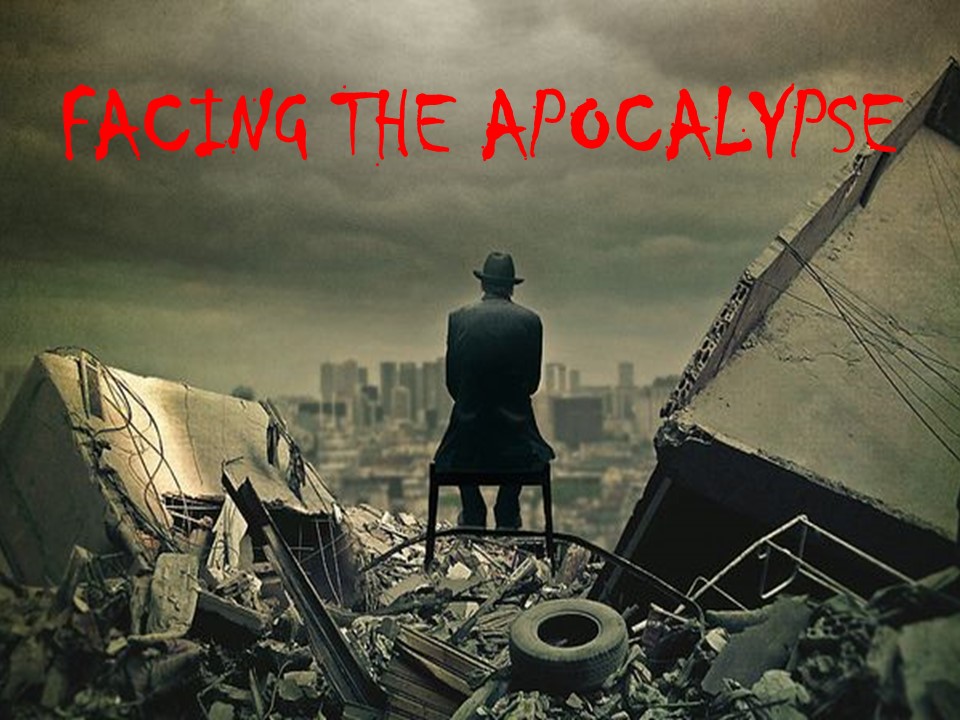
    I titled this sermon facing the apocalypse for more than one reason.

    In the first place, it is due to the fact that in our society today, there is an almost universal misunderstanding of the word itself.

    When we think of post-apocalyptic movies for instance like the Mad Max franchise or if you’re a Walking Dead fan – with the “Zombie Apocalypse”, we think of the “apocalypse” as the final or ultimate disaster. The ruination of all things and perhaps some few, brave and odd souls seeking to carve out a new life in the face of nuclear disaster, or an asteroid collision with earth, or some devastating plague nearly wiping out all mankind.

    [[IMAGE]] There is big business in that right now- like this kit, available from Amazon among 100’s of others: Zombie Apocalypse Survival Kit – $39.99.

    0001237_zombie-3-day-survival-kit-front

    [[IMAGE]] But that is not how the Bible uses the word – nor what it means in its first sense at all.

    [[IMAGE]] Revelation 1:1 The revelation of Jesus Christ, which God gave him to show to his servants the things that must soon take place. He made it known by sending his angel to his servant John,

    [[IMAGE]] Romans 8:19 For the creation waits with eager longing for the revealing of the sons of God.

    Now there is a sense in which the full revelation of God’s final purposes for this present age also ends in judgment, and the creating of a new heaven and a new earth – but the emphasis isn’t upon destruction, but rather upon the glory of the Lord being revealed in all its strength; Christians being fully revealed in their final conformity to the image of Christ; and the final unveiling of God’s eternal plans and purposes.

    [[IMAGE]] 1 Pet. 2:9 But part of this final revelation begins now.

    It begins in the deepening contrast between God’s reality, and the darkness of this present age.

    This is what Peter is after in is opening statement: “the end of all things is at hand”.

    It is not that the end of the world was about to take place, but rather we have entered into the “end times” – which culminate in the final and complete UNVEILING – REVELATION – APOCALYPSE of the glory of God in Jesus Christ.

    And all Believers are a part of that now!

    [[IMAGE]] Matt. 5:14

    [[IMAGE]] Philippians 2:14-15

    Christians, thinking and living like those genuinely translated out of the kingdom of darkness into Christ glorious kingdom of light, will stand out more and more in stark contrast to this present age.

    We are part of God’s “revealing” – His apocalypse.

    As a jeweler presents his finest diamonds against the darkest, light absorbing background of velvet – he or she does so, so that the beauty and true qualities of the diamond are seen in its clearest relief.

    This is the way Peter is writing to His brothers and sisters in Christ in their very difficult circumstances.

    He writes to them to remind them of what God is doing in them, around them – and especially – THROUGH THEM.

    The world is getting blacker and blacker & its sinfulness.

    Fallenness & godlessness get increasingly REVEALED when plopped down right in the middle of this darkness, are the Jewels of Christ Jesus – His People.  

    And in the presence of His people in this darkness – His glory is revealed.

    Part of the unveiling of God’s glory is how His people live in the face of opposition, persecution and marginalization.

    Peter’s 1st audience is living in the midst of these conditions – and we as Peter’s 2nd audience are beginning to see this advance more and more in our own culture.

    [[IMAGE]] “The end of all things is at hand” Peter writes in the 1st part of vs. 7 – “THEREFORE”.

    Therefore, this is what we do about it.

    In vss. 7-11 Peter sets forth the strategy Christians are to adopt in the face of the coming APOCALYPSE. And it may be a lot different than one would imagine.

    There is nothing here about storing up foodstuffs, converting cash into precious metals, withdrawing from the stock market, building a shelter or joining movements. All of which may or may not have some validity given certain external pressures.

    Peter’s 1st concern, which ought also to be OUR 1st concern, is seeing that these Holy Spirit breathed-out words for our instruction are to be the focus for Christians as we face such uncertain and troubled times – which have to do with our spiritual state and the continuation of the Church.

    [[IMAGE]] “What’s in your wallet? Is the question of credit card marketers.

    [[IMAGE]] “What’s in your safe?” Is the question of those in the business of making their money by selling you precious metals.

    [[IMAGE]] “What’s in your heart and mind?” Is the question The Holy Spirit poses to bring us into God’s reality in facing this present age.

    [[IMAGE]] Therefore:

    1. “Be self-controlled and sober-minded, for the sake of your prayers.”
    2. “Above all, keep loving one another earnestly, since love covers a multitude of sins.”

    To the 2nd, Peter attaches a number of ways that works out in practical terms.  

    We’ll concentrate on the 1st instruction today.


    [[IMAGE]] THEREFORE:

    [[IMAGE]] 1. “Be self-controlled and sober-minded, for the sake of your prayers.”

    1. Self-controlled
    2. Sober-minded
    3. For the sake of your prayers


    [[IMAGE]] a. Self-controlled.

    The word used here refers to the mind – even as the second one does.

    This with “sober-minded” may be a hendiadys – two words meaning the same thing for emphasis – but I think there is enough of a contrast to see them as related, but different.

    Self-controlled in this use means – to have control over our own thoughts.

    To be in possession of our selves – and especially our thought lives.

    To be a people, as God’s people, whose thought process is informed more by God’s Word than mere external influences.

    We are not immune to what the world around us says and how it reports what is going on.

    But the Spirit-filled Believer, filters these things THROUGH the Word of God – understanding His plans and purposes, and not simply reacting to the data the world throws at us.

    News agencies do not get viewership and thus advertisers, unless they continually shock, stir up, titillate, provoke and agitate their audience.

    They do not make money unless they upset you enough to keep tuning in.

    This is true of blogs and internet sites too – who earn money based on how many clicks their sites get, exposing surfers to the advertisements for products and services that appear on their pages.

    And if there is no “hook”, nothing to keep you nervous enough or interested enough to keep you coming back – they are out of business.

    The Christian needs to be careful here and to process all of this through a filter – to keep from being dragged around by a reactive brain by everything they throw at us.

    Drinking the water will kill you.

    Breathing the air will kill you.

    Your deodorant will kill you.

    Your toothpaste will kill you.

    Any of these and a million more, on any given day are either the key to ultimate health and happiness, or absolute horrid destruction.

    And Peter says – by the Spirit – STOP! Control your thoughts.

    Don’t allow yourself to get sucked in and live in perpetual fear and agitation.

    Learn the holy skill of directing your own thoughts.

    [[IMAGE]] Like Paul in his letter to the Philippians will write: Philippians 4:8–9 “Finally, brothers, whatever is true, whatever is honorable, whatever is just, whatever is pure, whatever is lovely, whatever is commendable, if there is any excellence, if there is anything worthy of praise, think about these things. 9 What you have learned and received and heard and seen in me—practice these things, and the God of peace will be with you.”

    If you find your own thought life obsessed with fears and doubts and considerations that will not let you go – you need to re-direct your thoughts by refusing to think on those distractions, and to focus upon that which is taught in God’s Word.

    True: I cannot always discern what is true in the news, but I know what the Bible says is true.

    Honorable: There is precious little that is honorable in politics today – but the Word of God depicts the honor deserving glory of God in Christ Jesus.

    Just: Injustice seems to rule the world around us – but God is just and will bring absolute justice in Christ’s return.

    Pure: Everything in the world is tainted by sin – but considering the purity and sinlessness of Christ will lead your thoughts to better places.

    Lovely: The world specializes in what is twisted, ugly and out of place, while the Bible brings you back over and over again to contemplate the loveliness of the beauty of God and holiness and uprightness.

    Commendable: The news focuses our minds upon crime and the brokenness of humankind, while the Bible bids us to ponder what is noble and sweet and good.

    THINK ON THESE THINGS. Give your heart and mind time to consider them and to delight in them more and more.

    Get self-controlled.


    1. Sober-minded.

    The use of this word is as the opposite of being drunk.

    To be under the influence of things which rob your thought process of thinking clearly, cogently, and without distortion.

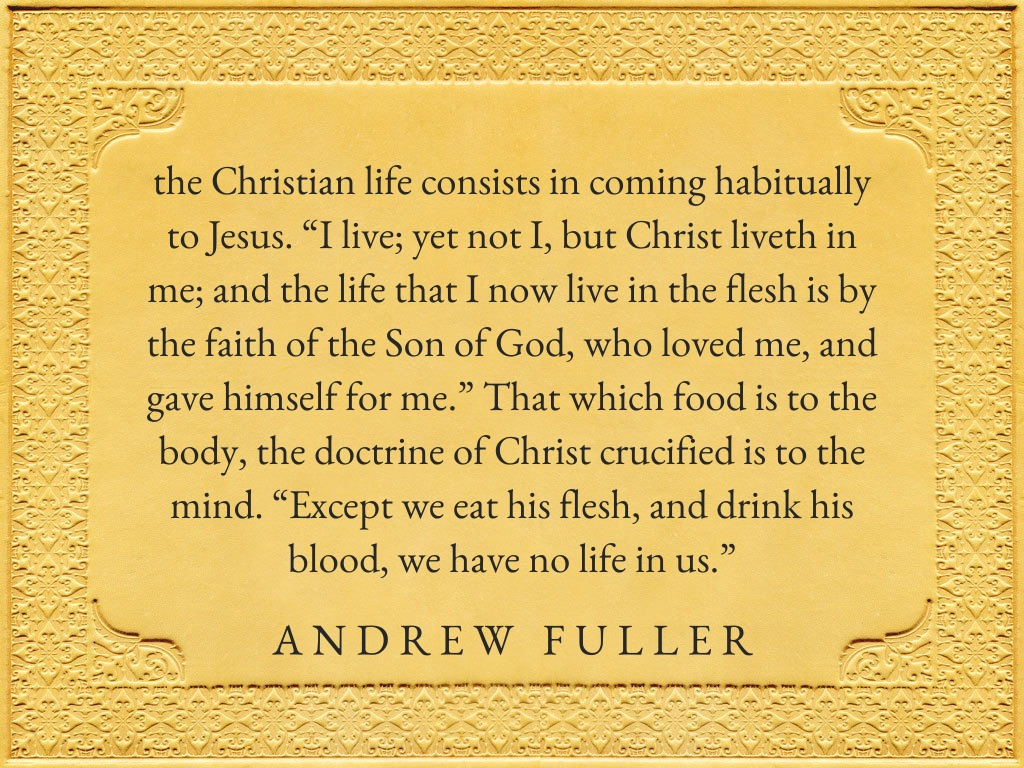
    [[IMAGE]] Andrew Fuller writes: “The mind is in danger of being intoxicated as well as the body. The mind may be intemperately fixed upon things of this life, and we may be drunken with the cares of this life, and so that day [of Christ’s return] come upon us unawares. Be sober. Sober in what? in the pursuits of wealth—in the pursuit of honours; be sober in all your plans and in all your pursuits. There is a kind of chastisedness of spirit that becomes a Christian; it requires that the soul of man in the present state be held in, as it were, with bit and bridle. We are apt to go to extremes in our pursuits, and, when once we have formed our plans, to pursue them with such ardour and eagerness, even plans of a worldly nature, as to intoxicate our minds in them. Beware that we be sober—sober in our plans—sober in our pursuits, and sober while we are viewing the great events that are passing in the world.[1]”

    [[IMAGE]] Again, Peter’s concern here is in line with Paul’s: Ephesians 5:18–21 And do not get drunk with wine, for that is debauchery, but be filled with the Spirit, 19 addressing one another in psalms and hymns and spiritual songs, singing and making melody to the Lord with your heart, 20 giving thanks always and for everything to God the Father in the name of our Lord Jesus Christ, 21 submitting to one another out of reverence for Christ.

    Drunkenness dulls and distorts the senses – whereas the Spirit of Christ sharpens them.

    Drunkenness destroys proper inhibitions, where the Spirit of God promotes self-control.

    Drunkenness distorts reality – Being filled with the Spirit brings you into reality as God knows it! REAL reality.

    Be about the business of constantly being filled with God’s Spirit – being under His influence and control.

    Make your interactions with one another occasions for rehearsing God’s goodness and grace and mercy – sparking Psalms and hymns and spiritual songs among you.

    Bring your mind to think carefully on God’s goodness to you so that thankfulness overflows, and not worry, fretfulness, resentment and fear.

    And don’t worry about not having power over life or others. Come to the place where you can joyfully submit to authorities, because personal power means nothing when you are loved and cared for by the One who is Lord over all.

    Be sober-minded. Clear. With a thought process that is not overly influenced by the news of the world, as though that is the whole truth.

    There are roughly 112 waking hours during each week. One cannot hope to have self-controlled and sober thoughts if only a few of these hours a week are given to the consideration of Biblical and Spiritual things. 


    [[IMAGE]] c. For the sake of your prayers.

    This is a most interesting connection – isn’t it?

    1. If we are not self-controlled and sober-minded, everything else will take precedence over prayer.

    We will let everything else take our time, and little or none will find us before God’s throne – on behalf of one another.

    On behalf of the Church as God’s people and as His program in the Church.


    1. We will not pray according to God’s plans, purposes and agendas, but only according to our own wants and desires. All self-absorbed.

    [[IMAGE]] Because we do not know HOW to pray as we ought…Rom. 8:26b

    Hallowed be YOUR name

    YOUR Kingdom come

    YOUR will be done


    If we are not self-controlled and sober-minded –

    1. Prayer will be born of panic and ill conceived, not expressed by faith and thankfulness.


    1. Prayer will not be a refuge for strength and encouragement, but a heavy duty and disagreeable.


    1. Prayer may cease to be realistic, and in thinking to bind God to promises He never made, end up undermining our own faith. It will become frustrating.


    1. Prayer may become little more than a meaningless ritual.


    1. Prayer will be aimed more at changing adverse and difficult circumstances, than seeking God to use those circumstances to bring about true spiritual change, in myself and others.


    1. Prayer will cease to be a place if intimate fellowship with God the Father.


    How do Christians face the apocalypse?


    [[IMAGE]] Being self-controlled by The Holy Spirit

    [[IMAGE]] Sober-minded by through the Word

    [[IMAGE]] And Constant in Prayer in confidence and trust in the One to Whom we pray, and have access by the grace of God as Christ opened the way for us.


    [1] Fuller, Andrew Gunton. 1988. The Complete Works of Andrew Fuller: Memoirs, Sermons, Etc. (Ed.) Joseph Belcher. . Vol. 1. Harrisonburg, VA: Sprinkle Publications.

  • As I was reading today – Proverbs 16:4

    April 17th, 2016

    img_0179

    Proverbs 16:4 The Lord has made everything for its purpose, even the wicked for the day of trouble.

    Bad eyes? Constant struggle with weight? Abandoned? Hurt? Poor? Wealthy? Too short? Bald? Too attractive to be taken seriously? No pedigree? Wrong ethnicity? Birth defect? Challenged? Poor hearing? Diabetic? Lack ambition? Lonely? Only liked for your money or influence? Dumped at the altar? Bullied? Abused? Betrayed? Uneducated? Handicapped?

    God has graciously & wisely given us each and every circumstance – from our physical strengths and weaknesses, to our positive and negative circumstantial environments – that we might be brought face to face with the conditions best suited to maximize the exposure of the sin within us that needs dealt with, as it hinders Christ’s likeness within us.

    On one side, it takes very penetrating hurts to go deep enough to uncover and expose the most buried and protected sins. On the other side, it takes very great privileges and pleasures to expose other of the deepest sins buried in our hearts.

    How then, will we respond?

    Will we use His “gifts”  –  to grow?

    Or will they serve as our chief excuses to remain as we are?

  • Sermon Notes from Maria Canham’s Memorial Service – Proverbs 14:32

    April 10th, 2016

    Maria

    Memorial Service for Maria Jane Canham

    April 9, 2016

    Proverbs 14:32 “The wicked is overthrown through his evildoing, but the righteous finds refuge in his death.”


    This short verse articulates a universe of reality – reality from God’s perspective that is, not necessarily ours.

    The writer is most likely Solomon, the son of King David, Israel’s 3rd king and the man whose name has become synonymous with wisdom.

    And in it, he sets out 2 very stark contrasts: 1 – Between what he calls “the wicked”, and those he labels “the righteous.”

    And the 2nd contrast he notes is that the wicked, meet their final demise, while carrying out their works – as we’ll see in a bit, simply going about their business; while the righteous, find refuge, even in the very end of life itself, in death.

    So the verse begs us to ask, what makes one “wicked”, versus one that is “righteous”?

    For if the righteous find a refuge in the very last place anyone would normally think to look – what must the difference between these two be?

    We will get how the Bible, how God defines who is “wicked” versus who is “righteous” as we consider 3 things about this idea of “refuge”.


    1. A refuge is a place of safety.

    The universe is a hostile place.

    Space is a frigid vacuum.

    Thus far, we’ve not found a single other planetary orb in all of the universe capable of sustaining life as we know it. At least not in the concrete sense, even though some scientists insist they must be out there somewhere.

    And even on this earth – made specifically to be inhabited by humankind, made in the image of God – ever since the Fall in Eden – we’ve had disease, war, human aggression and abuse, poverty, natural disasters and inclemencies of all kinds – famines, plagues and the such like.

    And Maria faced some of those head on in her own life and body.

    But Maria didn’t put her hope in whether or not these would come her way or impact her – but in the refuge who is Jesus Christ, who died to purchase her eternal redemption.

    She found a refuge in death – first and foremost, not in her own impending death, but in the death of her Savior Jesus Christ on her behalf.

    She took to heart His Word to her in places like Psalm 27:1–5 “The Lord is my light and my salvation; whom shall I fear? The Lord is the stronghold of my life; of whom shall I be afraid? 2 When evildoers assail me to eat up my flesh, my adversaries and foes, it is they who stumble and fall. 3 Though an army encamp against me, my heart shall not fear; though war arise against me, yet I will be confident. 4 One thing have I asked of the Lord, that will I seek after: that I may dwell in the house of the Lord all the days of my life, to gaze upon the beauty of the Lord and to inquire in his temple. 5 For he will hide me in his shelter in the day of trouble; he will conceal me under the cover of his tent; he will lift me high upon a rock.”


    1. A refuge is a place of rest or peace.

    Interestingly, most of us are unaware what we need rest from – from the reality that we are in the midst of a cosmic battle.

    That battle is located in contending with God over who has the right of supremacy over our lives.

    We come into this world already locked in this battle.

    The God who created us in His image and for His purposes, says He has the rights of a Creator over us – the way we claim rights over anything we make or create.

    But we – want to wrest that right from Him and live our lives according to our own plans and purposes, irrespective of His demands and how He has expressed them in His Word to us.

    And this is at the very heart of how God defines the wicked and the righteous.

    The wicked are those who, in spite of being able to do many noble and upright and loving and honorable things – yet remain locked in this rebellion against the God who made them over who has the right of supremacy over their lives.

    They insist that they have the right, while God insists that He does – and they make themselves the enemies of God. They fight against His right to rule over them.

    In contrast, the Christian is one who has come to see this battle for what it is, and has surrendered – has laid down their arms and been reconciled to this God they originally resisted, through the substitutionary sacrifice of Jesus Christ on the Cross. These are whom the Bible calls the “righteous” ones.

    For they are right in their relationship with God and have had the righteousness of Jesus Christ put on their account, when they put their faith in His death on Calvary to satisfy the debt they owed to God due to their previous rebellion – and so are counted righteous with His righteousness – not their own.

    So it is the Apostle Paul writes: Romans 5:1–6 “Therefore, since we have been justified by faith, we have peace with God through our Lord Jesus Christ.

    Paul goes on the mention what this “peace” buys the righteous or justified ones:

    1. Through him we have also obtained access by faith into this grace in which we stand,
    2. and we rejoice in hope of the glory of God.
    3. 3 Not only that, but we rejoice in our sufferings, knowing that suffering produces endurance, 4 and endurance produces character, and character produces hope, 5 and hope does not put us to shame, because God’s love has been poured into our hearts through the Holy Spirit who has been given to us.

    All this – because: 6 For while we were still weak, at the right time Christ died for the ungodly.”

    Maria knew this peace with her Creator through Jesus Christ and it is why she faced death the way she did.

    She was counted as a righteous one because of Jesus’ righteousness placed on her account through faith.

    So she knew that passing through the veil of her flesh in death, she would come into the welcoming arms of her Lord and Savior – to the very throne of God with whom she was not at war – but at peace, and who would welcome her into His glorious presence to receive her eternal reward at His hands.


    1. A refuge is a place of comfort.

    The hardness of life can be jarring.

    No one is spared some suffering in this life, and I am certain each one here could number out an impressive litany of things they’ve suffered – Emotionally

    – Physically

    – In loss

    – Disappointment

    – At the hands of others

    – Betrayal

    – On an on

    And finding true comfort can become both an all consuming and frustrating endeavor.

    Some seek comfort in escape – Drugs, alcohol, sex.

    Some in diversion – Occupation, recreation, involvement in causes or politics or some other pursuit.

    Some just retreat and try not to think about it at all.

    Maria took none of these routes – she knew that ultimately, true, lasting comfort was only to be had in running to the Refuge of her soul – Christ the Lord.

    And what comforts He promises!

    The old Puritan Charles Bridges wrote: “But even in death the righteous have a refuge. Their death is full of hope…The righteous dies in God’s grace, and in an assured confidence of the salvation of his soul, and of the glorious resurrection of his body” (Diodati).[1]

    Another Puritan, John Flavel writes: The immunities of the [resurrected] body are its freedom from all natural infirmities; which as they come in, so they go out with sin. Thenceforth there shall be no diseases, deformities, pains, flaws, monstrosities; their good physician death hath cured all this, and their vile bodies shall be made like unto Christ’s glorious body, Phil. 3:21. and be made a spiritual body, 1 Cor. 15:44. For agility, like the chariots of Aminadab; for beauty, as the top of Lebanon; for incorruptibility, as if they were pure spirits.

    The soul also is discharged and freed from all darkness and ignorance of mind, being now able to discern all truths in God, that chrystal ocean of truth. The leaks of the memory stopt for ever; the roving of the fancy perfectly cured; the stubbornness and reluctancy of the will for ever subdued, and retained in due and full subjection to God. So that the saints in glory shall be free from all that now troubles them; they shall never sin more, nor be once tempted so to do, for no serpent hisses in that paradise; they shall never grieve nor groan more, for God shall wipe away all tears from their eyes. They shall never be troubled more…and to them that are troubled, rest; they shall never doubt more, for fruition excludes doubting.

    The formal happiness is the fulness of satisfaction resulting from the blessed sight and enjoyment of God, by a soul so attempered to him, Psal. 17:15. “When I awake I shall be satisfied with thy likeness.” This sight of God, in glory, called the beatifical vision, must needs yield ineffable satisfaction to the beholding soul, inasmuch as it will be an intuitive vision. The intellectual or mental eye shall see God…The corporeal glorified eye shall see Christ…What a ravishing vision will this be! and how much will it exceed all reports and apprehensions we had here of it! Surely one half was not told us. It will be a transformative vision, it will change the beholder into its own image and likeness. “We shall be like him, for we shall see him as he is,” 1 John 3:2. As iron put into the fire, becomes all fiery; so the soul, by conversing with God, is changed into his very similitude. It will be an appropriative vision; “Whom I shall see for myself,” Job 19:26, 27. In heaven…fear is castut: no need of marks and signs there; for what a man sees and enjoys, how can he doubt of? It will be a ravishing vision; these we have by faith are so, how much more those in glory? How was Paul transported, when he was in a visional way wrapt up into the third heaven, and heard the unutterable things, though he was not admitted into the blessed society, but was with them, as the angels are in our assemblies, a stander-by, a looker-on….It will also be an eternal vision; (as Augustus said) we shall then be at leisure for this employment, and have no diversions from it for ever. No evening is mentioned to the seventh day’s sabbath; no night in the new Jerusalem. And therefore,

    Lastly, It will be a fully satisfying vision: God will then be all in all, “Curiosity itself will be satisfied.” The blessed soul will feel itself blessed, filled, satisfied in every part. Ah, what a happiness is here! to look and love, to drink and sing, and drink again at the fountain head of the highest glory!…

    And so also will the accessories of this blessedness be; The place where God is enjoyed, the empyrean heaven, the city of God, whither Christ ascended, where the great assembly are met. Paradise and Canaan were but the types of it; more excelling and transcending the royal palaces of earthly princes, than they do a pigeonhole. The company also with whom he is enjoyed, adds to the glory. A blissful society indeed! store of good neighbours in that city. There we shall have familiar converse with angels, whose appearances now are insupportable by poor mortals: There will be sweet and full closings also betwixt the saints; Luther and Zuinglius are there agreed. Here they could not fully close with one another, and no wonder, for they could not fully close with themselves. But there is perfect harmony and unity; all meeting and closing in God, as lines in the centre. This is a blessed glimpse of your inheritance.[2]

    This – is the joy and the hope and the reality of the REFUGE each in Christ has – and that which Maria has entered into already – the moment she passed from this life into the arms of her Savior.

    The hope I know for certain she desired each and every one of you she knew and loved – would have in Christ as well.

    As she lived in Christ, so she died in Christ, and will be resurrected because of Christ and with all His saints when He returns.

    For she made Him – her refuge, and in Him, even death itself became a refuge.

    [1] Bridges, Charles. 2001. Proverbs. (Crossway Classic Commentaries). Wheaton, IL: Crossway Books.

    [2] Flavel, John. 1820. The Whole Works of the Reverend John Flavel. . Vol. 1. London; Edinburgh; Dublin: W. Baynes and Son; Waugh and Innes; M. Keene.

  • My God, My God, why have you forsaken me? (Matt. 27:46) – Dr. Michael Canham preaching.

    April 10th, 2016

    tcsheadshot-61

    Today we had the privilege of Dr. Michael Canham preaching for us. It is always a joy and a blessing to have him here, and today was no exception. He was in town for his sister Maria’s memorial service which I had the great honor of preaching at. Sit back and prepare for a real feast in God’s Word.

    Mike is a longtime friend, holds a PhD from Westminster Seminary and serves as one of the professors at Cornerstone Seminary in Vallejo California.

    THE AUDIO FOR THIS SERMON CAN BE FOUND BY CLICKING HERE 

     The Notes can be seen by clicking on the following link  CanhamMatt27

  • A Brief Meditation for the Lord’s Supper

    April 4th, 2016

    real_world_communion-sm

    1 Corinthians 11:23–34  For I received from the Lord what I also delivered to you, that the Lord Jesus on the night when he was betrayed took bread, 24 and when he had given thanks, he broke it, and said, “This is my body which is for you. Do this in remembrance of me.” 25 In the same way also he took the cup, after supper, saying, “This cup is the new covenant in my blood. Do this, as often as you drink it, in remembrance of me.” 26 For as often as you eat this bread and drink the cup, you proclaim the Lord’s death until he comes. 27 Whoever, therefore, eats the bread or drinks the cup of the Lord in an unworthy manner will be guilty concerning the body and blood of the Lord. 28 Let a person examine himself, then, and so eat of the bread and drink of the cup. 29 For anyone who eats and drinks without discerning the body eats and drinks judgment on himself. 30 That is why many of you are weak and ill, and some have died. 31 But if we judged ourselves truly, we would not be judged. 32 But when we are judged by the Lord, we are disciplined so that we may not be condemned along with the world. 33 So then, my brothers, when you come together to eat, wait for one another— 34 if anyone is hungry, let him eat at home—so that when you come together it will not be for judgment. About the other things I will give directions when I come.

    There is an old cultural maxim for “good luck” that has survived the years, although not nearly as popular as it once was. It was addressed to brides and went like this:

    Something old

    Something new

    Something borrowed

    Something blue

    Most of however may not know that there is a closing line that almost never gets mentioned and it is:

    And a silver six-pence in her shoe


    Borrowing from that simple framework, I would like to modify it as we come to the Lord’s Table this evening. And my version goes like this:

    Something blended

    Something New

    Something Missing

    Something True

    And all things by Jesus, made brand new.


    As is clear from Mark’s Gospel (at least) the Last Supper was in fact a Passover meal. At the end of it however, Jesus co-opts the meal and transforms it in something entirely different than the original, and leaves it for His Church to continue until He returns. It still has ties to the Passover meal, but by virtue of Christ’s fulfilling all that the Passover foreshadowed, it must, by necessity undergo change.

    You will remember that the Passover meal was quite specific. An entire roasted lamb, which could have no blemish and no broken bones, to be consumed in its entirety. Unleavened bread – to signify the haste with which the Jews would need to leave Egypt. Naturally there would be wine. And there were to be bitter herbs, to remind them of the bitterness of their captivity. The lamb was slain at twilight, and the blood of the lamb was to be applied to the doorposts and the lintel of each household – so that when the Death Angel visited Egypt that night, those who had complied with these directives would be spared the loss of their firstborn sons. Where as all those not complying – certainly virtually ALL of the Egyptians, would suffer that loss.

    But now we come to the Last Supper. The meal ended, Jesus broke bread (the word for common bread is used in the text, not unleavened bread – something to be discussed at a later date) and took the cup and established the pattern the Church was to follow until He comes back.

    So let us notice 4 things:

    1. Something blended / In the Communion meal, there is no lamb to be consumed by us, because on the Cross, the Lamb of God which takes away the sin of the world was completely consumed. The type had been fulfilled. And, Jesus, as the very Bread of Life come down from the Father, not for the Jews only, but for all who would believe in Him – was broken for us. The Lamb and the Bread combine in the person of Christ who fulfills both. It is a magnificent transition signifying all fulfillment in Christ Jesus.

    But then too – there is –

    1. Something New / In vs. 25 Jesus says, “This cup is the new covenant in my blood”. He inaugurates the New Covenant at this moment. The Old Covenant is no longer the one which the Believer is under – and hence the removal of the Passover meal, and the installation of the Lord’s Supper – perpetuated until His return. A more stunning display of the total transition from one covenant to the other cannot be imagined. No Lamb, for THE lamb has died. And now the cup – not a prospective of an atonement to come – but a retrospective on an atonement accomplished! A, THE, New Covenant indeed.

    And then there is something truly astonishing. For sometimes, great truth emerges from what is NOT there, as much (if not more) from what is. IN this case:

    1. Something Missing / Utterly missing now, are the bitter herbs. Bitter herbs (as we know) symbolized the bitterness of the Israelites’ struggles in Egypt. God instituted that as part of this Passover meal. But in the Lord’s Supper, there is no place found for bitter herbs any more. For the Jews, the Passover meal was all retrospective – and that in remembering former bitterness. We’ll come back to this in a moment. But hear this now – in Christ, all bitterness is taken away in Him! It has no place in our remembrance at the table any more.

    Lastly, there is:

    1. Something True / The death of Christ and the New Covenant He established is a PRO-spective. It looks forward. So when Jesus established is He says: “And when the hour came, he reclined at table, and the apostles with him. 15 And he said to them, “I have earnestly desired to eat this Passover with you before I suffer. 16 For I tell you I will not eat it until it is fulfilled in the kingdom of God.” Luke 22:14–16

    This then is the truth of our final state: Then I saw a new heaven and a new earth, for the first heaven and the first earth had passed away, and the sea was no more. 2 And I saw the holy city, new Jerusalem, coming down out of heaven from God, prepared as a bride adorned for her husband. 3 And I heard a loud voice from the throne saying, “Behold, the dwelling place of God is with man. He will dwell with them, and they will be his people, and God himself will be with them as their God. 4 He will wipe away every tear from their eyes, and death shall be no more, neither shall there be mourning, nor crying, nor pain anymore, for the former things have passed away.”  Rev. 21:1-4

    NO BITTERNESS there! No crying. No mourning. Christ Himself wiping the tears from our eyes. And the Table bids us look there and taste something of that glory in the taking of the elements even now.

    Many of you here have drunk a full cup of bitterness in this life. Death of a loved one. Betrayal. Unwanted divorce. Chronic illness. Disappointment. Abuse. Loneliness. Failure. All the effects of sin, of the Fall in the Garden – not to mention the failures and lost battles against sin itself in our own lives.  Some have suffered extremes of bitter things in this life, so as to make it a wonder that you still stand today.

    But! SO great is our redemption in Christ, that in the New Kingdom when it comes in full – even our memories of all which transpired in this life – will be purged of all of its bitterness. There will be none left even in our most prefect recollections. For looking back we will see His glorious hand in every trial. His divine purposes in perfect wisdom. How He led and kept and sustained and used every bitter sip as part and parcel of preparing our eventual blessedness. So we will not look back on a one with sorrow any more – but only with understanding, joy and grateful worship.

    No, that may not be possible now – but it WILL be reality then. This is the redemptive work of Christ. And in these elements tonight, we get to taste it in advance.

    So Revelation 21:5 “And he who was seated on the throne said, “Behold, I am making all things new.” Also he said, “Write this down, for these words are trustworthy and true.”

  • Worshiping Like a Puritan

    April 3rd, 2016

    quote-a-puritan-is-someone-who-is-desperately-afraid-that-somewhere-someone-might-be-having-h-l-mencken-57-51-83

    It is quite common that Puritans get a bad rap. Mencken’s quip above expresses the sentiments of many a poorly informed soul in that regard.

    Were there self-righteous, overly pietistic, religionistic blowhards filled with quasi-spiritual smuggery among the Puritans? Yup. Just like there are today (and always have been) in every branch of the Church. But is that a legitimate broad brush with which to paint the entire crowd? Nope. Not even close.

    In fact, if you can read the following excerpt from my favorite of the Puritan preachers – John Flavel, and still come away with such a dim view – then I guess I have no means whatever to change your mind. No evidence will suffice.

    But for me – God give me the heart that can pour out this kind of worship, whether in public or in private, in preaching or in prayer, and I will die a blessed man.  This is what Puritan worship sounds like in the midst of a sermon. And this, is high stuff indeed.

    Of Jesus Christ, our Puritan Preacher waxed:

    “He is a sun of righteousness; a fountain of life; a bundle of love. Of him it might be said in that day, Here lies lovely Jesus, in whom is treasured up whatsoever an angry God can require for his satisfaction, or an empty creature for his perfection; before him was none like him, and after shall none arise comparable to him. “If every leaf and spire of grass,” (saith* one,) “nay, all the stars, sands and atoms, were so many souls and seraphims, whose love should double in them every moment to all eternity, yet would it fall infinitely short of what is due to his worth and excellency. Suppose a creature composed of all the choice endowments that ever dwelt in the best of men since the creation of the world, in whom you find a meek Moses, a strong Sampson, a faithful Jonathan, a beautiful Absalom, a rich and wise Solomon; nay, and add to this, the understanding, strength, agility, splendour, and holiness of all the angels, it would all amount but to a dark shadow of this incomparable Jesus.”

    “Who ever weighed Christ in a pair of balances?” saith another. “Who hath seen the foldings and plaits, the heights and depths of that glory that is in him! O for such a heaven, as but to stand afar off and see, and love, and long for him, while time’s thread be cut, and this great work of creation dissolved!—O, if I could yoke in among the throng of angels and seraphims, and now glorified saints, and could raise a new love-song of Christ before all the world! I am pained with wondering at new opened treasures in Christ. If every finger, member, bone and joint, were a torch burning in the hottest fire in hell, I would they could all send out love-praises, high songs of praise for evermore, to that plant of renown, to that royal and high Prince, Jesus my Lord. But, alas! his love swelleth in me, and finds no vent.—I mar his praises, nay, I know no comparison of what Christ is, and what he is worth. All the angels, and all the glorified, praise him not so much as in halves. Who can advance him, or utter all his praise?—O, if I could praise him, I would rest content to die of love for him. O, I would to God I could send in my praises to my incomparable Well-beloved, or cast my love-songs of that matchless Lord Jesus over the walls, that they might light in his lap before men and angels!—But when I have spoken of him till my head rive, I have said just nothing; I may begin again. A Godhead, a Godhead, is a world’s wonder! Set ten thousand thousand new-made worlds of angels and elect men, and double them in number ten thousand thousand thousand times: let their hearts and tongues be ten thousand times more agile and large than the hearts and tongues of the seraphims, that stand with six wings before him; when they have said all for the glorifying and praising of the Lord Jesus, they have spoken little or nothing. O that I could even wear out this tongue in extolling his highness! But it is my daily admiration, and I am confounded with his incomparable love.”[1]

    Search out this wonderful God until you can stand no more visions of His beauty, glory and grace.

    [1] Flavel, John. 1820. The Whole Works of the Reverend John Flavel. . Vol. 1. London; Edinburgh; Dublin: W. Baynes and Son; Waugh and Innes; M. Keene.

  • A good word from George MacDonald

    March 29th, 2016

      From his “Unspoken Sermons” – This, on Luke 23:46 “Father, into your hands I commit my spirit”. 

    How the earthly father would love a child who would creep into his room with angry, troubled face, and sit down at his feet, saying when asked what he wanted: “I feel so naughty, papa, and I want to get good”! Would he say to his child: “How dare you! Go away, and be good, and then come to me?” And shall we dare to think God would send us away if we came thus, and would not be pleased that we came, even if we were angry as Jonah? Would we not let all the tenderness of our nature flow forth upon such a child? And shall we dare to think that if we being evil know how to give good gifts to our children, God will not give us his own spirit when we come to ask him? Will not some heavenly dew descend cool upon the hot anger? some genial rain-drop on the dry selfishness? some glance of sunlight on the cloudy hopelessness? Bread, at least, will be given, and not a stone; water, at least, will be sure, and not vinegar mingled with gall.

  • Sermon Notes for Easter Sunday 2016 – “Fear Not!”

    March 27th, 2016

    Slide3The Risen Christ

    Revelation 1:9-20

    John, as we just read, was in prison when he received this revelation.

    He personally was exiled on this small, barren, volcanic island in the Aegean Sea called Patmos.

    He was not a young man, probably in his late 80’s or perhaps early 90’s.

    Aged. Oppressed. Exiled. Alone and probably not a little concerned for the state of the Church – as the last living Apostle, he has much to wrestle with.

    He has seen astounding things over his lifetime.

    His 3+ years with Jesus.

    The Crucifixion.

    The Resurrection.

    Pentecost.

    The birth of the New Covenant Church.

    Much persecution. His own escape from being boiled in oil.

    And the deaths of all his fellow Apostles.

    And our text finds him on this prison island – as it says in vs. 10 – “In the Spirit, on the Lord’s Day.”  i.e. – In prayer.

    And it is while he is deep in prayer, that he receives this divine visitation from the resurrected Christ.

    One would think it no big deal for Jesus to appear to the one Apostle who was called “The Beloved” – but the vision is so overpowering that John says: “When I saw him, I fell at his feet as though dead[1]”

    Nevertheless, Jesus tells John not to be afraid – and to record all that He will reveal to him next.

    But for this morning, I want to fix our attention on the reasons Jesus gives John in this text – for why he ought not to be afraid – tho the present circumstances are dire, and the Church – as Jesus reveals in letters to each of those in Asia Minor, was in a very mixed condition of spiritual health.

    Jesus’ 4 Reasons for John to “fear not”.

    1. “I am the first and the last”:

    He is the first and the Last.

    If there were ever any doubt in John’s mind, or that of anyone else – as to precisely who this Jesus is – this declaration was designed to wipe those doubts away forever.

    The words used here: “I am the first and the last” are not just a casual way of speaking.

    In Isa. 41:4  /  Isa. 44:6  /  Isa. 48:12 this title is used by God as an exclusive title regarding Himself!

    No mere human being, and no angel had a right to take this name to themselves. This is God’s title for Himself.

    Isaiah 41:1–4 Listen to me in silence, O coastlands; let the peoples renew their strength; let them approach, then let them speak; let us together draw near for judgment. Who stirred up one from the east whom victory meets at every step? He gives up nations before him, so that he tramples kings underfoot; he makes them like dust with his sword, like driven stubble with his bow. He pursues them and passes on safely, by paths his feet have not trod. Who has performed and done this, calling the generations from the beginning? I, the Lord, the first, and with the last; I am he.

    In all three of these instances, the use of the title is to show that He is sovereign over all creation as its maker, and even over Pagan nations!

    No doubt an incredible comfort to John and His fellow Christians suffering unspeakable persecution by the Roman government.

    He is the God who made Patmos.

    He is the God who made John himself.

    He is the God who superintends the Roman government that exiled him.

    He is the God of His people – The Church.

    Don’t be afraid John, the one on whose bosom you laid your head at the last supper, is Lord and God over ALL!

    TRUST ME!

    The full force of those passages from Isaiah are meant to crash in on the suffering Saint’s soul and bolster him for whatever lies ahead.

    Isaiah 44:6–8 Thus says the Lord, the King of Israel and his Redeemer, the Lord of hosts: “I am the first and I am the last; besides me there is no god. Who is like me? Let him proclaim it. Let him declare and set it before me, since I appointed an ancient people. Let them declare what is to come, and what will happen. Fear not, nor be afraid; have I not told you from of old and declared it? And you are my witnesses! Is there a God besides me? There is no Rock; I know not any.”

    This risen Christ is Lord and God of all.

    And if He gave His life to cleanse those who believe in Him from all of their sins – if we have nothing left to fear from Him in the burning presence of perfection and holiness and judgment – then surely we have nothing to fear from this life and its challenges.

    Fear not! He proclaims to John. And to all those who are in Christ.

    God has a purpose in it all.

    The beginning of God’s ways are located in Christ Jesus, and the end of His ways are located in Him.

    His eternal purpose to reveal the depths and wonder of His mercy and grace – culminating in the blessedness of the saints WITH Him forever.

    2. “The Living One”.

    He is the Living One. He is RISEN!

    Once again, ties to the OT come to the fore, and in this case, with a saying that most often finds its use in how it is God swears, makes binding promises or takes oaths:       “Deut. 32:39-42 ‘See now that I, even I, am he, and there is no god beside me; I kill and I make alive; I wound and I heal; and there is none that can deliver out of my hand. For I lift up my hand to heaven and swear, As I live forever, if I sharpen my flashing sword and my hand takes hold on judgment, I will take vengeance on my adversaries and will repay those who hate me. I will make my arrows drunk with blood, and my sword shall devour flesh— with the blood of the slain and the captives, from the long-haired heads of the enemy.’

    He is the One who swears upon His own immortality that all that He has promised will come to pass – and ESPECIALLY the final overthrow of all that opposes His Kingdom and His people.

    Secondly, He is alive among His churches and His people – regardless of their condition.

    This is the meaning of John seeing Jesus in vss. 12-13 as “in the midst of the golden lampstands” – which vs. 20 says are the Churches.

    He is alive here among us. Knowing our every plus, and our every failing.

    Our challenges, our strengths, our weaknesses and our needs given our circumstances.

    As you progress through this passage and see how intimately He knows the circumstances and the spiritual condition of all His Churches, so He has not stopped dealing with them – with us.

    He has not left us on our own in this hostile world – but is the One who is Living, and living right in our midst.

    He is not some far off mythical deity, but the Living God who dwells in the midst of His people.

    He is here today Believer.

    He is in your home with you.

    In your car.

    In your workplace.

    In the emergency room, and in the ambulance and in the Dr.s office.

    In your loneliness.

    In your sorrow.

    In your doubt and fear.

    He is WITH His people at all times as the Living One.

    FEAR NOT!

    3. “I died, and behold I am alive forever more.”

    Sin has its remedy in Him.

    Wrath is swallowed up in Him.

    He died in our place, and was raised for our justification and will never cease to be our living Savior and intercessor.

    He has conquered the unconquerable – DEATH – on our behalf.

    We do not worship a dead man – we worship the Living Christ!

    Who  – as Isaiah 53 so fully demonstrates:

    had no form or majesty that we should look at him, and no beauty that we should desire him.

    Who was despised and rejected by men; a man of sorrows, and acquainted with grief; and as one from whom men hide their faces he was despised, and we esteemed him not.

    It is he who has borne our griefs and carried our sorrows; yet we esteemed him stricken, smitten by God, and afflicted.

    But he was pierced for our transgressions; he was crushed for our iniquities; upon him was the chastisement that brought us peace, and with his wounds we are healed.

    All we like sheep have gone astray; we have turned—every one—to his own way; and the Lord has laid on him the iniquity of us all.

    He was oppressed, and he was afflicted, yet he opened not his mouth; like a lamb that is led to the slaughter, and like a sheep that before its shearers is silent, so he opened not his mouth.

    By oppression and judgment he was taken away; and as for his generation, who considered that he was cut off out of the land of the living, stricken for the transgression of my people?

    And they made his grave with the wicked and with a rich man in his death, although he had done no violence, and there was no deceit in his mouth.

    Yet it was the will of the Lord to crush him; he has put him to grief; when his soul makes an offering for guilt, he shall see his offspring; he shall prolong his days; the will of the Lord shall prosper in his hand. Out of the anguish of his soul he shall see and be satisfied; by his knowledge shall the righteous one, my servant, make many to be accounted righteous, and he shall bear their iniquities.

    Therefore I will divide him a portion with the many, and he shall divide the spoil with the strong, because he poured out his soul to death and was numbered with the transgressors; yet he bore the sin of many, and makes intercession for the transgressors.

    He died – and is alive forever more.

    And that too – as our ever living Intercessor before the throne of the Father. Watching and caring and pleading and seeing that our every need is attended to.

    4. I have the keys of death and Hades.

    To “have the keys of Death and of Hades” is to possess authority over their domain…According to Rabbinical teaching, this is the sole prerogative of God;[2]

    For John – this was a most comforting reality, and one he was supposed to write down and share with all the Churches of Christ – He is Lord over our living, and Lord over our dying.

    Lord over our living in when and where and how we live.

    Lord over our dying as to when and where and how – and especially able to raise us up from it, since He has absolute dominion over it!

    He is the One who can raise us from the dead to our everlasting inheritance in Him.

    Nothing can hinder His salvation – for He conquered death and the grave for us.

    Nothing, not even the grave can prevent us from receiving everything He has promised to us in our union with Him.

    As John recorded what Jesus said in John 5:25–29 “Truly, truly, I say to you, an hour is coming, and is now here, when the dead will hear the voice of the Son of God, and those who hear will live. For as the Father has life in himself, so he has granted the Son also to have life in himself. And he has given him authority to execute judgment, because he is the Son of Man. Do not marvel at this, for an hour is coming when all who are in the tombs will hear his voice and come out, those who have done good to the resurrection of life, and those who have done evil to the resurrection of judgment.”

    And here stands before John, the risen Christ Jesus to reaffirm His claim in undeniable glory.

    Because He is the First and the Last, the Living one, the One who died and yet is alive forevermore – all that He has said will come to pass in perfect measure and in His perfect time.

    FEAR NOT!

    Glory!

    Now, as we said to the audience over at White Haven earlier this morning –

    So I ask you today – do YOU know Him?

    Not merely the material facts about Him – do you KNOW Him?

    Have you met Him?

    This, is THE great question isn’t it?

    Do YOU know Him?

    Not simply – do you know God exists? – everyone knows that, even those who deny it (Rom. 1:18-23).

    And not – do you merely have some acquaintance with Him? Nicodemus, the Rich Young Ruler and a thousand others could claim that.

    Not – do you have some true relationship to Him? Jesus’ unbelieving brothers were no different.

    Not – do you consider yourself His disciple? Judas was truly a disciple and one of His chosen apostles.

    Not – do you know Christ as divine? For the devils themselves know that much.

    To KNOW God in that it is eternal life, is to know Him such that the wretchedness of this world’s and your own sin are shameful, rebellious and completely “other”, and that He is so perfect and infinitely lovely in every way, that your heart longs after Him and seeks Him and delights in Him.

    Do you love Him so as to love nothing else as much?

    Do you know Him so that He captivates your heart and mind?

    Do you love Him with a constant longing to love Him more and to have others see Him and love Him too?

    Do you love Him so as to want to make His glories known?

    Do you know His glories such that every glimpse makes you want more?

    Do you know Him so that Heaven is to be with Him and to know Him fully?

    Do you know the only true God, and Jesus Christ whom He has sent – in mercy and grace to be the propitiation for your sins?

    Do you know Him?

    Have you believed upon Him and been joined to Him by faith so that you are included in His death, burial and resurrection?

    You can today. That is the glory of the Gospel. Moving from mere facts to genuine, saving faith.

    Forsaking all other hope or means of being good enough for God – and having Christ’s own goodness put on your account, by trusting Him and Him alone. Coming to know Him by faith.

    He is RISEN! And all those in Him – will rise again too – to the eternal life that is in Him.

    Those that DO know Him, can FEAR NOT – indeed!


    [1] 2001. The Holy Bible: English Standard Version. Wheaton: Standard Bible Society.

    [2] Swete, Henry Barclay (ed.). 1906. The apocalypse of St. John. 2d. ed. (Classic Commentaries on the Greek New Testament). New York: The Macmillan Company.

←Previous Page
1 … 105 106 107 108 109 … 197
Next Page→

Blog at WordPress.com.


Loading Comments...
 

    • Subscribe Subscribed
      • ResponsiveReiding
      • Join 419 other subscribers
      • Already have a WordPress.com account? Log in now.
      • ResponsiveReiding
      • Subscribe Subscribed
      • Sign up
      • Log in
      • Report this content
      • View site in Reader
      • Manage subscriptions
      • Collapse this bar