  And of Zion it shall be said,
  “This one and that one were born in her”;
  for the Most High himself will establish her; The LORD records as he registers the peoples,
  “This one was born there.” Selah Ps. 87:5-6
In human terms, it is common for us to both refer to and bear the marks of – our heritage.
I, am a native New Yorker. That brings peculiarities with it. When I am in the South, those things distinguish me. My accent, certain attitudes, etc.
Even more specifically, I am from Rochester – western NY. And that means I know what a garbage plate is, and until recently, Wegman’s (a local grocery chain) was uniquely ours. White hot dogs, the prominence of fish-frys on Fridays. NY pizza. Different from everywhere else. The Lilac Festival, what The Can of Worms was, and all sorts of other things mark me out. Not the least of which is the nasally way we say “Rahchester”.
In Matthew 26, when Peter was following Jesus to His mock trials, some bystanders marked Peter out as a Galilean due to his accent.
But what are the distinguishing marks of those born again into the new heritage of hailing from The City of God? What is our accent? How do our speech, our comportment, our attitudes, responses, values and motivations make us known as citizens of Zion?
Can people note something different about us? Like those in Acts 4:13, will people take note that we have “been with Jesus”?
Will they note what it is we love, and what it is we detest? Will they see us as a joyous people? Peaceful and seeking peace? Patient in trial in tribulation? Inherently kind? Upright in our dealings with others? Loyal and faithful to our Master and one another? Gentle in the face of opposition? And full of self-restraint?
Will they be able to know that we are filled with His Spirit because refuse to be drunk with wine and flee debauchery? Addressing fellow citizens of Zion with psalms, hymns and spiritual songs because we are forever making melody to the Lord in our hearts, and thus perpetually thankful to the Father in the name of Christ?
Bold but not brash. Steadfast but not unnecessarily rigid. Flexible but not compromising. Truthful and merciful at the same time. Seeking the best for the souls of others before the throne of God. Hopeful in the face of a disintegrating culture and world.
Will any be able to say after meeting us: “I know where they are from, they must have been born in Zion, the City of God?”
O may it truly be so. May our accent give us away every time.
Many is the time I’ve heard a Mother’s Day sermon preached on this passage. Maybe you have too. And there is no question that one considering marriage does well to consider the kinds of attributes displayed in this passage when choosing a prospective mate. One must remember however this is a collective of ideals. All will fall short in places. AND, women should keep in mind those passages which outline the character traits of a godly man before opting for someone to be one with. There are some pretty high standards to be found for men as well.
All that said, I think we may lose something of the broader application of this passage if we only see it in terms of human marriage. Along with the likes of the Venerable Bede, John Gill, Wordsworth, Ambrosius, Augustine, Harry Ironside, Robert Hawker, Peter Lillback and others – I see here something of great importance in describing what should be the nature of Christ’s Bride – The Church. Read that way, the passage gives us much to consider if the Church is painted with these colors.
Think about it –
Proverbs 31:10–11 An excellent wife who can find? She is far more precious than jewels. The heart of her husband trusts in her, and he will have no lack of gain.
Can Christ trust us that He will gain from our efforts? That we are committed to His interests?
Proverbs 31:12 She does him good, and not harm, all the days of her life.
Do we do Him and His cause good? Or does His work or reputation suffer at our hands?
Proverbs 31:13 She seeks wool and flax, and works with willing hands.
Are we industrious for the Kingdom? Or just making do?
Proverbs 31:14 She is like the ships of the merchant; she brings her food from afar.
Do we go to great lengths to get His choice Word for our souls?
Proverbs 31:15 She rises while it is yet night and provides food for her household and portions for her maidens.
Do we labor secretly to see to it His Word is prepared for ourselves, His household, and for those who are close at hand?
Proverbs 31:16 She considers a field and buys it; with the fruit of her hands she plants a vineyard.
Do we seek the growth of the Kingdom and set in motion plans to make it happen, that the Fruit of His vine might increase?
Proverbs 31:17 She dresses herself with strength and makes her arms strong.
Have we strengthened ourselves in the Lord? And clothed ourselves in His righteousness?
Proverbs 31:18 She perceives that her merchandise is profitable. Her lamp does not go out at night.
Do we perceive how eternally valuable what we have in Him is – this ministry of the Word? Does His Word light us at all times?
Proverbs 31:19 She puts her hands to the distaff, and her hands hold the spindle.
Are we busy producing the bare thread of what becomes the garments of righteousness?
Proverbs 31:20 She opens her hand to the poor and reaches out her hands to the needy.
Are we generous to the lost and those in need?
Proverbs 31:21 She is not afraid of snow for her household, for all her household are clothed in scarlet.
Do we not fear evil and “cold” seasons because we have prepared well in Him? Prepared our hearts to trust Him at all times and in all things?
Proverbs 31:22 She makes bed coverings for herself; her clothing is fine linen and purple.
Do we make room for times of deep intimacy with Him? And do we adorn ourselves with the good works that make us attractive to Him?
Proverbs 31:23 Her husband is known in the gates when he sits among the elders of the land.
Have we protected Christ’s reputation in the marketplace?
Proverbs 31:24 She makes linen garments and sells them; she delivers sashes to the merchant.
Are we about the business of getting the garments of salvation out among the people?
Proverbs 31:25 Strength and dignity are her clothing, and she laughs at the time to come.
Are we strong in our relationship with Him and not fearful of the coming judgment because of it?
Proverbs 31:26 She opens her mouth with wisdom, and the teaching of kindness is on her tongue.
Are we making the Gospel known, and communicating it in kindness and compassion for the souls of men?
Proverbs 31:27 She looks well to the ways of her household and does not eat the bread of idleness.
Are we mindful of the orderliness of His Household, and not disengaged or lazy in our labors within it?
Proverbs 31:28 Her children rise up and call her blessed; her husband also, and he praises her:
Will those who come to Christ rise to bless our efforts on their behalf? Will the other saints? Will he?
Proverbs 31:29 “Many women have done excellently, but you surpass them all.”
Are we admired by Him for how we have attended Him in faithfulness?
Proverbs 31:30 Charm is deceitful, and beauty is vain, but a woman who fears the Lord is to be praised.
Have we been more occupied with making ourselves beautiful outwardly to the world, than about what pleases Him?
There are churches which specialize in charm – in appealing to tastes. And churches which specialize in the temporary beauty of the hour, being outwardly attractive. But the Church God praises, is the one that fears Him above all. This does not mean we ought to be purposefully unattractive or repellent, but it does mean fearing God will give us a sweet aroma and a beauty in the eye of the One we wish to please most.
Proverbs 31:31 Give her of the fruit of her hands, and let her works praise her in the gates.
If our reward is the fruit of what we’ve done in His name – will it prove sweet, satisfying and abundant?
Is the Church, are we – His excellent wife? Heavenly Father, make us so by Your Spirit.
Psalm 86 bears the title: “A Prayer of David.” And I love how David prays, as much as I need to look at what he prays for.
In the “how” column, he prays as a “poor and needy” man. Cognizant that he has nothing in himself.
He prays too as a “godly” man. Not perfect. Not righteous in himself. But one who looks to and desires to serve the one true and living God.
He prays to the Lord who is “good and forgiving, abounding in steadfast love to all who call upon you.” To the God who does “great and wondrous things.”
The “what” he prays for is notable as well.
Deliverance from opposing or oppressing enemies. That’s reasonable.
But the real sum and substance of his concern is in vs. 11 ” Teach me your way, O LORD, that I may walk in your truth; unite my heart to fear your name.”
a. To know God’s ways as taught from God Himself.
b. To walk in truth – in God’s reality.
c. And above all – that his heart might be united that he might fear God’s name.
How intriguing. A united heart.
A “united” heart; in other words, one that does not have any divided loyalties, but is wholly set upon finding its joy and satisfaction and fullness in Christ alone. One that fears God alone, and nothing nor anyone else.
So let’s pray with David today: Oh Holy Spirit, grant this heart to me! Heavenly Father, grant your Spirit to create this heart within this weak and brittle vessel. Give me, give we your servants, a singular, united heart – to fear your name. For the cause and glory of Christ we pray. Amen.
In the past number of years, many have noted how those leaving Evangelicalism, seem to be streaming into two tributaries: Roman Catholicism, and Eastern Orthodoxy.
For those who have come out of one of those two traditions into Gospel-centered, Christ-centered Biblical Christianity, it is virtually unthinkable. And yet, it is not without precedent. For after the Israelites were delivered from Egypt, many preferred to go back to the familiarity of their pagan captivity, and to the religious systems they began to imbibe there. It is the case (as my Dad used to say) that when there is no true regeneration, men will follow after “smells and bells” to try and make up for the void. It is the peculiar temptation and sin of the religious without the Spirit of Christ. And thus we read in Stephen’s discourse in Acts 7: “ Acts 7:39–43 (ESV): Our fathers refused to obey him, but thrust him aside, and in their hearts they turned to Egypt, 40 saying to Aaron, ‘Make for us gods who will go before us. As for this Moses who led us out from the land of Egypt, we do not know what has become of him.’ 41 And they made a calf in those days, and offered a sacrifice to the idol and were rejoicing in the works of their hands. 42 But God turned away and gave them over to worship the host of heaven, as it is written in the book of the prophets: “ ‘Did you bring to me slain beasts and sacrifices, during the forty years in the wilderness, O house of Israel? 43 You took up the tent of Moloch and the star of your god Rephan, the images that you made to worship; and I will send you into exile beyond Babylon.”
Jude notes that in fact their problem, was unbelief, albeit dressed in the lush garb of idolatry.
If this trend troubles you, and you are looking for solid help I give you the following link to Doreen Virtue’s episode where she gives a platform to Pastor Samuel Farag. Raised in the Eastern Orthodox Church and converted to saving faith in Jesus, he exposes the real dangers behind Eastern Orthodoxy and by connection, Roman Catholicism in ways you may have never heard before. It is an eye-opening video. And more so as it progresses.
May the Lord be pleased to us this material to help many seduced into this false and blasphemous system to find freedom and faith in Christ.
We now come to the end of Jesus’ public teaching on the end times. It is both a sour and a hopeful note. Which, depends upon your relationship to Him in faith. J.C. Ryle writes: “There are few passages in the whole Bible more solemn and heart—searching than this. May we read it with the deep and serious attention which it deserves.” Ryle, J. C. 1860. Expository Thoughts on Matthew. New York: Robert Carter & Brothers.
Note first, that we must beware of turning an analogical statement into a full orbed theological and doctrinal construct. This is a common error in our Bible study and interpretation, and an easy one to fall into. Jesus’ simple point is, that on the final day, He will separate Believers from unbelievers, and each will receive appropriately from His hand.
Some, mistakenly, have turn this parabolic statement into a construct of ontology. They see it as though the world is made up of people who are as fundamentally different by nature, as sheep are from goats. One confused soul even said to me once: “I was never a goat, I was always a sheep.” This is just confused.
Yes, the one who is saved by grace has become a dwelling place of the Holy Spirit, born again by His grace and adopted into the Family of God. But we must never forget Paul’s words in Eph. 2 when marking out what ALL of us used to be: “And you were dead in the trespasses and sins in which you once walked, following the course of this world, following the prince of the power of the air, the spirit that is now at work in the sons of disobedience— among whom we all once lived in the passions of our flesh, carrying out the desires of the body and the mind, and were by nature children of wrath, like the rest of mankind.” (Eph. 2:1-3)
Did you catch that last sentence? We were all, “by nature” children of wrath like the rest of mankind. There was no ontological, no constitutional difference between all human beings before salvation. We are all drawn from the same, fallen lump of Adam’s race.
As Don Carson is wont to say, we cannot make every simile, analogy or parable “walk on all fours.” We can over-interpret this way and end up distorting Scripture.
Note second: In the same vein as above, be careful to see that there is no attempt on Jesus’ part to turn “sheep” into believers everywhere sheep are mentioned in Scripture and “goats” everywhere they are mentioned into unbelievers. Sometimes, sheep are just sheep, and goats are just goats. All that is said here is that the Son will separate the believers from the unbelievers, in the same way a shepherd separates sheep from goats. The issue is separation, not ontological assignation.
Once again, if we press Jesus’ analogy too far, we’ll be at a real loss to deal with things like the Passover meal when instituted in Ex. 12; where the Israelites could select their Passover sacrifice from either the sheep or the goats, without distinction.
Note third: That the judgment for these two groups is different. One is rewarded for what they DID do, the other, punished for what they DIDN’T do. It is a most interesting dichotomy.
The Believer is rewarded according to his good acts, and the Unbeliever punished for his wicked acts.
Nothing that is holy but neglected will go undiscovered. Nothing done in earnest to serve Christ will go unnoticed either.
Note fourth: Both the terror and the glory of this one thing – It is Christ Himself who will sit as judge. Many a religionist fails to recognize that Jesus Himself is the judge. Yes, He is The Savior. Yes, He is the substitute. Yes, He is the Lamb of God who takes away the sin of the world. And yes, He will be our final judge. The omniscient, Son of God. The God who walked in human flesh and knows every heartache, every temptation, every opportunity, every obstacle, every circumstance we all have faced in this life. He, will judge us all. With the unsparing scrutiny of His omniscience. He is the Living Word, who discerns even the thoughts and intents of the heart.
Nothing will serve as a justifiable excuse for failure to reckon with the demand of the Gospel to find forgiveness and grace in Christ. He knows us. He knows all we face. He knows all of our circumstances. And no one will be able to exempt themselves from His all-seeing examination.
By the same token, nothing that any who are His have done because they are His, no matter how small, how seemingly insignificant, how unknown by any other human eye or ear – will go unrewarded.
Note fifth: Because of who He is – because He is God, and perfectly holy, He can neither over-punish, nor under-punish sin. He knows what the penalty of sin costs personally. He endured it on the Cross. And for the very same reasons, He can neither over-reward nor under-reward His saints in judgment. And yet, He is free to pour out of His limitless grace, infinitely more than our just rewards, for He makes Himself our inheritance. His eternal limitless self. The fountain of all goodness, grace, love, wonder and joy.
1 Pet. 1:3-9 “Blessed be the God and Father of our Lord Jesus Christ! According to his great mercy, he has caused us to be born again to a living hope through the resurrection of Jesus Christ from the dead, to an inheritance that is imperishable, undefiled, and unfading, kept in heaven for you, who by God’s power are being guarded through faith for a salvation ready to be revealed in the last time. In this you rejoice, though now for a little while, if necessary, you have been grieved by various trials, so that the tested genuineness of your faith—more precious than gold that perishes though it is tested by fire—may be found to result in praise and glory and honor at the revelation of Jesus Christ. Though you have not seen him, you love him. Though you do not now see him, you believe in him and rejoice with joy that is inexpressible and filled with glory, obtaining the outcome of your faith, the salvation of your souls.”
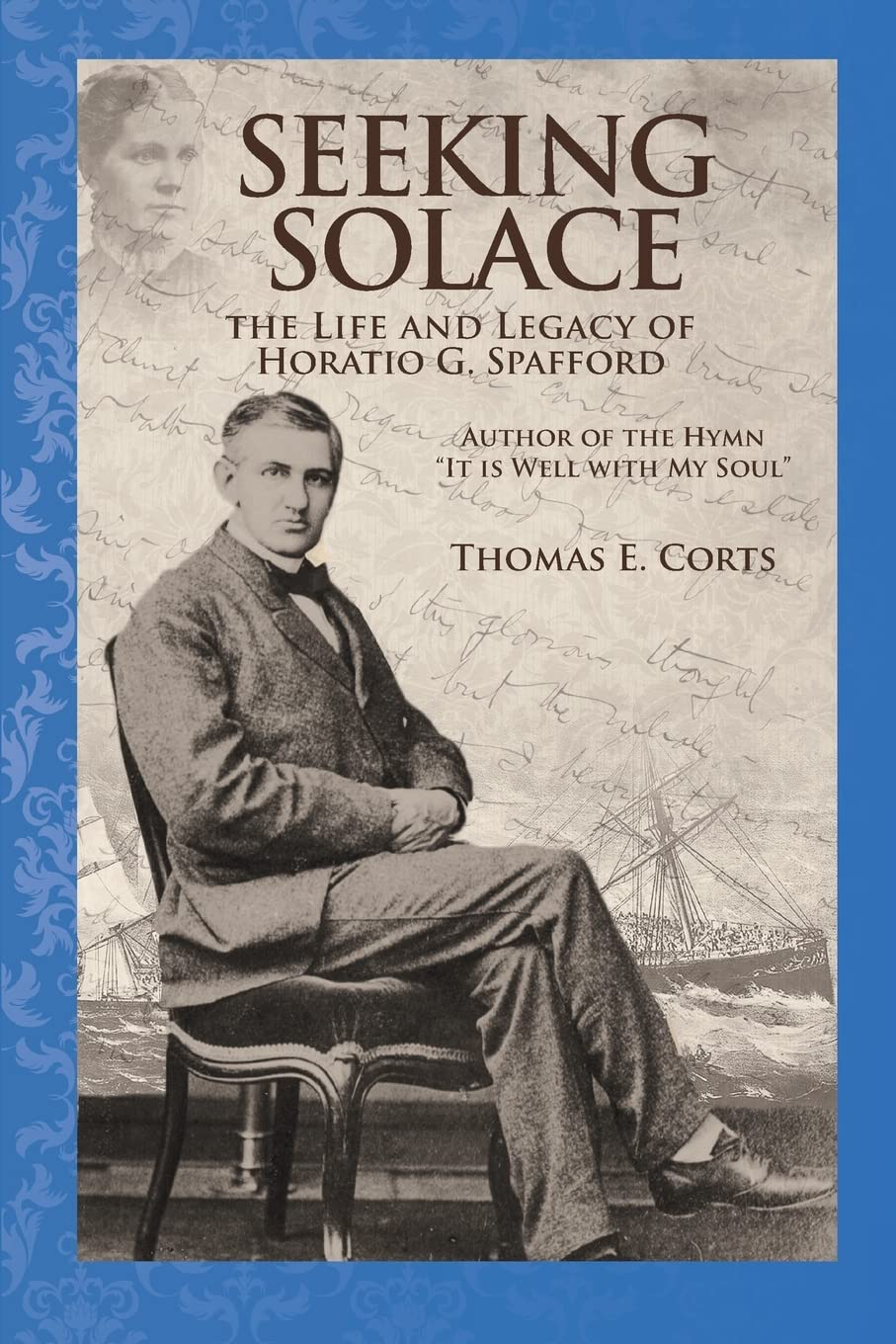
Horatio G. Spafford: The Man, The Myth, The Tragedy. A brief review of Thomas E. Corts’ “Seeking Solace, The Life and Legacy of Horatio G. Spafford”.
Cort’s impeccably and thoroughly researched biography of Spafford is a book I wish I hadn’t read, but find necessary that I did.
Throughout my life, the name Horatio Spafford was one I came to revere and admire.
To all who have imbibed the popular story behind Spafford’s composition of the words to “It is well with my soul”, he holds a cherished place in our hearts. As does his suffering wife, Anna. The account of losing nearly everything in the Chicago fire of 1871, followed by the unimaginable loss of his four daughters in a collision at sea between their passenger ship the Ville du Havre, and another ship, the Loch Earn – instinctively draws from our hearts the deepest sense of loss and compassion. Rightly so. But, with some of those central facts still intact, there remains yet much mythology that in the pursuit of truth, needs to be brought into the light.
Such de-mythologizing is painful. And I feel it keenly. But it is a necessary part of maturing. We often need to be dis-illusioned; freed from our illusions so that we can live in truth. And Corts’ fine biography does just that.
Warning: If you can’t handle seeing what may have been a hero to you examined in the bright light of reality, then do not, I repeat, DO NOT read this book. Go your blissful way with your image of Spafford unsullied and intact. But even at that, it is worth getting all the facts straight about the key points no matter what else you may learn.
We are all well aware that our heroes have flaws. Some more serious than others, but there are no super-saints among us. Some have flaws that are mere quirks of personality. Some are undergirded or exacerbated by mistaken understandings of Scripture. Some are located in a historical context very different from our own and ought not to be judged by present day sensibilities and cultural bents. Others, are truly disqualifying. Sadly, Spafford’s fall into the latter.
Let me lay out some of the chief myths Corts disabuses us of, and then fill in some additional information. I do not want to give a Cliff’s Notes version of the book. Rather, as you see some key facts, reading the book yourself will fill in the much-needed details.
Myth 1 – The Spafford’s lost everything in the Chicago fire. Untrue. Spafford was an attorney of some note, with an office and law library in Chicago which he indeed lost. The family lived, however, in a very fashionable suburb which suffered no damage by the fire whatever.
Myth 2 – Horatio penned the words to “It is well with my soul” while aboard a ship sailing over the place where his daughter’s drowned. Untrue. Ira Sankey – D. L. Moody’s close associate and Gospel singer remembered clearly it was not until 3 years after the tragedy. Philip Bliss who wrote the music for it and first sang it in public recalled the same. In fact, there is no record of Horatio ever placing any specific significance on the poem, or even referring to it. It was just one of many of his compositions.
Myth 3 – Upon her survival, Anna Spafford sent a simple 2-word cable home: “Saved alone.” Untrue. For many years, Sankey said Horatio had the original cable framed and hanging in his office. The cable operator listed the contents as 29 words.
Myth 4 – After their tragic loss, and the subsequent death of another child due to scarlet fever, the Spaffords were drummed out of their Church in Chicago. Untrue. Sadly, Horatio led a faction of the Church in accusing the pastor of financial impropriety. When the books were examined and the charges proved to be unfounded, Horatio led a group out and started a house church of sorts in his own home, later named the “Overcomers.”
Myth 5 – Moved by philanthropy and a burden for the Jews, the Spaffords moved to Jerusalem to start a missions work there. The most untrue and saddest of all. For years, it was unclear where Horatio was getting the money to finance his lifestyle, and even the 2 year trip abroad they were on when his daughters perished. Documents and court records show that given the executorship of 3 estates, he defrauded those he was to provide for, as well as running up mortgages on properties he owned. He fled from what was almost certain prosecution and perhaps prison.
Some random facts.
1 – Once the Overcomers were in swing, Horatio’s widowed sister (Margaret Lee) arrived, and praying to be filled with the Spirit, began getting direct words from the Lord on a whole host of topics and Biblical interpretations. Anna followed in this behavior, and soon the two women, seen as prophetesses ran everything.
2 – The move to Israel was due to a revelation in 1881, to Anna, that Christ would return on Mt. Zion within a month or 2. The Spaffords and a number of others immediately left for Israel, and clad in white robes waited on the Mt. But Jesus never came. Starting charitable ministry was plan “b” after the failed prophecy.
3 – In an 1881 interview he showed how he had totally split from Moody, Sankey and that ilk when stating: “Moody and his followers are all wrong, as well as all the Churches.” Consider that carefully, “all the churches.”
4 – Over time, under the strict command of Margaret and Anna, demanding celibacy even among the married in their group, denying the need for communion, the Lords’ Supper and other oddities, Horatio just became a sort of kindly old man, rambling about looking at flowers, teaching English occasionally and doing little else.
There is so very much more to the entire story you simply must read for yourself.
As I read the whole, I came to the conclusion that an unquenchable thirst for definitive answers to the “why” behind the inexplicable – especially in regard to personal tragedy – rather than dependence upon God’s character and His revealed Word, led to fanciful and dangerous journeys into mystical confusion.
That said, Corts, in extending every kindness he possibly can – points to the untold millions of people who have found true Biblical solace in the words to It is well with my soul. And Spafford’s sins, flaws and failings, do nothing to diminish that. God has used it. That is enough.
We looked first at an overview of Chapter 24, and then Jesus’ parable of the 10 virgins. But He is not done. He has two more major exhortations to make.
In 24 – The basic theme was: Don’t be fooled, lots of bad stuff is going to happen before I return, and there will be lots of Messianic imposters too. When I come, you won’t be able to miss it. With a bottom line that undergirds all four sections: Personal anticipation of and readiness for – Jesus’ return.
Men can argue all they want about signs of the times, world events, blood moons, eclipses, earthquakes, wars, yada, yada, yada – but none of it means a thing if I am not personally invested in His return, facing the full impact of what that will imply, and seeking to be ready to meet my King. None of it.
Sadly it seems, the enemy of our souls has done more damage by getting us fixated on trying to discern secret details about His return, than being about the truly central things. Peter put it most succinctly when he wrote by the Spirit: “But grow in the grace and knowledge of our Lord and Savior Jesus Christ. To him be the glory both now and to the day of eternity. Amen.” (2 Pet. 3:18)
Right now, the “apocalyptics” (to coin a term) are all about being “preppers.” This is true of nearly every Christian cult, and even in Evangelicalism. Store up food! Get guns and ammo! They’re coming for us! (whoever “they” are) and let’s all fight the one-world government! Of course, if the Bible says that’s going to happen anyway, I don’t know what you hope to accomplish. Antichrist will arise and there is precious little said in any portion of Scripture regarding trying to prevent it. No, not precious little – nothing. How can we possibly stop something inextricably tied to His return? It makes no sense.
All of this turns us away from Christ to news outlets and barking pundits. To sub-culture movements and obscurantists. Would you know all about the end times? Hear Christ! Read these portions. Seek first the Kingdom of God and His righteousness. And live in accord with His stated plan for everyone who is in Christ – being increasingly conformed to the image, the character of Christ, informed by the Word and empowered by the Spirit. Grow in the grace and knowledge of the person and work of Christ! That is the only real thing you can do in preparation for His return.
And so it is we have today’s text.
Note first: It is impossible to miss the picture Christ paints. He pictures Himself as one who has gone on a long journey, from which He will return.
In 1 Thess. 1, Paul sets out four marks of the truly born again: 1 – They turn FROM their idols. 2 – They do so to SERVE the living and true God. 3 – And they do these in an attitude of anticipation – waiting for His Son from Heaven. 4 – Looking to Jesus who delivers us from the wrath to come at His return. In this sense, all true Christianity is eschatological. The Christian to BE a genuine Christian, must be looking for Jesus’ return, and that His return includes the coming wrath of God. We live in the light of these truths. They inform our entire mindset. If not, we are not living as Christians.
Note second: Our King has put something of the improvement of His kingdom within us, into our hands.
Christians are not passive in our growth in Christ. True, such growth is not left up to our natural abilities. As the parable notes, He grants us His grace, His gifting to work from. But that we are called to use that grace and to (as the Puritans used to call it) “improve” that grace. Use it. Grow in it. Exercise it. Take on more and more of the likeness of Christ by the Spirit.
The old Puritan pastor Richard Baxter (1615-1691) used to meet with every congregant at least once a year. He used a simple diagnostic tool to probe. He asked first: “Have you grown spiritually in the past 12 months?” If they replied “yes”, then he would ask – “how do you know?” What are the indicators that is so? If they replied “no”. He asked – “why not?”
What if we were each to take such diagnostics on ourselves? Not to become Evangelical naval-gazers, but to take an honest look at our own spiritual condition from time to time.
What is apparent in Jesus’ parable here, is that He gives us something of His grace, and expects a return on it when He returns.
Does such a thoughts even enter the mind of the average Evangelical in America today? I fear not. Yet look at the emphasis Christ puts upon it here.
Note third: God does not require the same thing from each of us – only to be faithful according to what He has apportioned us.
Our God never requires us more than He supplies for us. Not everyone is gifted to counsel, preach, teach, evangelize, write, give etc. Each serves according to their sovereignly given capacity – hence we can never judge ourselves by others, nor anyone else by ourselves. While it may be useful to be challenged by seeing how others have employed what’s been given them, Paul will remind us that “But when they measure themselves by one another and compare themselves with one another, they are without understanding.” We dare not go there.
What has God given you? Use that. Employ that. It may seem small in your eyes, but if it His appointment, it is all He requires. He doesn’t expect children to do adult tasks, the physically impaired to jump through hoops, the poor to give as the rich, the slave to serve as though free, nor the ill to rise up off their beds as the hale and hearty.
Seek Him. Seek to grow in His likeness. Love and serve His people and your gift(s) will emerge naturally. And when they do, be about them as best you can.
Note fourth: The one who had but one talent here, wasn’t judged because he had little, but because he had no interest in his Master’s business, but only in how these matters impacted himself. This self-focus in the Kingdom, not caring for Christ’s agenda and plans and purposes, but only for our own, is the mark of one who knows not The Master.
The man’s argument was: “I didn’t become evil, I just didn’t grow in grace, I made no spiritual progress. Isn’t it enough that I just stayed and OK person?”
And Jesus’ answer is – no. That’s not enough.
Some measure of grace has been given to and shown to all – the redeemed and the lost. And each will have to answer for what happened with that grace in our lifetime.
Note lastly: How richly He delights to reward His own. We deserved no grace to begin with. We only did what was fitting with what we had. And yet He multiplies it when we have sought to be faithful.
From Luke 10:1 – “After this the Lord appointed seventy-two others and sent them on ahead of him, two by two, into every town and place where he himself was about to go.”
When I was growing up, the image above was the cultural picture of the modern street prophet. His message was taken from Amos 4:12c. And it was widely criticized, scoffed at and denigrated.
And yet, there is some truth in it, isn’t there?
Enter Luke 10:1.
There may in fact be no more succinct description in all of Scripture regarding the breadth and nature of true Gospel ministry than is given in Jesus’ words in this verse.
What is it we are to be doing above all other things? Preparing people for the arrival of Jesus.
We do this in preaching the Gospel of justification by grace alone through faith alone in Christ alone – so that they might enter the Kingdom and be reconciled to God.
And we teach those who believe how to walk with God, informed by the Word, empowered by the Spirit – to grow in the likeness of Christ that they may be welcomed by Him at His return.
Preachers, teachers, brother and sisters in Christ: Go into all the world, where Jesus Himself is about to arrive – and prepare all who hear you for His arrival. Reconcile to the lost to Him so that they might anticipate His arrival. And strengthen, encourage and assist Believers in their growth in His image, that they might be all the more ready to receive Him in due time.
The Parable of the Ten Virgins (as it is called) is a familiar one, and though some of its key points are subtle, they are powerful. It is unique to Matthew’s Gospel.
We should note that this parable appears to be a re-casting of the parable in the previous chapter regarding the “master of the house” being ready in 24:43-44. But it bears this addition – the warning that when the time of Jesus’ arrival comes, no human being can help you. Even Christians. It is too late then. The summary in vs. 13 IS the point.
Now he picture of all ten being virgins is meant to let us know that there are those in the visible Church, those among us who profess Christ and to all outward appearances are Christ’s, but who nevertheless are not prepared for His coming and being gathered to Him. In the final analysis, they will prove to be professors only.
This is vitally important: Merely being “moral” (symbolized here by all 10 being virgins) is not the same as having the saving righteousness of Christ by faith.
Many are those who have it in their mind that they want and expect the blessings of Heaven. But in truth, some of those do not have the key essential to a good and proper expectation – the indwelling, illuminating Spirit of Christ. They want the joys and the privileges of Christ, but have done nothing to be prepared for His coming and what it means. They have not been born again.
This parable illustrates the same concept as 2 Timothy 3:5 – that there are those who have a form of godliness, but deny the power of true godliness. Only the Spirit can illumine the heart and mind and make us ready for Jesus’ coming. Nothing less or else is sufficient. One may indeed have a lamp that looks like everyone else’s – but if it is empty – we will be lost.
So note 3 things:
1. Those without “oil” have no provision for the long haul – to endure while Christ delays. Indeed, they profess to be those who will celebrate His coming, but they are not prepared for it at all. They are bereft of the central need – union to Him in the Spirit.
2. And when He comes, such provision cannot be gotten from others, you must have it within yourself. The Spirit is not a borrowed commodity. No one else can give you some of the Holy Spirit from themselves. He must be had personally as given by Jesus.
You cannot borrow grace.
No one goes to Heaven on someone else’s coat tails. No is saved through association. Each must be a full partaker of the covenant and the Spirit of the covenant themselves. The foolish virgins here are like those Israelites of which Hebrews warns: They came out of Egypt, saw the miracles, ate the manna and were those who tasted of the age to come, but in the end were not men and women of faith. In truth, they disbelieved even though they were found among the faithful.
How many in our churches are like that today?
3. Only those who have set their hearts and minds upon receiving Him and being in right condition for that hour will be His. He returns for those who “love His appearing” (2 Tim. 4:8), none else.
And how many there are today who claim to be waiting for the return of Christ, but are in fact not really waiting, not truly prepared, but empty vessels even though they are among the company of the genuine. They look the same in every way, but they are not prepared, they are imposters. Virgins in external sense, but not at all looking to Christ’s return as their great expectation. And as such, their zeal is but on the surface, and not a passionate drive.
Now is a good time to ask yourself if you are one who truly loves His appearing, anticipates it with genuine joy, or one who simply owns it as a piece of religious dogma? Is Jesus’ return an authentic and motivating hope? If not, why not? And what are you going to do about it?
Having just survived (wink, wink) the total eclipse of 2024, the passage before us could not be more timely – no pun intended.
The self-anointed prophets from every circle made a host of wild predictions and untenable “coincidental” connections. Some were simply mistaken, and others, appear to be deliberate lies and fabrications. One of the most prevalent was how the path of the former eclipse of 2107 included 7 cities named Salem (supposedly having some connection with Jerusalem – a stretch at best). In comparison, the event of 2024 would included 7 cities named Nineveh – the capital of the ancient Assyrian Empire. In fact, only 2 cities named Nineveh saw the total eclipse, and what in the world that has to do with 21st Century America is simply a product of pure imagination. Nothing Biblical whatsoever. And what of the cities in other countries at other times? Humm.
One thing shared by virtually all of the prognosticators was references to Matthew 24, and in particular, vs. 29 “Immediately after the tribulation of those days the sun will be darkened, and the moon will not give its light.” Wow! An eclipse – the sun darkened and the moon not giving its light (the blood moons) and whammo! Youv’e got…, you’ve got…, you’ve got – 2 naturally occuring phenomena which happen on a predictable timetable. Humm.
Now we could spend some time asking why the stars didn’t fall from heaven in the midst of all of this – per the second part of the verse. But let’s never let the facts get in the way of our interpretations. That would be really cumbersome.
Sadly, the history of what is termed “Apocalyptic Fever” by Richard Kyle in his book by the same title – is rife with the same kind of things we heard pontificated over and over recently. I would encourage you to buy his book, it is quite insightful in this regard.
But what of Matthew 24? How do we treat it? How do we interpret it? How do we apply it?
There are 2 major ways this passage has been looked at historically. But there are also lots of nuances to be found on both of them. But basically, most choose between:
a. That Jesus is talking about His second coming in the entire passage, and so we need to make each feature fit that scenario.
Or,
b. Jesus is talking about 2 separate events. The first being the seige of Jerusalem with the destruction of the Temple in 70 A.D, and the second being His return.
I won’t venture into either, though I think a solid case for b. being the more historical view can be made. See John Chrysostom’s exposition of this chapter. Chrysostom was a 4th century theologian / pastor.
So let me try to summarize the passage as best I can.
1. (1-3) TWO IMPORTANT QUESTIONS.
a. WHEN will THESE things be?
b. WHAT will be the SIGNAL of the consummation?
c. (Implied) HOW does a., fit with b.?
2. (4-14) AVOIDING DECEPTION / Be aware:
a. (5) Many false Christs will come.
b. (6) Massive Civil unrest.
c. (7) Natural Disaster.(famines, earthquakes, etc.)
d. (9) Tribulation and Distress for the apostles.
e. (10) Mass defections from the Faith.
f. (11) Proliferation of false Prophets.
g. (12) Abandonment of Holiness accompanied by decreased Faithfulness.
Four clarifying encouragements:
a. (6) The End is NOT yet.
b. (8) These are only the Beginning.
c. (13) All will NOT be lost.
d. (14) The Gospel WILL permeate the whole world.
3. ANSWERING THE 1st QUESTION – When? / When will every stone of the Temple be thrown down?
a. (15) When the Daniel 9:27 comes to pass / Luke 21:20
b. (17-22) It will be a time of unprecedented Tribulation.
c. (23-28) Deceivers will Capitalize on the tragedy.
d. (27) My actual return Cannot be missed or misrepresented.
e. (29) Dark and re-orienting events will occur.
f. (30-31) This is all connected to Jesus’ Ascension. Daniel 7:13–14
1. I will ascend.
2. Peoples from everywhere will come to understand my crucifixion and mourn it.
3. These are those who will glory in my return.
4. This company of people will be created by my action of gathering in the elect from all over the planet through the preaching of the Gospel.
g. (32-33) So Watch for these things.
h. (34) They will happen before This generation is over.
i. (35) Count on it.
4. THAT DAY. Answering the 2nd question. What will be the sign of His “coming”?
a. (36) NO ONE knows when.
b. (37-39) It will be life as usual, without special Signs.
c. (40-41) Judgment will come swiftly and unexpectedly. Rev. 14:15-20 / Matthew 13:41–43
d. (42-51) So be occupied with His Bride until He arrives.
5. SUMMARY
a. Matthew 24:36 – “no one knows”
b. Matthew 24:42 – “You do not know”
c. Matthew 24:44 – I’ll come WHEN “YOU DO NOT EXPECT”.
Therefore – Be ready in remaining faithful to the Gospel and Christ’s glory.





 ResponsiveReiding