Prov. 27:1 “Do not boast about tomorrow, for you do not know what a day may bring.”
At the risk of being ever so predictable and pedestrian, 2023 is almost upon us, and as American Culture has it, some will be thinking about the proverbial “New Year’s Resolutions.”
But as our text reminds us today, no matter how well intentioned – planning the good things you are hoping to do tomorrow, in the new year – is subject to the unknowns of life. We do not know what a day may bring. All can change in a heartbeat. So boasting, even in our imaginations of what we think we’ll accomplish in the new year is simply too fanciful to be useful.
In fact, a much bigger question looms with the flip of the calendar.
Think with me for a minute. Such “boasting” as the text refers to is not limited to the promise of great exploits yet to be done- or how great you will be someday, but it is couched in the unspoken backdrop of putting off till tomorrow things which ought to be our business today. And nowhere is this more true and important than in spiritual matters.
We do not hold tomorrow. God cannot be served in the “what if”. We must seize the hours we have while we have them. All else is a vain boast against a future we do not possess.
Pray NOW.
Know His Word NOW.
Love others NOW.
Seek Christ NOW.
Walk with Christ TODAY.
Mortify the deeds of the flesh NOW.
Bless other NOW, with what you have and CAN do, not waiting until you have the hope of doing or having more.
Neither you nor I know what a day may bring.
Can the New Year’s Resolutions, and stop today and be about the things that make for your growth in Christ – NOW.
Proverbs 26:16 “The sluggard is wiser in his own eyes than seven men who can answer sensibly.”
Biblically, the word “sluggard” universally applies to one who is slow, lazy, idle, inactive.
It doesn’t imply they are stupid or ignorant or even unlearned. But having elevated their own reason above everything else, they never think any more deeply than their own opinions. They have a view on everything. A worldview that comprehends everything – and they never think beyond it – but squeeze everything else into that box.
The fact is, these are often very bright people – though probably not so bright as they would like you to believe, or as bright as THEY think they are. But there is always about them something of the smell that they have the inside track, and most everyone else really doesn’t get it. They know everyone else’s motives, and how everyone else should decide and act in their particular circumstances. Arm-chair quarterbacks who have never ever been on the gridiron, but can castigate the real players without end. They are certain they perceive what everyone misses constantly. But in truth, though vigorous in their opinions, they are woefully lazy thinkers – for they never reason beyond their own opinions.
As vs. 16 says: Sluggards are wiser in their own eyes than 7 men who can answer sensibly. Once they’ve made up their minds on anything – that is as far as it will ever go. No matter what.
Father, deliver me from this sin. The very word sluggard refers to the indolent and lazy. And while I may be industrious in many other things, let not my heart and mind grow lazy in self-deception – that somehow, my unconsidered thoughts and opinions, which have in reality NOT been examined very deeply – roll off my tongue like the fountain of wisdom I imagine myself to be. Teach me your ways, your thoughts, your understanding. Don’t give me up to my own narrow perceptions, perspectives and pontifications. Keep me forever diligent in seeking, finding out and pursuing the Wisdom you have placed in your Word, and incarnated in Christ. Let me see all through the lens of your eternal plans and purposes, and not that of my own conceptions.
Proverbs 23:1-8 “When you sit down to eat with a ruler, observe carefully what is before you, and put a knife to your throat if you are given to appetite. Do not desire his delicacies, for they are deceptive food. Do not toil to acquire wealth; be discerning enough to desist. When your eyes light on it, it is gone, for suddenly it sprouts wings, flying like an eagle toward heaven. Do not eat the bread of a man who is stingy; do not desire his delicacies, for he is like one who is inwardly calculating. “Eat and drink!” he says to you, but his heart is not with you. You will vomit up the morsels that you have eaten, and waste your pleasant words.”
Vss. 1-8 function here as a unit. And there is so very much to be gleaned here.
The idea in vss. 6-8, which informs the whole unit, is that people often have hidden agendas. Benjamin Franklin called them “axes to grind”. He recounted an experience from his youth when a man approached him, flattering him on how well he was sharpening some farming implements. Then the man asked if he could be so honored as to have such skill applied to getting his own axe sharpened. The flattered youth took the task on due to the flattery. And the man returned several more times until Franklin caught on to what was really happening. The flattery was offered, simply because a man had “an axe to grind.” When such offer you something, they do so not with an eye to actually bless you – though they may even rationalize it in their own minds as such – but rather to achieve some end of their own. This is the meaning of “their heart is not with you”. Not every gift, is one. Many are bribes and tools of manipulation. Beware. If not, the supposed blessing will come back upon you in a most unpleasant way. You’ll receive nothing from it when all is said and done.
Now there is a pointed application here to the promises of those seeking power – politicians in vss. 1-4. Make no mistake, few indeed are those who serve elected office in our present governmental system who have altruistic motives behind the campaign promises they make.
The Hebrew here will admit both – observe carefully “what” is before you, and “who” is before you. And indeed, there is no need to choose – for both needs be considered. What are they promising, and what is the character of the one promising.
Promises of easy money, safer streets, social safety nets, or expanded gun rights, and even religious freedoms. When you enter the voting booth, put a knife to your throat if you are hungry for what they have promised you as a delicacy to your appetite – however good your appetite may be. Look not to their promises or even their agendas – look to their character as much as it can be discerned. Wild, extravagant campaign promises are deceptive food indeed. They cannot be evaluated on the surface. If they are not tied to a man or woman of proven character – you will come to regret it in the end, even if at first, it appears to satisfy what you hunger for.
There is application here to those who seek the affections of others who are emotionally unavailable. To “conquer” one who is cold or indifferent, to finally get them to give you their love or affection, will prove to be but a short-lived victory. You will feel so special at having received what they seem to withhold from everyone else, but it is a ruse. Their heart is not really with you. Sooner or later that imagined affection will become exceedingly bitter. You will have wasted your affection on one who can never truly return it.
Nowhere is this more painfully experienced than when you receive accolades in front of someone who is stingy for human praise. You will find the daggers of envy most sharp and barbed.
Father God – give us your wisdom. Keep us from making our decisions based only upon what we see on the outside, what pleases us, tickles our ears or appeals to our dearest appetites. Teach us to consider all through the lens of your Word, and its diagnosis of the fallen human heart. And let us have the agenda of what pleases you most, over and above what may even seem to accord with our perception of what might be a short-term gain. Like the drunkard at the end of this chapter, keep us from indulging in the immediate pleasure of the wine when it is red in the cup, without considering what it will mean when we are in the hold of its stupor, and in the aftermath when we awake – with wounds we never even perceived to have been inflicted.
In the movie The Princess Bride, the character Vizzini exclaims “inconceivable” every time something goes against his expectations – even though it may be the most logical outcome. So it is after another such outburst, Inigo Montoya claps back with: “You keep using that word; I don’t think it means what you think it means.”
The framers of the Declaration of Independence began that august document with the words: “We hold these truths to be self-evident, that all men are created equal.” But I doubt they imagined equality the way this text holds it forth.
Prov. 22:2 “The rich and the poor meet together; the Lord is the Maker of them all.”
There is no VIP line at the gates of Heaven. No courtesy extended the rich above the poor. No special treatment for those who imagine themselves above the rest in any way. No place for personal aggrandizement.
All Believers are humble rescues by the nail scarred hands of the Savior who alone receives the glory. In fact, there is nothing mythical like the “self-made man.” The Lord is the maker of them all.
Who and whatever you are; who or whatever you may be; whatever station in life or rank among men you hold, remember this – you did not make yourself – you were made. And you were made by the very same hand as every other human being. You belong to your Creator. You were made for His purposes. He made you with the unique qualities which are yours. Take no pride that you differ from another in these things. Be humbled. For one day, each of us will stand before our Maker – to give an account of how we lived: For the purpose for which we were made? Or as renegades after our own liking? And there will be no boasting in that hour. Only those who more fully did what they should, according to the purpose of the Master – and those who did not. How have you lived your life? For Him, or imagining you were your own?
All are creatures, but God.
All must be sustained, but God.
All must die, but God.
All are sinners, but God.
All need redemption, but God.
All are lost apart from His loving and sovereign intervention, but God.
All stand to be judged, but God.
None then, are essentially above any other.
Let our external circumstances be what they may – in these, we are all equal. And in more.
Where then is pride?
How is it we look down our noses at any other human being?
How is it our hearts do not melt for those still lost, when none-the-more deserving, we have received Christ by pure grace?
Where then is prejudice?
Who dares discount or exalt any other person in deference to another?
Whence comes the exercise of my personal “rights” at the expense of any other?
Where then is preeminence?
Why is my subjective opinion so important?
Why are my personal preferences binding on others?
We will all stand before Him.
We will not be judged in comparison to one another – but to Christ.
Tremble.
What glory then in the Gospel.
And what fear if we have neglected so great a salvation.
Kindness and Righteousness – a bit like Tuna Fish Ice Cream?
Proverbs 21:21 (ESV) Whoever pursues righteousness and kindness will find life, righteousness, and honor.
The pursuit of righteousness AND kindness together, form a strange juxtaposition to many. And this on at least two counts: a. When kindness is confused with weakness or spinelessness. b. When the pursuit of righteousness is confused with militant brusqueness – as thought that implies strength.
In God’s ways, the pursuit of righteousness and kindness are to be wedded together; alloyed, neither one neglected. One thinks of Eph. 4:15 “Rather, speaking the truth in love, we are to grow up in every way into him who is the head, into Christ,” Truth MUST be spoken at all costs. But it also must be spoken lovingly – at all costs. Denigration and bluster add nothing to truth. In fact, they hinder its reception (Prov. 16:21 “The wise of heart is called discerning, and sweetness of speech increases persuasiveness.” Prov. 16:23 “The heart of the wise makes his speech judicious and adds persuasiveness to his lips.”)
Righteousness sought apart from kindness will result in hardness, legalism, intractability, and frustrated anger with self and others.
Kindness without the pursuit of righteousness and truth, will result in unclear speech and compromise.
Demonizing those who differ from us does nothing positive. Burying the truth of God’s Word does even more harm. It is those who seek after righteousness in themselves and in others in kindness, that will find life, true righteousness, and honor from our Christ and King.
Neither God’s standard for living, nor His Spirit’s kindness can be safely neglected.
Father, never let me separate the two. Never let me think that there is a true righteousness apart from kindness, nor that kindness is an excuse to compromise in righteousness. How I fail at this so often.
The Fear of the Lord is a complex issue. Some think the Believer ought not to have any fear of the Lord subsequent to salvation. Sadly, this ignores aspects of that fear that may be somewhat classified under the idea of reverential awe.
Sin distorts everything. As Christians, we know this as axiomatic. And nowhere is this more evident than when addressing a topic like the fear of the Lord. The Fear of the Lord gets twisted in our fallenness and sin-distorted reasoning, as we look at those words “the fear of the Lord” and import into them notions of ruthlessness, implacability, perpetual irritation, pettiness, unpredictability, volatility and harshness.
He becomes not a God to be awed at in His glory and wonder but cowered before.
So that God must be approached as though surrounded by a cosmic minefield and that we had better be constantly careful that we don’t tick Him off lest He explode at us in inexplicable rage.
And that, by keeping an endless list of revealed and even worse – secret and irrational rules regulations.
But in Psalm 147 we get one of the aspects of the fear of the Lord that is greatly overlooked. It reads: “the Lord values those who fear Him, those who depend upon His faithful care.” (JPS. Tanakh: 1985).
Here is a most sweet and wonderful consideration then: That part and parcel of fearing the Lord, is to “depend upon His faith care.”
And so I pray today: Heavenly Father, it is a thought above all thoughts that you take pleasure in your people. In the likes of me. But here you say it. And this in the most simple of contexts. To fear you, and to hope in your steadfast love. May I study to please you with all my might. To know your fear in truth. And to never doubt your love for a moment – but to trust and hope in it always. I want to make you smile.
Anyone reading their Old Testament, sooner or later comes across the account of David wanting to move the Ark of The Covenant to Jerusalem. And bound up with that account, is the somewhat shocking record of a man called Uzzah.
There a number of interesting things about this account, but what really stands out is that while David and his people were in the process of doing what was perfectly acceptable, even desirable, this tragedy occurs. They decide to transport the Ark on a cart. In the process, as 2 Samuel 6:6 notes, the oxen pulling the cart stumbled. Uzzah, fearing the Ark might tip off the cart, reached out and took hold of it to steady it. At which point the text says: “And the anger of the LORD was kindled against Uzzah, and God struck him down there because of his error, and he died there beside the ark of God.” (2 Sam. 6:7)
There are a number of lessons which can be drawn from this, but for time’s sake I want to focus on just one: Well-meaning actions are no substitute for Biblically informed obedience.
Just pasting the label of good intentions on what we do, is not sufficient to magically secure God’s blessing on things which are contrary to what He has plainly communicated in His Word. Where Scripture is less specific, we certainly have some leeway. But it is our responsibility first and foremost to KNOW what God has said, and to seek to fulfill those things.
So we have it here by startling example. David meant well by wanting the Ark, which represented God’s presence among His people, to have a prominent, centralized and permanent resting place. So far so good. And Uzzah meant well in wanting to see the Ark kept from damage. But what had been ignored in all of this – apparently by all parties (even the Priests!) was that no one was ever to touch the Ark; it was only to be carried on the shoulders of the priests with is carrying rods. Starting in Ex. 25 and numerous times after, God was explicit – the Ark was to be carried by the Levites and that was the only way it was to be moved.
The point is, that good men, being very well meaning, can still commit very grave offences in the very midst of doing what they believe is right with a clear conscience, because at the same time, they failed to know and observe the Word of the Lord. Good intentions are not enough. No matter how sincere, when they sit yet against the face of God’s given revelation.
We’ve no time to unpack it here, but we see this OT example fleshed out in the life of Jesus; though mercifully without the same tragic result. It is in Mark 8 and Matthew 16. Jesus was telling the disciples how He would go to Jerusalem and suffer and be killed. At which unsteady moment Peter – well-meaning as could be – said: “Far be it from you Lord, this shall never happen to you.” Which earned Peter the rebuke “Get behind me Satan.” Peter couldn’t steady the Ark that was about to be carried by the Levites. To try, would in effect make Him God’s own adversary. Though Peter’s intentions couldn’t have been further from it. I suspect that the references from the OT which would blaze to life for the Apostles after Jesus’ resurrection, ascension and the giving of The Spirit – which were less explicit than the commands regarding the transportation of the Ark – were at least in part why mercy was so manifest here. Yet even that does not negate the severity of the rebuke from Jesus. As with Nicodemus, He expected His people to know and understand His Word. And where they failed, there were always sad consequences.
No matter how gentle, how patient, how forgiving, how condescending, God is still to be treated with reverence and propriety. We cannot just approach Him and handle His things any way WE please – even if it is in sincerity. It is our responsibility to know His ways. David and the others had the Word of God at their disposal. They all knew, especially the Levites, what God had commanded. And when God is ignored as to His will, wishes and ways, He breaks out.
Heaven deliver us from the wicked self-stylings of a free-wheeling – make it up as you go – kind of Christianity. A Christianity unmoored from Biblical principles. How we need to read and study our Bibles consistently and responsibly so as to apply what God has said carefully in our present circumstances, and not just be well-meaning but uninformed in our approach to Him. May we come to Him, as He desires for us to come. And serve Him, as He Himself has designed. There are some things, even God is picky about. We should know them.
Modern discourse, both in and outside the Church, seems to be fraught with suspicion and accordant condemnation of others, because we think we fully know other’s motives. Especially if they are people we disagree with theologically or politically. If they do not see things completely as we do, then there MUST be some nefarious reason. And in our pretended omniscience, we are certain we can dive deep into their souls and divine the dark coal of their wicked purposes. Whether those purposes are actually there or not.
And it is sin.
Joshua chapter 22 shows us how even the very best of men can fall prey to this tendency. And, it shows us just how disastrous such a practice can be. Why we need to ask questions and ascertain a full blown set of truths, before we begin accusing. Or, as in this case, before we nearly start a civil war. A war very narrowly averted.
The book of Joshua catalogs the events and battles of Israel’s conquest of Canaan. Key victories and even some key defeats are displayed before us. There are acts of bravery, heroics, bad choices, miracles, sad compromises and throughout – God’s faithfulness to His promises. It is a rollicking account.
By the time we come to chapter 22, all of the major conquests are done. There are pockets of enemies still to be dealt with, but the basic landmass has been secured and parceled out among the tribes. And if you recall, the tribes of Reuben, Gad and 1/2 of Manasseh had petitioned to receive their inherited lands east of the Jordan. That petition had been granted on condition of those tribes still aiding the remaining tribes in their conquering of the land west of the Jordan. Which they did.
Now, it is time for Reuben, Gad and half of Manasseh to return to their allotment. Upon doing so, they stop at the Jordan – the traditional eastern border of Israel – and build what vs. 10 calls “an altar of imposing size.” Once news of this got out – we read: Josh. 22:12 “And when the people of Israel heard of it, the whole assembly of the people of Israel gathered at Shiloh to make war against them.”
Civil war.
God had made it abundantly clear over and over again, that there was to be but one place in Israel for sacrifice and worship – and that was to be where the Ark of the Covenant was – and where the Levitical Priesthood would officiate. For all intents and purposes, this signaled a breach of the worst kind – rebellious idolatry.
War seemed inevitable.
Israel gets its army together and marches up against Reuben, Gad and 1/2 of Manasseh and calls them out.
Josh. 22:16-17 ““Thus says the whole congregation of the Lord, ‘What is this breach of faith that you have committed against the God of Israel in turning away this day from following the Lord by building yourselves an altar this day in rebellion against the Lord? Have we not had enough of the sin at Peor from which even yet we have not cleansed ourselves, and for which there came a plague upon the congregation of the Lord,”.
Serious stuff indeed.
Until.
The “rebels” respond. In essence they say – “if we’re actually doing what you think we’re doing – you should wipe us out. But we’re not doing that. Since we are separated from you by the Jordan, we feared that in time you might not consider us still part of Israel, and might eventually say “You have no portion in the Lord.” So we built this, not for sacrifices or worship – but merely to serve as a reminder that we are still all one nation serving the same God.”’”
Here’s the problem.
Reuben, Gad and half-Manasseh thought they could guess the future motives of Israel about something that hadn’t even happened yet. And Israel thought they could guess the current motives behind something they didn’t fully understand. And because both groups were steeped in their mutual suspicion, they nearly entered into a civil war that potentially could have cost many thousands of lives. All because suspicious minds were certain they knew why other people were doing things they didn’t understand or like. And because no one thought to talk about it to the other party to find out what was really going on.
Maybe, just maybe, our homes, our Churches and our political discourse could learn something here.
Joshua chapters 13-19 might at first glance be a bit of a yawner, but “there’s gold in them-there hills.”
These chapters are comprised of the tribal allotments to Israel. The various landmasses assigned to each are detailed. And as you know, 2 tribes (Reuben and Gad) along with 1/2 the tribe of Manasseh, received their portion on the east side of the Jordan – all the rest on the west side. The tribe of Levi however was given no real estate of their own, but merely cities to dwell in within each of the tribal regions. The Lord was to be their inheritance.
And it is at this point we begin to look at the Providence of God in His assignments to them, and also to you and me. For each of us, under His sovereign hand, have a certain lot in life. A place and a time where each of us were born and raised. And circumstances – most well beyond our control, and some within where we could make alterations, improvements, and even mishaps.
In all the divisions which are recorded here – a specific area for each tribe, I am reminded of God’s apportioning the parameters of each of our lives as He sees fit. And I wonder, as you and me, did the tribes find reason to wish they had what some other tribe had instead of what was assigned them? More water? Fewer hills? Better grazing land? Better farming land? etc., etc.?
No doubt some did.
And as we read later, some thought their lot too hard and sought for other. West Manasseh complained that they didn’t have enough land. Joshua reminded them they were simply unwilling to do the hard work of clearing out some particularly tough inhabitants to get all of what had been allotted to them. They wanted an easier road.
Or consider Simeon. As it turns out, their assignment was actually a territory not completely their own, but within the territory of Judah.
Some had coastland, others none. Some were completely landlocked between two or more other tribes. Some had good grazing, others better farmland. There were mountainous regions, and flatlands; arid and lush. Each had their own conditions both to wrestle with, and take advantage of.
But our God knew what was wisest and best in each case. What challenges were best for each group. What pluses and minuses would keep them looking to Him for what was beyond their own strength, ability and preferences.
And so it is with you and me beloved.
In His providence, He knows better how to bless His people than we know how to be blessed. No doubt, you might prefer your circumstance to be what mine are, and I might prefer someone else’s. But here, we must rest in the perfect love and wisdom of our glorious Christ and King in all things. Father really does know best.
The Father knows what sins you need to wrestle with. What comforts will not spoil you, and what difficulties will not crush you. He knows how to best arrange those places that will help you grow in grace, look only to Him and prepare you best for Heaven. He knows how hard some of what you face is. And He knows how to provide for you in those places. He is never oblivious to your cares and concerns. As Paul preached on Mars Hill: “he made from one man every nation of mankind to live on all the face of the earth, having determined allotted periods and the boundaries of their dwelling place, that they should seek God, and perhaps feel their way toward him and find him. Yet he is actually not far from each one of us, for “ ‘In him we live and move and have our being’; as even some of your own poets have said, “ ‘For we are indeed his offspring.’ (Ac 17:26–28).
Now this is not to make us fatalists. It is not a place to throw up our hands and “whatever will be, will be.” This is not grin and bear it time, resignation to all things. As Paul wrote in 1 Cor. 7:21, “were you a bondservant when called? Do not be concerned about it. (But if you can gain your freedom, avail yourself of the opportunity.) And Joseph when in prison, sought consideration from the King’s Cupbearer to change his lot. It is rather to get our eyes upon His providential appointments, and seek out how it is He intends to bless us by them, what provision He has made for us in them, and how we are to respond righteously to them as we seek to improve, change, and be changed by them. In pain, we seek right remedies. In bounty, we seek avenues to bless others. In challenges, we seek to meet them in Christ’s character by The Spirit. In sorrow we seek Him as our comfort. In joy, we lift our hands to Him. In weakness, we look for His strength. In vigor, we look for opportunities to serve. In confusion we trust His providence. In clarity, we declare His truth to others.
But in all things: Father really does “know best.”
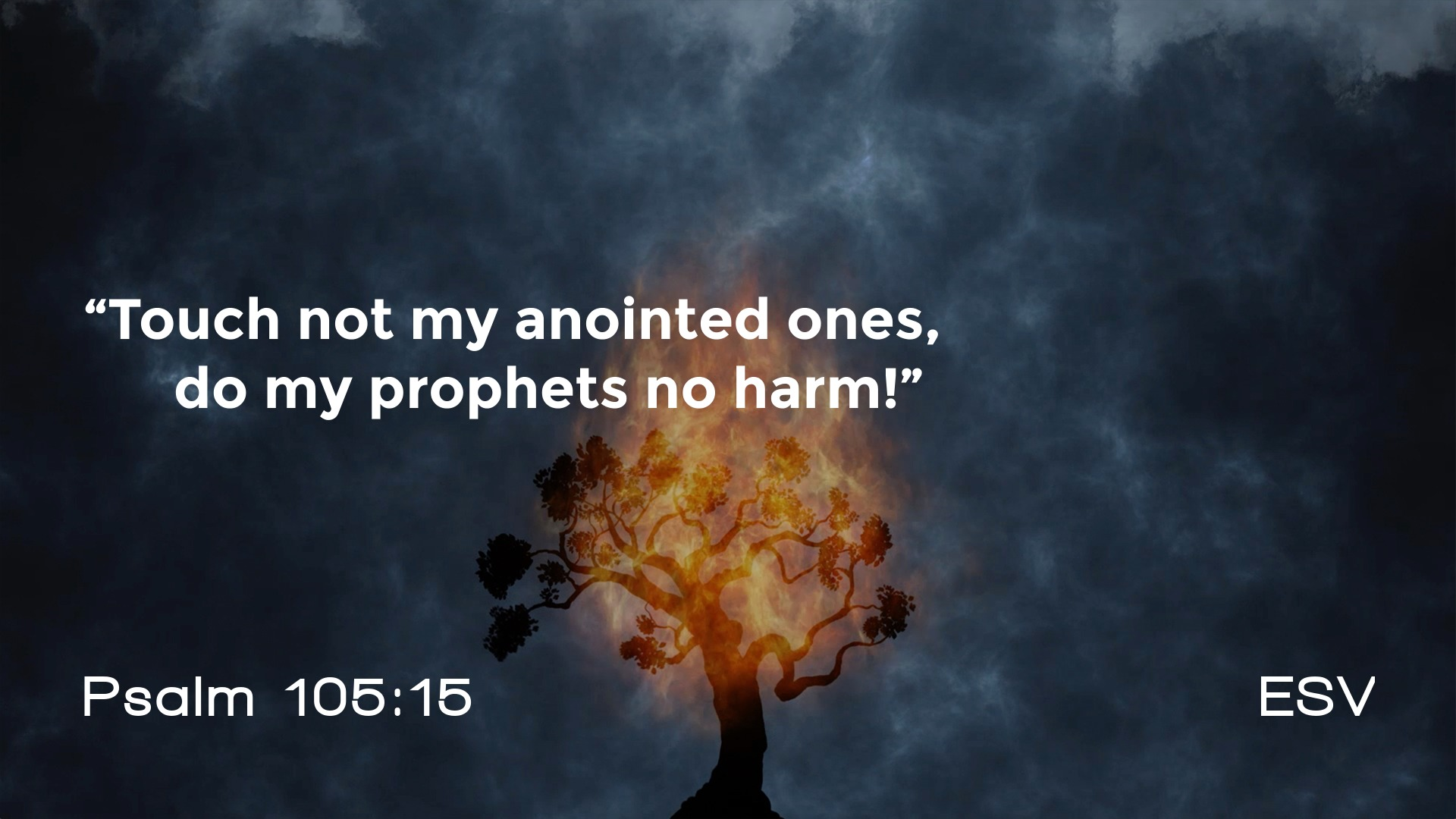
The verse cited above, and its companion 1 Chron. 16:22 serve well to help us make a very important distinction in Bible study and application.
“Touch not my anointed ones, do my prophets no harm” is a darling passage within the ranks of Charismatic and Pentecostal communities, especially by their leadership – to fend off criticisms and scrutiny. Unfortunately for them, they commit (among others) the critical error of using a passage stripped not only of its immediate context, but of the larger context of the whole of Scripture.
Let’s start with the immediate context of both Psalm 105:15 and 1 Chron. 16:22.
In both cases (for one is a repeat of the other) the immediate context frames what is being talked about. And it is NOT, about individual, self-proclaimed prophets, miracle workers, preachers, teachers or anything of the like. This is how the pericope reads:
"When you were few in number, of little account, and sojourners in it, wandering from nation to nation, from one kingdom to another people, he allowed no one to oppress them; he rebuked kings on their account, “Touch not my anointed ones, do my prophets no harm!” 1 Chron. 16:19-22
So the first thing you need to note is that this is written about the nation of Israel – not any one “prophet.”
2nd, you have to notice that God never actually said this to anyone! It is merely a statement regarding how He had decreed that Israel would remain safe from the attacks from other nations during its 40 years of wandering.
3rd, it has nothing to do with legitimate criticisms of any who are in ministry or some mythical place of prophetic or apostolic leadership.
What is being taught, is that God was faithful to His covenant promises to Israel, even during their wilderness journeys.
Back to the title of this post: yes, the Bible “says” what is often quoted in this verse – but the Bible does not TEACH what so many people try to use this verse to say it does. Instead, the Bible requires God’s people to scrutinize its teachers, to root out false teaching and those whose lives are not commensurate with a godly lifestyle.
So, for instance, the Apostle Paul publicly confronts the Apostle Peter in Antioch when his actions contradict the Gospel. So the Prophet David is rebuked by Nathan due to his sin. So Jesus criticizes the church in Pergamum for not ferreting out those who hold the doctrine of the Nicolaitans, and the Church in Thyatira for tolerating a woman who called herself a prophetess, but led others into sexual immorality and spiritual compromise. God is in no way saying we ought not to “touch” them, but to rid ourselves of them. And so too – Paul can call the “super-apostles” of Corinth into account, and Deuteronomy 13 can instruct us: 1 “If a prophet or a dreamer of dreams arises among you and gives you a sign or a wonder, 2 and the sign or wonder that he tells you comes to pass, and if he says, ‘Let us go after other gods,’ which you have not known, ‘and let us serve them,’ 3 you shall not listen to the words of that prophet or that dreamer of dreams. For the LORD your God is testing you, to know whether you love the LORD your God with all your heart and with all your soul. 4 You shall walk after the LORD your God and fear him and keep his commandments and obey his voice, and you shall serve him and hold fast to him.”
The Bible does NOT teach that supposed “anointed” ones or “prophets” are somehow immune from scrutiny, criticism or censure. In fact, it is just the opposite. For when the qualifications for those who would hold leadership positions in the Church are spelled out – they are to be evaluated by the congregation both as to their lifestyle, and their commitment to Biblical truth and competency in communicating and defending it.
Be careful Beloved that you find out what the Bible teaches, and not just what it “says.” It is true that Isa. 5:20 says “call evil good and good evil.” But that isn’t what it teaches. For the entire verse reads: “Woe to those who call evil good and good evil, who put darkness for light and light for darkness, who put bitter for sweet and sweet for bitter!”
Don’t fall for the false-teacher’s tricks. READ THE TEXT – IN CONTEXT.









 ResponsiveReiding