• Home
  • About
  • Blog
  • Atonement
    • The Atonement: Read this first!
    • Confession of an ex-u0022Highperu0022 Calvinist
    • Revisiting the Substitutionary Atonement
    • Discussing the Atonement – a lot!
    • Lecture Notes on The Atonement
  • Sermons
  • ReviewsAll book and movie reviews
    • Books
    • Movies

ResponsiveReiding

  • Do You Know Your Calling? – Part 2

    April 29th, 2022

    As we saw yesterday, the first calling of the Christian – that which takes precedence over every other concept we might have concerning ourselves – is that we embrace what it means to belong to Christ as His own possession. Scripture will use various terminology to tease that idea out: Children (as belonging to their parents); servants, as belonging to their Master; creatures as belonging to their Creator; the Bride of Christ as belonging to Him in committed (spiritually) monogamous intimacy, and others. But belonging to Him first and foremost – and that, so as to be given to His plans and purposes.

    If we were tease out the Bride of Christ motif just a bit, we could take it back to the original nature of Eve’s creation. She was made to be Adam’s “help meet.” One perfectly suited to come along side in his carrying out the mandates God had given to him. Serving together as one. So the Church. Uniquely crafted and given to Christ that we might come along side Him in His cosmic labors for the Father. But how often we are more intrigued by our own ministry – rather than seeing ourselves as vitally involved in His.

    Today brings us to the second facet of the Christian’s calling – and one we’ve explored before so I’ll not expound on it much here. It is found in Romans 1:7 where Paul opens his letter with these words: “To all those in Rome who are loved by God and called to be saints.”

    “Called to be saints.” Holy ones. Set apart ones. Those who have a divine mandate to search out, and live out, the very character of God Himself. Called to be saints.

    What a true tragedy it is when people do not see the calling to holiness as primary to any other calling they may truly have, or imagine. It is part and parcel of belonging to Christ. It is why 1 Peter 1:14-16 reads: “As obedient children, do not be conformed to the passions of your former ignorance, but as he who called you is holy, you also be holy in all your conduct, since it is written, “You shall be holy, for I am holy.” We are to be holy because the One to whom we belong is holy. And because we are to “strive…for the holiness without which, no man shall see God.” (Heb. 12:14)

    This does not mean we produce holiness out of ourselves. It means rather that being brought into right relationship with Christ in the new birth and justification, we find that the remnants of indwelling sin must be striven against by the power of the Spirit – every step of the way to glory. We strive to enter fully into what He has already given by grace, the way the Israelites were to strive to conquer the Canaan God had already given them. But strive we do. As J.C. Ryle said so well: “True holiness, we surely ought to remember, does not consist merely of inward sensations and impressions. It is much more than tears, and sighs, and bodily excitement, and a quickened pulse, and a passionate feeling of attachment to our own favourite preachers and our own religious party, and a readiness to quarrel with every one who does not agree with us. It is something of “the image of Christ,” which can be seen and observed by others in our private life, and habits, and character, and doings.” And that, not without something of our intentionality harmonizing with where God is bringing us.

    Once again, Ryle writes: “The saddest symptom about many so-called Christians, is the utter absence of anything like conflict and fight in their Christianity. They eat, they drink, they dress, they work, they amuse themselves, they get money, they spend money, they go through a scanty round of formal religious services once or twice every week. But of the great spiritual warfare,—its watchings and strugglings, its agonies and anxieties, its battles and contests,—of all this they appear to know nothing at all. Let us take care that this case is not our own. The worst state of soul is “when the strong man armed keepeth the house, and his goods are at peace,”—when he leads men and women “captive at his will,” and they make no resistance. The worst chains are those which are neither felt nor seen by the prisoner. (Luke 11:21; 2 Tim. 2:26.)”

    The history of the Church is strewn with the wreckage of gifted men and women who thought holiness was optional, or that at the least, it took a back seat to the exercise of their gifts. How many gifted men in ministry have excelled there for a time, while their sinful, hidden lives were protected by those who thought the “ministry” was more important than the communication of Christ’s holiness? That somehow their individual ministry was more important than the reputation and ministry of Christ Himself! Think only in terms of our own generation and the litany of names of both national and international prominence in Evangelicalism which have scandalized the cause of Christ. And in every case, because striving after the holiness of God wasn’t a primary calling – something else was.

    Beloved, give no thought to some individual calling, until you have wrestled with and obeyed the first calling of belonging wholly to Christ as His to use when, where and how He providentially sees fit and provides; and of pursuing the holiness He delivered you from sin to live freely in.

  • Do You Know Your Calling? – Part 1

    April 28th, 2022

    It has been my experience, that when the question of “calling” is raised, it is virtually always attached to the idea of some personal, special destiny or pursuit. Someone feels “called” to be a lawyer, a doctor, a homeschooling Mom, a prayer warrior, a musician, poet, worship leader, artist, encourager, writer, businessman, influencer etc. You name it. And people are encouraged to find their calling. To settle on who or what it is they are to be about in this world. What they are meant to be. Because God has some secret personal mission each of us is responsible to divine. With the unspoken implication that if you are just a worker (name the industry), just an ordinary Joe or Jane with no sense of a cosmic appointment, somehow, you are not fulfilling your REAL – calling. You are living below your spiritual privilege and even responsibility. After all – we are ALL special – aren’t we? No one is ever meant to be “ordinary.” Heaven forbid.

    Additionally, calling is the typical language of ministry. Many a seminary for instance requires their applicants to express some sense of their “calling” to ministry before admission. And almost all of those who I know personally in ministry (be it pastoral or any other branch) will use that language as well – they believe (most often, they feel) they are called to it. Don’t get me wrong, there is certainly a reality behind knowing whether or not one has the gifts, inclinations and character that ought to properly accompany the one who ventures upon the ministry of the Word, especially in the pastoral setting. And I have no doubt some very much do believe they are called to serve the Body of Christ in this way. But in a day and age where the rule of thumb seems to be if anything CAN be done, then it SHOULD be done (think: abortion, transexualism, genetic research and experimentation, etc.) many are those who simply have charismatic personalities, the gift of gab and the desire to have an audience – who take that as a calling to preach, teach and occupy places of authority in the Church.

    Shuffling all of that aside, I wonder if we have simply gone through Scripture to get a real handle on what the Christian is unambiguously called to? If you are a Christian, you ARE indeed, called. A calling which requires no subjective feeling to verify; that does not make you stand out among your peers; and does not define you over and against any others in the Body of Christ. A calling, which if pursued, brings us face to face with things much, MUCH higher than concentrating on self. To a place of freedom in self-forgetfulness, because of the glory and wonder of it.

    So, the first passage I would bring to your attention, one we’ve dwelt on before but bears repeating – is that found in Romans 1:6: “you who are called to belong to Jesus Christ.”

    Now let that sink in beloved. The first calling of every Christian, is to live mindful that they no longer belong to themselves, but that we belong to Christ, are the property of Him, and are the blood-bought trophies of – God’s grace. We do not belong to ourselves. We do not get to tell Him how we will serve. We were purchased that we might serve Christ’s interests, not He ours. This is our first calling. Our high, glorious, unimaginable calling. Just to be His, before we are anything else. Surrendered to Him. Seeking Him. Walking with Him. And if we are not settled in this, anything else we may think of as a calling in life, is irrelevant. Meaningless. No matter how amazing it might seem to us.

    I know it is not politically correct in our day to imagine anyone as actually being someone’s property – but it is the Biblical concept of the Redeemed. Redeemed from slavery to sin and death, back to being the image-bearers of the Living God. Back to being at His beck and call, at His disposal 24/7/365. Back to our original purpose – in carrying out His plans and purposes.

    So let me ask you – have you attended to this aspect of your calling yet? Have you simply yielded to not being your own, but His? That as His agent and representative, you are to order your life around the plans and purposes He has revealed in His Word? Setting aside your personal preferences, ambitions and goals, simply to be at His disposal? Don’t worry about what you FEEL called to, until you have started here: You are called to belong to Jesus Christ. The theater(s) in which you live this out, are not even secondary – they are WAY down the line.

    That, will take a ton of pressure off of some of you. It may be frustrating to others, or even disappointing – because you have imagined your sense of calling to be far more tasty to your sense of self. But it is your first and highest calling. And in time, it will prove the single most important thing you can arrive it this life.

  • Justice Delayed is Justice Denied: Except When it Isn’t

    April 26th, 2022

    Reading through the book of Judges is harrowing by any account. One wonders how Israel could get so confused and disordered so fast. Indeed, the various records show such violence, debauchery, twisted thinking and abandonment of the principles contained in the Mosaic covenant under which they lived – as to boggle the mind. By the time you get to chapter 18 you read: “And the people of Dan set up the carved image for themselves, and Jonathan the son of Gershom, son of Moses, and his sons were priests to the tribe of the Danites until the day of the captivity of the land. So they set up Micah’s carved image that he made, as long as the house of God was at Shiloh.” Moses’ grandson is carrying out the priesthood accommodating carved images. Imagine.

    The reason behind this is not hard to dig out however. It’s spelled out in the closing verses of Joshua: “Israel served the LORD all the days of Joshua, and all the days of the elders who outlived Joshua and had known all the work that the LORD did for Israel.” When people have no personal experience with God, no matter how clear and wise the laws which are supposed to govern them may be, they inevitably fall into the condition the author of Judges notes: “Everyone did what was right in his own eyes.” We become a law unto ourselves – according to our own wants, desires, opinions and fallen wisdom.

    So all that you read in Judges goes on in one tragic story after another. And you come away wondering – even given all of God’s chastening efforts – why didn’t He just wipe them out? Why not bring justice with its full force upon them long before the following centuries of continued disobedience and sinfulness?

    The answer to that isn’t hard to dig out either: It is “the riches of his kindness and forbearance and patience” with the aim that “God’s kindness is meant to lead you to repentance.”

    Oh the unimaginable patience of God in the way He deals with His people and their sins. With you and me. If it were not so, who of us would last a moment? And how that patience has continued for millennia as the Gospel is given continued, undeserved room to gather in more and more souls – even as the Spirit is given more and more room to continually fit Believers better for Heaven.

    What a patient, kind, and gracious God He is. How He delays His justice. Not a justice which will at all in the end be denied. But a justice painted upon the blindingly glorious backdrop of grace.

    Failing, weary Believer – rejoice in it.

    Hesitating, rebellious sinner – rejoice that even as you read this, such patience has kept you alive one more day to hear and obey the Gospel and come to Christ. But do not doubt it, though His justice is delayed, it will not be denied. Now is the day of grace.

    I beg you, don’t let it pass you by.

  • “I could’ve been a contender”

    April 25th, 2022

    Those now famous words were uttered by Marlon Brando’s character Terry Malloy in the 1954 classic film – “On The Waterfront.” It is the plaintiff cry of a man who woefully missed what he thought was his mark in life. But the second phrase is really revealing: “I could’ve been somebody.” My point? Sadly, many today in the Church – even if they won’t admit it to themselves, imagine they could be “somebody” too, if they could be “contenders.”

    Now there is clearly a powerful exhortation in Jude about the need, indeed the urgent need (both then and now) for Believers to “contend for the faith that was once for all delivered to the saints.” One of the highest responsibilities of the Church is to be a guardian of the truth of God’s Word as given to us. It is a never-ending battle which admits of no respite. And every generation of Believers must be about it in their day and context.

    Sadly though, there seems to be some confusion in our day between earnestly contending for the Faith, and being contentious about the faith – as well as contentious about other things. (Can you spell P-O-L- I-T-I-C-S?) It is as though being contentious in itself is somehow inherently virtuous. It isn’t. We forget that firmness is not the same as harshness. That correction is meant to be in gentleness, which at the same time does not yield to compromise. That the truth of the Gospel is never to be communicated through clenched teeth. That there are no prickly pears listed among the fruit of the Spirit. Uncompromised truth does not require irascibility. Jesus never had to yell at those he boldly opposed.

    I was reminded by a friend this this week of a quote I had read (and forgotten) by John Newton in a letter to a friend about handling controversies. While Newton encourages him to contend for truth, he also gives this very insightful and balanced consideration:

    “It seems a laudable service to defend the faith once delivered to the saints; we are commanded to contend earnestly for it, and to convince gain-savers. If ever such defences were seasonable and expedient, they appear to be so in our day, when errors abound on all sides, and every truth of the Gospel is either directly denied, or grossly misrepresented. And yet we find but very few writers of controversy who have not been manifestly hurt by it. Either they grow in a sense of their own importance, or imbibe an angry contentious spirit, or they insensibly withdraw their attention from those things which are the food and immediate support of the life of faith, and spend their time and strength upon matters which at most are but of a secondary value. This shews, that, if the service is honourable, it is dangerous. What will it profit a man if he gains his cause, and silences his adversary, if at the same time he loses that humble, tender frame of spirit in which the Lord delights, and to which the promise of his presence is made!”

    The point is clear, and necessary – the cause of Christ, must be conducted in the Spirit of Christ. Oh, may we not lose “that humble, tender frame of spirit in which the Lord delights” as we wade into the necessary contentions of our day.

    None of us should ever think that we “could’ve been somebody”, if only we had really been “contenders”, punchers in the ring.

    Tragically, in our day – some have built their ministries on this aberrance.

  • Know Your Limits

    April 22nd, 2022
    Do You Know Your Limits? note

    The original opening to Reinhold Neibuhr’s “Serenity Prayer” (made famous by Alcoholics Anonymous) reads: “God, give us grace to accept with serenity the things that cannot be changed, Courage to change the things which should be changed, and the Wisdom to distinguish the one from the other.”

    It isn’t Scripture, but it is wise. And it crystallizes a Biblical principle highlighted in Joshua chapters 18 and 19. They might seem pretty perfunctory in the surface, but there is something important here we don’t want to miss: How precise God is in assigning the boundaries of His people.

    This principle is reiterated later by the Apostle Paul in Athens. In Paul’s address on Mars Hill in Acts 17 we read: “From one man he made every nation of the human race to inhabit the entire earth, determining their set times and the fixed limits of the places where they would live, so that they would search for God and perhaps grope around for him and find him, though he is not far from each one of us.” And if that is true for every human being – then how much more for His own, blood-bought ones?

    Did you catch the idea? How it is that God has set certain fixed limits for all of us – with the intent that our very limitations would maximize our seeking after Him. And when it comes to those who are God’s people in Christ – the precision of those limitations is startling. And sometimes, we don’t like them.

    So it is in Joshua, God set out specific boundaries for each tribe. They were to work, live and grow within those proscribed limits – as given to them by God as an inheritance. Not as a punishment. Not as a hindrance to their personal dreams, aspirations or desires. But as a gift from His hand. And I would argue that for the Believer, our Heavenly, loving, all-wise Father has been no less careful and gracious in setting our limits in life as a blessing, than He was with Israel’s tribal land grants.

    So what kinds of divinely set limitations might we experience? Parentage. Physical abilities or dis-abilities. Challenges. The particular sins we battle. The people He surrounds us with. The circumstances in which we find ourselves – be they pleasant or not. The question is, will we see them all as from His hand, and respond to them as such, serenely receiving what we cannot or should not change, while courageously tackling what we can and should, as we look to Him both for the wisdom to know the difference, and the empowerment to do what is necessary?

    We get an interesting example of this in chapter 14 where Ephraim and Manasseh complained to Joshua that they didn’t have enough room. In truth, they did, but they were unhappy that their allotment included a rough hill territory with some particularly fierce Canaanites to face. They wanted different land, not one that was going to be so hard to settle. But the answer was – no – God has given you what it takes, now go possess it. That was not to make light of the true dangers and battles they were going to have to face. The dangers and difficulties were real. But in God Providence, these were the difficulties He had assigned them. And He intended blessing in it, even if they could not (or would not) see it. They simply wanted something else. Something more pleasing. Less challenging. Something that wouldn’t require them to rise to an occasion they did not savor.

    How many times I have been in that very place in life. And how many times I have spent more time complaining to God, and straining against the limits rather than seeing His hand – accepting what lines He has drawn, and responding to them in faith. Changing what I can and should, and yielding to His sovereignty in what I can’t. And looking more to Him in both. Convinced of His love, wisdom, promised provision and attendance to my needs.

    Maybe you are not in the circumstances you would prefer today Christian. God has set before you some heartbreaking challenges. Painful, frustrating and draining things you have no power to alter for the better. Know for certain He intends your good in it. Draw closer to Him. And look to Him for His resources. Ask for wisdom and courage to act righteously in regard to the things where you might be able to make good change. But in it all, know that He has set the boundaries, and that He can be trusted. That He has your soul’s best interest at heart. Do not fear that somehow He has done you wrong, even if people have. That is the oldest and vilest of the Enemy’s lies. Rest assured, every hill, valley, mountain, forest, wasteland, coastland, and oasis has been carefully scrutinized and assigned, that you might seek Him – and in Him, find your true heart’s content.

  • Was Israel’s Establishment in 1948 Eschatologically Significant?

    April 20th, 2022

    Let me let one cat out of my overcrowded cat-bag first. As an Historical Premillennialist (not Dispensational) I do believe the Bible teaches that there will be a tremendous ingathering of the Jews to faith in Christ before Jesus’ return – if not in some way concurrent with it. Preaching through Romans convinced me God has something yet in store for His original “chosen people” – and that, in conjunction with masses of ethnic Jews coming to saving faith in Christ. Even some Amillennialists like Eric Alexander and others would argue that as well.

    That said and out of the way, my question as stated in the title remains: Was Israel’s establishment of statehood in 1948 significant – in terms of being some sort of fulfilled prophecy?

    So on to cat #2 – I don’t think so. Despite the tsunami in recent years of Biblical-Prophecy mavens to the contrary. In reading Deuteronomy afresh this week, I was struck by God’s address the to the Israelites in the closing chapters – and a specific condition He speaks to – in terms of defining an eschatologically significant return of the Jews to the Promised Land. If indeed one is to be had at all.

    To put it mildly, a LOT gets said to Israel in Deuteronomy’s recapitulation of God’s instructions for His people once they enter and settle Canaan. And there is a powerfully pervasive atmosphere of warning throughout. The warning centers on fidelity to singular devotion to God. When that is abandoned, disaster is inevitable in judgment. Lack of fidelity to the Lord will result in their being prey to their enemies.

    But what caught my eye recently, is the very specific statements in Chap. 30. On the heels of 3 massively conditional “if”s in 28, and the revelation that they still have a “heart” problem in 29:4 (But to this day the LORD has not given you a heart to understand or eyes to see or ears to hear.), is the promise of forgiveness and restoration in Ch. 30. But it is a conditional restoration. It runs like this…

    “When you have experienced all these things, both the blessings and the curses I have set before you, you will reflect upon them in all the nations where the Lord your God has banished you. Then if you and your descendants turn to the Lord your God and obey him with your whole mind and being just as I am commanding you today, the Lord your God will reverse your captivity and have pity on you. He will turn and gather you from all the peoples among whom he has scattered you. Even if your exiles are in the most distant land, from there the Lord your God will gather you and bring you back. Then he will bring you to the land your ancestors possessed and you also will possess it; he will do better for you and multiply you more than he did your ancestors. The Lord your God will also cleanse your heart, and the hearts of your descendants so that you may love him with all your mind and being and so that you may live. Then the Lord your God will put all these curses on your enemies, on those who hate you and persecute you. You will return and obey the Lord, keeping all his commandments I am giving you today. The Lord your God will make the labor of your hands abundantly successful and multiply your children, the offspring of your cattle, and the produce of your soil. For the Lord your God will once more rejoice over you to make you prosperous just as he rejoiced over your ancestors, if you obey the Lord your God and keep his commandments and statutes that are written in this scroll of the law. But you must turn to him with your whole mind and being.“

    My point is this: The return to the land which has eschatological significance (as best as I can see in this text) is one predicated upon the people en mass turning to the Lord with their “whole mind and being.” As the portion closes: “But you must turn to Him with your whole mind and being.” (Emphases here and above, mine)

    Now unless someone can point me to something which indicates this whole-heartedness after God was the case with the re-creation of the State in 1948, and the flow of ethnic Jews back into the land, I cannot see how that event is the fulfillment of what we have here. And thus I think it lacks any true eschatological importance. For all intents and purposes, Israel is in fact a secular state not one born out of national repentance. Now that IS something I hope and pray to see. I believe it IS in God’s prophetic plan. But I do not believe we can safely establish that such is the case given the current circumstances. And thus I think the current view of many in the way they are responding to Israel – as though this is the case – is in error.

    Will Israel be gathered in in due time? I firmly believe the Bible says it is so. Is the current State of Israel that ingathering? I don’t believe so. And to look for all sorts of end-times signs around Israel’s 1948 establishment, especially as a means of determining where we are in God’s prophetic timetable is probably a pretty large error.

    Nevertheless – let us all continue to pray and work for the conversion of these dear folk in our generation.

    Now, let the arguing begin!

  • God of the Ordinary

    April 20th, 2022

    Joshua 4 carries the account of a very important transition in Israel’s history – the conquest of Jericho. Bundled with this foray into the Promised Land, come several profound changes, which if we are not careful readers, can get by us.

    The first we note is the curious mention in Joshua 4:13: “About 40,000 ready for war passed over before the Lord for battle, to the plains of Jericho.” Don’t miss the word “before.” Previously, throughout the 40 years in the wilderness, the Ark of the Covenant always preceded the steps of the Israelites. The Cloud over it led them. Even here, the Priests carrying the Ark enter the Jordan first. But the Priests and the Ark stand still in the midst of the river – and the men ready for war passed over “before” the Lord for battle. Then, in the days following, the Priests proceed in front of the Ark blowing trumpets, while the Ark follows. From this point on, the Ark never takes the lead again. In fact, the last mention of the Ark until Judges 20 is in Joshua 8, where the Covenant with God is reaffirmed. But it ceased to lead them anymore.

    Concurrent with that change, is the cessation of the daily manna in 5:12. Another major transition. Having left the wilderness and come into Canaan, they were no longer to be sustained by the obvious supernatural gift of manna, but were to eat the produce of the land they were going to have to plant, harvest and process for themselves.

    In both of these instances we see an interesting principle emerge: As God’s people come increasingly nearer to their promised destiny, they less they are led and sustained by God’s remarkable means, and instead by His more usual means. It doesn’t mean they were not to look to Him in constant dependence. But it does mean, they were to depend on Him more in the ordinary, than in the extraordinary.

    And so it is with Christians today.

    Before I apply that, let me note one other parallel. As you read the Old Testament, you will note that the times when the prophets were most active and vocal in Israel’s history, were not when Israel was on track and serving God well, but the times when they had forgotten God and strayed. When they abandoned living by His Word, God sent prophets to call them back to the revelation and the Word they already had.

    Now it is true, when we go anywhere, even in the natural, we want clear directions. Haven’t we become virtually dependent upon our GPSes? No question. And it is true in our Christian lives that we want solid direction too. But how often do we want some supernatural “sign”, rather than walking by the Biblical principles already at our fingertips in our Bibles? And that we imagine getting manna from the sky is somehow more spiritual than sowing, reaping and processing in the Promised land.

    For the rest of the Canaanite conquest, the Ark no longer leads them. Why? Because they know what it is they are to be about. They know where to go – to seize the land. And why no more manna? Because God had brought them to a better place than the wilderness. To live daily lives carried out by ordinary means. Still in complete dependence upon Him (for rain, good crops, etc.), but minus the overt (and let’s face it, more exciting) supernatural.

    Yet how many in the Church today are longing for, seeking after, frantically pursuing – the leading of the Ark, the supernatural manna and the voice of the prophets rather than taking up the Word; and being about the business of living out the wisdom and call of the revelation already given to us in it?

    We don’t need prophets to tell us to repent of sin and follow Christ. If we do, we acknowledge our dreadful spiritual decline. We don’t need the Ark to go before us to know we are to challenge sin and bring every thought captive to Christ. We don’t need a supernatural Word from God, when we can open that Word right now, whenever we want, and hear His voice clearly – and in a way that we can study it, learn it, memorize it and go back to it – unambiguously.

    The closer we come to our full inheritance, the less we need the overtly extraordinary, and learn to live in constant dependence upon the God who supernaturally superintends – the ordinary. The supernatural ordinary of God’s people.

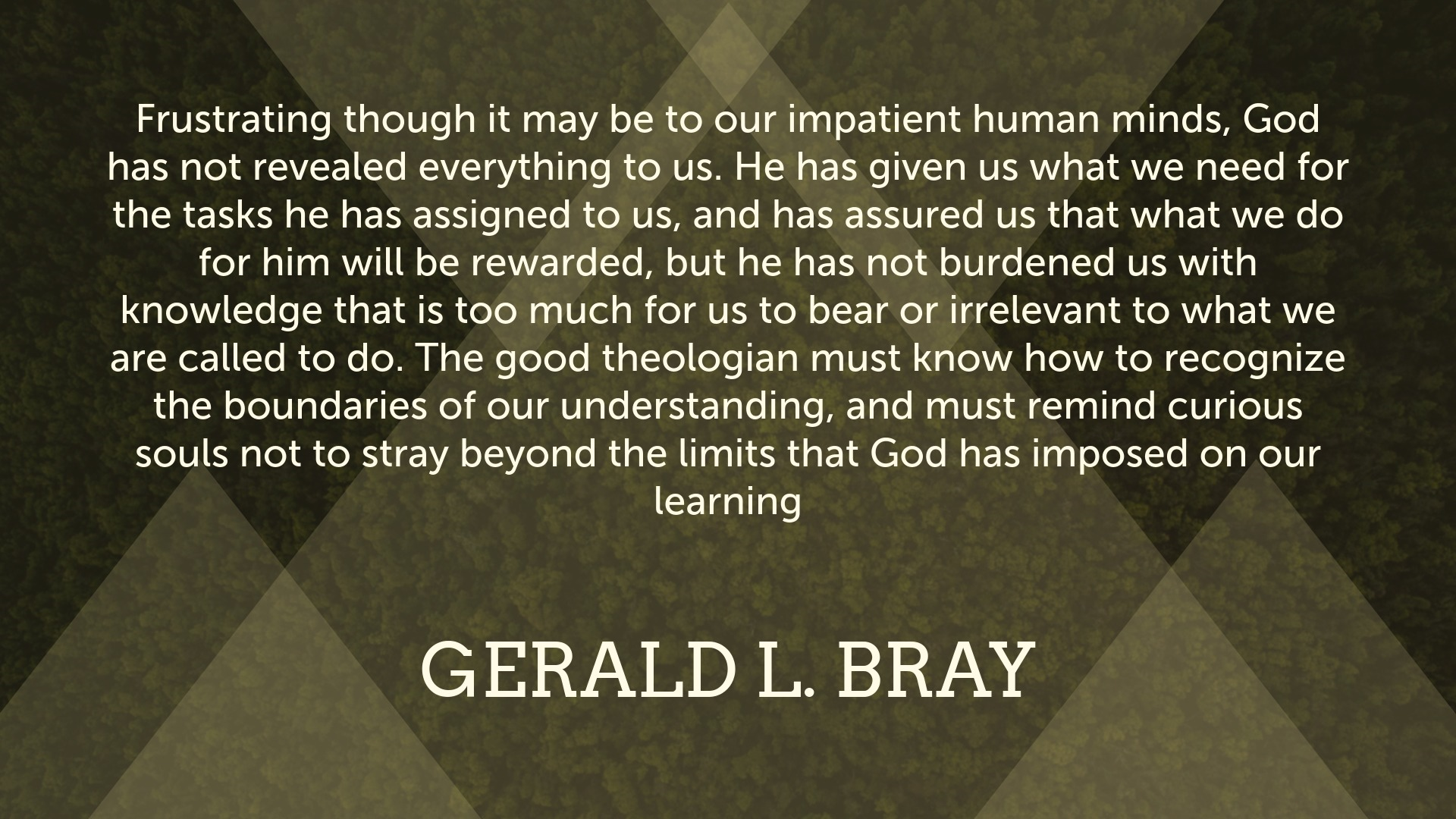
    Serve Him in what you can access in His Word. And trust Him, with what He hasn’t revealed, rather than trying to divine the hidden things He has kept to Himself. He is the God of everyday. The God of the ordinary. The God of all of life. Trust Him. Don’t make Him jump through hoops to satisfy your curiosity, or supplant what He has already revealed in his Word.   

  • I’ve Got A Secret! Well, actually, I don’t.

    April 18th, 2022

    Romans 10:4-13 / For Christ is the end of the law for righteousness to everyone who believes. For Moses writes about the righteousness that is based on the law, that the person who does the commandments shall live by them. But the righteousness based on faith says, “Do not say in your heart, ‘Who will ascend into heaven?’ ” (that is, to bring Christ down) “or ‘Who will descend into the abyss?’ ” (that is, to bring Christ up from the dead). But what does it say? “The word is near you, in your mouth and in your heart” (that is, the word of faith that we proclaim); because, if you confess with your mouth that Jesus is Lord and believe in your heart that God raised him from the dead, you will be saved. For with the heart one believes and is justified, and with the mouth one confesses and is saved. For the Scripture says, “Everyone who believes in him will not be put to shame.” For there is no distinction between Jew and Greek; for the same Lord is Lord of all, bestowing his riches on all who call on him. For “everyone who calls on the name of the Lord will be saved.

    We love secrets. We especially love thinking we have secrets no one else does. Virtually every false teacher, cult or false religion traffics on its “secrets.” And sadly, secrets have become the currency of much pop-Christianity too. Just scan the titles in your local Christian bookstore, or the offerings of the host of media ministries – and see how many of them portend to offer some secret or other to cure your illnesses, make more money, succeed in business, get the house, spouse, kids and career you want. And even more – secrets of Heaven itself. Spiritual secrets to a Spirit “activated” life, increased giftedness, more powerful prayers, the ability to command nature, marshal angelic hosts, get gold teeth and… – you name it.

    Now in this text from Romans, Paul is making a point which he borrows almost verbatim from Deuteronomy 30. And he does so with the very same intent Moses had when he uttered it back then.

    The idea for Israel was simply this – there is no secret to serving God and living in His favor, and it was not rocket science; it was no secret. God said – I call you to: A. Seek, know, obey and walk with Me. B. When you fail, repent, and I will restore. C. Know that steadfast refusal to repent brings great hardship. D. I am a most loving, merciful and forgiving God. A covenant keeping God.

    Deut. 30:11-13 / “For this commandment that I command you today is not too hard for you, neither is it far off. It is not in heaven, that you should say, ‘Who will ascend to heaven for us and bring it to us, that we may hear it and do it?’ Neither is it beyond the sea, that you should say, ‘Who will go over the sea for us and bring it to us, that we may hear it and do it?’ But the word is very near you. It is in your mouth and in your heart, so that you can do it.

    The “secret” of serving God is no secret. It is not hidden in Heaven. You don’t have to scour the earth for it – I’ve revealed it. You’ve heard it. You’ve affirmed it with your own lips. Stick to what is written.

    So when we get to Romans, we are hearing the very same thing when it comes to the New Covenant and salvation in Christ: There is no secret. It is not rocket science. No one has to ascend into Heaven to bring it down – it’s already here. No one has to descend into the dark recesses of the unknown to dredge up some secret truth about Christ. What God has said, He has said plainly and out in the open. You’ve all heard it before and know it: If you confess with your mouth that Jesus is Lord and believe in your heart that God raised Him from the dead – you WILL be saved.

    No secret formulas. No hidden or esoteric rituals. You don’t need a single secret to have your sins forgiven, to walk with God, to inherit eternal life or to walk in the Spirit as reconciled to the Father. You need to submit to Jesus Christ as Lord (master over you) and believe the truth that God raised Him from the dead after dying a substitutionary death on the Cross.

    Stop looking for and chasing after secrets of the Christian life. If you have Christ, you have all the fulness of God – in Him. Walk in it. Stick to what is written. And leave the “secret” stuff – to Him. “The secret things belong to the LORD our God, but the things that are revealed belong to us and to our children forever, that we may do all the words of this law.” (Deut. 29:29)

  • He is Risen – An Easter Poem

    April 17th, 2022

    I have one hope, It is but one

    That Christ’s work on the Cross once done

    And He then buried in the grave

    Arose to justify and save

    In death He crushed the Serpent’s head

    And dying in the sinner’s stead

    Took all the wrath of God due me

    Upon Himself to set me free

    He then descended to the tomb

    And entered Death’s and Hell’s dark room

    But there no power could hold Him fast

    The Son of God arose at last

    The King of Glory, Christ the Son

    The second of the Three in One

    Defeating Satan, Hell and Death

    Arising drew Salvation’s breath

    And now imparts through faith to all

    Life from the dead and from The Fall

    And makes them with the Father one

    Who flee to Christ, the Living One

    Who justifies all sinners who

    Trust Him for what good works can’t do

    Who rest in grace and grace alone

    And in Whose blood did full atone

    This Jesus, Savior, God and King

    Arose the Lord of everything

    Ascended to the Father’s side

    And waits to come and claim His Bride

    He will return in majesty

    And all will bow and bend the knee

    The day will come when all will stand

    Before the risen Son of Man

    When ev’ry thought and deed and word

    Each ever done and ever heard

    In contrast to His holiness

    Reveals the depths of sin in us

    And only those by His in faith

    Will without fear behold His face

    Those still fast bound in unbelief

    Will face His wrath without relief

    He’s risen! Oh, behold Him now

    Before His glory humbly bow

    The Promise – all who come by faith

    Will find forgiveness. Mercy. Grace.

  • A Stunning (and telling) Omission

    April 16th, 2022

    A Most Stunning (and telling ) Omission

    As most Christians are wont to do on Easter weekend, I found myself rereading the account of Jesus’ last days before His murder. Then I went on to the crucifixion account itself, and the events following, culminating in His resurrection and subsequent appearances before His final ascension. Then something caught my eye. All four Gospels carry their accounts of the crucifixion. They record how Joseph of Arimathea (John includes Nicodemus) saw Him wrapped and buried in the tomb. And then – silence. Silence until at the conclusion of the Sabbath, the 2 Marys went with spices and ointments to tend even more to His hastily buried body.

    It is the silence which intrigues me. Not a word from the Apostles. Not one. No record of what they did. No account of what they were thinking at that point. Not even a hint of what they felt.

    If the crucifixion had happened today, there would have been a news crew stationed outside of where either one or more of them could have been found. The paparazzi would have haunted every side street and the places they were known to frequent. Some group would have been stationed outside of Peter’s door for sure. And we all know the first questions which would have been asked had an interview been granted: “What did you feel when you saw Him brutalized? When you saw Him on the Cross? When He died? How do you feel about all of this now?”

    But Scripture doesn’t address these things at all.

    Silence.  

    Truth be told, many a Christian even today might hear a sermon with a similar query. Or maybe a small group studying these things in this season would find the members asked or asking that same question – “how do you feel about all of this?”

    And given today’s contest, we surely would have expected a spate of books – biographical or autobiographical with titles like: “3 Dark Days”, “The Hours of our Deepest Pain”, “How I overcame despair – The Memoir of a Disciple.” Etc. We look for such documents in vain. Not just extra-Biblically, but among the pages of Holy Writ itself. Why do we hear nothing of this span of time from the pen of John, or Peter, or Peter’s probable amanuensis Mark? Nor from the carefully researched history of Dr. Luke? Why nothing of it even in Peter’s epistles?

    Short answer? Because it doesn’t matter.

    It doesn’t matter.

    What they felt in those hours – both to THEM, and to the Holy Spirit, was and is utterly and completely irrelevant. As irrelevant as our feelings about it too.

    If we just glance quickly at Peter’s post resurrection writings, what we come away with is this – what matters is: That it was Jesus who came. It was Jesus who suffered. Jesus who was Crucified. Jesus who died. Jesus who was buried. Jesus who rose from the dead. Jesus who ascended to the Father and Jesus who is coming back again to judge the world in righteousness.

    So it is Paul can write to the Corinthians: “For I delivered to you as of first importance what I also received: that Christ died for our sins in accordance with the Scriptures, that he was buried, that he was raised on the third day in accordance with the Scriptures, and that he appeared to Cephas, then to the twelve.” (1 Cor. 15:3-35)

    And Peter: “May grace and peace be multiplied to you in the knowledge of God and of Jesus our Lord. His divine power has granted to us all things that pertain to life and godliness, through the knowledge of him who called us to his own glory and excellence.” (2 Peter 1:3)

    You see, grace and peace are multiplied to us through “the knowledge of God and of Jesus our Lord”, not by what we feel about them. It is through knowing Him, not sympathizing with His sufferings. Loving Him, not weeping at the brutality. Obeying Him, not feeling overwhelmed at the physical pain. Any normal human being can be moved by the spectacle of what took place. But being moved, and resting the whole of our hope for the forgiveness of sins, reconciliation to the Father and eternal life are two very different things. We can grieve and mourn and feel horrible for such things if they had happened to anyone. Our feelings about it do not save us. Our faith in His accomplished atoning work there does. “And this is eternal life, that they know you, the only true God, and Jesus Christ whom you have sent.” (John 17:3)

    The question is this – not how do you feel about His death, burial and resurrection – but do you know Him as you sin-bearer in His death burial and resurrection? If you do know Him savingly, it will impact your feelings and emotions. But do not confuse feelings which are evoked by the impact of the truth of the Gospel upon your soul, with feelings simply aroused by the brutality and physicality of Jesus’ crucifixion. Countless numbers have done the latter, who have never reckoned with the former. One is salvation. The other is not.

    So as you contemplate the wondrous realities this weekend occasions us to recall so pointedly – put the focus where it belongs: On Him, and what He did in dying on the Cross and rising from the dead. Not on yourself, or your feelings about it.

    All glory, laud, and honor
    to you, Redeemer, King,
    to whom the lips of children
    made sweet hosannas ring.
    You are the King of Israel
    and David’s royal Son,
    now in the Lord’s name coming,
    the King and Blessed One.

    The company of angels
    is praising you on high;
    and we with all creation
    in chorus make reply.
    The people of the Hebrews
    with palms before you went;
    our praise and prayer and anthems
    before you we present.

    To you before your passion
    they sang their hymns of praise;
    to you, now high exalted,
    our melody we raise.
    As you received their praises,
    accept the prayers we bring,
    for you delight in goodness,
    O good and gracious King!

    Theodulph of Orleans

←Previous Page
1 … 39 40 41 42 43 … 197
Next Page→

Blog at WordPress.com.


Loading Comments...
 

    • Subscribe Subscribed
      • ResponsiveReiding
      • Join 419 other subscribers
      • Already have a WordPress.com account? Log in now.
      • ResponsiveReiding
      • Subscribe Subscribed
      • Sign up
      • Log in
      • Report this content
      • View site in Reader
      • Manage subscriptions
      • Collapse this bar