Reading Isaiah and Jeremiah can be harrowing. But in both books, even as God’s judgments upon Israel and Judah are repeatedly and graphically described, there is also a constant call to repentance, the assurance of the Lord that He receives those who repent, and the promise of days of restoration that are supremely sublime. The mercy and grace of Christ make themselves known even in the midst of God pronouncing the severest of judgments. How great the wonder of the power of Jesus’ death for us.
Now one principle which is repeatedly addressed in these 2 books as well as others, is one established long ago in Eden, and is vital to the Gospel as well: That God created us both as individuals, and as members of one another.
In Eden, we all died in Adam. We were joined together with him in his sin, in that Adam and Eve were the entire human race at the time. And in falling, the race fell. Not just Adam and Eve.
Some rebel against this notion. After all (we say) “I didn’t disobey in Eden, it’s unfair!” But God imputes that sin to us nevertheless. He bound us together as a common humanity. A bond which we have no power to dissolve. But we must beware our protest against this arrangement if we would desire salvation. For it is the imputed righteousness of Christ which saves us, and not our own. So if we want to reject our union with Adam and its negatives, we should – being consistent – reject our union with Jesus and its positives. This however is how God made us. These are His rules of reality. This is His appointed economy.
But there are more unions than just these two. This comes out in stunning reality in the Scriptures as we see the righteous in Israel and Judah suffering captivity along with the unrighteous. Even as we see the unrighteous returning to Judah after the Babylonian captivity along with the righteous. The righteous in a nation share in God’s chastisements of the unrighteous, and the unrighteous in some ways enjoy the mercies of God along with the righteous. At one and the same time.
During the Trump era in America, it became common for some to say “he’s not my President.” And now, during the Biden administration, we hear the exact same from the other side. Of course, this ignores the ties that God has established between nations and their citizens. It is in fact a fiction. As citizens of the U.S., whoever is in office IS our President, no matter how much we might like or dislike, support or abhor them or their policies.
Like it or not, Adam was our head. And like it or not, Christ is now head of the human race, tho many would say “He’s not MY God.” Saying it, doesn’t make it so. Saying it, will not somehow remove the responsibility to obey Him; the basis upon which every human being will be judged.
So Christian, we cannot isolate ourselves from the sins of our nation. We own them in some degree corporately. We must recognize this. Own it. And pour out our confessions for the sins of our nation, even as Daniel did in Daniel 9. He wasn’t guilty of the idolatry that landed him in Babylon, but his people were. Not only that Scripture affirms the Babylonian captivity was a direct result of the sins Manasseh led Judah into – and that was both nearly 100 years before Daniel, and in spite of a great subsequent revival under the leadership of Josiah. But Daniel confessed and plead for mercy regarding those sins of both his forefathers and his contemporaries.
Isaiah 6:1–3 (ESV)In the year that King Uzziah died I saw the Lord sitting upon a throne, high and lifted up; and the train of his robe filled the temple. Above him stood the seraphim. Each had six wings: with two he covered his face, and with two he covered his feet, and with two he flew. And one called to another and said: “Holy, holy, holy is the Lord of hosts; the whole earth is full of his glory!”
I’m Reid Ferguson and this, is Today’s Reiding – a podcast of thoughts on the Scriptures, and Scripturally informed thoughts on a host of topics and issues that confront us every day – living in this post Genesis 3 world, and as we look forward to the Kingdom of Christ to come. You can subscribe to Today’s Reiding free, on most of the popular podcast platforms like: Spotify, Google, Breaker, Apple and others. Or, you can drop me a line at reid.ferguson@gmail.com, and I’ll add you to my mailing list.
I promise to email only when new episodes drop.
Isaiah ministered in Judea for around 60 years, and under the administrations of 4 different Kings. He predicted and witnessed Israel’s fall to Assyria. And, he predicted Jerusalem’s fall to Babylon, the Jewish exile, Babylon’s fall to the Medes and the Jews return to Judah.
During King Uzziah’s term in office, Judah prospered greatly. Times were uncertain, but overall, good. Uzziah’s death was not welcome, and it apparently shook Isaiah. Isaiah’s touch-points of earthly stability, a sound, good man in the highest office; national military successes; and economic prosperity all began to crumble. So God turns Isaiah’s eyes away from earth to Heaven. And there, Isaiah sees this mind bending vision of God’s throne with its attendant seraphim; spirit beings who appear to guard God’s throne, engaged in perpetual and spontaneous worship at God’s revealed glory.
Their song? A 2 part refrain: Thrice holy is the Lord of hosts. The tripling there indicating holiness to the highest possible degree. And, the entire earth is filled with God’s glory.
No one would argue that God is gloriously, infinitely, unalteringly and wonderfully – holy. Sinless, pure and undefiled in any way. But, the whole earth filled with God’s glory? Maybe we’re not so sure. Isn’t sin rampant here? Aren’t there wars, famines, plagues, rape, violence, racism, atheism, corruption in the Church and the government, false religion, disease, sexual perversion, death and all manner of other woe? How does that fit with the whole earth being filled with God’s glory?
I thought you’d never ask.
The Bible asserts this is true on 2 concurrent fronts. But like Elisha’s servant in 2 Kings 5, Isaiah before this vision, and probably you and me before considering passages like Hebrews 2:8 where we are told Christ is reigning now even though we don’t see it physically yet. Blind to it as we are, in truth, the whole earth IS filled with His glory.
As in Romans 1 and other places, all the woes we see in this fallen world right now, stem from God’s judgment upon sin. He’s active, not passive. Gloriously pouring out a measure of His just wrath in the world – evidenced by all of the things we’ve just mentioned and more. These judgments are manifestations of His glory in His justice in dealing with sin.
Secondly, in the midst of this just judgment, it is still not as severe as it could be. God in mercy is restraining Himself, and using these punishments as a means to wake us up to our lost condition and need for forgiveness and reconciliation to Him. On top of which He deploys His Church, armed with His gospel of grace in the Cross of Jesus to the four corners of this sin cursed world.
So it is, the whole earth IS filled with His glory. Glory in just and holy judgment, and glory in restraining mercy with the the testimony of His saving grace in and through the Church. We just need the news of it to penetrate our souls, more than the blind reports from the earthly news outlets who haven’t a clue as to what’s really going on. The truth is: God is truly, actively and superlatively holy, and the earth is FILLED with His glory, whether we see it, believe it, or not.
One of the opportunities my recent “retirement” has afforded me, is to visit around to various Churches in my area to see what’s going on. Sadly, with but a few notable exceptions, it has not been a very happy experience thus far. And this, for one key reason: There has been a forsaking of preaching the Word of God.
Now don’t get me wrong – in most cases, the Bible has at least been referenced. But it has been so only in the sense that the preacher had something he wanted to say – and then found a passage (or worse, just a single word which they then defined to suit their purposes) that appeared to buttress their idea. But they were far from simply going to the Scripture, ascertaining what was being said to whom, under what circumstances, and thus what the passage was meant to teach when it was written. For in truth, only then, can we rightly find out what God has taught, and thus what we desperately need to hear. Instead, I’ve heard a lot of kindly, (and yes, even sound at times) Christian advice. Advice aimed at scratching where the preacher thought the people itched. Or simply where he did. But was all centered around the idea of how the Bible can be accessed to help me live the life I want to live, and not around how God has spoken so that I might live the life He wants me to live in accordance with how I am to be His image-bearer as I approach the final destination of eternity in His presence, fully bearing the image of Christ.
The whole experience thus far has reminded me of Amos 8:11 (NIV84) “The days are coming,” declares the Sovereign Lord, “when I will send a famine through the land— not a famine of food or a thirst for water, but a famine of hearing the words of the Lord.
This last Sunday, the preacher began by reading out 4 passages from 1 John on loving. All disconnected from their context, and apart from any attempt to define love Biblically. And then he unashamedly went on to preach 4 points (out of 12) from their Church membership covenant on how they agreed to treat each other. Along the way, he kept saying that these points were Biblically based. But at the same time, he failed to show even once from whence these points as he articulated them, were derived. Just saying something is Biblical or comports with Biblical teaching in some way, is not preaching the Word of God. It is the propounding of man’s ideas using the Bible as the justification for what they want to say. And some of those ideas may be good, moral, ethical and lovely. But that is not the same as hearing what God has said as God has said it, and then moving on to how that ought to inform my soul about the God I serve, and how to serve Him as He desires. It may be a good Christian lecture – but it is not what was meant by the Apostle Paul – when inspired by the Holy Spirit – he wrote to Timothy: 2 Timothy 4:2 (NIV84) “Preach the Word”.
If you are in a Church where the approach to the Sunday sermon (and other teaching venues) is to try and open up God’s Word, by what Alistair Begg calls SCEOTS (Systematic, Consecutive, Exposition of The Scriptures) – cherish it. Treasure it for what it is. Maybe it is not the slickest presentation. Maybe the music is not your personal preference. Maybe there are other likes or dislikes which can easily become distractions. Don’t let them! If the attempt, if the action week after week is to dive into a passage in understanding what the Spirit wrote through His men to particular peoples in their places and times and circumstances – and then to see how that applies to us – you have no idea how you are being fed in the midst of this very great and severe famine which afflicts our land right now. Savor that sacred food. For that alone can truly nourish your soul. It may not show you how to live your idea of a victorious, successful or more happy life – but such a steady diet will bring you to spiritual health so as to be equipped to know and serve the living and true God on your way to the Heaven He has prepared for you.
It will deliver you from death. It will open your eyes to the wonder and glory of the Christ who died for you, that you might be eternally reconciled to the Father, and fit you for an eternity with Him.
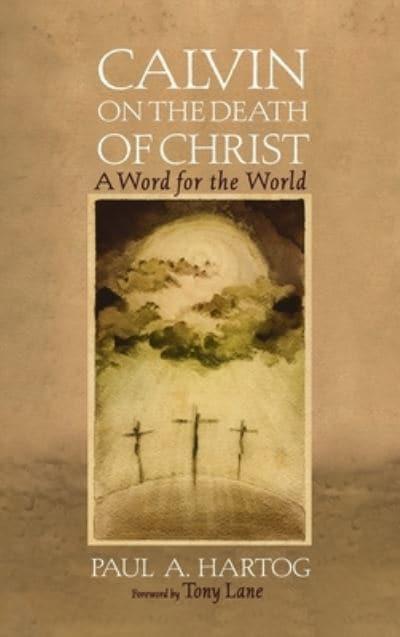
With endorsements from the likes of Tony Lane, Martin Foord, Curt Daniel and Robert Lightner, my weak voice is hardly needed as an impetus to read and consider Paul Hartog’s “Calvin on the Death of Christ: A Word for the World” – but I’ll give you my 2 rusty pennies anyway. I venture that partially (in the interest of full disclosure) because I interacted with Dr. Hartog before the book was finished and thus my name appears in the Acknowledgements. Feel free to question my objectivity. Though in this case, I don’t think that’s really an issue. And I most heartily encourage you to read this volume carefully as an important contribution to a hotly debated and contentious discussion.
For those of us within the Reformed/Calvinistic branches of American Evangelicalism, discussion of the nature of what is most commonly (though certainly unhelpfully) termed “limited atonement”, is an ongoing reality. For myself, this came to a head a number of years ago. Having come into a “Calvinistic” soteriology, I was taught what is most often portrayed as THE Reformed presentation of “Calvin’s T.U.L.I.P.” A misnomer on several fronts. First off because Calvin never formulated the T.U.L.I.P. If you are unfamiliar with that acronym, it stands for Total Depravity, Unconditional Election, Limited Atonement, Irresistible Grace and the Preservation or Perseverance of the Saints. Commonly referred to as “The 5 Points of Calvinism.” More recent studies have shown that the T.U.L.I.P. is in fact a 20th Century invention traceable to a sermon by Dr. Cleland Boyd McAfee in 1905. Thus it did not emerge either directly from Calvin, nor (as is thought by many) from the Synod of Dordt.
But secondly, (speaking to the issue at hand) a strict view of Limited Atonement (such as advanced most powerfully and convincingly by John Owen among others) was never “THE” Reformed or Calvinistic view. As though one could not claim to stand within Reformed orthodoxy unless they embraced the notion that Christ died ONLY for the elect. Massive amounts of recent scholarship by Robert Muller, Curt Daniel, Carl Trueman, Alan Clifford, Michael Lynch and many others have disproved that idea without question. So it is the likes of Archbishop Ussher, Willam Twisse, Edmund Calamy, Richard Vines, Edwards Reynolds and above all John Davenant – are all examples of men who supported views other than strict Limited Atonement even at the Westminster Assembly.
If you want the most robust accounting in this regard – especially in treating how Calvinistic Southern Baptists debated this – you cannot afford to neglect David Allen’s magisterial The Extent of the Atonement: A Historical and Critical Review. It is unparalleled in setting the historical record straight.
All that said, those on both sides of the Limited Atonement debate inevitably try to marshal Calvin to their side. Hartog points out how this is really not useful on serval counts. First off, Calvin is not the last word on Reformed theology. Hartog writes: “Calvin cannot be elevated as the plumb-line of Reformed theology, and Reformation theology was a work in progress.” There were many voices of the Reformation and John Calvin was but one. Second, Calvin himself would have gagged on the notion that people would ever appeal to anything bearing his name, like “Calvinism.” He never set out to create such a thing and would have been repulsed by it. His Institutes were simply an attempt to provide the everyday Christian with a digest of generally received Reformed thinking. Thirdly, it is anachronistic to make Calvin weigh in on a debate which was not raging at the time he wrote and ministered. And lastly, which is at the heart of Hartog’s book – Calvin’s own writings with their inherent tensions prevent one from saying Calvin held to a strict view of Limited Atonement.
Painstakingly combing though Calvin’s works, Hartog mounts the Herculean task of endeavoring to let Calvin speak for himself – and never requiring him to anachronistically endorse later positions. As Dr. Hartog notes in his introduction: “It is evident that Calvin never discussed the question of the extent of the atonement as a separate doctrinal point.” (See: Kennedy, “Was Calvin a Calvinist?” 194.) Or, in my terms, Calvin never spoke of the atonement in quantitative terms. Quantity, is the wrong category.
Now if you were only to read Chapter 2 and Hartog’s attempt to “elucidate what I perceive to be the complex structure of Calvin’s theology through a series of twelve issues and how he seems to address them through his own writings” – you will strike a vein of solid gold. This is profoundly useful as it serves as an incredible digest of Calvin’s thought.
1. “Will all individuals ultimately be saved? Calvin responds with a firm negative.” Whatever his views on the universal applicability of the atonement – he was no “universalist.”
2. “Who is beckoned in the offer of the gospel? Calvin firmly supports the general offer of the gospel with its universal promises.”
3. “Why is it not everyone believes? [Because] “not everyone is efficaciously drawn by the Holy Spirit.”
4. “What distinguishes these specific individuals (whom the Spirit efficaciously draws) from all others?” “The gracious, eternal, unconditional election of God sets them apart.”
5. “Does this mean that the elect are saved by Christ’s work in the cross even prior to their belief?” “No…God, through his Spirit, effectually applies Christ’s work to the elect when they believe, but they are not saved until they believe.”
6. “Does this mean that the provision of Christ’s sacrifice is limited to the elect alone, since God eternally intended to apply Christ’s work ultimately to the elect alone?” “No, because Calvin seems in some sense to coordinate a universal provision of Christ’s sacrifice with the general call of the gospel: “God commends to us the salvation of all men without exception, even as Christ suffered for the sins of the whole world.”
7. “Is the fact that the provision of Christ is universally offered important to the elect themselves? Yes. “The Holy Spirit does not “create” faith in the elect ex nihilo as if it were some kind of a substance or material or object or property. Faith is a confident, relational trust in God’s promises centered in the person and work of Christ.”
8. “Are there ramifications of Christ’s all-sufficient, universal provision in the ministry of evangelism? Yes. “If we wish to serve our Master, that is the way we must go about it. We must make every effort to draw everybody to the knowledge of the gospel.”
9. “Do unbelievers despise the grace that is offered to them? Yes, affirms Calvin. He asserts that “the obstinacy of men rejects the grace which has been provided and which God willingly and bountifully offers.”
10. “In our finite comprehension of matters, may we distinguish between our understanding of a revealed will in the universal promises of the gospel and a secret will in God’s eternal decree? Yes, concedes Calvin cautiously, if we understand that we thereby manifest our human, limited comprehension—as God’s will is truly unified, being “one and undivided.”
11. “So then did Christ die for all people or for the elect? In view of the totality of Calvin’s materials, he would seemingly answer, “Yes,” with further explanations. Christ died intentionally as a sufficient expiation and redemption for the sins of all humanity, and he died intentionally for the efficacious salvation of the elect in particular.”
12. “If Christ suffered as a provision for all humanity (as understood through one intentional aspect), and the Spirit works efficaciously only in particular individuals (the elect), does this mean the Trinity is not unified in redemption? No. “Calvin declares, “For it was God who appointed His Son to be the Reconciler [or Propitiation] and determined that the sins of the world should be expiated by His death.” “For however proud men may be, they are the possession of the devil, until they are regenerated by the Spirit of Christ. For in the word world is here embraced the whole human race.”
And then in each of these, Calvin is quoted meticulously, contextually and copiously.
Make no mistake, this book is not about the Limited Atonement debate itself. It is about how Calvin gets unfairly backread into that debate by modern theologians. And in the process, it decisively (in my opinion) takes the “Calvin missile” out of the arsenal of those who argue he taught “Limited Atonement” as it is portrayed today.
Weighing in at just over 200 pages, Paul Hartog’s “Calvin on the Death of Christ: A Word for the World” is lucid, succinct, thorough, refreshing and important.
As one reaches the closing of Jesus’ 7 letters to the Churches in Revelation, a couple of curious things catch one’s attention. Let me point these out ever so briefly. They seem to me to have something timely for us to note in the Church in America today. I don’t want to be overly simplistic, but there are some things worth considering here.
a. Each person in each Church was to think in terms of: This is where you are, deal with it. Sins at home are the most critical, not the sins of others. None of the 7 are told to censure any of the other 7. No pot shots. All 7 are to read all of the letters. As the text repeats 7 times: “He who has an ear, let him hear what the Spirit says to the churchES.” But the instructions for each Church are for that Church and that is to be the concentration for those congregants. Each Church has its problems. The question is, what are the problems in the Church where I am? And how do I address them in repentance and fidelity?
b. Each Church is warned about its issues, and the call to each then is to pray and to repent where THEY are. There is no call to criticize the others Churches. No call to intervene in the affairs of the other Churches. There is an implicit warning that we too might fall into the same errors of others. But MY preoccupation is not to be with THEIR problems, it is to be about serving Christ where I am. In our day, there is a morbid and destructive preoccupation with the sins of others. We need to shut up. Nor is there any room for a romanticized envy of another Church. Each has its own faults, foibles, sins, defects and its pluses. So what? How am I contributing in walking with Christ rightly where I am?
c. There is no call for anyone to leave their Church over the issues raised. Be faithful, be repentant, serve Christ as fully as you can – where you are. There is not a single call for anyone to start or be their own Church because the Church they are in isn’t up to snuff. No abandoning even though some of the errors are grossly problematic. They didn’t have the false luxury we imagine we have today in the American consumer Church. Jesus never tells anyone to leave their defective church and run to another. Even in Laodicea, which was only 10 miles away from Hierapolis and pastored by the venerable Papias, and a mere 6 miles from Colossae. Even these had some viable options within their general region. If the basic Gospel is still preached – serve Christ where you are. Make it better by your prayers, your repentant lifestyle, your devotion to Christ and His Word, His people and His cause.
Is there never a reason to leave? Sure there is. A topic for another day. But from what we have in these 2 chapters, the first and best response is personal repentance and fidelity. I find it interesting Jesus never abandoned the local Synagogue nor the Temple – as broken and defective as those were in His day. He sought reform. So ought we.
I’ve often lamented that we are not much of a reading generation. Truth be known, preachers and theologians in almost every generation have lamented the same. One can’t help but wonder if there is not some scheme of the Enemy of our souls overall at work in that. Seeing that God saw fit to give us His Word in written form, a general lack of being a “reading people” would seem a universal and undetected attack on the souls of humankind, to keep us ignorant of God’s great revelation to us in the Bible. Compound this with mountains of unprofitable reading fodder, and then the advent of extreme visual media in our day – and you have a potent formula for spiritual ignorance. This, seems to be in general. But when that infection remains prominent in the lives and habits of those professing saving faith in Christ – it takes on particular significance.
Those who will not read (notice I said “will not”, not “cannot”) do the utmost harm to their own growth in Christ; first in neglect of His breathed-out revelation to us, and then in the neglect of the amazing repository of those who gifted by grace throughout the ages continued to write for the edification of Christ’s blood-bought ones.
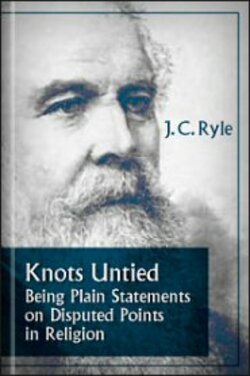
One such giant among those who has left us much in opening God’s Word and its truths to us in ages past is J. C. Ryle. Ryle, the 19th century Anglican and 1st Bishop of Liverpool. Originally intending to be a Parliamentarian, God altered his course to enter upon the ministry which continues to serve God’s Church to this day.
Now there are few Evangelicals today who have Ryle on their shelves, and fewer still who have read him at any length. But as the failure to recognize gold doesn’t diminish its actual value, so the Gospel truths this man of God was gifted to communicate are no less valuable because so few have read them. Because this is so, for the next little bit, I intend to offer up some delicious servings from Ryle’s rich pantry by way of feeding them to you in smaller bites. All this with the hope that both your hearts and minds in Christ will be fed, your appetites whetted to search out more, and the Gospel truths examined to rejoice your souls and cause you to delight in your Savior Jesus Christ all the more.
Thus below is today’s installment. We’ll be working through a paper of Ryle’s on the subject of Regeneration. And I’ve no doubt it will be well worth your while. I’ll do my best to keep each day’s selection to under 1000 words, and make slight alterations to make it clearer where needed.
Enjoy.
Ryle: THE subject of Regeneration is a most important one at any time. Those words of our Lord Jesus Christ to Nicodemus are very solemn: “Except a man be born again, he cannot see the kingdom of God.” (John 3:3.) The world has gone through many changes since those words were spoken. Eighteen hundred years have passed away. Empires and kingdoms have risen and fallen. Great men and wise men have lived, labored, written, and died. But there stands the rule of the Lord Jesus unaltered and unchanged. And there it will stand, till heaven and earth will pass away: “Except a man be born again, he cannot see the kingdom of God.”
But the subject is one which is peculiarly important to [any claiming to be Christians] in the present day. Things have happened of late years which have drawn special attention to it. Men’s minds are full of it, and men’s eyes are fixed on it. Regeneration has been discussed in newspapers. Regeneration has been talked of in private society. Regeneration has been argued about in courts of law. Surely it is a time when every true [Christian] should examine himself upon the subject, and make sure that his views are sound. It is a time when we should not halt between two opinions. We should try to know what we hold. We should be ready to give a reason for our belief. When truth is assailed, those who love truth should grasp it more firmly than over. I propose in this paper to attempt three things:—
What regeneration, or being born again, means.
The show the necessity of regeneration.
To point out the marks and evidences of regeneration.
If I can make these three points clear, I believe I shall have done my readers a great service.
I. Let me then, first of all, explain what Regeneration or being born again means. Regeneration means, that change of heart and nature which a man goes through when he becomes a true Christian.
I think there can be no question that there is an immense difference among those who profess and call themselves Christians. Beyond all dispute there are always two classes in the outward Church: the class of those who are Christians in name and form only, and the class of those who are Christians in deed and in truth. All were not Israel who were called Israel, and all are not Christians who are called Christians. “In the visible Church,” says an Article of the Church of England, “the evil be ever mingled with the good.”
Some, as the Thirty-nine Articles say, are “wicked and void of a lively faith;” others, as another Article says, “are made like the image of God’s only-begotten Son Jesus Christ, and walk religiously in good works. Some worship God as a mere form, and some in spirit and in truth. Some give their hearts to God, and some give them to the world. Some believe the Bible, and live as if they believed it: others do not. Some feel their sins and mourn over them: others do not. Some love Christ, trust in Him, and serve Him: others do not. In short, as Scripture says, some walk in the narrow way, some in the broad; some are the good fish of the Gospel net, some are the bad; some are the wheat in Christ’s field, and some are the tares.
I think no man with his eyes open can fail to see all this, both in the Bible, and in the world around him. Whatever he may think about the subject I am writing of, he cannot possibly deny that this difference exists.
Now what is the explanation of the difference? I answer unhesitatingly, Regeneration, or being born again. I answer that true Christians are what they are, because they are regenerate, and formal Christians are what they are, because they are not regenerate. The heart of the Christian in deed, has been changed. The heart of the Christian in name only, has not been changed. The change of heart makes the whole difference.
This change of heart is spoken of continually in the Bible, under various emblems and figures. Ezekiel calls it “a taking away the stony heart, and giving an heart of flesh;”—“a giving a new heart, and putting within us a new spirit.” (Ezek. 11:19; 36:26.) The Apostle John sometimes calls it being “born of God,”—sometimes being “born again,”—sometimes being “born of the Spirit.” (John 1:13; 3:3, 6.) The Apostle Peter, in the Acts, calls it “repenting and being converted.” (Acts 3:19.) The Epistle to the Romans speaks of it as a “being alive from the dead.” (Rom. 6:13.) The Second Epistle to the Corinthians calls it “being a new creature: old things have passed away, and all things become new.” (2 Cor. 5:17.) The Epistle to the Ephesians speaks of it as a resurrection together with Christ: “You hath He quickened, who were dead in trespasses and sins” (Eph. 2:1); as “a putting off the old man, which is corrupt,—being renewed in the spirit of our mind,—and putting on the new man, which after God is created in righteousness and true holiness.” (Eph. 4:22, 24.) The Epistle to the Colossians calls it “a putting off the old man with his deeds; and putting on the new man, which is renewed in knowledge after the image of Him that created him.” (Col. 3:9, 10.) The Epistle to Titus calls it “the washing of regeneration, and renewing of the Holy Ghost.” (Titus 3:5.) The first Epistle of Peter speaks of it as “a being called out of darkness into God’s marvellous light.” (1 Peter 2:9.) And the second Epistle, as “being made partakers of the Divine nature.” (2 Peter 1:4.) The First Epistle of John calls it “a passing from death to life.” (1 John 3:14.)
All these expressions come to the same thing in the end. They are all the same truth, only viewed from different sides. And all have one and the same meaning. They describe a great radical change of heart and nature,—a thorough alteration and transformation of the whole inner man,—a participation in the resurrection life of Christ; or, to borrow the words of the Church of England Catechism, “A death unto sin, and a new birth unto righteousness.”
This change of heart in a true Christian is thorough and complete, so complete, that no word could be chosen more fitting to express it than the word “Regeneration,” or “new birth.” Doubtless it is no outward, bodily alteration, but undoubtedly it is an entire alteration of the inner man. It adds no new faculties to a man’s mind, but it certainly gives an entirely new bent and bias to all his old ones. His will is so new, his tastes so new, his opinions so new, his views of sin, the world, the Bible, and Christ so new, that he is to all intents and purposes a new man. The change seems to bring a new being into existence. It may well be called being “born again.”
J. C. Ryle, Knots Untied: Being Plain Statements on Disputed Points in Religion (London: William Hunt and Company, 1885), 110–113.
Recently I obtained a copy of Brian Simmons’ “The Passion Translation”, published by Broadstreet Publishing. Gaining in popularity, I was anxious to be digging into it myself.
If you are not aware, The Passion Translation (TPT) is primarily the work of Dr. Brian Simmons. I say primarily, because the official website uses similar terminology. They state: “While Brian serves as the lead translator for The Passion Translation, every book (including the numerous footnotes) is evaluated by respected scholars and editors.” As of today, 5/12/2021, a list of who these reviewing scholars may be is nowhere to be found. At least I’ve not been able to find any.
I will say at the outset that I did find a number of places where Simmons’ rather poetic phrasing was very pleasing indeed. And there are touches of real insight here and there. That said, in the process of reading, I began to notice some things which caught my eye. A number of places (quite a few in fact) where the meanings of words from the original are quite oddly handled.
For example, his translation of Romans 1:1 – reads: “Paul, a loving and loyal servant of the Anointed One, Jesus. He called me to be his apostle and set me apart with a mission to reveal God’s wonderful gospel.” OK. But then there is this footnote (his footnotes I found out later he claims Jesus gave him a revelation to use) on the word “servant” which reads: “The Greek word doulos signifies more than a servant; it is one who has chosen to serve a master out of love, bound with cords so strong that it could only be severed by death.”
Hmmmmm.
To put it quite plainly and simply – he is just plain wrong. It’s an interesting thought, but has absolutely no linguistic support whatever. You can look up the word doulos (the Greek word for servant in this text) in any Greek dictionary and see that Simmons’ definition has no basis at all. A doulos was the common, basic word for a slave. Love had nothing to do with it. It is not to say I suppose that some slaves loved their masters, but he is saying this is how you ought to translate the word. He, is simply wrong. His definition is fabricated. It may be well meaning, but it is in error. And to claim that he was inspired by God to make this translation when it is wrong on something this basic, simple and straightforward, really began to give me great pause.
Then as I continued to read, I saw a lot of footnotes that appealed to the Aramaic language. While it is most likely that Jesus spoke and taught in Aramaic, the reality is that the original writing of the New Testament was in Greek. Researching online I saw where Simmons claims that new scholarship says our Greek texts came from Aramaic originals. That was contrary to all I had learned over the years, but I investigated just in case I had somehow missed something. But the more I dug, as I suspected, the more I found that such a claim is utterly without foundation. All solid New Testament scholarship (Evangelical or not) appeals to the Greek text as original (excepting for a few short portions of Daniel for example). The Bible was LATER translated into Aramaic FROM the Greek, but the Greek was never translated from the Aramaic. He is either simply mistaken, or misrepresenting. In either case, he is quite in error.
Not satisfied, I continued to dig. And so as to make this a truly brief review and not unnecessarily long, let me give you a few links to check out in doing your own research.
The first is a short video from Alissa Childers on her research into the Passion Translation. I found much of what she reported to be quite disturbing. But it is only 10 mins. and good intro some of the chief concerns.
Shead’s article includes this abstract: “Brian Simmons has made a new translation of the Psalms (and now the whole New Testament) which aims to ‘re-introduce the passion and fire of the Bible to the English reader.’ He achieves this by abandoning all interest in textual accuracy, playing fast and loose with the original languages, and inserting so much new material into the text that it is at least 50% longer than the original. The result is a strongly sectarian translation that no longer counts as Scripture; by masquerading as a Bible it threatens to bind entire churches in thrall to a false god.”
That’s pretty strong language. I hope you will prayerfully and carefully consider it.
3rd, is a pretty full video from Mike Winger. Mike is a Charismatic pastor (Calvary Chapel) so he is not a guy opposed to the gifts of the Spirit for today, a crowd this translation seems to be aimed at. But this video, with his interview of Douglas Moo who is a world renowned Biblical and Greek scholar, is long, but very eye-opening. https://youtu.be/PcUmQJpi9Do
Not least in all of this is solid documentation I have found that Simmons has baldly misrepresented (if not outright lied) about his credentials and training for doing a translation. His website makes this claim: “As a missionary, he and his wife, Candice, pioneered church plants in Central America. As a linguist, Brian co-translated the Paya-Kuna New Testament for the Paya-Kuna people of Panama.”
In truth, Simmons’ doctorate is in “practical ministry with an emphasis on prayer” from Wagner Leadership Institute, not a seminary, accredited or otherwise – https://www.linkedin.com/in/passiontranslationbriansimmons). His training has nothing to do with study or credentials as a translator. Thus in interviews others have done with New Tribes Mission and Brian’s colleagues from Panama, they state that he has no training as a linguist and was never involved in the translation process beyond reading what the translators had done to some natives, and reporting back how they understood it. He was never a “co-translator”. In fact, in an interview I found on the Web he himself admits he has very “minimal” training in Greek and Hebrew. He deliberately lies about this on his website. And then when he says things like that Jesus told him He is going to give him a whole new chapter to the Gospel of John – I am afraid we are dealing with some pretty heavy delusion if not deception. Simmons has no closed canon, and will be the one to reveal new scripture to the world. YIKES! Things like this, for me, make everything more than suspect.
Bottom line, if you or folks you know are considering or using TPT, don’t. While Simmons’ gift for artful turns of phrases in English are pleasing in many places, the blatant misrepresentation of key facts – not the least of which are his own credentials and qualifications – the mishandling of the original texts and the insertion of sectarian phrases and ideas in catering to a specific group combine to make this a most untrustworthy and even destructive “translation.”
1. Racism is not a social problem with sin implications, it is a sin issue with social implications.
2. Racism is rooted in all attempts to consider another individual or group inferior to ourselves (whatever the reason, race is only one feature which may be utilized)) that we might consider ourselves superior in some way.
3. Racism then is ultimately just one manifestation of pride.
4. A profound example in Scripture is in Matthew 18:1–14 (ESV) — 1 At that time the disciples came to Jesus, saying, “Who is the greatest in the kingdom of heaven?”
NOTE: The issue here was the seeking of greatness (superiority) over others, who by default must be considered inferior. Whether the inferiority rests in race, ability, gifting, intellect, etc., it all springs from the same mechanism. So we will see it raise its head again when the mother of James and John seeks position for them at Jesus’ right hand. The rest are upset because it raises the inferiority/superiority dynamic.
So how does Jesus address this?
2 And calling to him a child, he put him in the midst of them 3 and said, “Truly, I say to you, unless you turn and become like children, you will never enter the kingdom of heaven. 4 Whoever humbles himself like this child is the greatest in the kingdom of heaven.
Jesus completely changes the category of what constitutes greatness. And it has nothing to do with superiority or inferiority in terms of comparison one to another. His use of a child in this case is very important.
Children manifest their sin in all sorts of ways from the get-go. But there is one area they do not venture into until they get older and observe others: While they will crave and seek for attention and love, they are not mindful that they somehow DESERVE that love or attention as opposed to anyone else. They may be jealous that someone else has the love and attention (or whatever else it is they desire) instead of themselves, but they have no sense that they deserve it because they are superior to an inferior. This is what Jesus is driving at. It grows out of the Apostles’ arguing among themselves.
What about these children? A. Being great in the Kingdom isn’t even on their radar screen. And neither ought it to be on ours. B. The child was set in their midst by another, not by himself. C. The child is humble. Not assuming he or she has anything to add, but looking to be added to.
Two points.
1. Greatness in the kingdom is irrelevant, when entrance into the kingdom is still in question. Unless we are humbled to the point of absolute dependence, we will not even be IN the kingdom. So, wrong question.
2. In fact, greatness in the kingdom is a matter of one’s realization of need of grace. Those are greatest in God’s eyes, (not man’s) who know their need the most, and look only to Him.
Apart from a concept of grace and undeservedness, racism and all forms of the superiority/inferiority dynamic will be present.
It was this way even in the Garden. Confronted with his sin, Adam immediately blameshifts to Eve, implying her inferiority as the cause of his error. Sexism. Eve in turn see the serpent as the inferior and more to blame – (angelic speciesism?) And so we still look to some inferior as the cause of our woes, in order to protect our self-image of superiority.
I recently watched a series of interviews with men on death row for all kinds of heinous crimes. But each referred to others who were inferior to them, and cemented their superiority. So a multiple murderer says “at least I’m not a pedophile.” And a man who freely admitted he murdered his cell-mate in order to get on death row because he would have a private cell and better food, declared – “but I’m no liar.”
Now so wicked is this impulse that Jesus then goes on to say: 5 “Whoever receives one such child in my name receives me, 6 but whoever causes one of these little ones who believe in me to sin, it would be better for him to have a great millstone fastened around his neck and to be drowned in the depth of the sea.
In other words, Jesus considers this superior/inferior dynamic so wicked, that to incite that way of thinking into children would result in that it would be better never to have been born. Any foray into this line of thinking is not just wrong, it is a gross abomination. Hence: Romans 12:3 (ESV) — 3 For by the grace given to me I say to everyone among you not to think of himself more highly than he ought to think, but to think with sober judgment, each according to the measure of faith that God has assigned.
So you have “giftism” in 1 Corinthians. Classism in James. “Positionsim” in the Apostles. Doctrinism, Denominationalism (not mere denominations), Politicism (the Left see the Right as inferior and vice versa), Opinionism (anyone proffering a different point of view is inferior), Racism in Acts 7, and so on and so on.
None of this is to say that some ideas and understandings, etc. are superior not to others. Not all views or statements or beliefs are equally viable, valuable or true. We do not throw away those right and proper distinctions. Some things are wrong. Untrue. And some people are wrong about them. Ignorant, deceived, confused or simply in error.
But it is to say that when we move from debate about ideas, truth, beliefs, etc., to making another person somehow less valuable as a human being because of those very real differences – this is where our particular “ism” raises its ugly head. And so Politicism, those on the right actually denigrate the humanity of those on the Left and vice versa. It is the denigration of their humanity so that we make them somehow less human or a lesser human that we are – where this all comes together. Ethnicity and color is just one manifestation of the same mechanism.
No portion of Scripture treats this problem more fully and precisely than does the book of James. If you can read that letter and come away looking at anyone as less than yourself for any reason – you are still lost in the gall of iniquity. The moment we cross over into pronouncing other as fundamentally less – we tread into dangerous territory for our souls.
And how grievously evident this has become even in Christian discourse in our day. If any who profess Christ, see nothing of this root of pride from which the racist branch grows in ourselves – we are at best self-deceived, and at worst – and more likely – liars.
If everything is not of grace, and I deserve anything as opposed to anyone else – I will gravitate toward my superiority and their inferiority and latch on to whatever is easiest to identify them as inferior. And my inferiors then become the scapegoat for all of my ills. Not my fallenness in Adam.
Racism is the laziest of the manifestations of the wickedness of this pride. It has no basis at all, other than I rise to the level of considering myself the norm by which all others must be judged, rather than Jesus being the norm by which I am judged.
In short – Racism is one of the primary ways we choose most to avoid our own guilt and sinfulness and taking full blame for it upon ourselves. And thus it could not possibly be any more antithetical to the Gospel. It is the crudest form of self-justification.
There is no curing of racism apart from the curing of pride.
And there is no curing of pride without the following elements:
1. Humble acknowledgment of my personal utter ruin, guilt and sin before God. 2. Humble submission to God’s sole means of righteousness, the imputed righteousness of Jesus Christ by faith. 3. Humble submission to the truth of God’s Word concerning our common origin and corruption in Adam, and common salvation in Christ alone. 4. The total repudiation of all personal merit before God, and all imagined superiority over others dissolved in the revelation of each human being as an image bearer of our creating God. 5. Absolute acknowledgment that sin is such, that the same substitutionary death of Jesus on the cross was necessary for me, if I alone were to be saved, and necessary and sufficient for all who would be saved. No more and no less for one, any or all. 6. A constant spirit of repentance from the adoption of superiority or inferiority paradigms in my view of and interaction with all other human beings. 7. Realization that the standard for determining the norm for humanity is not comparison with one another – least of all myself – but Jesus Christ, the incarnate Son of God. 8. A settled conviction that I will one day stand before the Living God to give an answer for myself in respect to these realities.