For the audio Podcast of this and every episode, find us on Breaker, Google Podcasts, Overcast, Pocket Casts, RadioPublic, Spotify or HERE
If you’d like to join us in our journey reading all the way through the Bible this year, drop me a line at reid.ferguson@gmail.com, and I’ll be glad to email back a copy of the reading plan we are using.
Every generation has had branches of the Church enamored with prophets and prophecy. There is something mystical and intriguing in it all. The prospect of getting secret knowledge, or of having some kind of spiritual authority is a lure just too enticing from some to pass up. It’s been true from the beginning. And when society is in upheaval, or even when it is just our personal lives, in times of hardship, trial, disaster or uncertainty, the so-called prophets and the fascination with getting a “prophetic word” here or there goes off the charts.
But what are God’s prophets really all about? We’ll talk about that today on Through the Word in 2020. I’m your host – Reid Ferguson.
Today’s assignments find us in Luke 8:1-8, 1 Thessalonians 2:-3:5 and 2 Chronicles 22:10-24:22. And it is verse 19 of 2 Chron. 24 that I like to call your attention to today. It is insightful and helpful on 2 fronts. First, it gives us a sense of what constitutes the main part of a true prophetic ministry. And note well, if it fails in this aspect, it is truly suspect. Second, it lays out the burden of those who have such a ministry. To use the vernacular – it ain’t easy.
As one surveys both the Testaments, the prophets always functioned within the framework of the 1st part of vs. 19: “Yet he sent prophets among them to bring them back to the Lord.” The prophet’s primary call was always to confront sin, call for repentance and bring people back into line with God’s plans and purposes. Even when there were predictive elements, the focus was typically either on the disaster to come if they continued in their sin, and/or the blessings promised should they repent – and a reminder of what God intends at the end of all things. Repentance from sin is always the backbone. Not, the kind of prophecy that is more like the amorphous blather of the horoscopes in the local paper. “These testified against them” the text reads.
But the problem then as even now is: “But they would not pay attention.” And here, a prophet has to have some real backbone. For the most typical response to REAL prophecy – with rare exceptions is – “but they would not pay attention.” As God testifies against Israel in its rejection of Isaiah’s prophetic ministry: “For they are a rebellious people, lying children, children unwilling to hear the instruction of the Lord; who say to the seers, “Do not see,” and to the prophets, “Do not prophesy to us what is right; speak to us smooth things, prophesy illusions, leave the way, turn aside from the path, let us hear no more about the Holy One of Israel.” (Isa. 30:9-11)
Think about it. John the Baptizer who is the last of the great prophets never predicted anything. But he hammered home the need for repentance from sin – and pointed to the Lamb of God who takes away the sin of the world. If you want a prophet or to be a prophet – there’s your exemplar. Of him Jesus said he was even more than a prophet – that among those born to women none is greater than John. And he never uttered a syllable of secret knowledge.
Don’t waste a minute of your time, a single calorie of your energy or a penny of your money on any so-called prophet or prophetic ministry that isn’t built around calling people back from their sin, to walk in holiness and fidelity to Jesus Christ as Lord of their lives. That doesn’t have as it’s banner: “Seek first the Kingdom of God and His righteousness.”
God bless, and God willing – we’ll be back tomorrow.
For the audio Podcast of this and every episode, find us on Breaker, Google Podcasts, Overcast, Pocket Casts, RadioPublic, Spotify or HERE
If you’d like to join us in our journey reading all the way through the Bible this year, drop me a line at reid.ferguson@gmail.com, and I’ll be glad to email back a copy of the reading plan we are using.
All of us face times of great indecision in life. Confronted with situations we simply do not know how to navigate. What we would really like is a sign, a “word from the Lord”, a directing impulse or some sort of supernatural communication that blazes across the sky: “DO THIS!” Fortunately for those who are Christ’s, we are never at a total loss. We are His and He is ours and we are never left alone. And we can go to His Word both for wisdom principles, as well as for examples in the lives of those who have walked with God before us. One such example is in our reading today in
2 Chronicles 20–22:9; which along with Luke 7:18–50; Psalm 114; and 1 Thessalonians 1:2–10 round out today’s Scripture readings.
I’m Reid Ferguson. And this is Through the Word in 2020.
King Jehoshaphat was in a tough place. Someone brought him the news that a huge army was about to attack. And the text says “Jehoshaphat was afraid.” I would be too. But what he did next is what forms the 1st of 4 things we need to see in this account. Yes, he was afraid, and being afraid he “set his face to seek the Lord.” In fact, he led the nation in this act. His prayer is found in vss. 6-12. In and of itself the prayer isn’t remarkable though it is a good model – he just laid the whole situation out before the Lord in detail as he understood it. But it is his closing sentence that strikes me as the 1st necessary step: “We do not know what to do, but our eyes are on you.”
In other words, he simply fully humbled himself before His God. He didn’t suggest or tell God what to do. He didn’t formulate his plan and then ask God to give it success. He just flat out said – we don’t have a clue as to what to do, but we are going to look to you and not try to come up with the answer ourselves. Help!
God does answer this prayer, but not the way you might have thought. Jahaziel prophesies to him. And what does he say? Essentially, go about the business of doing what you know you should be doing in serving and obeying Him. You’ve got a battle to fight, get ready to go to battle. Not very profound was it? But the point was, whether you know exactly what to do about THIS specific threat or not – don’t become paralyzed – do what you know you should be doing either way.
The 3rd thing to note is that Jehoshaphat and all the people at this point simply needed to trust God to provide what was needed in the right way and in the right time – whether they could see it then or not.
And lastly, they stopped to “Give thanks to the Lord, for his steadfast love endures forever.” To remind themselves of who God is – Lord, sovereign – even over this situation; that His steadfast love endures forever – which includes NOW. And to give thanks that this is the case.
In the end, they went away far richer then the way they went into it. But in the dark moments of indecision – they gave us a most blessed example to follow.
Christian – facing something you feel you are just without the wherewithal to handle?
Humble yourself before Him.
Be about what you know you ought to be doing even if this weren’t the case.
Trust Him to answer – perhaps in a way you never imagined.
And give thanks to the Lord. For His steadfast loves truly does endure forever. Even now.
For the audio Podcast of this and every episode, find us on Breaker, Google Podcasts, Overcast, Pocket Casts, RadioPublic, Spotify or HERE
If you’d like to join us in our journey reading all the way through the Bible this year, drop me a line at reid.ferguson@gmail.com, and I’ll be glad to email back a copy of the reading plan we are using.
Only God is all-knowing. Only God is present everywhere at the same time. Only God has all power. And only God can care about everything and everybody all at once. Nowhere do we try more to be like God than when we try to take on what can only belong to Him. To be human, is to the have the limits He created us with. And as I hope we’ll see today – that’s a relief.
I’m Reid Ferguson, and this is Through the Word in 2020.
We only have 3 passages to read today and two of them are exceedingly brief: 1 Thessalonians 1:1; Luke 7:11–17; and 2 Chronicles 16–19.
The portion I’d like to consider for a moment is the account of Jesus raising the son of a woman in a town called Nain – from the dead. Luke is the only Gospel writer to record the event, and it is so brief we can pass over it in a perfunctory manner. But sometimes, there are little things in the text that really mean a lot.
What caught my eye afresh this morning was the repeated use of the singular pronouns: His, Him, She, Her, You. While there was a crowd there, and at least some of Jesus’ disciples, attention is given to the singular.
Think for a moment about the way you and I are bombarded with information, images and stories of tragedy, upheaval, turmoil, conflict and unrest, globally, 24 hours a day. And one wonders, are each of us as individuals really designed to care so deeply about so many people and so much pain and distress all over, all the time? I don’t think so.
Back to our text. Here is Jesus, in His incarnation, but in one local place at a time. Not everywhere. He is in this specific village, at this specific time, with this specific widow and her dead son – and He functions within that local context – within His immediate sphere. But He is not at this moment healing all people everywhere. As the text notes, in that moment, He saw “her” and had compassion on “her” and spoke to “her.” The rest of the World was in the care of His Father – and He was free to care and do what what He could do where He was in that moment. And that is how we are meant to be as well.
I am not suggesting we refuse to know what else is going on in the world around us. I am suggesting that we are not designed to care about all things and all people at all times – that is a usurpation of God’s sphere. A dash of human hubris with a distorted understanding of compassion, but above our means and call.
Beloved, we each only have so much emotional capital to spend. Some of us wonderfully more than others. But it must be spent where it can actually do some good. Matter where you can. And trust, where you can’t.
I could go out today and give 1,000 pennies to 1,000 needy people across the country. Or, I could give $10.00 to the guy next door who needs a meal. Touching 1,000 sounds good. But in actuality, it’s not very much at all. I have to humbly stay within the limits God has assigned to me in my sphere – and not try to be Him. Not be more altruistic than Jesus in His incarnation. Not pretend I can do what only God can do. And trust Him that He has others, in those places, to do what they can do there too.
Don’t stop caring – but trust in His care too. And pour into those He has providentially placed within your actual sphere of life and influence. Knowing that it does not ALL depend upon you.
DO, be His instrument, but know that you are not the only tool in His tool-box.
For the audio Podcast of this and every episode, find us on Breaker, Google Podcasts, Overcast, Pocket Casts, RadioPublic, Spotify or HERE
If you’d like to join us in our journey reading all the way through the Bible this year, drop me a line at reid.ferguson@gmail.com, and I’ll be glad to email back a copy of the reading plan we are using.
Social justice. We hear the term all the time these days. Most often in the context of some strata or people groups in our society not receiving the same treatment as others under the law. A skewed system oppressing some, and elevating others. And to any reader of the Bible, God’s interest in justice can’t be escaped. Christians ought to be vitally interested in justice, and look to right wrongs when and where we can.
At the same time, a different sort of “injustice” can raise its head, and it too needs to be addressed. This is rooted in a misunderstanding about some passages of Scripture like vss. 7-8 in Psalm 113. We’ll look at that briefly today on Through the Word in 2020.
Along with Psalm 113 we have Colossians 4:2–18; 2 Chronicles 11:18–15:19 and Luke 6:46–7:10 to consider. But as I already mentioned, it is vss. 7-8 of Psalm 113 which catches my eye today.
“He raises the poor from the dust and lifts the needy from the ash heap, to make them sit with princes, with the princes of His people.”
Verses like these, and dozens of others throughout the Bible, are sometimes cited as proof that God has a special regard for the poor, the oppressed and the disenfranchised. And it is true. With, some necessary qualifications. Sometimes, what is true, is not the whole truth. And failing to get at the whole truth, can make a lie out of something true. So let’s note 3 things here.
In this passage, the poor being referred to are God’s people looking to God for the fulfillment of His promises to them. It is not a general statement about all the poor in every place and at all times.
2nd, some infer that simply being poor, disadvantaged or oppressed, somehow confers some sort of spiritual status upon them before God. Our relationship to Him is rooted only in Jesus Christ and the Gospel. We are not nearer and dearer to Him in terms of salvation on the basis of our life circumstances. Yes, He loves to be merciful to those suffering – but that kind of common grace must not be confused with saving grace. The rich oppressing unbeliever and the poor oppressed unbeliever are equally distant from God and both equally in need of the the saving grace of Jesus Christ through repentance from sin and faith in Jesus’s atoning work on Calvary to reconcile them to the Father.
3rd. The fact that God will pour out judgment on any and all who oppress others in this life, does not somehow mean that that the oppressed are not themselves still responsible for their own sins before God.
Being sinned against does not somehow mitigate my sin, any more than drinking a diet Coke cancels out the calories in the Snickers bar I have with it.
Yes, any and all who oppress others, take advantage of the disadvantaged and deny them justice, will answer for their sins. No doubt about it. But make no mistake, those who may find themselves among the poor and disadvantaged, will still stand before the judgment seat of God to answer for their own sins. No amount of being sinned against, erases my sin. Only the blood of Christ can cleanse us from sin. Nothing else. Nothing less.
Now we do not want to miss the fact that one day, at the return of Christ, justice, true justice, for all will in fact be finally meted out. We long for that day. And no one will be able to point to any advantage or disadvantage in this life as some means to escape that judgment. Which calls us all to flee from our sin and to Christ today – no matter where we find ourselves in our society. That we might be made the righteousness of God in Jesus.
I’m Reid Ferguson, and God willing, we’ll be back tomorrow.
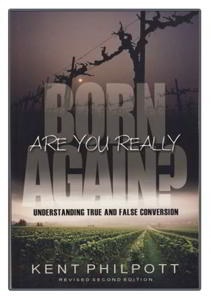
Let me introduce you to, and recommend 2 books I’ve read recently: Kent Philpott’s thought provoking and useful little book, “Are You Really Born Again?” – subtitled “Understanding True and False Conversion.” And Gavin Ortland’s extremely timely and potent “Finding the Right Hills to Die On: The Case for Theological Triage.”
Let me be clear that these 2 books have nothing whatever to do with one another. They are as far away from one another in theme and content as can be imagined, and yet both are profoundly useful in their spheres.
The usefulness of “Are You Really Born Again?” Is located first and foremost in 2 Corinthians 13:5a & b (ESV): “Examine yourselves, to see whether you are in the faith. Test yourselves.”
It is incumbent upon all those who profess saving faith in Jesus Christ to enter upon this examination from time to time. Due to our own sinful capacity for self-deception, and because there are so many “false gospels” out there, re-examination from time to time is very healthy. I would aver even necessary. Of course some personality types can run with this and take it to morbid extremes, never arriving at place of assurance even though others wouldn’t hesitate to confirm their authenticity. Philpott’s book is helpful here too. Though, if I have one slight critique it is that I think he lays a tad too much stress on every genuine Christian having full assurance. Nevertheless, when it is all said and done, this book is helpful both in terms of defining true conversion – over and against the several types of false conversions he describes; and, in laying out sound Biblical means for working through such an examination well.
One of the most helpful concepts the author develops is in drawing a distinction between being “Christianized” versus being genuinely “converted.” I do not think this differentiation is anywhere near enough explored or explained. If only for this, the book is well worth the purchase price and the read. That he develops his points in this regard using numerous case histories from his decades of pastoral experience make the work extremely practical rather than theoretical. You DO NOT need to be a theologian to access it on every page. You WILL learn from fundamental theology along the way.
Philpott names an array of groups who he would classify as falling into 2 broad categories: The non -religious unconverted comes in many forms: The “jilted” (victims of bad church experiences); Careerists – too caught up in career and cultural sub-groups to pursue religion; Hedonists who view Christianity as too restrictive and joy-killing; Gnostics who think they know what they need to know and that gives them freedom to live any way they please; Technocrats, Existentialists, Humanists, Secular-ethicists, the Driven – and more. He explains each in easy to grasp terms and in only a paragraph or so each. Many of these he posits walked away from Christianity at some point due to their views.
Then there are the RELIGIOUS unconverted. The “loving and fair mined liberal” for whom Christianity is wrapped up fairness. The Do-gooder, the Mimic, the Positive Thinker, the Superstitious, the Sentimentalist, the Traditionalist and others. These would claim some form of Christianity, but fall short of being truly converted.
He tackles some of the false conversions he’s observed: Crisis conversions, Moral Conversions, Spiritual Conversions (rooted in some spiritual experience), Doctrinal conversions and more.
As he urges on pg. 132, in terms of helping one another find out where we are, he suggests asking this question first: “What are they relying on for their salvation?” And now you have a real starring point – for yourself as well.
Worth the price of the book alone is Appendix I – a sermon preached by Jonathan Dickinson in 1741. In it, Dickinson lays out “the principle method by which this great change is wrought in the heart of a sinner by the Spirit of God is in giving him a realizing view of the great truths revealed in the Word of God, and enabling him to see things as they are.” Rich!
He then lists 5 of those realizations: 1. His own miserable spiritual condition for what it really is. 2. Realizing his unworthiness of divine mercy, and his utter inability to help himself. 3. A deep desire to search after Christ. 4. Realizing the fullness and sufficiency of Christ to meet his need, and Christ’s willingness and readiness to save him. 5. Continued views of spiritual things as they are and seen in God’s Word.
“Are you Really Born Again” is not just good for those wrestling with this question consciously, but also as an evangelistic tool. It is winsomely written, clear and chapter 4’s walk through key redemptive vocabulary: Love, Atonement, Sacrifice, Substitution, Propitiation, Reconciliation, Redemption, Justification and the like – in short, clear bursts – can help build a really sound theology of salvation.
My thanks to Pastor Tony Bartolucci for giving me my copy. An excellent resource.
The 2nd book, Gavin Ortland’s “Finding the Right Hills to Die On: The Case for Theological Triage.” I found so compelling, I bought each of our Elder’s a copy.
In today’s climate of raging commentary in the media, and especially in the often cowardly world of social media, where there lacks no number of angry, vitriolic verbal combatant – coming to grips with what is really important enough to “fight” about, and what isn’t – isn’t an easy task. We are called upon every day from countless corners to feel deeply and respond strongly to an endless list of causes. Many, very legitimate. Many not. In either case, the ability to determine what is genuinely worthy of certain levels of response is not always easy to pin point.
Ortland is not going to help you in terms of the secular media. This book is aimed at helping us sort out what theological, doctrinal and Church life issues fall into what he has laid out as 4 orders of importance, what Ortland calls “Theological Triage.” If you’ve never heard that term before – he explains: “As far as I know, the expression “theological triage” was first coined by R. Albert Mohler, who draws analogies with medical triage. At the scene of a terrible accident or some other violent event, there may be too few first responders to deal with all the victims immediately. Decisions have to be made: should the first concentrated attention go to the victim with severe burns, the victim who is bleeding profusely, or the victim with a couple of broken limbs? It is the responsibility of the initial triage teams to make these hard choices. Similarly, in the realm of theology some theological issues are more important or more urgent than others, and Christians who have to decide on how best to deploy their energy need to exercise godly judgment as to where their theological priorities should go.”
Don Carson in his introduction notes: “Ortlund usefully develops four tiers in his theological-triage system: (1) doctrines that are essential to the gospel; (2) doctrines that are urgent for the health and practice of the church, such that Christians commonly divide denominationally over them; (3) doctrines that are important for one branch of theology or another, but not such that they should lead to separation; (4) doctrines that are unimportant to gospel witness and ministry collaboration.”
What appears neat and clean at the outset, Ortland is careful to tease out necessary nuances and clarifications to these 4 all the way through. His is not a rigid grid but a flexible guide. You will appreciate the wisdom and thoughtfulness he puts into the examples he uses at each level. The table of contents demonstrates what I am talking about.
Part 1 Why Theological Triage?
1 The Danger of Doctrinal Sectarianism
2 The Danger of Doctrinal Minimalism
3 My Journey on Secondary and Tertiary Doctrines
Part 2 Theological Triage at Work
4 Why Primary Doctrines Are Worth Fighting For
5 Navigating the Complexity of Secondary Doctrines
6 Why We Should Not Divide over Tertiary Doctrines
Conclusion: A Call to Theological Humility
His tone is conciliatory while utterly lacking compromise on essentials. I think he gets it as right as anyone I can think of. And his call to making how we debate such issues as important as the issues themselves is vitally important when those with opposing views often hurl barn-burner comments at one another.
Rather than interjecting too much of my own thought here, let me leave you with. A smattering of quotes that impacted me, and that I will return to over time. Enjoy!
Chapter 1
Martin Luther noted, “Softness and hardness . . . are the two main faults from which all the mistakes of pastors come.” The same could be said of all Christians.
Turretin was opposing not only the elevation of what he regarded as false doctrines into necessary articles of faith but also the elevation of true but secondary doctrines into necessary articles of faith.
We should have lower theological criteria for looser forms of partnership.
Baxter’s words remind us that theological zeal must be subjected to the test of love. Not all zeal is from God.
Even when the error we oppose is a deadly heresy, our aim must be to heal, not to disgrace.
Chapter 2
If we isolate everything outside the gospel as a matter of indifference, we end up trivializing the majority of what God has communicated to us.
In his classic book Knowing God, J. I. Packer even suggests that a love for all of God’s truth is a distinguishing mark of regeneration.
On many other issues, as well, we might say with Machen: better to be wrong than indifferent.
Chapter 4
Theological wisdom does not consider doctrines in the abstract, concerned mainly with technical correctness. Instead, it considers doctrines in their “real life” influence on actual people and situations and churches.
Even in our theological polemics, we must exhibit a self-restraint that subordinates our personal likes and dislikes to the concerns of the kingdom.
Several distinctions can help us in this regard. First, we should distinguish between what must be affirmed and what must not be denied.
Related to this, we must distinguish between what must be affirmed when someone becomes a Christian and what must be affirmed as characteristic of growth in Christ over time.
In addition, when a first-rank doctrine is denied, we must distinguish between a denial based upon ignorance or confusion and a knowing, willful denial.
We must distinguish between confused sheep and active wolves.
Herman Witsius put it long ago: “It may not be safe and expedient for us to receive into church-fellowship, a person chargeable with some error or sin; whom, however, we should not dare, on account of that error or sin, to exclude from heaven.”
The fact that someone does not verbally affirm justification by faith alone does not necessarily mean that in that person’s heart and conscience he or she is not trusting in Christ for justification. As John Owen observed, “Men may be really saved by that grace which doctrinally they do deny; and they may be justified by the imputation of that righteousness which in opinion they deny to be imputed.”
Chapter 5
Too often, each side assumes the worst of the other or associates everyone who holds a particular view with its worst representations.
Being a member in a church and being an elder in a church should have different doctrinal criteria.
Let that sink in: more Christians were killed by each other over baptism during the Reformation than were killed by the Roman Empire over their faith in Christ.
This is a constant danger with the sacraments—that the outer rite replaces, rather than spotlights, the inner reality of which it is a symbol.
Chapter 6
I would suggest that a wise theologian, like a wise military general, will be characterized by patience far more frequently than by action.
The issue is not whether but how Genesis 1 is narrating history.
Conclusion
The greatest impediment to theological triage is not a lack of theological skill or savvy but a lack of humility.
Pride makes us stagnant; humility makes us nimble.
If maintaining the unity of the body of Christ is not costing you anything—if it doesn’t hurt—then you probably are not adjusting enough.
Honesty is not the same as volunteering your views at the earliest possible moment, regardless of context.
For the audio Podcast of this and every episode, find us on Breaker, Google Podcasts, Overcast, Pocket Casts, RadioPublic, Spotify or HERE
If you’d like to join us in our journey reading all the way through the Bible this year, drop me a line at reid.ferguson@gmail.com, and I’ll be glad to email back a copy of the reading plan we are using.
One of the misnomers that has made its way into the minds of many Christians, is that work is a kind of necessary evil, unless of course you are in some sort of “ministry.” Our reading in Colossians 3 today should divest us of both errors. Sadly for some, that error leads them to very frustrating lives. We’ll talk about that today on Through the Word in 2020. I’m Reid Ferguson.
Colossians 3:18-4:1, Luke 6:43-45 and 2 Chronicles 9:13-11:17 finish up our reading for this week. And once again, we could say so much about each portion. But I’d like us to consider the idea in Colossians 3 of the sacredness of work.
Pastors, preachers and teachers are often heard telling people about the nature of their high calling, and how there is nothing higher in life. There’s some truth in that. It is a high calling. But the way that is often heard, is that if you are not engaged in some sort of teaching or preaching ministry, that somehow, you are doing what is less than best. That teachers and preachers are some separate sacred class. It isn’t so.
And I’ve personally known an almost endless parade of good men who would settle for nothing less than a “ministry” role in order to feel good about themselves. That any kind of secular work was somehow a step down. And many of these have grown bitter, frustrated and angry because they’ve not been used by God that way.
It is a very sad thing to see. And in truth, they end up ruining what usefulness to Christ they might have had.
As The Holy Spirit speaks in this passage, He says something to wives, husbands, children, parents, employers and employees – about their individual roles. As a side note here, I’ll mention that nowhere are the instructions to one group ever nullified because another group fails at their role. Each of us is responsible for our sphere, irrespective of how others fare in theirs.
That said, it is vs. 23 which deserves some special focus. “Whatever you do” – note the “WHATEVER”. Whatever place of work or employment you might find yourself in – do THAT work heartily – as unto the Lord. Serve Him there. Serve Him in it. Knowing this: “That from the Lord you will receive the inheritance as your reward. You are serving the Lord Christ.”
Here is the amazing sacredness of work – all work, when engaged in by a Believer. Doing a “secular” job as unto Christ, while the world pays you for it, and the Father prepares to reward you for it. The World paying us to earn Heavenly rewards. Imagine. And we, whether we are butchers, bakers or candlestick makers, we are His workers in that place with those people. It is as important and sacred to our God to have us there, as it is to have the most gifted preacher in the pulpit.
Mechanics, engineers, doctors, cable installers, lawyers, coders, undertakers, housewives, writers, clothes designers, musicians, honey-dippers, soldiers and even politicians. No matter what field we might find ourselves in – our call is to work there, heartily – as unto the Lord! Because then, we are serving the Lord Christ as His agents in that place. And we can have no more sacred occupation than to serve Him. The theater of service is wholly irrelevant.
Be about your next shift at work – whatever work that may be, and know that if it is done as unto Him, that it is every bit as sacred as any so-called ministry role in the Church.
And then, you’ll find a satisfaction there you never knew could be. For you are serving the Lord Christ. The truth is, if you cannot serve God with contentment in secular work, then you won’t if you find yourself in “ministry” either.
For the audio Podcast of this and every episode, find us on Breaker, Google Podcasts, Overcast, Pocket Casts, RadioPublic, Spotify or HERE
If you’d like to join us in our journey reading all the way through the Bible this year, drop me a line at reid.ferguson@gmail.com, and I’ll be glad to email back a copy of the reading plan we are using.
Out of the 4 passages before us today: Psalm 112, 2 Chronicles 7:1-9:12, Colossians 3:1-17 and Luke 6:37-42, I’ve little doubt the latter is the one most familiar to most of us. Taking the log out of our own eye before trying to take a speck out of someone else’s has become proverbial. I’m Reid Ferguson, and I’d like (no pun intended) to take another look at that passage today on Through the Word in 2020.
As Christians, we spend a lot of time thinking and talking about sin. One can’t read the Bible without that theme being found everywhere. The entire plan of redemption and Jesus’ death on the cross is in reference to sin. To deliver us from sin’s penalty, power and eventually, its very presence. But when our interest in sin is more about other’s sins than our own, bad things can happen. Hence Jesus’ reference in Luke 6.
He asks a very pointed question: “Why do you see the speck that is in your brother’s eye, but do not notice the log that is in your own eye?” We tend to fix on the comparison here between a speck and a log, and we are meant to notice that feature.
What we tend to overlook is answering Jesus’ question – why is it we do this? And the answer is clear, we are most often blind to our own sins because they are so large – they prevent us from seeing clearly. And that then makes us pretty poor candidates for addressing other’s sins. But that doesn’t stop us much does it? Attacking other’s sins seems to be a national pass-time right now – both inside and outside of the Church.
That aside, let’s note a few other things of importance here.
First, this portion is not talking about mere public rebuke of public wrongs. It is about personal investment in helping one another grow in Christ.
Those not well accustomed to dealing with their own sin, are never qualified to deal with someone else’s. Those that are like a bull in a China shop with other’s sins, are those who have little experience dealing with their own. Their aggressiveness and vitriol is a dead give away.
Second, Jesus’ reference to taking something out of one’s eye is wonderfully informative. For the eye is tender, and dealing with something in the eye takes:
a. Carefulness. Other damage is easily done. Such surgery can cause permanent blindness if not handled well. The old Chinese proverb: “Never remove a fly from a friend’s face with an axe” comes to mind. We must be very clear what “speck” we are after, and judge it a speck. We are to see their sins as less than our own. And remember that a speck needs tweezers, not a crowbar.
b. Gentleness. Eyes are sensitive and tender. Sins are often very dear to our hearts. Our object is to be curative, not retributive. Think of how painful it has been when facing your own sins. And if you do not have that experience, hand this off to someone else. The Church Father Origin who emasculated himself trying to deal with lust, is not the guy to go to if you have a problem with lust. Until, maybe, long after he had found his methods severely wanting.
c. Relationally. Dealing with people’s individual sins is not something you do walking down the street with strangers. Do I have the person’s trust such that they will trust me with a sensitive area? Have I earned that? Do they know I have only their best interest at heart, and have some skill in what I am approaching, and some experience of how delicate a thing it is?
We need to be about helping one another with our sins. But we are not prosecuting attorneys. We are fellow convicts, leading each other to grace.
For the audio Podcast of this and every episode, find us on Breaker, Google Podcasts, Overcast, Pocket Casts, RadioPublic, Spotify or HERE
If you’d like to join us in our journey reading all the way through the Bible this year, drop me a line at reid.ferguson@gmail.com, and I’ll be glad to email back a copy of the reading plan we are using.
Church. When we think of coming to or going to Church, we think of entering a building, gathering with other Believers, sitting in pews or chairs, singing, praying, hearing the Word of God preached and fellowship with one another. The Old Testament Jews in Solomon’s time had a very different experience. One we can not identify with at all. The why behind that massive shift is something worth our consideration – which we’ll do today on Through the Word in 2020.
Circumstances wouldn’t allow our visiting yesterday – but I trust you continued reading. If we take yesterday’s and today’s portions together, they lead us through Psalm 111, Colossians 1:15-2:23, Luke 6:17-36 and 1 Chronicles 29:23-2 Chronicles 6.
Now the section in 2 Chronicles is probably most familiar to us due to Solomon’s prayer there, and God’s oft mis-applied answer in Ch. 7.
But if you read the description of the construction of Solomon’s Temple carefully, the one thing you may have noticed is that it had no place for the average guy or gal to sit. In fact, it had no seating at all. And as the singular house of worship for the entire nation – for millions of people – it was only 90’ long and 30’ wide. You see, it wasn’t meant to provide access for the average worshipper at all. All of their sacrifices, all of their worship activities were done outside. Only the priests could enter at all. And then, only the High Priest – once a year could go into the most Holy Place.
God and His people were separated. Until Christ.
It is why when Jesus was crucified, the curtain in the Temple, separating the Holy Place from the Holy of Holies was torn in two. And why Hebrews 10:19-22 can read:
Therefore, brothers, since we have confidence to enter the holy places by the blood of Jesus, by the new and living way that he opened for us through the curtain, that is, through his flesh, and since we have a great priest over the house of God, let us draw near with a true heart in full assurance of faith, with our hearts sprinkled clean from an evil conscience and our bodies washed with pure water.
Jesus has given us the access directly to the Father no generation prior to His coming ever had. And even our architecture reflects this astounding reality.
The next time you enter a Church building, remember that this way of gathering together before God as a people was unheard of prior to Jesus death, burial and resurrection. Even the synagogue (which didn’t come about until long after the Temple was destroyed) served mainly as a teaching and social gathering place. They had no concept – and still don’t – that all these were symbols of the Temple He is building out of the living stones we as Believers are.
We, The Temple of God, indwelt by His Spirit who is no longer hidden behind a curtain, gather together in groups and worship without the aid or need of priests, artifacts or minutely prescribed rites and ceremonies. We draw near with true hearts in full assurance of faith and sprinkled clean from an evil conscience. Because of Christ and Christ alone.
Lay hold of the miracle and the privilege the ordinary Church service is. Those humble pews, communal hymns, common prayers, hearing of God’s Word and sharing at the Lord’s Table were purchased with nothing less than the blood of the eternal Son of God – for us.
Don’t neglect it.
I’m Reid Ferguson. And God willing, we’ll be back tomorrow.
For the audio Podcast of this and every episode, find us on Breaker, Google Podcasts, Overcast, Pocket Casts, RadioPublic, Spotify or HERE
If you’d like to join us in our journey reading all the way through the Bible this year, drop me a line at reid.ferguson@gmail.com, and I’ll be glad to email back a copy of the reading plan we are using.
What do you look for when it comes to leadership – especially in the Church? Business expertise? Oratorical skill? Advanced degrees? Organizational savvy? Musical ability? Years of experience? Good looks? A powerful voice? A winning personality? All of those are good and well. And if a new leader brings some of these to the table – well, all the better. But what are the key things? The things which ought to be non-negotiable? The things which go beyond our wish-list of preferences – to what we we really need? The things which ought to make us say: “He’s our guy!” Some thoughts on that today out of
1 Chronicles 27:16-29.
I’m Reid Ferguson. And you’re listening to Through the Word in 2020.
It’s interesting to see how all 3 of our passages today dovetail. 1 Chronicles, Luke 6:12-16 and Colossians 1:3-14.
In Colossians Paul marks out the value of Epaphras’ ministry by simply saying “he is a faithful minister of Christ.” Probably not the first item on the list of most pastoral search committees. But oft repeated in the New Testament. Then, when Jesus appoints His apostles to leadership in Luke 6, He’s not drawing from the best schooled and certainly not from the most experienced.
I dare say that many would argue that leadership is no place to learn the ropes. Yet this is precisely what Jesus did with His Disciples. Some things must be, and can only be – learned on the job. It does not mean they are not responsible, they are. But neither must every man be so fully equipped before he enters into service, that there is no room for mistakes and growth. We must beware of not choosing total novices on the one hand, and of not requiring more than is meet.
Which brings us back to David’s charge to Solomon his son as he is about to enter into leadership over Israel. And 4 things which are indispensable in my opinion, but again, rarely seen on the qualifications list of most pulpit committees.
Here are the priorities of true leadership as outlined in our text:
1. Knowing God – not just knowing about Him. “And you, Solomon my son, know the God of your father.”
Many know lots about God, the Bible and maybe even doctrine. But we need men in leadership who KNOW God. Personally. Those we can get a sense of as walking with Him in private – who carry on an ongoing, living relationship with God.
2. Serving God. And this David marks out in two categories:
a. Serving God with a WHOLE heart. They have given themselves to serving God above just having a ministry or career.
b. Serving God with a WILLING mind. One lexicon says the word “willing” means one who takes pleasure and delight in serving the Lord. Whether they have a position, a career in ministry or not, they will seek places to serve and do so with joy – irrespective of life circumstances.
3. Seeking God – that He may be found. One who makes it their practice personally to be seeking the Lord. Seeking to know Him more, serve Him better, walk with Him more closely, love what He loves and hate what He hates. One who has a personal passion to grow in their relationship with Him.
4. Being careful and strong in the building of Christ’s House, the Church. Having the goal of building up the saints in the most holy faith. Not worried about building up a reputation, a ministry or championing some cause.
These are the ones we look for. And granted, these qualities may not be as easily discernible as the ones which fall more easily into categories of gifts or abilities. But these are those who will lead His Church, because of where they are going. They are pursuing Christ, and Christ-likeness. Follow them as they follow Him.
For the audio Podcast of this and every episode, find us on Breaker, Google Podcasts, Overcast, Pocket Casts, RadioPublic, Spotify or HERE
If you’d like to join us in our journey reading all the way through the Bible this year, drop me a line at reid.ferguson@gmail.com, and I’ll be glad to email back a copy of the reading plan we are using.
I don’t know about you, but speaking for myself, I resist change. The older I get, the more I seem to resist it. I get used to and come to like the way things are.
Of course this is a tendency which has to be resisted itself, for it militates against the continual growth and change in the image of Christ all of His children are called to. A life of perpetual change in being made more and more like Him.
We unconsciously imagine our attitude toward spiritual maturity should correspond more directly to our attitude toward physical maturity with its unpleasant prospects of decline. We forget that our present declines are only for the season we spend in our present physical bodies – and that we have an eternity before us, not the few decades or less we might be facing now. More on that in a minute on Through the Word in 2020 – I’m Reid Ferguson.
Today’s readings bring us to: Philippians 4:21–Colossians 1:2; Psalm 110; Luke 6:1–11; 1 Chronicles 23–27.
1 Chronicles 23:26 makes a most interesting observation. For hundreds of years, since the Israelites first came out of Egypt, God appointed the Levites over the administration of His tabernacle. One set of those Levites had a special job: to carry the tabernacle and all its furnishings and equipment wherever the Lord led them next. Now, they were settled in the Promised Land and Solomon was about to build a permanent Temple. And these Levites it seems were out of a job.
What were they to do? Were they now useless? Antiquated? It was a new day. Things had changed drastically. They were going to have to find a new focus, when their entire sense of identity had been wrapped up in this one thing for generations.
By way of the immediate context, the issue here points to an important principle for those of us in ministry. I wrestle with it now in contemplating my own impending retirement from a pastoral role.
Those who have God appointed ministries MUST not think them so absolute, as to think a shift in efforts is somehow a loss or demotion. As times and circumstances change, so might the focus of those once committed to a certain kind of ministry shift to another. This is right and good. It is sad that many who have filled pastoral rolls, find themselves somewhat lost when time and circumstances mean they cannot serve in that same capacity any longer. They often see it as becoming useless. But it is not so.
But this issue is not faced by those in ministry alone. Many a man after a long career in the workplace finds a severe disorientation upon retirement. No longer the “breadwinner” – how is one to think of themselves? Or that Mom who has devoted all of her life to raising children – now finding herself an empty-nester. Widows and widowers. The newly disabled or declining who can no longer serve and do as they once did.
These can be harrowing times in life. But here we see the principle. As the Levites did, so we – we learn to accept these changes in focus and settle upon new avenues of service. We embrace them as the next steps toward the eternity just before us, rather than the loss of what was never meant to be permanent anyway. We grow.
Oh to receive God’s gracious seasons with grace ourselves. To learn to pray: Father, as you have brought me to this new place, use me as will best serve your Kingdom: However and in whatever capacity in your perfect wisdom you determine that to be.
He is not done with you Christian, wherever you are. He’s just led you to the next step. Seize it by faith.


 ResponsiveReiding