Most views of the end times, fall into shades or versions of either Premillennialism, Amillennialism or Postmillennialism.
So on the top level we have a view that either says: 1 – Human history will plod on until Jesus returns, and then there is his literal 1000 year reign on the earth; 2 – Jesus is ruling and reigning now and will continue to do so until he returns – but the “1000” years is basically now until he returns; 3 – Christianity is going to gradually grow until it becomes dominant on the earth, and then Jesus will return. And then like I said, there are variations on each of these themes. And, each points to scriptures that appear to validate their particular view, and then extrapolate what that will look like in the unfolding of human history.
To be honest, I think there are in fact smattering of all 3 concepts in the Bible. The question is, are these views mutually exclusive – or might something else be at play? And I think it may be the latter.
Let me explain, but with a bit of oversimplification to get at a point.
Most Premills, envision Christianity in the world continuing but facing an inevitable period of severe persecution just before Jesus comes back. Again, with some variations.
Amills envision Christianity in the world, but with Jesus on the throne now – all things sort of continue as is until his return.
PostMills envision Christianity in the world continuing and progressing to a wonderful state until Jesus’ return.
But hind all 3 of these views, is the tendency (I’m just citing a tendency mind you) to interpret these matters in light of what is or isn’t happening where were are in our little corner of the world.
For example, Jonathan Edwards, a convinced PostMill, experiencing the Great Awakening and it impact here in America, easily sees his PostMill convictions verified in the move of God he is in the midst of. Naturally. But while this move of God was happening here, what was going on in China, or the Sudan, or Australia? Would Believers there think the Kingdom was dawning in that way?
And how would Premills here during that time read it? Where is the persecution and the rise of anti-christ? Or Amills? Was this a sign of Jesus’ present reign? Or was it simply one of the ups-and-downs of history?
My point is this: When Jesus returns – when it comes to Believers globally, he will probably return to Christians somewhere nearly extinguished by persecution, where others are enjoying revival and great advancement, and others still in other climes solidly holding the fort. Some will be grinding at the mill in hard labor, some just laboring in the field – maybe harvesting and rejoicing, some will be asleep, others awake, some marrying, some burying, some rejoicing, some weeping. The “Church” in any given region may be living and ministering in a PreMill, PostMill or Amill context. And to assume that the whole Church globally will be experiencing Jesus’ near return in exactly the same way is perhaps a bit too parochial, too narrow. It does not leave room for the various ways the Scripture may speak.
So, when we look at the group of parables in Matt 13 – Will there be sowing the Gospel with varying results? Yup. Will the Kingdom be growing like a mustard seed? Yup. Will the Kingdom be invading like the leaven? Yup. Will evil weeds be growing in God’s field? Yup. Will the Kingdom be hidden like treasure? Yup. Will the Kingdom be like gathering good and bad fish together? Yup? All of these will be true, in varying degrees in various places and at various times.
At some times and in some places, the Church will look fantastically triumphant. Satan utterly bound.
At some times and in some places, the Church will look like it is snuffed out. Satan rampaging and seemingly conquering.
At some times and in some places, the Church will be steady Eddie. Satan bound but still active.
And then the big deal: All of these can be happening in various places on the globe AT THE VERY SAME TIME – when Jesus returns.
Bottom line? Don’t let your eschatology be governed by your local newspaper. The Kingdom is vast, and is in various stages of growth and experience all over the place.
No matter what the current stage or experience you or I are undergoing right now, nor what trend we may see on the horizon – it may be very VERY different for your brothers or sisters elsewhere. How some of the Believers during the Black Plague must have understood their plight as the sure sign of final torment before Jesus’ return.
He’s coming back. As Robert Winsett wrote in song years ago:
Troublesome times are here, filling men’s hearts with fear Freedom we all hold dear now is at stake Humbling your hearts to God saves from the chastening rod Seek the way pilgrims trod, Christians awake
Jesus is coming soon, morning or night or noon Many will meet their doom, trumpets will sound All of the dead shall rise, righteous meet in the skies Going where no one dies, heavenward bound
Troubles will soon be o’er, happy forevermore When we meet on that shore, free from all care Rising up in the sky, telling this world goodbye Homeward we then shall fly, glory to share
Oh, Jesus is coming soon, morning or night or noon Many will meet their doom, trumpets will sound All of the dead shall rise, righteous meet in the skies Going where no one dies, heavenward bound
Jesus is coming soon, morning or night or noon Many will meet their doom, trumpets will sound All of the dead shall rise, righteous meet in the skies Going where no one dies, heavenward bound Heavenward bound, heavenward bound
As one who has spent decades preaching and teaching God’s Word, I can say without fear of contradiction that this beast we call preaching is sometimes akin to riding an untamed monster. Let me explain.
First, we are met with the weight of trying to communicate God’s Word, on his behalf. to his people. So it is we need to separate between our own mere thoughts, opinions, agendas and ideas, and God’s as they are found in the text. There is the constant danger of letting us as communicators spill over on to him. To superimpose ourselves onto Christ’s personality, heart and mind. Here is a battle we must constantly fight – to let his Word be heard, and not our own.
Second, we come to the task with all sorts of defects. We preach to people about their sins, but must never lose touch with our own lest we become imperious and give the impression we do not need the Gospel as much as our hearers do. That we are the example – not Christ. Truth be told, we often do not want to need the Gospel as much as we tell others they do. We want to think ourselves above certain attitudes, weaknesses and outright sins. But as the old saying goes, we are in fact only lepers, telling other lepers where they can find bread – as per 2 Kings 7.
Third, we are so often prone to gauge our success (or lack thereof) by how we feel a particular sermon was received or not; by the sensory experience of that particular worship service. To rely on the comments of others, both positive and negative. In this, we can forget the reality of how our own subjective feelings on any given day may fluctuate due to a host of factors – as well as those of our audience. It is a fruitless consideration – but very present and real.
Fourth, it is easy to forget that we are merely heralds and that the Holy Spirit alone can make our preaching effectual in the hearts and minds of our hearers. And so to constantly plead with him for his moving upon both ourselves, and them in the execution of our office.
It is in thinking on these things again this morning that I offer up something I wrote many years ago for my own reflection upon my preaching duties. I titled it then – The Preacher’s Manifesto.
And might I add, if you are going to worship this morning – pray for your preacher. Please.
I am a preacher of the Gospel,
One of the sails on a great ship.
I did not make myself.
I was created by His hand,
For His purpose.
Sin brought rottenness, carelessness and neglect.
But the holes are mended through by His Grace,
Lest even unfurled, I am of no use.
Prayerlessness keeps me wrapped and rolled.
Prayer alone hoists me high in preparation for service.
Yet, mended in righteousness and hoisted high in prayer,
If the Wind not blow,
If the Spirit not move;
There is no power, no progress,
no true advancement toward the Harbor.
I am, we are, adrift – and at the mercy of the currents, or lack of them.
One has to appreciate the succinct brevity with which the author of 1 Chronicles 11 sums up the demise of Israel’s first King – Saul. Vs. 13 reads: “So Saul died for his unfaithfulness to the LORD, because he did not keep the word of the LORD and even consulted a medium for guidance, and he failed to inquire of the LORD. So the LORD put him to death and turned the kingdom over to David son of Jesse.”
By any account, Saul is a tragic figure. Chosen by God to be Israel’s first King, he is set in place by God’s prophet – Samuel. Samuel was a faithful priest – though himself displaying weakness in his failure to discipline his sons. But as weak and fractured as both of these men were, God was working out his plans with his nation through them. They were a formidable pair.
What happened?
It all began with Saul’s need to solidify his leadership at a time when his men were losing heart. The account is found in 1 Sam. 13. Because he was over-anxious, instead of waiting for Samuel to arrive and offer up the burnt offering which was the responsibility of the priest, not the King – Saul overstepped. Samuel tells him he had “not kept the command of the Lord.” Samuel tells Saul that because of this foolish act – going beyond the bounds God had set, that his dynasty will end in but this one generation, and be given to another, viz, David.
And so we are back to our text: “So Saul died for his unfaithfulness to the LORD, because he did not keep the word of the LORD.”
Disaster ingredient #1 – Stepping outside of God’s boundaries in his Word, because we are under pressure from circumstances.
If we do not cherish the commands of God and adopt some form of situational ethics – we have begun the descent. When we know what God’s Word has spoken clearly, we use that as the supreme guide for life and practice. It trumps everything else. So Jesus will counter Satan in the desert by answering: “It is written: ‘Man shall not live on bread alone, but on every word that comes from the mouth of God.’” (Matt. 4:4) Yes, my stomach pinches after a long fast – but God’s Word stands above my uncomfortability. I can trust the Father fully with my pain.
Disaster ingredient #2 – Having rejected God’s Word as the supreme authority, Saul sought supernatural help elsewhere.
This can be true even for Christians – failing to trust that God’s Word is sufficient in revealing what we need to know in living rightly unto him, we can turn to impressions, omens, signs, oracles like modern day prophets, chills, twitches, and maybe even horoscopes. Other means to divine God’s will above what he has provided in his Word, with the illumination of the Spirit.
No, I’m not suggesting we do not draw from the wisdom of other Godly men and women. We have teachers appointed by God in the Church. And we have each other with our shared experience in how the Lord has dealt with us over the years – and how we understand the wisdom of his Word.
The issue here is the need to sort of peek behind the curtain, to get inside information into the heart, mind and will of God that he has chosen not to reveal. To get divine direction, so that in effect, we do not have to actually trust him with the unknowns, but take power over them with special, hidden knowledge. Something that borders on, if it doesn’t actually cross over into occultism.
Knowing God’s Word that seeking after such counsel was sin, nevertheless, Saul pursued the medium at Endor because in his unrepentant sin, God had ceased communicating. Not altogether. He still had the Law. But facing the Philistines in this instance, and with Samuel dead, with himself separated from God by unrepentant sin – he sought a way to get over on God and get the assurance of victory from some other source. Rather than repent, he rebelled yet further.
Disaster ingredient #3 – “he failed to inquire of the LORD.”
Now 1 Sam. 28:6 tells us that Saul inquired of the Lord, but the Lord did not answer him by dreams or Urim or prophets.” How do we reconcile these 2 accounts? As Saul had continued his murderous assault on David, knowing full well David was to succeed him, he put himself in the place where God would not answer – while he remained in his rebellion.
When we pretend to want to know God’s will and enjoin his help, while living in unrepentant sin – the heavens grow silent. It is like the volume and tuning dials on a radio. If I don’t like what’s playing on one station, I can either change stations, or turn the volume down. There are problems with both. If I don’t like God’s counsel, and switch to another station, I end up consorting with his enemies. But if I turn down the volume, I turn down all means of receiving counsel, from his Word, or his people.
Saul sought the Lord, but not to seek the Lord in repentance and reconciliation so as to obey, but merely to get assurance of the course he was pursuing.
Nope.
He had mixed these three together, with the end result that he lost his and his son’s lives on the same day, in shameful defeat before the enemies of God, and even lost possession of the Ark of The Covenant.
How dreadfully, dreadfully sad. And unnecessary.
And how do we avoid such disaster ourselves? How do we un-bake this cake?
Cherish God’s Word.
Reject attempts to get secret knowledge, even in the face of dire circumstances no matter how supernaturally attractive they seem. “The secret things belong to the LORD our God, but the things revealed belong to us and to our children forever, so that we may follow all the words of this law.” (Deut. 29:29)
In all things – inquire of the Lord in his Word. Learn it. For in learning it, you learn of him. Hear it. For in hearing it, you hear him. “His divine power has given us everything we need for life and godliness through the knowledge of Him who called us by His own glory and excellence.” (1 Pet. 1:3)
For if your pursuit is a life lived unto him in godliness – you can be assured of all of his mighty provisions placed at your disposal.
In D. A. Carson’s wonderful memoir of his Dad – (Memoirs of an Ordinary Pastor: The Life and Reflections of Tom Carson) – he mentions something his Dad wrote in one of his journals; the entry reads: “Keep me from the sins of old men”—some of which he details: a tendency to gravitate toward watching television, the temptation to look backward instead of forward, sliding toward self-pity, easy resentment of young men.” D. A. Carson, Memoirs of an Ordinary Pastor: The Life and Reflections of Tom Carson (Wheaton, IL: Crossway, 2008), 144.
Those are excellent words, and not surprisingly, in principle, demonstrating pitfalls alluded to in Scripture. Among those references I think we can rightly look at Proverbs 3:25-26. For it references one of the other sins of old age – the tendency to give into various fears. As weakness and frailty begin to make their way in our bodies, so neither are our minds and hearts immune to new places of weakness and frailty. Things which we used not give a passing thought to now take center stage in our minds.
The Preacher in Ecclesiastes 12 calls old age the “days of adversity”. When the eyes don’t see as well, the hands tremble, the ears lose their acuity, sleep patterns shift and even things like climbing steps engender fears we never had before.
Growing old is not for the faint of heart!
Now while all of these are natural processes in these years before resurrection, most, if not all of these and more, spark a raft of new fears. Fears which are then exacerbated by a society and media machine that blares constant predictions of doom at every turn. Nature gone wild, politics gone wild, nations gone wild, movements of all kinds threaten us at every turn. And then we read this: “Do not fear sudden danger or the ruin that overtakes the wicked, for the LORD will be your confidence and will keep your foot from the snare.” Prov. 3:25-26
Is ruin at hand, that overtakes the wicked? Yep. And how are we to respond to it? Young or old? By confidence in the Lord. For the one who is bought with the blood of Christ – keeping our hearts and minds fixed on the love of God that sent Jesus to die for us, and will raise us up in the resurrection to rule and reign with him – that love, drives out fear. (1 John 4:18) In fact, nothing else will. Not the right party in office; the end of religious radicalism; not a better economy; not the absence of war; not the eradication of diseases and other existential threats. Nothing but the privilege of the Believer, to rest in the love of the triune God.
Let me apply this to the time we find ourselves in America today, with the shifting sands of everything we once thought stable, by way of example in Israel’s history.
When Israel and Judah were judged for their sin as nations, the righteous among them went into exile with them. They too endured invasion, war and captivity. But the righteous could cling to the Lord and have confidence in His keeping, while those actually being chastened could not.
It is not far fetched to think America soon to fall under more severe judgments than are already ours for our national sins.
But the Christian, the child of God need not be afraid of the sudden terror and the ruin of the wicked when it comes. The Lord remains our confidence, and He will keep our foot from being caught up in it. We remain His.
Mature saint – let us take up the mantle of living this way – so that we can pass it on to a younger generation who – surveys tell us – are living under more and more fear of existential threats reinforced by social media and magnified on every hand.
There is security from the fear that something unseen, unknown, unstoppable will suddenly come upon us. It is the steadfast love of the Lord.
Let not the younger ones around us grow faint because we have caved to a panicked dread. But let them see our calm resolve in the faithfulness of our Christ and King and his sovereign hand over all – in love.
Reading this passage, what popped into my head was a scene from my early youth – in Sunday School (or was it VBS?). We were taught this little song:
Building up the Temple Building up the temple, Building up the temple. Building up the temple of the Lord. Brother, won’t you help me? Sister, won’t you help me? Building up the temple of the Lord.
We did it complete with hand gestures, of fist upon fist as building stones and then waving to “brothers and sisters” to come and help. It’s a sweet memory.
Now the artificial division between the end of 1 Kings 6 and the beginning of 7 tends to soften what is at first a jarring consideration. Solomon takes 7 years to build the Temple, but thirteen years to build his own palace? What’s going on here?
As for what the actual reasons are for the disparity – who knows? One commentator chalks it up to 2 factors; a. Solomon felt more urgency and importance in building the Lord’s House, thus finishing it first as a priority, and b., since the palace encompassed both Solomon’s residence and the complex for the seat of government – it was much larger and wasn’t as urgent.
Again – who knows? We’ll give Sol the benefit of the doubt.
But perhaps there is something of a type or shadow here too?
Creating the heavens and the earth was but a 6 day affair for our God; which contained the Garden, His first “Temple”.
Think then how long Christ has been about the work of building His own house through the making and assembling the living stones redeemed by His blood.
It is a much more monumental and glorious task to build His Church as His dwelling place than to create the cosmos.
What then is this “building” He is assembling to dwell in? And no wonder when Paul prays in Eph. 3:16-17 he notes that it requires nothing less than the glorious efforts of the Holy Spirit to strengthen us in our inner man so that Christ may dwell in our hearts through faith.
The unbearable weight of the glory of His presence must be supernaturally granted. We cannot stand it in ourselves. How much time, care and divine craftsmanship is being exercised in this great assemblage.
1 Peter 2:4-5 “As you come to Him, the living stone, rejected by men but chosen and precious in God’s sight, you also, like living stones, are being built into a spiritual house to be a holy priesthood, offering spiritual sacrifices acceptable to God through Jesus Christ.”
He is taking his time with us beloved. For the glory we are to so fully contain, is indeed, uncontainable – and beyond description. “In My Father’s house are many rooms. If it were not so, would I have told you that I am going there to prepare a place for you? And if I go and prepare a place for you, I will come back and welcome you into My presence, so that you also may be where I am.” John 14:2-3
6 Days of creation, thousands of years for his house. And Christ is faithful as the son over God’s house – whose house we are if we hold firmly to our confidence and the hope of which we boast. He who began the good work in us – WILL complete it!
I just finished the audio version (unedited). And for the first time, I found I would have rather had the print version of a book. Why? Because this unedited version contains so much extraneous and tedious data, that in print at least – I could have skipped over mountains of unimportant stuff.
That all said, there is much profit to be had in reading the account of this most remarkable man of God, and how God used him in the most extraordinary of ways. Wesley stood at the very center of God’s miraculous outpouring in the 1700’s in the British Isles as no one else. And that is saying something given the other luminaries and extraordinary men like his own brother Charles, George Whitefield and others. He was a man wholly given up to God (as best he could be it seems) and was uniquely suited to spearhead the Methodist movement within the Anglican communion. For make no mistake, he considered himself a life-long Anglican and in league with the Church of England.
Because of the nature of a personal journal, I cannot review this book in terms of logic, flow of arguments, etc. But what I can do is list out a number of features which stood out. Some curious, some inspiring, some challenging and some – I’m not sure what to call them.
1 – JW’s own account of his conversion is useful. Seeing how God worked in him after his miserable experience as a missionary to America while as yet unconverted, is painful to say the least. He is such an earnest man and so wanting to serve God. As Prov. 19:2a reads: “Even zeal is no good without knowledge.” A theme Paul reiterates in Rom. 10:2 regarding the Pharisees of his day. JW was a Protestant Pharisee. Not in terms of pride or arrogance, but in terms of an assiduous pursuit of Protestant Biblicalism, but as yet unregenerate. Until God opened his eyes. A Protestant religionist of the highest order – with a discipline of life that would put most “born again” Christians to shame. Unregenerate Christianity is one of the severest forms of soul slavery.
2 – JW’s Mother is often held up as the model of a godly woman. But as we find out, all of her years of raising her children, (19 in all though only 6 made it to adulthood) were done while still unconverted. She too was this type of Pharisee until much later. Christianized to the highest degree – but without saving grace having changed her soul.
3 – Excepting for several serious bouts of illness in his younger years, JW was almost completely free of physical maladies of any kind. His physical constitution was more than mere iron. It almost seems superhuman. Perhaps he was supernaturally sustained for the work he was to do. It wasn’t until he was in his 80’s that he began to notice some decline. But even then – always felt strong after preaching.
It is interesting to note he refers to his strength and stamina quite often, and usually chalks it up to (after acknowledging God’s goodness) these key things:
a. He rose at 4 every morning. This he said was most profitable.
b. That he typically preached almost every day at 5 am. This too was key he thought. And yes, there were crowds all the time.
c. That he rode on horseback seldom less than 4000 miles per year. Sometimes much more. This he said kept him hale and hearty due to being outdoors in all kinds of weather.
d. He ate quite sparingly. Never starving himself but never over-indulging either. He mentions at one point that when younger he subsisted almost entirely on bread and water for quite a period – and not all that much bread. He said this made for a heartier constitution later.
He also mentioned a curious trait that he appreciated – that he could fall immediately to sleep whenever he wished, and never had any trouble sleeping no matter where or under what circumstances.
Additionally, he records that he could not remember ever being in angst about anything above one time, just once, for about 15 minutes. That he simply did not fret or worry – ever. Period. God bless him!
4 – He read very broadly – and constantly. While he did most of his reading while on horseback (he notes how leaving the reins slack allowed him to pay attention to his book – for the horse knew what to do) – he read books on geology, astronomy, government, philosophy, history and biography and many other subjects. He read the classics, poetry, and plays and fiction.
On the last, he attended plays as well. And remarked how those authored by “Christian” writers tended to be of less quality than those of unbelievers – and that the unbelievers often made moral points in a better fashion.
He notes two occasions, one with horses and another with lions in a sort of zoo – where he observed the animals responding to music in a curious way. He mused, but drew no conclusions.
5 – As he traveled, preaching sometimes 3 times a day, he also took time to go sight-seeing when in places with notable things to visit.
6 – He is not given nearly enough credit as a scholar. Writing a both Greek and Hebrew grammars and lessons of all sorts for people of all stripes. He wanted his people to be as well educated as he could contribute to.
7 – In setting up his Methodist “societies” he showed himself to be an organizational genius. The sheer number of the various “houses” (he didn’t like the term meeting places) he either built, instigated, oversaw and regulated is mind boggling. He knew how to choose good people to administrate them and kept abreast of what was going on in virtually all of them.
8 – He loved scientific advancement, and especially where it had medical applications. An up-and-coming trend in his day was what was called “electrifying.” People would be connected to generators producing a small current which was supposed to help restore the body’s own healing properties and relieve almost any ailment. Having used it frequently himself (for minor complaints) he saw to it at least four of these generators were procured and placed around England where some of his people could operate them. He felt strongly the Church should make such curatives available to the public and encouraged the leaders of the Methodist houses to talk up the treatment, and make it available to as many as wanted to avail themselves of it. Likewise, he investigated and employed other homeopathic remedies.
9 – He seemed to hold no grudges of any kind against any individual, no matter how they had treated him. If it may be put this way – he loved forgiving.
10 – When told that another well know preacher remarked how every minister ought to burn his old sermons every 7 years so as to write better ones now that they were older, more learned and more experienced – he balked. He said (this was when he was well into his 70’s) that he would never go back for all of his sermons were just fine, and that he had never changed his mind on a single doctrine or point since he was a young man, and could see no sense in the other preacher’s recommendation.
On that note, as he often mentions which text he preached from on a particular day – you find that he must have preached the same sermons not just dozens, but perhaps hundreds of times over the years. This can work when you are itinerate, but as we all know – would not work if you were preaching to the same congregation week in and week out.
11 – He always saw Methodism as an in-house movement of the Anglican Church. At the annual meetings or conferences, whenever the issue of separation from the Church of England came up – he vigorously opposed it. He died an Anglican and said that he fully held and was committed to its doctrines from the beginning. Except when the Church censured him for preaching out of doors or praying extemporaneously, he believed he kept to the governance of the Church in all respects.
12 – He quite adamantly opposed America’s Revolutionary War as rebellion that ought not to be sanctioned.
13 – Happy-hyperbole. Over and over and over, if something was beautiful or striking, it was the “most glorious I ever saw”, or, “I’ve never seen anything so beautiful in all of my travels.” etc., etc., ad infinitum. If it was pleasant, it was the MOST pleasant. And if it bad – it was “the worst I ever saw.” But far and away, this hyperbole was used to express his being impressed by beauty, symmetry, architectural design, and orderliness.
14 – Lastly, and perhaps most markedly and wonderful, was his thankfulness to God. And this, in an interesting juxtaposition. For example, (both of these examples are factual in the book and occur more than once) say his horse stumbled and then recovered. He would immediately praise and thank God for his good fortune and being able to continue on his way to minister. But say the horse stumbled and died unexpectedly – interrupting his plans. He would simply accept this as the providence of God with no negative connotations whatever. Constant thankfulness, and calm, even joyful acceptance of darker (in our opinion) providences.
I can only guess that this is why he was so bereft of worry, anxiety and stress. He saw God’s loving hand everywhere – and deliberately and consistently thanks God accordingly. And, he so trusted his loving Savior, that those things which could be perceived as negatives, he still believed were in his Master’s hand and were to be received in faith.
One stunning example of that latter, is the very brief note he pens when his wife abandons him. He simply says, it happened, he will not act in any way upon it. He will not chase her. I’m not sure in that instance if his norm was the best – but he was consistent in it in any case. And I wish to be more like him in the every day realities of my own life.
Thank God constantly. Set an eye to appreciate every good thing his hand has proffered. And if the providence is a hard one – know that same, constantly and unerringly loving and wise God, is superintending that as well.
No, I cannot recommend you read the nearly 500 pages of this book. But, there are giant gems in this mine. And I am sure someone else somewhere has already done that digging for you.
The concept is found throughout the Bible. Perhaps its simplest articulation is in Deut. 29:29 – “The secret things belong to the LORD our God, but the things revealed belong to us and to our children forever, so that we may follow all the words of this law.”
But one place where we get this principle I’ve dubbed – Manoahism – fleshed out, is in Judges chapter 13.
The story of Samson is legendary, even outside of the Bible. But the back-story is full of its own revelations and in need of consideration. Not the least of which occurs when the Angel of The Lord appears to Manoah (soon to be Samson’s father) and Samson’s mother.
You’ll recall that this Angel appears to Manoah’s wife (she is never named in the text) and tells her that even though she has been barren, she is about to conceive and bear a son.
The good woman runs home to tell her husband Manoah all that the Angel had said. Of special note is how the Angel instructed her to refrain from all wine, strong drink or eating anything unclean. The reason for this regimen was due to the fact the boy to be born was to be a Nazirite from the very get go.
If you didn’t know, the Mosaic Law made provision for any who would feel so moved, to take a special vow of service to the Lord. (See: Numbers 6) This was called a “Nazirite” vow. With this single exception, Nazirite vows were completely voluntary. And among other things, during the duration of the vow – the one vowing had to refrain from wine, strong drink, even grapes and raisins until the period of the vow expired. Oh yeah, and they could not cut their hair during this period either.
Continuing with the narrative: After filling Manoah in on her angelic encounter, Manoah then prays to the Lord that the Angel might return and give them further instructions about this wholly unique circumstance, and especially their role as parents to this promised child. God answers Manoah’s prayer and before you know it, the Angel reappears.
Now we get to the key verse: Judges 13:12 “Then Manoah asked, “When your words come to pass, what will be the boy’s rule of life and mission?” Pretty reasonable I’d say. “We’re gonna have this special kid – spill the tea. what is to be his rule of life – and his mission? How do we prepare him for whatever it is God has in mind?”
Are you ready for the great revelation they are about to receive? Here it is in 13-14: “So the angel of the LORD answered Manoah, “Your wife is to do everything I told her. She must not eat anything that comes from the vine, nor drink any wine or strong drink, nor eat anything unclean. She must do everything I have commanded her.”
Did you get that? In case you missed it, let me put my finger on it.
In effect the Angel of The Lord said: “None of your business. Just do what I’ve already revealed to you.”
Here is the essence of Manoahism – always wanting to peek behind the curtain, to get inside information, perhaps (as in this case) even extra revelation – so that we know what to do about the future.
And the response is?: “Pay attention to what I have revealed, and leave what I haven’t – to me.”
We want increased revelation so we don’t really have to trust him with the unknowns. He wants us to live by faith, by believing and acting on what he HAS revealed, and then trusting him with the unknowns.
We want assurances about the darkness. He wants us to trust him in that he rules the darkness, and that he has given us the light we do need to fulfill what he’s called us to.
We want to know what’s going to happen tomorrow.
He says: “Therefore do not worry about tomorrow, for tomorrow will worry about itself. Today has enough trouble of its own.” (Matt. 6:34)
Oh how much angst and foolishness we would avoid if we would repent of our Manoahism, and trust the Lord of today, tomorrow and eternity.
If we would but fully occupy ourselves with what he HAS revealed – we’d already have more than we can master. We wouldn’t go wrong. We wouldn’t try to force the future along. We would live with far more settled and peaceful hearts.
So for all of us Manoahs – and I count myself among you – may we hear and take to heart the wisdom so plainly displayed for us in this familiar passage.
We can trust him. So let’s leave the secret stuff to him.
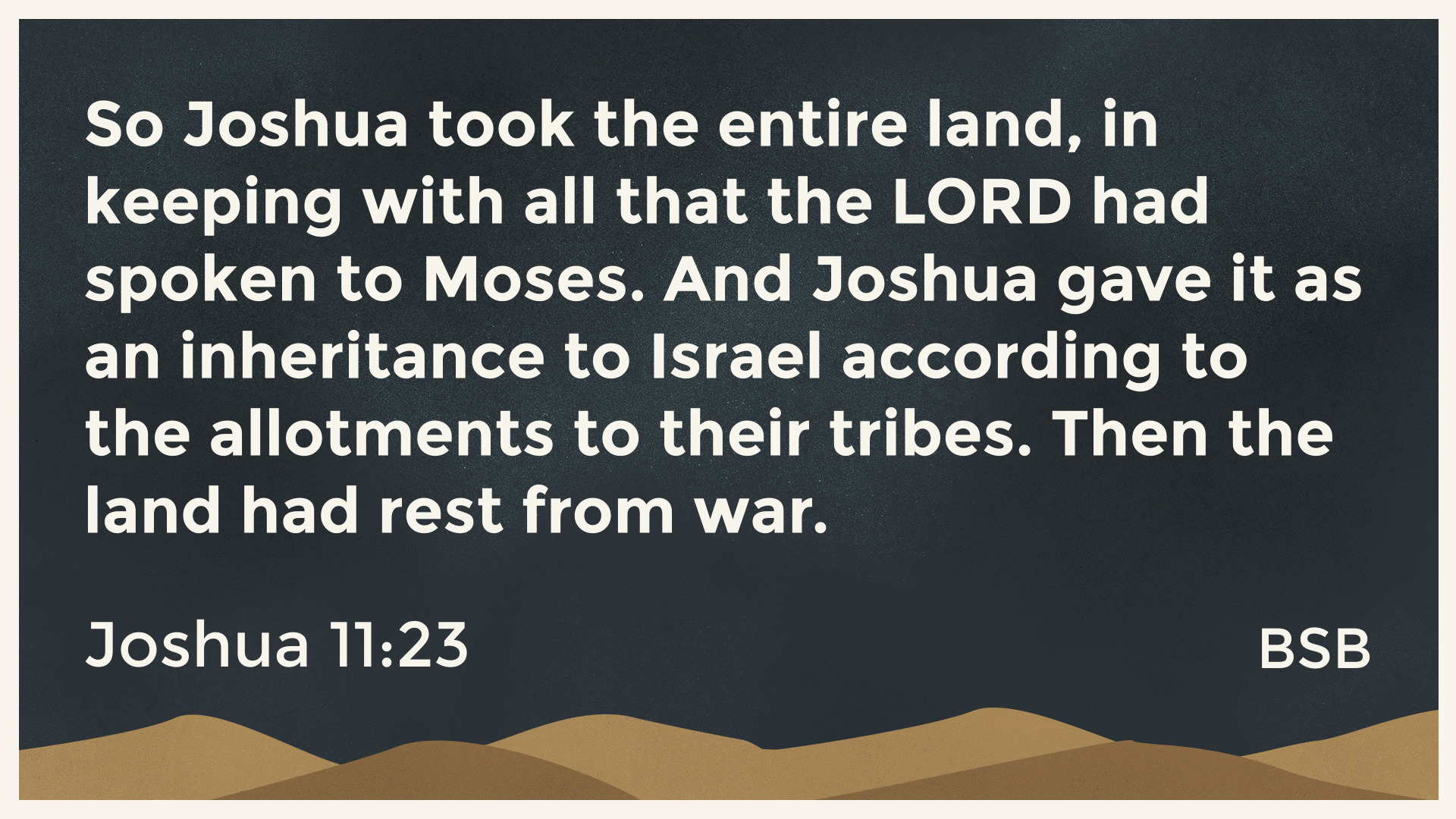
“So Joshua took the whole land, according to all that the Lord had spoken to Moses. And Joshua gave it for an inheritance to Israel according to their tribal allotments. And the land had rest from war.” ESV Jos 11:23.
One of the most difficult aspects of the Christian life to wrap our heads around is: How much has changed, and how much hasn’t? We read passages like 2 Cor. 5:17 “Therefore, if anyone is in Christ, he is a new creation. The old has passed away; behold, the new has come.” and we say to ourselves, “ALL things new? I still have so much of the old hanging on!” And confusion over this state can lead to times of near despair. You are not alone.
Fortunately, portions like the book of Joshua are meant – by means of their graphic descriptions of the invasion and conquering of the Canaan – to give us pictures of the Christian struggle as well.
So here, we have a pretty categorical statement: “Joshua took the whole land.” And if that’s all we read we think “wow! That’s it! It’s all done!” But in truth they were very, very far from “done” in terms of all God had called them to. Yes, they had entered the land. Yes, they had come to a place of dominance over the whole territory. Yes, they had rest from the necessary first invasion wars. But then we remember that the verse right before this one noted they had not been able to expel all of the Anakim – like those in Ashdod, Gaza and Gath; The very place where later, a descendant of the Anakim, Goliath of Gath would arise to challenge God’s armies. Nor have we read yet: Joshua 13:1 “Now Joshua was old and advanced in years, and the Lord said to him, “You are old and advanced in years, and there remains yet very much land to possess.”
Well which is it? Had they taken the whole land, or was there “yet very much land to possess”? Yes! It is an issue of what has been called “the already, but not yet” principle.
The idea here isn’t that the territory was entirely free of Canaanites, or that every inch of land was fully occupied. Rather, the whole was under Israel’s control. This is the same with the Believer and indwelling sin. Christ has won all of the territory of “self” for us. We now live in it so to speak – but not all sins are gone. Not every area of life is fully subdued as it ought to be and one day will be. But by God’s grace, we have entered the land and the decisive victory has been fought – even though there is massive work to be done.
Don’t be discouraged or downhearted Christian – if you are Christ’s – all things are indeed new – but not as new as they one day will be. Keep at the work. Keep battling sin. Keep looking to and trusting Christ , for one day, unlike the Israelites, you WILL be fully conformed to the image of Christ. Already new, justified, but not yet glorified. But you WILL be! By God’s good grace.
Paul, an apostle of Christ Jesus by command of God our Savior and of Christ Jesus our hope, To Timothy, my true child in the faith: Grace, mercy, and peace from God the Father and Christ Jesus our Lord. As I urged you when I was going to Macedonia, remain at Ephesus so that you may charge certain persons not to teach any different doctrine, nor to devote themselves to myths and endless genealogies, which promote speculations rather than the stewardship from God that is by faith. The aim of our charge is love that issues from a pure heart and a good conscience and a sincere faith. Certain persons, by swerving from these, have wandered away into vain discussion, desiring to be teachers of the law, without understanding either what they are saying or the things about which they make confident assertions. Now we know that the law is good, if one uses it lawfully, understanding this, that the law is not laid down for the just but for the lawless and disobedient, for the ungodly and sinners, for the unholy and profane, for those who strike their fathers and mothers, for murderers, the sexually immoral, men who practice homosexuality, enslavers, liars, perjurers, and whatever else is contrary to sound doctrine, in accordance with the gospel of the glory of the blessed God with which I have been entrusted.
Jonathan Edwards: “There is perhaps no part of divinity attended with so much intricacy, and wherein orthodox divines do so much differ as stating the precise agreement and difference between the two dispensations of Moses and Christ.”
From our text, note the following:
A – The Law is good IF it is used LAWFULLY or rightly.
B – The Believer stands in a new RELATIONSHIP to law than they did prior to trusting Christ.
1. The Law must be used LAWFULLY – It must be used for what it was intended.
2. [The] law is not made for a righteous person – The primary use of the Law is NOT for the man who has been made righteous with the righteousness of Christ
BUT: [It IS made] for those who are lawless and rebellious, for the ungodly and sinners, for the unholy and profane, for those who kill their fathers or mothers, for murderers and immoral men and homosexuals and kidnappers and liars and perjurers, and whatever else is contrary to sound teaching,
3. The Believer is NOT “lawless” – Since the Law is NOT made for the righteousness man but for the lawless man – The Believer is NOT lawless, even though he is not “under” the Mosaic Law.
Titus 2:14 who gave himself for us to redeem us from all lawlessness and to purify for himself a people for his own possession who are zealous for good works.
1 Peter 4:3 For the time that is past suffices for doing what the Gentiles want to do, living in sensuality, passions, drunkenness, orgies, drinking parties, and lawless idolatry.
Rom. 6:14 For sin shall not be master over you, for you are not under law but under grace.
The Gospel is meant for: The restoration of God’s OWN holiness to the HEART of the Believer – as it is re-inscribed there by the Holy Spirit in regeneration and energized by the indwelling presence of the Spirit and is now the PRINCIPLE under which the Believer lives.
Believers are not constrained by externals as much as they are now motivated by new internals – We have a new – underlying inclination.
We are – to use Paul’s words in 2 Cor. 5:14 – Constrained by love
1 John 5:1 “Whoever believes that Jesus is the Christ is born of God, and whoever loves the Father loves the child born of Him. 2 By this we know that we love the children of God, when we love God and observe His commandments.”
The one who has been born again, loves the righteous and holy God they once rebelled against and ran from. They now see God’s righteousness as lovely, not distasteful. They love righteousness BECAUSE they love the righteous God who loved them.
But – Sure, I may now LOVE righteousness, but what exactly is my relationship to God’s Law?
And that IS the key word, RELATIONSHIP
The point is, that being born again and justified by His grace and indwelt by His Spirit – we now stand in a totally different relationship to the Law than we once did.
The Law didn’t change – WE DID!
The issue is one of a change of relationship.
THE LAW IS STILL EXACTLY THE SAME FOR THE LAWLESS – 1 Tim. 1:8
Illustration: Trespassing vs. Being a co-owner (or joint-heir)
While my parents were alive, I always knew that at any time, I could go to their house – and even if they weren’t home, I could raid the refrigerator, use the facilities, sack out on the couch, watch the TV and relax.
Now what is also true, is that I cannot do that just anywhere. If I go to stranger’s houses, the very same activities are in fact illegal and punishable by law.
If I become an heir, what did not belong to me now does – what attempting access to would once bring the charge of trespass, is now turned on its head. My relationship to it changed. I now have an entrance to the throne room of God which was once not mine to enter.
Illustration: NYS Driving age. Once I turned 16, the law that said I could not drive at 15, became the law that said I COULD drive. The law didn’t change, I did.
The Law is good IF it is used “lawfully”.
Classically – 3-Fold Purpose of the Law (Louis Berkhof) —
a. CIVIL: “The law serves the purpose of restraining sin and promoting righteousness. Considered from this point of view, the law presupposes sin and is necessary on account of sin. It serves the purpose of God’s common grace in the world at large.”
b. PEDAGOGICAL: “In this capacity the law serves the purpose of bringing man under conviction of sin, and of making him conscious of his inability to meet the demands of the law. In that way the law becomes his tutor to lead him unto Christ, and thus becomes subservient to God’s gracious purpose of redemption.”
c. DIDACTIC (or Normative): “The law is a rule of life for believers, reminding them of their duties and leading them in the way of life and salvation.” (Lutheran controversy)
Actually, while this is generally accepted, and nice and neat – it is nowhere near as full and complete as the Bible speaks.
The 7-Fold Purpose of the Law
The Bible itself articulates at least 7 reasons for the Law.
a. EXPOSES SIN / Rom. 3:20b: “since through the law comes knowledge of sin.”
Rom. 5:20: “Now the law came in to increase the trespass”
Rom. 7:7 “Yet if it had not been for the law, I would not have known sin. I would not have known what it is to covet if the law had not said, “You shall not covet.”’”
In this way, it is PURELY DIAGNOSTIC – Like an X-Ray machine.
Like an X-Ray machine for the soul, it can show you the broken bone, but has no power to MEND the broken bone.
b. INSTRUCTS / Ex. 24:12 “The LORD said to Moses, “Come up to me on the mountain and wait there, that I may give you the tablets of stone, with the law and the commandment, which I have written for their instruction.”
In this way, the Law serves to help us know what God thinks about things – what He likes & dislikes, proscribes and warns against.
Looking at the 10 Words as ten revelations of our God Himself. Above everything else, it instructs us in a right view of God, self and life.
1 – God is God alone and must be recognized as such
2 – God is not to be reduced to an image, to anything tangible. It preserves His transcendence. Something desperately needed in our day too.
3 – God is not to be taken lightly – even in the use of His name
4 – God is to be worshipped (Calvin – Harmony of the Law – The object of this Commandment is that believers should exercise themselves in the worship of God; for we know how prone men are to fall into indifference, unless they have some props to lean on or some stimulants to arouse them in maintaining their care and zeal for religion.)
5 – Man is to be respected as created in God’s image – first with parents, and then with other authorities.
6 – Life is sacred before God. As created in His image, humankind, all members of the race are to be treated with dignity. None are to be simply disregarded, and in something like the case of abortion, as disposable.
7 – Sexual purity is required to love man.
8 – Man’s property is not to be violated.
9 – Man is not to sinned against even in the use of law.
10 – Contentment with God’s provision.
c. HUMBLES / Lev. 16:31 “It is to be a Sabbath of solemn rest for you, that you may humble your souls; it is a permanent statute.” (NAS95)
Whether we hold to a specific weekly “sabbath” or not, the principle remains the same: We need rest. We were created that way. And to ignore proper rest is to live apart from faith. It is outside the order He has created us to live in.
It reminds us that we are under His authority – not autocrats. In all places and at all times, He is the ultimate authority. And He need not give us reasons for His ordering of things. We are to trust that He is wisest and most loving and that He orders all things in life in accordance with His wisdom and love.
d. DECLARATIVE / Deut. 4:6-8 Keep them and do them, for that will be your wisdom and your understanding in the sight of the peoples, who, when they hear all these statutes, will say, ‘Surely this great nation is a wise and understanding people.’ For what great nation is there that has a god so near to it as the LORD our God is to us, whenever we call upon him? And what great nation is there, that has statutes and rules so righteous as all this law that I set before you today?
When we set ourselves properly under His authority to guide our lives and choices, we live out the Gospel in a most tangible way to those who observe us, even if they do not recognize it as such.
e. IDENTIFICATION / Same as Above – It shows we’re God’s people. We listen to Him, cherish His words, and live by His precepts.
f. PROPHETIC / Col. 2:16-17 “Therefore let no one pass judgment on you in questions of food and drink, or with regard to a festival or a new moon or a Sabbath. These are a shadow of the things to come, but the substance belongs to Christ.”
g. PROTECTIVE / Gal. 3:19 “Why then the law? It was added because of transgressions, until the offspring should come to whom the promise had been made, and it was put in place through angels by an intermediary.”
In this capacity, it is mainly protective against two things: The Wrath of God / Natural Consequences of our sins.
Also – Ga 3:24 So then, the law was our guardian until Christ came, in order that we might be justified by faith.
MUCH MORE – I want to suggest to you that due to our change in relationship to the Law, the Law may be used “lawfully” (in respect to him or herself) by the Believer in the following three ways.
Col. 2 – Due to the fact that the decrees against us have been removed out of the way (i.e. Nailed to His cross) THEREFORE we are no longer to be judged concerning Sabbath days etc. – BECAUSE – they were shadows of that which was to come (i.e. Christ) and now that the substance is here – we no longer occupy ourselves with the shadows.
When the Believer is confronted with the Law of God, his first response ought to be to look at it as “having received double” – for his sins against God.
An infinite debt stamped – PAID IN FULL!
When we consider the 10 Words (as well as other places) we have His payment placarded before us.
This is what Jesus fulfilled for us in His obedience.
And this is what Jesus paid the penalty for for our every infraction.
2. Christ’s Imputed Righteousness / Rom. 3:21-26 “But now the righteousness of God has been manifested apart from the law, although the Law and the Prophets bear witness to it— the righteousness of God through faith in Jesus Christ for all who believe. For there is no distinction: for all have sinned and fall short of the glory of God, and are justified by his grace as a gift, through the redemption that is in Christ Jesus, whom God put forward as a propitiation by his blood, to be received by faith. This was to show God’s righteousness, because in his divine forbearance he had passed over former sins. It was to show his righteousness at the present time, so that he might be just and the justifier of the one who has faith in Jesus.”
Not only has my infinite debt been canceled – this is what has been deposited into my account!
I am righteous with the righteousness of Christ Himself!
2 Cor. 5:21 He made Him who knew no sin to be sin on our behalf, so that we might become the righteousness of God in Him.
Rom. 5:19 For as through the one man’s disobedience the many were made sinners, even so through the obedience of the One the many will be made righteous. What Christ has done which is imputed to me.
He deals with me as though Christ’s own righteousness were mine!
What an unspeakable comfort!
3. The Glorious Promise / 1 John 3:1-3 “See what kind of love the Father has given to us, that we should be called children of God; and so we are. The reason why the world does not know us is that it did not know him. Beloved, we are God’s children now, and what we will be has not yet appeared; but we know that when he appears we shall be like him, because we shall see him as he is. And everyone who thus hopes in him purifies himself as he is pure.”
We will wake in His likeness
Those words: Thou shalt & Thou shalt not – are promises!
We can rightfully read them this way:
This is my promise, when I am done with you dear child you will –
love me with all your heart mind soul and strength and never have some other god before me.
I will preserve you from falling prey to any idols
You will not bear my name vainly – it will not be an empty thing to say you are God’s. To bear the name – Christian.
You will rest in the perfect rest of Christ’s completed work for ever.
You will honor your mother and father.
You will not murder any more.
You’ll never commit adultery again.
You will never steal.
You will never bear false witness against your brother or covert your neighbor’s wife or anything else he has.
Quotes:
Luther: we say that the law is good and profitable, but in his own proper use: which is, first to bridle civil transgressions, and then to reveal and to increase spiritual transgressions. Wherefore the law is also a light, which sheweth and revealeth, not the grace of God, not righteousness and life; but sin, death, the wrath and judgment of God. For, as in the mount Sinai the thundering, lightning, the thick and dark cloud, the hill smoking and flaming, and all that terrible shew did not rejoice not quicken the children of Israel, but terrified and astonished them, and shewed how unable they were, with all their purity and holiness, to abide the presence of God speaking to them out of the cloud: even so the law, when it is in his true sense, doth nothing else but reveal sin, engender wrath, accuse and terrify men, so that it bringeth them to the very brink of desperation. This is the proper use of the law, and here it hath an end, and it ought to go no further. Martin Luther, Commentary on Galatians (Oak Harbor, WA: Logos Research Systems, Inc., 1997), 302.
Now the foolishness of man’s heart is so great, that when the law hath its office and terrified his conscience, he cloth not only not lay hold upon the doctrine of grace, but seeketh to himself more laws to satisfy and quiet his conscience. “If I live,” saith he, “I will amend my life. I will do this and that.” Here except thou do quite the contrary: that is, except thou send Moses away, with his law, and in these terrors lay hold upon Christ, who died for thy sins, there is no salvation for thee.
These things are easily said: but blessed is he which knoweth how to lay sure hold on them in distress of conscience, that is, which can say when sin overweighteth him, and the law accuseth and terrifieth him: What is this to me, O law, that thou accusest me, and sayest that I have committed many sins? Indeed I grant that I have committed many sins, yea and yet still do commit sins daily without number. This toucheth me nothing: I am now dead and cannot hear thee. Therefore thou talkest to me in vain, for I am dead unto thee. But if thou wilt needs dispute with me as touching my sins, get thee to my flesh and members my servants: teach them, exercise and crucify them, but trouble not me, not Conscience, I say, which am a lady and a queen, and have nothing to do with thee: for I am dead to thee, and now I live to Christ, with whom I am under another law, to wit the law of grace, which ruleth over sin and the law. By what means? By faith in Christ, as Paul declareth hereafter.
This sentence of Paul: “through the law I am dead to the law,” is full of consolation. Which if it may enter into a man in due season, and take sure hold in his heart with good understanding, it may so work, that it will make him able to stand against all dangers of death, and all terrors of conscience and sin, although they assail him, accuse him, and would drive him to desperation never so much. True it is, that every man is tempted: if not in his life, yet at his death. There, when the law accuseth him and sheweth unto him his sins, his conscience by and by saith: Thou hast sinned. If then thou take good hold of that which Paul here teacheth, thou wilt answer: I grant I have sinned. Then will God punish thee. Nay, he will not do so. Why, doth not the law of God so say? I have nothing to do with that law. Why so? Because I have another law which striketh this law dumb, that is to say, liberty. What liberty is that? The liberty of Christ, for by Christ I am utterly freed from the law. Therefore that law which is and remaineth a law to the wicked, is to me liberty, and bindeth that law which would condemn me; and by this means that law which would bind me and hold me captive, is now fast bound itself, and holden captive by grace and liberty, which is now my law; which saith to that accusing law: Thou shalt not hold this man bound and captive, or make him guilty, for he is mine; but I will hold thee captive, and bind thy hands that thou shalt not hurt him, for he liveth now unto Christ, and is dead unto thee.
John Bunyan: “Wherefore whenever thou who believest in Jesus, dost hear the law in its thundering and lightning fits, as if it would burn up heaven and earth; then say thou, I am freed from this law, these thunderings have nothing to do with my soul; nay even this law, while it thus thunders and roareth, it doth both allow and approve of my righteousness. I know that Hagar would sometimes be domineering and high, even in Sarah’s house and against her; but this she is not to be suffered to do, nay though Sarah herself be barren; wherefore serve it also as Sarah served her, and expel her out from thy house. My meaning is, when this law with its thundering threatenings doth attempt to lay hold on thy conscience, shut it out with a promise of grace; cry, the inn is took up already, the Lord Jesus is here entertained, and here is no room for the law. Indeed if it will be content with being my informer, and so lovingly leave off to judge me; I will be content, it shall be in my sight, I will also delight therein; but otherwise, I being now made upright without it, and that too with that righteousness, which this law speaks well of and approveth; I am not, will not, cannot, dare not make it my saviour and judge, nor suffer it to set up its government in my conscience; for by so doing I fall from grace, and Christ Jesus doth profit me nothing (Gal 5:1–5).
John Bunyan, The Trinity and a Christian (alternate Title: The Law and a Christian), vol. 2 (Bellingham, WA: Logos Bible Software, 2006), 388.
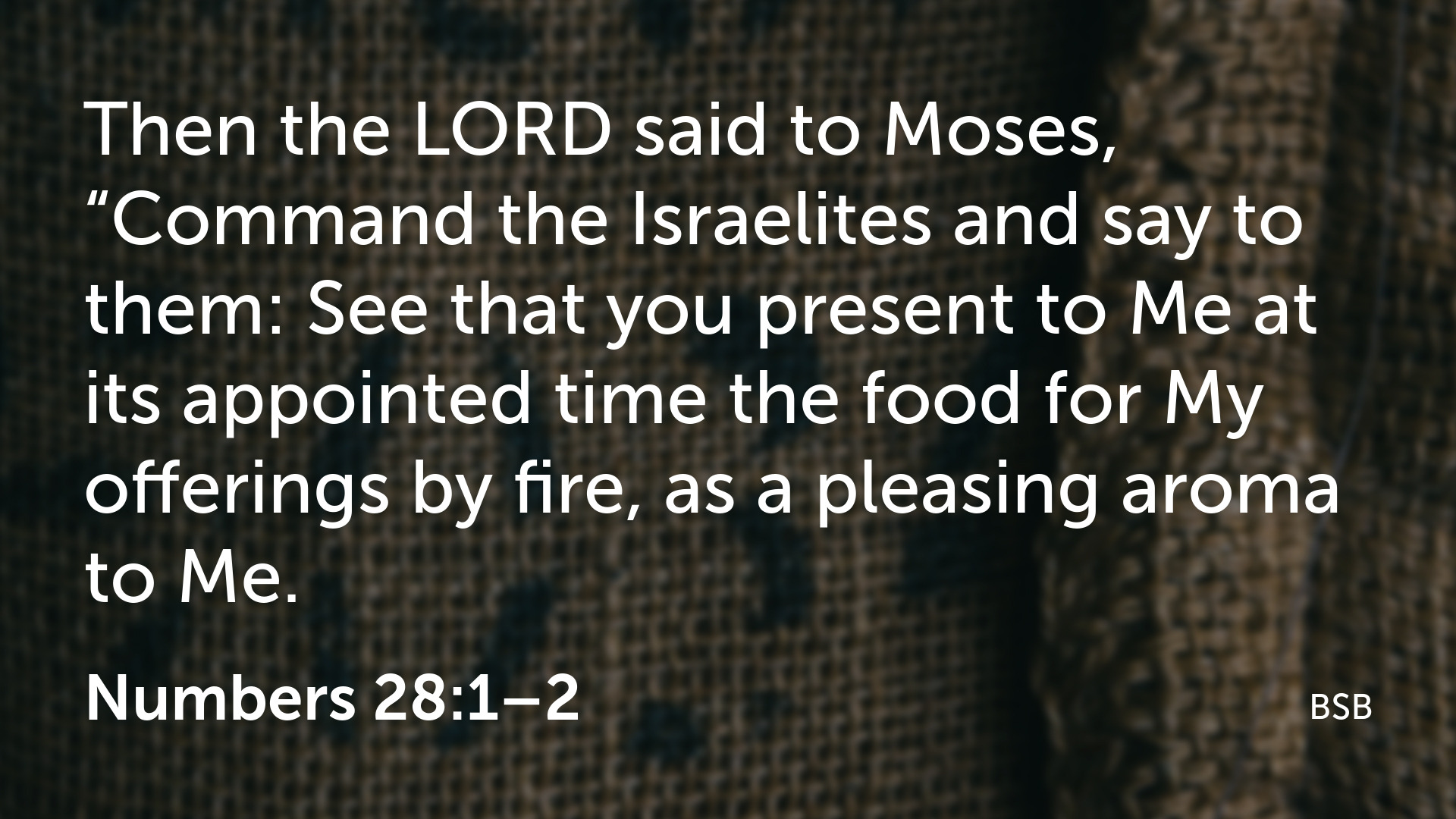
These closing chapters of Numbers find Israel at a pivotal place. Aaron’s priesthood has been transferred to his son, and Aaron has died. Moses is told to commission Joshua as his replacement. Major transitions are happening in the life of God’s people. Now we encounter Moses carrying out his last responsibilities – not the least of which we see here in 28:1. It begs a very big question.
Why all these laws, especially the daily service, reiterated and spelled out over and over? I mean, they already have all this – right? It has already been written out and explained more than once. What is going on here?
Justin Martyr in his dialog with Trypho makes the point that the reason why all of these things were pressed upon the Jews, was because of their sinfulness. He explained it this way: If God did not appoint such things, they would not naturally maintain to serve and worship him as he desired. In sinfulness, we always devolve down. Apart from such patterns built into our lives, the right honor and service to God is left to whims, fancies, tastes and then eventually – utter neglect. This is how God kept his name and presence alive in the world.
And so with us. We are not to adopt holy habits of reading and praying and public worship because God is pleased by mere activities. He doesn’t demand ritualistic service. We cultivate holy habits to counteract the downward gravitational pull of the remnants of indwelling sin. We have to weed the garden of our souls with regularity, or it will not be long before we neglect holy things altogether. We do not want to pursue legalism, but we MUST be watchful over the self-deception that we will maintain fidelity to him without such measures. It is not to earn his favor. It is to keep our hearts alive before him. It is Paul’s admonition 2 Tim. 1:6 to “fan into flame the gift of God which is within” us. Like the need to trim the lamps in the Tabernacle twice a day – so the light in us will grow dim quite quickly if we do not pay attention to it.
What is interesting here, is that the whole nation (“the people of Israel”) is charged with making sure the daily sacrificial duties which are to be carried out by the Levites – is done. It is everyone’s responsibility to make sure the Leadership does not abandon their main responsibilities. This then, even when by their own demands the Leadership is asked to pay attention to some other “needs” the Congregation might deem desirable. As congregants, we are to be vigilant that our ministers give themselves to prayer and the ministry of the Word. See: Acts 6:4.
We need the grace of Jesus’ death morning and night, weekly, monthly, and at special seasons throughout the year.
If we do not do this, we grow content in our sin, not recognizing the constant need for continual cleansing – for a perpetual dependence upon Christ and His atoning work. It is not as though we’ve been cleansed and go our way. We stay here, and live in the reality of it every minute. Such is our sinfulness, that even from morning till night, it escapes our view – and needs to be stimulated over and over and over with the utmost care.
What a warning that we cannot have “morning devotions” and then just our way. The memory will fade. The vividness will quickly wane.
Oh Father, forgive us! We do our holy “duty” and think little more of it after that. We are so prone to this horrid decline, and so lacking in careful, regular, incessant attention to it. And then we wonder why we sin at the rate we do in other things. Simply, because we are not paying attention to our actual need before you. You have provided a perpetual fountain of grace, and we take our sip and go our way and think we’re fine.




 ResponsiveReiding