Category: soteriology
-
The subject of spiritual maturity
ought to beIS one in which every Christian has a vital interest. If God’s stated purpose for us in our redemption, is conformity to the image of Christ (Rom. 8:29). And if Eph. 4:15 exhorts us to “grow up every way into Him who is the head, into Christ.” And if 1 Peter 2:2 reminds us “Like newborn infants, long for the pure spiritual milk, that by it you may grow up into salvation” – there is no question that attention must be paid to this crucial aspect of our salvation.But what does that look like?Once again, John Newton in his sweet and masterful way, notes 3 key concepts for leading the heart and mind of the Believer in a mature stability in the ways of Christ.Enjoy this short letter to his friend.“WEAK, unskilful, and unfaithful, as I am in practice, the Lord has been pleased to give me some idea of what a Christian ought to be, and of what is actually attainable in the present life, by those whom he enables earnestly to aspire towards the prize of their high calling. They who are versed in mechanics can, from a knowledge of the combined powers of a complicated machine, make an exact calculation of what it is able to perform, and what resistance it can counteract; but who can compute the possible effects of that combination of principles and motives revealed in the Gospel, upon a heart duly impressed with a sense of their importance and glory? When I was lately at Mr. Cox’s Museum, while I was fixing my attention upon some curious movements, imagining that I saw the whole of the artist’s design, the person who showed it touched a little spring, and suddenly a thousand new and unexpected motions took place, and the whole piece seemed animated from the top to the bottom. I should have formed but a very imperfect judgment of it, had I seen no more than what I saw at first. I thought it might in some measure illustrate the vast difference that is observable amongst professors, even amongst those who are, it is to be hoped, sincere. There are persons who appear to have a true knowledge (in part) of the nature of the Gospel religion, but seem not to be apprised of its properties in their comprehension and extent. If they have attained to some hope of their acceptance, if they find at seasons some communion with God in the means of grace, if they are in measure delivered from the prevailing and corrupt customs of the world, they seem to be satisfied, as if they were possessed of all. These are indeed great things; sed meliora latent. The profession of too many, whose sincerity charity would be unwilling to impeach, is greatly blemished, notwithstanding their hopes and their occasional comforts, by the breakings forth of unsanctified tempers, and the indulgence of vain hopes, anxious cares, and selfish pursuits. Far, very far, am I from that unscriptural sentiment of sinless perfection in fallen man. To those who have a due sense of the spirituality and ground of the Divine precepts, and of what passes in their own hearts, there will never be wanting causes of humiliation and self-abasement on the account of sin; yet still there is a liberty and privilege attainable by the Gospel, beyond what is ordinarily thought of. Permit me to mention two or three particulars, in which those who have a holy ambition of aspiring to them shall not be altogether disappointed.1. A delight in the Lord’s all-sufficiency, to be satisfied in him as our present and eternal portion. This, in the sense in which I understand it, is not the effect of a present warm frame, but of a deeply rooted and abiding principle; the habitual exercise of which is to be estimated by the comparative indifference with which other things are regarded. The soul thus principled is not at leisure to take or to seek satisfaction in anything but what has a known subserviency to this leading taste. Either the Lord is present, and then he is to be rejoiced in; or else he is absent, and then he is to be sought and waited for. They are to be pitied, who, if they are at sometimes happy in the Lord, can at other times be happy without him, and rejoice in broken cisterns, when their spirits are at a distance from the Fountain of living waters. I do not plead for an absolute indifference to temporal blessings: he gives us all things richly to enjoy; and a capacity of relishing them is his gift likewise; but then the consideration of his love in bestowing should exceedingly enhance the value, and a regard to his will should regulate their use. Nor can they all supply the want of that which we can only receive immediately from himself. This principle likewise moderates that inordinate fear and sorrow to which we are liable upon the prospect or the occurrence of great trials, for which there is a sure support and resource provided in the all-sufficiency of infinite goodness and grace. What a privilege is this, to possess God in all things while we have them, and all things in God when they are taken from us.2. An acquiescence in the Lord’s will, founded in a persuasion of his wisdom, holiness, sovereignty, and goodness.—This is one of the greatest privileges and brightest ornaments of our profession. So far as we attain to this, we are secure from disappointment. Our own limited views and short-sighted purposes and desires, may be, and will be, often over-ruled; but then our main and leading desire, that the will of the Lord may be done, must be accomplished. How highly does it become us, both as creatures and as sinners, to submit to the appointments of our Maker! and how necessary is it to our peace! This great attainment is too often unthought of, and overlooked: we are prone to fix our attention upon the second causes and immediate instruments of events; forgetting that whatever befalls us is according to his purpose, and therefore must be right and seasonable in itself, and shall in the issue be productive of good. From hence arise impatience, resentment, and secret repinings, which are not only sinful, but tormenting: whereas, if all things are in his hand; if the very hairs of our head are numbered; if every event, great and small, is under the direction of his providence and purpose; and if he has a wise, holy, and gracious end in view, to which everything that happens is subordinate and subservient; then we have nothing to do, but with patience and humility to follow as he leads, and cheerfully to expect a happy issue. The path of present duty is marked out; and the concerns of the next and every succeeding hour are in his hands. How happy are they who can resign all to him, see his hand in every dispensation, and believe that he chooses better for them than they possibly could for themselves.3. A single eye to his glory, as the ultimate scope of all our undertakings.—The Lord can design nothing short of his own glory, nor should we. The constraining love of Christ has a direct and marvellous tendency, in proportion to the measure of faith, to mortify the corrupt principle Self, which for a season is the grand spring of our conduct, and by which we are too much biased after we know the Lord. But as grace prevails, self is renounced. We feel that we are not our own, that we are bought with a price; and that it is our duty, our honour, and our happiness, to be the servants of God and of the Lord Jesus Christ. To devote soul and body, every talent, power, and faculty, to the service of his cause and will; to let our light shine (in our several situations) to the praise of his grace; to place our highest joy in the contemplation of his adorable perfections; to rejoice even in tribulations and distresses, in reproaches and infirmities, if thereby the power of Christ may rest upon us, and be magnified in us; to be content, yea glad, to be nothing, that he may be all in all; to obey him, in opposition to the threats or solicitations of men; to trust him, though all outward appearances seem against us; to rejoice in him, though we should (as will sooner or later be the case) have nothing else to rejoice in; to live above the world, and to have our conversation in heaven; to be like the angels, finding our own pleasure in performing his:—This, my lord, is the prize, the mark of our high calling, to which we are encouraged with a holy ambition continually to aspire. It is true, we shall still fall short; we shall find that, when we would do good, evil will be present with us. But the attempt is glorious, and shall not be wholly in vain. He that gives us thus to will, will enable us to perform with growing success, and teach us to profit even by our mistakes and imperfections.O blessed man! that thus fears the Lord; that delights in his word, and derives his principles, motives, maxims, and consolations, from that unfailing source of light and strength. He shall be like a tree planted by the rivers of water, whose leaf is always green, and fruit abundant. The wisdom that is above shall direct his plans, inspire his counsels; and the power of God shall guard him on every side, and prepare his way through every difficulty: he shall see mountains sink into plains, and streams spring up in the dry wilderness. The Lord’s enemies will be his; and they may be permitted to fight against him, but they shall not prevail, for the Lord is with him to deliver him. The conduct of such a one, though in a narrow and retired sphere of life, is of more real excellence and importance, than the most splendid actions of kings and conquerors, which fill the annals of history, Prov. 16:32. And if the God whom he serves is pleased to place him in a more public light, his labours and cares will be amply compensated, by the superior opportunities afforded him of manifesting the power and reality of true religion, and promoting the good of mankind.I hope I may say, that I desire to be thus entirely given up to the Lord; I am sure I must say, that what I have written is far from being my actual experience. Alas! I might be condemned out of my own mouth, were the Lord strict to mark what is amiss. But, O the comfort! we are not under the law, but under grace. The Gospel is a dispensation for sinners, and we have an Advocate with the Father. There is the unshaken ground of hope. A reconciled Father, a prevailing Advocate, a powerful Shepherd, a compassionate Friend, a Saviour who is able and willing to save to the uttermost. He knows our frame; he remembers that we are but dust; and has opened for us a new and blood-besprinkled way of access to the throne of grace, that we may obtain mercy, and find grace to help in every time of need.Newton, John, Richard Cecil. 1824. The works of the John Newton. . Vol. 1. London: Hamilton, Adams & Co. -

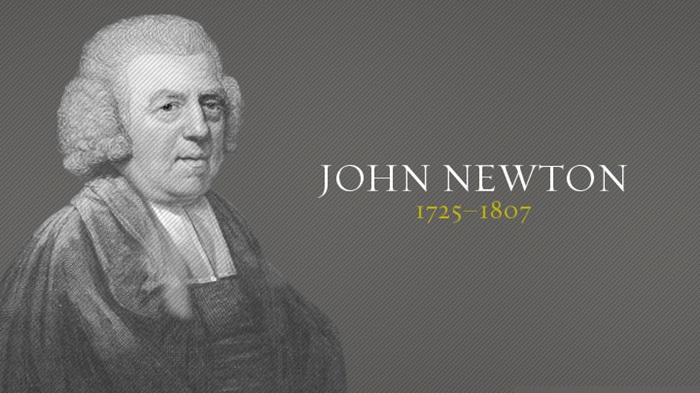
Image processed by CodeCarvings Piczard ### FREE Community Edition ### on 2016-02-10 10:47:04Z | http://piczard.com | http://codecarvings.com Among John Newton’s letters is the following one to an unnamed recipient. In it, Newton addresses what few of us admit to in public: That even as Christians, our prayer lives, our attention to Scripture, our love for Christ and our trust of Him in our trials – are things we treasure and know we derive the greatest benefit from – and yet fail at so miserably.
Once again, this spiritual giant of 18th century in clarity, sweetness, gentleness, and love for the souls of others – gives comfort for the unspoken maladies that afflict most, if not all of us.
Enjoy! It is very tasty.
Gal. 5:17, “Ye cannot do the things that ye would.”
This is an humbling but a just account of a Christian’s attainments in the present life, and is equally applicable to the strongest and to the weakest. The weakest need not say less, the strongest will hardly venture to say more. The Lord has given his people a desire and will aiming at great things; without this they would be unworthy the name of Christians; but they cannot do as they would: their best desires are weak and ineffectual; not absolutely so (for he who works in them to will, enables them in a measure to do likewise), but in comparison with the mark at which they aim. So that, while they have great cause to be thankful for the desire he has given them, and for the degree in which it is answered, they have equal reason to be ashamed and abased under a sense of their continual defects, and the evil mixtures which taint and debase their best endeavours. It would be easy to make out a long list of particulars which a believer would do if he could, but in which, from first to last, he finds a mortifying inability. Permit me to mention a few, which I need not transcribe from books, for they are always present to my mind.
PRAYER: He would willingly enjoy God in prayer. He knows that prayer is his duty; but, in his judgment, he considers it likewise as his greatest honour and privilege. In this light he can recommend it to others, and can tell them of the wonderful condescension of the great God, who humbles himself to behold the things that are in heaven, that he should stoop so much lower, to afford his gracious ear to the supplications of sinful worms upon earth. He can bid them expect a pleasure in waiting upon the Lord, different in kind and greater in degree than all that the world can afford. By prayer, he can say, You have liberty to cast all your cares upon him that careth for you. By one hour’s intimate access to the throne of grace, where the Lord causes his glory to pass before the soul that seeks him, you may acquire more true spiritual knowledge and comfort, than by a day or a week’s converse with the best of men, or the most studious perusal of many folios: and in this light he would consider it and improve it for himself. But, alas! how seldom can he do as he would! How often does he find this privilege a mere task, which he would be glad of a just excuse to omit? and the chief pleasure he derives from the performance, is to think that his task is finished: he has been drawing near to God with his lips, while his heart was far from him. Surely this is not doing as he would, when (to borrow the expression of an old woman here) he is dragged before God like a slave, and comes away like a thief.
READING SCRIPTURE: The like may be said of reading the Scripture. He believes it to be the word of God: he admires the wisdom and grace of the doctrines, the beauty of the precepts, the richness and suitableness of the promises; and therefore, with David, he accounts it preferable to thousands of gold and silver, and sweeter than honey or the honeycomb. Yet, while he thus thinks of it, and desires that it may dwell in him richly, and be his meditation night and day, he cannot do as he would. It will require some resolution to persist in reading a portion of it every day; and even then his heart is often less engaged than when reading a pamphlet. Here again his privilege frequently dwindles into a task. His appetite is vitiated, so that he has but little relish for the food of his soul.
LOVE OF CHRIST: He would willingly have abiding, admiring thoughts of the person and love of the Lord Jesus Christ. Glad he is, indeed, of those occasions which recall the Saviour to his mind; and with this view, notwithstanding all discouragements, he perseveres in attempting to pray and read, and waits upon the ordinances. Yet he cannot do as he would. Whatever claims he may have to the exercise of gratitude and sensibility towards his fellow-creatures, he must confess himself mournfully ungrateful and insensible towards his best Friend and Benefactor. Ah! what trifles are capable of shutting him out of our thoughts, of whom we say, He is the Beloved of our souls, who loved us, and gave himself for us, and whom we have deliberately chosen as our chief good and portion. What can make us amends for the loss we suffer here? Yet surely if we could, we would set him always before us; his love should be the delightful theme of our hearts
But though we aim at this good, evil is present with us; we find we are renewed but in part, and have still cause to plead the Lord’s promise, To take away the heart of stone, and give us a heart of flesh.
TRUSTING GOD IN TRIALS: He would willingly acquiesce in all the dispensations of Divine Providence. He believes that all events are under the direction of infinite wisdom and goodness, and shall surely issue in the glory of God and the good of those who fear him. He doubts not but the hairs of his head are all numbered; that the blessings of every kind which he possesses, were bestowed upon him, and are preserved to him, by the bounty and special favour of the Lord whom he serves;—that afflictions spring not out of the ground, but are fruits and tokens of Divine love, no less than his comforts; that there is a need-be, whenever for a season he is in heaviness. Of these principles he can no more doubt, than of what he sees with his eyes; and there are seasons when he thinks they will prove sufficient to reconcile him to the sharpest trials. But often, when he aims to apply them in an hour of present distress, he cannot do what he would. He feels a law in his members warring against the law in his mind; so that, in defiance of the clearest convictions, seeing as though he perceived not, he is ready to complain, murmur, and despond. Alas! how vain is man in his best estate! how much weakness and inconsistency even in those whose hearts are right with the Lord! and what reason have we to confess that we are unworthy, unprofitable servants!
It were easy to enlarge in this way, would paper and time permit. But, blessed be God, we are not under the law, but under grace. And even these distressing effects of the remnants of indwelling sin are over-ruled for good. By these experiences the believer is weaned more from self, and taught more highly to prize and more absolutely to rely on him, who is appointed unto us of God, Wisdom, Righteousness, Sanctification, and Redemption. The more vile we are in our own eyes, the more precious he will be to us; and a deep repeated sense of the evil of our hearts is necessary to preclude all boasting, and to make us willing to give the whole glory of our salvation where it is due. Again, a sense of these evils will (when hardly any thing else can do it) reconcile us to the thoughts of death; yea, make us desirous to depart, that we may sin no more, since we find depravity so deep-rooted in our nature, that (like the leprous house) the whole fabric must be taken down before we can be freed from its defilement. Then, and not till then, we shall be able to do the thing that we would: when we see Jesus, we shall be transformed into his image, and have done with sin and sorrow for ever.[1]
[1] Newton, John, Richard Cecil. 1824. The works of the John Newton. . Vol. 1. London: Hamilton, Adams & Co.
-
In The School of Prayer with Jesus
Matthew 6:1-13
Matthew 26:36-44
7 Lessons
AUDIO FOR THIS SERMON CAN BE FOUND HERE
When a baby is born, it’s as fully human as it will ever be.
However, it is not yet all that a human is fully meant to be.
Its nature is to grow.
If it remains as a baby, something is dreadfully wrong.
But growth and maturity require a number of essential elements.
Sustenance.
Rest.
Continual cleaning to prevent infection and disease.
Physical exercise and the development of those capacities – hand to eye coordination, walking, etc.
Communication beyond merely crying – language.
Mental and intellectual development – learning.
Relationships. Babies cannot survive alone. Someone must sustain them.
And each of these essentials has its spiritual corollary.
When Jesus tells Nicodemus in John 3 that he “must be born again” or he would not be able see the Kingdom of God – He draws us into the use of this parallel between physical and spiritual growth which the other NT writers employ and develop further.
A parallel intended by God in how He established creation.
GROWTH: Ephesians 4:11–16 “And he gave the apostles, the prophets, the evangelists, the shepherds and teachers, 12 to equip the saints for the work of ministry, for building up the body of Christ, 13 until we all attain to the unity of the faith and of the knowledge of the Son of God, to mature manhood, to the measure of the stature of the fullness of Christ, 14 so that we may no longer be children, tossed to and fro by the waves and carried about by every wind of doctrine, by human cunning, by craftiness in deceitful schemes. 15 Rather, speaking the truth in love, we are to grow up in every way into him who is the head, into Christ, 16 from whom the whole body, joined and held together by every joint with which it is equipped, when each part is working properly, makes the body grow so that it builds itself up in love.”
1 Peter 2:2 “Like newborn infants, long for the pure spiritual milk, that by it you may grow up into salvation”
2 Peter 3:17–18 “You therefore, beloved, knowing this beforehand, take care that you are not carried away with the error of lawless people and lose your own stability. 18 But grow in the grace and knowledge of our Lord and Savior Jesus Christ. To him be the glory both now and to the day of eternity. Amen.”
What does that look like then?
Sustenance. Word of God
Rest. Faith, trust in God’s character
Cleansing. Daily forgiveness (Matt. 6)
Physicality. Walking in holiness
Communication. Worship & Edification – PRAYER!
Intellect. Knowledge of Christ (2 Peter)
Relationships. The Church
Today, I want to focus on the aspect of communication – PRAYER.
One of the interesting features of Jesus’ own incarnation, was that in His incarnate state – He too had to grow.
So we read in Luke 2:40 “And the child [Jesus] grew and became strong, filled with wisdom. And the favor of God was upon him.”
If Jesus would demonstrate such growth, as our supreme example – how much more ought we to pursue the same?
Coupled with that then, is also the record in the Gospels both of Jesus’ teaching on the subject of prayer, and His own practice of prayer.
In Matt. 6, we have Jesus’ key teaching on prayer, and in Matt. 26 we have the key example He sets in His own prayer life.
Between these two, I want to make a number of observations central as to how we ought to think about and approach prayer in the Christian life.
When the Writer to the Hebrews is in the midst of opening up some of the immense privileges that belong to the Believer as a result of Christ’s work on our behalf, he writes: Hebrews 10:19–22 “Therefore, brothers, since we have confidence to enter the holy places by the blood of Jesus, 20 by the new and living way that he opened for us through the curtain, that is, through his flesh, 21 and since we have a great priest over the house of God, 22 let us draw near with a true heart in full assurance of faith, with our hearts sprinkled clean from an evil conscience and our bodies washed with pure water.”
And what is this entering “the holy places” and “drawing near” to God in full assurance and faith, other than prayer?
In teasing these out, I will confine myself almost exclusively to the 2 passages we had read – though you can see those ideas scattered throughout the Word.
1. Prayer is both assumed and commanded in Scripture. Matthew 6:1–4 “Beware of practicing your righteousness before other people in order to be seen by them, for then you will have no reward from your Father who is in heaven. 2 “Thus, when you give to the needy, sound no trumpet before you, as the hypocrites do in the synagogues and in the streets, that they may be praised by others.
1 5 “And when you pray”
16 “And when you fast”
As I’ve mentioned any number of times previously – these 3, Prayer, Alms and Fasting form 3 assumptions in the mind of Jesus regarding the normal Christian life.
In each case it is not: IF you pray, fast or give, but WHEN.
When this is coupled with a great number of other passages, we cannot escape the reality that prayer is an assumed central reality of the Christ life as given to us by God Himself. Not as a mere religious construct.
2. Prayer brings us into private, personal communion with God.
Matthew 6:5–6 “And when you pray, you must not be like the hypocrites. For they love to stand and pray in the synagogues and at the street corners, that they may be seen by others. Truly, I say to you, they have received their reward. 6 But when you pray, go into your room and shut the door and pray to your Father who is in secret. And your Father who sees in secret will reward you.”
This is the private aspect of prayer which is so essential.
“No public ordinances can make amends for the neglect of secret prayer; nor will the most diligent attendance upon them justify us in the neglect of those duties, which, by the command and appointment of God, we owe to society.” Newton, John, Richard Cecil. 1824. The works of the John Newton. . Vol. 1. London: Hamilton, Adams & Co.
Christian lives never grow dynamically beyond the level of time we spend alone with God.
That’s where we draw our life. That’s where we draw our vitality. If you want to constantly live in discouragement, and constantly live in panic, and constantly live going from crisis to crisis without stability in your life, continue to believe you can live without being alone with Him on a daily basis. And enjoy your crisis.
The only way you’ll come to the stability is to spend time with Him.
Just as exposure to the Sun leaves you with a tan, exposure to the presence of God in prayer leaves its mark on the soul and in the mind. It changes our spiritual complexion.
NOTE: The core of what true prayer is all about, is not to be found in protracted dialog, but in the pleasure of being in the presence of God, without fear of any kind because of Christ.
2 Corinthians 3:18 “And we all, with unveiled face, beholding the glory of the Lord, are being transformed into the same image from one degree of glory to another. For this comes from the Lord who is the Spirit.”
3. Prayer is the submission of our will to His; not the imposition of our will upon His.
I take this both from Matthew 6:9–10 “Pray then like this: “Our Father in heaven, hallowed be your name. 10 Your kingdom come, your will be done, on earth as it is in heaven.”
And Jesus’ living this out in Matthew 26 where 3 times on the night of His passion He prays: “My Father, if it be possible, let this cup pass from me; nevertheless, not as I will, but as you will.”
Let me read you something by Thomas Aquinas: “It is clear that he does not pray who, far from uplifting himself to God, requires that God shall lower Himself to him, and who resorts to prayer, not to stir the man in us to will what God wills, but only to persuade God to will what the man in us wills.”
If you’re spending all your time in prayer convincing God, He’s doing the wrong thing, something’s amiss.
Because that isn’t what Jesus did. He said, “I will tell you what my natural will is, but the reality is, I’m willing to submit that to you. You do what You know is best.”
I’m convinced that the source of much, if not all, of the frustration in our prayer lives, is that we think that God just isn’t coming around to our way of thinking.
That’s precisely what prayer is designed to combat in us.
Prayer is designed to get our hands off the driver’s wheel, and to commit the course to His keeping.
It’s the humbling and surrendering of our wills, not trying to yank His around. That’s hard.
I’ll tell you, you’ll be able to find out very quickly for yourself where you are in your prayer life: just mark out what it is you’re petitioning for.
How much time are you spending saying, “God, do this,” more than saying, “God, do this in me, because I’m the one who needs to change.
Show me how to meet this situation for your glory.
Show me how to bear up under this temptation so that you might be exalted.
Teach me how to grow in wisdom during this thing so that I might magnify your name, so that I might be equipped to minister to others.”
Instead, we’re constantly saying, “God, make it stop. God, make them stop. God, change them.”
Isn’t that a big one? We’re always praying, “God, change them.” Very little of our prayer is, “God, change us.” And yet that’s the key, because it’s the submission of our will, not the twisting of His. But we miss this in prayer! And because we do, we walk around frustrated.
“I’ve been praying about this for six months, and God isn’t doing anything.” Oh yes He is! He’s teaching you how to submit. You’ve been walking around for six months saying, “God isn’t doing anything,” because you’re the one who hasn’t submitted yet. What He’s doing is breaking you.
That’s so hard to come to. And it’s so contrary to the way we approach prayer, because we want to just lift up hands on high and say the magic words, and have God change the situation to suit us. He says, “No, I’ve crafted the situation to change you. I don’t want to change the situation; I want to change you!”
4. We pray in order to obtain forgiveness. Matthew 6:11–12 “Give us this day our daily bread, 12 and forgive us our debts, as we also have forgiven our debtors.”
We are to pray in order that we may obtain forgiveness. But what do I mean by that when I say “obtain forgiveness?”
We have a theological construct to deal with.
We understand that God, when He crucified Christ on our behalf, made an atonement for all of our sin, past, present, and future. Yet we don’t live in a state of the eternal past, present, and future. We live in space and time. We live in the midst of things that unfold sequentially. We live in the dynamic of a regular relationship.
In the dynamic of our ongoing relationship with Him, we can injure our intimacy with Him by virtue of our sins in the present. And those sins need to be dealt with.
5. We pray because in prayer is an act of worship.
We worship God when we look to Him for our needs in right relationship to Him.
This, I take from the overall circumstance in both passages, not a specific verse. Psalm 116:16–19 “O LORD, I am your servant; I am your servant, the son of your maidservant. You have loosed my bonds. 17 I will offer to you the sacrifice of thanksgiving and call on the name of the LORD. 18 I will pay my vows to the LORD in the presence of all his people, 19 in the courts of the house of the LORD, in your midst, O Jerusalem. Praise the LORD!”
Seeking the Father in prayer gives worshipful honor as the One we go to with our needs and cast our cares upon.
He LOVES to be trusted!
Without faith it is impossible to please God. And nothing shows distrust of God more than prayerlessness.
Colossians 4:2 says, “Devote yourselves to prayer, keeping alert in it with an attitude of thanksgiving.”
The first reason why we grow dull in prayer is when we lack in bringing thanksgiving to Him for what He’s done. It never fails.
One of the reasons why prayer becomes such drudgery, such difficulty -why it’s only a laundry list- is because you’ve stopped giving thanks.
You’ve stopped being grateful for what He has done, and you’re only focusing on what you think He hasn’t done in response to some other prayer.
Nothing will kill a relationship quicker. It kills it on your side, not His. He’s standing there waiting. But you lose the joy of His presence. It’s in prayer that we express our thanksgiving – our gratitude for all that He’s done, for all that He’s doing, for all that He’s promised He’s going to do. Face to face!
But how often does our prayer, instead, revolve around a series of complaints dressed up as concerns? That’s really the attitude. “I’ve got a concern over this. I’ve got a concern over that.” And what you’re saying is, “God, you haven’t done this yet.”
I know nothing that’s more effective at guarding the soul against bitterness and hardness than cultivating a habit of thanksgiving in prayer. If that’s all you do when you go to prayer, you’ve prayed well. And I’ll tell you why, on the basis of His Word: so when you come and you pray, don’t pray like the heathen do with all these vain repetitions [Matthew 6:7]. Don’t pray with sweat coming off like God isn’t going to answer unless you sweat bullets. Pray with this confidence: that He knows your need better than you know it. And it’s in the “coming” that He delights. He’s already going to meet the need. Oh, that we knew that! If we just knew how tender His heart was toward our needs: that He’s never left a single thing undone for us! It’s only our dissatisfaction with His perfection. He brings us alive when our hearts are thankful. And how rare it is (I mean this is truly rare) to find someone who is truly contented in this life. But true contentment can only happen on our knees. And it can only happen in the posture of a thankful heart filled with gratitude. No other place. If prayer for you is like pulling teeth, I guarantee you’re not a very thankful individual. That’s always a problem.
6. We pray in order to deal with anxiety. Matthew 6:25 & 31-33 “Therefore I tell you, do not be anxious about your life, what you shall eat or what you will drink, nor about your body, what you will put on. Is not life more than food, and the body more than clothing?..31 Therefore do not be anxious, saying, ‘What shall we eat?’ or ‘What shall we drink?’ or ‘What shall we wear?’ 32 For the Gentiles seek after all these things, and your heavenly Father knows that you need them all. 33 But seek first the kingdom of God and his righteousness, and all these things will be added to you.
Let me give you my own personal definition of anxiety: Anxiety is the powerless feeling we get when our pride is confronted with an impossibility.
We are anxious because we can’t change the impossible situation.
And it wounds our pride. We can’t handle that conflict.
The cure then, only comes in one place: humbling yourself before God. That’s what prayer does. It humbles us.
7. We pray that we might receive. In Matthew 7 [v.7], Jesus says, “Ask, and it will be given to you; seek, and you will find; knock, and the door will be opened to you.”
I don’t understand the dynamic, but this I do know by the teaching of the Scripture: God has ordained to meet our needs, and to answer even our daily things, by virtue of prayer.
How He weaves together our petitions with His sovereign will, I don’t know.
I don’t think we can explain that, and I know I can’t. Let me jump over to somebody who’s far better than I’ll ever hope to be, that grand genius of another age, Robert Haldane. “This teaches us that God, by His providence, regulates all that takes place. There is nothing with which Christians should be more habitually impressed than that God is the disposer of all events. They should look to His will in the smallest concerns of life, as well as in affairs of the greatest moment. Even a prosperous journey is from the Lord. In this way they glorify God by acknowledging His providence in all things and have the greatest confidence and happiness in walking before Him. Here we also learn that while the will of God concerning any event is not ascertained, we have liberty to desire and pray for what we wish, provided our prayers and desires are conformed to His holiness. But will our prayers be agreeable to God if they be contrary to His decrees? Yes, provided they be offered in submission to Him and not opposed to any known command. For it is the revealed and not the secret will of God that must be the rule of our prayers. We also learn in this place that since all events depend upon the will of God, we ought to acquiesce in them however contrary they may be to our wishes. And likewise, that in those things in which the will of God is not apparent, we should always accompany our prayers and our desires with this condition: ‘if it be pleasing to God,’ and be ready to renounce our desires as soon as they appear not to be conformed to His will. Oh how sweet a thing, as one has well observed, were it for us to learn to make our burdens light by framing our hearts to the burden, and making our Lord’s will a law.”
What a mystery that is! But He designs to answer and to meet our needs, and to fill our requests, by prayer.
1. Prayer is both assumed and commanded in Scripture.
- Prayer brings us into private, personal communion with God.
- Prayer is the submission of our will to His; not the imposition of our will upon His.
- We pray in order to obtain forgiveness.
- We pray because in prayer is an act of worship.
- We pray in order to deal with anxiety.
- We pray that we might receive.
Prayer is the supreme privilege given to the Believer at the cost of Jesus’ death on the cross, and as a direct result of the power of His resurrection.
-
Doing All to The Glory of God
1 Corinthians 10:31
(and selected texts)
AUDIO FOR THIS SERMON CAN BE FOUND HERE
No doubt, virtually all Christians are familiar with this verse out of Paul’s 1st letter to the Corinthians.
And it sounds good.
But the statement by itself begs several questions as we seek to understand exactly what it means and what its implications are.
It seems to me there are 3 essential questions we need to try to address in this regard:
- What exactly IS the glory of God?
- What does it MEAN to glorify God?
- WHY is glorifying God so important?
- What IS the glory of God?:
I am going to give you my very reduced but I believe Biblically defensible definition of what the glory of God is: It is simply – GOD REVEALED SO THAT HE IS KNOWN FOR WHO AND WHAT HE IS.
Exodus 14:4 “And I will harden Pharaoh’s heart, and he will pursue them, and I will get glory over Pharaoh and all his host, and the Egyptians shall know that I am the Lord.”
Exodus 16:10 “And as soon as Aaron spoke to the whole congregation of the people of Israel, they looked toward the wilderness, and behold, the glory of the Lord appeared in the cloud.”
John 2:11 “This, the first of his signs, Jesus did at Cana in Galilee, and manifested his glory. And his disciples believed in him.”
John 17:1–5 “When Jesus had spoken these words, he lifted up his eyes to heaven, and said, “Father, the hour has come; glorify your Son that the Son may glorify you, 2 since you have given him authority over all flesh, to give eternal life to all whom you have given him. 3 And this is eternal life, that they know you the only true God, and Jesus Christ whom you have sent. 4 I glorified you on earth, having accomplished the work that you gave me to do. 5 And now, Father, glorify me in your own presence with the glory that I had with you before the world existed.”
From Adam Clarke’s Commentary: A general definition of this great First Cause, as far as human words dare attempt one, may be thus given: The eternal, independent, and self-existent Being: the Being whose purposes and actions spring from himself, without foreign motive or influence: he who is absolute in dominion; the most pure, the most simple, and most spiritual of all essences; infinitely benevolent, beneficent, true, and holy: the cause of all being, the upholder of all things; infinitely happy, because infinitely perfect; and eternally self-sufficient, needing nothing that he has made: illimitable in his immensity, inconceivable in his mode of existence, and indescribable in his essence; known fully only to himself, because an infinite mind can be fully apprehended only by itself. In a word, a Being who, from his infinite wisdom, cannot err or be deceived; and who, from his infinite goodness, can do nothing but what is eternally just, right, and kind. Reader, such is the God of the Bible; but how widely different from the God of most human creeds and apprehensions!
Glorifying God then isn’t making Him bigger or better than He actually is – it is letting others see Him for who He really already is.
God’s glory is wrapped up in:
Revealing His Person – His Character & attributes
Revealing His Mind – Through His Communications – Words
Revealing His Heart – Though His Plans and purposes
Example combining all three: Exodus 33:17–23 “And the Lord said to Moses, “This very thing that you have spoken I will do, for you have found favor in my sight, and I know you by name.” 18 Moses said, “Please show me your glory.” 19 And he said, “I will make all my goodness pass before you and will proclaim before you my name ‘The Lord.’ And I will be gracious to whom I will be gracious, and will show mercy on whom I will show mercy. 20 But,” he said, “you cannot see my face, for man shall not see me and live.” 21 And the Lord said, “Behold, there is a place by me where you shall stand on the rock, 22 and while my glory passes by I will put you in a cleft of the rock, and I will cover you with my hand until I have passed by. 23 Then I will take away my hand, and you shall see my back, but my face shall not be seen.”
Exodus 34:4–7 “So Moses cut two tablets of stone like the first. And he rose early in the morning and went up on Mount Sinai, as the Lord had commanded him, and took in his hand two tablets of stone. 5 The Lord descended in the cloud and stood with him there, and proclaimed the name of the Lord. 6 The Lord passed before him and proclaimed, “The Lord, the Lord, a God merciful and gracious, slow to anger, and abounding in steadfast love and faithfulness, 7 keeping steadfast love for thousands, forgiving iniquity and transgression and sin, but who will by no means clear the guilty, visiting the iniquity of the fathers on the children and the children’s children, to the third and the fourth generation.”
- (6) The Lord, The Lord
- Repetition as emphasis in Hebrew.
- He made everything.
- It all exists by Him and for Him.
- He writes the rules – it all revolves around His plan and purposes.
- Merciful Compassionate – Acting to relieve the suffering brought on by our own sin.
- Gracious Friendly – He smiles upon His own.
He delights in and is friendly toward humankind and specifically, the undeserving.
- Slow to anger Just like “makrothumia” – it takes a LOT to get Him riled up. He is not perpetually grumpy or ticked off.
- Abounding in steadfast love and faithfulness
Steadfast love: His love is not up and down, steady. Loyal & unfailing.
Faithfulness: He is truthful – keeps promises, trustworthy.
- Forgiving iniquity AND transgression AND sin.
Hebrew has 12 different words for SIN – each with its own nuance.
Sin is complex and we need a Savior who can deal with every aspect of it.
Here, The Lord opens up the 3 most common and root ideas regarding sin – and thus the completeness of His forgiveness.
INIQUITY: Twistedness – inner warped-ness.
TRANSGRESSION: Rebellion
SIN: Missing the mark
Romans 3:23 reminds us: “for all have sinned and fall short of the glory of God”
We were made in His image, to bear that image. By sinning, we fall short of being able to make His character and attributes known. When we sin, we obscure that image.
In every place and in every WAY we fall short of the glory of God, the image in which we were made and were made to reflect.
- But who will no means clear the guilty.
Holy and Just – He cannot simply dismiss sin.
How is it then that anyone can be saved – if God will by no means clear the guilty?
ONLY – if we are made “not guilty” – only if we are justified.
This then HAS to bring us to the cross, where righteousness and peace kiss.
Remember WHERE it is the glory of God is most manifested in the OT times? In the Tabernacle/Temple – more specifically over THE MERCY SEAT.
Now God has pursued a number of means to make His glory known, or to reveal Himself.
Creation – Psalm 19:1–2 The heavens declare the glory of God, and the sky above proclaims his handiwork. Day to day pours out speech, and night to night reveals knowledge.
Immensity Infinitude Order Eternal Beauty Purpose
Word – God speaking. God revealing how He works and what His plans and purposes are. So the Bible reports:
What He did in Creation
How He deals with sin
What He made humankind for
How His Law reveals Him and our obscuring of Him
How He has dealt with the sin problem (the supreme revelation / glorification of His mercy and grace in Jesus Christ
Where everything is going
Manifestation – As we saw in the opening quotations.
Incarnation – Christ The EXPRESS image. Hebrews 1:1–3 He is the radiance of the glory of God and the exact imprint of his nature,
John 2:11 “This, the first of his signs, Jesus did at Cana in Galilee, and manifested his glory. And his disciples believed in him.”
John 17:1–5 “When Jesus had spoken these words, he lifted up his eyes to heaven, and said, “Father, the hour has come; glorify your Son that the Son may glorify you, 2 since you have given him authority over all flesh, to give eternal life to all whom you have given him. 3 And this is eternal life, that they know you the only true God, and Jesus Christ whom you have sent. 4 I glorified you on earth, having accomplished the work that you gave me to do. 5 And now, Father, glorify me in your own presence with the glory that I had with you before the world existed.”
US! Mankind created to bear His image – make Him known.
So that brings us to our 2nd question
- What does it MEAN (for us) to glorify God?
Simply to make Him known with as little distortion or veiling as possible. Obviously, by the power of the Holy Spirit.
The human being, as made in God’s image, is more uniquely privileged to glorify God than the highest angels in Heaven.
For we alone were made especially to PERCEIVE Him for who and what He is, AND, to EXPERIENCE Him and enjoy Him in being the objects and recipients of MERCY and GRACE which are two hidden things in Him which He delights in to the highest degree.
We then can do this – can glorify Him a number of ways.
Let’s apply the passage we looked at earlier first, and then reduce it a bit.
- (6) The Lord, The Lord / Living consciously as under the authority of the One who made us for His purposes – and not for ourselves.
Not ruled by fate or Chance
Human governments
Circumstances
But by a sovereign, holy, loving Creator and God.
- Merciful / Being Compassionate & acting to relieve the suffering of other brought on by their own sin.
- Gracious / Displaying God’s friendly attitude toward humankind and others who – like we – are underserving, by our own attitude.
- Slow to anger / Being those whom it takes a LOT to get riled up. He is not perpetually grumpy or ticked off & neither are we to be.
- Abounding in steadfast love and faithfulness / Steadfast love: Not up and down, steady. In our relationship with Him and with others. Loyal & committed. Faithfulness: Truthful – keeps promises, trustworthy.
- Forgiving iniquity AND transgression AND sin / Being those who forgive easily and quickly, even when it is costly.
- But who will no means clear the guilty / Aware of our own accountability before God, seeking justice and equity in the society around us.
As we live in relationship like this with God, and then endeavor to employ and display those same attributes to those we interact with.
This plays out in the following 4 main ways:
DECLARATION – Communicating God’s Word: Teaching, Preaching & Conversation John 16:13–15 “When the Spirit of truth comes, he will guide you into all the truth, for he will not speak on his own authority, but whatever he hears he will speak, and he will declare to you the things that are to come. 14 He will glorify me, for he will take what is mine and declare it to you. 15 All that the Father has is mine; therefore I said that he will take what is mine and declare it to you.”
WORSHIP – Psalm 86:12–13 “I give thanks to you, O Lord my God, with my whole heart, and I will glorify your name forever. 13 For great is your steadfast love toward me; you have delivered my soul from the depths of Sheol.”
VINDICATION – Joshua 7:19 “Then Joshua said to Achan, “My son, give glory to the Lord God of Israel and give praise to him. And tell me now what you have done; do not hide it from me.”
Israel’s defeat in the face of her enemies, makes it look like it is God who is not faithful to His promise. Clear God of the charge – establish His righteousness, let Him be seen as glorious by owning your sin.
In the Gospel, God is vindicated. Men show by their confession of sin that God is the good one and they are not. His righteousness is revealed. We justify Him, and by grace, he justifies us.
OBEDIENCE – 1 Corinthians 6:20 “for you were bought with a price. So glorify God in your body.”
When we walk as people who belong to the Kingdom of Christ.
NOTE: God does not need to be apologized for, nor tamed to make Him easier for people to reckon with.
The more Jesus revealed the Father, the more some were offended at Him.
Giving God glory NEVER includes lying about Him or trying to give false testimony.
He is glorious enough as is – He never needs us to use our sanctified imaginations in making things into to miracles that aren’t or making His interventions seems more spectacular, etc.
He does not need our help in that way – He just needs to be known for who and what He really is and really does. Nothing less, and certainly nothing more.
This is why we must be extremely careful not to put either words in God’s mouth or attitudes in His heart.
We must be VERY sure that when we say “God said” it is GOD who “said”.
Anything else is the very opposite of glorifying Him – because it obscures the truth.
This is why preachers and teachers need to be so careful in exegeting God’s Word – for we do not want to make it say what it does not,
nor leave out anything it does say,
nor use it as a pretext to communicate what WE want to say,
nor bend it to serve our purposes,
Nor simply say what we FEEL about it.
What did God say through His writers, to the people He was speaking to at the time?
III. WHY is glorifying God so important?
BIBLICAL MANDATE – 1 Corinthians 10:31 “So, whether you eat or drink, or whatever you do, do all to the glory of God.”
IT IS WHAT WE WERE CREATED AND REDEEMED FOR – Ephesians 1:11–12 “In him we have obtained an inheritance, having been predestined according to the purpose of him who works all things according to the counsel of his will, 12 so that we who were the first to hope in Christ might be to the praise of his glory.”
1 Peter 2:9–10 “But you are a chosen race, a royal priesthood, a holy nation, a people for his own possession, that you may proclaim the excellencies of him who called you out of darkness into his marvelous light. 10 Once you were not a people, but now you are God’s people; once you had not received mercy, but now you have received mercy.”
Genesis 1:26–27 “Then God said, “Let us make man in our image, after our likeness. And let them have dominion over the fish of the sea and over the birds of the heavens and over the livestock and over all the earth and over every creeping thing that creeps on the earth.” 27 So God created man in his own image, in the image of God he created him; male and female he created them.”
IT IS GOD’S MEANS TO GOD’S END – Romans 8:29 “For those whom he foreknew he also predestined to be conformed to the image of his Son, in order that he might be the firstborn among many brothers.”
Ephesians 3:14–19 “For this reason I bow my knees before the Father, 15 from whom every family in heaven and on earth is named, 16 that according to the riches of his glory he may grant you to be strengthened with power through his Spirit in your inner being, 17 so that Christ may dwell in your hearts through faith—that you, being rooted and grounded in love, 18 may have strength to comprehend with all the saints what is the breadth and length and height and depth, 19 and to know the love of Christ that surpasses knowledge, that you may be filled with all the fullness of God.”
2 Corinthians 3:18 “And we all, with unveiled face, beholding the glory of the Lord, are being transformed into the same image from one degree of glory to another. For this comes from the Lord who is the Spirit.”
This is why Paul locates the focus of His own preaching and ministry in this very thing: 1 Corinthians 2:1–2 “And I, when I came to you, brothers, did not come proclaiming to you the testimony of God with lofty speech or wisdom. 2 For I decided to know nothing among you except Jesus Christ and him crucified.”
This singular aim – to preach Christ and Him crucified is to preach the love of God for the lost,
It is to preach the epitome of God’s self-revelation in the giving of mercy to the guilty and blessing to the undeserving. Mercy & Grace.
IT IS THE HIGHEST ACT OF LOVE – What can possibly be better in blessing others than exposing them to the fountain of all good?
To the very ultimate of all blessing and good – God Himself as revealed in His mercy and grace IN Christ Jesus?
- What exactly IS the glory of God? Who and what He is.
- What does it MEAN to glorify God? To make Him known for who and what He is.
- WHY is glorifying God so important?
He is worthy
It is why we were created
It is the highest act of love toward Him and other of which we are capable.
-
A Wonderful Warning
1 Corinthians 11:17-34
Luke 18:9-14
AUDIO FOR THIS SERMON CAN BE FOUND HERE
As we approach the Table this morning, a bit of history might be helpful regarding Paul’s warning in vs. 27
In doing that, we need to note that Paul’s warning is against eating “In an unworthy manner”,(27) – it has nothing to do with personal worthiness to come to the table.
It speaks to actions and attitudes that change the Lord’s Supper into something else – by drawing unwarranted distinctions between Christians that ought not to be there.
So Paul begins in vs 20 – “But in the following instructions I do not commend you, because when you come together it is not for the better but for the worse. For, in the first place, when you come together as a church, I hear that there are divisions among you. And I believe it in part, for there must be factions among you in order that those who are genuine among you may be recognized. When you come together, it is not the Lord’s supper that you eat.”
Why not? What specifically ruined the gathering so that it was no longer “the Lord’s Supper?
Verse 21 spells it out: “For in eating, each one goes ahead with his own meal. One goes hungry, another gets drunk.”
It was common in the early Church – drawing on the fact that Jesus instituted the Lords’ Supper immediately after the Passover meal – to have a group meal called a love feast or agape feast – and then have communion.
What had begun to happen, is that some of the wealthier ones, would bring a sumptuous meal, only for themselves, leaving the poor to only a sandwich or perhaps even nothing at all – and THEN coming to the table which is supposed to signify our unity in Christ.
And in that “love feast” some would in fact even overindulge to the point of being tipsy or drunk, while others with little or nothing were shamed by their lack.
Again – there was some display of personal rights or privileges above some other persons or groups – at the very place where our universal unworthiness before the Throne of God is obscured.
The unworthy manner here is located in 1 chief thing:
Divisiveness based upon some imagined personal, social or spiritual superiority, that then needlessly shames those who do not share that imagined superiority.
This traces Paul’s thought back to the beginning of the letter where some declared they were followers of Peter vs Paul vs Apollos vs Jesus.
The implication behind such elitism and cliquishness is that Christ didn’t need to die as much for me, as He did for this one or that one.
To think that in any way – Christ didn’t need to die for you as much as any other sinner, is to deny your absolute need of the full and free grace put forward in His atonement, and in some sense to justify yourself.
And when we justify ourselves in any way – we become “guilty of the body and blood of the Lord”, fail to “discern” the nature of His sacrifice rightly, and eat and drink damnation to ourselves.
This played out in 3 subtle but very real ways, that might even secretly infect some here today.
- PERSONAL WORTHINESS, versus acceptance ONLY in the Beloved – the Lamb without spot or blemish. I am worthy to be saved, but simply unable to save myself. I belong to the right group.
Remember the Pharisee and The Tax Collector as addressed by Jesus in Luke 18:9–14? “He also told this parable to some who trusted in themselves that they were righteous, and treated others with contempt: 10 “Two men went up into the temple to pray, one a Pharisee and the other a tax collector. 11 The Pharisee, standing by himself, prayed thus: [[A]] ‘God, I thank you that I am not like other men, extortioners, unjust, adulterers, or even like this tax collector. [[B]] 12 I fast twice a week; I give tithes of all that I get.’ 13 But the tax collector, standing far off, would not even lift up his eyes to heaven, but beat his breast, saying, ‘God, be merciful to me, a sinner!’ 14 I tell you, this man went down to his house justified, rather than the other. [[C]] For everyone who exalts himself will be humbled, but the one who humbles himself will be exalted.”
The Pharisee didn’t say he wasn’t a sinner – just that he wasn’t a sinner like other men. I don’t do THEIR sins.
And we can have the same mindset. When we do, we completely forget that our salvation is 100% wrapped up in our being IN Christ, by faith, and nothing in ourselves.
Ephesians 1:3–14 Blessed be the God and Father of our Lord Jesus Christ, who has blessed us in Christ with every spiritual blessing in the heavenly places, 4 even as he chose us in him before the foundation of the world, that we should be holy and blameless before him. In love 5 he predestined us for adoption as sons through Jesus Christ, according to the purpose of his will, 6 to the praise of his glorious grace, with which he has blessed us in the Beloved. 7 In him we have redemption through his blood, the forgiveness of our trespasses, according to the riches of his grace, 8 which he lavished upon us, in all wisdom and insight 9 making known to us the mystery of his will, according to his purpose, which he set forth in Christ 10 as a plan for the fullness of time, to unite all things in him, things in heaven and things on earth. 11 In him we have obtained an inheritance, having been predestined according to the purpose of him who works all things according to the counsel of his will, 12 so that we who were the first to hope in Christ might be to the praise of his glory. 13 In him you also, when you heard the word of truth, the gospel of your salvation, and believed in him, were sealed with the promised Holy Spirit, 14 who is the guarantee of our inheritance until we acquire possession of it, to the praise of his glory.
Some form of personal worthiness, however slight, versus acceptance ONLY in the Beloved – the Lamb without spot or blemish.
- PERSONAL ACCOMPLISHMENT: “I tithe, I fast”, versus looking only to Christ having fulfilled the Law on our behalf. I can do enough to deserve to be saved even if I can’t save myself. I have done the right stuff.
Again forgetting places like Romans 3:20 “For by works of the law no human being will be justified in his sight, since through the law comes knowledge of sin.”
3. PERSONAL AMMENDS OR ATONEMENT, versus Christ having atoned for human sin alone at Calvary.
The only acceptable atonement.
A heart that says: I’ve not done anything so bad, that it cannot be overlooked, or counterbalanced by my good works or religion. I have responded the right way.
No one is more worthy because they have been in Christ longer than the newest Believer.
No one is more worthy because they have walked more uprightly than the most struggling saint.
No one is more worthy because they know more truth than the most elementary of Believers.
No one is more worthy because they’ve been permitted earthly privileges, than those who’ve lived in the deepest poverty and adverse circumstances.
No one is more worthy because they’ve been spared from participation in certain sins than those who were plunged into the deepest sins before their redemption.
At this table, above all other places, we come face to face with the absolute bedrock of our salvation: Christ died for sinners.
Not the righteous.
Not rich sinners vs. poor sinners; vs. American sinners vs. Foreign sinners; vs. Republican or Conservative sinners vs. Democrat or Liberal sinners – etc.
We cannot, MUST not make such distinctions at this table – since there is no form of human worthiness that has any truck with God whatsoever.
And so, as Paul warns, let us examine our hearts before we come today.
And if there is the slightest air of superiority or personal worthiness, or even “at least I’m not as a bad as” – that underlies our coming – let us confess it, and condemn it, and seek forgiveness for it before we come.
And come, trusting in but one thing – the substitutionary and atoning death of Jesus Christ at Calvary for our sin.
And celebrate HIS great worthiness on behalf of the most unworthy of all mankind – we sinners.
1 Corinthians 1:26–31 “For consider your calling, brothers: not many of you were wise according to worldly standards, not many were powerful, not many were of noble birth. 27 But God chose what is foolish in the world to shame the wise; God chose what is weak in the world to shame the strong; 28 God chose what is low and despised in the world, even things that are not, to bring to nothing things that are, 29 so that no human being might boast in the presence of God. 30 And because of him you are in Christ Jesus, who became to us wisdom from God, righteousness and sanctification and redemption, 31 so that, as it is written, “Let the one who boasts, boast in the Lord.”
Let us come to this table, boasting in Christ alone. And leaving everything else behind.
-
Mission to Mars (Mars Hill that is)
What’s All This About Worldview?
Acts 17:16-34
Romans 1:18-23
AUDIO FOR THIS SERMON CAN BE FOUND HERE
What is a worldview, and why does it matter?
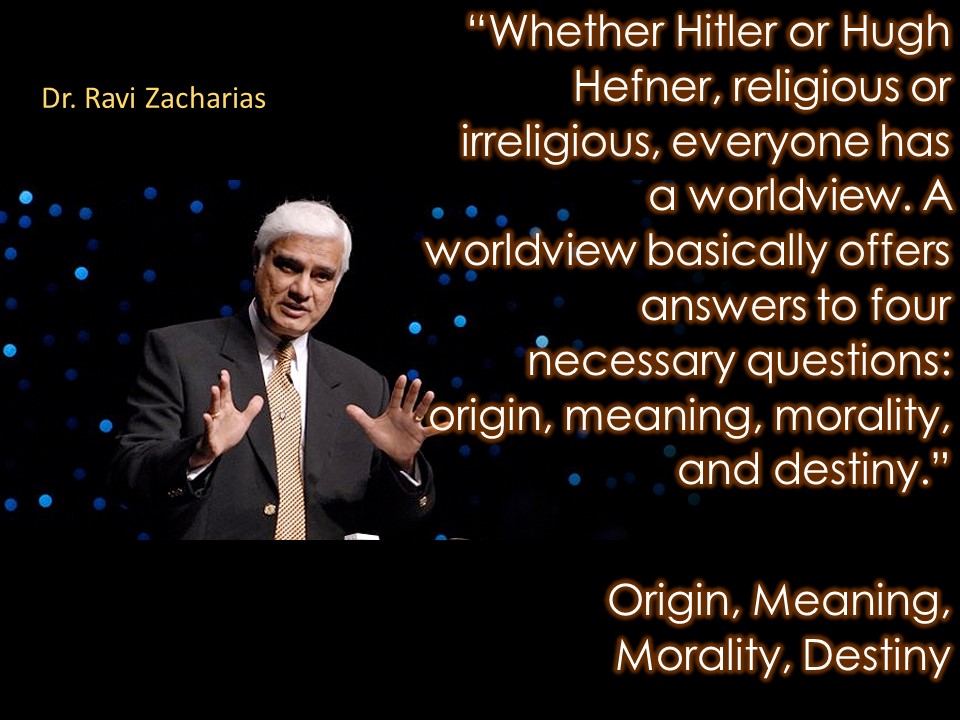
The simplest and best definition I’ve heard comes from apologist Ravi Zacharias.
Fully aware of it or not, all of us have an understanding of these 4 things, and that understanding undergirds how we see all of life.It informs our opinions on things like abortion, human rights, war, taxation, ethics, religion – you name it.
In Acts 17, the Apostle Paul gives a master’s class in engaging worldview, without using the word .
If we are going to discuss The Gospel with anyone, the questions of Origin, Meaning, Morality & Destiny must come up, and we need to be sure we are speaking the same language as those we speak with.
That the words we use mean the same thing to each other.
And the very first place we need to go, if we are to have any meaningful conversation on these topics – is to define what we mean by the word and concept of GOD.
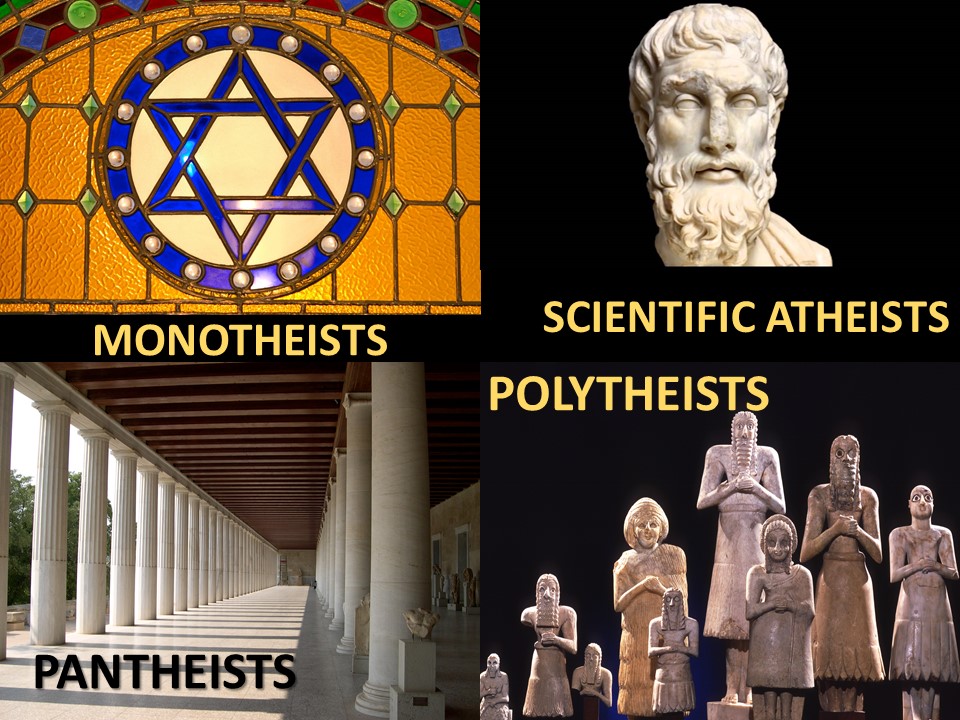
Paul knows he is speaking to at least 4 different groups, each of whom has a different world view, and therefore different notions of who and what GOD is – so that forms his jumping off point.
4 main groups – vs. 16-18 – The 4 are the 4 main worldviews outside of the Biblical Worldview.
All worldviews we encounter are forms of 1 of these 4. Paul is going to converse with all 4 at the same time.
Pagans:
Jews:
Epicureans:
Stoics:
Pagans: Many “gods” and relying upon superstition.
These “gods” were nothing more than powerful versions of fallen man with the same negative personality traits and passions as humanity. Think of Homer’s Illiad and other Greek Mythology.
The gods were just like the people but in a higher form of spiritual (as opposed to physical) existence.
They were Immortal, but they were also Petty. Jealous. Sexually active and bound. Vindictive. Capricious, prideful and downright immature.
In our times, Q of Star Trek – The Next Generation would be a prime example.Jews: God. One God. Some right notions of God, some not.
Psalm 50:16–21 But to the wicked God says: “What right have you to recite my statutes or take my covenant on your lips? 17 For you hate discipline, and you cast my words behind you. 18 If you see a thief, you are pleased with him, and you keep company with adulterers. 19 “You give your mouth free rein for evil, and your tongue frames deceit. 20 You sit and speak against your brother; you slander your own mother’s son. 21 These things you have done, and I have been silent; you thought that I was one like yourself. But now I rebuke you and lay the charge before you.
Epicureans / Epicurus (341-270 BC):
“God” in name only.
Not personal.
No actual involvement in the world.
Annihilationists.
Pleasure is the chief good.
Material universe is all there ever was, is and will be.
Worship makes no sense though some form of religion might be OK for giving people ethics and structure.
Stoics (Painted Porch) / Zeno (333-264 B.C. :
God is everything and everything is god.
“Steel your sensibilities, so that life shall hurt you as little as possible.”
Que sera sera
Everything (god too) is governed by fate
Pleasure is not good and pain is not evil
What is – is
Dispassionate virtue
End all desire
Pagans – Polytheists & Superstitionalists.
Jews – Monotheistic Religionists
Epicureans – Scientific atheists / Carl Sagan
Stoics – Pantheists / New Age – Hinduism – Moksha: Oneness with deity & all things
Paul was clearly trying to preach Christ and the resurrection (18) but was making little headway.
As his sermon following shows, Paul realizes he has to back up and start at some other place.
He picks the only point of commonality between all of these disparate groups: Each has some notion of God.
But God needs to be defined not through their pre-existing system, but Biblically.
What I want to do by means of this passage is to look at how Paul addresses worldview; to ask 5 crucial questions, and then look at 3 concluding observations.
- (24-31) Who & What is God?
NOTE: NOT EVERY WAY TO GOD IS VALID! The very fact that Paul starts here, negates the idea that we just leave people to their blindness. He does not leave them alone with their false notions of “god”. For they are still lost even though they may “worship” God in some way.
- 24 – Creator of the material universe.
- 24 – Lord – He actively rules in the affairs of men.
- 24 – Transcendent – He is not contained IN the universe and He is not the universe itself. Nor is he like man.
- 25- Self sustaining – He doesn’t NEED our praises or sacrifices.
- 25 – Sustaining all life.
- 26 – Not Tied to any specific race or region – not tribal. No room for “you’ve got your God and I’ve got mine.”
- 26 – Purposeful – not capricious.
- 26 – Sovereign over His creation. Ultimately unopposed.
- 27 – Seeking relationship – Not impersonal.
- 28 – Omnipresent. Can’t be located or managed.
- 29 – Incomparable – Cannot be “imaged” – by any creature or object – even man himself. Defies even our imagination! Not to be “pictured”.
- 30 – Patient – Not testy and irritable.
- 31 – Judge – Does not ignore morality. No Karma or Fate.
- 31 – Righteous – According to His own nature.
- Who & What is Man?
- 26 – Created being – Not accidental, nor merely part of the natural order or emerging from a purely material universe; Not self-made.
- 26 – Governed being – Not a totally “free” agent.
- 27 – Purposed – To seek and know the true God
- 30 – Morally responsible to God
- 30 – Separated – unreconciled to God
- 30 – Capable of knowing God
- 31 – Headed toward final judgment
Man was made to know God.
Made not only with the capacity to know Him, but set in an environment specifically designed to lead us to knowledge of Him.
But we refuse to live within the construct which was created for us, and for which we were created.
We were made to be near Him and to reach out to Him easily.
But we do not. His image, shattered though it may be, can be seen in each one of us – He is not “far” from us – and still we make gods of gold, silver, stone and other art – after our imaginations.
Think: The new Emoji Bible. God must be reduced to an image.
How can it be?
We are SO fallen.
We can no longer find Him the way we were designed to.
It is here, the revelation of Jesus Christ must break in upon the soul – for in our corruption, even though it might be true that “in him we live and move and have our being” – yet we are still separated from him and doomed.
Hence, a day of judgment has been appointed – and that judgment is all wrapped up in Jesus Christ whom God has raised from the dead.
- What is their Relationship? (i.e. God and Man)
Lord / Subject
Sustainer / Dependent
Parent / Child
Authority / Rebellious
Judge / Guilty
- What does it matter?
31 – A FIXED day of judgment is to come – all men everywhere are called to repent.
- What can be done?
Reconciliation through repentance. Looking for mercy in face of the coming judgment.
Repent of:
A Wrong view of God
A Wrong view of Mankind
A Wrong view of the present Relationship between them
A Wrong view of Reconciliation (restoring the relationship)
A Wrong of view of what is needed – Sin needs dealt with!
Repent of Self-government and rebellion in the face of the One who made me for His purposes.
I need to able to face God’s RIGHTEOUS judgment.
This – culminates in expounding Jesus Christ.
Christ is Paul’s climax point, not his starting point. Too much ground needs to be cleared first.
It has been noted that these kinds of engagements in the Areopagus went for hours. All we have here is most likely Paul’s outline.
What we can tell is that he builds this foundation BEFORE he brings the discussion finally around to who Jesus is and what He has done.
CONCLUSIONS:
- Our goal is not to make men merely religious, but to reconcile them to God in Jesus Christ: 2 Cor. 5.16 From now on, therefore, we regard no one according to the flesh. Even though we once regarded Christ according to the flesh, we regard him thus no longer.
17 Therefore, if anyone is in Christ, he is a new creation. The old has passed away; behold, the new has come.
18 All this is from God, who through Christ reconciled us to himself and gave us the ministry of reconciliation;
19 that is, in Christ God was reconciling the world to himself, not counting their trespasses against them, and entrusting to us the message of reconciliation.
20 Therefore, we are ambassadors for Christ, God making his appeal through us. We implore you on behalf of Christ, be reconciled to God.
21 For our sake he made him to be sin who knew no sin, so that in him we might become the righteousness of God.
The goal is not to convince them to our point of view, but to reconcile them to God through Jesus Christ.
- We must not assume what anyone knows, but work from the ground up.
Some will find more common ground right away, others not – but we’ll be speaking the same language. 1 Cor. 14:6 Now, brothers, if I come to you speaking in tongues, how will I benefit you unless I bring you some revelation or knowledge or prophecy or teaching?
7 If even lifeless instruments, such as the flute or the harp, do not give distinct notes, how will anyone know what is played?
8 And if the bugle gives an indistinct sound, who will get ready for battle?
9 So with yourselves, if with your tongue you utter speech that is not intelligible, how will anyone know what is said? For you will be speaking into the air.
10 There are doubtless many different languages in the world, and none is without meaning,
11 but if I do not know the meaning of the language, I will be a foreigner to the speaker and the speaker a foreigner to me.
12 So with yourselves, since you are eager for manifestations of the Spirit, strive to excel in building up the church.
If we must take such pains to be clear IN the Church, how much more outside of it?
- Note the manifest love of God for lost mankind.
His love is such that:
- He COMMANDS all men everywhere to repent, rather than leaving it to a choice they would never make.
Repent from what? Having such wrong views of God that they are alienated from Him even IN their religion!
And that they are responsible to this God, based upon His standard of righteousness, and not according to their own standard.
And to turn and serving the Living God in Christ Jesus:
1 Thessalonians 1:9–10 For they themselves report concerning us the kind of reception we had among you, and how you:
- turned to God from idols
- To serve the living and true God,
- 10 and to wait for his Son from heaven, whom he raised from the dead, Jesus who delivers us from the wrath to come.
He commands ALL PEOPLE EVERYWHERE to repent.
This is not a Gospel for some exclusive group, but a Gospel to be preached to all, everywhere.
-
As we were singing in worship this morning, that old hymn by Edwin Hatch “Breathe on me Breath of God” – I could not help but think back to the words of the Puritan John Owen regarding our need to pray for the Holy Spirit. This hymn fills just such a role – but I hope none of us stop at that, but pray continually for the Spirit’s work in our hearts and lives. On that subject, Owen wrote this:“We are taught in an especial manner to pray that God would give his Holy Spirit unto us, that through his aid and assistance we may live unto God in that holy obedience which he requires at our hands, Luke 11:9–13. Our Saviour, enjoining an importunity in our supplications, verses 9, 10, and giving us encouragement that we shall succeed in our requests, verses 11, 12, makes the subject-matter of them to be the Holy Spirit: “Your heavenly Father shall give the Holy Spirit to them that ask him,” verse 13; which in the other evangelist is “good things,” Matt. 7:11, because he is the author of them all in us and to us, nor doth God bestow any good thing on us but by his Spirit. Hence, the promise of bestowing the Spirit is accompanied with a prescription of duty unto us, that we should ask him or pray for him; which is included in every promise where his sending, giving, or bestowing is mentioned. He, therefore, is the great subject-matter of all our prayers. And that signal promise of our blessed Saviour, to send him as a comforter, to abide with us for ever, is a directory for the prayers of the church in all generations. Nor is there any church in the world fallen under such a total degeneracy but that, in their public offices, there are testimonies of their ancient faith and practice, in praying for the coming of the Spirit unto them, according to this promise of Christ. And therefore our apostle, in all his most solemn prayers for the churches in his days, makes this the chief petition of them, that God would give unto them, and increase in them, the gifts and graces of the Holy Spirit, with the Spirit himself, for sundry especial effects and operations whereof they stood in need, Eph. 1:17, 3:16; Col. 2:2. And this is a full conviction of what importance the consideration of the Spirit of God and his work is unto us. We must deal in this matter with that confidence which the truth instructs us unto, and therefore say, that he who prayeth not constantly and diligently for the Spirit of God, that he may be made partaker of him for the ends for which he is promised, is a stranger from Christ and his gospel. This we are to attend unto, as that whereon our eternal happiness doth depend. God knows our state and condition, and we may better learn our wants from his prescription of what we ought to pray for than from our sense and experience; for we are in the dark unto our own spiritual concerns, through the power of our corruptions and temptations, and “know not what we should pray for as we ought,” Rom. 8:26. But our heavenly Father knows perfectly what we stand in need of; and, therefore, whatever be our present apprehensions concerning ourselves, which are to be examined by the word, our prayers are to be regulated by what God hath enjoined us to ask and what he hath promised to bestow.”Owen, John. The works of John Owen. (Ed.) William H. Goold. . Vol. 3. Edinburgh: T&T Clark.Indeed:1. Breathe on me, Breath of God,
fill me with life anew,
that I may love what thou dost love,
and do what thou wouldst do.2. Breathe on me, Breath of God,
until my heart is pure,
until with thee I will one will,
to do and to endure.3. Breathe on me, Breath of God,
till I am wholly thine,
till all this earthly part of me
glows with thy fire divine.4. Breathe on me, Breath of God,
so shall I never die,
but live with thee the perfect life
of thine eternity. -
There is a tendency in the human mind to deviate from Divine truth. Had it not been for the illuminating influence of the Spirit of God, we should never have understood it; not because of its abstruseness, but on account of the uncongeniality of our minds; and when we do understand and believe it, there is a continual tendency in us to get wrong. It might seem that when a person has once obtained a just view of the gospel, there is no danger of his losing it; but it is not so. There is a partiality in all our views, and while we guard against error in one direction, we are in equal danger from a contrary extreme. Many, in shunning the snare of self-righteous pride, have fallen into the pit of Antinomian presumption; and many, in guarding what they consider as the interests of practical religion, have ceased to teach and preach those principles from which alone it can proceed. Besides this, there are many ways by which a minister may get beside the gospel without falling into any palpable errors. There may be nothing crooked, yet much wanting. We may deliver an ingenious discourse, containing nothing inconsistent with truth, and yet not preach that truth “in which believers stand, and by which they are saved.”
Fuller, Andrew Gunton. 1988. The Complete Works of Andrew Fuller: Memoirs, Sermons, Etc. (Ed.) Joseph Belcher. . Vol. 1. Harrisonburg, VA: Sprinkle Publications.
-
Can be sung to the tune of O Sacred Head, Now Wounded.
Lord Jesus, God incarnate
True God, and truest man
The two in one united
To be Atonement’s Lamb
What praises can we offer
To sing Thy worthiness?
Eternity’s songs will falter
To match Thy blessednessDear Saving Son, Redeemer
Forgive my faithless heart
That fails in times of trial
To trust in Whom thou art
Thou sum of Love’s perfections
God’s Word and Wisdom full
Enlarge my soul’s affection
And sever deception’s pullHigh Priest and Intercessor
In all my weakness, plead
Thy Spirit’s keeping power
According to all my need
Christ’s light amid the darkness
Christ’s strength when I am weak
Christ’s holiness in temptation
Christ’s words when e’re I speakLet praise and adoration
O’er flow my heart and mind
Till naught but all Thy beauty
Remains for Thee to find
Transform and full conform me
Purge all that’s base and mean
And bring me to Thy glory
Till Christ alone is seen -
The following is a very short sermon by Andrew Fuller on how it is God seems to send days of mercy to balance off days of affliction. He notes how days of difficulty and dark trials are to be an impetus for prayer for days of refreshing, and why we ought to look for them with expectancy. Whether our trials are personal, ecclesiastical, national or whatever. God is good to follow our dark days with refreshing, hope and restoration.
PAST TRIALS A PLEA FOR FUTURE MERCIES
“Make us glad according to the days wherein thou hast afflicted us, and the years wherein we have seen evil.”—Psal. 90:15.
THIS “prayer of Moses the man of God,” as it is entitled, is thought to have been occasioned by the sentence denounced against that generation of Israelites which came out of Egypt, viz. that they should perish in the wilderness. In it we see much of the plaintive, and yet much of the man of God, cleaving to God under his judgments, and hoping in his covenant mercy and truth. Forbidden to enter their promised dwelling-place, they are directed to make up their loss in God, ver. 1, 2. Cut short as to the number of their days, to apply their hearts to wisdom, ver. 12. And though they, and himself with them, were doomed to die, they are taught to pray that the cause of God may live, ver. 16, 17.
The language of the text implies that it is usual for God, in dealing with his people in this world, to balance evil with good, and good with evil. He neither exempts them from chastisement, nor contends with them for ever. If he had dealt with us on the mere footing of justice, we had had a cup of wrath only; but through his dear Son it is mixed with mercy. The alternate changes of night and day, winter and summer, are not more fixed in the course of nature, than the mixture of judgment and mercy in the present state.
The children of Israel were long afflicted in Egypt, and when delivered from that grievous yoke, their numerous sins against God brought on them numerous evils in the wilderness, till at length it issued in the dismal sentence which is supposed to have occasioned this plaintive song. Yet this dark night was preparatory to a morning of hope and joy. The people that were left of the sword found grace in the wilderness. The judgments upon the first generation proved a source of wholesome discipline to the second, who appear to have been the best of all the generations of Israel. It was of them that God spoke in such high terms by Jeremiah:—“I remember thee, the kindness of thy youth, the love of thine espousals, when thou wentest after me in the wilderness, in a land not sown. Israel was holiness unto the Lord, and the first-fruits of his increase.” All that God had done for them till then was but ploughing up the fallow ground; but now he began to reap the fruits of his work. Now Balaam, instead of being able to curse them, is compelled to bless and envy them. And now the prayer of the man of God is answered. They are made glad according to the days in which they were afflicted, and the years in which they had seen evil. God’s work appeared to his servants, and his glory unto their children. His beauty was upon them, and he prospered the work of their hands.
We might refer to numerous instances in the Scriptures in which the same truth is exemplified. In the first hundred and thirty years of Adam’s life, he drank deeply of the bitter effects of his fall. He had a son; but after high hopes had been entertained of him, he proved wicked. He had another son, but him his brother murdered; and as the murderer was spared and his family increased, it would seem as if the world was to be peopled by a race of wicked men. But it did not end thus: God gave Adam another seed, instead of Abel whom Cain slew; and soon after this men began to call upon the name of the Lord. It must have been very afflictive for Noah to have been “a preacher of righteousness” century after century, and at last, instead of seeing his hearers converted to God, to see them all swept away by the deluge. But as the waters were assuaged when they had risen to their height, so the wrath of Heaven issued in mercy. God accepted the sacrifice of his servant, and made a covenant of peace with him and his posterity.
Similar remarks might be made from the histories of Jacob, and Joseph, and David, and many others: these were made glad according to the days wherein they had been afflicted, and the years wherein they had seen evil. Nor is it confined to individuals. When idolatrous Israel drew down the Divine displeasure in Hazael’s wars, Jehu’s revolution, and Elisha’s prophecies, it was very afflictive. Yet when Jehoahaz besought the Lord, the Lord hearkened unto him, and was gracious to his people, in respect of the covenant which he had made with their fathers, 2 Kings 13:3–5, 23. Thus the wind, the earthquake, and the fire were succeeded by the still small voice, 1 Kings 19:11, 12. Finally, the great afflictions of the church during the successive overturnings of the monarchies issued, according to Ezekiel’s prophecy, (chap. 21:27,) in Christ’s coming and kingdom.
It is not difficult to perceive the wisdom and goodness of God in thus causing evil to precede good, and good to follow evil. If the whole of our days were covered with darkness, there would be but little of the exercise of love, and joy, and praise; our spirits would contract a habit of gloominess and despondency; and religion itself would be reproached, as rendering us miserable. If, on the other hand, we had uninterrupted prosperity, we should not enjoy it. What is rest to him that is never weary, or peace to one that is a stranger to trouble? Heaven itself would not be that to us which it will be, if we came not out of great tribulation to the possession of it.
Evil and good being thus connected together, the one furnishes a plea for the other. Moses pleaded it, and so may we. We may have seen days of affliction, and years of evil, both as individuals and families. Borne down, it may be, with poverty and disappointment, our spirits are broken. Or if circumstances have been favourable, yet some deep-rooted disease preys upon our constitution, and passes a sentence of death within us long before it comes. Or if neither of these has befallen us, yet relative troubles may eat up all the enjoyment of life. A cruel and faithless husband, a peevish and unamiable wife, or a disobedient child, may cause us to say with Rebecca, What good does my life do me? Or if none of these evils afflict us, yet if the peace of God rule not in our hearts, all the blessings of life will be bestowed upon us in vain. It may be owing to the want of just views of the gospel, or to some iniquity regarded in our heart, that we spend days and years with but little communion with God.
Finally, If, as in some cases, a number of these evils should be combined, this will make the load still heavier. But, whatever be our afflictions, and however complicated, we may carry them to the Lord, and then turn them into a plea for mercy. Though the thorn should not be immediately extracted, yet if God cause his grace to be sufficient for us, we shall have reason to be glad.
We have also seen days of affliction and years of evil as a nation. It is true we have less cause to apply this language to ourselves than most other nations at the present time; yet to a feeling heart there is matter for grief. What numbers of widows and fatherless children have been left even among us, within the last sixteen years! Let the faithful of the land turn it into a prayer, not only in behalf of our country, but of a bleeding world.
Many of our churches, too, have experienced days and years of evil. The loss of faithful and useful pastors, disorders, scandals, strifes, divisions, the consequent withdrawment of the Holy Spirit, are evils which many have to bewail. Let the faithful remnant in every place carry these things to the throne of grace, and there plead with the God of mercy and truth, by whom alone Jacob can arise; and though weeping may continue for a night, joy will come in the morning.
The whole church of God has seen much evil hitherto. Its numbers have been few and despised. It has often been under persecution. Compared with what might have been expected, in almost six thousand years, “we have wrought no deliverance in the earth, neither have the inhabitants of the world fallen.” But all these things furnish a plea for better times. Even the wickedness of the wicked may enable us to plead with the psalmist, “It is time for thee, O Lord, to work, for they have made void thy law.” We may urge the prayer of faith too on this subject, since glorious things are spoken of the city of God. Both the world and the church have their best days to come.
It is necessary, however, to recollect that the happy issue of all our troubles depends upon our union with Christ. If unbelievers, our troubles are but the beginning of sorrows. It is a fatal error in many, that great afflictions in this life indicate that we have had our evil things here. Few men have been more miserable than Saul was in his latter days. But if, renouncing every other ground of hope, we believe in Jesus the crucified, whatever our sorrows may be in this life, they will be turned into joy.
Fuller, Andrew Gunton. 1988. The Complete Works of Andrew Fuller: Memoirs, Sermons, Etc. (Ed.) Joseph Belcher. . Vol. 1. Harrisonburg, VA: Sprinkle Publications.


![1 Corinthians 1031 [fullscreen]](https://responsivereiding.com/wp-content/uploads/2016/08/1-corinthians-1031-fullscreen.png?w=1024&h=768)