
She trembles
Smiles
Gleefully and feebly claps her hands
He smiles
Laughs in conversation
Wheels her
Every day
Same place
Same time
Simple joy
Tenderness
Love in motion
I weep
Rejoice
Pray for glory
She trembles
Smiles
Gleefully and feebly claps her hands
He smiles
Laughs in conversation
Wheels her
Every day
Same place
Same time
Simple joy
Tenderness
Love in motion
I weep
Rejoice
Pray for glory
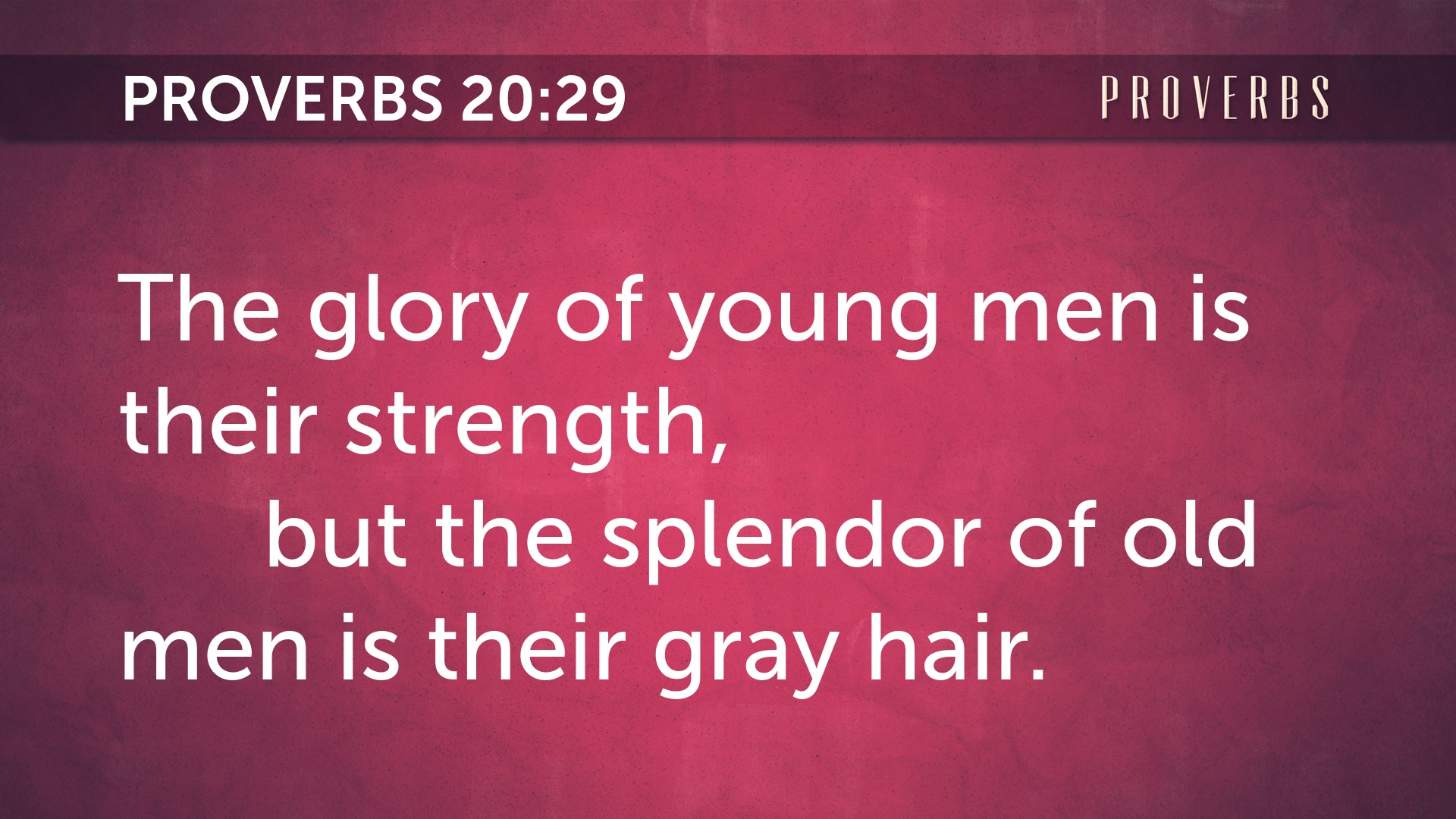
The longer I continue to read and study Proverbs, the more my heart is amazed at the wondrous economy of wisdom the Spirit has packed into phrases like this in Prov. 20:29: “The glory of young men is their strength, but the splendor of old men is their gray hair.”
So, young men, yes, you can do exploits, good for you – but can you endure?
It is one thing to consider “look at what I can do!” It is the pride of the young, both emotionally and spiritually. But it is a far different thing to look back and say, “this is where the Lord took me. This is where He delivered me. This is where He met me, kept me, where He prevented me from following my own path.”
Youth reflects upon itself in the immediate. Age reflects upon the Lord and how that gray hair is a testimony to God’s faithfulness.
This is why Paul argues so vehemently against taking pride in spiritual gifts. It puts the spotlight upon “look what I can do” instead of upon “Look what He has done!”
May we grow wise enough in our youth to turn our eyes toward the glory of the God who made, us, keeps us, empowers us and promises us the unimaginable in Christ. To be more enamored with Him, rather than what He might have decided to gift us with, or do through us.
Not to us, O LORD, not to us, but to your name give glory,
for the sake of your steadfast love and your faithfulness!
The Holy Bible: English Standard Version. Crossway Bibles, 2016, p. Ps 115:1.

Out of sight, out of mind – so the saying goes. And nowhere is that more true than it is in our apprehension of God and His goodness as a constant, living reality to our souls.
So it is in Psalm 103, David needs to remind himself of who and what God is and has done, in order to restore an inward atmosphere of worship.
Note then in the Psalm this catalogue of “His benefits” – or as the 1985 Jewish Publication Society version calls them “His bounties.” But in either case, they are His benefits/bounties toward His own. They are personal. How He loves to bless His own Himself, and not just provide blessings impersonally or as rank and file, generic niceties.
So let these sink in Believer.
(v3) There is no species of sin beyond the power of His forgiveness.
(v3) And He grants forgiveness, not just of individual sins, but of our very sinfulness.
And then, healing from the effects of our sin.
The word for diseases here is only used 5 times in the OT and is always attached to the griefs the Lords lays upon people in punishment for sins. There is no species of suffering brought on by sin, that is beyond His mercy to heal.
(v4) He gives the promise of resurrection.
(v4) And grants the reality of His steadfast – not vacillating – love and mercy.
(v5) There is His desire to give us that which is a true blessing to us, and not decay our souls.
(v6) The privilege of looking forward to a day of complete justice.
(v7) And above all, His self-revelation, located in:
(v8) His imperturbable nature.
(v10) His dealing with us according to grace and mercy because His justice is satisfied in Christ.
(v13) His compassion on our weakness.
(v17) His personal, everlasting love.
(v19) And His divine superintendency over the entirety of our lives.
Remind yourself today of His great benefits.

O’er all the span of endless space
No atom’s hidden from your face
No object lacks your touch of hand
No creature void of your command
A Sovereign true in every way
Your daily work in full display
All Nature, but your own true task
Smile hid ‘neath Providence’s mask
Yet lo how poorly I conceive
How slow my heart to full believe
Such glory, power majesty
In love does condescend to me
The Son in all divinity
Leaves Heaven’s grand felicity
Enrobes Himself in human flesh
To come and die a sinner’s death
In conq’ring grace to overcome
My traitor’s heart in sin undone
To set a wicked captive free
And bind Himself to one like me
This mind so low can’t comprehend
Such love, I cannot apprehend
This Triune grand conspiracy
Unleashed in holy unity
Should Father God, and Christ the Son
Join with the Spirit, three in one
To bring about redemption’s plan
And save the dregs of fallen man
For strength! To know, I humbly cry
To bear such weight of glory high
The length, the width, the depth the height
Unknowable with all my might
Until at last my soul’s consumed
All thoughts and feelings full subsumed
And filled with God’s own fullness. Done
I bear the likeness of The Son

In my younger years, I fantasized about hosting a Talk/Debate TV show. I had determined then that if ever that should come to pass – I would start each discussion with: “Gentlemen, define your terms.” And only after that was done would we proceed. For if parties do not know what each other means by the words they use, very little progress can be made. And nowhere is this more important than when discussing Biblical and theological topics. It is why Paul in his discourse with the august brain trust at the Areopagus begins by defining what he means by using the word “God” before going one step further. Until they knew what he meant when he referred to God, they would import their own meaning(s) into it, and the Gospel would be lost.
Think about this just in terms of the word “Gospel.” Then find out what Roman Catholics mean by it, or Mormons, Jehovah’s Witnesses, and scads of others. Each has very different definitions from the other, and for many, very different definitions from how the Bible defines it. Or the term “Christian.” How many today would defer to something like the descriptors Paul uses for the Thessalonians: “how you turned to God from idols to serve the living and true God, and to wait for his Son from heaven, whom he raised from the dead, Jesus who delivers us from the wrath to come.” 1 Th 1:9–10. Does that scream “Christian!” to you? It should.
So, “holiness.” The word gets thrown around all the time among Christians, but what we may mean by it might be subject to wide conceptions. For some, it only refers to behavioral conformity to Biblical and perhaps ecclesiastical norms. For others, it has to do with having been set apart for God. Still others may think of it only in terms of God’s own righteousness, and that then imparted or infused or whatever into Believers. But in J. C. Ryle’s book – he strives to use the word as pertains to Believers in one consistent sense: Being conformed to the mind and character of Christ. And he uses it in this sense interchangeably with the word sanctification – which he defines simply as growing in Christ.
As such, this book is not about listing rules which if followed, will make you holy. Nor is it rooted in learning how to keep those rules. It is not about whipping readers into behaviors and performances. Nor is it aimed at helping one achieve some sort of one-time, life transforming experience whereby “ZAP! – Now you’re holy!” It is a book about how we are to “grow up in every way into him who is the head, into Christ.” (Eph. 4:15) The privilege, call and duty of every true believer in Christ Jesus. Hence the full title of the book: “Holiness: Its Nature, Hindrances, Difficulties and Roots.”
With the skilled and steady hand of a spiritual surgeon, page after page finds Ryle doing what D. A. Carson says should be 2 key elements in every sermon – wounding, and healing. You will seldom read a book which is simultaneously as convicting or as encouraging as Ryle’s Holiness. I truly think it has no true equal in this regard.
Holiness, may be (in my humble opinion) the single most Gospel-centered, Christ-centered book I’ve ever read. And that is not for one moment to downgrade any of the multitude of profound writings of all my Puritan heroes – nor of any of the great “Doctors” of the Church. Christ has seen to it His Body is richly supplied in this way. And has so throughout history. But there is a unique richness and clarity, focus and singleness of purpose in these chapters that sets it apart into a category of its own.
At the risk of being overly reductionistic, let me cite two aspects of this book that make it so profoundly useful.
On this last point, I cannot say enough myself. How many tender souls in Christ live perpetually suspecting their status before God because they find indwelling sin still so painfully present. And parallel to this is the striving after an imaginary place where I’ll no longer be tempted by X or Y or Z. Forgetting that sin does not die – we die to it. Daily we have to take up that cross. There is no mysterious super-spiritual plane to achieved where we are no longer bothered by such battles. Holiness is a clarion call for the Christian to “gird up your loins,” and to “act like men.”
In Chapter 4, titled “The Fight” a representative and classic portion in Ryle reads thus: “The first thing I have to say is this: “True Christianity is a fight. True Christianity! Let us mind that word “true.” There is a vast quantity of religion current in the world which is not true, genuine Christianity. It passes muster; it satisfies sleepy consciences; but it is not good money. It is not the real thing which was called Christianity eighteen hundred years ago. There are thousands of men and women who go to churches and chapels every Sunday, and call themselves Christians. Their names are in the baptismal register. They are reckoned Christians while they live. They are married with a Christian marriage-service. They mean to be buried as Christians when they die. But you never see any “fight” about their religion! Of spiritual strife, and exertion, and conflict, and self-denial, and watching, and warring, they know literally nothing at all. Such Christianity may satisfy man, and those who say anything against it may be thought very hard and uncharitable; but it certainly is not the Christianity of the Bible. It is not the religion which the Lord Jesus founded, and His Apostles preached. It is not the religion which produces real holiness. True Christianity is “a fight.”
I’m afraid we would be hard pressed to find such words from very many preachers or teachers today. Precious few. And until this truth is firmly in the heart and mind of the Believer – the “fight” will be experienced and processed as something foreign to the “victorious Christian life” rather than an essential feature of it.
I know of no single volume more needed in our day, nor more valuable to the Christian Believer in understanding and living out the Christian life than this one.
It is in my estimation, the finest companion to your Bible in practicality and applied Christian thought and living that you can lay your hands on.
If you read no other book this year, read this one.

There are books which I value greatly, and am edified by. Books that inform and feed the soul. And, there are books I just plain enjoy. I smile when reading them. There is a peculiar delight to be found in them. But rare indeed are those which combine the two as richly and deftly as Austin Brown’s “A Boisterously Reformed Polemic Against Limited Atonement.” It takes a skilled author to write a polemic work which engages in witty “repartee” without crossing over into “rip-apart-thee”, but Brown has done it. To the greater benefit of the Reformed camp of our day in the United States. May it find a wide and receptive audience.
Brown and I share some history. Not personally, I’ve never met the man. But in terms of somewhat shared experience.
Like many in Reformed Protestantism, I was taught that a strict view of Limited Atonement (the L in T.U.L.I.P. and SLA hereafter) was THE Reformed understanding. This view is sometimes labeled the “Owenic” view – after that towering genius of a theologian, John Owen, who for many remains its champion in residence. In truth, I had a very defective understanding of the history of the Church in general, and in the development of some doctrines within Orthodoxy – Limited Atonement in particular. As time and study would prove, many in my circle who would proudly embrace the names, writings and ministries of a John Bunyan, J. C. Ryle, Jonathan Edwards, Charles Davenant (if you restrict yourself to the Banner of Truth edition of his commentary on Colossians which sadly omits his dissertation on the death of Christ), Twisse, Ussher and even John Calvin himself (and a host of other Reformed luminaries) – and tout them as propounders and defenders of SLA – erred. The names above did not embrace SLA. They are misrepresented. And, SLA has never been THE Reformed position. Variations and nuances abound. But we don’t like nuance. We want black and white, concrete absolutism.
The process of moving from a high-Calvinist view of SLA (I differentiate here between High and Hyper Calvinism) to a real and objective atonement for the sins of all – was long, arduous and painful. It came at great cost, especially in terms of pastoral fellowship and relationships. But it has been worth it. Not least because I found that I had been parsing the call of the Gospel in ways which quite frankly, were shameful. In my research, I came upon this from a sermon by Jonathan Edwards: “”Come to Christ and accept salvation. You are invited to come to Christ, heartily to close with Him, and to trust in Him for salvation. If you do so, you shall have the benefit of His glorious contrivance. You shall have the benefit of all, as much as if the whole had been contrived for you alone. God has already contrived everything that is needful for your salvation; and there is nothing wanting but your consent. Since God has taken this matter of the redemption of sinners into His own hand, He has made a thorough work of it. He has not left it for you to finish. Satisfaction is already made; righteousness is already wrought out; death and hell are already conquered. The Redeemer has already taken possession of glory, and keeps it in His hands to bestow on them who come to Him. There were many difficulties in the way, but they are all removed. The Savior has already triumphed over all, and is at the right hand of God to give eternal life to His people. Salvation is already brought to your door; and the Savior stands, knocks, and calls that you would open to Him so that He might bring it to you. There remains nothing but your consent. All the difficulty now remaining is with your own heart. If you perish now, it must be wholly at your door. It must be because you would not come to Christ that you might have life, and because you virtually choose death rather than life.” My heart ached to preach the Gospel like that. But in my circles, some of those expressions would have been looked upon quite dubiously.
But by God’s grace, in time, I was freed. How I wish I had had two helps at the time which are available now: David Allen’s magisterial “The Extent of The Atonement: A Historical and Critical Review.” And Austin Brown’s “boisterously Reformed Polemic.” Dr. Allen’s work thoroughly debunks the myth of SLA being THE Reformed stance. In that regard, it is utterly unassailable. And in Brown’s book, you have a thoughtful dismantling of the logic errors of SLA, along with careful exegesis of the most pertinent passages. The 2 together would have saved me years of personal study. But then again, maybe I needed to read the original sources and work through the exegetical issues on my own. I don’t know.
Now the title itself ought to clue you in that this volume will contain a lot of tongue-in-cheek banter. It does not disappoint. While I found so much of it refreshing and just flat out fun, some of my SLA friends will perhaps be offended. But Brown does not write to wound. He writes in this style to jog and jar the reader out of unquestioned paradigms. It is effective. And don’t let his lightheartedness fool you into thinking his points are not salient and rooted in serious Biblical exposition. It is not theological fluff. But it is intended to point out over and over, the hidden folly behind some of the reasoning and passage twisting which has to go on in defending SLA. And underneath it all, I think I detect an edge which is stained with personal pain. But pain which has yielded sweet fruit. He does not denigrate any person. But he fearlessly attacks ideas. As it should be.
Since I started my journey in this area, I have begun to detect a corrective wave sweeping into our Reformed camp in terms SLA. I fear, lest, like Roger Miller’s old lyric “England swings like a pendulum do”, that some will swing too far in response. In debates like these, both sides are prone to chuck babies and bathwater together. But Brown remains balanced. He rightfully feels the pinch of having been misled (if “lied to” is too strong) about the historical realities of the discussion. I know I feel that way. But it does not lapse into bitterness, even in his discursive “rants.”
When all is said and done, I think there are two target groups this book will help the most. Those like myself a few years ago, who were already recoiling at a Denmarkian odor but were just starting to find out where the smell was coming from. It will save them hours, days, weeks, months and perhaps even years of sorting out tinted exegesis. And those who as new Christians, or at least new to the debate, are confused about where to go with their discomfort. It can spare them a much and not needed theological detour. There is a small 3rd group. Some of my dear brethren who are still in the SLA camp, but can’t quite put their finger on the uneasiness they feel (but never feel they can safely voice) over SLA. May this serve as a beacon drawing them back away from some rocky shores.
If there is one concept I pray each reader could grasp in it all – it would be this: Yes, there are stark antitheses in Scripture. Sin is not righteousness. Dead is not alive. Christ is either God, or not. But there are both/and dynamics at play in Scripture too. So, is Jesus fully God or fully man? Yes. Is Scripture God breathed, or penned by men? Yes. Is the Godhead three, or one? Yes. Did Jesus die for all, or for the elect? Yes. Requiring yes or no answers from questions which cannot be answered fully or properly that way, makes a hash of the Bible. One of the finer skills in Biblical exegesis is determining whether or not you have a true antithesis before you, or a place where only a both/and dynamic answers more truly. Get that in the SLA discussion, and you will have heard Brown – and understood your Bible better. Brother Brown beats that drum a lot. Necessarily so.
Bottom line?
Buy this book. Better yet – READ IT!

A Most Important and Timely Book
I don’t know about you, but if you are anything like me, current debates about Black Lives Matter, CRT (Critical Race Theory), Neo-Marxism, etc., while they permeate the public square, suffer from a lack of clarity as to what each actually means – and the import of each. Enter Douglas Groothuis’ profound and much needed book – “FIRE IN THE STREETS: How You Can Confidently Respond to Incendiary Cultural Topics.”
In 9 short and very readable chapters, Groothuis unpacks the cultural terms slung about by pundits and commentators from all sides clearly and concisely. Especially appealing to their historical origins and popular permutations.
At last! Some clarity. I am most grateful for it.
With endorsements from the likes of Os Guinness, J.P. Moreland and Voddie Baucham, one hardly needs my $.02. But I’ve never let that stop me before and I won’t let it do so now.
If one is to understand the current debates, and respond to them in any meaningful way, we need to grasp the central concepts themselves – so as to avoid straw-man rejoinders, and where they come from originally – so as to rightly discern original trajectories. Ideas do not exist in vacuums. They not only have inevitable consequences, they also have a point of origin which determines the goal(s) the originators or adopters and proponents expect those ideas to achieve when taking effect. This is where Groothuis excels. He get it. Gets them. Gets their original intent. Even if many of the modern adopters themselves do not perceive where the thought systems will (if uninterrupted) inevitably lead. And he exposes the underlying and often hypocritically nefarious and hidden agendas which are really there. And in it all, he continually calls us back to consider the Gospel of Jesus Christ as the true answer to society’s ills.
This is an exceedingly important book for our point in history. It is a must read for informed Christians. And I plan to use it evangelistically due to its saliency and unsparing willingness to grapple with the issues at their base. I can give it without reservation to “Conservatives” for its cogency in addressing the topics with facts and logic, while unflinchingly drawing the reader back to the need for and the role of the Gospel as meeting the need behind the perceived need. And, I can do so for non-Conservatives, in opening a dialog based on facts, and not mere emotional heat.
If there are any weaknesses in the book, it would be in two places.
The section on reparations I found well-reasoned, but failing somewhat in addressing the Biblical response more thoroughly. It failed to be as comprehensive as I would have liked. I agreed with the conclusions but wished he had dealt with some areas which required a deeper and more nuanced understanding of events such as David’s handling of Saul’s sin against the Gibeonites in 2 Sam. 21, and how in the minor prophets, God often calls nations into account for historical sins committed generations before. I think that would have added weight to his argument in the face of what I imagine will be the criticisms of some.
The 2nd place was in the handling of the George Floyd killing. While at a distance, we can of course see that Floyd was a man with a troubled and criminal past. But unless we could show that the responding officers were aware of that past at the time, and that such knowledge somehow informed how they dealt with Floyd that day – it should not be used in examining the isolated facts of that event. Much like in jurisprudence where “prior bad acts” are not admissible in prosecution unless they can be shown to demonstrate a relevant pattern – Groothuis’ use of them here could be seen as an attempt to mitigate his treatment by police. Mind you I said could. I don’t believe that’s what Groothuis was trying to do. But I think it could easily be read that way by some. I think it may have been wiser to have left out Floyd’s history in that place, and to have confined his analysis only to the facts at hand at the time.
Those two things considered, they in no wise negate the ultimate conclusions drawn. They in no wise lessen the fundamental power of the book and its vital role in helping all readers, Christians and non-Christians alike, in wrestling through the issues, carefully, soundly, compassionately, Biblically and with an eye to truly seeking to provide a remedy.
I highly commend it to you.
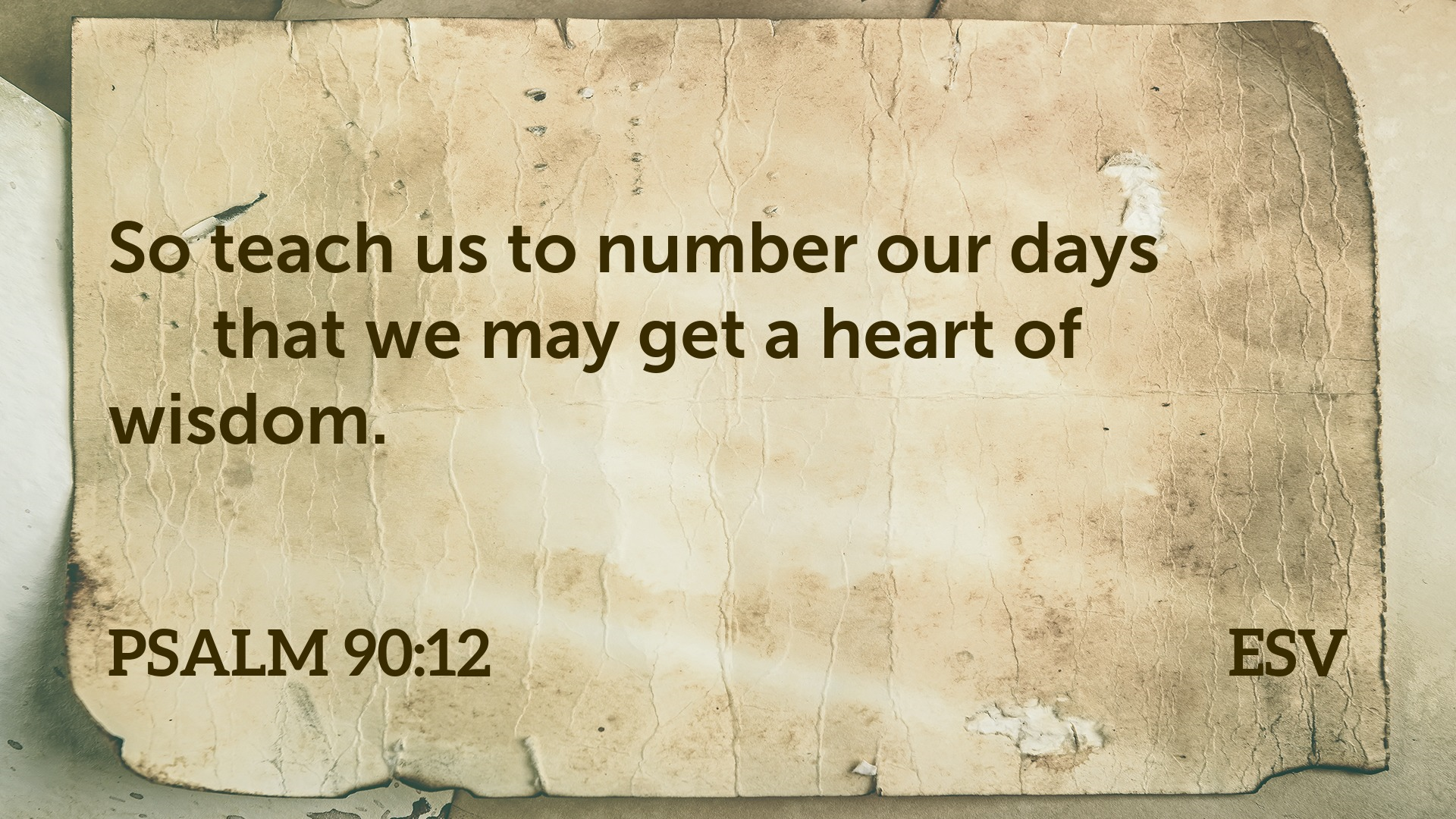
It happened once again, just a few minutes ago. A communication that a friend, highly useful in the Kingdom of God, we suddenly taken ill, and may have but a few months to live. We don’t know yet. But the older I get and the more live goes by, the more these types of events repeat themselves.
Upon hearing it, the verse that came immediately to mind was this one. One I need to meditate on often. And while part of a prayer uttered by Moses, it was kept by the Spirit for you and me.
The idea of numbering here isn’t about knowing exactly how much time each or any of us may have left in this present life. It is first and foremost a simple reminder that life is finite. That our days are indeed – numbered. Contrary to Rod Stewart and his 1981 hit “Young Turks” – time is NOT on our side. So it is we need to be sure we are on the side of eternity.
And thus, my short prayer borne out of Moses’ words:
“Heavenly Father, I pray this along with Moses today. Let it be so. Teach ME to number my days. To take advantage of the time you have given. Not to waste it on the world and on frivolous things. Not to squander it on what is temporary, and least of all, sinful. May my days be spent in learning of you, joying in you, making your glory known to others, and manifesting your great love in the earth. Make my time productive in the advancement of your kingdom within my own heart, in the hearts of those who know you, and to extend to those who do not – that they too might come under your banner in salvation. Let me not lose one moment in bitterness. Not a single second musing upon wickedness. No time invested in self-pity, arrogance, self-will or hatred against any other. Let me not give up one of these precious hours to anything that would displease you. Let me invest each passing moment in reveling in your glory and goodness and grace. Teach me to number my days, that I may get a heart of true wisdom. Let me live clinging to the Cross of Christ, and proclaiming His saving work on Calvary to all my brothers and sisters in Christ, and to this lost and dying world any and every way open to me.”

Recommendations: Derek Prime’s very short but useful commentary – Opening up 1 Corinthians and D. A. Carson’s “Showing The Spirit: A Theological Exposition of 1 Corinthians 12-14”.
1 Corinthians 12:1–14:40 (ESV) — 1 Now concerning spiritual gifts, brothers, I do not want you to be uninformed. 2 You know that when you were pagans you were led astray to mute idols, however you were led. 3 Therefore I want you to understand that no one speaking in the Spirit of God ever says “Jesus is accursed!” and no one can say “Jesus is Lord” except in the Holy Spirit.
RAF: The first contrast in the text is between “spiritual[s]” vs. pagan or natural[s]. The word “gifts” is not in the original. As with Paul in all places, one can only be “spiritual” if they are in Christ. The Bible does not equate spiritual with merely supernatural. Spiritual matters belong only to spiritual (redeemed) people. Note 2ndly that Paul is pitting “mute” idols, against the communicating God who has revealed Himself. Hence, this initial thought that those under the influence of this communicating God will never speak things which are contrary to the glory and honor of God and especially of Jesus Christ. These two are antithetical. The confession of truth is always a two-sided coin – content and conduct. These two are inseparable. The one who claims to be Christ’s also owns Christ as Lord.
Bishop Lightfoot says this refers to Jewish exorcists and magicians who would perform their “miracles” and yet say “Jesus is accursed.” This would seem an unlikely application in the Corinthian context – tho possible. More likely is the understanding (as per the New Bible Commentary) that as former pagans who were used to asking their deities to curse their enemies, no one who is a Christian would adopt that same practice and try to use Jesus’ name to curse others for one’s own advantage or revenge. The old life of pagan idolatry and how one’s relationship to those “mute” idols functioned, must be set aside. There is an entirely new paradigm in Christ. One which will culminate in chapter 13 – love.
4 Now there are varieties of gifts, but the same Spirit; 5 and there are varieties of service, but the same Lord; 6 and there are varieties of activities, but it is the same God who empowers them all in everyone.
RAF: Note the 3-fold description. There are:
a. Different gifts that the Spirit gives – many will be enumerated in this passage, others are found elsewhere (above 20 in the NT).
b. These gifts serve the Body of Christ in varying ways. They meet varying needs.
c. These gifts can sometimes function in different ways. Hence the need to be careful to not lump ALL prophecy together, and make it either all preaching, or all prediction, etc. Paul will capitalize on this in regard to the gift of tongues in ch. 14 demonstrating that it functions in several different capacities. Given all this variety – we still see it all comes from the same Spirit and is under the Lordship of the same God. So there can be no contradiction between them, and no other purpose than what is stated in the following section – for the common good. Spiritual MUST function “for the common good.” This cannot be over-emphasized.
7 To each is given the manifestation of the Spirit for the common good. 8 For to one is given through the Spirit the utterance of wisdom, and to another the utterance of knowledge according to the same Spirit, 9 to another faith by the same Spirit, to another gifts of healing by the one Spirit, 10 to another the working of miracles, to another prophecy, to another the ability to distinguish between spirits, to another various kinds of tongues, to another the interpretation of tongues.
RAF: I have already expatiated on the verbal gifts in another place and will not go over that again here. The bottom line in that discussion is simply this: as on The Day of Pentecost, note the content. They heard no new revelations – only a reiteration of the “mighty works of God.” This, it appears – with the rarest of exceptions – is how the verbal gifts typically function within the local Church: They shine a spotlight on particular EXTANT Biblical truth at a particular place and time.
I would only note that if we take the idea of “ecstatic” tongues out of the equation, then we are making this gift little other than linguistic capability which I think the rest of Paul’s discussion will not support. More on that later.
11 All these are empowered by one and the same Spirit, who apportions to each one individually as he wills.
RAF: This portion cannot be over-emphasized. It is the Spirit who decides who gets what gift (or gifts) and when, or conversely when not. We must be content to use or NOT use both the gifts and ourselves as He sees fit. We dare not take the lead in this area – which to the great shame of the Pentecostal and Charismatic movements (which is my own background) has led to untold damage, misuse, misunderstanding and outright blasphemy at times. We also need to recognize that the Spirit’s apportioning may include allowing a person to utilize a particular gift perhaps only once – to meet a particular need at a particular moment. That these gifts are necessarily abiding or permanent bestowals (though that may be the case in some instances) I think is a mistake. Balaam’s ass spoke only once, it didn’t continually counsel his errant master after that one incident. And so it may well be with all of these gifts.
Note too – how easily we impose our own concept of what ought to normative in terms of the frequency or exercise of the gifts – above what the Spirit may or may not do at His discretion. There was little (or no) prophecy in the 400+ years of the intertestamental period. That was up to Him. We cannot dictate to Him how much, when, where, whom or how. There is no “normative” in that sense. Congregations, times, places and circumstances will differ. To somehow require that all Churches under the influence of the Spirit must demonstrate certain gifts in certain ways is to try an usurp the Spirit’s authority. This holds true for both my Continuationst and Cessationist friends. Neither school has the last word on what is normative in this regard. The Spirit is free to apportion “to each one individually as he wills” – irrespective of our personal paradigm.
12 For just as the body is one and has many members, and all the members of the body, though many, are one body, so it is with Christ. 13 For in one Spirit we were all baptized into one body—Jews or Greeks, slaves or free—and all were made to drink of one Spirit. 14 For the body does not consist of one member but of many. 15 If the foot should say, “Because I am not a hand, I do not belong to the body,” that would not make it any less a part of the body. 16 And if the ear should say, “Because I am not an eye, I do not belong to the body,” that would not make it any less a part of the body. 17 If the whole body were an eye, where would be the sense of hearing? If the whole body were an ear, where would be the sense of smell? 18 But as it is, God arranged the members in the body, each one of them, as he chose. 19 If all were a single member, where would the body be? 20 As it is, there are many parts, yet one body. 21 The eye cannot say to the hand, “I have no need of you,” nor again the head to the feet, “I have no need of you.” 22 On the contrary, the parts of the body that seem to be weaker are indispensable, 23 and on those parts of the body that we think less honorable we bestow the greater honor, and our unpresentable parts are treated with greater modesty, 24 which our more presentable parts do not require. But God has so composed the body, giving greater honor to the part that lacked it, 25 that there may be no division in the body, but that the members may have the same care for one another. 26 If one member suffers, all suffer together; if one member is honored, all rejoice together.
RAF: No one has the right to promote or denigrate any of the gifts, either in ourselves or in others. Some gifts may appear to us to be less important or superfluous, or others more important. What is important is their source (the Holy Spirit) and His divine right and limitless wisdom in apportioning them as is best to Him for the best care of the Body in any given place, at any given time with any given people or individuals.
27 Now you are the body of Christ and individually members of it. 28 And God has appointed in the church first apostles, second prophets, third teachers, then miracles, then gifts of healing, helping, administrating, and various kinds of tongues.
RAF: I think most commentators are right to note here that apostles, prophets and teachers are one kind of gift to the Church for the common good, which also fill roles which the other gifts do not. These are plainly offices and not just functions – while the ones following are functions and not offices. Here again is how the gifts both differ and differ in service and action. We have the offices in the Church (to varying degrees and at varying times) but no one holds the office of tongues-speaker or miracle-worker.
Without expansion – I consider apostles (small “a” after the 12 have gone, who are not replaced) are those occupied with the FOUNDATIONS of the Church. So it is Calvin referred to Luther as an “apostle” in that sense, helping recover the foundation central to the Church in justification by faith. We need such “foundationally” minded men in every generation – and at times (like in the Reformation) more critically than others. But we can never do without them entirely. Since the passing of the original 12, no one occupies that “office” in terms of apostolic authority. Nowhere in Church history has that ever been countenanced until recently or in fringe groups. Apostles in our age are men burdened with seeing the Church is stabilized upon its most central and important doctrinal and Biblical foundation stones.
In contrast, prophets are occupied with reminding us of God’s original purpose and plan as articulated in the Bible, and calling God’s people back to it when that focus gets lost. In this way almost all of the OT prophets functioned, and is vital when the Church strays from its preoccupation with God’s plans and purposes above our own. J. Gresham Machen would be a good example of one who spoke “prophetically” to the Church in his generation. Such men are men of “vision”. Not a new vision, but a restoration to God’s vision. We need them especially at critical times. But as we will see (say with an Agabus) “prophecy has more than one way it can “act.” Sometimes predictively (foretelling – its least common function) and sometimes (most commonly) forth-telling. God’s voice calling us to see Him and His plan and purposes once more.
Teachers are always needed in every generation (hence the marriage of pastor/teacher in the NC era) due to our constant need to know and understand God’s Word and how to apply it to our lives.
It is only under these (or after these if you will) that miracles, healings, helps, administrations and even tongues are distributed in the Church. Hence these subsequent gifts are not the gifts which “lead” the Church in its understanding of itself, doctrinal truth, and/or its identity.
29 Are all apostles? Are all prophets? Are all teachers? Do all work miracles? 30 Do all possess gifts of healing? Do all speak with tongues? Do all interpret? 31 But earnestly desire the higher gifts. And I will show you a still more excellent way.
RAF: The summary point is clear – These gifts and roles are distributed at the sole and absolute discretion of the Holy Spirit. In terms of the overall good of the Church, the “higher” gifts (I think apostles, prophets and teachers is meant here, some disagree) are what we ought to desire to see manifested in the Church since they guide the Church in its call and function as a whole. Nevertheless, not even these are to be sought in the abstract. Sought either in terms of someone desiring to be able to function in such a gift, or desired in terms of simply seeing the need met within the Body. No matter who the Spirit may choose to bestow these upon – the guiding principle is more important: Love. What will ‘love” the Body of Christ best in any given situation and time? This must be the primary concern. What is best for Christ’s Church, in this place, and this time and under these circumstances in fulfilling Christ’s mission and goals (as seen in His Word) – so that any one person’s personal ambitions are completely cast aside. What will best equip Christ’s Church to fulfill Christ’s mission in the world.
This then is the great subject matter of all of Chapter 13, NOT MARRIAGE. Irrespective of any gift, seek to be filled with the love of Christ for His Church and its people and its mission – and in seeking to love others – to best serve them, and the “gifts” will rise up naturally as the Spirit’s ministrations. Don’t seek “gifts” per se, seek the opportunity to serve others, and let the Spirit use you to meet their needs however He sees fit.
On a side note, most often, when the Spirit is really in control and people are mindless of having or exercising their gift(s) and only concerned with blessing others in Christ – the gifts, like our bodily organs, bring no attention to themselves, but simply bless. I should not be aware of any internal organ of mine functioning, IF, it is functioning properly. They only time I am aware of my kidneys, is when they are sick or diseased. The same with my heart, lungs, gall bladder, appendix, etc. When they are really doing their work well, they do so quietly, efficiently and without calling attention to themselves. I think this way of seeing the gifts fits well with Paul’s “systemic” analogy of the Body above. Spiritual gifts functioning properly should be painless and appear outwardly as simply the natural function of the Body loving itself through each individual part, bringing health to the whole.
Hence I will not unpack 13 in any detail, since the call is to love, and love never manifests itself in self-promotion. (Insert the text of Chapter 13 here). No matter what gift I may “think” I have, or really have, if it is not exercised in a way to bring people to know, love and serve Christ better, it is NOTHING. Without love my finest preaching DOES nothing. My highest theology, deepest understanding and greatest faith still do not make me more than nothing. And my severest sacrifices and expenditures – even of my own body gain me nothing.
What does that look like?
Love is PATIENT outwardly, because love is KIND inwardly.
Love does not boast outwardly, because love is not envious inwardly.
Love isn’t rude outwardly, because love isn’t arrogant inwardly.
Love isn’t irritable and insist on its own way outwardly, because love isn’t resentful inwardly.
Love doesn’t rejoice when others fall into wrong outwardly, because love rejoices in the truth inwardly.
Impatient, boastful, rude, irritable people who gloat over other’s faults and failings do not love, and no matter what gift they might have, it is null and void as a result.
So what is Paul’s more excellent way than seeking any gift? Love. So…
1 Pursue love, and earnestly desire the spiritual gifts, especially that you may prophesy.
Why prophesy? Because (as Paul will develop in great detail) – in the gathered congregation, what we are always aiming at is the maximum benefit to those around us.
Now without unpacking ALL of that here, let me just point out the particulars in the way he deals with the gift of tongues. And why does he focus upon that? Obviously from the text, misuse of this gift was a particular problem at Corinth. Also, (no doubt) this was fueled somewhat from their pagan experiences with ecstatic utterances. But also because it showcases how varied the uses of a particular gift may be, and how then to govern their use properly in the Church.
Now because tongues is SO controversial, I will do my best to limit most of my remarks to the particular remarks he makes regarding it, and not focus on the more general aspects applying to all the gifts which emerge. We’ll do that another time if God wills. Here are a series of observations without all of the extra arguments which need to be explored somewhere else.
2 For one who speaks in a tongue speaks not to men but to God; for no one understands him, but he utters mysteries in the Spirit.
Obs. 1 – In the first place, tongues DOES not address men, but God. Why? I do not know. But this aspect of tongues is not to be cast aside. In SOME capacity, it is directed to God in general. He’ll show in a minute how in order to benefit the Body it needs interpretation – but that does not negate his opening statement. If this then were simply a matter of foreign human languages, we would have a very strange occurrence indeed, for all human languages have people as their primary focus, not God. This will be expanded upon by Paul further down. “no one understands him” – apparently apart from an interpretive gift. Not even a foreigner. This does not appear to be human language. He however utters “mysteries” in the Spirit. If we remember what that looked like at Pentecost, it seemed to be a glorifying of God for His marvelous works. Paul will reiterate that below.
3 On the other hand, the one who prophesies speaks to people for their upbuilding and encouragement and consolation. 4 The one who speaks in a tongue builds up himself, but the one who prophesies builds up the church.
Obs. 2 – 3 areas of action for prophecy are “upbuilding” (or building together – “edificing” if I may coin a word – the Church, bringing the “living stones” of the Church together), encouragement and consolation. Tongues (uninterpreted for the Body) may do something for the one speaking – but it does nothing for others. Not good.
5 Now I want you all to speak in tongues, but even more to prophesy. The one who prophesies is greater than the one who speaks in tongues, unless someone interprets, so that the church may be built up. 6 Now, brothers, if I come to you speaking in tongues, how will I benefit you unless I bring you some revelation or knowledge or prophecy or teaching? 7 If even lifeless instruments, such as the flute or the harp, do not give distinct notes, how will anyone know what is played? 8 And if the bugle gives an indistinct sound, who will get ready for battle? 9 So with yourselves, if with your tongue you utter speech that is not intelligible, how will anyone know what is said? For you will be speaking into the air. 10 There are doubtless many different languages in the world, and none is without meaning, 11 but if I do not know the meaning of the language, I will be a foreigner to the speaker and the speaker a foreigner to me. 12 So with yourselves, since you are eager for manifestations of the Spirit, strive to excel in building up the church.
Obs. 3 – Without interpretation, tongues is useless to others, and is clearly to be treated as such. Unless the gift is converted into usefulness for the congregation by interpretation so as to bring some “revelation” (I will take as illuminating truth here as it was in Acts 2), “prophecy” – speaking forth God’s mind (in accordance with the Word since it can be tested) or “teaching” (explicating and applying God’s Word) no one else is benefitted, and this contradicts the law of love. If it is unintelligible – forget it. Strive to build up The Church! Note however that tongues CAN serve in these 3 ways – if interpreted.
13 Therefore, one who speaks in a tongue should pray that he may interpret. 14 For if I pray in a tongue, my spirit prays but my mind is unfruitful. 15 What am I to do? I will pray with my spirit, but I will pray with my mind also; I will sing praise with my spirit, but I will sing with my mind also.
Obs. 4- Contrary to some, apparently, tongues here can function in terms of prayer. But even then, if not interpreted it still does not even do the speaker good! An un-interpreted “prayer language” is useless. And the speaker is admonished (indeed I believe it is incumbent upon the individual) here to ask for interpretation. And I would add that if no intelligible interpretation is forthcoming, the practice ought to be discontinued. Paul says he will do BOTH – pray “in the Spirit” which he appears to equate with tongues here – AND with the understanding or the mind. No doubt this raises a difficult thing to understand – how one can pray or “sing” this way which in some manner excludes the normal intellect in its base operation. But no matter how we understand it, the one to is press on FOR understanding, even when used in this capacity, and if understanding is not forthcoming – cease. It should be an indication this was not the Holy Spirit.
16 Otherwise, if you give thanks with your spirit, how can anyone in the position of an outsider say “Amen” to your thanksgiving when he does not know what you are saying? 17 For you may be giving thanks well enough, but the other person is not being built up.
Obs. 5 – Tongues can also apparently be a legitimate way of giving thanks. However, the interpretive aspect cannot be neglected even here. If no one else can understand it, it is not done in love and therefore is useless.
18 I thank God that I speak in tongues more than all of you. 19 Nevertheless, in church I would rather speak five words with my mind in order to instruct others, than ten thousand words in a tongue.
Obs. 6 – If Paul is talking about mere linguistics here, I fail to see how the passage makes sense in the discussion. If he is not referring to something other than mere human languages, I am lost to understand it. However, no matter how we see that aspect, the basic issue remains the same; he apparently knows this experience personally, and also knows that love requires that whatever is said or done MUST be done in such a way to benefit others. And that is CLEARLY here, speaking to the Church in an intelligible, useful way.
20 Brothers, do not be children in your thinking. Be infants in evil, but in your thinking be mature.
Obs. 7 – This love/usefulness factor is central to mature, spiritual thinking. It is only rejected by the immature.
21 In the Law it is written, “By people of strange tongues and by the lips of foreigners will I speak to this people, and even then they will not listen to me, says the Lord.” 22 Thus tongues are a sign not for believers but for unbelievers, while prophecy is a sign not for unbelievers but for believers. 23 If, therefore, the whole church comes together and all speak in tongues, and outsiders or unbelievers enter, will they not say that you are out of your minds? 24 But if all prophesy, and an unbeliever or outsider enters, he is convicted by all, he is called to account by all, 25 the secrets of his heart are disclosed, and so, falling on his face, he will worship God and declare that God is really among you.
Obs. 8 – Yet another use for tongues is as a sign of judgment to the Jewish community. Paul’s quote here from Isa. 28 is without dispute in that context. While this application is probably less in use today, as it would increasingly be the case in the original spread of Gentile Christianity, nevertheless it may once again play a more prominent role if the there is a great ingathering of Jews to Christ in the last days. Either way, this was one of its applications or uses – to be a fulfillment of judgment prophecy against unbelieving Jews.
Obs. 9 – If all speak in tongues, and there is no interpretation to bless the Body, it would certainly appear to be madness to observers. Unfortunately, much of what is done today under the cover of the expression of this gift is absolutely open to that charge. Sad.
26 What then, brothers? When you come together, each one has a hymn, a lesson, a revelation, a tongue, or an interpretation. Let all things be done for building up. 27 If any speak in a tongue, let there be only two or at most three, and each in turn, and let someone interpret. 28 But if there is no one to interpret, let each of them keep silent in church and speak to himself and to God.
Obs. 10 – No matter what the contributions of anyone in the Body – the focus MUST be, “what is good for others?” – NEVER – “I need to exercise my gift”. And here is a most unambiguous rule to be followed – in regard to tongues, “let there be only two, or at the most three” – then, they must take turns (not blurting out all at once) and then, ONLY if there is someone to interpret. It appears incumbent upon those who claim to the have to gift of tongues to inquire whether or not there is an interpreter present – and if not, to shut up. In remaining quiet, to do this silently. And, if we marry that with what came above – even then to pray for their own interpretation.
29 Let two or three prophets speak, and let the others weigh what is said. 30 If a revelation is made to another sitting there, let the first be silent. 31 For you can all prophesy one by one, so that all may learn and all be encouraged, 32 and the spirits of prophets are subject to prophets.
Obs. 11 – How many seem to believe it is their right or need to exercise their gifts irrespective of other’s gifts and the best benefit of the assembly. How often do we as pastors hear from people that they need to leave our Church so that can “use their gifts”? Hogwash. Paul clearly notes that part of our learning to love and be a true blessing within the Body is in cultivating the capacity to refrain from using my gift when someone else is being used. None of this is EVER out of the control of the individual. And learning to control it and NOT need to exercise it is basic to spiritual maturity. When I was pastoring, we had at least 4 men in our congregation with preaching and teaching gifts; but we each deferred and took turns and never ever felt the need to use our own gift when someone was in the full engagement in theirs. This is essential to Body order and health.
33 For God is not a God of confusion but of peace. As in all the churches of the saints, 34 the women should keep silent in the churches. For they are not permitted to speak, but should be in submission, as the Law also says. 35 If there is anything they desire to learn, let them ask their husbands at home. For it is shameful for a woman to speak in church.
Obs. 12 – I would concur with others that this reference to women is not absolute. If it were, they could not worship out loud either. Whatever else it may mean, it cannot contradict chapter 11 where in some context, women praying or prophesying in the congregation is regulated but not forbidden (a topic for another day). The most likely concept here is that women are not to be the ones judging prophecy – but that that task is left up to the elders or other prophets.
36 Or was it from you that the word of God came? Or are you the only ones it has reached? 37 If anyone thinks that he is a prophet, or spiritual, he should acknowledge that the things I am writing to you are a command of the Lord. 38 If anyone does not recognize this, he is not recognized. 39 So, my brothers, earnestly desire to prophesy, and do not forbid speaking in tongues. 40 But all things should be done decently and in order.
Obs. 13 – However we define tongues, the unambiguous statement here is – it is not to be forbidden. And indeed, if it is regulated properly according to the rules in this passage, not the least harm could ever come to the Church. The safeguards are comprehensive. But it does take a bold, engaged and knowledgeable leadership. If regulated in strict accordance with the Scripture – spurious and foolish outbursts and practices will very quickly fade away.
Obviously some of what is treated here is done so in only the most cursory manner, and open to all kinds of challenges, nuances and corrections. But I toss it out for consideration.
The bottom line to this entire section (11-14) is the ministry of love to the Body of believers, and to selfless service, with regard to order and decency in the assembly.
Heaven help us to so conduct ourselves at all times and in all places.

So far we’ve seen that ALL Believers are called to: Belong to Jesus Christ as His personal possession;
Called To be Saints;
Called To fulfill His eternal purposes as given in His Word;
Called to walk in living fellowship with God and Christ;
Called to be men and women of Peace;
Called to believe and live in the grace of Christ in the Gospel;
And called to freedom from the yoke and penalty of the Law, and from sin’s grip.
But Scripture is not done yet. So we read in Eph. 4:4-6 “There is one body and one Spirit—just as you were called to the one hope that belongs to your call— one Lord, one faith, one baptism, one God and Father of all, who is over all and through all and in all.”
What a profound calling this is! Did you catch all of its facets?
Called to:
One Hope;
To have One Lord;
To one Faith;
One baptism;
And to one God and Father.
And once again I am struck with the overwhelming thought that if we as Christians were consumed with pursuing the calling that is comprised of all we’ve seen thus far – we would not be preoccupied with the Christian version of navel gazing that plagues so many – trying to find some personal, peculiar role, purpose or even ministry in life. These – one would think – would be sufficient to occupy our time and effort. But alas, we are so self-focused, that we simply will not be content with “all the trees of the Garden”, but need to find that one special tree, that will bring us to that higher level we imagine is somehow being veiled form us.
So let’s look at this passage just a bit more.
Being called to “one hope” – let me ask, do we pursue the anchoring of our hearts and minds in the hope of the resurrection and what is to be brought to us at the appearing of Jesus? Peter expounded on this in his first letter:
1 Peter 1:3-9 “Blessed be the God and Father of our Lord Jesus Christ! According to his great mercy, he has caused us to be born again to a living hope through the resurrection of Jesus Christ from the dead, to an inheritance that is imperishable, undefiled, and unfading, kept in heaven for you, who by God’s power are being guarded through faith for a salvation ready to be revealed in the last time. In this you rejoice, though now for a little while, if necessary, you have been grieved by various trials, so that the tested genuineness of your faith—more precious than gold that perishes though it is tested by fire—may be found to result in praise and glory and honor at the revelation of Jesus Christ. Though you have not seen him, you love him. Though you do not now see him, you believe in him and rejoice with joy that is inexpressible and filled with glory, obtaining the outcome of your faith, the salvation of your souls.”
Time and space won’t allow us to say much more on this part today than just this – what is your hope Beloved? What are you ultimately aiming at? Do you spend any time occupying yourself, goading your own soul to meditate on and order your steps according to – an inheritance that is imperishable, undefiled and unfading – kept in Heaven for you? Or is it what you can do or be or have or experience here and now?
Are you pursuing your calling? This is a high and liberating calling indeed:
1 Peter 1:13 “Therefore, preparing your minds for action, and being sober-minded, set your hope fully on the grace that will be brought to you at the revelation of Jesus Christ.”
And if this is not motivating us in life above some other sense of personal purpose or calling – is it any wonder if we live dissatisfied and ever searching for something else?
O that we would answer the calls He HAS put on our lives, and give ourselves to it. For here, is true joy, satisfaction and usefulness in the Kingdom. And this, irrespective of any outward theater of service. It is equally available to the young, the old, the hale and hearty or the disabled, shut-ins or adventurers, gifted or plain, eloquent or halting, men, women, children, well-read or illiterate. Here is the call: live in the one hope Christ has purchased for us with His blood.
 ResponsiveReiding