• Home
  • About
  • Blog
  • Atonement
    • The Atonement: Read this first!
    • Confession of an ex-u0022Highperu0022 Calvinist
    • Revisiting the Substitutionary Atonement
    • Discussing the Atonement – a lot!
    • Lecture Notes on The Atonement
  • Sermons
  • ReviewsAll book and movie reviews
    • Books
    • Movies

ResponsiveReiding

  • Margin notes: 1 Cor. 3, building into people’s lives and a recommendation.

    September 16th, 2019

    Yesterday, Pastor Jim preached to us out of 1 Cor. 3. In doing so he helped us to see Paul’s diagnosis of the core Corinthian problem, and then Paul’s treatment for it. He gave us a central truth and then 2 implications. One of those implications was how we must be careful in instructing one another in the faith – what we build into other’s lives and our own, in spiritual terms. That what we pass on to others must be ready to stand the test of God’s fire in the last day. How it must accord with the foundation we have in Christ. Part of that is to be careful about what we recommend to others as resources for their souls. This is an issue the Elders at ECF consider all the time in making book and resource recommendations to you all. We want to build into your lives things that will stand the test not only of time, but of eternity.

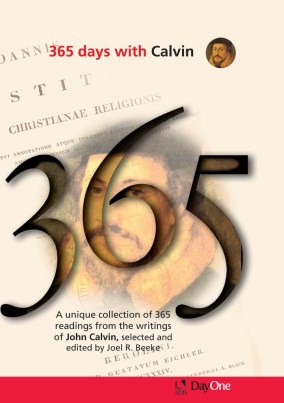
    It is in that spirit that I make a recommendation to you today: a fine little volume titled “365 Days with Calvin.” It is a wonderful little daily devotional where Joel Beeke takes just a snippet from Calvin’s comments on scripture in bite-sized portions that are wonderfully useful. Now some haven’t the foggiest who John Calvin is, or have preconceived negative or positive views of him. But in this volume, Calvin’s usefulness as an expositor of God’s Word comes through with his Pastor’s heart in a wonderfully useful and accessible way. And I submit the following from yesterday’s reading to whet your appetite. Enjoy!

    Touch not; taste not; handle not; which all are to perish with the using; after the commandments and doctrines of men. Colossians 2:21–22

    Paul points out to what length the waywardness of those who bind consciences by their laws is likely to go. From the very beginning they are unduly severe; hence Paul begins with their prohibitions not simply against eating but even against slightly partaking.

    After they have obtained what they wish, they go even further than the command, declaring it unlawful even to taste what they do not wish should be eaten. At length they make it criminal even to touch such food. In short, once leaders have taken upon themselves the right to tyrannize people’s souls, there is no end of daily adding new laws to old ones and starting up new enactments from time to time. Hence Paul admirably admonishes us that human traditions are a labyrinth in which consciences are more and more entangled; nay, more, they are snares, which from the beginning bind people in such a way that in time they are strangled.

    In sum, the worship of God, true piety, and the holiness of Christians do not consist of what they drink and eat and wear, for those things are transient, liable to corruption, and perish by abuse.

    Second, Paul adds that such observances originate with men and not with God, who, by his thunderbolt prostrates and swallows up all traditions of men. Paul says God does this because “Those who bring consciences into bondage do injury to Christ, and make void his death. For whatever is of human invention does not bind conscience.”

    For meditation: In the church today, we create many laws and think that obeying them recommends us to God. We even bind them upon the consciences of others. But some of those laws are simply the creations of men and cannot gain us favor in God’s sight. Such favor can only come through the Son, Jesus Christ. Man-made laws often hinder people in pursuing salvation.

  • 1 Corinthians Ch. 2 – 3 Foundations

    September 14th, 2019

    1 Corinthians Ch. 2

    Reid A Ferguson


    A few weeks ago when we began this study – we were introduced to the 1st Century city of Corinth. A thriving multi-port city that had everything one could wish for – at least in earthly terms.

    Wealth, art and culture abounded. It was a city that thrived on intellect, success, fame, self-promotion and sex. It didn’t abide fools, bumpkins, or anyone who wasn’t striving for recognition among the social elites.

    The Apostle Paul went there to plant the Church of Jesus Christ. To preach the Cross of Jesus to a people who thought they had it all, and a salvation that stood in stark contrast to everything they held dear.

    And it worked!

    In a culture smug in its superiority – that loved its sports, its politics, its money and its immorality – within 18 months Paul had established a thriving band of Believers. A Church we saw in the opening to this letter that flourished in “all speech and knowledge” – rich with spiritual gifts.

    But it was a Church which was also deeply troubled by a host of issues.

    Topping the list of those issues was its fractured membership. Beginning to mirror its culture, it was a church which had divided itself up in cliques. Each group clinging to its identification with various figures like Paul himself, Peter, Apollos and even Jesus. Each vying for some measure of recognition and superiority over the others. And Paul seeks to address this problem head on before he even begins to touch on the other matters he was aware of, and that they themselves had written to him about.

    And as Jim so ably unfolded for us last time – the first thing Paul does is take aim at what was threatening to tear them apart and lose the witness for Christ in that city. Thus we saw for ourselves as well how God graciously destroys our self-confidence – so that our confidence is in Christ alone. Confidence in their factions, in their heroes, in their intellect, in their goodness, and in their imagined status over and against each other – all of it needed to be abandoned. NEEDS, to be abandoned. For God receives us only in, and because of Christ Jesus our Lord.

    The Church is not rooted in its own perceived wisdom, power, goodness, status or accomplishment. It is founded upon the finished work of Christ to reconcile lost and justly condemned sinners to the Living God through faith in the substitutionary sacrifice of Jesus for our sins on the Cross. Nothing more. Nothing less. Nothing else.

    But Paul’s work in healing these factions has only just begun. In fact, as we turn to chapter 2, we see how he needs to put 3 critical foundation stones in place, before he can tackle the faction problem more directly. That is what brings us to our text this morning.

    Now the passage breaks itself up fairly naturally in discussing 3 problems which lurk below the surface. The disease underlying the symptom of division in the Church.

    1. vss. 1-5 The Problem of Losing the Simplicity and Centrality of the Gospel.
    2. vss. 6-12 The Problem of embracing a salvation of Reason apart from Revelation.
    3. vss. 13-16 The Problem of failing to distinguish between the Spiritual and the Natural.
    4. 1-5 The Problem of Losing the Simplicity and Centrality of the Gospel.

    Paul had done his homework. He knew what made Corinthian society hum. And he took aim at it in the very way he approached ministry there. So he reminds his readers and us of the 3 things he intentionally avoided in bringing them the Gospel:

    1. 1 Cor. 2:1-2 He made no impressive presentation:

    1 Corinthians 2:1–2 ESV / And I, when I came to you, brothers, did not come proclaiming to you the testimony of God with lofty speech or wisdom. For I decided to know nothing among you except Jesus Christ and him crucified.

    Knowing Corinthian culture and how they placed such great value on people sounding smart and “with it” – he intentionally went in the opposite direction.

    He wanted nothing to get in the way of their ultimate need, and his ultimate aim – to reconcile them to God through the preaching of Jesus Christ and Him crucified.

    What did that look like? Paul will recount it in 1 Corinthians 15:3–4 ESV / For I delivered to you as of first importance what I also received: that Christ died for our sins in accordance with the Scriptures, that he was buried, that he was raised on the third day in accordance with the Scriptures,

    Nothing in all the world is more important for anyone to know than these things: Who Jesus is, why He came and what He did. Everything in Biblical Christianity flows out of this incredibly simple declaration.

    Paul is a strategist and loves this approach of opposites. On Mars Hill where the culture was all about hearing something new, he stood up and said: “I’m going to tell you about something you already know – but don’t know well enough – your “unknown god.” And here, where high ideas spoken by gifted speakers ruled the day – he started with the simple, unadorned Gospel. He refused to feed into their appetite, but aimed at creating a new one.

    He aimed at making no impressive presentation – so as to spotlight the message rather than the medium.

    1. 1 Cor. 2:3 He refused to present himself as an impressive person:

    1 Corinthians 2:3 ESV / And I was with you in weakness and in fear and much trembling,

    When Paul got to Corinth, he was arriving after facing a raft of difficulties. Rabid opposition had turned everything to chaos in Philippi. In Thessalonica, a riot broke out and he had to be secretly dispatched. Things at Berea started out better, but then trouble-makers from Thessalonica arrived and the brothers sent him away again. At Athens, the response is tepid.

    Years ago I sort of always thought of the Apostle Paul a bit like Yosemite Sam – coming into town guns blazing and taking no prisoners. But then I read this, or 2 Cor. 10:10 where he admits his detractors say his in-person persona is weak and he is not a great orator.

    Trauma leaves its mark. At this point Paul was no doubt a bit gun shy. In 1972 I was mowing a lawn when I slipped on the grass and lost a portion of a toe to the power mower. And to this day I cannot see or hear a power mower without a certain inward twinge.

    After a number of beatings, riots, threatenings and narrow escapes, can we imagine Paul unfazed? No. Now it didn’t stop him, but it didn’t make him look like much in human terms either. And He let that weakness be seen.

    From the text here we gather that he did not try to pass himself off as a person to be admired, followed or emulated – but as a weak and trembling man simply relying on a great Savior. The message, not the man took precedence.

    1. And 3rd, 1 Cor. 2:4 He made no attempts at making the message more plausible – why in earthly wisdom it should be believed.

    1 Corinthians 2:4 ESV / and my speech and my message were not in plausible words of wisdom, but in demonstration of the Spirit and of power,

    The message was sufficient on its own – preached within the Biblical framework. As he would remind us in his letter to the Romans – he was not ashamed of the Gospel because IT – THE MESSAGE – is the very power of God unto salvation (Rom. 1:16)

    The demonstration of its power being nothing other than the changed lives it produced. It raised people from spiritual death to new life in Christ. It caused people to be born again.

    Now don’t get me wrong, he never tried to obscure the message or detract from it any other way either. He didn’t work to make it objectionable – just clear and not dependent upon anything other than the Holy Spirit creating life in the hearers by it. Clarity was always a concern. So he says in Colossians 4:3–4 ESV / At the same time, pray also for us, that God may open to us a door for the word, to declare the mystery of Christ, on account of which I am in prison— that I may make it clear, which is how I ought to speak.

    He made no impressive presentation;

    Didn’t advance himself as an impressive person;

    And refused to try to make the message plausible – more reasonable – to unaided human reason.

    All 3 of which had evidently begun to seep into the Church there from the culture – and were contributing to competition and factions in the Church.

    And here is a massive warning needed in our own day.

    Christian, do not center your own Christian life around ministries that major on slick presentations, magnetic and persuasive personalities or what might sound like high-flying insights: Keep to the Gospel, the simple, unadorned Gospel of Jesus Christ and His saving work to bring to you the Father in due time – robed in His righteousness.

    1. vss. 6-12 The Problem of embracing a salvation of Reason apart from Revelation.

    Now Paul had already mentioned in Ch. 1 that the message of the cross is foolishness to most people, and that God Himself ordered this world so that unassisted by the Spirit, people cannot reason themselves to God’s means of salvation.

    We read the same thing in Ecclesiastes 8:16-17  / “When I tried to gain wisdom and to observe the activity on earth— even though it prevents anyone from sleeping day or night— then I discerned all that God has done: No one really comprehends what happens on earth. Despite all human efforts to discover it, no one can ever grasp it. Even if a wise person claimed that he understood, he would not really comprehend it.” NET

    But when the Church losses its confidence in the message of the Cross, or, as in this case they were laboring in a culture that put an excessively high premium on logic and human persuasiveness, the temptation is to try and strip away anything from the Gospel which seems contrary to a thoughtful, logical, scientifically oriented mind.

    And this has remained a problem in every generation.

    So some try to downplay the parts of Scripture which others might find troubling. Let’s deny or modify special creation. Make Noah’s flood merely local. Skip the bits about angelic visitations, Jonah being swallowed by a great fish, the parting of the Red Sea, Jesus walking on the water, etc.. Let’s make our message more palatable to the rational mind and get rid of the supernatural bits. So Jesus dies as a great example but not as an actual substitutionary blood sacrifice in our place. And His resurrection is just a spiritual thing, not physical. Let’s make salvation merely a matter of intellectually assenting to a certain set of religious propositions rather than insisting – like Jesus – that one “must be born again” – when that is an act of God after all and we have no control over it. Let’s make the whole thing plausible to an unregenerate mind. Never mind if it is what the Bible teaches, can we make it sound OK? Can we make it acceptable to people who are still enemies of the Living God?

    But it can’t be done – no matter how many times it has been tried. Because it isn’t God’s method. His, is to preach this bare message, and leave it to the Holy Spirit to make it reasonable by opening their eyes to the truth of it all. But that WILL exclude us from certain company. It will not gain the Church its highest acceptance in society. And it will create and artificial elite within the ranks of the Church. The intellectual elite who know better than to buy all this supernatural stuff, but let the hoi polloi cling to it if they need to. And these elite then can rub shoulders with the more sophisticated in society having rejected the stuff of the low-brow, slack-jawed Luddites.

    That said – Paul goes on to say we DO NOT speak utter nonsense, but true sense – to the awakened soul. 1 Cor. 2:6-7

    1 Corinthians 2:6–7 ESV / Yet among the mature we do impart wisdom, although it is not a wisdom of this age or of the rulers of this age, who are doomed to pass away. But we impart a secret and hidden wisdom of God, which God decreed before the ages for our glory.

    The word mature here isn’t meant to bring up the issue of age, but one of capacity.

    You can discuss the properties of the visible spectrum all day long with a blind person, but they cannot see that light, even though they can understand every single scientific fact and concept. Apart from the faculty of sight, the facts remain true, but simply talk.

    So as our text here says, to those who have been born again, the realities surrounding Christ and the cross make perfect sense, they are realities, not mere theories or ideas. This is the hidden or secret wisdom which He alone imparts to us by opening our eyes. And He designed it this way that our glory comes from Him, from His “well done” on the final day and not from men as though the one with the highest intellect is the most spiritual.

    So John Flavel would write: “All other knowledge is natural, but this wholly supernatural, Mat. 11:27. “No man knoweth the Son, but the Father; neither knoweth any the Father, save the Son, and he to whomsoever the Son will reveal him.” The wisest Heathens could never make a discovery of Christ by their deepest searches into nature; the most eagle-eyed philosophers were but children in knowledge, compared with the most illiterate Christians.”

    So, 1 Cor. 2:8 goes on

    1 Corinthians 2:8 ESV / None of the rulers of this age understood this, for if they had, they would not have crucified the Lord of glory.

    But men cannot know these things with bare intellect – thus 1 Cor. 2:9-10  ESV / But, as it is written, “What no eye has seen, nor ear heard, nor the heart of man imagined, what God has prepared for those who love him”—
    these things God has revealed to us through the Spirit. For the Spirit searches everything, even the depths of God.

    The significance of Paul referring to Isa. 64 here is that it is a passage proclaiming the seeming impossible restoration and salvation of God’s people in light of their sin and captivity. No one would ever imagine God could make a way! But out of the hidden depths of His magnificent mercy and grace – He makes a way. And it is the express domain of the Spirit to make that impossibility known to us.

    The glories and benefits of the saving work of Jesus Christ – these are the deepest things in the heart and mind of God – 1 Corinthians 2:10–11 ESV / these things God has revealed to us through the Spirit. For the Spirit searches everything, even the depths of God. For who knows a person’s thoughts except the spirit of that person, which is in him? So also no one comprehends the thoughts of God except the Spirit of God.

    These are what the Spirit of God alone searches out and knows and what He alone reveals to us. And this is why the Spirit of God is given: 1 Corinthians 2:12 ESV / Now we have received not the spirit of the world, but the Spirit who is from God, that we might understand the things freely given us by God.

    Did you get that last phrase? We must have the Spirit of God within us, in order to understand the things which are freely given to us by God in Christ.

    Seeing Jesus for who He is and what He has done; God as Creator; Mankind as created; Mankind as rebelliously fallen; God’s plan of reconciliation; Jesus Christ the substitute and risen Lord; The gift of The Spirit; The truth of The Word; The reality of coming judgment; Resurrection; Heaven and Hell; The Church of the redeemed – only the Spirit knows all of God’s mind, and only the Spirit can bring that light to ours.

    Apart from this quickening, this awakening by the Holy Spirit – they remain words we can understand, but realities we do not possess.

    This is why there are so many today who claim Christianity in one form or another, who nevertheless live as though the Spirit of God is not in them leading them to love and live in holiness. And why their Christianity consists not in growing into the image of Christ and seeking to walk intimately with Jesus and arrive at an eternal destiny in the presence of their redeeming God – but who are driven more by social issues, bare morality, and a fixation on how God can simply make my life better, or this world a better place.

    This is why so many who claim to be Christians and sit in Christian pews week after week are in fact still dead in their trespasses and sins. Because we have made salvation a matter or mere reason, and abandoned the need for the supernatural work of the Holy Spirit in bring men and women to new life in Jesus Christ through the Gospel.

    And that brings us to Paul’s 3rd foundation stone:

    1. vss. 1-5 The Problem of Losing the Simplicity and Centrality of the Gospel.
    2. vss. 6-12 The Problem of embracing a salvation of Reason apart from Revelation.
    3. vss. 13-16 The Problem of failing to distinguish between the Spiritual and the Natural.

    This obviously is an extension of the previous 2.

    Those who have been given the Spirit, have their eyes opened to the truth of all that the Bible teaches – especially in relation to the person and saving work of Jesus Christ – and then we – we instruct one another in THESE things, with the Biblical language and concepts He has given us: 1 Corinthians 2:13 ESV / And we impart this in words not taught by human wisdom but taught by the Spirit, interpreting spiritual truths to those who are spiritual.

    And here is a most timely word to us. For as it was then, so it is on our own day that people will say “I’m not religious”, or “I don’t subscribe to organized religion”, or “I don’t go to Church”, but: “I’m spiritual.”

    But as our text notes we use a Spirit bred vocabulary which the world sometimes tries to borrow, but in fact strips of the meaning God has given to it.

    For this is the Biblical reality: No one is “spiritual” unless they have been born again by the Spirit of God, and given new life in Christ – believing on the Gospel of Jesus Christ. No one. No matter how nice, how sensitive, how religious sounding, etc.

    Once again the lines become blurred and even the Church can become comprised of a largely unregenerate membership when we accept as “spiritual” that which God says is NOT spiritual – but merely natural.

    And when this happens, the words, the ideas, the teachings and methods of people who claim this spirituality, are accepted into the Church and the insistence upon the Gospel, upon regeneration, the authority of God’s Word, upon the pursuit of Christ and eternal life with Him – become mixed, muddled, and eventually lost altogether. It ALWAYS results in one of two things – or both: Legalism, because Christianity becomes external moralism rather than Spirit motivated holiness – or Cross-less political correctness bowing to the trends of the culture.

    Biblical words and concepts like redemption, regeneration, salvation, justification, righteousness, holiness, penal substitution, resurrection and even faith and God – all get reinterpreted and robbed of their true significance and power.

    The truth is: 1 Corinthians 2:14 ESV / The natural person does not accept the things of the Spirit of God, for they are folly to him, and he is not able to understand them because they are spiritually discerned.

    Evangelism and proselytizing are looked upon askance and as unspiritual because they call people to know they are sinners who need to be redeemed by grace. Biblical truths declare some things are really wrong, some views are really wrong, some lifestyles are really wrong, some religions are really wrong – and people are lost and undone apart from Christ.

    But when the Church can no longer differentiate between those who profess Christianity but manifest nothing of His Spirit changing them – bringing the loves into them that the Spirit invariably does for His Word, His people and confidence in the revelation His Word brings – then the Church loses all of its power and authority to preach the Gospel and call men to salvation.

    It cannot help but degenerate into a mere social and religious organization – with some priority other than seeing people reconciled to God through the Gospel – and seeking the glory of God in all things through the revelation of Him in the cross of Jesus Christ.

    Paul is going to show what this failure looks like as he opens up ch. 3. When spiritual men and women begin to act as though they are still only natural. It brings wicked division.

    Now the truth is – the truly spiritual – those supernaturally in Christ, will always be misunderstood by those outside of Christ – no matter what they profess.

    1 Corinthians 2:15 ESV / The spiritual person judges all things, but is himself to be judged by no one.

    I saw a movie this week where a little boy of about 10 witnessed a terrible crime. But when he was brought to be questioned by the Police, he was completely uncooperative. At first they chalked it up to shock. But in time they began to suspect he was withholding for some reason – and was being stubborn in not answering a single one of their questions. As exasperation grew and they were about to get really tough on him for his unresponsiveness – one of the Policemen got an idea. And kneeling down before the lad he made a gesture with his hand. And the little boy smiled and gestured back. He wasn’t being stubbornly unresponsive, he was totally deaf, couldn’t read lips, didn’t know sign language. And, he was scared out of his wits. Once they knew his condition, all of his actions made perfect sense. But until then, they were all misinterpreted.

    The World, natural men and women, will not understand why we do what we do at times. They cannot. Even though we can fully understand why they do what they do. We were there once too. We know what it was to be blind back then. To be bound in darkness and sin. To think these things of Christ silly and senseless. We get it. They can’t.

    So Paul puts a final label on that difference: 1 Corinthians 2:16 ESV / “For who has understood the mind of the Lord so as to instruct him?” But we have the mind of Christ.

    This is the great dividing line in all of humanity – those who have the “mind of Christ” the Spirit of Christ, and those who do not.

    As the Church we must be willing to retain the reality that people are not all the same. That there are those who are born again, who have the Spirit and the mind of Christ – those who are spiritual, and those who are not – those who are natural. It does not make the spiritual superior, it only makes them recipients of grace. A grace that moves them to desire the same for the others. It calls us to compassion, understanding, but also to say they cannot be considered as part of the Church so as to have influence in its call, mission or message.

    1. vss. 1-5 The Problem of Losing the Simplicity and Centrality of the Gospel.
    2. vss. 6-12 The Problem of embracing a salvation of Reason apart from Revelation.
    3. vss. 13-16 The Problem of failing to distinguish between the Spiritual and the Natural.

    While we’ve made a few applications along the way, let me take a moment to leave us with just a couple of very important takeaways.

    1. Very briefly, do not be taken in by what is so often labeled as “spiritual” out there.

    If they will not make a bold profession of saving faith in the Gospel of Jesus Christ and His substitutionary atonement on the Cross – accepting the whole of the Word of God as authoritative and true – and pursuing a life of holiness – they are NOT spiritual, but natural. Fallen man apart from Christ. And their lessons and teachings are to be rejected as not having any true spiritual import. Not when it comes to salvation and life in Christ.

    I cannot emphasize this enough beloved. It may be clothed in Bible terms, they may say “Jesus” etc. But everything hinges on the true Gospel and submission to Christ as Lord. Apart from that, do not receive them as spiritual authorities in your life.

    There are books, programs, shows, podcasts and articles galore which purport to be Christian, but have nothing to do with leading you to greater trust in Jesus, the fullness of His work on the Cross, His Word and growing in Christ – and everything to do with secrets to success, power, money, happiness and well-being – as though they are legitimate after-market add-ons to give you the REAL Christian life. DON’T BUY IT! If they don’t take you back to Christ and the Cross, they are fakes.

    2 – And of absolute supreme importance – Let no one ever make you ashamed of or shy away from the simplicity of the Gospel.

    No, it doesn’t sound cool. It cannot be made to sound cool and retain its power.

    The message of the Cross is that all humankind has rebelled against God the creator by wanting to be lords over our own lives, and that we are guilty and condemned before Him. That we need a savior to rescue us. That salvation is beyond our power to accomplish. And the only savior God has provided is Jesus Christ, God in human flesh – dying on the cross to take the just punishment due to us for our sins. And that His satisfaction of the Father on our behalf must be received by faith in the power of that work alone to reconcile us to the Father. He alone is the truth, the life and the way, and no man can come to the Father but by Him.

    And that salvation rests in being reconciled back to God in Jesus’ death, burial and resurrection.

    Never let that simple message be obscured for any reason. It is in fact foolishness to others until the Spirit uses it to open their eyes. But don’t try to escape the raw reality of it.

    You don’t have to make some snazzy presentation.

    You don’t have to be a great speaker.

    You don’t have to pretend to have everything together, know all the answers or defend every objection.

    You just have to state the facts as clearly and simply as possible. And look to the Holy Spirit to make it real to their souls.


     

  • Margin notes: Simple Faith

    September 13th, 2019

    Luke 5:4–6 (ESV) — 4 And when he had finished speaking, he said to Simon, “Put out into the deep and let down your nets for a catch.” 5 And Simon answered, “Master, we toiled all night and took nothing! But at your word I will let down the nets.” 6 And when they had done this, they enclosed a large number of fish, and their nets were breaking.

    There are some principles in Scripture which need to be revisited over and over. They are like the foundation stones of a skyscraper. If they give way, everything gives way. If they are compromised, instability is the inevitable result. And, as in this text, they can appear quite inconspicuously, unless you really stop to consider them. And they greatly inform key strands in Scripture and the Christian life in such a way that they prevent the Believer from very destructive and debilitating thought patterns.

    Of these, developing right thoughts about faith, Biblical faith, is truly one of the utmost importance. I’ve beat this drum before, but rehearse it with me again today.

    In vs. 5, the words and actions of Peter in response to Jesus’ “put out into the deep and let down your nets for a catch” hold the clearest and most succinct exposition of faith. It reasons in the face of everything else “but at your word.”

    So note carefully, faith does not groundlessly hope. It does not pluck its expectation from the air. It is not the product of imagination, or a contrived desire. We cannot have faith regarding that which God has not said. No. It roots itself firmly in one place: What God HAS said. And then acts accordingly.

    So many, sadly, do almost irreparable harm to their own faith. They do so when they hold God to promises He never made, or to impressions they thought came from Him. Then, when He appears not to have come through, they inwardly undermine their own ability to believe Him in the things He HAS said.

    Though stated in another context, Paul’s words in 1 Cor. 4:6 have broad application and especially in this issue: “learn by us not to beyond what is written.” What God has said, what He has inspired by His Spirit to have written down for us in His Word – these are the things (rightly interpreted) in which we can have absolute faith. And when we go beyond that into thoughts, desires, impressions or hopes of our own creation – we open ourselves to faith-destroying disappointments.

    Let Peter’s example be your guide – “But at your word.” And you will find a safe haven for your soul. A truly firm foundation for your faith.

  • Margin notes: Symptoms, Disease and Social Justice

    September 11th, 2019

    Isaiah 1:2–4 (ESV) — 2 Hear, O heavens, and give ear, O earth; for the Lord has spoken: “Children have I reared and brought up, but they have rebelled against me. 3 The ox knows its owner, and the donkey its master’s crib, but Israel does not know, my people do not understand.” 4 Ah, sinful nation, a people laden with iniquity, offspring of evildoers, children who deal corruptly! They have forsaken the Lord, they have despised the Holy One of Israel, they are utterly estranged.

    Isaiah is a powerful book in its sweeping condemnation of God’s people for their sin, warnings, visions of the future Day of the Lord both as the day of restoration and of justice, and of ultimate hope in God’s redemptive power. But as it starts out, it deals head-on with the sins God intends to deal with them about.

    Balance is an issue of constant concern in the Church, and this text brings us one place of balanced consideration into sharp focus. Here is a very great lesson – the need to distinguish between diseases themselves, and their symptoms. And as we all know, no cure can be had by merely treating symptoms. Ultimately, we must aim at a cure. And a cure can only be had by treating the root cause – the disease itself.

    Isaiah is going to rehearse a litany of dreadful symptoms that indicated Israel’s diseased state: Idolatry. Oppression of the poor. Religion without repentance. Sexual immorality. Materialism. Superstition. False religion. Corruption in government. Bribery to pervert justice. Arrogance. Trust in political power and military might. Neglect of widows, orphans and the lower classes of society. And many, many more. All wretched things. And all, just the symptoms. The underlying disease? The same as it was in the Garden, and remains inherent in every sin you and I and society at large manifest today: Rebellion against God’s rightful authority over us, and the pursuit of provision for heart and soul and mind from some source other than God Himself. Not recognizing our absolute need of Him. From these twin contagions spring every manifestation of sinful putrefaction.

    We dare not ignore the symptoms. We must respond. They are God-appointed indicators. But we must respond in full, not in part. The symptoms are no more the real issue than the red light on your dashboard is. No bandaids on cancers. Cures are what we need. THE cure. Repentance from sin, and faith toward God in Jesus Christ, resulting in lives lived loving the Lord our God with all our hearts, minds, souls, and strength, and our neighbors as ourselves. For as we have a dual disease, so we must have a dual cure. One that addresses only God and not our neighbor, or only our neighbor and not our God will still be treating only symptoms. There is no such thing as a Christianity which is compassionless to the suffering of men, even as there is no Christianity but brings men to the foot of the Cross, and reconciles them to God in the blood of Christ as the first compassion – compassion on their eternal souls. Tip this boat on either side, and it WILL capsize. No man who loves God can disregard human suffering in all of its manifestations. And no man who truly loves people can actually love them while ignoring the eternal destiny of their souls. There is no social justice apart from reckoning with eternal justice and the Cross of Jesus Christ.

    Biblical balance is hard-won.

  • Margin notes: The power of faith?

    September 10th, 2019

    Matthew 9:20–22 (ESV) — 20 And behold, a woman who had suffered from a discharge of blood for twelve years came up behind him and touched the fringe of his garment, 21 for she said to herself, “If I only touch his garment, I will be made well.” 22 Jesus turned, and seeing her he said, “Take heart, daughter; your faith has made you well.” And instantly the woman was made well.

    As Dr. Smith took us through this amazing passage this last Sunday, I could not help but be caught by those words of Jesus “your faith has made you well” – or “saved you”, or “made you whole.” Jesus alluded to this concept at least 4 times in the Gospels if not more. “Your faith has made you well.” But how are we to understand that? Does this imply that faith is some force that we can just tap into to get what we want? What is really going on here?

    It is vitally important to note the context here, as well as in each of the cases where a similar thing is said. And so we MUST see this: Her faith did not do this, did not make her well,  in a vacuum, as though faith had power in itself. What her faith did was bring her to Christ, and to trust HE could work.

    Faith does nothing on its own. Faith is neither a “work”, nor a generic cosmic force we can somehow tap into for our own uses, it is looking to Christ. If faith could operate on its own, then she did not need to get to Jesus at all. She could have “just believed” where she was. So too with the others where this phrase is used. But in each case, it was faith that brought them into contact with Jesus. It was bringing their need to Him, not just “believing.” This is vitally important to see if we are not to turn faith into a Christianized view of magic. Faith brings us to Christ, and looks to Him to meet the need, as He sees fit. It simply looks to Him. This is always what faith does. 

    But note the nature of her faith. She did not imagine she needed Him to stand and make pronouncements, move mountains, still seas, rebuke storms or demons – she knew all she needed was the slightest touch. That grace and mercy are so grand, so expansive, that the slightest true touch – even of just His garment, will transform in the most unspeakably glorious and powerful way.

    What we need every day, is the sense of our need being great enough, to press through the mob of all that claims our attention and seems to make Him distant, to but touch the hem of His robe. Lord Jesus, let me come to you – today!

    This is the place of prayer. Press through. Touch His hem.


  • Margin notes: Lessons from a former demoniac

    September 6th, 2019

    Mark 5:18–20 (ESV) — 18 As he was getting into the boat, the man who had been possessed with demons begged him that he might be with him. 19 And he did not permit him but said to him, “Go home to your friends and tell them how much the Lord has done for you, and how he has had mercy on you.” 20 And he went away and began to proclaim in the Decapolis how much Jesus had done for him, and everyone marveled.

    The astounding account of this man delivered from the legion of demons stans on its own as a demonstration of the mercy, goodness and power of Jesus Christ. His authority over the demons. His mercy on this horribly bound man. His sad rejection by the townsfolk. But there are two other things are worth noting in this brief account.

    First: Not every good and right desire, is the best desire. There is nothing in this man’s request but what is good and pure and honorable. But God determines what is best. Best for the man, best for the kingdom and best for those he will reach. Do not be discouraged if God chooses some other path for you than the one you think most desirable or proper. How you think you can serve best. Nothing could be more right – in a sense – than wanting to travel with Jesus, sit at His feet, serve Him and listen to Him. But Jesus had other plans. He needed him to go bear witness back in Decapolis. Thus it was personally costly to serve Him this way. To not have what he would rather have, that the King might be served as He best thought fit. Father, give me such a willing heart – that I do not demand to serve you as I see fit, above what you do.

    Second: Though it has been discounted in some circles, here is a great encouragement in evangelism. With only the barest exposure to Christ. With little or no theological training. With no more detailed instruction than this – a man may enter upon a fruitful and Christ sanctioned ministry of evangelism: “Go home to your friends and them how much the Lord has done for you, and how He has had mercy on you.” Isn’t that just so abundantly simple and sweet and ready at hand? The telling of how He has met us in our sin, and of His great mercy is enough. Each of us is a ready-made evangelist in this accounting. Don’t wait a minute more. Don’t fear you don’t know enough or haven’t been given techniques or strategies. Just tell them how much He’s done for you. That’s all He asks. It is enough.

    But note that the key, the bottom line is this: He needed and received MERCY. Those who do not believe they need mercy, know nothing of true saving grace. If we have not, in mercy, been delivered from our bondage to sin, and the just wrath it deserves, we are not saved. And we cannot be His witnesses.


  • Margin notes: Psalm 46

    September 5th, 2019

    Psalm 46
    God is our refuge and strength, a very present help in trouble.
    2  Therefore we will not fear though the earth gives way, though the mountains be moved into the heart of the sea,
    3  though its waters roar and foam, though the mountains tremble at its swelling. Selah

    4  There is a river whose streams make glad the city of God, the holy habitation of the Most High.
    5  God is in the midst of her; she shall not be moved; God will help her when morning dawns.
    6  The nations rage, the kingdoms totter; he utters his voice, the earth melts.
    7  The LORD of hosts is with us; the God of Jacob is our fortress. Selah

    8  Come, behold the works of the LORD, how he has brought desolations on the earth.
    9  He makes wars cease to the end of the earth; he breaks the bow and shatters the spear;
    he burns the chariots with fire.
    10  “Be still, and know that I am God. I will be exalted among the nations, I will be exalted in the earth!”
    11  The LORD of hosts is with us; the God of Jacob is our fortress. Selah

    God IS our refuge, He does not provide one outside of Himself. He desires us to run to Him in everything.

    God is our strength – He does not make US strong, He bids us to rely upon Him.

    God is VERY present in our troubles. He is not far off. He remains with us at all times.

    THEREFORE the Psalmist concludes: Since the One who made the earth is the one we run to when it crumbles beneath our feet; since the one who formed the mountains is our strength, when they begin to disintegrate; since He is ever with us though by all accounts we are to be overwhelmed and drowned – we will not fear. Our reality encompasses more than the created universe. We are loved by the Creator.

    And therefore, we can “be still.” Be calm. Be comforted, in knowing that He is God.

    That he WILL be exalted among the nations in due time.

    That He WILL be exalted in the earth.

    That He IS with us.

    That He IS our fortress.

    Hallelujah!

  • Margin notes: An encouragement to prayer

    September 4th, 2019

    Matthew 20:29–34 (ESV) — 29 And as they went out of Jericho, a great crowd followed him. 30 And behold, there were two blind men sitting by the roadside, and when they heard that Jesus was passing by, they cried out, “Lord, have mercy on us, Son of David!” 31 The crowd rebuked them, telling them to be silent, but they cried out all the more, “Lord, have mercy on us, Son of David!” 32 And stopping, Jesus called them and said, “What do you want me to do for you?” 33 They said to him, “Lord, let our eyes be opened.” 34 And Jesus in pity touched their eyes, and immediately they recovered their sight and followed him.

    What a great encouragement to prayer this account is.

    Note that Jesus is never too busy, never too preoccupied to hear us when we pray. Nor does He fail to hear us because of where we are. These men were unable to go to Him, but He was passing by. He always is. And despite the chaos of the “great crowd” and the rebukes of that crowd to stop pestering Jesus – perhaps interrupting His teaching – He heard. And stopped. And responded.

    And note how He did not presume to know what they wanted. He asked them. He does not respond like a machine, but in pity and in an attitude of personal care. While we might think their blindness was the obvious need, who knows what else may have been the case. Might there be an even worse malady, or perhaps someone else they would petition for? But He stops to ask. As He does with us. He waits to hear our hearts and minds. He gives us His tender, personal attention.

    Nor is He offended that their prayer centered on their own perceived need at the moment. He did not rebuke them that they did not ask for greater, grander, more spiritual things. They cried out, out of their need. And so do we. And no doubt, there were better, more important things they could have asked for. But this is where they were. This is what filled their hearts at the moment. And Jesus, in His tenderness and compassion meets the need of the moment as they were experiencing it. He is so good and gracious and overflowing with compassion toward us – in all of our needs, great and small.

    As they followed Him after their healing, no doubt they learned to pray for many other things far beyond their mere physical needs. But this is where they began. And so with us. We grow in grace in time and the focus of our prayers can and will shift. But we ought never to forget how He meets us where we are, even as He designs to take us beyond where we are in time. Never be ashamed of the smallest need, but cast ALL of your cares upon Him. For He cares for us.

  • Margin notes: The power of prayer

    September 3rd, 2019

    Matthew 14:27–31 (ESV) — 27 But immediately Jesus spoke to them, saying, “Take heart; it is I. Do not be afraid.” 28 And Peter answered him, “Lord, if it is you, command me to come to you on the water.” 29 He said, “Come.” So Peter got out of the boat and walked on the water and came to Jesus. 30 But when he saw the wind, he was afraid, and beginning to sink he cried out, “Lord, save me.” 31 Jesus immediately reached out his hand and took hold of him, saying to him, “O you of little faith, why did you doubt?”

    We all know this famous account of Jesus walking on the water to the Disciples. Here they were in the storm, and here comes Jesus – in the most unlikely way. We can only imagine how mind-boggling this must have been for them. And then Peter – perhaps without thinking it through at all takes the step of asking Jesus to command him to walk on the sea. I for one would never have the nerve. Blessed impetuous Peter.

    And then, distracted by the wind and waves, Peter begins to sink. And so he prays. No formally, the way we normally think of prayer – he just cries out in his panic. And it is so very informative and encouraging.

    And when it is all said and done, could there be a more eloquent prayer? It is but 2 words in the Greek – “Lord! Save!”

    It wasn’t dismissed for its brevity. It wasn’t ignored because it was uttered in terror. It wasn’t denied because the very thing which occasioned it was lack of faith – but it was answered because it was directed at our Lord. Because Christ is a Christ who saves those who call upon Him. Because He is merciful. Because He is faithful. Because He is compassionate. Because He is full of grace. Because He loves us. It is not the power, eloquence, length or glory of our prayers – but the wonder of the One we pray to. Never think your prayer too weak, too poorly phrased, too imprecise, too un-religious sounding to be heard and answered. For the power in prayer is not located in how well we pray, but in how well our Savior hears and responds. He is a prayer-hearing and answering God. And we have full access to Him because of Christ’s death on our behalf.

    If your prayer today is only “Lord! Save!” Know it is enough. Because He is enough.

  • Margin notes: The Gift of Suspicion

    August 30th, 2019

    Proverbs 30:7–9 (ESV): Two things I ask of you; deny them not to me before I die: 8  Remove far from me falsehood and lying; give me neither poverty nor riches; feed me with the food that is needful for me, 9  lest I be full and deny you and say, “Who is the Lord?” or lest I be poor and steal and profane the name of my God.

    The two things our writer is concerned about here merge in being kept back from deception by virtue of his own response to external conditions.

    Poverty lies to us – in that when we feel deprived, we begin to believe it is a worng doen to us by God and profane Him in theft. Riches deceive in our foolish trust in them. It is this tendency toward self-deception our writer sees within himself and prays that God will not allow him to fall victim to his own perverse inward sinfulness. “Lead us not into temptation, but deliver us from the evil one.”

    And in this day of the proliferation of the “prosperity Gospel”, who would think to pray this way? In a world obsessed with success (humanly measured), performance, personal achievement and the notion that God seems to exist for me, to make my life what I desire it to be – what a rebuke this is! How it challenges us to examine our desires and priorities. To see if our goal is Christlikeness above comfort; freedom from sin instead of freedom to sin; and self-suspicion above self-confidence. But it seems as though we assume that if we want it, it must be valid and therefore it is God’s mandate to help us secure it. Whatever “it” may be.

    Personally, abundance seems to be the more destructive to me. My tendency to take what is abundantly given, and to rest in it apart from the Giver, and to be greedy in it so as to want even more beyond what He has provided is a most pernicious facet of my own soul. But I have also known the sin of self-justifying theft when pinched by circumstances.

    Heavenly Father, you know my heart better than I. You know my propensity to grow more stingy when I have abundance, and resentful when in lack. Grant me the gift of suspecting my own motives that I might seek only what will be most in keeping with recreating the image of Christ within me, and honoring you in my life and decisions. Grant only what is most needful for me in your quest to rid me of sin, and make me like Jesus.

←Previous Page
1 … 80 81 82 83 84 … 197
Next Page→

Blog at WordPress.com.


Loading Comments...
 

    • Subscribe Subscribed
      • ResponsiveReiding
      • Join 418 other subscribers
      • Already have a WordPress.com account? Log in now.
      • ResponsiveReiding
      • Subscribe Subscribed
      • Sign up
      • Log in
      • Report this content
      • View site in Reader
      • Manage subscriptions
      • Collapse this bar