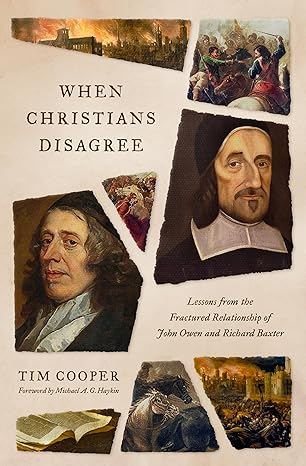
If the title to this entry is worthy of the title to a Puritan’s sermon, that is not an accident. I do it on purpose. It only makes sense when the subjects of a book are two titans of Puritan England: John Owen and Richard Baxter.
If the notion of a theological page-turner seems to be an oxymoron, you have to, you MUST read Tim Cooper’s “When Christians Disagree”. You must. It is subtitled: “Lessons from the Fractured Relationship of John Owen and Richard Baxter.” When you simply cannot put the book down until you have read it cover to cover, you’ve struck gold. I started this about 10 last evening, quit a little after midnight, and sat to polish it off this morning. True, it is not a huge tome – just around 160 pages. But it is so crisply and engagingly written, you simply don’t want it to end. All of that without even addressing the actual topic and how it is handled yet.
Amazon’s “About the author” carries this: “Tim Cooper (PhD, University of Canterbury) serves as professor of church history at the University of Otago in New Zealand. He is the author of John Owen, Richard Baxter and the Formation of Nonconformity and an editor of the Oxford University Press scholarly edition of Baxter’s autobiography.” And I will mention quickly that the forward is written by Michael Haykin.
What Cooper so deftly does in this book, is expound Luther’s Simul Justus et Peccator as displayed in the lives and relationship of its two subjects. Two giants of the Faith; two towering geniuses; two godly and theological powerhouses; two men committed to Christ and his glory – whose personal foibles, personalities and disagreements make us blush to consider how they disliked and ill-treated each other. A study in contrasts if there ever was one.
But the author is not interested in painting these warts-and-all portraits for the sake of morbid or emotionally prurient curiosity. His is not to expose their flaws to the rubber-necking gawker. Rather, he is wanting to use their tragic mutual story, to goad us all on to Christian lives that ponder our own sins and shortcomings, how those impact others – especially in discourse – and spur us on to be more fully clothed with Christ.
These men are both heroes in my theological pantheon. And I, like they, am just as sinful, often blind to myself, and have been the unwitting instrument of unnecessary division among the saints at times. Father, forgive us. Forgive me!
Cooper wisely takes the time to examine the political, religious and social landscape of the England in which they both dwelt, and yet experienced vastly differently. Each with their unique upbringing and familial contexts. Each with strong personalities and rigid convictions. Each used by God. Each sinning against the other – especially (and this is SO VERY timely given our online communications) in how they discoursed in print. What a warning and road map this blessed book is.
There are but 7 short chapters followed by a “Conclusion”, a helpful Chronology, a Glossary and a very helpful section on further reading.
Where this crosses over into an oh-so practical book, is that at the end of each chapter (from chapter 2 on) Cooper includes a section for reflecting on what we’ve just read, and then provides insightful questions to ask ourselves in light of what we’ve witnessed. They are sound and deep questions without being contrived or crossing over into the oft-noted Puritan tendency toward morbid introspection. These are truly helpful and worth the time to consider. Not just alone, but with others.
I would really encourage this book to be used by Pastors with their Elders or leadership groups, as well as other small groups as a 7-8 week study. Reading and thinking about the chapter during the week, and then gathering to talk over the questions with others would be absolutely invaluable.
Of all the books I’ve read this year, this was at once the most engaging and enjoyable, as well as instructive and convicting. I cannot recommend it highly enough. If a book can be tasty – that’s what this book is.
Do your soul a favor – buy it and read it soon. Make it a Christmas gift to yourself, and a New Year’s treat. You won’t be sorry.




 ResponsiveReiding