
Psal. 73:25. “Whom have I in heaven but thee?” If it could be supposed (saith one) that God should withdraw from the saints in heaven, and say, Take heaven, and divide it among you; but as for me, I will withdraw from you; the saints would fall a weeping in heaven, and say, Lord, take heaven, and give it to whom thou wilt; it is no heaven to us, except thou be there: Heaven would be very Bochim to the saints without God. In this, our glory in heaven consists, to be ever with the Lord, 1 Thess. 4:17. God himself is the chief part of a saint’s inheritance; in which sense, as some will understand, Rom. 8:1. they are called heirs of God.
Category: redemption
-
-

The balance (scales) of Justice is seen outside France’s national assembly in Paris October 16, 2008. REUTERS/Charles Platiau (FRANCE) – RTX9MO1 2 Corinthians 4:17–18 (ESV) For this light momentary affliction is preparing for us an eternal weight of glory beyond all comparison, 18 as we look not to the things that are seen but to the things that are unseen. For the things that are seen are transient, but the things that are unseen are eternal.
It is a reality, that those who have suffered, are often best equipped to others who are suffering. Especially if their sufferings are somewhat similar.
However, we also know that a doctor need not have suffered from the identical illnesses or conditions we might have, in order to effectively alleviate our suffering. Not every surgeon has had that same surgery we face. That does not disqualify him or her from operating upon us with the best of success. One need not have been poor, to know how to help someone whose finances are in disarray, nor must a doctor have had a baby in order to deliver one.
Nevertheless, there are times when someone’s experience with our particular suffering can be of particular use.
I once knew a pastor who was truly gifted in preaching and teaching God’s Word, and was a truly good and godly man. However, he had hardly ever been ill in his life – and until stricken with an unusual infection, lacked a bit in compassion toward others in their illnesses. He had always been sympathetic, but through his experience become empathetic. But in truth, the spiritual comfort he gave still issued from the very same source – the Word of God under the ministration of the Holy Spirit.
Now it is also true that sometimes, we Believers can be guilty of tossing a passage like the one above at some suffering saint, in a most careless and matter of fact manner. We can try to remind them that that their affliction is but “momentary”, and thus “light.” But if we forget that the Apostle’s point here is that our afflictions are “light” and “momentary” in COMPARISON, to the eternal weight of glory about to be ours – if that contrast is lost, the words can be felt more like an insult if not a downright denial that we are truly suffering at all.
So my first point is that we need to maintain the context here, and use such portions of God’s Word as they were given, if they are to offer the maximum benefit. To use them in such a way that they are not dismissive of the very real and present pain one might be enduring. And then to help them, gently, to try and weigh the present distresses, against the coming glories.
That said, it might also be well for us to remember – and this is my second point, that the one who penned the above passage also penned this: 2 Corinthians 11:23–33 (ESV) Are they servants of Christ? I am a better one—I am talking like a madman—with far greater labors, far more imprisonments, with countless beatings, and often near death. 24 Five times I received at the hands of the Jews the forty lashes less one. 25 Three times I was beaten with rods. Once I was stoned. Three times I was shipwrecked; a night and a day I was adrift at sea; 26 on frequent journeys, in danger from rivers, danger from robbers, danger from my own people, danger from Gentiles, danger in the city, danger in the wilderness, danger at sea, danger from false brothers; 27 in toil and hardship, through many a sleepless night, in hunger and thirst, often without food, in cold and exposure. 28 And, apart from other things, there is the daily pressure on me of my anxiety for all the churches. 29 Who is weak, and I am not weak? Who is made to fall, and I am not indignant? 30 If I must boast, I will boast of the things that show my weakness. 31 The God and Father of the Lord Jesus, he who is blessed forever, knows that I am not lying. 32 At Damascus, the governor under King Aretas was guarding the city of Damascus in order to seize me, 33 but I was let down in a basket through a window in the wall and escaped his hands.
In other words, the one who wrote the first passage, knew suffering well. In a variety of ways few of us will ever experience. And at that, he knows well the sufferings of His Savior Jesus. And this man, so well acquainted with such suffering, is the one who gently brings us back to weigh our present sufferings in the light of the coming, eternal glories. Not as a disinterested promulgator of religious platitudes, but as a fellow sufferer – and one who shares this comfort with us – because it is the comfort he himself has taken advantage of so liberally.
Minister the Word to one another beloved – with tenderness and mercy, and in a balance that soothes the wounds rather than exacerbating them. This is the Spirit of Christ.
-

In this election year, one cannot read or hear anything about the Presidential hopefuls and their constituents without hearing about the “evangelical” voting block.
Some candidates want to take the label to themselves, in order to identify with this block, and others want to eschew it. It a matter of both guilt by, and vindication by – association.
But if you were ask most people what an Evangelical actually is, my guess is – it would run the gambit from fanatic and bigot, to anyone who is simply not Roman Catholic, Jewish, Muslim, or the member of any other recognized or organized religion.
But the term Evangelical once was both very powerful, and well defined. Powerful most likely, BECAUSE it was well defined. However, in all cultures, words and terms come to be redefined through usage, misusage, and sometimes even deliberate recasting.
So Michael Jackson could sing “I’m Bad, I’m Bad” meaning hot, or cool, or awesome. It’s hard to tell which (or maybe all) since as each of those descriptive words also suffer from cultural morphology.
We as a local, independent Church, call ourselves “Evangelical.” The Evangelical Church of Fairport. The question is – what do WE mean by that? And the second necessary question is – what do other people think when they hear that name?
The term Evangelical has a rich historical heritage. And we consciously take the label upon ourselves. Tho I do begin to wonder if it fails to communicate much of anything positive to those who have no clue as to its meaning, beyond its amorphous cultural distortions.
So what IS an Evangelical? Or maybe better, what ought to define one as an Evangelical? We need to poke around in Church history to get a clear view.
In our search for the earliest mention of someone being referred to as “evangelical”, the honor seems to rest withJohn Wycliffe (1320-1384), often described as the “Morningstar of the Reformation”, and also – doctor evangelicus.

The term gained popularity early in the Lutheran side of the Reformation and spread from therewith the awakening of the Gospel across Europe.
Those men wanting to be identified with the recovery of the gospel in terms of its central doctrine of justification by faith called themselves evangelici viri – evangelical men.

Luther liked and used the expression in German as die Evangelischen.
The direct connection in each case was the idea of the gospel – the “evangel”, or “good news.”
“Evangelical continued to gain popularity, and achieved its widespread use during the 18th century in the revival movement associated with Wesley and Whitefield. (See: John Stott’s excellent little book – Evangelical Truth).
The preamble to the Cambridge Declaration, a modern evangelical statement reads: “In the course of history words change. In our day this has happened to the word “evangelical.” In the past it served as a bond of unity between Christians from a wide diversity of church traditions. Historic evangelicalism was confessional. It embraced the essential truths of Christianity as those were defined by the great ecumenical councils of the church. In addition, evangelicals also shared a common heritage in the “solas” of the sixteenth century Protestant Reformation.”
In John R. W. Stott’s “Evangelical Truth, A Plea for Unity, Integrity and Faithfulness”, he cites J. I. Packer’s “anatomy of evangelicalism” (from his monograph – “The Evangelical Anglican Identity Problem” – 1978″ where he he lays out the foundation in four general claims, and six particular convictions.
The four general claims of historic evangelicalism are:
- Evangelicalism is PRACTICAL Christianity. A lifestyle of total discipleship to the Lord Christ.
- It is PURE Christianity. Since you cannot add to the Christian faith without in the end subtracting from it.
- It is UNITIVE Christianity. Seeking unity through a common commitment to gospel truth.
- It is RATIONAL Christianity. Over and against the popular preoccupation with mere experience.The six fundamentals would be as follows:1. The supremacy of the Holy Scripture (Because of its unique inspiration)
- The Majesty of Jesus Christ (the God-man who died as a sacrifice for sin)
- The Lordship of the Holy Spirit (who exercises a variety of vital ministries)
- The necessity of conversion (a direct encounter with God effected by God alone – being born again)
- The priority of evangelism (Witness being an expression of worship)
- The importance of fellowship (the Church being essentially a living community of believers)To go back to elucidate the 5 great solas of the Reformation which form the substrata of all true evangelicalism – these are: (I’ll quote the affirmations from the Cambridge Declaration)Thesis One: Sola Scriptura / We reaffirm the inerrant Scripture to be the sole source of written divine revelation,which alone can bind the conscience. The Bible alone teaches all that is necessary for our salvation from sin and is the standard by which all Christian behavior must be measured.We deny that any creed, council or individual may bind a Christian’s conscience, that the Holy Spirit speaks independently of or contrary to what is set forth in the Bible, or that personal spiritual experience can ever be a vehicle of revelation.Thesis Two: Solus Christus / We reaffirm that our salvation is accomplished by the mediatorial work of the historical Christ alone. His sinless life and substitutionary atonement alone are sufficient for our justification and reconciliation to the Father.We deny that the gospel is preached if Christ’s substitutionary work is not declared and faith in Christ and his work is not solicited.Thesis Three: Sola Gratia / We reaffirm that in salvation we are rescued from God’s wrath by his grace alone. It is the supernatural work of the Holy Spirit that brings us to Christ by releasing us from our bondage to sin and raising us from spiritual death to spiritual life.
We deny that salvation is in any sense a human work. Human methods, techniques or strategies by themselves cannot accomplish this transformation. Faith is not produced by our unregenerated human nature.
Thesis Four: Sola Fide / We reaffirm that justification is by grace alone through faith alone because of Christ alone. In justification Christ’s righteousness is imputed to us as the only possible satisfaction of God’s perfect justice.
We deny that justification rests on any merit to be found in us, or upon the grounds of an infusion of Christ’s righteousness in us, or that an institution claiming to be a church that denies or condemns sola fide can be recognized as a legitimate church.
Thesis Five: Soli Deo Gloria / We reaffirm that because salvation is of God and has been accomplished by God, it is for God’s glory and that we must glorify him always. We must live our entire lives before the face of God, under the authority of God and for his glory alone.
We deny that we can properly glorify God if our worship is confused with entertainment, if we neglect either Law or Gospel in our preaching, or if self-improvement, self-esteem or self-fulfillment are allowed to become alternatives to the gospel.
So it is on these foundation that we continue to call ourselves The Evangelical Church of Fairport
That’s it in a nutshell. Though a whole lot could be cited to differentiate historical evangelicals from fundamentalists and fundamentalism – but that will have to wait for another day.
Let me also recommend D. Martin Lloyd-Jones’ superb little treatment titled: “What is an Evangelical.”
Evangelicalism has deep historical roots and a fairly definitive theological framework.
Historically, these foundational truths are the things that make for being an Evangelical.
But to be an Evangelical in the historical sense, includes the idea that one must also be a Christian. So we need to ask that question as well – What is a Christian?
I believe, if we take the Biblical categories responsibly, we come to see that there a number of things – which no doubt are almost (if not entirely) missing from modern conceptions of what a Christian is. From that Biblical standpoint we can at least say the following:
A Christian is one who believes God exists, and that He created all things.
A Christian is one who believes what God has said is true and orders their lives accordingly.
That God created humanity in His image.
That through rebellion as a race we sinned against God and are lost.
That the world is the way it is because of these things.
A Christian is one who has come to see the reality of their personal guilt and ruin before God, and their need of a Savior.
A Christian is one who has believed that Jesus Christ is the God/man, and that He died on the Cross historically to bear the just punishment for sin due to fallen mankind.
A Christian is one who has personally trusted in Christ’s death at Calvary as their substitute, and God’s only means to be reconciled to Him – through faith in that death.
A Christian is one who is now living their lives in loving gratitude and service to Jesus Christ as their Lord, proclaiming the grace and mercy that saved them, to others.
A Christian is one who is ever moving toward Heaven as their final home and their highest joy in being with God and Christ Jesus eternally.
If these ideas hold true – then when I hear that Evangelicals are supporting some candidates with rabid fervor – I have to ask, by what definition are they indeed – Evangelicals?
Something to ponder.
-

1 Peter Part 14b
The Fellowship of His Suffering
1 Peter 3:13-22
AUDIO FOR THIS SERMON CAN BE FOUND HERE
Before we even get into the text in detail this morning, it might be good to acknowledge the 800# gorilla in the room.
What I mean by that, is that we need to think just a bit about the unique statements Peter makes in vss. 19-20:
1 Peter 3:18–20 “For Christ also suffered once for sins, the righteous for the unrighteous, that he might bring us to God, being put to death in the flesh but made alive in the spirit, 19 in which he went and proclaimed to the spirits in prison, 20 because they formerly did not obey, when God’s patience waited in the days of Noah, while the ark was being prepared, in which a few, that is, eight persons, were brought safely through water.”
What in the world is going on here?
Some of you will remember our series in the book of Daniel.
In that series, we talked about dealing with certain portions of Scripture which are difficult to understand – in that case, Biblical Prophecy. What needs untangled.
And you will recall that we set out a little grid for dealing with difficult passages.
We consider obscure passages in 3 ways. We major on:
1. What is CERTAIN in the passage.
We treat carefully –
2. What may be REASONABLE to infer.
And for the most part, we avoid camping on –
3. What is SPECULATIVE.
We noted then, as we need to do with today’s passage, to be sure we major on what is CERTAIN above all else.
There may be some reasonable inferences we can draw, but we do not base any doctrine upon them.
And, there may be ideas which we might speculate upon, but once again, we do not want to base our conclusions on those ideas – but focus upon what is certain.
Why do I bring that up here?
Because, as one commentary I consulted on vss. 18-20 noted: There are no less than 18 major interpretations of what precisely is meant here. (Holman Bible Commentary)
So we have a real need to tread lightly.
It is obvious we cannot treat all 18 of those possible interpretations today, but let me lay out the 4 most prominent, and why I personally hold to one particular view – while leaving the door slightly open to one other.
At the same time, let me add that should you disagree with me in some of the particulars in the precise interpretation here, I’ll not wrestle you to the mat over it, as long as we all confine ourselves to keeping the CERTAIN points in view.
So difficult are these several verses that Martin Luther wrote, “A wonderful text is this, and a more obscure passage perhaps than any other in the New Testament, so that I do not know for a certainty just what Peter means.”[1]
Tom Schreiner – James Buchanan Harrison Professor of New Testament Interpretation and Professor of Biblical Theology (1997); Associate Dean of the School of Theology @ SBTS in Louisville KY helps us greatly here summarizing top 4 interpretations.
This passage is speaking of:
VIEW 1: Christ’s Spirit preaching through Noah in days before the Flood.
VIEW 2: Jesus, after death and before resurrection, preaching to the OT saints in Hades, and leading them to Heaven.
VIEW 3: Jesus, after death and before resurrection, preaching to those who perished in Noah’s Flood, offering them a 2nd chance.
VIEW 4: Jesus’ proclamation of His victory over the evil angels who co-habited with human women precipitating the Flood, and who are imprisoned forever in Hell. Maybe before resurrection, or after.
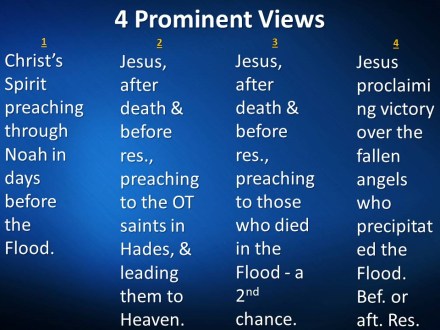
I must acknowledge here that the 4th seems to be most common today among conservative scholars.
The truth is, there are problems with each of the views here – mine included. Either on grammatical grounds, or a mixture of grammar, or in comparison with the rest of Scripture, and in the immediate context.
View #2 Seems to be ruled out because it is based on a view of Hades as a double compartmented abode of the dead, the righteous on one side and the wicked on the other.
But a careful study of how the words Hades and Hell are used in the OT demonstrate that this dual compartmented view comes from Pagan thought and not Bible teaching and fails at the outset.
View #3 Seems ruled out due to unambiguous Scripture statements such as: Hebrews 9:27 And just as it is appointed for man to die once, and after that comes judgment, The idea of a 2nd chance at salvation after death is not only not taught in the balance of Scripture, it is flat out denied.
View #4 In my estimation fails on 4 main fronts – tho as I said, it is the most common view today. While it offers the most in-depth grammatical solutions to the passage:
a. I believe it fails to follow Peter’s logic as carefully as it should leading up to this point.
b. It relies heavily on the extra-Biblical book of Enoch – which in my opinion falls into the category of Jewish myth.
c. It relies on a view of angelology which I believe Scripture does not support.
d. It presupposes Peter’s readers would have a working knowledge of this extra-Biblical material to draw from, take to be truth, and know how to apply it even though it is only mentioned in passing.
I think that stretches credibility a bit farther than I can go.
If you would like to discuss that in more detail, in a way I simply cannot this morning – then perhaps we can arrange a Wednesday night to do so.
In short – regarding this 4th view, we have no Biblical data supporting the idea that angels even CAN co-habit with human humans. At that, the Bible says they neither marry nor are given in marriage (Luke 20:35), and do not appear to be a race which propagates itself, but each are individual creations.
The idea that the offspring of such unions were the “Nephelim” of Gen. 6:4, seems disproved by the fact that Nephelim still exist after the Flood (Numb. 13:33) – which would create so many other exegetical problems as to be (in my opinion) impossible to overcome.
That said, this 4th view is held by many whom I would gladly sit under the feet of to learn. They are both godly and scholars in the highest degree, so I do not take their view lightly, even if I take issue with it.
So where does that leave us? With View #1. It seems most likely to me, that Peter is saying that the same Spirit which raised Christ from the dead, was active even back in Noah’s Day, preaching through Noah for 120 years – and that the example of Noah laboring so is to be an encouragement to Believers now.
That said, let’s get back to the start of this text and try to work it through.
Vs. 17 – You as one of Christ’s elect are suffering – so why is it “better” to suffer for righteousness if that should be God’s will?
Why does the Believer have SUCH hope, that our sufferings are “better” than those that our neighbors endure?
In short, because, above all else – we have the promise of not only suffering with like and with Jesus, but of also being raised with Him.
Our union with Him in our being born again is more than just a nice notion – It is a most powerful and living reality – Something we even taste a bit of now – Colossians 3:1 “If then you have been raised with Christ, seek the things that are above, where Christ is, seated at the right hand of God.”
So, 1 Peter 3:14 “even if you should suffer for righteousness’ sake, you will be blessed. Have no fear of them, nor be troubled”
What then can we take away from these portions in terms of what we can be certain of?
5 Great Certainties:
A. SUFFERING IS NOT SHAMEFUL: Because Christ also suffered under God’s will, this is nothing to be ashamed of should it happen – since it was even part and parcel of how Christ came as our substitute to die in our place.
In the culture where Peter’s first readers lived, humility in the face of adversity was NOT considered a positive trait. In fact, is was downright shameful.
Jesus’ willingness to go to the Cross without putting up a good fight would have been seen as gutless and the mark of an exceedingly weak character. The same would have attached itself to those who followed in Christ’s steps the way Peter is calling for.
But Peter is urging his readers – and us: Do not let the World make you ashamed of suffering for His name’s sake. Peter is building to a point he will reiterate in the next chapter: 1 Peter 4:12–16 Beloved, do not be surprised at the fiery trial when it comes upon you to test you, as though something strange were happening to you. 13 But rejoice insofar as you share Christ’s sufferings, that you may also rejoice and be glad when his glory is revealed. 14 If you are insulted for the name of Christ, you are blessed, because the Spirit of glory and of God rests upon you. 15 But let none of you suffer as a murderer or a thief or an evildoer or as a meddler. 16 Yet if anyone suffers as a Christian, let him not be ashamed, but let him glorify God in that name.
B. SUFFERING BRINGS EVANGELISTIC OPPORTUNITY: As Christ suffered “to bring us to God” – so too, as we’ve seen already in the whole argument up until now, HOW we suffer for His name in this present world, is a powerful apologetic to bring make Christ known in this present darkness, and to see them brought to saving faith.
2:5 – Our Priesthood in this present world
2:9 – The Proclamation of His excellencies
2:12 – Testimony to the persecutors which will be verified on the last day
2:15 – Putting to silence the ignorance of foolish people
3:1 – In winning the lost
C. SUFFERING FOR BELIEVERS ALWAYS TERMINATES FINALLY IN RESURRECTION: Should our suffering even bring us to death – remember that resurrection through the Spirit of Christ is ours.
The same Spirit who raised Christ from the dead (Romans 8:11 If the Spirit of him who raised Jesus from the dead dwells in you, he who raised Christ Jesus from the dead will also give life to your mortal bodies through his Spirit who dwells in you.)
The very same Spirit which raised Christ will raise us, and this same Spirit has always proclaimed forgiveness and deliverance from God’s judgement, even all the way back to the dark, dark days of Noah – days darker even than our own.
D. DISCOURAGEMENT NEED NOT SPOIL YOUR SUFFERING: If so few as only 8 responded to the preaching of the Gospel in face of coming judgment in Noah’s Day – do NOT be discouraged if you do not see many come to Christ as a result of your witness of suffering righteously for His sake.
Whatever else may be going on in these verses as regards preaching to the spirits in prison who did not obey in Noah’s time – whether the preaching referred to is the Spirit of Christ preaching through Noah then, or Jesus proclaiming to those imprisoned spirits after His death –
FEW LISTENED. And that is never reason to be discouraged, or to stop being those who endure suffering in this present age – in a way that makes the Spirit of Christ evident to our detractors.
Don’t lose heart!
We are about the business of fulfilling God’s eternal plan in Christ Jesus.
E. CHRIST RULES AND REIGNS OVER ALL EVIL SPIRITS. HE IS VICTOR!
As Tom Schreiner notes – who takes VIEW #4 by the way: Believers should not become intimidated in suffering but continue to sanctify Christ as Lord because the suffering of Christ was also the means by which he was exalted. Just as suffering was the pathway to exaltation for Christ, so also suffering is the prelude to glory for believers…the emphasis on Christ’s victory reminds believers that the troubles of the present time are temporary, that victory is sure because Christ has triumphed over evil powers. The theme of the text therefore is not the imitation of Christ, contrary to some scholars,265 but his victory over evil.[2]
All of this is wrapped up in this one great reality – That Jesus Christ has been raised up from the dead, and so will all of those who are His with Him, when He comes.
Paul summarizes Peter’s thought here, in Ephesians 1:15–23 (ESV) For this reason, because I have heard of your faith in the Lord Jesus and your love toward all the saints, 16 I do not cease to give thanks for you, remembering you in my prayers, 17 that the God of our Lord Jesus Christ, the Father of glory, may give you the Spirit of wisdom and of revelation in the knowledge of him, 18 having the eyes of your hearts enlightened, that you may know what is the hope to which he has called you, what are the riches of his glorious inheritance in the saints, 19 and what is the immeasurable greatness of his power toward us who believe, according to the working of his great might 20 that he worked in Christ when he raised him from the dead and seated him at his right hand in the heavenly places, 21 far above all rule and authority and power and dominion, and above every name that is named, not only in this age but also in the one to come. 22 And he put all things under his feet and gave him as head over all things to the church, 23 which is his body, the fullness of him who fills all in all.
[1] Schreiner, Thomas R. 2003. 1, 2 Peter, Jude. . Vol. 37. (The New American Commentary). Nashville: Broadman & Holman Publishers.
[2] Schreiner, Thomas R. 2003. 1, 2 Peter, Jude. . Vol. 37. (The New American Commentary). Nashville: Broadman & Holman Publishers.
-

Because of the season, and the circumstances surrounding his death – no burial service to speak of had been arranged.
Right after he was found, a few of us found a plot of ground – more than 6’ feet away from any other graves (according to the custom for suicides) – and buried him.
We all wept.
We all wondered.
We all grieved.
We all agonized.
We all questioned. A thousand things.
Some things would become clearer in time.
But by no means all.
Now, it was two months later.
So much had happened in the meantime.
Jesus had appeared to us over and over.
At first, we couldn’t believe it.
Now, we can’t doubt it.
And not just us. There are hundreds more that have seen Him.
And then – Pentecost.
What a day!
What a transformation.
Everything was – IS – so different now.
Each of us had begun to make plans for what to do next.
Some, for where to go next.
Though in truth, until the persecution began to ratchet up a little while later, we barely thought of anything other than just staying in Jerusalem.
Thaddaeus was the first to say anything.
He said it just wasn’t right for us to forget him.
Yes, we knew all about the betrayal now.
Yes, he was always a mercurial – an up and down kind of guy.
But wasn’t his passion part of what we loved about him?
Didn’t we love him?
Of course we did!
He was one of us from the beginning.
Something needed to be done.
Something needed to be said.
Yes, Matthias was one of us now – but Judas, Judas had been here all along – from the start.
We couldn’t just act like he hadn’t been there at all.
We couldn’t just forget him.
And it got silent for a very long time.
A long, tear-filled silence.
A confused silence.
A soft but solid – “I’ll do it” – broke the air.
We all looked at him.
Astonished.
“I’ll do it” he repeated.
“You’re right.”
“We can’t just brush his memory under the carpet.”
“Give me a day or two, then let’s go to the grave and remember him.”
What to do next?
Let his family know?
Get the word out to those who had been with us so much?
Sure, some would scoff and refuse to come.
Others might just grimace at the thought of his name let alone agree to come.
Some, no doubt would think us foolish or even blasphemous.
But we’d let everyone know we could.
And how they responded would be between them and their hearts and the Lord.
But in two days, we would gather.
The day itself was unremarkable.
And a goodly number did show up.
Around 200 I’d guess – give or take.
Some were clearly conflicted.
All were somber.
It became uncommonly and uneasily – quiet.
Then Peter stepped out and stood opposite us.
“I want to thank you all for coming, regardless of precisely why.”
“But as we – the 12, thought about it, we just couldn’t let Judas’ death go without reflecting on it. And doing something about it.”
“So here we are.”
Without exception, everyone wondered what he would say.
What COULD he say?
I don’t think any of us were really breathing.
“I want to say first of all, that this man, Judas, was my friend” – Peter began.
“And I loved him.”
“I loved him like a brother – more than a brother – a fellow apostle of the Lord Jesus Christ.”
At this, Peter broke, and began to sob.
The tears flowed freely and copiously down his face.
“Tradition calls us to eulogize the dead” he began.
“And I can truly do that today.”
“But let no one confuse my eulogy as exoneration.”
“That, I cannot do.”
“And each of you knows full well why not.”
“But this man, Judas, born in Kerioth, was someone I knew for years.”
“I walked with him – lived with him, virtually unbroken for almost 3 years.”
“Once, I would have told you that I knew him as well as I knew myself.”
“Now, it seems none of us really knew him.”
“Except that in him, we come to see the true depths of the sin that infects the souls of each one of us.”
“There was nothing special about him that singled him out from the rest of us in terms of being any more wicked or sinful.”
“Nothing.”
“In fact, if there was anyone we all trusted, it was Judas!”
“If there was anyone we never suspected, it was Judas – at least no more than we suspected ourselves.”
“How well I remember those nights around the fire when we tried to fathom the things Jesus was saying and doing in front of us day by day.”
“Those long nights – stretching out into the early morning hours, speculating about who He really was – and what that really meant.”
“I loved his sense of humor.”
“He had the most uncanny way of putting others at ease – instantly.”
“You couldn’t help but like him – and trust him.”
“He was the most natural choice to be our treasurer.”
“He gave off this air of being solid and caring.”
“Sure, he had his opinions and his sharp edges – but nothing more than the rest of us.”
“When he was aghast at the extravagance of Mary’s anointing – he only said what the rest of us were thinking.”
“And when Jesus sent us out two by two – Phillip will tell you – he preached with conviction and clarity.”
“And the miracles! He wasn’t any less blessed to be the source of healing on that trip than any of the rest of us.”
“Again, when the seventy two got sent out – he was such a mentor to the new ones, drawing on his previous experience.”
“If you had asked me then who Judas was, I would have told you that he was the most trusted and trustworthy of all of us 12.”
“That he was a bosom friend of the most profound kind.”
“That not a one of us would ever have dreamed he would betray Jesus, and be the means of His crucifixion.”
“Sometimes, I still can’t believe it.”
And at this, Peter broke once more, just hung his head and – sobbed.
We wept with him.
Peter started again.
“Perhaps the thing which perplexes me most, is why Judas, and not me?”
“Listen to me carefully friends.”
“Yes, Judas denied Jesus.”
“But so did I!”
“Three times – you all know it.”
Just as Jesus said I would – that very night, I denied I knew Him three times!”
“Oh how my heart aches to think about it once again.”
“Yes, Judas denied Jesus by selling Him out to the Chief Priests for the 30 pieces of silver.”
“Yes, he denied Him once again by kissing Jesus in the Garden.”
“But the worst denial of all was in the act of hanging himself!”
“In that denial, the most important denial, he denied that there was forgiveness of sins in the blood of Jesus.”
“This, is the denial that damns.”
“It was a form of earthly, worldly repentance. But not a godly sorrow.”
“He tried to atone for his own sin in killing himself.”
“But there is no human way to expunge sin – even at the cost of one’s own life.”
“Jesus Himself told us that it was He who had authority on earth to forgive sins.”
“We can’t do it – for ourselves or for others.”
“Only God’s mercy extended to us in the Gospel – through the blood of Jesus as our substitute can suffice.”
“Nothing other.” Nothing else.”
“We all know this now.”
“This is the Gospel we preach everywhere we go.”
“Christ died for our sins!”
“This is our only hope.”
“This is what He told us to tell to the nations.”
“We must trust His atoning death on our behalf and that alone.”
“And when it is all said and done – this is what Judas didn’t believe.”
“So why?, I ask myself.”
“Why am I here today talking to you all while Judas lays dead?”
“Why are my three denials not the means of damning me, as his denials have damned him?”
“And there is but one word – listen to me – all of you.”
“One word – – grace.”
“Some how.”
“Some way.”
“For some reasons hidden deep in the heart and mind of God alone – He had mercy upon me, and wrought in my soul a saving faith which my friend Judas never received.”
“I will not lie to you nor try to explain the inexplicable.”
“I was no more deserving in any way, and Judas no less.”
“We were both born to the same Jewish heritage.”
“We were both taught in the Synagogues.”
“We were both called by Jesus to follow Him.”
“We both preached and taught and healed at Jesus’ behest.”
“We both saw Him raise the dead.”
“We both saw Him feed the five thousand from just a few loaves and fishes.”
We were both in the boat when Jesus calmed the sea, and we were both there when He called Lazarus out of the grave.”
“We both walked with Jesus and heard Him and watched Him for these three years.”
“We both hoped for a better day because He had come.”
“Listen to me – every one of you.”
“This is not an issue of lack of any proof.”
“Jesus proved Himself to us over and over and over again.”
“And we all heard Him give us the Gospel of the Kingdom more times than we can count.”
“Like Noah in his day, I can only say that I found grace in the eyes of the Lord.”
“Grace that our Lord has commissioned us to preach to you today – even to every living creature.”
“Grace that calls you to come to Him and believe upon Him and be saved from your sins.”
“Grace that uses this very occasion to see in no uncertain – and in the most graphic and tragic of terms – the end of those who reject this Jesus as God incarnate and the only hope of salvation.”
“The end of those who deny Him, but never run to Him for His forgiveness.”
“The end of those who think to deal with their own sin their own way and not depend upon His mercy and grace alone.”
“The end of those who deny Him His right to rule and reign in their hearts and lives.”
“I stand here before you today every bit the denier of Jesus that Judas was.”
“And I stand here forgiven.”
“Cleansed.”
“Made new.”
“And a preacher of the Gospel of Jesus Christ to each one of you at this critical moment in your lives.”
“Judas is dead.”
“But Christ is risen!”
“Judas and I both denied Him.”
“But Christ’s supreme sacrifice is greater than all our sin.”
“In the words of Isaiah the Prophet: “Turn to me and be saved, all the ends of the earth! For I am God, and there is no other.”’”
“All of your denials: denying Him His right to rule;
denying His singular power to forgive sins and save;
denying His deity and atoning sacrifice – He can and will forgive them all!”
“Judas refused all this. And died his death in his sins.”
“Do not do the same.”
“I plead with you – do not!”
“I stand before you as proof that Jesus Christ can save the worst of deniers.”
“And I plead with you to come to Him today – and believe.”
With that, Peter prayed.
Oh what a prayer!
A prayer of thanksgiving for God’s grace.
A prayer of intercession for those who were among us who still didn’t believe.
A prayer filled with tears.
A prayer of comfort for Judas’ family and friends.
A prayer, in the name of the blessed Son of God – Jesus the Christ – who alone can forgive sins, because of His atoning sacrifice on the cross at Calvary.
-
Below is a slightly edited (by me) version from the 6th volume of Owen’s Commentary on the Book of Hebrews. It gives so very very much to think about in celebrating and diving more deeply into the privileges of the New Covenant Believer in Christ. Enjoy!
OWEN: Wherefore we must grant two distinct covenants, rather than a twofold administration of the same covenant merely, to be intended. We must, I say, do so, provided always that the way of reconciliation and salvation was the same under both. But it will be said,—and with great pretence of reason, for it is that which is the sole foundation they all build upon who allow only a twofold administration of the same covenant,—‘That this being the principal end of a divine covenant, if the way of reconciliation and salvation be the same under both, then indeed are they for the substance of them but one.’ And I grant that this would inevitably follow, if it were so equally by virtue of them both. If reconciliation and salvation by Christ were to be obtained not only under the old covenant, but by virtue thereof, then it must be the same for substance with the new. But this is not so; for no reconciliation with God nor salvation could be obtained by virtue of the old covenant, or the administration of it, as our apostle disputes at large, though all believers were reconciled, justified, and saved, by virtue of the promise, whilst’ they were under the covenant.[1]
The things wherein this difference doth consist, as expressed in the Scripture, are partly circumstantial, and partly substantial, and may be reduced unto the heads ensuing:—
- These two covenants differ in the circumstance of time as to their promulgation, declaration, and establishment This difference the apostle expresseth from the prophet Jeremiah…In brief, the first covenant was made at the time that God brought the children of Israel out of Egypt, and took its date from the third month after their coming up from thence, Exod. 19, 24…The new covenant was declared and made known “in the latter days,” Heb. 1:1, 2; “in the dispensation of the fulness of times,” Eph. 1:10. And it took date, as a covenant formally obliging the whole church, from the death, resurrection, ascension of Christ, and sending of the Holy Ghost.
- They differ in the circumstance of place as to their promulgation;…The first was declared on mount Sinai;…The other was declared on mount Zion, and the law of it went forth from Jerusalem, Isa. 2:3. This difference, with many remarkable instances from it, our apostle insists on, Gal 4:24–26: “These are the two covenants; the one from mount Sinai, which gendereth to bondage, which is Agar.” That is, Agar, the bondwoman whom Abraham took before the heir of promise was born, was a type of the old covenant given on Sinai, before the introduction of the new, or the covenant of promise; for so he adds: “For this Agar is mount Sinai in Arabia, and answereth unto Jerusalem which now is, and is in bondage with her children.” This mount Sinai, where the old covenant was given, and which was represented by Agar, is in Arabia,—cast quite out of the verge and confines of the church. And it “answereth,” or “is placed in the same series, rank, and order with Jerusalem,” namely, in the opposition of the two covenants. For as the new covenant, the covenant of promise, giving freedom and liberty, was given at Jerusalem, in the death and resurrection of Christ, with the preaching of the gospel which ensued thereon; so the old covenant, that brought the people into bondage, was given at mount Sinai in Arabia.
- They differ in the manner of their promulgation and establishment. There were two things remarkable that accompanied the solemn declaration of the first covenant:—
(1.) The dread and terror of the outward appearance on mount Sinai, which filled all the people, yea, Moses himself, with fear and trembling…
(2.) That it was given by the ministry and “disposition of angels,” Acts 7:53; Gal. 3:19. Hence the people were in a sense “put in subjection unto angels,” and they had an authoritative ministry in that covenant… Things are quite otherwise in the promulgation of the new covenant. The Son of God in his own person did declare it…And the whole ministry of angels, in the giving of this covenant, was merely in a way of service and obedience unto Christ; and they owned themselves the “fellow-servants” only of them that have “the testimony of Jesus,” Rev. 19:10. So that this “world to come,” as it was called of old, was no way put in subjection unto them.
- They differ in their mediators. The mediator of the first covenant was Moses… But the mediator of the new covenant is the Son of God himself…He who is the Son, and the Lord over his own house, graciously undertook in his own person to be the mediator of this covenant; and herein it is unspeakably preferred before the old covenant.
- They differ in their subject-matter, both as unto precepts and promises, the advantage being still on the part of the new covenant. For,—
(1.) The old covenant, in the preceptive part of it, renewed the commands of the covenant of works, and that on their original terms. Sin it forbade,—that is, all and every sin, in matter and manner,—on the pain of death; and gave the promise of life unto perfect, sinless obedience only… (2.) The old testament, absolutely considered, had, [1.] No promise of grace, to communicate spiritual strength, or to assist us in obedience; nor, [2.] Any of eternal life, no otherwise but as it was contained in the promise of the covenant of works, “The man that doeth these things shall live in them;” and, [3.] Had promises of temporal things in the land of Canaan inseparable from it. In the new covenant all things are otherwise, as will be declared in the exposition of the ensuing verses.
- They differ, and that principally, in the manner of their dedication and sanction. This is that which gives any thing the formal nature of a covenant or testament. There may be a promise, there may be an agreement in general, which hath not the formal nature of a covenant, or testament…but it is the solemnity and manner of the confirmation, dedication, and sanction of any promise or agreement, that give it the formal nature of a covenant or testament. And this is by a sacrifice, wherein there is both bloodshedding and death ensuing thereon. Now this, in the confirmation of the old covenant, was only the sacrifice of beasts, whose blood was sprinkled on all the people, Exod. 24:5–8. But the new testament was solemnly confirmed by the sacrifice and blood of Christ himself, Zech 9:11; Heb. 10:29, 13:20. And the Lord Christ dying as the mediator and surety of the covenant, he purchased all good things for the church; and as a testator bequeathed them unto it. Hence he says of the sacramental cup, that it is “the new testament in his blood,” or the pledge of his bequeathing unto the church all the promises and mercies of the covenant; which is the new testament, or the disposition of his goods unto his children. But because the apostle expressly handleth this difference between these two covenants, chap. 9:18–23, we must thither refer the full consideration of it.
- They differ in the priests that were to officiate before God in the behalf of the people. In the old covenant, Aaron and his posterity alone were to discharge that office; in the new, the Son of God himself is the only priest of the church.
- They differ in the sacrifices whereon the peace and reconciliation with God which is tendered in them doth depend.
- They differ in the way and manner of their solemn writing or enrolment. All covenants were of old solemnly written in tables of brass or stone, where they might be faithfully preserved for the use of the parties concerned. So the old covenant, as to the principal, fundamental part of it, was “engraven in tables of stone,” which were kept in the ark, Exod. 31:18; Deut. 9:10; 2 Cor. 3:7. And God did so order it in his providence, that the first draught of them should be broken, to intimate that the covenant contained in them was not everlasting nor unalterable. But the new covenant is written in the “fleshy tables of the hearts” of them that do believe 2 Cor. 3:3; Jer. 31:33.
- They differ in their ends. The principal end of the first covenant was to discover sin, to condemn it, and to set bounds unto it…The end of the new covenant is, to declare the love, grace, and mercy of God; and therewith to give repentance, remission of sin, and life eternal.
- They differed in their effects. For the first covenant being the “ministration of death” and “condemnation,” it brought the minds and spirits of them that were under it into servitude and bondage; whereas spiritual liberty is the immediate effect of the new testament. And there is no one thing wherein the Spirit of God doth more frequently give us an account of the difference between these two covenants, than in this of the liberty of the one and the bondage of the other…On the other hand, the new covenant gives liberty and boldness, the liberty and boldness of children, unto all believers. It is the Spirit of the Son in it that makes us free, or gives us universally all that liberty which is any way needful for us or useful unto us. For “where the Spirit of the Lord is, there is liberty;” namely, to serve God, “not in the oldness of the letter, but in the newness of the spirit.”…And we may briefly consider wherein this deliverance and liberty by the new covenant doth consist, which it doth in the things ensuing:—
(1.) In our freedom from the commanding power of the law, as to sinless, perfect obedience, in order unto righteousness and justification before God…
(2.) In our freedom from the condemning power of the law, and the sanction of it in the curse. This being undergone and answered by him who was “made a curse for us,” we are freed from it, Rom. 7:6; Gal. 3:13, 14.
(3.) In our freedom from conscience of sin, Heb. 10:2,—that is, conscience disquieting, perplexing, and condemning our persons; the hearts of all that believe being “sprinkled from an evil conscience” by the blood of Christ.
(4.) In our freedom from the whole system of Mosaical worship, in all the rites, and ceremonies, and ordinances of it; which what a burden it was the apostles do declare…
(5.) From all the laws of men in things appertaining unto the worship of God, 1 Cor. 7:23.
And by all these, and the like instances of spiritual liberty, doth the gospel free believers from that “spirit of bondage unto fear,” which was administered under the old covenant.
It remains only that we point out the heads of those ways whereby this liberty is communicated unto us under the new covenant. And it is done,—
(1.) Principally by the grant and communication of the Spirit of the Son as a Spirit of adoption, giving the freedom, boldness, and liberty of children, John 1:12; Rom. 8:15–17; Gal. 4:6, 7. From hence the apostle lays it down as a certain rule, that “where the Spirit of the Lord is, there is liberty,” 2 Cor. 3:17. Let men pretend what they will, let them boast of the freedom of their outward condition in this world, and of the inward liberty or freedom of their wills, there is indeed no true liberty where the Spirit of God is not.
(2.) It is obtained by the evidence of our justification before God, and the causes of it.
(3.) By the spiritual light which is given to believers into the mystery of God in Christ.
(4.) We obtain this liberty by the opening of the way into the holiest, and the entrance we have thereby with boldness unto the throne of grace.
(5.) By all the ordinances of gospel-worship. How the ordinances of worship under the old testament did lead the people into bondage hath been declared; but those of the new testament, through their plainness in signification, their, immediate respect unto the Lord Christ, with their use and efficacy to guide believers in their communion with God, do all conduce unto our evangelical liberty.
- They differ greatly with respect unto the dispensation and grant of the Holy Ghost. It is certain that God did grant the gift of the Holy Spirit under the old testament, and his operations during that season, as I have at large elsewhere declared; but it is no less certain, that there was always a promise of his more signal effusion upon the confirmation and establishment of the new covenant. See in particular that great promise to this purpose, Joel 2:28, 29, as applied and expounded by the apostle Peter, Acts 2:16–18. Yea, so sparing was the communication of the Holy Ghost under the old testament, compared with his effusion under the new, as that the evangelist affirms that “the Holy Ghost was not yet, because that Jesus was not yet glorified,” John 7:39; that is, he was not yet given in that manner as he was to be given upon the confirmation of the new covenant.
- They differ in the declaration made in them of the kingdom of God. It is the observation of Augustine, that the very name of “the kingdom of heaven” is peculiar unto the new testament. It is true, God reigned in and over the church under the old testament; but his rule was such, and had such a relation unto secular things, especially with respect unto the land of Canaan, and the flourishing condition of the people therein, as that it had an appearance of a kingdom of this world… But now in the gospel, the nature of the kingdom of God, where it is, and wherein it consists, is plainly and evidently declared, unto the unspeakable consolation of believers. For whereas it is now known and experienced to be internal, spiritual, and heavenly, they have no less assured interest in it and advantage by it, in all the troubles which they may undergo in this world, than they could have in the fullest possession of all earthly enjoyments.
- They differ in their substance and end. The old covenant was typical, shadowy, and removable, Heb. 10:1. The new covenant is substantial and permanent, as containing the body, which is Christ.
- They differ in the extent of their administration, according unto the will of God. The first was confined unto the posterity of Abraham according to the flesh, and unto them especially in the land of Canaan, Deut. 5:3, with some few proselytes that were joined unto them, excluding all others from the participation of the benefits of it…But the administration of the new covenant is extended unto all nations under heaven; none being excluded, on the account of tongue, language, family, nation, or place of habitation. All have an equal interest in the rising Sun. The partition wall is broken down, and the gates of the new Jerusalem are set open unto all comers upon the gospel invitation.
- They differ in their efficacy; for the old covenant “made nothing perfect,” it could effect none of the things it did represent, nor introduce that perfect or complete state which God had designed for the church. But this we have at large insisted on in our exposition of the foregoing chapter.
Lastly, They differ in their duration: for the one was to be removed, and the other to abide for ever; which must be declared on the ensuing verses.
It may be other things of an alike nature may be added unto these that we have mentioned, wherein the difference between the two covenants doth consist; but these instances are sufficient unto our purpose. For some, when they hear that the covenant of grace was always one and the same, of the same nature and efficacy under both testaments,—that the way of salvation by Christ was always one and the same,—are ready to think that there was no such great difference between their state and ours as is pretended. But we see that on this supposition, that covenant which God brought the people into at Sinai, and under the yoke whereof they were to abide until the new covenant was established, had all the disadvantages attending it which we have insisted on. And those who understand not how excellent and glorious those privileges are which are added unto the covenant of grace, as to the administration of it, by the introduction and establishment of the new covenant, are utterly unacquainted with the nature of spiritual and heavenly things.[2]
[1] Owen, John. 1854. An Exposition of the Epistle to the Hebrews. (Ed.) W. H. Goold. . Vol. 23. (Works of John Owen). Edinburgh: Johnstone and Hunter.
[2] Owen, John. 1854. An Exposition of the Epistle to the Hebrews. (Ed.) W. H. Goold. . Vol. 23. (Works of John Owen). Edinburgh: Johnstone and Hunter.
-

Repentance is a common theme in the Bible. No one disputes that.
However, in our day of words taking on new meaning, what repentance actually is, is somewhat debated and, I think greatly misunderstood.
It is not uncommon for me to hear someone say they’ve “repented” of some particular sin. What they mean by that is they have felt sorry for it. Either for acting sinfully, or in the aftermath of having suffered the consequences of it – felt bad about it.
But this not how the Bible defines repentance.
Yes, repentance includes a realization that what one was doing is wrong in the sight of God, and feeling the pangs of distress that God has been offended, but there is more. It is also to change one’s understanding, belief and attitude toward sinful things, so as to alter one’s behavior.
If there is not a pursuit of renewed behavior, one has not repented. They’ve only gone ½ of the way.
Perhaps the most full bodied description of what true repentance looks like is found in 2 Corinthians 7:10–11
“For godly grief produces a repentance that leads to salvation without regret, whereas worldly grief produces death. 11 For see what earnestness this godly grief has produced in you, but also what eagerness to clear yourselves, what indignation, what fear, what longing, what zeal, what punishment! At every point you have proved yourselves innocent in the matter.” (ESV)
Irrespective of the particular sin cited in this passage, the pattern is remarkably clear.
- Godly grief. Grief at having offend God, not mere regret at having been caught or suffering the consequences of the sin.
- Earnestness in taking a new course.
- Eagerness to be clear of it in the future – to distance oneself from having countenanced the sin in the first place.
- Indignation that you allowed yourself to go that route at all.
- Fear of what continuing along that course would bring as opposed to the former brazenness.
- What longing after change in inward desires. To bless and serve God rather than to walk in contrariness.
- Zeal to put away the old and pursue the new.
- Willingness to accept right punishment. No attempt to confess and accept guilt as a tactic to escape what might be a just result. For example, the thief wants to let his or her responsibility go at saying “I’m sorry” while expecting to be exempted from having to make restitution. True repentance seeks to make things right among men if it in any way can, while knowing that making all things right with God is the exclusive province of the atonement of Christ. But it does not confuse the categories. It does not imagine that the free grace we can enjoy in Christ in no way destroys our responsibility toward those humanly whom we may have offended.
While each of these could be teased out and examined in deeper detail, for our purposes today, I think you get the point: Biblical repentance is far more than feeling bad about sin. It had a requisite aspect of changing course.
And that brings us to the real point of this short article. This displays what repentance looks like after sin. But we want to examine what repentance looks like – before the sin which has come to us in the germ of temptation brings forth its deadly fruit.
Here is the issue: As our model of sin becomes more and more “medical”, repentance loses its place altogether.
In other words, when we treat our sins as conditions or problems or defects to be treated, failing to accept the full weight of moral responsibility for them – we no longer repent. We say “I’m sorry”, to God and men (if other humans are included in the sin), but it ends there.
What takes the place of repentance? Helpless complaining. A fruitless and endless whining about how bad one feels about the sin, but a disinterest or half-hearted attempt at actually changing one’s thoughts, attitudes or actions.
The end result is a sullen Christian on an endless up and down sin-cycle, tainted with hopelessness.
What then is the answer? True repentance.
What does that look like?
- It takes a brutal, unwavering commitment to expose their sin to God every time it lures, coupled with a conscious reliance upon the indwelling Spirit of Christ to walk away.
The moment one senses their temptation stirring inwardly (and if you’ve been caught in a besetting sin for very long, you can see temptation on the horizon well before it becomes fully formed) praying. But the prayer must be as open and honest and graphic as possible. Something like “Father, you see what my heart wants right now. I want to __________. I know it is wrong, I know it is sin, I know it is an offense against you in the worst way, but I confess that I want it, and I will pursue it apart from the empowering of your Spirit. I am helpless against sin myself but bring to you right now. I really WANT this sin in myself, but am asking you for your gift of repentance through your Spirit’s work in me. Grant me grace to overcome.”
It is in the honesty of confessing our sin, owning our responsibility for it, and asking for the Spirit’s work to produce in us the likeness of Christ and the power to deny ourselves that we find Him supplying. Not bemoaning our failure in the aftermath but in fleeing to Him in them in full honesty before they become actions. Conscious, constant, deliberate dependence upon the Holy Spirit. Nothing else will do.
Sometimes, one will be praying like that 10, 20, 100, 1000 times a day. But this I know from God’s Word, that when we run to Christ in our helplessness, ripping off the mask of any self-righteousness and self-reliance – He answers. “God opposes the proud, but gives grace to the humble.” (James 4:6, 1 Pet. 5:5)
- It takes a willingness to identify the seemingly harmless precursors to actual sin, the things, places, people, attitudes, thoughts, etc. that through our repeated having fallen into sin are now familiar to us – and pleading for repentance then.
So there may be very legitimate things, things not sinful in and of themselves, but for you personally, you know to be gateways to certain sins, that you will need to avoid.
And I know the way sin argues. “But this is OK, there’s nothing wrong with it. Lots of other Christians do it all the time and with no problem.”
Yup. So what? You know that for you, this inevitably leads to something else that is sin.
Maybe it is entertaining criticism of others, which they may be deserving of, but for you ends up opening the floodgates of judgmentalism. Maybe it is a magazine or TV program that for you, soon blazes into lust. Maybe it is window shopping, which soon leaves you awash in a torrent of covetousness. Or the office pool that incites a deeper involvement in the thrill of habitual gambling with its lure of “just one more and I know I’ll strike it big!” Perhaps while ill, a little pampering by others feels so good, that the seeds of self-pity grow into a full crop that leads to the bottomless pit of depression. Or the joy of dabbling in politics that soon mushrooms into the sin of gripping anxiety over the state of affairs and plunges you deeper into despondency and other sinful heart states.
What we need is repentance. A heart that turns from those things, to find our needs met in Christ. To know ourselves well enough, honestly enough to recognize what easily leads into sinful paths, and to run to Christ at the first glimpse of them. To plead in our weakness, and to be willing to makes the changes we can make, so as prevent our presuming upon by grace, by plunging ourselves into temptation, and then complaining that we got soiled in the process.
- An increased delight in, and pursuit of those things which militate against sin arising in the heart.
One cannot cease from sin in a vacuum. If the heart does not take time to investigate, drink in, revel in, fill the heart and mind with the wonders, goodness, truth and blessings of God, one makes themselves an easy target for sin.
The more one is familiar with the highest and purest of things, the less they are satisfied with the lesser and more faulty. One who cultivates an eye and taste for fine art, loses their appreciation for velvet Elvises. The better things spoil you for the poorer. And the more you grow in the wonders of God’s truth and beauty, the less you will be tantalized by those things which are infinitely much less.
Repentance. Turning. Looking to Christ. Refusing the legitimate things that sometimes lead us there. And growing in the good things that truly nourish the soul.
Beloved, don’t treat your sins and sinful habits like disorders that just need the right medication or accommodation. Fight them – by seeking for true repentance from the Giver of repentance. He delights to bless His own.
-

Got your knickers in knot over the continuing hype over John Hagee’s “Blood Moons Prophecy” stuff? Well, take the knots out. You’ll be a lot more comfortable, and you won’t have to walk funny.
Below is a link to Chris White’s YouTube video doing an excellent job of showing the glaring holes, omissions, mis-use of the Scriptures, bad theology and poor reasoning rampant in John Hagee and Mark Biltz’s book: “Four Blood Moons.”
While I do not agree with all of White’s exegesis – nevertheless, what he DOES do, and that very effectively, is show the utter nonsense behind making (as little Billy Shakespeare would say) “Much Ado About Nothing.”
Once again it is a study in bringing a theory to the Scriptures and then using them any way you want to justify or prove it. And in this case, exceptionally poorly.
Don’t be taken in. Save your shekels and buy new Study Bible, or a book that will help you grow in Christ’s likeness. Four Blood Moons isn’t even good fiction.
-

Piper’s analysis here is a very important one. And a growing one in our present culture. How we look to others to fill the voids in us which Christ is specifically meant to fill singularly, and how we demand others love us the way we WANT to be loved, and so that we FEEL loved. All of which adds up to disaster if not rightly seen and addressed.
It is a grave mistake to make any other person or persons responsible for our happiness or fulfillment. But it seems logical when we do it. We want something from them they seem to be withholding. “Seem” being the operative word here.
Beware Christian, that you place a burden on your spouse, your parents, your children, your fellow Christians or your Church leadership none of them were ever designed to bear.
Piper’s extremely short but powerful article is HERE.
-
![Proverbs 2813 [fullscreen]](https://responsivereiding.com/wp-content/uploads/2015/03/proverbs-2813-fullscreen.png?w=300&h=225)
Proverbs 28:13 Going To Confession
[xxx] = SLIDE
[Proverbs 28:13 (ESV) Whoever conceals his transgressions will not prosper, but he who confesses and forsakes them will obtain mercy.]
[Confession.] Some traditions have made a “sacrament” out of it.
By the word “sacrament” is meant an act that serves as a direct channel of God’s grace.
[“The common definition of a sacrament accepted by the Reformed and Roman Churches is that of an outward and visible sign, ordained by Christ, setting forth and pledging an inward and spiritual blessing.[1]”]
In that sense, the Bible only speaks of two things ordained by Christ specifically for the Church to carry on as rites that serve as signs of His promised inward blessings: [The Lord’s Supper and Baptism.]
However, many have sought to expand that number, and to even make them serve in ways the Bible never teaches. Requiring them of people in order to be right with the Church and with God.
So it is some see confession as something the Church, or a Priest acting on behalf of the Church administers.
But that is not all how we understand confession Biblically.
Confession as it is taught in the Scripture is simply a part – albeit a vital part – first and foremost of the individual’s relationship to God – having once been united to Him in Christ by the Spirit.
So it is, Jesus can teach in the model of prayer He taught His disciples – that “forgive us our debts, as we also forgive our debtors” is part and parcel of the normal Christian prayer life.
That said, we can see in 28:13 that in the first place: CONFESSION no doubt refers to oneself.
If we conceal our transgressions from ourselves, or seek to deny their real sinfulness or egregiousness, then we will seldom confess to the Lord or forsake them.
[We must be honest with ourselves.] This is the beginning.
The problem is, that as people – simply, saved or unsaved, most often, we want to fool ourselves – to think better of ourselves than we really are. We are desperate to ignore our sinfulness.
We do not want to own the depths of it.
This, oddly enough is true even of Christians.
We, who once we have been justified have the freedom to search our darkest depths without fear of condemnation would still rather turn a blind eye and be gentle with ourselves and our sin.
We though, in Christ, can at last afford to be brutally honest and absolutely ruthless with our sin.
For it is in bringing our sins into the full light of day, first to ourselves, and then to our merciful and gracious God, that in confession we find the means to forsake them.
[Ephesians 5:8–9 (ESV) for at one time you were darkness, but now you are light in the Lord. Walk as children of light 9 (for the fruit of light is found in all that is good and right and true),]
[Ephesians 5:13–14 (ESV) But when anything is exposed by the light, it becomes visible, 14 for anything that becomes visible is light. Therefore it says, “Awake, O sleeper, and arise from the dead, and Christ will shine on you.”]
So…Been to confession lately?
Go.
There is little that so erodes the sweet intimacy of Christ’s Spirit with our own souls as that of carrying around the weight of unconfessed sins upon our shoulders.
Nor am I alluding to great and heinous sins, but that myriad of “little things” that grows most imperceptibly into a mountain of guilt and pain.
As Protestants, we know full well that Christ is our great intercessor, and that we need no other man – no human “Priest” to fill that role.
Christ has become our [“Great High Priest” as Heb. 4:14] calls Him.
We are fully aware that we can come to the Father directly and without some invented, human intermediary.
Yet I wonder how lax many of us become in the need for a consistent audience before God where we don’t fail to pour out the cache of sins and transgressions that we have tried to hide from our own eyes as well as from His?
[Psalm 51:6 (ESV) 6 Behold, you delight in truth in the inward being, and you teach me wisdom in the secret heart.]
If God’s Word has ceased to speak to you; if the Spirit of God seems so distant and your own heart has grown cold and unmoved – it just may be that you have forgotten to come and make your confession of failure before Him, that nothing might hinder His nearness.
Nothing kills intimacy more than dishonesty and secrecy.
It is true in human relationships and especially true in our relationship with our God.
Recall Adam and Eve immediately after they fell – hiding their sin and nakedness was their first instinct.
The secrecy of sin is its power to bind. What is forced underground, hides and cannot be easily rooted out.
The Writer here reminds us that breaking this secrecy is essential to [“prospering”] – which is nothing else than gaining victory over the motions of indwelling sin.
The truth is, He is never far away, but our sin can cloud the reality and enjoyment of His loving presence.
Beyond the obvious benefit of the clearing of the conscience and the relieving of the guilt designed to bring us back to the Cross, the confession of our sins regularly, fully, and graphically, prevents us from falling into false pride and a pretended self righteousness.
It is a great preventative against an imagined spiritual superiority.
No one who deals with their own sins before the throne of God candidly, thoroughly and regularly finds it easy to persecute others for theirs.
In fact, it is almost certain that one has lost all touch with their own sinfulness when they take up stones to punish other sinners personally.
So it is that Galatians 6:1 admonishes “Brethren, even if a man is caught in any trespass, you who are spiritual, restore such a one in a spirit of gentleness; each one looking to yourself, lest you too be tempted.”
Such gentleness issues from familiarity with and brokenness over your own sin first. Then you may be of use in recovering others. Until then, you will imagine yourself both judge, jury and all too often – executioner.
Are you preoccupied with the sins and failings of others? I can guarantee you do not spend much time investigating, confessing and grieving over your own sins.
This is not “penance” – it earns nothing, but DOES much!
Remember the words of David: [Psalm 139:23–24 (ESV) 23 Search me, O God, and know my heart! Try me and know my thoughts! 24 And see if there be any grievous way in me, and lead me in the way everlasting!]
But there is a word in our text which draws us off to see a peculiar blessing attached to such confession that quite exceeds any guilty man’s hope.
It is in that very last expression – [“compassion”] (NASB), or “mercy” in the ESV.
I don’t know about you, but compassion is not what comes to my mind first when I think of the way that God deals with me concerning the sins I bring before Him.
It is one thing to say that in coming, the Believer might be pleased to know that he will find forgiveness with God on behalf of Christ.
Thoughts of confession usually find us running back to 1 John 1:9 “If we confess our sins, He is faithful and righteous to forgive us our sins and to cleanse us from all unrighteousness.”
Rightly so.
But our familiarity with the way men forgive can find us thinking that God’s forgiveness is a grudging one.
Yes, we find mercy, but is there not a need to placate Him somehow as well? We wonder.
Then, we might even venture to think beyond the mercy which withholds the punishment that is our due, and have faith to believe that He might even show us grace – unmerited favor – beyond mere mercy on Christ’s behalf as well.
How the soul rejoices to be able take such comfort in those hours of grief for sin.
But the Writer’s word here transcends grace and mercy both, and would have us fix upon a promise of compassion.
(rāḥam). vb. have mercy, pity, show compassion. Refers to the act of being moved with compassion to show care or pity for another.[2]
It is one thing to hope for mercy, another to believe for grace, but what divine love is this, that when we sin in our filth against so holy a God as ours is – we come to expect compassion too?
O is not His love for us beyond our finding out!
[The Lord knows all things, but He waits for your words, not that He may punish, but that He may pardon. It is not His will that the devil should triumph over you and accuse you when you conceal your sins. Be beforehand with your accuser: if you accuse yourself, you will fear no accuser; if you report yourself, though you were dead you shall live.[3] Ambrose of Milan.]
Beloved, this is one of those divine mysteries that fills the soul with genuine wonder. Here is God’s Word to His people. So great is the change wrought in us by saving grace, that grief over sin – true grief for the commission of it, not for being caught in it – though not another human being know it, is a signal mark of regeneration.
And it is to this that God our Father then comes and does not only forgive, does not only continue His blessing upon us, but in fact soothes the troubled conscience by His Spirit and the Word that we might be recovered from the very soul wounds we have inflicted upon ourselves.
How can such a thing be?
When He should rail against us in His just wrath – yet for Christ’s sake, He actually ministers unto us in the tenderest of compassions, that our sin might not swallow us up.
Christian, if you would know mercy, if you would fully comprehend grace, then you must know that the Father’s forgiveness is not some grudging half dismissal still awaiting our ability to salve His holy anger and restore ourselves to Him.
He has compassion on the pain we suffer for our own sins, and ministers to us according to the depths of His divine love.
This, is past understanding. Let not another moment go by, where you are carrying about the load of unconfessed sin upon your back.
Call to Him. Come to Him.
Confess it all, turn from it all back to His loving arms, be free of it all, and know the compassion of His great love for you in Christ.
Now the issue of “confession” raises questions about whom we might confess to, and under what circumstances.
This is not a simple matter.
Some things simply cannot profit others and thus are not fit for public consumption.
In fact, too much said about shameful things to large, unprepared audiences can cause much positive harm.
So it may be wise to look at this in terms of layers.
The very first layer is that confession must begin with SELF.
As we’ve already seen: God requires truth in the inward parts (Ps. 51:6).
We must be absolutely honest with ourselves about our sin – facing it head on for what it really is, neither excusing nor soft-soaping it (nuancing our own conceptions by thinking of our own sin in therapeutic terms and without horror, disgust and the need to find freedom), not accommodating it or giving up on its need to be mastered.
If we do not begin here, no true progress can be made.
Here in fact, we may well appeal to God’s Spirit to open our eyes to our own sin and its depths – lest we rely only upon our own deceptive hearts. We WILL try to fool ourselves. Psalm 139:23 (ESV) Search me, O God, and know my heart! Try me and know my thoughts!
The next layer is confession to God.
If we cannot speak openly, truthfully, brutally to Him about our sins, then there is no help to be had.
For it is only by walking in the Spirit that we can be prevented from gratifying the lusts of the flesh (Gal. 5:16).
If we cannot honestly and fully enlist His help, there is no other source of help to be had.
Whether or not a 3rd layer of confession to another Christian confidant or several, would seem to be dictated upon whether or not the first two have been utilized fully – and have dealt with the problem.
If not, other measures are required.
Appropriate brothers and/or sisters need to be brought into the situation to lend encouragement, accountability, advice, prayer and other support.
It is my considered opinion however that failure to truly live in the first two, is most often what requires the implementation of the 3rd.
You see, the Christian life never goes further than the Cross. It is there we stay.
And if you are not a Believer today – how especially do you need to fully recognize, and confess your sins of unbelief and self-love and self-determination. To bring your rebellious heart to Him openly and fully and to find the compassion and forgiveness He offers – because of the remedy for sin made in the substitutionary death of Jesus at Calvary.
And if you know you are not sensible of your own hardness against Him – to come confessing that – that He might have compassion on your lost and hardened state.
Mercy and compassion await those who will own their sinfulness. And you will prosper in the most valuable way of all – being reconciled to your God and Creator in Jesus Christ.
Heavenly Father, give me a heart that detects and acknowledges my sin fully and quickly. May there be nothing between us on any level. May my heart be open and honest before you, looking to you and depending upon you till at last, by your grace, those areas which at present remain untamed and defiant of Christ’s Lordship, are brought to their knees before you.
[1] R. J. Coates, “Sacraments,” ed. D. R. W. Wood et al., New Bible Dictionary (Leicester, England; Downers Grove, IL: InterVarsity Press, 1996), 1034.
[2] J. David Stark, “Forgiveness,” ed. Douglas Mangum et al., Lexham Theological Wordbook (Lexham Bible Reference Series; Bellingham, WA: Lexham Press, 2014).
[3] Elliot Ritzema, 300 Quotations for Preachers from the Early Church (Pastorum Series; Bellingham, WA: Lexham Press, 2013).


![Proverbs 2813 [fullscreen]](https://responsivereiding.com/wp-content/uploads/2015/03/proverbs-2813-fullscreen.png)
 ResponsiveReiding